Twelve Ying-Spring Points: Navigating Metacarpophalangeal Topography, Febrile Heat Clearance, and Distal Acupressure Protocols
1. Opening — A Problem This Solves Today
If you have ever experienced the sudden, prickling heat of frustration rising into your temples during a stalled commute, an acidic burn creeping upward behind the sternum following a late-night meal consumed in haste, or the maddening, dry restlessness that prevents sleep despite profound physical exhaustion, you have encountered the somatic reality of internal heat. In contemporary physiological terms, these manifestations represent acute states of autonomic dysregulation: sympathetic nervous system hyperarousal, localized microvascular dilation, pro-inflammatory cytokine release, and compromised peripheral thermoregulation. The body, trapped in an unrelenting stress response, produces a surplus of metabolic and vascular "heat" that the central regulatory systems fail to dissipate efficiently.
For more than two millennia, East Asian medicine has addressed this exact physiological dilemma through a specialized category of therapeutic loci known as the Ying-Spring (滎穴, Ying Xue) points. Situated strategically on the distal extremities—just proximal to the web spaces of the toes and fingers—these twelve points act as hydrodynamic pressure-release valves for the entire meridian architecture. Where modern individuals reach for antacids, non-steroidal anti-inflammatory drugs, or sedatives to suppress the symptoms of physiological friction, classical Chinese medicine offers a sophisticated, non-invasive biomechanical interface. By applying precise, calibrated manual pressure to these distal neurological and fascial nexuses, one can engage endogenous mechanotransductive pathways to clear visceral heat, quench systemic inflammation, and restore homeostatic equilibrium.
FROM SPRING TO SEA: THE CLASSICAL HYDRODYNAMICS OF THE NAN JING
2. The Meridian Path — A Journey Through the Body
To understand how pressing a point between your toes or on the palm of your hand can extinguish a burning sensation in the throat or quiet a racing pulse, one must examine the classical hydrodynamic model articulated in the foundational canons of Chinese medicine. In the Nan Jing (The Classic of Difficult Issues), Chapter 68, the flow of Qi and blood through the primary meridians is analogized to the natural progression of water descending from a high mountain spring to the vast ocean:
"The well is where the Qi issues forth (Jing-Well); the spring is where the Qi glides forward (Ying-Spring); the stream is where the Qi pours through (Shu-Stream); the river is where the Qi moves extensively (Jing-River); the sea is where the Qi gathers and enters inward (He-Sea)."
At the Jing-Well points, located at the extreme tips of the digits, the meridian energy is superficial, narrow, and volatile, like water bubbling out of an underground fissure. As the channel traverses proximally toward the metacarpophalangeal and metatarsophalangeal joints, it arrives at the Ying-Spring points. Here, the energetic volume expands and accelerates: the Qi "glides forward" (Liu) with dynamic, laminar momentum. Because the kinetic energy of the meridian is at its most rapid and fluid at this junction, the Ying-Spring points exert an exceptionally immediate and potent regulatory influence over the channel's entire longitudinal course.
+---------------------------------------------------------------------------------------+
| CLASSICAL CANONICAL FOUNDATION: THE DUAL MANDATE OF YING-SPRING LOCI                  |
+---------------------------------------------------------------------------------------+
| 1. Nan Jing (Chapter 68): Hydrodynamic Acceleration                                  |
|    "Ying Zhu Shen Re" (滎主身熱) — The Ying-Spring points govern heat in the body.   |
|                                                                                       |
| 2. Ling Shu (Chapter 44): Chromatic & Pathological Dynamics                           |
|    "Bing Bian Yu Se, Qu Zhi Ying" (病變於色取之滎) — When pathology manifests as       |
|    changes in facial complexion or erythema, select the Ying-Spring point.            |
+---------------------------------------------------------------------------------------+
Complementing this hydrodynamic principle, Chapter 44 of the Ling Shu (The Spiritual Pivot) establishes the diagnostic and therapeutic imperative for these loci: "When the disease manifests as a change in the facial complexion, select the Ying-Spring point" (Bing Bian Yu Se, Qu Zhi Ying). Facial flushing, conjunctival injection, malar erythema, and perioral pallor are all microvascular signatures of acute thermal and emotional upheaval. The ancient texts recognized that the Ying-Spring points possess a specific affinity for redistributing blood flow away from an inflamed, congested cranium and viscera back toward the systemic periphery.
The Five-Phase Thermodynamic Polarity
The therapeutic efficacy of the Ying-Spring points in extinguishing heat is further governed by their placement within the Five-Element (Wu Xing) systemic framework. Across the twelve primary meridians, an elegant thermodynamic polarity exists between the Yin and Yang divisions:
- The Six Yin Meridians (Fire Phase): On the Yin channels (Lung, Spleen, Heart, Kidney, Pericardium, Liver), the Ying-Spring points correspond to the Fire element (Huo). In classical Five-Phase dynamics, these points represent the concentrated elemental fire of their respective internal organs (Zang). When stimulated with dispersive manual techniques (Xie Fa), these points vent stagnant pathogenic fire, toxic heat, and inflammatory agitation directly out of the visceral core.
- The Six Yang Meridians (Water Phase): On the Yang channels (Large Intestine, Stomach, Small Intestine, Bladder, Triple Burner, Gallbladder), the Ying-Spring points correspond to the Water element (Shui). Water inherently controls and quenches Fire. Stimulating the Water Ying-Spring points on a Yang channel directly mobilizes cooling, downward-draining hydraulic power to subdue exuberant exterior heat, febrile flaring, and localized tissue inflammation.
Modern Neurovascular Mechanotransduction and Thermoregulation
Contemporary biomedical research provides a compelling physical counterpart to these classical constructs. Distal extremities are rich in high-density vascular networks, arteriole-venular anastomoses, and specialized sensory nerve endings. When non-invasive mechanical pressure is applied to a Ying-Spring site, the deformation of the extracellular matrix triggers neurofascial mechanotransduction. Fibroblasts and interstitial cells respond to physical shear stress by releasing extracellular adenosine triphosphate (ATP), which is rapidly metabolized into adenosine—a potent local analgesic and vasodilator that acts on adenosine A1 receptors.
Simultaneously, mechanical stimulation engages low-threshold A-beta mechanoreceptors and small unmyelinated C-fibers, sending ascending impulses through the spinal cord's dorsal horn to modulate autonomic tone in the hypothalamus. This cross-talk stimulates the release of nitric oxide (NO) and down-regulates pro-inflammatory cytokines such as interleukin-1 beta (IL-1β), interleukin-6 (IL-6), and tumor necrosis factor-alpha (TNF-α). The resulting systemic sympatholysis causes microvascular thermoregulation via transient receptor potential (TRP) channels, effectively shifting the body out of an inflammatory, hyper-adrenergic state and restoring hemodynamic balance.
THE THERAPEUTIC LOCI: PROPORTIONAL MAPPING AND SENSORY SIGNATURES
3. Key Points You Can Press Right Now
To bridge classical theory and direct therapeutic application, we examine five premier Ying-Spring points. The anatomical descriptions follow international standard bone-proportional measurements (Cun) established by the World Health Organization (WHO) Standard Acupuncture Point Locations, translated into clear, somatic landmarks for immediate palpation.
=============================================================================================================
                          SUMMARY TABLE: THE TWELVE YING-SPRING ACUPOINTS
=============================================================================================================
Meridian         Point Code & Name       Phase   Anatomical Localization Summary         Primary Heat Indication
-------------------------------------------------------------------------------------------------------------
Lung (Hand Taiyin)      LU10 (Yuji)     Fire    Midpoint of 1st metacarpal bone, palm   Sore throat, hemoptysis, lung heat
Large Intestine (Hand)  LI2 (Erjian)    Water   Radial depression distal to 2nd MCP jt  Toothache, epistaxis, acute pharyngitis
Stomach (Foot Yangming) ST44 (Neiting)  Water   Web margin between 2nd & 3rd metatarsal Toothache, gastric fire, acid reflux
Spleen (Foot Taiyin)    SP2 (Dadu)      Fire    Distal & inferior to 1st MTP joint      Abdominal distension, febrile heat
Heart (Hand Shaoyin)    HT8 (Shaofu)    Fire    Palm, between 4th & 5th metacarpals     Palpitations, chest heat, insomnia
Small Intestine (Hand)  SI2 (Qiangu)    Water   Ulnar depression distal to 5th MCP jt   Tinnitus, throat pain, febrile states
Bladder (Foot Taiyang)  BL66 (Tonggu)   Water   Depression distal/lateral 5th MTP jt    Occipital headache, neck rigidity
Kidney (Foot Shaoyin)   KI2 (Rangu)     Fire    Anterior/inferior to navicular tuberosity Nocturnal sweat, dry throat, yin-fire
Pericardium (Hand)      PC8 (Laogong)   Fire    Center of palm, between 2nd/3rd metacarp Restlessness, delirium, mouth ulcers
Triple Burner (Hand)    TB2 (Yemen)     Water   Dorsum of hand, 0.5 cun proximal to web Temporal migraine, red eyes, deafness
Gallbladder (Foot)      GB43 (Xiaxi)    Water   Dorsum of foot, 0.5 cun proximal to web Subcostal pain, dizziness, ear heat
Liver (Foot Jueyin)     LV2 (Xingjian)  Fire    Dorsum of foot, 0.5 cun proximal to web Liver Fire surge, vertex migraine
=============================================================================================================
1. Liver 2 (LV2, Xingjian — "Moving Between")
- Classification: Ying-Spring Point of the Foot Jueyin Liver Meridian (Fire Phase).
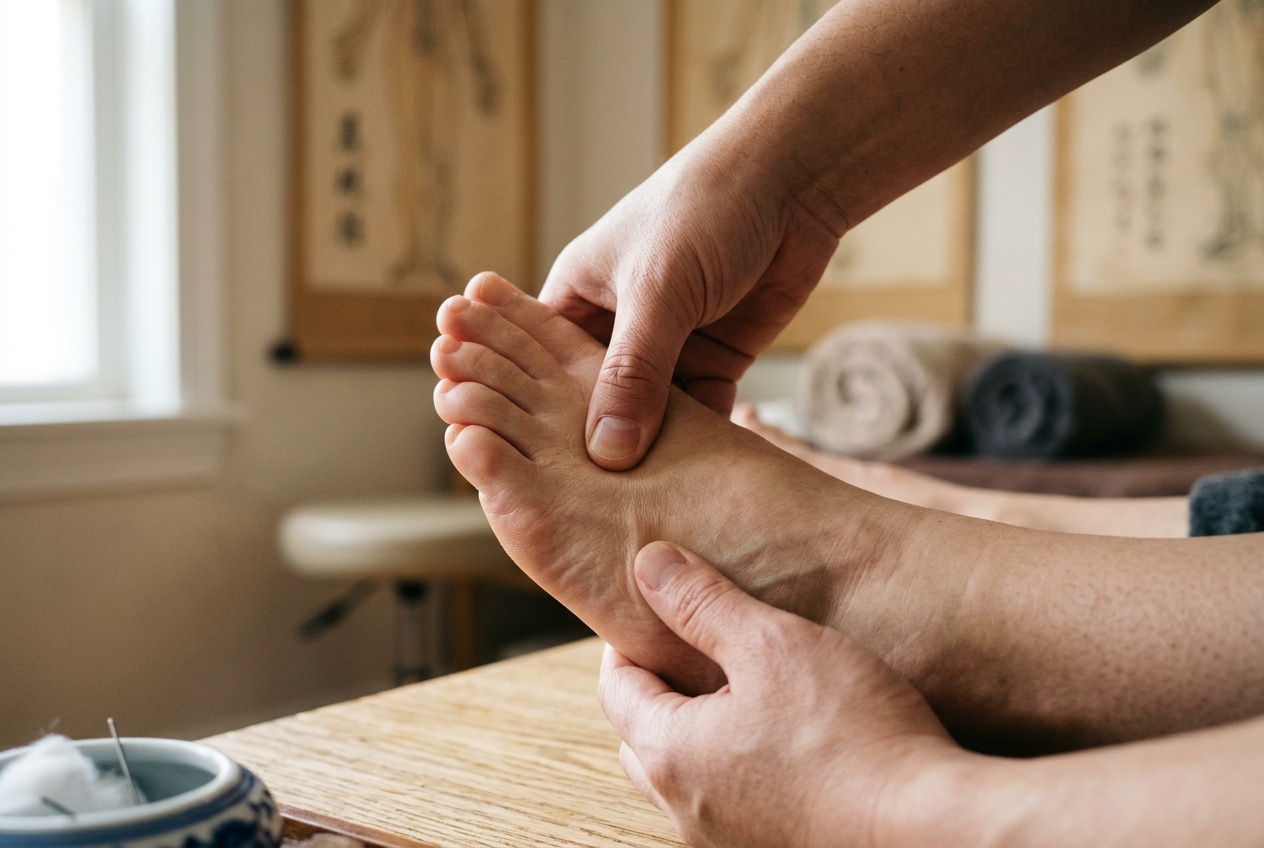
- Anatomical & Proportional Localization: Situated on the dorsum of the foot, in the interdigital cleft between the first and second toes, approximately 0.5 cun proximal to the margin of the web. To locate it without instruments, slide your index finger along the valley between your big toe and second toe, moving backward toward the ankle. You will feel your finger drop into a pronounced, soft depression just before the bony metatarsophalangeal articulation blocks further movement.
- Sensory Signature (Deqi): When precise pressure is engaged, you will experience an unmistakable, sharp, radiating distension (Suan Zhang) that often travels proximally across the top of the foot or deep into the sole.
- Acupressure Biomechanics: Apply sustained, deep circular pressure using the tip of your thumb or a rounded knuckle. Execute a counter-clockwise, dispersive circular motion (Xie Fa) at a cadence of 1 to 2 revolutions per second for 60 to 90 seconds per foot.
- Clinical Indications: LV2 is the supreme point for clearing surging Liver Fire. It is indicated for pounding temporal or vertex headaches, sudden red and painful eyes, acute episodes of uncontrollable anger, hypertension flares, and dizziness associated with hyperactive Liver Yang.
2. Stomach 44 (ST44, Neiting — "Inner Courtyard")
- Classification: Ying-Spring Point of the Foot Yangming Stomach Meridian (Water Phase).
- Anatomical & Proportional Localization: Located on the dorsum of the foot, in the depression proximal to the interdigital web margin between the second and third toes. Sit with your foot flat on the floor; place your thumb directly into the web space between the second and third toes and press firmly into the proximal groove just anterior to the metatarsophalangeal joints.
- Sensory Signature (Deqi): Palpation yields a crisp, highly localized, electrical tenderness that can cause an involuntary reflex retraction if pressed too sharply.
- Acupressure Biomechanics: Employ firm, perpendicular downward compression with the edge of the thumbnail or index finger pad. Maintain static pressure combined with subtle, micro-oscillatory vibrations for 90 seconds.
- Clinical Indications: As a Water point on a Yang channel, ST44 douses exuberant Stomach Fire. It provides rapid relief for frontal sinus headaches, burning epigastric pain, acute acid reflux, gingivitis, toothache involving the upper jaw, and excessive febrile hunger.
3. Lung 10 (LU10, Yuji — "Fish Border")
- Classification: Ying-Spring Point of the Hand Taiyin Lung Meridian (Fire Phase).
- Anatomical & Proportional Localization: Situated on the radial aspect of the palmar surface, at the midpoint of the first metacarpal bone, directly on the anatomical border where the red (palmar) and white (dorsal) skin surfaces meet (thenar eminence). Palpate the fleshy mound at the base of your thumb; find the exact center of the bone and roll your thumb onto the margin where the palmar skin transitions to the back of the hand.
- Sensory Signature (Deqi): A profound, spreading ache that radiates throughout the entire thenar muscle compartment (abductor pollicis brevis and opponens pollicis).
- Acupressure Biomechanics: Use the opposite thumb to knead the muscle belly deeply against the shaft of the first metacarpal bone, utilizing an outward sweeping stroke toward the wrist to disperse heat.
- Clinical Indications: Clears Lung Heat and moistens a dry respiratory tract. Highly effective for acute, scratchy sore throats, dry or croupy coughs, laryngitis with loss of voice, sensation of heat in the palms (Five Palm Heat), and chest oppression accompanied by feverish restlessness.
4. Heart 8 (HT8, Shaofu — "Lesser Mansion")
- Classification: Ying-Spring Point of the Hand Shaoyin Heart Meridian (Fire Phase).
- Anatomical & Proportional Localization: Located on the palm of the hand, between the fourth and fifth metacarpal bones. When you make a loose, natural fist, the point lies directly beneath the tip of your little finger where it rests against the palmar crease.
- Sensory Signature (Deqi): A deep, sharp tenderness that resonates along the ulnar side of the forearm toward the inner elbow.
- Acupressure Biomechanics: Press the tip of your thumb perpendicularly into the intermetacarpal space. Apply firm, steady pressure accompanied by slow, rhythmic circular dispersion for 60 to 90 seconds.
- Clinical Indications: Quenches pathological Heart Fire. It treats acute emotional agitation, palpitations triggered by anxiety, insomnia characterized by racing thoughts and excessive dreaming, night sweats, and painful aphthous ulcers on the tongue.
5. Pericardium 8 (PC8, Laogong — "Palace of Toil")
- Classification: Ying-Spring Point of the Hand Jueyin Pericardium Meridian (Fire Phase).
- Anatomical & Proportional Localization: Positioned in the absolute center of the palm, between the second and third metacarpal bones. When a loose fist is formed, the point is located directly under the tip of the middle finger where it meets the palm.
- Sensory Signature (Deqi): A distinct, warm, radiating sensation that travels across the entire palmar fascia and up the anterior midline of the forearm along the median nerve trajectory.
- Acupressure Biomechanics: Rest your hand open, palm facing upward. Place your opposite thumb firmly into the center of the palm. Execute deep, circular frictions in a clockwise direction to disperse internal heat and settle the spirit (Shen).
- Clinical Indications: Primary locus for clearing Ministerial Fire from the Pericardium. It addresses profound psychological distress, panic attacks, delirium during febrile illness, halitosis from internal heat, and burning sensations in the center of the palms.
CLINICAL PROTOCOL: RESOLVING NOCTURNAL HYPERAROUSAL AND SYSTEMIC HEAT
4. A Point Combination for One Common Issue
One of the most ubiquitous clinical presentations in modern society is the "Tired-and-Wired" syndrome: an individual arrives at the end of the day with profound physical fatigue, yet experiences an elevated core body temperature, racing mental activity, gastroesophageal warmth, and inability to transition into deep sleep. This condition represents a simultaneous flare of Liver Fire, Stomach Heat, and Heart Agitation.
The following sequenced Ying-Spring protocol is designed to systematically drain heat from the upper and middle reaches of the body, directing circulation downward to ground the central nervous system.
The Evening "Somatic Thermal Reset" Protocol
- Optimal Timing: 30 to 45 minutes before sleep, performed in a dimly lit, quiet room.
- Postural Setup: Recline comfortably in bed or on a yoga mat with your knees slightly elevated over a bolster, allowing the abdominal wall to remain completely soft and receptive.
- Breathing Cadence: Maintain a 4-second nasal inhalation followed by a 6-second soft, unforced exhalation throughout the sequence.
=============================================================================================================
                          STEP-BY-STEP SOMATIC HEAT-CLEARING PROTOCOL
=============================================================================================================
Step  Point Name           Location                   Technique & Cadence              Duration
-------------------------------------------------------------------------------------------------------------
1     LV2 (Xingjian)       Cleft between 1st/2nd toe  Deep circular counter-clockwise  75 seconds per foot
                                                      dispersion (Xie Fa), 1.5 Hz
2     ST44 (Neiting)       Web space 2nd/3rd toe      Sustained perpendicular pressure 75 seconds per foot
                                                      with micro-vibrations
3     PC8 (Laogong)        Dead center of the palm    Firm, broad circular friction    60 seconds per palm
                                                      spreading toward the fingers
4     HT8 (Shaofu)         Where little finger lands  Deep static compression with     60 seconds per palm
                           on the palmar crease       focused exhalations
5     LU10 (Yuji)          Fleshy mound at thumb base Outward sweeping strokes toward  60 seconds per hand
                                                      the wrist margin
=============================================================================================================
+---------------------------------------------------------------------------------------+
| CLINICAL PROOF: NEUROPHYSIOLOGICAL CASCADE OF DISTAL DISPERSION                       |
+---------------------------------------------------------------------------------------+
| By stimulating the lower extremity Ying-Spring points (LV2, ST44) prior to the palmar |
| points (PC8, HT8, LU10), the protocol initiates a somatic pressure gradient. Blood    |
| volume shifts from the congested cerebral cortex and visceral core toward the high-   |
| capacitance venous beds of the feet. This peripheral vasodilation lowers core body    |
| temperature—a biological prerequisite for the initiation of Stage N3 slow-wave sleep. |
+---------------------------------------------------------------------------------------+
BIOMECHANICAL THRESHOLDS AND CONTRAINDICATIONS
5. Safety & Sense
While non-invasive acupressure carries an exceptional safety profile compared to pharmaceutical interventions or invasive needle therapeutics, the potent energetic and neurovascular actions of the Ying-Spring points require measured application.
Pressure Mechanics and Thresholds
The objective of acupressure is to elicit the Deqi sensation—characterized by local dull distension, warmth, or mild tingling—without crossing the threshold into sharp, defensive pain. The optimal manual force ranges from 2.0 to 3.5 kg/cm². Applying excessive force that triggers muscle guarding or leaves subcutaneous ecchymosis (bruising) is counter-therapeutic; it activates the sympathetic nervous system and induces peripheral vasoconstriction, completely negating the intended heat-clearing effect.
Specific Precautions & Contraindications
- Pregnancy: While Ying-Spring points are not categorically contraindicated like certain Shu-Stream or Lower Sea points (such as SP6 or LI4), aggressive, dispersive stimulation on the lower extremities (particularly LV2 and ST44) should be avoided during the first and third trimesters. Strong downward-draining Qi mechanics can theoretically stimulate uterine contractions. Gentle, harmonizing pressure on the upper extremity points (PC8, LU10) remains safe and beneficial.
- Skin Integrity and Peripheral Vascular Disease: Never apply direct manual pressure over sites of acute skin ulceration, active fungal infection (such as tinea pedis in the interdigital web spaces), localized burns, or phlebitic veins.
- Diabetic Neuropathy: Patients with compromised peripheral sensation must not use sharp implements (such as acupressure probes or fingernails) to stimulate Ying-Spring loci, as reduced pain feedback increases the risk of unperceived microtrauma and subsequent infection.
When to Seek Immediate Medical Evaluation
Self-administered acupressure is an adjunctive, regulatory practice, not a replacement for emergency clinical medicine. If internal "heat" presents as crushing substernal chest pain, sudden high fever exceeding 39°C (102.2°F), acute abdominal rigidity, projectile vomiting, sudden focal neurological deficits, or severe, unyielding ocular pain, the patient must immediately be evaluated in an emergency department. Consult a licensed practitioner of Acupuncture and East Asian Medicine for chronic, complex metabolic or inflammatory conditions.
IMMEDIATE SOMATIC INTERVENTION: THE 120-SECOND PALMAR QUENCH
6. Today's Takeaway
You do not need an entire clinical treatment suite or hours of meditation to alter your physiological state. If you are reading this while feeling an acute surge of workplace stress, a dry sensation in your throat, or a wave of mental agitation, pause and execute this 120-second biological reset immediately:
+---------------------------------------------------------------------------------------+
| THE 2-MINUTE PC8 (LAOGONG) EMERGENCY DE-ESCALATION PROTOCOL                           |
+---------------------------------------------------------------------------------------+
| 1. Form a loose fist with your non-dominant hand. Observe where the tip of your       |
|    middle finger touches the central valley of your palm. This is PC8 (Laogong).      |
|                                                                                       |
| 2. Open your hand and place the pad of your opposite thumb directly on this spot.    |
|    Support the back of your hand with your remaining four fingers.                   |
|                                                                                       |
| 3. Inhale deeply through your nose for a count of 4. As you exhale smoothly through   |
|    your mouth for a count of 6, press your thumb firmly into the center of the palm,  |
|    executing slow, smooth counter-clockwise circles at 1 cycle per second.            |
|                                                                                       |
| 4. Maintain this rhythmic dispersion for exactly 60 seconds on the left palm, then    |
|    switch and repeat for 60 seconds on the right palm.                                |
+---------------------------------------------------------------------------------------+
Notice the immediate physical shift: the subtle drop in shoulder elevation, the release of tension in the jaw muscles, the spreading warmth through the extremities, and the clearing of mental static. By engaging the primary Fire point of the Pericardium channel, you have leveraged classical hydrodynamic medicine to clear excess heat from your nervous system, transforming ancient biophysical wisdom into an immediate, lived reality.