Wuyun Liuqi Meridian Dynamics: Navigating Five Movements and Six Qi Cosmic Cycles, Heavenly Stem Resonance, and Precision Acupressure Protocols
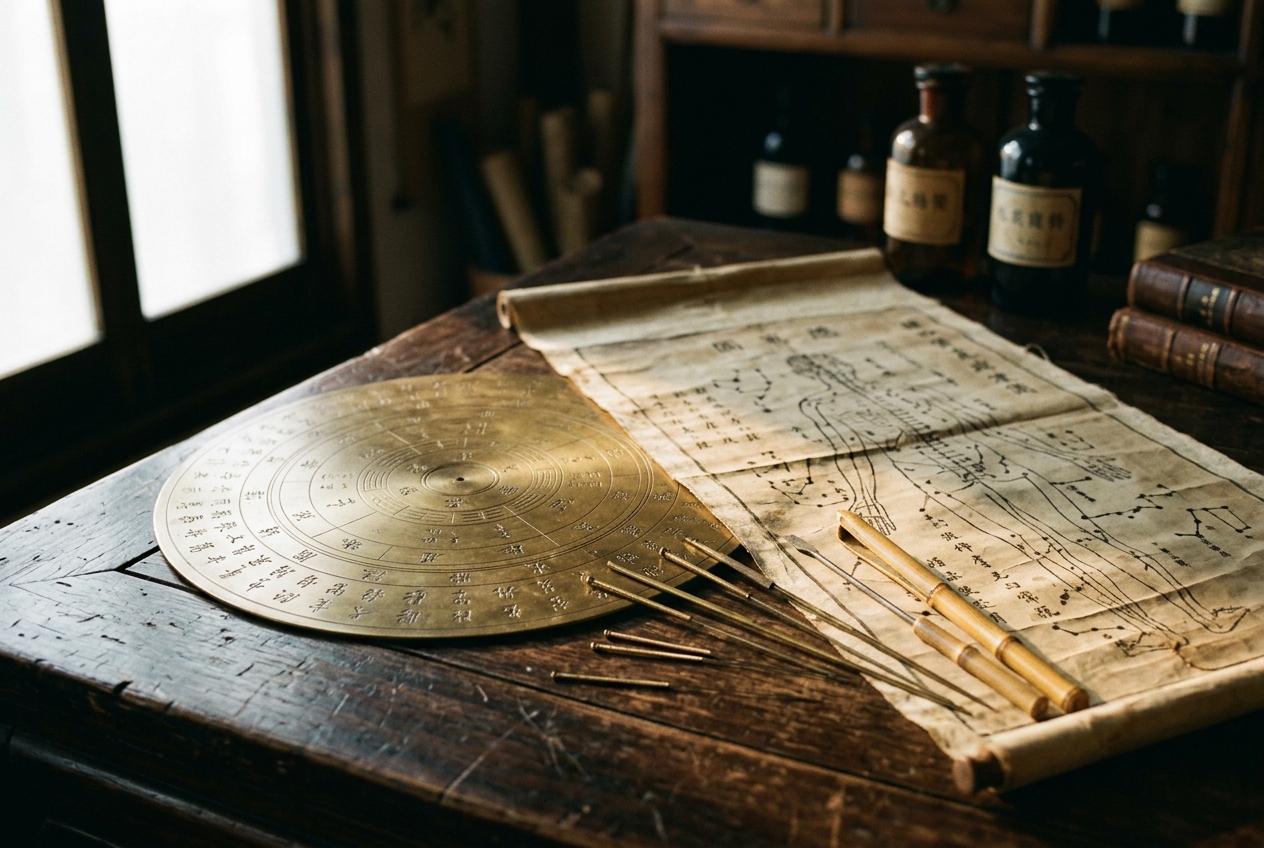
If you have ever noticed an unexplainable wave of joint stiffness whenever an autumn cold front sweeps through the valley, an inexplicable surge of midday agitation during early summer heatwaves, or a sudden, heavy lethargy in your gut during the oppressive humidity of late August, you have experienced the somatic imprint of macro-climatic shifts. Conventional biomedicine increasingly recognizes these patterns through the lens of chronobiology and meteorological medicine, noting how barometric drops, ambient thermal oscillations, and geomagnetic fluxes perturb human vascular, autonomic, and neuroendocrine systems. Yet more than two millennia ago, classical Chinese physicians codified an extraordinarily sophisticated, predictive mathematical model of these exact phenomena: Wuyun Liuqi (五運六氣), commonly translated as the Five Movements and Six Qi or Yunqi Theory.
Far from being mere esoteric folklore, Yunqi theory represents an ancient systemic cosmology that bridges celestial mechanics, planetary meteorology, and human physiology. It posits that the human body does not terminate at the perimeter of the skin; rather, our vascular and bio-energetic networks—the twelve primary meridians—operate as open thermodynamic conduits resonating continuously with celestial cycles and terrestrial currents. When macrocosmic forces veer into excess or deficiency, predictable pathogenic stresses are exerted across specific Zang-Fu organ networks and their corresponding channels. By understanding these seasonal rhythms and deploying targeted, non-invasive acupressure protocols across fundamental homeostatic loci, we can consciously synchronize our internal channel flow with the shifting atmospheric continuum.
1. The Theoretical Foundations: Suwen Chapters 66–74
The core doctrines of Wuyun Liuqi are preserved in the foundational canon of East Asian medicine, the Huangdi Neijing (The Yellow Emperor’s Classic of Internal Medicine). Specifically, they are articulated across a renowned cluster of seven treatises within the Suwen (Plain Questions)—Chapters 66 through 74 (traditionally referred to as the Qi Da Lun or Seven Comprehensive Treatises, interpolated and preserved by the Tang Dynasty scholar Wang Bing in 762 CE). These chapters—such as the Tian Yuan Ji Da Lun (Great Treatise on the Natural Elements of Heaven) and the Zhi Zhen Yao Da Lun (Great Treatise on the Essentials of the Most Reliable Manifestations)—detail an integrated mathematical framework mapping how celestial mechanics directly govern earthly ecology and human pathology.
The Ten Heavenly Stems (Tian Gan) and the Five Major Movements (Da Yun)
In classical Chinese chronopuncture, time is calculated through the sexagenary (60-year) cycle, generated by the geometric permutation of the Ten Heavenly Stems (Tian Gan: Jia, Yi, Bing, Ding, Wu, Ji, Geng, Xin, Ren, Gui) and the Twelve Earthly Branches (Di Zhi: Zi, Chou, Yin, Mao, Chen, Si, Wu, Wei, Shen, You, Xu, Hai).
The Ten Heavenly Stems govern the Five Major Movements (Da Yun), which correspond to the energetic archetypes of the Five Phases (Wu Xing): Wood, Fire, Earth, Metal, and Water. The stems pair systematically to dictate the annual prevailing thematic movement: * Jia (Yang) & Ji (Yin) transform into Earth Movement (Tu Yun) * Yi (Yin) & Geng (Yang) transform into Metal Movement (Jin Yun) * Bing (Yang) & Xin (Yin) transform into Water Movement (Shui Yun) * Ding (Yin) & Ren (Yang) transform into Wood Movement (Mu Yun) * Wu (Yang) & Gui (Yin) transform into Fire Movement (Huo Yun)
Each movement expresses either as Excess (Tai Guo, Yang years) or Deficiency (Bu Ji, Yin years). In a Tai Guo Wood year (a Ren year), environmental Wind Qi surges aggressively, directly challenging the Liver and Gallbladder channel networks and hyper-restraining the Spleen-Stomach Earth axis via Five-Phase Five-Element overacting cycles. Conversely, in a Bu Ji Wood year (a Ding year), deficient Wood Qi fails to disperse, rendering the organism vulnerable to pathogenic Metal dryness and internal Wood stasis, which manifests as stagnant Qi, tendon tightness, and depressive somatic tension.
The Twelve Earthly Branches (Di Zhi) and the Six Environmental Qi (Liu Qi)
While Heavenly Stems govern the macro-thematic movements of the cosmos, the Twelve Earthly Branches govern the manifestation of tangible meteorological and seasonal forces on the planet, designated as the Six Qi (Liu Qi): Wind, Cold, Summer Heat, Dampness, Dryness, and Fire. The twelve branches pair across diametric axes to generate the Six Channel Divisions:
The Mathematical Dynamic: Host Qi (Zhu Qi) vs. Guest Qi (Ke Qi)
To predict precisely how environmental vectors influence human health throughout any given year, the Suwen establishes a dual-layered matrix comprising Host Qi (Zhu Qi) and Guest Qi (Ke Qi).
-
Host Qi (Zhu Qi): The baseline, unvarying seasonal progression of terrestrial climate. Every year is subdivided into six chronological steps (Bu), each spanning approximately 60.875 days, initiating at the Beginning of Spring (Lichun, around February 4). The sequence is strictly immutable: * First Step: Jueyin Wind Wood (Early Spring) * Second Step: Shaoyin Imperial Fire (Late Spring/Early Summer) * Third Step: Shaoyang Ministerial Fire (Mid-Summer) * Fourth Step: Taiyin Damp Earth (Late Summer) * Fifth Step: Yangming Dry Metal (Autumn) * Sixth Step: Taiyang Cold Water (Winter)
-
Guest Qi (Ke Qi): The dynamic, macro-cosmic influence that shifts every single year according to the prevailing Earthly Branch. The Guest Qi introduces two dominant climatic vectors: * Heaven Governing (Si Tian): Controls the first half of the year (Steps 1–3), reaching its zenith during the Third Step (Summer Solstice). * Earth Presiding (Zai Quan): Controls the second half of the year (Steps 4–6), reaching its zenith during the Final Step (Winter Solstice).
When Host Qi and Guest Qi harmonize (e.g., both express warmth or moisture in appropriate proportions), physiological systems remain resilient. However, when the Guest Qi severely conflicts with the Host Qi—such as when a Guest Taiyang Cold Water infringes upon a Host Shaoyang Ministerial Fire—severe climatic volatility ensues.
In the human organism, this macrocosmic friction translates directly into channel tension. The twelve primary meridians function as fluid-filled, highly conductive connective-tissue arrays; when atmospheric conditions oscillate violently, fluid pressure, peripheral microvascular resistance, and autonomic equilibrium fluctuate along the specific meridians corresponding to the embattled Qi phases.
2. The Meridian Path: A Somatic Journey Through the Body
To understand how cosmic and seasonal forces create palpable tension within us, we must ground this theory in living anatomy. Rather than abstract charts, consider the human meridian network as a set of interconnected rivers that run through the valleys, ridges, and muscle planes of your physical frame. In the context of Yunqi dynamics, three major meridian pathways bear the brunt of seasonal-atmospheric tension: the Stomach/Spleen (Earth) axis, the Liver/Gallbladder (Wood) axis, and the Kidney/Bladder (Water) axis.
The Spleen and Stomach Axis: The Earth Matrix
The Stomach Meridian of Foot-Yangming begins directly below the pupils of your eyes, descends down the jaw, courses through the neck muscles, and travels down the front of the chest and abdomen. Passing through the groin, it surges down the front-outside edge of your thigh and runs straight down the muscular valley alongside your shinbone—the fleshy tier on the outside of your lower leg that clenches when you flex your foot upward. It terminates at the tip of the second toe.
Its Yin partner, the Spleen Meridian of Foot-Taiyin, begins at the inside corner of the big toenail, travels across the arch of the foot, sweeps up directly behind the inner ankle bone, and ascends the inner border of your shinbone. Continuing up the inner thigh, it traverses deep into the lower abdomen, branching out across the digestive organs before ascending the ribcage.
When late-summer dampness or sudden atmospheric humidity overwhelms the system, the Spleen-Stomach axis bogs down: you feel a physical heaviness in the lower limbs, water retention around the ankles, brain fog, and chronic digestive bloating.
The Liver and Gallbladder Axis: The Wood Vector
The Liver Meridian of Foot-Jueyin starts at the outer margin of the big toe, travels across the top of your foot through the webbing between the first and second toes, and climbs the inner calf, tracing the seam of the inner thigh into the pelvic basin and groin. It wraps around the reproductive organs, threads through the lower ribcage, and connects internally with the diaphragm and eyes.
Its Yang counterpart, the Gallbladder Meridian of Foot-Shaoyang, weaves a complex zigzag across the sides of the skull, cascades over the tops of the shoulder muscles (the precise band that knots during emotional stress), runs down the lateral seam of the ribcage, sweeps past the hip joint, tracks the outer seam of your leg, and terminates at the fourth toe.
When spring atmospheric winds or excessive macro-Wood movements surge, this axis tightens like an overtuned violin string: you experience temporal tension headaches, neck and shoulder rigidity, sudden flashes of irritability, and erratic eye strain.
The Kidney and Bladder Axis: The Water Depths
The Kidney Meridian of Foot-Shaoyin emerges on the sole of the foot, wraps in a protective loop behind the inner ankle bone, and ascends the innermost, deepest channel of the calf and thigh into the base of the spine, kidneys, and adrenal complex.
The Bladder Meridian of Foot-Taiyang starts at the inner corner of the eye, crests the skull, and flows all the way down both sides of the spine along the long erector muscles, cascading down the backs of the thighs, the center of the calves, and curling around the outer ankle to the pinky toe.
When winter cold waves or deficient Water cycles dominate, this axis contracts: lower back aching, chilling of the sacrum and knees, deep structural fatigue, and heightened baseline anxiety naturally surface.
3. Five Master Loci: Somatic Precision Acupressure
To remediate the disharmonies triggered by Host-Guest Qi interactions, we employ five paramount balance loci. These points function as regulatory valves, dynamically balancing pressure across the twelve channels through their identities as Yuan-Source points (which access deep primordial visceral reserves) and Five Shu points (which govern specific energetic transformations from distal extremities).
===================================================================================================
                               FIVE MASTER HOMEOSTATIC LOCI
===================================================================================================
  Point Name & Code      Channel / Category           Topographical Landmark          Sensory Trigger
---------------------------------------------------------------------------------------------------
  Zusanli (ST36)         Foot-Yangming / He-Sea       One handwidth below knee,       Deep aching
                         (Earth on Earth)             outer muscular valley           radiating down shin
---------------------------------------------------------------------------------------------------
  Sanyinjiao (SP6)       Foot-Taiyin / Crossing       Four fingers above inner        Sharply tender,
                         of 3 Lower Yin Meridians     ankle, behind shinbone          subtle spreading ache
---------------------------------------------------------------------------------------------------
  Taichong (LV3)         Foot-Jueyin / Yuan-Source    Webbing valley between 1st      Sharp, electric, or
                         & Shu-Stream (Earth on Wood) & 2nd metatarsal bones          diffuse throbbing
---------------------------------------------------------------------------------------------------
  Neiguan (PC6)          Hand-Jueyin / Luo-Connecting Three fingers above wrist,      Dull tingling
                         & Confluent of Chong Mai     between central forearm tendons reaching palm/chest
---------------------------------------------------------------------------------------------------
  Taixi (KI3)            Foot-Shaoyin / Yuan-Source   Hollow between prominent inner  Warm, deeply soothing
                         & Shu-Stream (Earth on Water) ankle bone & Achilles tendon   structural ache
===================================================================================================
1. Zusanli (ST36) – "Leg Three Miles"
- Theoretical Classification: He-Sea (Earth Point) of the Stomach Channel.
- Topographical Location: Place the palm of your hand directly over the center of your kneecap on the same side. Let your fingers rest naturally down the shin. Your ring finger will land roughly four finger-widths below the base of the kneecap, approximately one finger-width to the outside of the sharp anterior crest of the tibia (shinbone). You are resting directly in the belly of the tibialis anterior muscle.
- Somatic Palpation & Sensory Feedback: When engaged, press firmly inward and slightly toward the shinbone. You should not encounter bone; rather, you will feel a firm, rubbery muscle bundle. Correct activation yields the classical De Qi sensation: a profound, heavy, dull ache that frequently radiates downward into the dorsum of the foot.
- Biomechanical Application & Duration: Apply sustained, circular pressure using your thumb or knuckle. Rotate clockwise with firm, steady force (calibrated at roughly 4–6 pounds of pressure per square centimeter) for 2 to 3 minutes.
- Therapeutic Resonance: Governs systemic Earth deficiency and atmospheric Damp overload. Invaluable for alleviating postprandial lethargy, chronic digestive hypofunction, physical exhaustion, and lower-extremity heaviness. Research archived in NCBI PubMed corroborates ST36's capacity to modulate gastrointestinal motility and downregulate systemic inflammatory cytokines via vagal nerve stimulation.
2. Sanyinjiao (SP6) – "Three Yin Intersection"
- Theoretical Classification: Intersection point of the three lower Yin channels (Spleen-Taiyin, Liver-Jueyin, and Kidney-Shaoyin).
- Topographical Location: Sit comfortably and place the flat of four fingers of your opposite hand across the inside of your lower calf, aligning the lower edge of your pinky finger precisely with the peak of your inner ankle bone (medial malleolus). The location lies directly above your index finger, nestled into the soft, tender depression along the posterior border of the shinbone.
- Somatic Palpation & Sensory Feedback: Press your thumb into the posterior edge of the tibia, angling slightly forward against the bone. This point is exceptionally sensitive in nearly all individuals. Correct engagement produces a sharp, tender, mildly electric or spreading ache that travels up the inner calf toward the knee.
- Biomechanical Application & Duration: Utilize static, perpendicular thumb pressure. Begin gently, gradually increasing depth over 60 seconds. Maintain for 2 minutes while breathing slowly through the lower abdomen.
- Therapeutic Resonance: Serves as the premier systemic regulator for fluid metabolism, blood stagnation, and hormonal dysregulation. Counteracts climatic Damp-Heat and Dryness, resolving lower-abdominal distension, pelvic congestion, menstrual cramping, insomnia, and nervous exhaustion.
3. Taichong (LV3) – "Great Surge"
- Theoretical Classification: Yuan-Source and Shu-Stream (Earth) Point of the Liver Channel.
- Topographical Location: Locate the junction where the bones of your big toe and second toe meet on the top of your foot. Place your finger in the webbing between these two toes and slide it upward toward your ankle. Your finger will drop into a pronounced, soft, valley-like dip directly before the bony angle formed by the first and second metatarsal bones.
- Somatic Palpation & Sensory Feedback: Press firmly straight down into the floor of this metatarsal valley. The sensation is typically acute, sharp, and highly tender, often evoking an immediate, spontaneous deep breath as systemic tension begins to discharge.
- Biomechanical Application & Duration: Apply deep, pulsing pressure with the tip of your thumb. Press firmly for 5 seconds, slightly release for 2 seconds, and repeat this rhythm for 90 to 120 seconds per foot.
- Therapeutic Resonance: Specifically counters celestial Wood excess (Tai Guo) and environmental Wind perturbations. Instantly smooths Liver Qi constraint, lowering somatic pressure manifestations such as vertex and temporal tension headaches, hypertensive emotional irritability, jaw clenching, and eye strain.
4. Neiguan (PC6) – "Inner Gate"
- Theoretical Classification: Luo-Connecting Point of the Pericardium Channel; Confluent Point of the Yin Link (Yin Wei) Vessel.
- Topographical Location: Turn your palm upward. Lay the three middle fingers of your opposite hand flat across the inside of your wrist, with the edge of your ring finger resting on the proximal transverse wrist crease. The point lies directly beneath your index finger, exactly in the central ditch between the two prominent, rope-like tendons of your inner forearm (flexor carpi radialis and palmaris longus). If these tendons are hard to distinguish, make a tight fist and flex your wrist slightly toward your face.
- Somatic Palpation & Sensory Feedback: Press your thumb directly down between the two tendons. The sensation is distinct: a deep, spreading, dull ache accompanied by a pleasant tingling sensation that radiates downward into the palm and upward through the medial arm toward the chest.
- Biomechanical Application & Duration: Maintain steady, continuous, moderate pressure while gently rotating your wrist in small, relaxed circles for 2 minutes on each arm.
- Therapeutic Resonance: Regulates the Imperial and Ministerial Fires (Jun Huo and Xiang Huo). As cataloged in classical texts and modern WHO Acupuncture Guidelines, PC6 acts directly upon cardiac rhythm, vagal modulation, diaphragm relaxation, acute nausea, motion sickness, epigastric reflux, and stress-induced cardiac palpitations.
5. Taixi (KI3) – "Supreme Stream"
- Theoretical Classification: Yuan-Source and Shu-Stream (Earth) Point of the Kidney Channel.
- Topographical Location: Trace the inner contour of your lower leg down to the prominent, rounded bony protrusion of the inner ankle (medial malleolus). Slide your thumb backward toward the thick cord of the Achilles tendon. KI3 sits directly in the soft, concave depression midway between the highest prominence of the inner ankle bone and the anterior border of the Achilles tendon.
- Somatic Palpation & Sensory Feedback: Apply thumb pressure inward toward the center of the ankle joint. You should experience a subtle, deeply comforting, warm, and grounding ache, rather than an aggressive or sharp shock.
- Biomechanical Application & Duration: Apply slow, rhythmic kneading in a gentle circular vector for 2 to 3 minutes per side, preferably in a seated, relaxed posture with feet resting flat.
- Therapeutic Resonance: Anchors the root of Water (Yuan Yin and Yuan Yang). Counters severe cold invasion, dry climatic depletion, and deficient fire flare-ups. Clinically indicated for chronic low back weakness, nocturnal restlessness, tinnitus, postural dizziness, and systemic depletion resulting from seasonal extremes.
4. Remediation Protocols: Navigating Host-Guest Clashes
When the macrocosm experiences unseasonal meteorological deviations, our internal energetic equilibrium requires strategic recalibration. Below is an exhaustive, actionable evening clinical protocol designed to counter a classic, severe Host-Guest Qi clash: Excess Wood-Wind Overacting upon Deficient Earth-Dampness (a common phenomenon in early spring or unseasonably turbulent transitional seasons).
Complete "Do This Tonight" Step-by-Step Procedure
- Clinical Context: Indicated after intense days characterized by high mental stress, screen overload, atmospheric storm fronts, digestive stagnation, neck tightness, or fitful, unrefreshing sleep.
- Recommended Posture: Reclining semi-upright on a comfortable surface with knees slightly bent and supported by a pillow, allowing the abdominal wall and inner leg adductors to relax fully.
-
Step 1: Drain the Excess Wood Surge (LV3 – Taichong) * Execution: Begin on the left foot. Place your thumb deeply into the valley between the 1st and 2nd metatarsal bones. * Mechanism: Sedate hyperactive Liver Qi and release upward somatic tension. * Duration: 2 minutes per foot using rhythmic 5-second pulsing compressions. * Somatic Focus: Inhale deeply through the nose; exhale slowly through parted lips, consciously releasing tension from your jaw, forehead, and shoulders.
-
Step 2: Balance the Core Autonomic Rhythm (PC6 – Neiguan) * Execution: Position your opposite thumb between the central flexor tendons of your inner forearm, three finger-widths above the wrist crease. * Mechanism: Unbinds the chest, downregulates sympathetic autonomic outflow, and relieves diaphragmatic constriction. * Duration: 2 minutes per arm using steady, continuous, moderate pressure accompanied by slow wrist rotations.
-
Step 3: Fortify Central Digestive Transformation (ST36 – Zusanli) * Execution: Move to the lower leg. Hook the thumb or index knuckle into the fleshy belly of the tibialis anterior muscle, one finger-width lateral to the shinbone. * Mechanism: Activates digestive enzyme secretion, supports peristalsis, and clears systemic heavy-headedness and digestive dampness. * Duration: 3 minutes per leg with strong, circular, clockwise friction until local warmth develops.
-
Step 4: Consolidate the Yin Reservoirs (SP6 – Sanyinjiao & KI3 – Taixi) * Execution: Using one hand, grasp the lower calf from behind so your thumb rests securely on SP6 (four finger-widths above the inner ankle) while your middle finger curls around the back of the ankle to press directly into KI3 (the hollow in front of the Achilles tendon). * Mechanism: Synthesizes water and earth elements, anchoring kidney vitality, nourishing blood, and inducing parasympathetic restoration. * Duration: 2 minutes per leg with coordinated, simultaneous, gentle compression.
5. Clinical Safety, Sensory Thresholds & Contraindications
While non-invasive acupressure provides an accessible bridge to chronobiological regulation, it is a potent neuro-somatic intervention requiring clinical mindfulness and anatomical discernment.
+-------------------------------------------------------------------------------------------------+
|                                 CRITICAL SAFETY MANDATES                                        |
+=================================================================================================+
|  1. MATERNAL PRECAUTIONS: Strictly avoid deep acupressure on SP6 (Sanyinjiao) and LI4 (Hegu)   |
|     during pregnancy due to their clinically documented capacity to stimulate uterine tone.     |
|                                                                                                 |
|  2. TISSUE INTEGRITY: Never perform firm acupressure over acute open wounds, local bone         |
|     fractures, acute phlebitis, active varicose veins, or sites of unresolved hematoma.         |
|                                                                                                 |
|  3. CALIBRATED FORCE: Optimal stimulation produces De Qi (a deep, heavy, spreading ache).       |
|     Sharp, burning, or excruciating pain indicates excess pressure; lighten pressure instantly. |
|                                                                                                 |
|  4. RED FLAG CONDITIONS: Chronic vertigo, severe chest pain, sudden unilateral weakness, or    |
|     unexplained high fevers require immediate formal evaluation by licensed physicians.         |
+-------------------------------------------------------------------------------------------------+
The Sensory Metric: Understanding De Qi vs. Mechanical Trauma
Acupressure operates by stimulating mechanoreceptors, neurovascular bundles, and fascia-embedded nerve fibers within the meridian matrices. The therapeutic benchmark is the elicitation of De Qi (得氣)—a sensation described in classical texts as "the arrival of the vital needle."
- True De Qi: Experienced as a dull, heavy, spreading ache, a localized sensation of warmth, mild numbness, or a subtle magnetic tingling along the trajectory of the channel. It should feel deeply restorative and satisfying.
- Mechanical Trauma / Excessive Force: Sharp, piercing, lancinating, or burning pain is an indication of direct periosteal contusion or superficial cutaneous nerve compression. If bruising occurs post-treatment, pressure must be reduced by at least 40% in subsequent sessions.
Absolute and Relative Contraindications
- Obstetric Precautions: SP6 (Sanyinjiao), along with LI4 (Hegu) and GB21 (Jianjing), possesses strong descending and down-bearing energetic actions. In classical literature and modern clinical practice, these points are strictly contraindicated during pregnancy, except during active labor under the supervision of a licensed midwife or acupuncturist.
- Vascular and Cutaneous Fragility: Avoid direct, deep pressure on limbs affected by deep vein thrombosis (DVT), severe varicose veins, active cellulitis, skin ulcerations, or directly over sites of recent bone fractures.
- Scope and Practitioner Referral: Acupressure is an adjunctive self-regulatory discipline designed for systemic maintenance, stress reduction, and functional balancing. It is not an alternative to emergency medical intervention. Individuals presenting with acute severe hypertension, unstable cardiac arrhythmias, persistent localized pain, or progressive neurological symptoms should consult a board-certified biomedical physician or a licensed Traditional Chinese Medicine (TCM) practitioner accredited via the National Certification Commission for Acupuncture and Oriental Medicine (NCCAOM) or corresponding national medical boards.
6. Today's Takeaway: The Two-Minute Reset
You do not need an exhaustive knowledge of the sexagenary calendar or advanced pulse diagnostics to begin experiencing the regulatory power of Wuyun Liuqi chronopuncture today.
Whenever you feel the turbulent pressures of seasonal shifts, atmospheric disruptions, or modern digital overload, pause for two minutes. Reach down to the top of your foot, engage LV3 (Taichong), and gently guide your internal energies back into effortless resonance with the steady, timeless rhythm of the cosmos.
Authoritative Resources & Scholarly References
- World Health Organization (WHO) Standard Acupuncture Point Locations in the Western Pacific Region
- National Center for Biotechnology Information (NCBI PubMed) – Mechanisms of Acupressure & Meridians
- National Center for Complementary and Integrative Health (NCCIH) – Acupuncture & Acupressure Research
- National Certification Commission for Acupuncture and Oriental Medicine (NCCAOM)
- Traditional Chinese Medicine — Historical and Philosophical Foundations (Wikipedia)
- Meridian Channels and Qi Circulation Systems (Wikipedia)