Wind-Damp Dispelling Herbs (Qu Feng Shi Yao) Pharmacodynamics: Governing Bi Syndrome Resolution, Arthralgia Alleviation, Sinew-Bone Strengthening, and Channel Unblocking in Traditional Chinese Medicine
When atmospheric dampness and cold infiltrate compromised tissues, joints ache and movement falters. Traditional Chinese Medicine identifies this as Bi syndrome—an intricate vascular, neurological, and immunological gridlock. Here is how ancient botanical pharmacology and modern bioscience resolve painful obstruction, rebuild structural integrity, and restore bodily ease.
1. Opening Scene — A Moment You'll Recognise
You wake on an overcast, rain-drenched morning, and before your feet even touch the floorboards, your body delivers an unmistakable meteorological report. Your knees feel heavy and swollen, as though packed with damp sand; your lower back resists extension with a dull, locked stiffness; and the small joints of your fingers throb with a deep, weather-sensitive ache that eases only after twenty minutes under a scalding shower.
We often dismiss this phenomenon as an inevitable quirk of aging or an idiosyncratic sensitivity to low barometric pressure. Yet in the classical paradigm of Traditional Chinese Medicine, this visceral discomfort is neither mysterious nor purely mechanical. It represents the quintessential manifestation of Bi syndrome (痹证, Painful Obstruction Syndrome).
Long before modern rheumatology isolated inflammatory cytokines, synovial pannus formation, and autoimmune antibody cascades, classical physicians recognized that the human musculoskeletal apparatus exists in dynamic, permeable equilibrium with the external environment. When our systemic vitality and surface defenses fluctuate, atmospheric macroclimates—specifically meteorological Wind, Cold, and Dampness—can penetrate the peripheral tissues, stagnating the circulation of vital energy (Qi) and blood (Xue) within the meridian channels (Jing-Luo).
The result is a sensation millions experience every day: joints that feel rusted, muscles that ache with leaden exhaustion, and a structural frame that struggles against the damp chill of the surrounding world. Resolving this deep-seated obstruction requires a sophisticated pharmacopeia known as Wind-Damp Dispelling Herbs (Qu Feng Shi Yao, 祛风湿药)—a specialized botanical arsenal that unblocks obstructed channels, clears cellular debris, quells neurogenic pain, and fortifies the foundational sinews and bones.
2. What This System Does: The Pathogenesis of Bi Syndrome and the Pharmacodynamics of Wind-Damp Dispelling Herbs (Qu Feng Shi Yao)
To grasp how these botanical agents operate, one must first dismantle the physiological architecture of Bi syndrome. The foundational medical canon, the Huangdi Neijing Suwen (黄帝内经素问, The Yellow Emperor's Classic of Internal Medicine), states unequivocally in Chapter 43: "When the three pathogens of Wind, Cold, and Dampness arrive in combination, they unite to produce Bi syndrome."
In plain clinical terms, Bi means "closure" or "obstruction." Under physiological equilibrium, our Defensive Qi (Wei Qi) acts as an active bio-electromagnetic and immunological shield circulating in the subcutaneous and fascial planes, while our Nutritive Qi (Ying Qi) and Blood (Xue) continuously bathe muscles (Ji Rou), sinews (Jin), and bones (Gu). When constitutional exhaustion, occupational overwork, or systemic deficiency compromises this defensive barrier, environmental micro-pathogens invade:
- Wind (Feng, 风) acts as the mobile, penetrating vector, carrying other pathogens inward and causing shifting, migratory joint pains (Xing Bi).
- Cold (Han, 寒) constricts microvasculature, freezes fluid flow, slows enzymatic processes, and triggers sharp, spastic, fixed pain that craves heat (Tong Bi).
- Dampness (Shi, 湿) is heavy, viscous, and lingering; it infiltrates interstitial spaces, generating edema, joint effusion, a sense of leaden heaviness, and stubborn chronicity (Zhuo Bi).
- Heat (Re, 热) can either invade directly or emerge secondarily when long-standing, stagnant Wind-Cold-Damp transforms into friction and acute cellular inflammation, manifesting as red, burning, swollen joints (Re Bi).
When these pathogens lodge in the connective tissue matrices, synovial membranes, and periosteum, standard circulation halts. To dislodge these entrenched pathogens, Chinese herbal pharmacology deploys Wind-Damp Dispelling Herbs (Qu Feng Shi Yao). These agents possess distinctive organ tropisms, thermodynamic temperatures, and specialized phytoconstituents. Clinically and pharmacologically, they divide into three primary subcategories:
Category 1: Herbs that Dispel Wind-Dampness and Relieve Pain (Dispersing Cold & Unblocking Collaterals)
These botanicals are predominantly acrid, bitter, and warm, designed to penetrate deep fascia, drive out cold-damp stagnation, and activate stalled microcirculation.
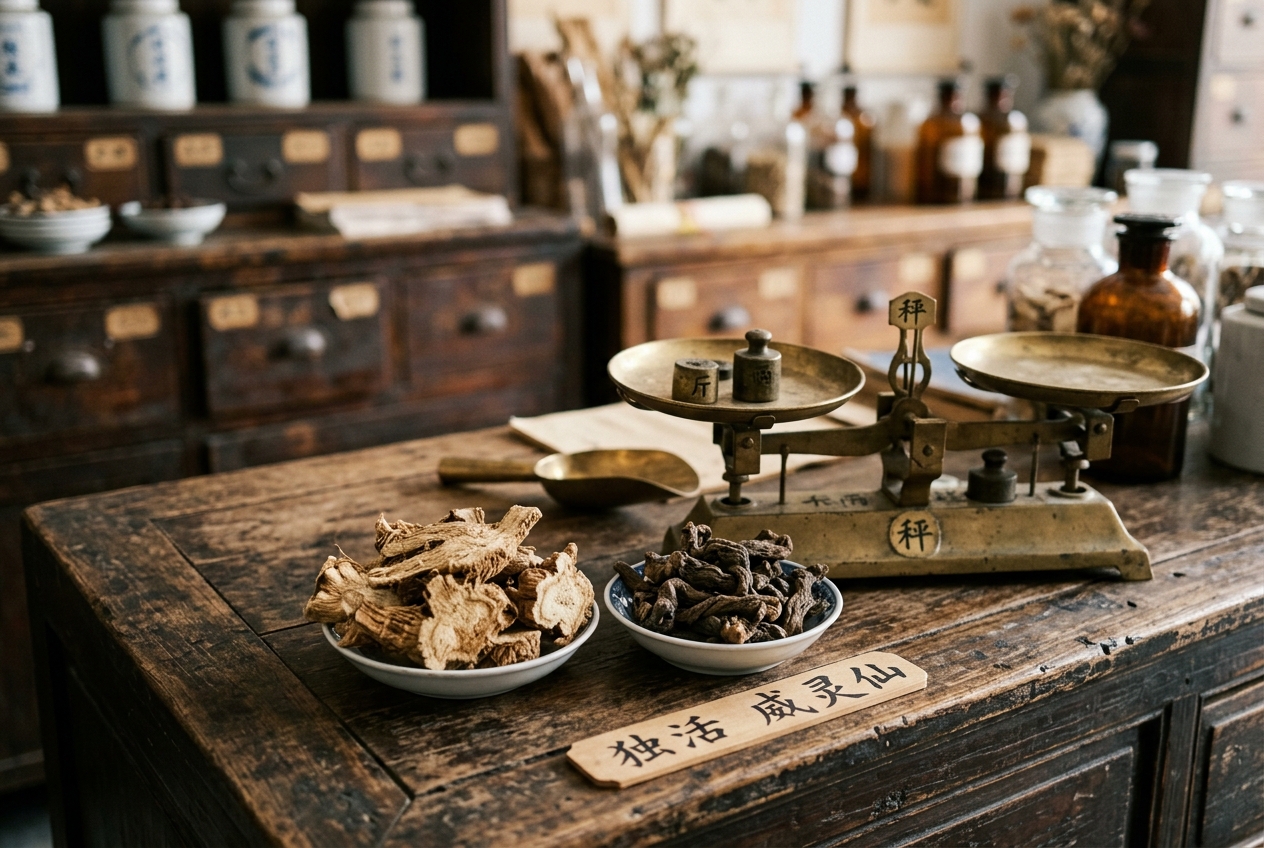
- Du Huo (Radix Angelicae Pubescentis / 独活):
- Channel Tropism: Kidney and Urinary Bladder meridians.
- TCM Action: Renowned for descending into the lower burner (Xia Jiao), Du Huo specifically targets the lumbar spine, sacrum, hips, knees, and ankles. It dispels latent Wind-Cold-Damp lodged deep in the bone and sinew layers.
- Biomedical Mechanism: Abundantly rich in furanocoumarins and pyranocoumarins—most notably osthole, columbianetin, and angelol. Modern pharmacological studies cataloged in the NCBI PubMed Database demonstrate that osthole exerts potent anti-inflammatory and analgesic effects by suppressing cyclooxygenase-2 (COX-2), down-regulating inducible nitric oxide synthase (iNOS), and modulating nuclear factor-kappa B (NF-κB) transcription cascades, thereby directly quelling neuro-inflammatory arthritic signals.
- Wei Ling Xian (Radix Clematidis / 威灵仙):
- Channel Tropism: Enters all twelve primary meridians.
- TCM Action: Celebrated as an aggressive, fast-moving kinetic agent that "softens hardness, pierces obstructions, and unblocks every channel." It is the premier herb for acute, agonizing joint fixation, tendon contracture, and recalcitrant numbness.
- Biomedical Mechanism: Contains triterpenoid saponins (such as clematichinenoside AR), anemonin, and protoanemonin. Clematichinenosides have been shown to inhibit pro-inflammatory cytokines, including Tumor Necrosis Factor-alpha (TNF-α), Interleukin-1 beta (IL-1β), and Interleukin-6 (IL-6), while protecting articular cartilage from matrix metalloproteinase (MMP-13) degradation.
- Qin Jiao (Radix Gentianae Macrophyllae / 秦艽):
- Channel Tropism: Gallbladder, Liver, Stomach channels.
- TCM Action: Unique within this category, Qin Jiao is slightly cold and non-drying. It is known as "the gentle wind-damp herb that does not injure body fluids," capable of treating both acute and chronic wandering arthralgia as well as low-grade bone-steaming tidal fevers.
- Biomedical Mechanism: High concentrations of secoiridoid glucosides, predominantly gentiopicroside and sweroside, which exert systemic immunosuppressive, hepatoprotective, and central analgesic actions via modulation of spinal cord pain pathways.
Category 2: Herbs that Dispel Wind-Dampness and Clear Heat for Hot Bi Patterns (Re Bi)
When chronic joint stagnation generates frictional heat, or in systemic autoimmune states like rheumatoid arthritis and gouty arthropathy, warm herbs are contraindicated. Instead, bitter, cold, clearing botanicals are deployed.
- Sang Zhi (Ramulus Mori / Mulberry Twig / 桑枝):
- Channel Tropism: Liver meridian; specifically guides to the upper extremities.
- TCM Action: Unblocks the channels of the shoulders, arms, elbows, and hands. It clears rheumatic heat, reduces localized edema, and restores flexor/extensor mobility.
- Biomedical Mechanism: Rich in flavonoids (morin, mulberroside A) and stilbenoids with established xanthine oxidase-inhibiting properties (critical in uric acid clearance) and systemic vasodilation through endothelial nitric oxide pathways.
- Fang Ji (Radix Stephaniae Tetrandrae / 防己 - specifically Han Fang Ji):
- Channel Tropism: Bladder, Spleen, Kidney channels.
- TCM Action: Extremely bitter and cold, Fang Ji dispels damp-heat, unblocks the interstitial water passages, and drains severe synovial swelling and lower-extremity edema.
- Biomedical Mechanism: Characterized by the bisbenzylisoquinoline alkaloid tetrandrine. Research indexed by the World Health Organization (WHO) Traditional Medicine Strategy highlights tetrandrine as an exceptional L-type calcium channel blocker, immunosuppressant, and inhibitor of synovial fibroblast proliferation in progressive inflammatory arthritis.
- Qing Feng Teng (Caulis Sinomenii / 青风藤):
- Channel Tropism: Liver and Spleen channels.
- TCM Action: Expels wind-damp, clears inflammatory heat, and calms persistent, migrating arthritic pain.
- Biomedical Mechanism: Contains the morphinan-type alkaloid sinomenine. Sinomenine is a cornerstone of modern autoimmune pharmacology; it inhibits lymphocyte activation, blocks histamine release, suppresses prostaglandin E2 (PGE2) synthesis, and suppresses RANKL-mediated osteoclastogenesis, protecting joint architecture from permanent erosive destruction.
Category 3: Herbs that Dispel Wind-Dampness, Tonify Kidney-Liver, and Strengthen Sinews and Bones
In chronic, degenerative joint disease, the root issue is no longer just external pathogen invasion; it is internal structural bankruptcy. In Chinese medical theory, the Liver rules the Sinews (Gan Zhu Jin)—governing tendons, ligaments, and fascial elasticity—while the Kidney rules the Bones (Shen Zhu Gu)—governing bone density, structural cartilage, and marrow. When Liver Blood is dry and Kidney Essence (Jing) is depleted, joints degenerate, cartilage wears thin, and pathogens settle permanently.
- Sang Ji Sheng (Herba Taxilli / Mulberry Mistletoe / 桑寄生):
- Channel Tropism: Kidney and Liver meridians.
- TCM Action: Sweet, bitter, and neutral. It dispels wind-dampness while deeply nourishing Liver Blood and Kidney Yin, moistening sinews, stabilizing bones, and even calming the fetus during pregnancy-related lumbar instability.
- Biomedical Mechanism: Flavonoids (avicularin, quercitrin, taxilloside) promote osteoblast differentiation, downregulate osteoclast resorption, and confer neuroprotective and cardiovascular-stabilizing actions without causing gastric irritation.
- Wu Jia Pi (Cortex Acanthopanacis / Siberian Ginseng Root Bark / 五加皮):
- Channel Tropism: Kidney and Liver meridians.
- TCM Action: Pungent, bitter, warm. Expels wind-damp, strengthens the lumbar spine and knees, relieves gait fatigue, and transforms accumulated damp-edema.
- Biomedical Mechanism: Abundant in eleutherosides (B, E) and polysaccharides. Known for adaptogenic, anti-fatigue, and immunomodulatory properties that upregulate systemic cellular vitality, mitigate oxidative stress in chondrocytes, and accelerate structural recovery following mechanical trauma.
Classical Formula Integrations
In clinical practice, single herbs are rarely prescribed in isolation; they are integrated into balanced architectural formulas designed to address both the pathogen (Biao, the branch) and constitutional vulnerability (Ben, the root):
- Du Huo Ji Sheng Tang (独活寄生汤 / Angelica Pubescens and Sangjisheng Decoction): Formulated by Sun Simiao in the 7th-century masterpiece Qianjin Yaofang (Thousand Golden Ducats Prescriptions). It combines Du Huo, Sang Ji Sheng, and Du Zhong with a complete Si Wu Tang (Blood nourishing: Dang Gui, Shu Di Huang, Bai Shao, Chuan Xiong) and Si Jun Zi Tang (Qi tonifying: Ren Shen, Fu Ling, Bai Zhu, Gan Cao). As documented in clinical studies on Du Huo Ji Sheng Tang for Osteoarthritis, this formula is the worldwide gold standard for chronic lumbar disc herniation, sciatica, and osteoarthritis where wind-damp cold coexists with profound Qi and Blood deficiency.
- Juan Bi Tang (蠲痹汤 / Remove Painful Obstruction Decoction): Targets acute to subacute attacks where external wind, cold, and dampness have locked the upper torso, neck, and shoulders. Utilizing Qiang Huo, Du Huo, Jiang Huang (turmeric), and Dang Gui, it acts as an immediate microcirculatory unblocking formula to drive pathogens from the exterior musculature.
3. How You Can Feel It — Signs of Balance and Imbalance
Because the musculoskeletal and meridian networks reflect environmental and constitutional balance, you can assess the health of your channels and Liver-Kidney axis right now.
The Landscape of Harmony (Balanced Jing-Luo & Structural Axis)
When your defensive Qi is robust, your channels are unobstructed, and your Liver and Kidneys are well-nourished: * Joints articulate silently, smoothly, and without clicking, crepitus, or restriction. * Waking up in the morning is effortless; your spine and extremities feel supple within minutes of rising, regardless of damp or cold weather. * Muscles recover rapidly from exertion, with tendons displaying high tensile elasticity and resistance to injury. * Your tongue exhibits a healthy pink body with a thin, clear, moist white coat, reflecting optimal fluid metabolism.
The Warning Signs of Imbalance (The 5 Patterns of Bi Syndrome)
Use this clinical self-assessment to identify which manifestation of Bi syndrome may be active in your system:
| Pattern | Dominant Pathogen | Primary Visceral Sensation & Location | Impact of Environment / Modality |
|---|---|---|---|
| Wandering Bi (Xing Bi) | Wind (Feng) | Migratory, shooting pains that jump from shoulder to wrist to knee; muscle aches that shift without a fixed center. | Aggravated by windy, drafty rooms, fans, or air conditioning; relieved by gentle movement. |
| Painful / Cold Bi (Tong Bi) | Cold (Han) | Severe, sharp, stabbing pain in a fixed joint; intense contracture or spasming of surrounding tendons. | Strongly worsened by cold exposure and winter months; rapidly alleviated by heating pads or hot baths. |
| Damp / Fixed Bi (Zhuo Bi) | Dampness (Shi) | Leaden, heavy sensation in limbs; fixed, dull, throbbing joint aches accompanied by visible edema or swelling; numbness. | Severely aggravated before rainstorms, in humid climates, or living in basements; feels sluggish. |
| Hot Bi (Re Bi) | Heat (Re) | Burning, throbbing, visibly red, hot-to-the-touch joint inflammation; feverish sensations and thirst. | Worsened by heat, alcohol, and spicy foods; temporarily soothed by cold compresses or ice packs. |
| Deficiency Bi (Xu Bi) | Liver-Kidney / Blood Void | Chronic, persistent aching in the lower back and knees; sensations of structural "hollowness" and weakness; cracking joints. | Aggravated by fatigue, prolonged standing, and late nights; relieved by rest and nourishing soups. |
4. Qigong & Movement Practice: Sinking the Turbid, Opening the Sinews
To expel stagnant, latent dampness from the synovial spaces and unblock the flow of Qi and Blood through the spine and extremities, practice this dynamic classical medical Qigong sequence: "Separating Heaven and Earth to Nourish the Sinews" (天地分张通络功). This practice mobilizes the myofascial lines, lubricates the joint capsules, and encourages mild, therapeutic diaphoresis (Han Fa) to release exterior pathogens without depleting internal fluids.
Setup & Starting Position
- Stand with feet shoulder-width apart, parallel to one another.
- Unlock your knees, allowing your tailbone to sink gently as if perching on a high stool.
- Suspend the crown of your head (Baihui, DU-20) toward the sky, lengthening the cervical spine and dropping your chin slightly.
- Rest your hands gently over your lower abdomen (Dantian), palms facing inward.
- Take three slow, diaphragmatic breaths, inhaling through your nose and exhaling smoothly, feeling your lower abdomen expand and contract.
Movement Mechanics & Breath Synchronization
Prescribed Dosage & Sensations to Track
- Repetitions: Complete 8 to 12 cycles (one cycle equals both sides), lasting approximately 8 to 10 minutes.
- What to Look For: Within 4 to 5 repetitions, you should feel a subtle, radiating warmth spreading from your core down your spinal column and out into the fingertips and toes. As Qi circulates, a fine, imperceptible mist of moisture may appear on your skin—this represents the therapeutic expulsion of latent cold-dampness through the pores. If you hear minor, painless fascial release or popping in the ribs and hips, this marks the opening of previously obstructed Jing-Luo pathways.
5. Acupressure Points You Can Try Today: Unblocking the Conduits
Acupressure offers a non-invasive, direct method to clear stagnant pathogens, relax spasming sinews, and stimulate endogenous endorphin and anti-inflammatory cascades. Focus on these three classical points:
1. Zusanli (ST-36, 足三里) — "Leg Three Miles"
- Anatomical Location: Sit with your knees bent at 90 degrees. Locate the lower border of your kneecap (patella). Measure four finger-widths (three inches) down along the outer edge of your shinbone (tibia). The point lies in the fleshy depression one finger-width lateral to the sharp anterior crest of the tibia.
- Technique & Firmness: Apply deep, sustained perpendicular pressure using the tip of your thumb or a rounded knuckle. Rotate in small clockwise circles for 2 to 3 minutes per leg. The pressure should feel intensely heavy, aching, and warm—a classic neuro-reflexive sensation known as De Qi (得气).
- Clinical Value: ST-36 is the most powerful systemic tonification point on the body. It activates the Spleen and Stomach to dramatically improve interstitial fluid metabolism, "drain" turbid dampness from swollen joints, and invigorate general Qi circulation. Detailed acupressure mappings can be explored via Wikipedia's Directory of Acupuncture Points.
2. Yanglingquan (GB-34, 阳陵泉) — "Yang Mound Spring"
- Anatomical Location: On the lateral (outer) side of your lower leg. Slide your fingers up the outside of your calf until you feel the small, bony protrusion just below the knee joint—the head of the fibula. Slide your thumb slightly down and forward into the natural, soft hollow located just anterior and inferior to this bony head.
- Technique & Firmness: Press with firm, penetrating pressure angled slightly upward toward the knee joint for 2 minutes on each side. Maintain rhythmic pulsing pressure (5 seconds on, 2 seconds off).
- Clinical Value: In classical acupuncture doctrine, GB-34 is the single Hui-Meeting Point of the Sinews (Jin Hui). It holds therapeutic dominion over every tendon, ligament, and fascial band in the body. It immediately relieves muscular contracture, dispels wind-damp stagnation from the hips and knees, and restores joint flexibility.
3. Fengchi (GB-20, 风池) — "Wind Pool"
- Anatomical Location: At the base of the skull on the back of the neck. Feel the prominent bone behind your ear (mastoid process). Trace your fingers backward along the base of your skull into the large, tender depression between the outer edge of the trapezius muscle and the sternocleidomastoid muscle.
- Technique & Firmness: Interlock your fingers behind your head and place your thumbs directly into these hollows. Press upward and inward toward the center of your head with steady, moderate-to-firm pressure while allowing your head to tip back slightly. Hold for 1 to 2 minutes while taking deep, slow breaths.
- Clinical Value: True to its name, "Wind Pool" is the primary reservoir where external Wind and Cold lodge, causing stiff necks, occipital headaches, upper-back spasms, and atmospheric joint sensitivity. Stimulating GB-20 clears the sensory orifices, disperses external wind, and promotes cerebral and cervical blood flow.
6. Food & Lifestyle — Small Changes for Today
Pharmaceutical herbs must be prescribed by licensed practitioners, but you can dramatically optimize your internal terrain right now through accessible dietary therapy (Shi Liao, 食疗) and microclimate management.
What to Add to Your Daily Plate
- Job's Tears / Coix Seed (Yi Yi Ren, 薏苡仁): Widely available in Asian markets and health stores, this gluten-free grain is a clinical superstar. It specifically drains dampness from the joints, reduces lower-body swelling, and clears mild chronic heat. Simmer 1/3 cup of coix seeds with brown rice or oatmeal several times a week.
- Fresh Ginger (Sheng Jiang) & Ceylon Cinnamon (Gui Zhi alternative): Add sliced fresh ginger and whole cinnamon sticks to your morning teas and stews. Fresh ginger disperses exterior cold and stops nausea, while cinnamon warms the micro-capillaries and drives circulation into cold, numb fingers and toes.
- Black Sesame Seeds (Hei Zhi Ma) & Walnuts (Hu Tao Ren): In TCM, black foods resonate with the Kidney system. Rich in essential fatty acids, zinc, and calcium, these foods directly nourish Liver Blood, moisten brittle sinews, and strengthen the lumbar vertebrae.
- Adzuki Beans (Chi Xiao Dou): Small red beans that gently promote urination, reduce interstitial fluid retention, and support the Spleen’s fluid-handling capacity.
What to Reduce or Eliminate Immediately
- Iced and Raw Foods: Consuming iced beverages, cold smoothies, and large raw salads directly shocks the "digestive fire" of the Spleen (Pi Yang). When Spleen Yang is weakened, it fails to transform fluids, generating internal dampness that travels directly into the joint spaces.
- Refined Sugars and Dairy: Highly damp-producing substances that coat the digestive tract, impair microcirculation, and fuel systemic inflammatory cytokine production.
- Drafty Cold Exposure Post-Sweat: Classical medicine issues a stern warning against exposing sweaty skin to cold drafts or stepping directly into air-conditioned environments after exercise. Open pores (Xuanfu) allow pathogenic Wind-Cold-Damp to drive straight into deeper fascial layers.
Practical Lifestyle Ergonomics
- The Evening Warming Foot Bath (Pao Jiao, 泡脚): Soak your feet and ankles in a deep basin of hot water (104°F / 40°C) containing 2 tablespoons of Epsom salts and 5 thick slices of fresh smashed ginger for 15 to 20 minutes before bed. This draws stagnant dampness downward, stimulates the foundational Kidney-1 (Yongquan) point, and induces restorative deep sleep.
7. Today's Takeaway
Your 5-Minute Daily Protocol: If your joints feel heavy, stiff, or vulnerable to the weather today, take five minutes to perform the "Separating Heaven and Earth" Qigong sequence for ten slow cycles, followed immediately by sixty seconds of firm, circular acupressure on GB-34 (Yanglingquan) below the outer knee. This simple pairing actively resets fascial tension, commands your nervous system to release tendon contracture, and pumps fresh, oxygenated Blood through the stagnant channels—reclaiming fluid ease and structural resilience from the inside out.