Shi Er Jing Mai Twelve Primary Meridians: Circadian Organ Clock Pathways, Longitudinal Channel Biocircuitry, and Visceral Qi Synchronization in Classical Daoyin
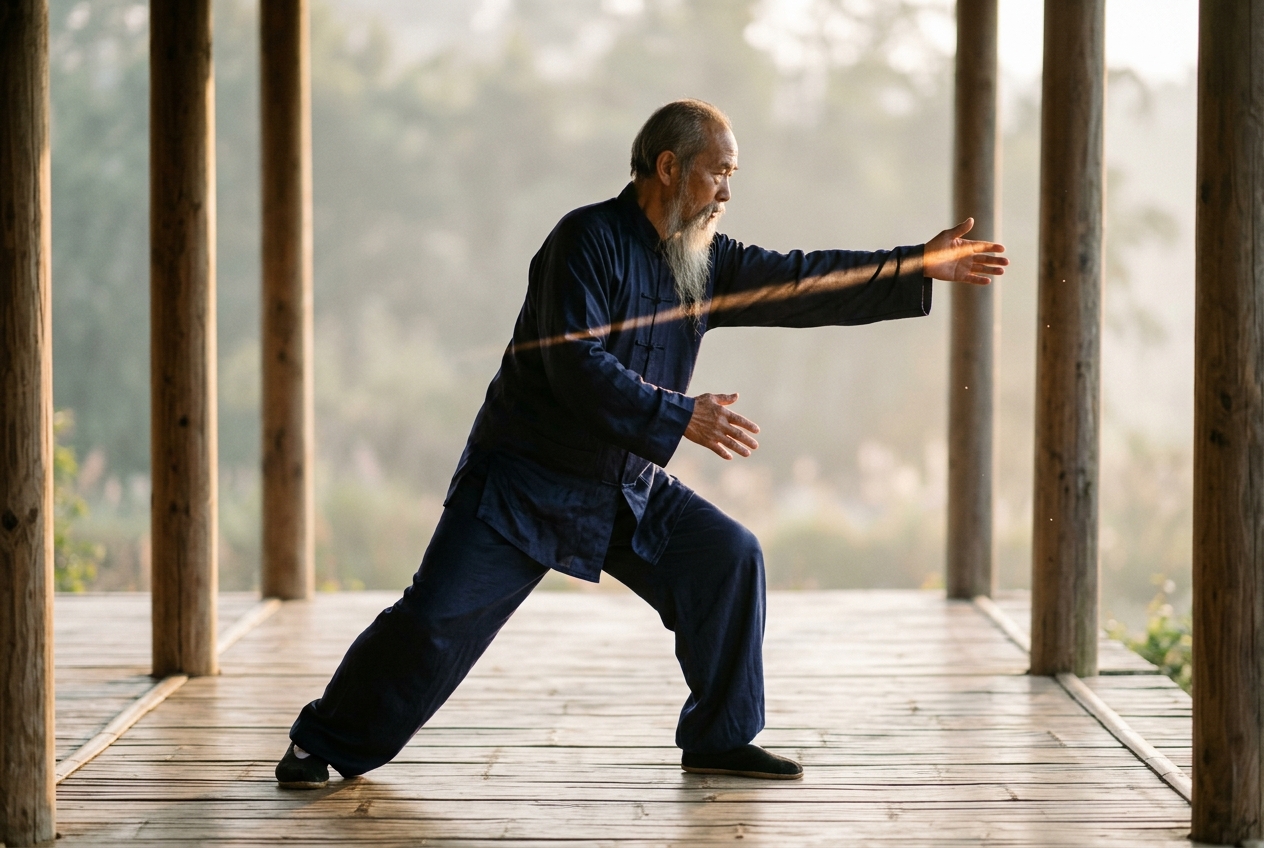
This systemic circulation is temporally regulated by the Zi Wu Liu Zhu, historically known as the Horary Organ Clock. The classical model divides the twenty-four-hour solar day into twelve two-hour energetic windows (Shichen), during which metabolic priority and channel perfusion peak within a specific organ-meridian complex:
- Lung Channel of Hand Taiyin (3:00 AM – 5:00 AM, Yin Metal): Initiates the circadian cycle within the thoracic cavity, coordinating oxygen uptake, cellular respiration, and the distribution of defensive energy (Wei Qi) to the skin and superficial fascia.
- Large Intestine Channel of Hand Yangming (5:00 AM – 7:00 AM, Yang Metal): Travels from the index finger up the lateral anterior arm to the face and colon, governing somatic elimination, bowel motility, and mucosal boundary integrity.
- Stomach Channel of Foot Yangming (7:00 AM – 9:00 AM, Yang Earth): Descends from beneath the eye down the throat, anterior trunk, quadriceps, and anterior tibialis to the second toe, mediating enzymatic breakdown, nutrient assimilation, and leg biomechanics.
- Spleen Channel of Foot Taiyin (9:00 AM – 11:00 AM, Yin Earth): Ascends from the medial aspect of the big toe along the inner calf and thigh into the spleen, pancreas, and diaphragm, governing fluid transformation and muscular tone.
- Heart Channel of Hand Shaoyin (11:00 AM – 1:00 PM, Yin Fire): Emerges from the axilla and runs down the anteromedial aspect of the arm to the tip of the little finger, governing systemic hemodynamics, arterial elasticity, and mental calm (Shen).
- Small Intestine Channel of Hand Taiyang (1:00 PM – 3:00 PM, Yang Fire): Ascends from the ulnar border of the little finger across the scapula to the zygomatic region of the cheek, governing micro-nutrient sorting and postural stability of the upper back.
- Urinary Bladder Channel of Foot Taiyang (3:00 PM – 5:00 PM, Yang Water): The longest channel in the body, originating at the inner eye canthus, traveling over the cranium, descending in two bilateral columns down the erector spinae and posterior legs to the pinky toe, regulating fluid filtration, autonomic tone, and the posterior myofascial chain.
- Kidney Channel of Foot Shaoyin (5:00 PM – 7:00 PM, Yin Water): Rises from the sole of the foot (Yongquan, K1) up the medial ankle and anterior midline of the trunk to the clavicle, anchoring endocrine equilibrium, adrenal function, and bone density.
- Pericardium Channel of Hand Jueyin (7:00 PM – 9:00 PM, Yin Fire): Traverses the center of the inner arm from the pectoralis into the middle finger, modulating microcirculation, pericardial lubrication, and cardiac autonomic regulation.
- Sanjiao / Triple Burner Channel of Hand Shaoyang (9:00 PM – 11:00 PM, Yang Fire): Extends from the ring finger up the posterior arm, over the shoulder and ear, coordinating thermoregulation, interstitial fluid distribution, and lymphatic drainage across the three body cavities.
- Gallbladder Channel of Foot Shaoyang (11:00 PM – 1:00 AM, Yang Wood): Weaves across the lateral skull, flanks, hips, and outer legs to the fourth toe, governing lateral fascial stability, neuro-motor decisiveness, and cellular detoxification.
- Liver Channel of Foot Jueyin (1:00 AM – 3:00 AM, Yin Wood): Ascends the medial dorsum of the foot, inside of the knee, and inguinal crease into the hypochondrium, regulating bile synthesis, hepatic blood storage, and ligamentous resilience, before looping back to the Lungs to renew the cycle.
Step-by-Step Practice Guide: The Twelve-Channel Mobilization Protocol
This progressive sequence coordinates diaphragmatic respiration, micro-articular spiraling, and conscious somatic intention (Yi) to stretch, compress, and mechanically hydrate the twelve primary longitudinal pathways. Practice in a quiet space with loose clothing and bare feet or flat shoes.
Phase 1: Structural Setup (Wuji Alignment)
- Foot Foundation: Place your feet parallel, hip-to-shoulder width apart. Distribute your body weight evenly across the tripod of each foot: the base of the big toe, the base of the little toe, and the center of the calcaneus (heel).
- Pelvic & Spinal Unwinding: Slightly tuck the tailbone by relaxing the inguinal creases (Kua), allowing the lumbar spine to gently flatten. Suspend the vertex of your head (Baihui) as if suspended from above by a silk cord, gently retracting the chin to decompress the cervical vertebrae.
- Resting the Tongue: Place the tip of your tongue against the hard palate behind your upper incisors. This anatomical bridge unites the Conception (Ren) and Governing (Du) vessels, reducing salivary dryness and calming the trigeminal nerve.
Phase 2: Opening the Upper Limb Pathways (Hand Yin & Hand Yang)
Targets: Lung, Pericardium, Heart (palmar surface); Large Intestine, Triple Burner, Small Intestine (dorsal surface). 1. Inhale (4 Seconds): Slowly raise your arms in front of you to shoulder height. As your arms rise, externally rotate your shoulders and forearms so your palms rotate upward toward the ceiling, fingers gently spreading. Feel an expansive stretch across your pectoralis major and along the inner seam of your bicep and radial forearm toward your thumb (Lung channel). 2. Exhale (6 Seconds): Push your palms forward while internally rotating your wrists so that your thumbs turn downward and outward, pressing through the heels of your hands. Extend through the index finger (Large Intestine) and little finger (Heart and Small Intestine), dropping your shoulder blades down your ribcage. 3. Micro-Articular Spiral: As you push, perform a gentle corkscrew rotation through the elbows and wrists. Imagine wringing out a damp towel along the myofascial sleeves of your arms. 4. Repetitions: 6 smooth cycles.
Phase 3: Unfolding the Sagittal and Anterior Pathways (Foot Yang & Foot Yin)
Targets: Stomach, Spleen, Urinary Bladder, Kidney. 1. Inhale: Sweep both arms out to the sides and overhead in a wide circle. Gently arch the upper thoracic spine without compressing the lower back, opening the anterior throat, sternum, and stomach line running down the abdominal rectus and anterior thighs. 2. Exhale: Hinge smoothly from the hips (Kua), letting the head and arms cascade toward the floor in a relaxed forward fold. Keep the knees slightly bent. Feel the continuous fascial stretch unraveling along the posterior chain: calves, hamstrings, gluteals, and the dual columns of the erector spinae (Urinary Bladder channel). 3. Inhale (The Medial Roll-Up): Press down into the bubbling spring point (Yongquan, K1) in the center of your soles. Slowly uncurl the spine vertebra by vertebra, consciously imagining drawing cool spring water up the inner seam of your shins, medial knees, and adductors (Kidney, Spleen, and Liver channels) back into your lower abdomen (Dan Tian). 4. Repetitions: 6 rhythmic cycles.
Phase 4: Lateral Rotational Cleansing (Shaoyang Pathways)
Targets: Gallbladder, Sanjiao / Triple Burner. 1. Stance: Widen your feet to 1.5 times shoulder width. 2. Movement: Inhale as you raise your left arm overhead while the right hand rests behind your sacrum. Exhale and gently crescent-bend the torso to the right, spiraling your gaze upward beneath your left armpit. 3. Somatic Focus: Feel the lateral ribs, intercostal muscles, iliotibial band, and outer peroneals lengthen (Gallbladder channel). Hold for two deep diaphragmatic breaths, expanding the lateral ribs on the inhale and softening deeper into the lateral sheath on the exhale. 4. Switch: Inhale smoothly to center, switch arm positions, and repeat on the opposite side. 5. Repetitions: 4 cycles per side.
Common Beginner Mistakes & Precise Adjustments
- Mistake 1: Locking the Knees and Over-arching the Lower Back.
- Correction: When bending or standing, maintain a soft hydraulic micro-bend in the knees. Let the pelvis act as a hanging plumb line; never force the lumbar spine into excessive lordosis.
- Mistake 2: Thoracic Hyper-Ventilation (Chest Breathing).
- Correction: If your collarbones rise on the inhalation, you are activating sympathetic fight-or-flight mechanisms. Direct your breath into the lateral and lower lobes of the lungs so your lower ribs and belly expand three-dimensionally like an inflating sphere.
- Mistake 3: Muscular Straining (Li) instead of Intentional Guidance (Yi).
- Correction: Avoid tensing your muscles into rigid contractions. Move with 70% of your maximum physical effort; allow internal pressure, fascial elasticity, and micro-rotations to generate the movement.
Somatic Sensations to Monitor (Deqi Phenomena)
- Warmth: Indicates vasodilation and increased capillary microcirculation along cutaneous nerve pathways.
- Tingling / Buzzing: Represents neuro-fascial signaling and the discharge of interstitial electrical gradients.
- Heaviness or Fullness: Corresponds to increased hydraulic pressure within the extracellular matrix and lymphatic return.
- Spontaneous Sighing / Yawning: A reliable biological marker of the nervous system shifting into parasympathetic dominance.
The Body Science: Bridging Ancient Channels and Modern Anatomy
For decades, modern medical science struggled to map the Chinese meridian system onto standard gross anatomy because researchers were searching exclusively for discrete, hollow endothelial tubes resembling blood vessels. However, contemporary biomechanics, histology, and connective tissue research published in the NCBI PubMed biomedical database have revealed that the meridian system closely corresponds to the living network of the human fascial system.
1. Interstitial Fascial Planes & Collagen Cleavage Lines
Pioneering research led by neurobiologist Dr. Helene Langevin and colleagues has demonstrated that acupuncture meridians and their associated acupoints exhibit an approximate 80% anatomical concordance with the intermuscular and intramuscular connective tissue cleavage planes of human fascia. When a practitioner performs Daoyin movements involving micro-rotations and gentle tensile loading, they induce mechanical shear stress across multi-layered fascial sheets. This mechanical tension stimulates fibroblasts, remodeling the extracellular matrix, reducing tissue stiffness, and promoting free gliding between muscle compartments.
2. Piezoelectricity and Liquid Crystalline Matrix Dynamics
Fascia is comprised predominantly of type I and type III collagen fibrils arranged in a highly organized, liquid crystalline matrix. Under physical deformation—such as the slow, spiraling torques practiced in classical Qigong—collagen produces piezoelectric currents and streaming potentials. These minute electrical fields polarize the surrounding interstitial fluid, transforming the connective tissue into a low-electrical-impedance bio-semiconductor network. This explains why functional meridians consistently register lower electrical resistance and higher galvanic skin conductivity compared to adjacent non-meridian cutaneous tissue.
3. Neurovascular Bundles & Perivascular Sheaths
Every primary meridian corresponds closely with major peripheral nerve pathways and neurovascular bundles. For example, the Pericardium channel tracks the median nerve and the brachial artery; the Stomach channel parallels the anterior tibial neurovascular bundle; and the Urinary Bladder channel correlates with the sciatic nerve and the spinal nerve branches emerging from the dorsal rami. Mobilizing these channels mobilizes the neural sheaths, reducing nerve entrapment, improving axonal transport, and stimulating perivascular sympathetic and parasympathetic fibers.
4. Diaphragmatic Dynamics, Intra-Abdominal Pressure, and Vagal Tone
Daoyin breathwork utilizes deep, rhythmic descent of the thoracic diaphragm. Each inhalation increases intra-abdominal pressure (IAP), gently compressing the visceral organs against the pelvic floor and spinal column, while each exhalation releases this pressure, creating a visceral pump that accelerates venous return and lymphatic drainage through the thoracic duct. This cyclic pressure oscillation stimulates the baroreceptors and the wandering fibers of the vagus nerve (Cranial Nerve X), instantly upregulating parasympathetic activity, elevating heart rate variability (HRV), and downregulating systemic inflammatory cytokines.
Diagnostic Considerations, Stagnation Patterns, and Safety Precautions
In clinical practice, disharmony within the twelve primary channels manifests in predictable somatic and visceral patterns. Understanding these markers allows practitioners to tailor their movement practice while observing necessary medical cautions.
Common Channel Stagnation Patterns
- Liver & Gallbladder Channel Stagnation (Qi Zhi): Manifests as chronic tension along the trapezius muscles, tension headaches around the temples, tightness in the lateral ribcage (hypochondrium), frequent sighing, jaw clenching (bruxism), and emotional irritability.
- Spleen & Stomach Dampness Stagnation: Manifests as heavy, leaden sensations in the limbs, digestive bloating after eating, water retention around the ankles, brain fog, and myofascial tenderness along the medial tibia and quadriceps.
- Urinary Bladder & Kidney Channel Exhaustion: Manifests as chronic aching in the lumbosacral region, cold sensations in the knees and soles of the feet, postural instability, and fatigue peaking between 3:00 PM and 7:00 PM.
- Lung & Large Intestine Channel Weakness: Manifests as shallow clavicular breathing, rounded upper back and shoulders, chronic sinus congestion, cutaneous dryness, and reduced resistance to environmental pathogens.
Clinical Contraindications & Practice Adaptations
- Acute Inflammation & Structural Injury: Do not forcefully stretch or rotate joints experiencing acute sprains, tears, or inflammatory flare-ups (such as acute gout or rheumatoid arthritis crises). Practice gentle visualization and distant peripheral joint mobilization instead.
- Severe Hypertension & Cardiovascular Fragility: Avoid sudden upward-reaching movements or holding the breath (Kumbhaka) after inhalation, which can spike arterial blood pressure. Keep movements smooth, grounded, and focused on downward exhalations toward the feet.
- Pregnancy Precautions: Pregnant individuals must avoid aggressive twisting of the abdominal region and avoid strong downward-draining movements or intense point stimulation associated with points like Hegu (LI4), Sanyinjiao (SP6), and Jianjing (GB21). Focus on gentle, open-chest posture and rhythmic lower-leg circulation.
- Herniated Discs & Spinal Pathologies: Avoid deep forward folding or uncontrolled spinal flexion. Substitute sagittal spinal bending with neutral-spine hip hinging and micro-movements of the extremities.
Classical Lineage: The Historical Evolution of Channel Daoyin
The systematic practice of tracing and clearing the twelve primary channels is the product of over two millennia of empirical clinical observation and somatic refinement.
The earliest visual records were unearthed in 1973 at the Mawangdui archaeological site in Changsha, Hunan province. The famous Daoyin Tu (Daoyin Illustrations), painted on silk and dating to 168 BCE during the Western Han Dynasty, depicts 44 individual figures of various ages and genders engaging in specific dynamic postures, animal-mimicry stretches, and breathing exercises designed to alleviate specific organ ailments and clear channel blockages.
During the fourth century CE, the prominent Daoist scholar and alchemist Ge Hong (283–343 CE) systematized internal energy cultivation in his masterwork Baopuzi, emphasizing that the preservation of life requires unobstructed channel permeability achieved through the harmonious integration of movement (Dao) and breath (Yin). Later, during the Tang Dynasty, the legendary physician Sun Simiao (581–682 CE), often revered as China's "King of Medicine," integrated channel-specific Daoyin sequences into his monumental medical encyclopedia Qianjin Yaofang ("Essential Prescriptions Worth a Thousand Pieces of Gold"), prescribing targeted meridian gymnastics alongside herbal pharmacopeia to treat chronic musculoskeletal and metabolic disorders.
Today, this empirical heritage has evolved from monastic hermits and court physicians into contemporary, evidence-based integrative health protocols championed by organizations such as the National Qigong Association and documented in global medical frameworks for traditional and complementary medicine.
Today’s Practice Commitment
Tomorrow morning, before you pour your first cup of coffee or check your digital devices, commit to just six minutes of this channel-opening practice:
- Stand in Wuji alignment for one minute, anchoring your breath two inches below your navel.
- Complete three repetitions of the Upper Limb Spiral (Phase 2), opening the Lung and Large Intestine channels to awaken your upper body and respiratory system.
- Complete three gentle repetitions of the Sagittal Spinal Wave (Phase 3), uncurling the Bladder and Kidney channels to mobilize your spine and clear morning stiffness.
- Conclude by placing both palms flat over your lower abdomen, taking three deep abdominal breaths, and observing the immediate shift in your physical balance, mental clarity, and internal warmth.
Notice how your body feels across the rest of the morning: the subtle lightness in your step, the ease in your breathing, and the grounded calm in your mind are the direct, natural results of an open, unobstructed living circuit.