Hui Guang Fan Zhao Turning the Light Inward: Ocular Convergence, Pineal Phototransduction, and Shen Illumination in Classical Daoist Neidan
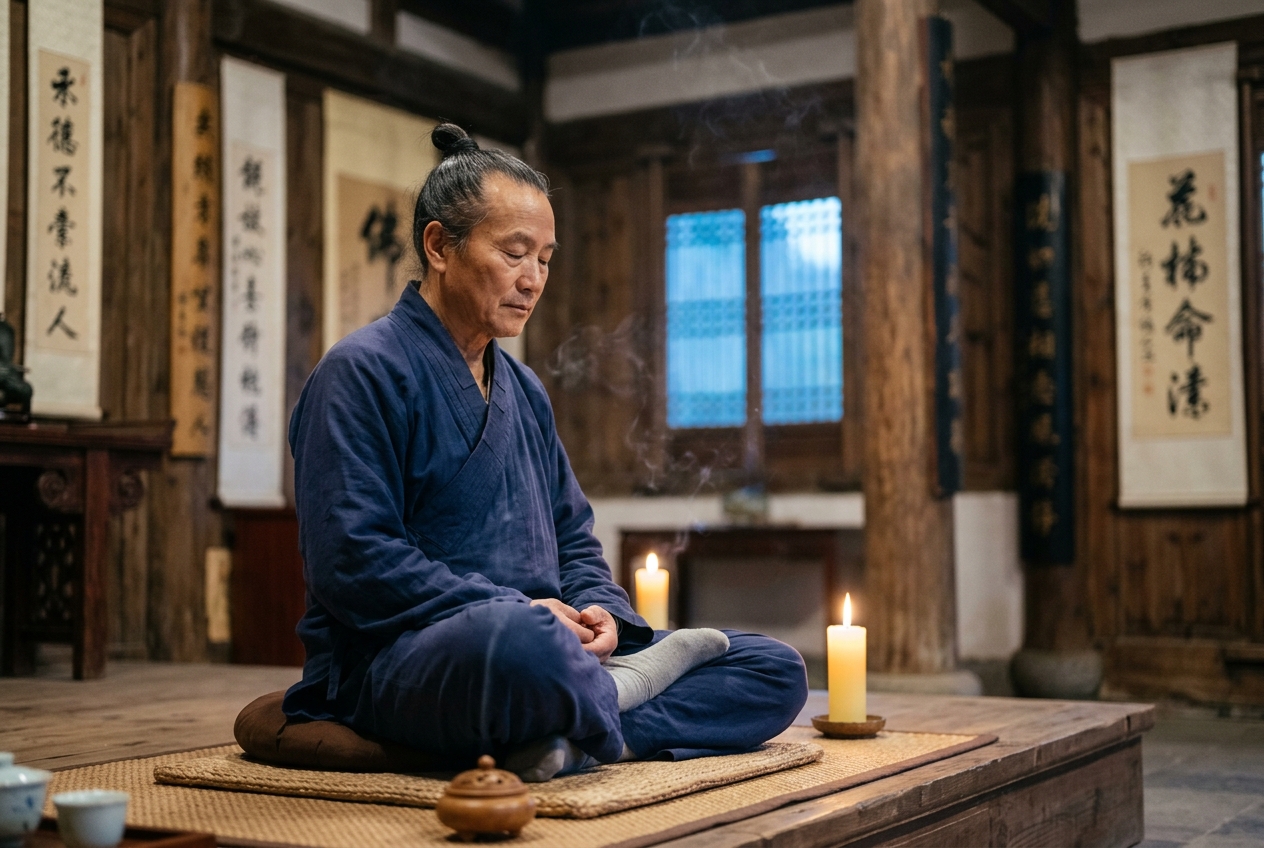
Once the physical gaze is anchored, the practitioner coordinates this resting vision with slow, rhythmic breathing into the lower belly, about two to three inches below the navel—an energy center known as the Lower Dantian (丹田, or "Elixir Field"). In doing so, the mind’s conscious awareness, termed Shen (神, Spirit or Mind), ceases its frantic outward projection and merges with Jing (精, physical essence and vitality) and Qi (氣, bioelectric breath-energy). The internal "light"—which practitioners experience subjectively as subtle warmth, a steady internal glow, or a luminous spatial clarity inside the cranial vault and heart center—begins to circulate systematically through the upper and middle compartments of the energetic body rather than leaking into the environment.
Step-by-Step Practice Guide: The Classical Methodology
The following systematic protocol translates the classical instructions of the Taiyi Jinhua Zongzhi into an actionable, repeatable practice that can be safely cultivated at home without esoteric ambiguity.
1. Somatic Setup and Postural Architecture
- The Seat: Sit upright upon the forward third of a firm cushion or a stable chair. If on a chair, plant both feet flat on the floor, shoulder-width apart, knees aligned directly over the ankles. If cross-legged, ensure your hips are elevated slightly above your knees to preserve the natural lumbar lordosis.
- The Central Axis (Zhong Mai): Lengthen the spine upward from the perineum to the crown of the head (Baihui). Gently tuck the chin by a fraction of an inch to open the suboccipital space at the base of the skull.
- The Tongue Bridge: Rest the tip of your tongue lightly against the upper palate just behind the front teeth, bridging the Conception (Ren) and Governing (Du) energetic channels.
- The Hands: Rest your hands on your lap in the Taiji Mudra—the right hand cupping the left, with both thumb tips lightly touching to form a closed energetic circuit.
2. The Ocular Gateway: Anchoring on Bi Duan (Nose Tip)
- The Pearl Curtain Eyelids: Do not close your eyes entirely; closing them fully invites mental torpor, dream-imagery, and drowsiness. Do not leave them wide open; that invites sensory distraction. Lower the upper lids until they resemble a fine silk curtain hung halfway down a window.
- Micro-Convergence: Cast your soft, unfocused gaze downward along the ridge of the nose toward its very tip (Bi Duan 鼻端).
- Avoiding Eye Strain: Never cross the eyes aggressively or force the physical musculature. Think of the nose tip merely as a directional compass or sighting mark. Once the gaze aligns with the nose tip, let the physical ocular muscles completely relax. The phrase in the classical texts is: "Look at the nose tip with the eyes, but look into the heart with the mind."
3. The Inward Reversal: Projecting into the Niwan Palace
- The 180-Degree Reflection: From the vantage point of the nose tip, invert your conscious visual vector inward. Trace a gentle diagonal line straight back through the bridge of the nose into the center of the cranial vault—an anatomical zone corresponding to the thalamus and pineal gland, celebrated in Daoism as the Niwan Gong (泥丸宮, the "Muddy Pellet" or Upper Dantian).
- Resting the Shen: Allow your attention to rest in this internal space without straining to "see" anything. Experience the internal cranium as a spacious, luminous chamber. When thoughts arise, do not fight them; simply reflect them like a mirror without retaining their images.
4. Synchronizing the Breath (Tiao Xi)
- Auditory Attunement: Draw the hearing inward (Ting Xi 聽息). Listen to the subtle sound of your breath until the breathing becomes so soft, uniform, and fine that it produces no audible friction against the nostrils.
- Diaphragmatic Respiration: Inhale smoothly through the nose, feeling the breath descend through the throat, past the chest, and deep into the lower abdomen (Qihai).
- The Circulation Cycle: 1. On the Inhalation: Sense a cool, clarifying stream of awareness gathering at the nose tip and drawing backward into the Upper Dantian (Niwan). 2. On the Exhalation: Direct this gathered luminous warmth downward through the throat and chest into the Middle Dantian (the heart center or Huangting, the Yellow Court) and resting in the lower belly. 3. The light descends to nourish the bodily essence (Jing), and the essence rises to fuel the mental luminosity (Shen).
5. Diagnosing and Correcting Meditative Deviations
Classical manuals emphasize that two primary obstacles derail internal light circulation:
| Obstacle | Classical State | Somatic Indicators | Classical Correction |
|---|---|---|---|
| Mental Torpor / Dullness | Hun Chen (昏沉) | Head nodding, heaviness in the eyelids, drifting into reverie or sleep, foggy sluggishness. | Gently open the eyes slightly wider, lift the sternum, direct the gaze slightly upward toward the brow center (Yintang), and take three crisp, slightly deeper inhalations through the nose to restore alertness. |
| Scattered Agitation | San Luan (散亂) | Rapid heartbeat, racing thoughts, restlessness, physical fidgeting, ocular tension. | Drop your conscious focus entirely down to the lower abdomen (Dantian) or the soles of the feet (Yongquan). Soften the exhalation, lengthening it so the out-breath is twice as long as the in-breath. |
Why It Works: The Neurobiology and Somatic Science
While classical Daoist scholars articulated this practice in the poetic language of alchemy—describing the fusion of Fire (Li) and Water (Kan)—modern neurophysiology, autonomics, and cognitive neuroscience describe identical mechanisms through cellular and neural pathways.
1. Ocular-Cranial Innervation and the Oculocardiac Reflex
The human visual system consumes an enormous percentage of central nervous system processing power. When the eyes continuously jump across a visual field via rapid saccades, the reticular activating system remains in high-alert sympathetic tone. By fixing the eyes into a relaxed, downward convergence on Bi Duan, the practitioner activates the oculomotor (Cranial Nerve III) and trigeminal (Cranial Nerve V) pathways.
As documented in peer-reviewed clinical literature indexed on NCBI PubMed, gentle ocular pressure and sustained, relaxed convergence can trigger the oculocardiac reflex, stimulating the vagus nerve (Cranial Nerve X). This instantly lowers heart rate, increases heart rate variability (HRV), and enhances respiratory sinus arrhythmia, shifting systemic autonomic tone from sympathetic fight-or-flight into deep parasympathetic recuperation.
2. Down-Regulation of the Default Mode Network (DMN)
The constant mental chatter and cyclical anxiety that plague modern individuals are neurologically mediated by the Default Mode Network (DMN)—a constellation of interconnected brain regions including the medial prefrontal cortex, posterior cingulate cortex, and inferior parietal lobule. Studies published in Frontiers in Human Neuroscience demonstrate that inward-focused attention and conscious interoceptive monitoring drastically dampen hyperactive DMN nodes.
When the practitioner practices Hui Guang ("returning the light"), visual inputs from the striate cortex are decoupled from external narrative processing. Instead of constructing endless past-and-future mental movies, cortical electrical rhythms shift from high-frequency beta waves into synchronized alpha (8–12 Hz) and deep theta (4–8 Hz) oscillations. The subjective feeling is one of profound mental stillness, expansive internal space, and enhanced emotional resilience.
3. The Epithalamic-Pineal Corridor
The Daoist concept of the Niwan Palace aligns with the epithalamic-pineal complex at the geographic center of the human brain. The pineal gland is not merely a photosensitive endocrine organ governing circadian rhythms through melatonin secretion; as highlighted in integrative neurobiology research supported by the World Health Organization Traditional Medicine initiatives, deep meditation modulates the hypothalamic-pituitary-adrenal (HPA) axis. By dampening cortisol production and elevating neuroprotective indoleamines, conscious ocular reflection creates the neurochemical substrate for restorative homeostasis and sustained somatic repair.
4. Interoception and Fascial Tensegrity
By anchoring the internal gaze deep within the body, practitioners train the insular cortex—the primary brain structure responsible for interoception, or the conscious sensing of internal physiological states. As recognized by contemporary biomechanical frameworks and the National Qigong Association, sustained diaphragmatic breathing combined with relaxed axial alignment releases tension along the deep front fascial line (connecting the pelvic floor, psoas, respiratory diaphragm, pericardium, and suboccipital muscles). This structural decompression relieves intra-abdominal congestion and restores smooth venous return to the heart.
Classical Lineage & Historical Context
The method of Hui Guang Fan Zhao sits at the very heart of the Quanzhen (全真, Complete Perfection) school of Daoism, which emerged during the Jin and Yuan dynasties under the inspiration of ancestral masters such as Wang Chongyang and the legendary Tang Dynasty immortal Lü Dongbin (呂洞賓). Unlike earlier liturgical or external laboratory alchemical systems (Waidan) that sought immortality through consuming cinnabar and metallic elixirs, the Quanzhen and Longmen (Dragon Gate) lineages revolutionized Daoist cultivation by asserting that the true cauldron (Lu) and furnace (Ding) are the human body, mind, and breath.
The seminal manual Taiyi Jinhua Zongzhi was transmitted across centuries through esoteric master-disciple lineages before being printed in woodblock editions in the eighteenth century. In 1929, the German sinologist Richard Wilhelm translated the text, bringing it to the attention of analytical psychologist Carl Gustav Jung. As explored in scholarly archives on Stanford Encyclopedia of Philosophy: Daoism, Jung was captivated by the text’s mandala-like symbolism and described the "Circulation of the Light" as a profound somatic archetype of psychological individuation—the integration of the conscious ego with the deeper, unconscious Self.
However, while Western psychoanalysis viewed the text primarily as an allegory for psychological integration, traditional masters emphasize that the Taiyi Jinhua Zongzhi is first and foremost an embodied, energetic practice. Later translations by scholars like Thomas Cleary restored the manual’s original somatic integrity, underscoring that mental clarity (Shen) cannot be detached from physiological vitality (Jing) and the breath (Qi). The practice remains a living bridge connecting classical Daoist meditation, internal martial arts (Neijiaquan), and modern somatic science.
Today’s Practice Commitment: The 10-Minute Morning Reset
To experience the transformative physiological and cognitive benefits of Hui Guang Fan Zhao, theoretical knowledge must be transformed into experiential daily practice.
Your Action Protocol: Set a gentle timer for 10 minutes tomorrow morning before looking at your phone, checking email, or drinking coffee.
- Sit upright with your spine lengthened, hands cupped in your lap, and the tip of your tongue touching your upper palate.
- Lower your eyelids until they are nine-tenths closed. Rest your soft visual focus on the tip of your nose (Bi Duan).
- Turn the internal vector of your gaze backward into the center of your head (Niwan), allowing the eyes to become completely soft and relaxed.
- Inhale smoothly into your lower abdomen; exhale and let the internal warmth settle deep into your heart center and belly.
- Whenever your mind drifts to your daily to-do list, simply acknowledge the thought, relax your eyebrows, and return your awareness to the quiet light inside the central core of your body.
After the timer sounds, keep your eyes closed for thirty seconds. Rub the palms of your hands together until they become pleasantly warm, place the warm centers of your palms over your closed eyes, and absorb the soothing heat into your ocular orbits before opening your eyes to meet the day. Notice the remarkable clarity in your visual perception, the absence of neck tension, and the centered, unshakeable calm that accompanies you throughout the morning.