Tongue Diagnosis (She Zhen) Meridian Diagnostics: Governing Lingual Topography, Sublingual Venous Dynamics, and Visceral Coating Differentiation in Traditional Chinese Medicine
Every morning, millions of people perform an instinctive, unthinking ritual: standing before the bathroom mirror, toothbrush in hand, inspecting their reflection in the harsh fluorescent light. You open your mouth and notice something unusual on your tongue. Perhaps it is a thick, pasty white coating that feels sticky even after brushing; perhaps the edges are visibly scalloped, indented with the corrugated impressions of your own molars; or perhaps the tip is an angry, bright crimson against a surprisingly pale body. Alongside this visual evidence, you register how you feel: heavy-limbed, sluggish, plagued by a vague mental fog that your double espresso fails to penetrate, or carrying a simmering irritability and a tight knot behind your sternum.
In contemporary Western biomedicine, the tongue is frequently reduced to a muscular organ of mastication, deglutition, and gustatory sensation, examined cursorily for acute fungal overgrowth or localized ulceration. Yet in Traditional Chinese Medicine (TCM), this four-inch muscular landscape is understood as the body’s most immediate, objective, and non-invasive diagnostic monitor. The tongue is the only internal visceral tissue continuously visible from the exterior. Long before a functional imbalance hardens into structural pathology or registers on standard blood assays, the lingual mucosa, microvascular bed, and surface biofilm alter their characteristics in direct response to systemic physiological shifts.
What you are looking at in the morning mirror is not merely an oral hygiene issue; it is a high-resolution topographical map of your autonomic nervous balance, microcirculatory efficiency, metabolic fire, and fluid homeostasis.
2. What This Organ System Does: The Epistemology and Topography of She Zhen
The practice of lingual diagnostics, known classically as She Zhen (舌诊), represents one of the most sophisticated observational methodologies in East Asian medicine. Its clinical rationale rests on the anatomical and energetic reality that the tongue is intimately interconnected with the entire network of twelve primary channels (Jing Mai) and visceral organ systems (Zang-Fu).
Classical Epistemological Foundations
The theoretical architecture of tongue inspection was first systematized in the foundational canon Huangdi Neijing (The Yellow Emperor's Inner Canon, c. 1st century BCE). The Ling Shu (Spiritual Pivot) established that the Heart channel terminates in the tongue root, the Spleen channel spreads across its inferior surface, the Kidney channel terminates at its base, and the Liver channel encircles its muscular attachments. Consequently, lingual tissue serves as the direct physical emissary of visceral vitality (Shen), vital energy (Qi), Blood (Xue), and Body Fluids (Jin-Ye).
This diagnostic framework underwent profound clinical evolution through successive epidemiological epochs. In the 3rd century CE, Zhang Zhongjing composed the Shanghan Lun (Treatise on Cold Damage Diseases), utilizing the tongue to track the interior penetration of exterior climatic pathogens through six channel conformations. Centures later, during the epidemic crises of the Qing Dynasty, the Wenbing Xue (Warm Disease Theory) school, spearheaded by master clinicians Ye Tianshi and Wu Jutong, elevated She Zhen to its zenith. In Wenbing diagnostics, the tongue coating was demonstrated to reflect the invasion of pathogenic Heat across four discrete physiological depths: Defense (Wei), Qi (Qi), Nutrient-Structure (Ying), and Blood (Xue).
Canonical Topographic Mapping
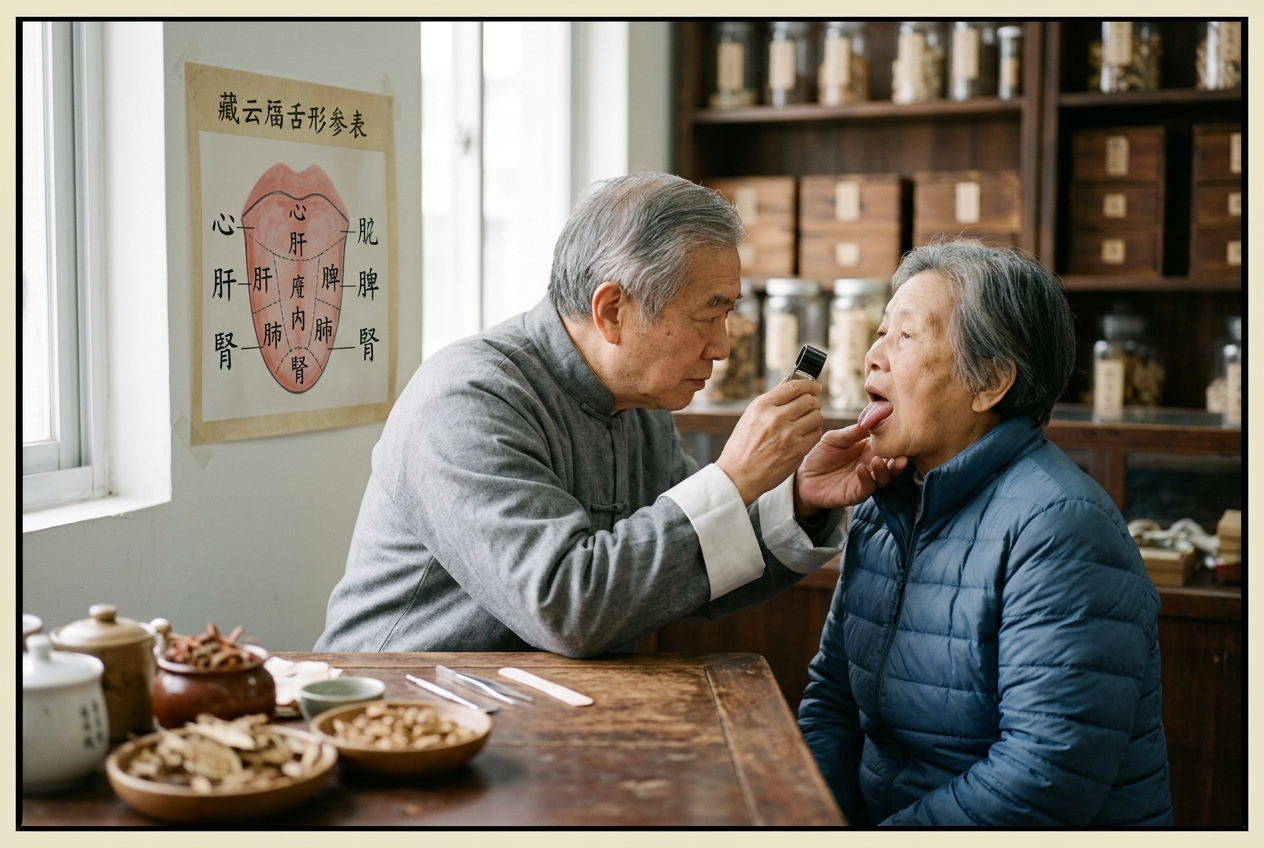
In classical lingual topography, the tongue represents a somatic microcosm divided into the Three Burning Spaces (San Jiao):
- The Tongue Tip (She Jian) — Upper Jiao: Reflects the Heart (Xin) and Lungs (Fei). Because the Heart governs the Blood and houses the conscious mind (Shen), the vascularity of the tip mirrors emotional equilibrium, cerebral circulation, and respiratory vitality.
- The Central Dorsum (She Zhong) — Middle Jiao: Governed by the Spleen (Pi) and Stomach (Wei). This zone reveals the metabolic efficiency of digestion, nutrient absorption, and the production of fundamental post-natal Qi and Blood.
- The Lateral Margins (She Bian): Correlate with the Liver (Gan) and Gallbladder (Dan). These borders reflect hepatic microcirculation, neuroendocrine tension, and the smooth flow of somatic energy.
- The Lingual Root (She Gen) — Lower Jiao: Governed by the Kidneys (Shen), Urinary Bladder (Pangguang), Large Intestine (Dachang), and Small Intestine (Xiaochang). This posterior region reflects deep hereditary vitality (Jing), reproductive vigor, hormonal reserve, and lower bowel ecology.
Evaluating the Tongue Body Substance (She Zhi)
When an experienced practitioner evaluates the lingual canvas, they divide the inspection into two fundamental categories: the Tongue Body (She Zhi), which indicates the chronic, structural state of the organs, Blood, and Qi; and the Tongue Coating (She Tai), which reveals the acute progression of pathogenic influences, digestive fire, and fluid metabolism.
1. Tongue Body Color
- Pale Red (Dan Hong): The clinical gold standard. Reflects balanced microcirculation, robust Heart Blood, and harmonious Stomach Qi.
- Pale / Whitish (Dan Bai): Indicates profound Qi Deficiency or Blood Deficiency (hypoperfusion, microcytic anemia, or diminished systemic metabolism/Yang deficiency).
- Deep Red / Crimson (Hong / Jiang): Indicates internal Heat or hyper-metabolic systemic inflammation. If bright red, it signifies full pathogenic Heat; if deep crimson and stripped of coating, it indicates Yin Deficiency (loss of constitutional cooling fluids).
- Cyanotic Purple (Zi): The definitive hallmark of Blood Stasis (Xue Yu). A dark, dusky reddish-purple denotes warm-stagnation; a bluish-purple signifies severe interior cold-induced vasoconstriction and ischemic hypoperfusion.
2. Tongue Body Morphology and Movement Dynamics
- Swollen with Dental Impressions (Pang Da & Chi Hen): Lingual tissue expands due to interstitial fluid retention, reflecting Spleen Yang Deficiency and cellular metabolic incompetence. The tongue presses against the dental arches, creating scalloped lateral borders.
- Thin and Emaciated (Shou Xiao): If pale and thin, it reveals chronic Blood Deficiency; if red and thin, it demonstrates severe Yin exhaustion and systemic dehydration.
- Cracked and Fissured (Lie Wen): Deep central or cross-hatched fissures indicate long-standing dehydration of the organ matrices, chronic gastric mucosal atrophy, or profound constitutional Yin exhaustion.
- Stiff and Rigid (She Ying): Difficulty articulating or protruding the tongue signals internal Wind, acute neurological impairment, or severe microvascular compromise in the cerebral circulation.
- Deviated (Wai Xie): A tongue that veers to one side upon protrusion is an urgent classical warning sign of cerebral ischemia or imminent cerebrovascular accident (stroke / Zhong Feng).
Evaluating Tongue Coating and Moss (She Tai)
The lingual coating is generated by the physiological evaporation of residual fluids ascending from the Stomach's metabolic activity. Modern microbiological research reveals that She Tai corresponds precisely to the oral microbiome, desquamated epithelial cells, and salivary proteinaceous matrices.
- Thickness: A thin coating through which the underlying body remains visible is physiological. A thick coating that completely obscures the lingual mucosa signifies internal accumulation of pathogenic Dampness, Phlegm, food retention, or severe endotoxemia.
- Coloration: A thin white coating is normal or indicates exterior Cold. As internal inflammation, metabolic heat, or bacterial proliferation escalates, the coating shifts to cream, then bright yellow, and finally deep burnt-yellow or dry black, marking critical stages of systemic febrile toxicity.
- Moisture and Texture: A slippery, wet tongue indicates water accumulation and poor lymphatic clearance (Shui Shi). A bone-dry, sandpaper-like texture indicates fluid depletion. A greasy, turbid moss (Ni Tai) resembles soft curd, pointing directly to intestinal dysbiosis, lipid metabolic disorders, and chronic phlegm-dampness.
- Adherence (Rooted vs. Rootless): A rooted coating (You Gen) appears to grow organically from the lingual papillae and cannot be easily scraped off, signaling intact Stomach Qi. A rootless coating (Wu Gen) floats atop the surface like peeling paint or curdled milk, warning of the near-exhaustion of visceral regenerative capacity.
Sublingual Collateral Inspection (She Xia Luo Mai)
When the patient lifts the tongue to the hard palate, the examiner evaluates the two sublingual veins flanking the lingual frenulum. In healthy individuals, these vessels are faintly visible, soft, and measure under 2.7 mm in diameter without tortuosity.
Contemporary studies published in NCBI / PubMed Central on Sublingual Microcirculation substantiate that sublingual collateral pathology correlates with systemic cardiovascular resistance, hemorheological viscosity, and endothelial dysfunction. Veins that are engorged, tortuous, nodular, or display dark purple, inky-black, or arborizing collateral branches serve as an unmistakable clinical signature of chronic Blood Stasis (Xue Yu), microvascular thrombosis, and systemic inflammatory congestion.
3. How You Can Feel It: Signs of Balance and Imbalance
The tongue does not change in isolation; its visual shifts are directly linked to everyday physical and cognitive sensations. By correlating your lingual presentation with your internal symptoms, you can identify imbalances across the major Zang-Fu networks:
+------------------------------------+---------------------------------------+---------------------------------------------+
| Lingual Presentation               | Predominant TCM Syndrome              | Accompanying Somatic & Mental Symptoms      |
+------------------------------------+---------------------------------------+---------------------------------------------+
| Pale, swollen, scalloped edges,    | Spleen Qi Deficiency with             | Severe post-prandial fatigue, brain fog,   |
| thick greasy white moss            | Phlegm-Damp Accumulation              | heavy limbs, loose stools, muscle weakness  |
+------------------------------------+---------------------------------------+---------------------------------------------+
| Dusky purple hues, distended dark  | Liver Qi Stagnation with              | Intercostal tightness, chronic irritability,|
| sublingual veins, taut red margins | Systemic Blood Stasis                 | tension headaches, menstrual dysmenorrhea   |
+------------------------------------+---------------------------------------+---------------------------------------------+
| Crimson tip, deep midline fissure, | Heart Fire Flaming &                  | Insomnia, vivid dreaming, palpitations,     |
| peeled or absent coating           | Stomach-Kidney Yin Depletion          | nocturnal anxiety, afternoon flushing, thirst|
+------------------------------------+---------------------------------------+---------------------------------------------+
| Pale wet body, deep tooth marks,   | Kidney Yang Deficiency with           | Lower back soreness, cold extremities,      |
| thick white moss at the root       | Fluid-Cold Congestion                 | frequent clear urination, deep exhaustion   |
+------------------------------------+---------------------------------------+---------------------------------------------+
| Fresh pale-red, supple structure,  | Harmonious Zang-Fu Equilibrium        | Clear mental acuity, steady physical energy,|
| thin rooted translucent white moss | (Balanced Qi, Blood, and Fluids)      | robust digestion, restorative deep sleep    |
+------------------------------------+---------------------------------------+---------------------------------------------+
Self-Assessment Protocol
Stand before a mirror under natural morning daylight (avoid artificial fluorescent or yellow tungsten lighting). Relax your facial musculature, open your mouth, and extend your tongue naturally without straining or curling the tip. Run through this four-step diagnostic checklist:
- Step 1: The Base Palette (Body Color) — Is your tongue pale like raw poultry, healthy pale-red, fiery crimson, or dusky purple?
- Step 2: The Structural Form (Morphology) — Do you see scalloped teeth marks along the margins? Is the tongue bloated and filling the mouth, or contracted and thin? Are there fissures?
- Step 3: The Landscape Coating (Moss) — Is the coating thin and translucent, or thick like heavy cream? Is the pigment white, yellow, or patchy and peeling?
- Step 4: The Vascular Underside (Sublinguals) — Roll the tongue tip up toward the roof of your mouth. Are the two veins under the tongue thin and pale blue, or are they distended, rope-like, and dark purple?
4. Qigong & Movement Practice: The Red Dragon Stirs the Sea (Chilong Jiao Hai)
To actively restore microvascular circulation, balance the autonomic nervous system, and harmonize digestive fluid metabolism, classical Daoist longevity medicine developed a targeted oral-lingual dynamic practice known as The Red Dragon Stirs the Sea (Chilong Jiao Hai, 赤龙搅海), paired with Swallowing the Jade Nectar (Lian Jin Hua Qi, 炼津化气).
Anatomical Setup and Posture
Sit upright on the front third of a firm chair, or stand in the Wuji natural stance with feet shoulder-width apart, knees unlocked, pelvis gently tucked, and the crown of your head (Baihui, GV-20) suspended as if by a silk thread. Relax the muscles of your neck, drop your shoulders, and soften your jaw. Rest your hands over your Lower Dantian (two inches below the navel).
Step-by-Step Movement Mechanics
- Clockwise Lingual Circumduction: Close your mouth gently without clenching your teeth. Extend your tongue into the space between your lips/cheeks and teeth (the buccal vestibule). Begin sweeping the tip of your tongue in a wide, firm, clockwise circle across the outer surface of your upper gums, down across the lower gums, and back up. Complete 36 smooth, unhurried revolutions. Coordinate this with slow, relaxed diaphragmatic breathing through the nose.
- Counter-Clockwise Circumduction: Reverse the vector. Sweep the tongue in a counter-clockwise direction along the outer tooth surfaces for 36 full revolutions. You will feel the salivary glands under your tongue (sublingual) and along your jaw (submandibular and parotid) activate, filling your oral cavity with thin, enzyme-rich saliva.
- Palatal Stimulation and Ocean Churning: Move the tongue inside the dental arch. Firmly sweep the rough surface of the hard palate from back to front 18 times, then gently tap the upper and lower molars together 36 times in a soft rhythm known classically as Kou Chi ("Knocking the Heavenly Teeth") to stimulate the bone matrices and Kidney meridian.
- Swallowing the Jade Nectar (Lian Jin): Do not swallow the accumulated saliva casually. Gather the fluid in your mouth, swish it vigorously through your teeth 36 times to aerate and energize it, and then divide the liquid into three equal portions. Swallow each portion intentionally in three distinct gulps. With each swallow, mentally track the warm liquid descending smoothly down your esophagus, past your solar plexus, and settling into the Lower Dantian.
Duration, Repetitions, and Somatic Shifts
- Duration: 5 to 7 minutes daily, preferably upon waking or during the mid-afternoon energy lull (3:00 PM – 5:00 PM).
- What to Look For: You should experience an immediate release of suboccipital and temporal muscular tension, a reduction in sympathetic nervous tone, a warming sensation in the epigastrium, and a moistening of a dry, scratchy throat. In TCM terms, this practice stimulates the Conception Vessel (Ren Mai), descends rebellious Stomach Qi, clears lingering Heart fire, and replenishes constitutional Jin-Ye fluids.
5. Acupressure Points You Can Try Today
To directly support the meridians that terminate in the tongue and regulate visceral hemodynamics, stimulate these three classical Acupuncture Points:
Anatomical Meridian Point Localizations:

[ Lianquan (CV-23) ]
           \
            • (Superior notch of Hyoid Bone)

     [ Tongli (HT-5) ]
        |
        • (1 cun proximal to wrist crease, radial side of FCU tendon)

     [ Zusanli (ST-36) ]
        |
        • (4 finger-widths below patella, 1 finger-width lateral to tibia)
1. Lianquan (CV-23 / Ren-23) — Spring at the Ridge
- Anatomical Location: Located precisely on the anterior midline of the neck, in the soft depression directly superior to the upper border of the hyoid bone (just above the Adam’s apple / laryngeal prominence).
- Application Technique: Tilt your chin upward slightly. Place the pad of your thumb into the soft depression above the hyoid bone. Direct your pressure gently upward toward the root of the tongue at a 45-degree angle. Maintain firm, steady pressure accompanied by slow nasal breathing for 90 to 120 seconds.
- Clinical Utility: The master local point for clearing tongue stiffness, dry mouth, vocal strain, chronic throat constriction (globus hystericus / "plum-pit Qi"), and descending rebellious Qi.
2. Tongli (HT-5) — Penetrating the Interior
- Anatomical Location: On the palmar aspect of the forearm, exactly one thumb-width (1 cun) above the transverse wrist crease, located on the radial side of the flexor carpi ulnaris tendon (the prominent tendon on the little-finger side of the wrist).
- Application Technique: Support your wrist with your opposite fingers and place your thumb over HT-5. Apply focused, circular pressure until a mild, radiating sensation of distension or warmth spreads toward the little finger or up the inner arm. Massage firmly for 2 to 3 minutes per side.
- Clinical Utility: As the Luo-Connecting Point of the Heart Channel, its internal branch ascends directly to the root of the tongue. It is the premier point for clearing Heart fire (manifesting as a red, ulcerated, or burning tongue tip), soothing acute emotional agitation, mitigating palpitations, and resolving insomnia.
3. Zusanli (ST-36) — Leg Three Miles
- Anatomical Location: On the anterolateral aspect of the lower leg, four finger-breadths below the inferior border of the kneecap (patella), and one finger-breadth (approx. one thumb-width) lateral to the sharp anterior crest of the shinbone (tibia).
- Application Technique: Use your thumb or knuckle to apply deep, perpendicular pressure into the tibialis anterior muscle. Use slow, rhythmic circular kneading with enough force to produce a distinct dull, aching sensation (De Qi). Continue for 3 minutes per leg.
- Clinical Utility: The single most potent point for tonifying the Spleen and Stomach. It resolves metabolic Dampness (clearing thick, pasty, scalloped tongue presentations), strengthens post-natal Qi, accelerates sluggish digestion, and revitalizes chronic fatigue.
6. Food & Lifestyle: Small Changes for Today
Dietary therapy (Shi Liao) in East Asian medicine is tailored directly to the patient's lingual presentation. By matching your nutritional choices to the state of your tongue, you can use food as a daily therapeutic tool.
+------------------------------------+---------------------------------------+---------------------------------------------+
| Observed Lingual Profile           | Foods to Prioritise (Add)             | Foods to Restrict (Reduce)                  |
+------------------------------------+---------------------------------------+---------------------------------------------+
| Swollen, scalloped edges,          | Coix seed (Job's tears), adzuki beans,| Dairy products, refined sugars, iced drinks,|
| thick greasy white/yellow moss     | roasted barley tea, ginger, cardamom, | raw salads, cold smoothies, ultra-processed |
| (Dampness & Spleen Weakness)       | steamed squash, lightly cooked greens | greasy/deep-fried foods                     |
+------------------------------------+---------------------------------------+---------------------------------------------+
| Crimson body, peeled coating,      | Stewed Asian pears, steamed apples,   | Pungent dried spices (chili, cayenne),      |
| dry horizontal cracks              | black sesame seeds, bone broths, duck,| excessive black coffee, high-proof alcohol, |
| (Yin Deficiency & Heat)            | tremella mushroom, cucumber, mung bean| late-night heavy roasted meats              |
+------------------------------------+---------------------------------------+---------------------------------------------+
| Cyanotic purple body, dark distended| Cooked beetroot, hawthorn berry tea,  | Saturated trans-fats, excessive sodium,     |
| sublingual veins, mottled spots    | turmeric, black fungus (wood ear),    | sedentary lifestyle, excessive iced liquids |
| (Blood Stasis & Poor Circulation)  | fresh ginger, unrefined cold-pressed oils| causing acute vasoconstriction           |
+------------------------------------+---------------------------------------+---------------------------------------------+
Practical Rules for Accurate Lingual Assessment
To ensure your daily tongue self-evaluation yields accurate insights rather than false readings, keep these essential clinical guidelines in mind:
- Beware of Dietary Chromogens: Coffee, black tea, blueberries, turmeric, red wine, liquorice, and synthetic confectionery dyes will immediately alter your tongue coating. Always assess your tongue before eating, drinking colored beverages, or brushing your teeth.
- Avoid Immediate Mechanical Scraping: If you scrape your tongue vigorously with a metal or copper scraper before inspecting it, you strip away the diagnostic She Tai, making it impossible to evaluate your baseline digestive and fluid status. Inspect first, scrape afterward.
- Account for Ambient Light: Fluorescent lighting adds an artificial blue/purple tint to the tongue body, while incandescent domestic bulbs exaggerate yellow tones in the moss. Natural daylight from a window is the gold standard for accurate assessment.
- Mind the Mechanical Stretch: Holding the tongue protruded under extreme tension for more than 10 seconds causes local venous congestion, artificially turning a pale tongue red or purple. Protrude the tongue gently for 3 to 5 seconds, relax, and re-examine if necessary.
- Integrate with Radial Pulse Palpation (Mai Zhen): In classical practice, tongue inspection is always cross-verified with Radial Pulse Palpation. For instance, if the tongue appears pale and scalloped (suggesting Spleen Qi deficiency) and the right middle pulse position (Guan) is weak and soft, the diagnosis is confirmed with clinical certainty.
7. Today's Takeaway
Your tongue is a dynamic, living map of your internal terrain, offering immediate feedback on your hydration, digestive efficiency, and systemic vitality. Tomorrow morning, before reaching for coffee or your toothbrush, spend 30 seconds observing your reflection in natural daylight. If you see scallops, bloating, or heavy coating, dedicate five minutes to practicing The Red Dragon Stirs the Sea, drink a warm cup of roasted barley or ginger tea, and apply firm pressure to Zusanli (ST-36). By learning to read this internal compass, you gain a practical, daily tool for fine-tuning your health and restoring physiological harmony from the inside out.