Taiji Ruler Qigong: Bilateral Laogong Magnetic Coupling, Micro-Torsional Fascial Vectoring, and Toroidal Dantian Circulation
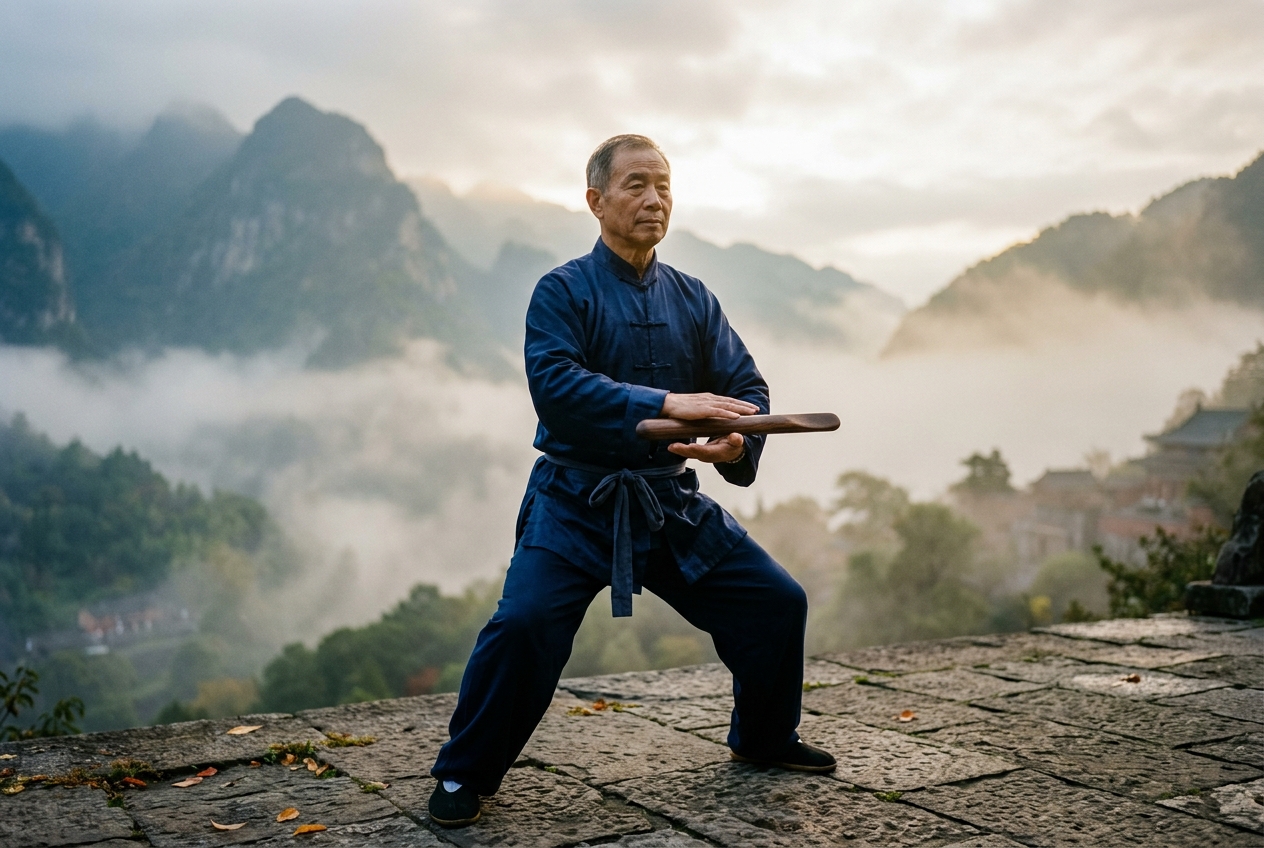
1. The Starting Stance and Grip Mechanics (Wuji Foundation)
- Foot Placement and Grounding: Position your feet parallel, exactly shoulder-width apart, with your toes pointing forward. Soften your knees by three to five degrees—never locking them backward—and allow your tailbone to sink gently as though sitting on the edge of a high stool. Sense the tri-planar weight distribution across each foot, anchoring through the ball of the foot, the outer edge, and the heel, specifically awakening the Yongquan (涌泉, Kidney-1) point located in the soft depression behind the ball of the foot.
- Axial Suspension: Imagine a silk cord gently lifting the crown of your head (Baihui, GV-20) toward the ceiling. Let your chin tuck inward by a fraction of an inch to elongate the cervical spine, permitting the back of your neck to feel long, open, and effortless.
- The Closed-Circuit Grip: Rest the hemispherical or bulbous ends of the wooden ruler against the exact center of each palm—the Laogong (劳宫, Pericardium-8) acupoint. Rest your fingers lightly around the contour of the wood without clutching it. The ruler is held entirely by light, inward lateral pressure—a delicate compression no greater than the force required to keep a ripe peach from slipping from your hands.
2. Foundational Form 1: The Toroidal Dantian Circle (Sagittal Wave)
This movement establishes core diaphragmatic synchronization with the sagittal plane, circulating movement in a smooth, continuous toroidal loop.
- Initiation (Inhale): Beginning with the ruler resting horizontally at the level of your lower abdomen, inhale slowly through your nose. Draw the ruler smoothly inward toward your navel while maintaining relaxed elbows. Allow the lower abdomen and flank tissues to gently expand in a three-hundred-and-sixty-degree circumference.
- Crest (Top of Breath): Guide the ruler upward along the midline of your torso until it reaches the level of your sternum (mid-chest). Keep your shoulders dropped and scapulae anchored down your back; do not allow your collarbones to shrug toward your ears.
- Descent and Extension (Exhale): As you begin a slow, unforced nasal exhalation, roll the top of the ruler gently forward and outward away from your chest, tracing an elliptical arc. Let your arms extend softly to roughly seventy percent of their full length without locking the elbows.
- Return and Sink: Continue the exhalation as you guide the ruler downward toward the level of your hips, completing the vertical circle as you draw it back toward your lower belly. The movement should feel like water gently churning in a continuous, seamless vertical orbit. Perform this cycle twelve to twenty-four times.
3. Foundational Form 2: Horizontal Wave Churning (Transverse Rotation)
This form mobilizes the transverse plane, stimulating deep spinal rotation and lateral fascial shearing.
- Setup: Hold the ruler horizontally at navel height, keeping your forearms parallel to the floor and your elbows floating slightly away from your ribcage.
- Transverse Churning (Left to Right): Inhale and rotate your hips and waist (Kua) ten to fifteen degrees to the left. Allow the left end of the ruler to lead, drawing a smooth horizontal circle outward, away from your body.
- Forearm Pronation and Supination: As the ruler sweeps across the front of your body from left to right, allow your left forearm to gently pronate (turn slightly downward) while the right forearm supinates (turns slightly upward), creating a subtle micro-torsional spiral through the wood.
- Return and Mirror: Exhale as you draw the right side of the ruler back toward the right hip, completing the horizontal ellipse, before smoothly transitioning to churn in the opposite direction. Keep the motion fluid, like turning a heavy millstone through warm water. Repeat for sixteen balanced rotations.
4. Foundational Form 3: Vertical Rocking Cadence (Coronal & Sagittal Weight Transfer)
This form integrates the lower kinetic chain with upper-body circular mechanics, stimulating the neurovascular bundles of the soles.
- Weight Transfer to the Forefoot: As you inhale and begin the upward, inward phase of the Dantian circle, allow sixty percent of your body weight to shift forward onto the balls of your feet (Yongquan, K-1), without lifting your heels off the ground. Feel the arches of your feet activate and your calves gently engage.
- Weight Transfer to the Rear: As you exhale and roll the ruler forward and down, gently shift sixty percent of your weight back into your heels, releasing the tension in your toes without lifting them.
- Integration: The entire body acts as an unbroken, oscillating pendulum. The forward shift of the feet feeds directly into the upward lift of the arms, and the backward settling of the heels drives the downward, grounding return of the wooden apparatus.
Common Beginner Mistakes and Precise Corrections
| Beginner Error | Biomechanical Mechanism of Fault | Somatosensory Correction |
|---|---|---|
| The "Death Grip" | Over-recruiting forearm flexors (flexor digitorum) locks the wrist joint and arrests micro-fascial transmission into the shoulder capsule. | Open the fingers slightly. Imagine holding a warm bird's egg between your palms; maintain only enough surface tension at the Laogong point to keep the wood suspended. |
| Isolated Arm Movement | Using the deltoids and biceps independently while the torso remains rigid, severing the kinetic link to the pelvic core. | Lock your elbows in a soft, constant arc and initiate all turning from the rotation of the pelvis and waist (Kua), letting the arms serve merely as passengers. |
| Shoulder Shrugging | Hyper-activating the upper trapezius and levator scapulae during the upward phase of the hand circles. | Consciously depress the shoulder blades down the posterior ribs; imagine balancing a drop of water on the tip of each shoulder without spilling it. |
| Apical Chest Breathing | Raising the clavicles and expanding the upper chest on inhalation, triggering sympathetic nervous system arousal. | Place your physical attention two inches below your navel; visualize an expanding balloon in your pelvic basin that gently widens the lower ribs on every inhale. |
Somatosensory Sensations: What You Will Feel and What It Means
As you practice these continuous circular forms, several distinct physical sensations typically arise within five to ten minutes:
- Thermal Expansion (Deep Warmth in the Palms): A pronounced sensation of heat spreading across the palms and fingertips indicates peripheral vasodilation. As sympathetic vascular tone decreases, smooth muscle surrounding the digital arterioles relaxes, dramatically increasing microvascular perfusion.
- Micro-Tingling / "Bioelectric" Buzzing: A tingling sensation resembling mild champagne bubbles along the inner forearms and palmar fascia corresponds to the sensory feedback of mechanoreceptors discharging under cyclical, low-frequency fascial shear. In traditional frameworks, this marks the uninhibited flow of Qi through the Pericardium and Heart channels.
- Somatic Heaviness in the Lower Abdomen: A grounded sensation of weight in the pelvis reflects the downward settling of your center of mass and the stabilization of core intra-abdominal pressure.
- Spontaneous Postural Release: Sensations of yawning, involuntary deep sighing, or warm fluid movement across the thoracic spine signify the active down-regulation of the autonomic nervous system and the unwinding of chronic paraspinal tension.
Why It Works: The Somatic and Biomechanical Science
The physiological elegance of Taiji Ruler Qigong lies in how it synthesizes contemporary neurophysiology, soft-tissue biomechanics, and neuromuscular feedback into a gentle movement protocol.
1. Bilateral Closed-Loop Meridian Stimulation and Hemispheric Integration
In standard open-chain somatic practices, the hands move through space independently, which requires continuous unilateral motor planning. When both palms cup the opposite ends of a single wooden ruler, the movement becomes a bilateral closed kinetic chain. The tactile contact against the Laogong (PC-8) point stimulates dense fields of low-threshold mechanoreceptors—specifically Meissner’s corpuscles and Pacinian corpuscles—within the palmar skin and aponeurosis.
According to medical research indexed by the National Center for Biotechnology Information (NCBI PubMed), bilateral coordinated hand movements facilitate interhemispheric communication across the corpus callosum, reducing cortical noise and dampening central nervous system hyper-reactivity. In the framework of classical meridian theory, detailed by organizations such as the National Qigong Association, connecting the bilateral Laogong points via a dense hardwood medium establishes a closed bio-energetic circuit, preventing the dissipation of vitality and directing circulation back into the central channel (Chong Mai).
2. Micro-Torsional Fascial Dynamics and Thomas Myers’ Spiral Lines
The subtle wrist circling and rhythmic forearm pronation and supination inherent to the Taiji Ruler do not isolate small muscle groups; instead, they generate a continuous torsional wave that travels through the entire myofascial network. As categorized in modern fascial anatomy—such as the anatomical models documented on Wikipedia's exploration of Fascia—the rotation of the radius around the ulna tensions the antebrachial fascia, which directly links into the lateral intermuscular septum of the arm, passes across the rotator cuff, and integrates with the Spiral Line and Deep Front Line of the body.
This micro-torsional dynamic gently mobilizes the costovertebral joints of the thoracic spine and the sternocostal junctions. For individuals experiencing joint stiffness, osteoarthritis, or age-related movement restrictions, this unforced, self-limiting range of motion provides continuous synovial fluid imbibition and reduces the cross-linking of pathological collagen fibers without placing mechanical strain on compromised articular cartilage.
3. Autonomic Down-Regulation, Diaphragmatic Hemodynamics, and Vagal Tone
Taiji Ruler movements are calibrated to a rhythmic cadence of approximately four to six breaths per minute. This specific breathing frequency engages the pulmonary stretch receptors and stimulates the afferent pathways of the vagus nerve (Cranial Nerve X).
As the diaphragm descends deeply into the abdominal vault on each inhalation, it creates gentle fluctuations in intra-abdominal pressure. This rhythmic piston-like action massages the abdominal viscera, enhances venous return through the inferior vena cava, and shifts the autonomic equilibrium away from sympathetic fight-or-flight arousal toward parasympathetic rest, repair, and tissue regeneration. The global health implications of these gentle traditional practices are extensively recognized in the preventive health guidelines published by the World Health Organization Traditional Medicine Programme.
Classical Lineage and Historical Context
The lineage of the Taiji Ruler is steeped in the esoteric longevity traditions of imperial China, originating during the tumultuous transition between the Five Dynasties period and the dawn of the Song Dynasty (circa 960 CE).
The Genesis of the art is historically attributed to the legendary Daoist recluse and master of internal alchemy, Chen Tuan (陈抟, also known as Chen Xiyi), who lived in the sacred granite peaks of Mount Hua. Chen Tuan, renowned for his mastery of Neidan (internal alchemy) and sleeping meditation techniques (documented in the historical account of Chen Tuan), developed the ruler as an external physical anchor to assist practitioners in stabilizing the mind and consolidating the body's internal energies without physical strain.
According to classical accounts, when Zhao Kuangyin (Emperor Taizu, the founder of the Song Dynasty) sought out Daoist masters to secure longevity and mental fortitude amidst the grueling pressures of imperial governance, Chen Tuan transmitted the secret ruler techniques directly to the imperial family. The practice was christened Song Imperial Taiji Chi and was preserved exclusively within the imperial palace walls for centuries. Because the court emperors, ministers, and scholars spent long hours in sedentary study and political administration, the ruler served as an ideal therapeutic tool: it required minimal physical space, carried zero risk of injury, and systematically reversed the debilitating postural stagnation caused by long periods of sitting.
For nearly a millennium, the Taiji Ruler remained a guarded imperial and family secret. Its modern public emergence did not occur until the mid-twentieth century, spearheaded by Master Zhao Zhongdao (1844–1962), a direct descendant of the Song imperial clan. Having maintained his own health, robust physical vitality, and mental acuity into his late nineties through the daily practice of the ruler, Master Zhao founded the Taiji Ruler Health Preservation Association in Beijing in 1954, opening the art to the public for the first time.
Shortly thereafter, renowned medical Qigong pioneer Hu Yaozhen and internal martial arts grandmaster Feng Zhiqiang (the founder of Hunyuan Taijiquan) further refined and integrated the ruler exercises into contemporary clinical Qigong and internal martial arts curriculums. Today, the art stands as a pinnacle of Chinese somatic science—a bridge uniting Daoist longevity cultivation, imperial heritage, and modern therapeutic rehabilitation, as surveyed in broader academic overviews such as Wikipedia's overview of Qigong and classical texts on the Pericardium meridian anatomy.
Today's Practice Commitment
To experience the restorative benefits of Taiji Ruler Qigong firsthand, you do not need an elaborate studio space or hours of free time. Tomorrow morning, before checking your email, opening your phone, or taking your first sip of coffee, commit to just seven minutes of practice:
- Pick up a lightweight wooden dowel, a smooth ruler, or even hold your palms cupped facing one another as if holding an invisible sphere of warm air.
- Stand with feet rooted, knees soft, and crown suspended.
- Perform twenty-four slow, continuous repetitions of the Toroidal Dantian Circle, synchronizing the rising motion with an effortless nasal inhale and the descending motion with a soft, settling exhale.
- Conclude by resting both hands over your lower belly, closing your eyes, and taking three quiet breaths into your palms.
Pay close attention to what occurs during the subsequent hour: the subtle clarity in your thinking, the unburdened ease across your neck and shoulders, and the warm, grounded stability resting quietly at the core of your body. That quiet, centered vitality is the living legacy of the Taiji Ruler.