Taiji Ball Qigong: Rotational Inertia, Multi-Planar Fascial Spherical Tensegrity, and Toroidal Dantian Dynamics in Classical Daoyin
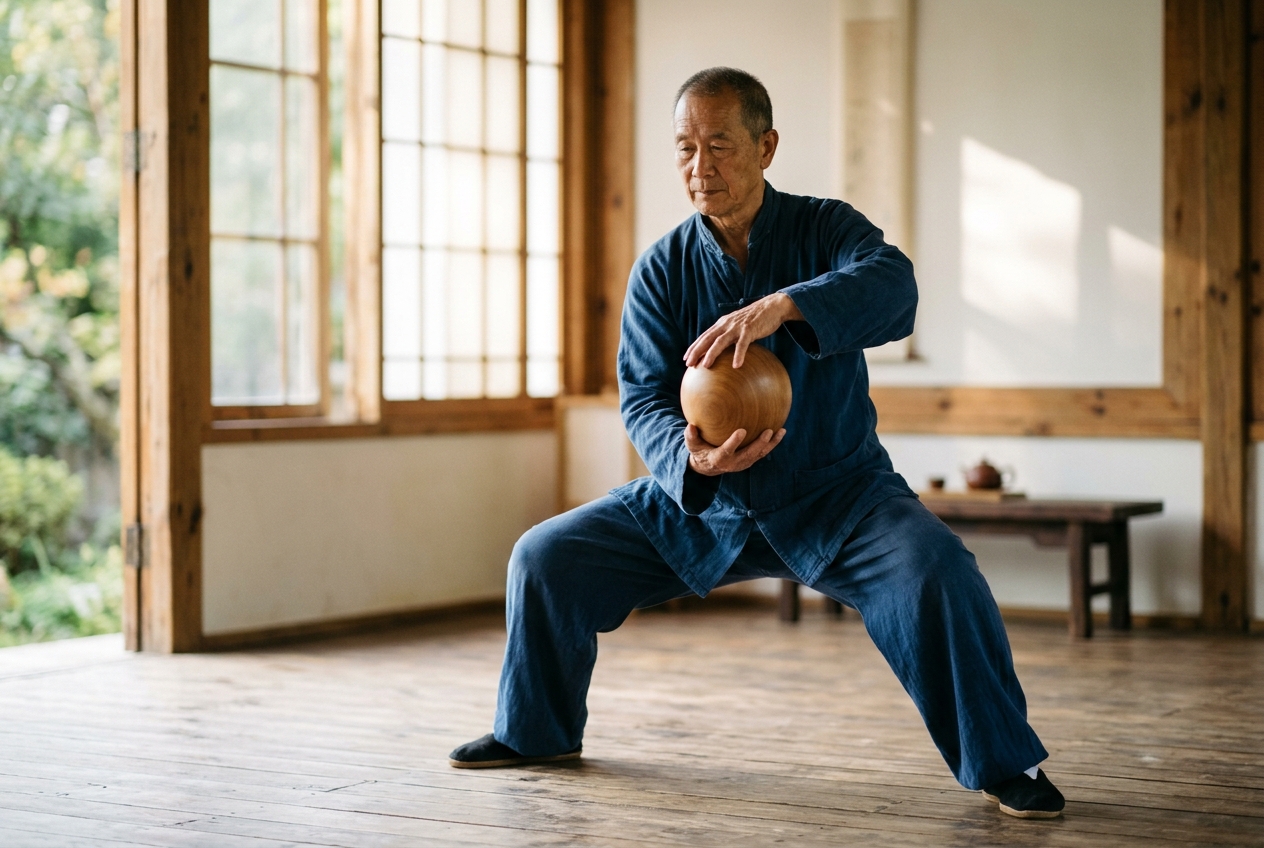
In everyday life, modern humans move with fractured kinetic patterns: we lift from our shoulders, twist with our necks, and hold our torsos in rigid compartments. Taiji Ball training dismantles these compensations. By rolling, rotating, and spiralling a three-dimensional sphere through defined spatial pathways, the practitioner anchors the movement in the hips and waist—termed the Kua (胯, the inguinal crease) and the Yao (腰, the lumbar core). The sphere becomes both a mirror and a magnifying glass: if your arms try to do the work alone, your balance falters and the movement stiffens; but when your pelvic basin, spine, and breath drive the orbit, the entire body transforms into a resilient, interconnected spring. Research documented by the National Qigong Association and peer-reviewed studies indexed on the National Center for Biotechnology Information illustrate how such integrative internal exercises significantly enhance neuromuscular coordination, balance control, and autonomic regulation.
Step-by-Step Practice Guide
To practice Taiji Ball Qigong effectively, one must progress systematically through postural architecture, breath cadence, and geometric trajectories. The following protocols can be performed either with an imaginary ball (for energetic sensitivity) or a light wooden sphere weighing between one and three kilograms (to cultivate structural myofascial tone).
1. Postural Architecture and Grounding (Zhan Zhuang Alignment)
- The Base: Position your feet parallel, precisely shoulder-width apart. Spread your toes and establish tripod contact across each foot: the base of the big toe, the base of the little toe, and the centre of the heel. This activates the Yongquan (湧泉, Kidney 1, or "Bubbling Spring") acupoint at the anterior sole, grounding your kinetic chain.
- The Pelvic Basin (Kua and Mingmen): Soften the inguinal folds (Song Kua). Allow your tailbone to sink gently toward the floor as if resting on the edge of a high stool. This flattens the excessive inward curve of the lumbar spine, opening the Mingmen (命門, "Gate of Life" at L2–L3) and creating an elastic baseline for core rotation.
- The Upper Pole (Baihui): Gently tuck the chin toward the throat to lengthen the cervical spine, imagining the crown of your head (Baihui, GV-20) suspended from above by a delicate silk thread. Relax the chest inward slightly (Han Xiong Ba Bei) to allow the scapulae to glide flat against the posterior rib cage.
2. The Four Classical Movement Orbits
Every movement of the ball must be initiated exclusively by the shifting of weight between the feet and the rotation of the Yao (waist), with the arms serving merely as fluid conduits.
- Vertical Sagittal Circulation (The Waterwheel):
- Trajectory: Hold the sphere at the Lower Dantian. As you inhale, sink your weight slightly into your heels and draw the sphere inward toward your abdomen, lifting it along the central midline (Ren Mai) up to the heart centre. As you reach the apex, roll the palms over the top of the sphere, shift your weight slightly toward the balls of your feet, and exhale as you press the ball outward and downward in an expansive arc, returning to the lower navel.
- Breath Cadence: Inhale on inward gathering/ascent; exhale on outward projection/descent.
- Frontal Vertical Plane (The Sun and Moon Wheel):
- Trajectory: Facing forward, rotate the sphere across the coronal plane like a clock face. Shift your weight into your right Kua, allowing the sphere to sweep down and to the right; then, as you shift weight into your left Kua, rotate the sphere upward along the left side, rolling the right hand on top and the left beneath, returning across the upper arc down to the right.
- Breath Cadence: Inhale as the ball ascends along the lateral flank; exhale as it descends across the midline.
- Horizontal Transversal Rotation (Grinding the Cosmic Mill):
- Trajectory: Keep the sphere parallel to the floor at the height of your navel. Fix your knees so they do not twist, and rotate your torso from the Yao forty-five degrees to the right. Push the ball forward and sweep it across the front horizon to the left forty-five degrees, then retract it back along your left flank to the centre.
- Breath Cadence: Inhale as the sphere draws back toward the body; exhale as it sweeps across the forward perimeter.
- Three-Dimensional Lemniscate (Silk-Reeling Spiral / Chansijin):
- Trajectory: This is the pinnacle trajectory. Trace a continuous three-dimensional horizontal figure-eight. As the ball travels through the loop on your right side, your right arm pronates while the left supinates, spiralling the sphere inward toward the flank. As it passes through the centre intersection, the hips transition weight to the left, spiralling the ball outward and around the left loop with reciprocal forearm pronation and supination.
- Breath Cadence: Inhale as the ball crosses through the central nexus toward either hip; exhale as it sweeps through the outer perimeter of each lateral loop.
3. Common Beginner Biomechanical Errors & Clinical Corrections
| Biomechanical Error | Musculoskeletal Compensation | Clinical Correction |
|---|---|---|
| Deltoid Isolation | Clavicles elevate; upper trapezius and anterior deltoids cramp from lifting the ball with the arms. | Sink the Elbows (Chen Jian Zhui Zhou): Imagine heavy lead weights hanging from the olecranon process of your elbows. Keep the armpits hollow (Hu Kou open). |
| Lumbar Hyperlordosis | Lower back arches excessively; belly protrudes outward during forward ball extension. | Engage the Pelvic Floor & Flatten Mingmen: Tuck the coccyx slightly downward, gently draw the lower abdomen inward, and anchor the movement into the hamstrings. |
| Knee Valgus (Collapse) | Knees buckle inward toward each other during pelvic weight transfers, straining the MCL. | Root Through the Lateral Arches: Keep the knee tracking directly over the second toe. Turn the movement entirely from the femoral head within the acetabulum (Kua), not the knee joint. |
| Clavicular Hyperventilation | Breath rises into the upper chest; neck muscles (SCM and scalenes) tense up during the lift. | Diaphragmatic Piston Regulation: Direct air into the back and lateral ribs. Keep the tongue resting lightly on the hard palate (Jie Qiao) behind the upper incisors. |
4. Sensory Markers & Internal Somatics
As you execute these orbits, observe the emerging interoceptive landmarks: * Thermal Accumulation: A distinct sensation of radiant warmth spreading through the palms and radiating into the wrists, indicating microvascular capillary vasodilation. * Bio-magnetic Viscosity: The air between your palms and the surface of the ball begins to feel dense, viscous, or spring-like—as though moving through warm water. * Fascial Elastic Recoil: Instead of muscular fatigue, the limbs feel suspended by a network of buoyant, tensile cables, creating a sensation of effortless structural fullness (Peng Jin).
Why It Works — The Body Science & Fascial Tensegrity
The transformative efficacy of Taiji Ball Qigong lies at the confluence of modern biomechanics, fascial network dynamics, and autonomic neurophysiology. Rather than operating on models of isolated muscle contraction, contemporary kinesiology understands human movement through the lens of Biotensegrity—a structural principle wherein rigid compressive elements (bones) are suspended within a continuous, tensioned web of soft tissue (muscles and fascia).
Spherical Myofascial Tensegrity and Fascial Kinetic Chains
When manipulating a sphere in three dimensions, the human body recruits the Spiral Line and the Deep Front Line as catalogued in modern anatomical frameworks. As the waist rotates and the hands manipulate the ball, rotational torque travels from the plantar fascia of the feet through the tibialis anterior, up the lateral iliotibial band, crossing the abdominal obliques, and linking directly through the serratus anterior to the rhomboids and latissimus dorsi.
By demanding continuous circularity, Taiji Ball practice eliminates "dead angles" in movement. The scapulothoracic joint—which often adheres to the posterior thoracic cage in sedentary individuals—is forced into dynamic, glide-facilitating articulation. Because the arms must hold a spherical spatial relationship without collapsing, the deep stabilizers of the rotator cuff (supraspinatus, infraspinatus, teres minor, and subscapularis) work in isometric harmony with the pectoralis major and latissimus dorsi, creating a distributed load network that relieves localized joint compression.
Intra-Abdominal Pressure (IAP) and Visceral Hemodynamics
The rhythmic oscillation between spinal flexion, extension, and axial rotation, matched with diaphragmatic respiration, exerts a continuous, gentle compression upon the abdominal and pelvic viscera. During the inward retraction phase (inhalation), intra-abdominal pressure rises moderately, massaging the liver, kidneys, and spleen. During the outward projection phase (exhalation), this pressure releases, promoting venous return to the right atrium of the heart and stimulating lymphatic drainage through the thoracic duct.
       [ Inward Phase: Inhalation ]            [ Outward Phase: Exhalation ]
          • Diaphragm descends                    • Diaphragm ascends
          • Intra-abdominal pressure ↑            • Intra-abdominal pressure ↓
          • Visceral perfusion primed             • Venous & lymphatic surge
          • Elastic fascial loading               • Kinetic release (Toroidal Qi)
Autonomic Regulation and Vagal Stimulation
Slow, rhythmic movement coordinated with extended exhalations stimulates the mechanoreceptors embedded throughout the deep fascial matrix, which communicate directly with the central nervous system. This continuous sensory feedback upregulates parasympathetic tone via the auricular and vagal nerve pathways, downregulating sympathetic "fight-or-flight" arousal. The physiological consequence is an increase in Heart Rate Variability (HRV), a reduction in circulating cortisol levels, and an immediate stabilization of baseline arterial blood pressure, consistent with standards for traditional medicine defined by the World Health Organization.
Neuro-Energetic Mechanisms in Traditional Chinese Medicine
Within the framework of Traditional Chinese Medicine (TCM), the manipulation of the sphere creates a dynamic energetic circuit: * Bilateral Laogong (PC-8) Coupling: The centre of each palm houses the Laogong point, the primary portal of the Pericardium Meridian (Jueyin). Facing the palms toward one another across the sphere creates a closed bio-electromagnetic feedback loop. As the forearms pronate and supinate, the myofascial sheaths encasing the median nerve and pericardium channel are cyclically stretched and relaxed, unblocking stagnant energy (Qi) across the chest. * Toroidal Qi Circulation in the Lower Dantian: The continuous multi-planar rotation of the sphere acts as an external model of the energetic field within the body. By guiding the physical ball around the pelvic centre, the mind-intent (Yi) gathers scattered peripheral vitality and condenses it into a self-sustaining, toroidal vortex of energy within the Lower Dantian, fortifying the body's foundational vitality (Yuan Qi).
Classical Lineage & Historical Evolution
The lineage of Taiji Ball training reflects an evolution from combative apparatus conditioning to sophisticated internal cultivation (Neigong).
In the martial ecosystems of the late Ming and Qing Dynasties (spanning the 17th through 19th centuries), internal martial arts masters recognized that empty-hand forms alone were insufficient to develop the explosive, whole-body spiral power (Fajin) necessary for close-quarters combat. In lineages such as Chen-style and Yang-style Taijiquan, as well as Baguazhang and various Daoist monastic Daoyin systems, masters developed heavy apparatus methods.
Initial training utilized solid stone spheres (Shi Qiu, 石球) carved from granite, weighing anywhere from five to over twenty kilograms. Practitioners rolled these stones across their forearms, chests, and thighs, developing extraordinary tendon resilience, bone density, and core grounding.
As pedagogical systems matured, the heavy stone apparatus gave way to resonant wooden spheres (Mu Qiu, 木球), meticulously turned from dense woods such as camphor, boxwood, willow, or cedar. Wood provided a living, organic texture that felt responsive to the skin and allowed for the cultivation of subtle internal listening skill (Ting Jin). Practitioners learned that true internal strength was not produced by contracting the superficial muscles of the arms, but by using the mass of the rolling wood to reveal where their internal kinetic chain was broken. If a practitioner’s waist stopped turning, the heavy wooden sphere would immediately drop or stall.
In the twentieth century, as Daoyin practices transitioned from closed martial lineages to broader public health systems, masters such as Dr. Yang Jwing-Ming and lineage holders of classical Baguazhang synthesized these techniques into standardized medical and meditative Qigong curricula. The weighted sphere became an instructional bridge: once the practitioner’s nervous system and fascial matrix fully mapped the physical weight and circular geometry of the wooden ball, the physical apparatus could be set aside. The seasoned practitioner then works with the "empty" or energetic sphere (Kong Qiu), cultivating pure interoceptive focus, bio-electromagnetic palm coupling, and seamless breath integration.
Today's Practice Commitment
To translate these principles into direct physiological experience, undertake the following ten-minute introductory protocol every morning for the next seven days, ideally before breakfast or your morning tea:
- Minutes 0:00 – 2:00 (Wuji Centering): Stand in neutral posture, feet shoulder-width apart. Rest your palms over your Lower Dantian (left hand over right for men, right over left for women). Breathe deeply into the lower belly, feeling it expand into your hands.
- Minutes 2:00 – 5:00 (Sagittal Waterwheel Orbit): Bring your hands forward as if holding a light, melon-sized sphere. Perform slow vertical sagittal rotations. Inhale as the ball gathers toward your chest; exhale as it rolls down and out from the navel. Focus purely on driving the ascent and descent through the flexing and unweighting of your ankles and hips.
- Minutes 5:00 – 8:00 (Transverse Grinding Orbit): Lower the ball to navel height. Rotate forty-five degrees to the right, sweep the ball across the front horizon to the left, and draw it back along the flank. Keep your knees firmly rooted and generate the entire arc from the turning of your waist (Yao).
- Minutes 8:00 – 10:00 (Energetic Condensation): Return to stillness. Bring your palms three inches apart in front of your navel. Close your eyes. Spend two minutes simply observing the magnetic pulse, heat, and structural resonance suspended between your hands, then gently place both palms over your navel to store the gathered vitality.
Notice the clarity of your mind, the openness of your chest, and the grounded stability of your stance throughout the remainder of your day.