Song Kua Inguinal Fold Mobilization: Coxofemoral Joint Decompression, Pelvic Floor Reciprocity, and Ground Force Vectoring in Classical Neigong
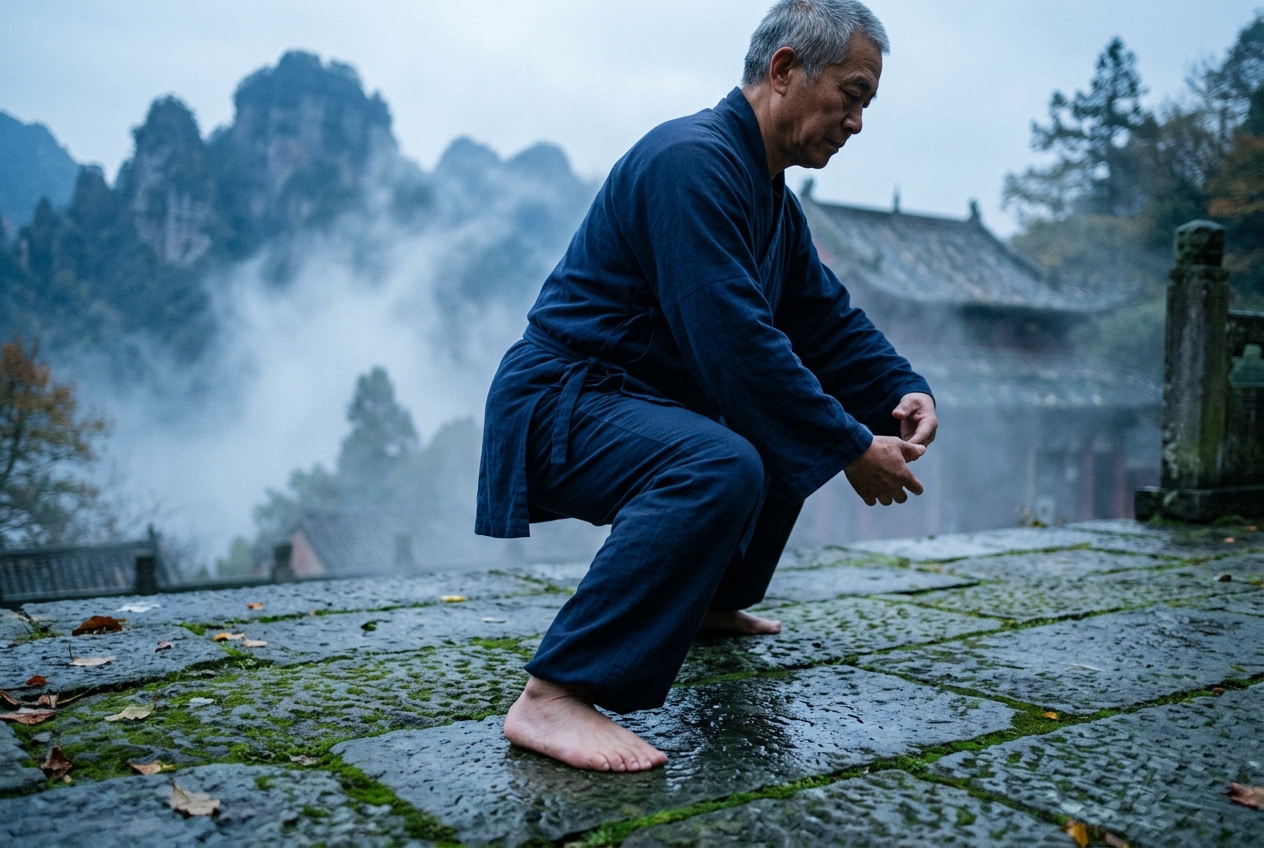
To comprehend the discipline without esoteric obfuscation, one must recognize that Song (松) does not mean limp, flaccid collapse; rather, it denotes an active, alert release of superfluous tension that allows the connective tissue network to attain dynamic structural buoyancy (Peng Jin). The Kua (胯) refers anatomically not merely to the external hip bone, but to the entire pelvic-inguinal complex: the deep ball-and-socket joints, the iliopsoas complex, the pelvic floor, and the surrounding myofascial webbing. When the Kua is released (Song), the lower abdominal reservoir known in Traditional Chinese Medicine (TCM) as the Lower Dantian (Wikipedia: Dantian—the body's physical and energetic center of gravity, situated roughly three finger-widths below the navel and two inches inward) connects directly to the skeletal support of the legs. This structural integration decompresses the lumbar vertebrae, frees the breath, and facilitates the unobstructed flow of vital force (Qi) into the earth through the bubbling spring point (Yongquan, Kidney 1) on the sole of each foot.
The Anatomical Architecture: Deep Stabilizers and Dual Diaphragms
To master Song Kua, one must deconstruct the intricate musculoskeletal mechanics governing the human pelvis. The pelvic girdle is not a static monolith; it is an articular crossroad where force vectors from the upper torso, axial spine, and lower extremities intersect.
1. The Coxofemoral Articulation and Capsular Space
The primary joint of the Kua is the coxofemoral articulation, a deep spheroidal (ball-and-socket) joint wherein the head of the femur articulates with the acetabulum of the pelvis. In chronically seated populations, the anterior hip capsule and its robust reinforcements—particularly the iliofemoral ligament (the Y-ligament of Bigelow) and pubofemoral ligament—become foreshortened and rigid. When a practitioner attempts to sink their posture without Song Kua, the femoral head shears anteriorly against the joint capsule rather than gliding posterior-inferiorly into the acetabular cup. True Song Kua requires the subtle, eccentric release of the anterior capsule, creating micro-spaciousness within the joint socket so the pelvis can articulate around the femoral heads without compressive friction.
2. The Iliopsoas Complex and Deep External Rotators
The iliopsoas—comprising the psoas major, which originates along the anterolateral bodies and transverse processes of T12 through L5, and the iliacus, which lines the internal iliac fossa—merges into a common tendon inserting onto the lesser trochanter of the femur. As the primary muscular bridge connecting the axial spine to the appendicular skeleton, a hypertonic, chronically shortened psoas pulls the lumbar spine into excessive lordosis, tilts the pelvis anteriorly, and locks the Kua.
Surrounding the posterior and deep inferior margins of the joint are the deep pelvic stabilizers: * Obturator Internus & Externus: Critical modulators of acetabular centralization and pelvic floor tension. * Piriformis: Originating from the anterior sacrum and inserting into the greater trochanter. * Gemelli and Quadratus Femoris: Deep lateral stabilizers that maintain structural alignment during weight transfer.
When these deep rotators chronically spasm, they pinch the sciatic nerve and immobilize the sacroiliac (SI) joints. Song Kua mandates the neuromuscular down-regulation of these deep rotators, allowing the ischial tuberosities ("sit-bones") to broaden gently, providing a stable foundation for the pelvic viscera.
3. Dual-Diaphragm Reciprocity and Intra-Abdominal Pressure
The human trunk relies on the reciprocal, piston-like interplay between two horizontal muscular shelves: the thoracic diaphragm above and the pelvic diaphragm (levator ani: pubococcygeus, iliococcygeus, and puborectalis) below. During functional diaphragmatic respiration: * Inhalation: The thoracic diaphragm contracts and descends, increasing intra-abdominal pressure (IAP). Simultaneously, the pelvic diaphragm must eccentrically lengthen and yield downward without losing tone, while the inguinal creases (Kua) soften to accommodate the downward displacement of visceral mass. * Exhalation: The pelvic floor undergoes an elastic, concentric recoil upward, assisting the thoracic diaphragm as it ascends back into the thoracic cage.
When the Kua is locked, the pelvic diaphragm cannot descend; intra-abdominal pressure is forced upward into the chest cavity, triggering shallow apical breathing, hyperarousal of the sympathetic nervous system, and structural tension along the thoracic spine.
Energetic Mechanics: The Hydraulic Gateway of Traditional Chinese Medicine
In the energetic topography of Daoist internal cultivation (Neigong) and Traditional Chinese Medicine, the Kua serves as the bilateral hydraulic gateway regulating energetic and fluid communication between the core and the lower extremities.
1. The Lower Dantian, Mingmen, and Dai Mai Axis
The Kua functions as the mechanical actuator for the Lower Dantian (the primary crucible of vital essence, or Jing), the Mingmen (命門, "Gate of Life," situated between the second and third lumbar vertebrae), and the Dai Mai (帶脈, the "Girdling Vessel"). The Dai Mai is unique in channel theory: it is the sole horizontal meridian, encircling the waist like a belt and binding all vertical meridians traversing the torso.
When the Kua is rigid, the Dai Mai constricts, acting like an overtightened tourniquet that severs energetic communication between the upper and lower halves of the body. By releasing the Kua, the Dai Mai relaxes and expands, allowing the Mingmen to gently open posteriorly. This eliminates lumbar hyperextension, unlocks the sacral pump, and allows the Lower Dantian to rotate freely in all planes of motion.
2. Channel Hydrodynamics Across the Six Lower Meridians
Six primary bilateral acupuncture channels traverse the Kua gateway, dividing equally into yin and yang vectors:
| Meridian Channel | Anatomical Route Through Kua | Functional & Energetic Significance |
|---|---|---|
| Kidney Channel (Zu Shaoyin) | Medial groin, pelvic floor, deep perineal fascia | Connects primal water energy (Jing) to the earth root at Yongquan (KI-1). |
| Liver Channel (Zu Jueyin) | Inguinal fold, surrounding the external genitalia | Governs tendon elasticity and smooth, unimpeded emotional/energetic flow. |
| Spleen Channel (Zu Taiyin) | Anterior-medial inguinal crease, ascending the abdomen | Governs fascial integrity, fluid transformation, and muscular tone. |
| Urinary Bladder (Zu Taiyang) | Posterior sacroiliac margin, traversing the piriformis | Governs postural support along the spine and downstream grounding force. |
| Gallbladder Channel (Zu Shaoyang) | Lateral hip, traversing the Huantiao (GB-30) point | The pivot point for lateral weight shifting and spatial orientation. |
| Stomach Channel (Zu Yangming) | Anterior hip crease, traversing the femoral triangle | Governs vitality, physical strength, and vertical grounding alignment. |
When a practitioner exhibits "Dead Kua," these energetic pathways suffer vascular and energetic stagnation. Compression at Huantiao (GB-30) or Chongmen (SP-12) starves the lower limbs of smooth Qi circulation, manifesting clinically as cold feet, restless legs, knee instability, and profound mental agitation.
Diagnostic Indicators: "Dead Kua" versus "Song Kua"
To correct somatic errors, the practitioner and instructor must cultivate precise diagnostic acuity. The table below delineates the clinical, biomechanical, and perceptual differentials between pathological pelvic fixation (Si Kua) and functional dynamic release (Song Kua).
         DIAGNOSTIC COMPARISON: DEAD KUA vs. SONG KUA

[ DEAD KUA / 死胯 ]                  [ SONG KUA / 松胯 ]
    • Anterior Pelvic Tilt              • Neutral Sacral Suspension (Diao Bao)
    • Lumbar Lordosis / L5-S1 Shear     • Decompressed Lumbar (Mingmen Open)
    • Femoral Internal/Valgus Strain    • Spheroidal Acetabular Gliding
    • Patellofemoral Shear Forces       • Weight Vector Through Tibial Shaft
    • Shallow Clavicular Respiration    • Synchronized Diaphragmatic Breathing
    • Superficial Muscular Clamping     • Elastic Fascial Tensegrity
| Structural Metric | "Dead Kua" (Si Kua / 死胯) | "Song Kua" (Song Kua / 松胯) |
|---|---|---|
| Sacropelvic Vector | Rigid anterior or posterior tilt; pelvic shearing during lateral transitions; sacrum jammed against the ilia. | Diao Bao (吊包): Sacrum suspended vertically like a plumb bob; sit-bones gently widened; micro-mobility intact. |
| Lumbar Mechanics | Hyperlordotic pinching at L5-S1; hyperextension; lumbar musculature (erector spinae, QL) chronically hypertonic. | Mingmen flat, spacious, and open; spine elongates vertically; axial decompression across all vertebral discs. |
| Femoral Articulation | Femoral head jammed anteriorly against the joint capsule; superficial quadriceps and TFL chronically gripped. | Femoral head sinks smoothly into the acetabular cup; inguinal crease folds softly; deep rotators responsive. |
| Knee & Foot Alignment | Valgus collapse (inward knee buckling); torque transferred directly into the medial collateral ligament and meniscus. | Knee tracks true along the foot axis; ground reaction force vectors pass cleanly through the tibia to Yongquan. |
| Perceptual Experience | Sensation of top-heaviness, muscular burning in the thighs, localized lower back ache, and rapid respiratory fatigue. | Sensation of deep pelvic spaciousness, hydraulic lightness in the torso, root connection to earth, and warm micro-pulsation. |
Step-by-Step Somatic Practice Sequence
Mastery of Song Kua cannot be achieved through intellectual understanding alone; it demands systematic neuromuscular repatterning. Practice the following four-stage pedagogical sequence daily to rewire your pelvic mechanics.
Drill 1: Seated Inguinal Mobilization (De-linking Pelvis and Spine)
- Objective: Isolate pure acetabular rotation from compensatory lumbar flexion or extension.
- Starting Setup: Sit upon the forward third of a firm, flat wooden chair or meditation bench. Your feet should rest flat on the floor, hip-width apart, with your shins perpendicular to the ground.
- Execution:
- Place the knife-edges of both hands into the inguinal folds.
- Inhale deeply through your nose into the Lower Dantian, feeling the pelvic floor widen against the seat.
- Exhale slowly and, without rounding your lower back or craning your neck, hinge forward purely from the hip joints.
- Feel your fingers being gently "pinched" or drawn inward by the deepening inguinal creases.
- Maintain your gaze forward and your spine long; your chest and belly move as a single, unified cylinder.
- Return to vertical on the inhalation by pressing down through the sit-bones, not by pulling with the lower back.
- Duration: 10 to 15 smooth repetitions.
Drill 2: Zhan Zhuang Alignment — Sacral Suspension (Diao Bao)
- Objective: Establish static structural alignment, allowing gravity to release the deep hip stabilizers.
- Starting Setup: Stand with your feet parallel, precisely shoulder-width apart. Let your arms hang effortlessly at your sides, fingertips relaxed.
- Execution:
- Align the crown of your head (Baihui, GV-20) upward as if suspended by an ethereal silk thread from the cosmos.
- Soften the eyes, release the jaw, and tuck the chin slightly to lengthen the cervical spine.
- Soften the knees, letting them bend slightly (no more than 2–3 inches).
- Imagine a heavy plumb bob attached to the tip of your coccyx. Allow the tailbone to "hang" vertically toward the floor between your heels (Diao Bao).
- Place your awareness in the inguinal creases: release any gripping in the front of the hips, allowing the pelvis to settle like a heavy bronze bell.
- Check your lower back: the lumbar arch should flatten naturally without forceful pelvic tucking.
- Sensory Cues: Look for a feeling of buoyant support under the arches of your feet and a warm, hydrostatic fullness in the lower abdomen.
- Duration: Stand motionless for 5 to 10 minutes, breathing diaphragmatically.
Drill 3: Single-Leg Loading and Empty-Leg Release (Xu Bu)
- Objective: Cultivate the classical principle of "Differentiating Substantial and Insubstantial" (Fen Qing Zhuo) through the Kua.
- Execution:
- From the neutral Zhan Zhuang posture, shift 100% of your body weight slowly into your right leg.
- As the weight settles, focus entirely on the right inguinal crease: let it fold and sink down-and-inward, as if your right hip were a well-oiled hinge swallowing the weight.
- Keep your right knee stacked over your right foot; do not let the knee collapse inward or the outer hip jut laterally outward.
- The left leg becomes completely "empty" (Xu). Release the left Kua entirely so the left foot can lift off the floor without disturbing your upper body's equilibrium.
- Step the left foot forward onto its heel with zero weight, then slowly transition the weight forward by folding the left Kua and releasing the right.
- Duration: 10 slow transitions per side.
Drill 4: Spiral Silk-Reeling Transitions (Chan Si Jin)
- Objective: Integrate rotational torque across the pelvis without shearing the sacroiliac joint.
- Execution:
- Adopt a wider horse-stance (Ma Bu), roughly 1.5 times shoulder-width.
- Place your hands on your hips with your thumbs resting on the posterior iliac crests and fingers on the inguinal folds.
- Shift your weight to the right leg, sinking the right Kua.
- Begin a smooth, horizontal figure-eight (infinity sign: $\infty$) loop with the center of your pelvis: as you sink into the right Kua, rotate the pelvis 15 degrees to the right.
- Draw the weight across the perineum (Huiyin) toward the left heel, simultaneously sinking and opening the left Kua as you rotate the pelvis 15 degrees to the left.
- Ensure the knees remain stable and resilient; all rotation must occur within the acetabular sockets, not via twisting of the knee joints.
- Duration: 20 fluid, continuous loops.
Western Biomechanical & Physiological Correlates
The classical instructions of internal Qigong map directly onto modern concepts in anatomy, myofascial architecture, and neurophysiology.
1. Fascial Tensegrity and Thomas Myers' Deep Front Line (DFL)
In contemporary fascial anatomy, as popularized by structural integration researcher Thomas Myers in Anatomy Trains, the structural core of the human body is governed by the Deep Front Line (DFL). This myofascial meridian begins deep in the plantar aspect of the foot, ascends through the posterior tibialis, traverses the popliteal fossa, travels up the adductor group, engages the pelvic floor, envelops the iliopsoas, passes through the respiratory diaphragm, ascends the anterior longitudinal ligament of the spine, and terminates at the basilar portion of the occiput and jaw.
When the Kua is locked, the continuous fascial tensegrity of the DFL is severed at the pelvic crossroad. Compressive vectors replace tensile distribution, forcing the skeletal system to absorb damaging shear forces. Releasing the Kua restores continuous tensile integrity across the DFL, transforming the human body into an elastic spring capable of absorbing and projecting force with minimal muscular exertion. Peer-reviewed research available via the National Center for Biotechnology Information (NCBI PubMed) corroborates the essential role of myofascial continuity and tensegrity in non-muscular force transmission and chronic pain alleviation.
2. Hemodynamic and Lymphatic Decompression of the Femoral Triangle
Traversing the anterior crease of the Kua is the Femoral Triangle (Scarpa's Triangle), bounded superiorly by the inguinal ligament, medially by the adductor longus, and laterally by the sartorius. Passing through this critical bottleneck are the femoral artery, femoral vein, femoral nerve, and the deep inguinal lymph nodes.
Chronic pelvic clenching and hyperlordotic posturing mechanically compress these neurovascular structures. Song Kua relieves pressure upon the femoral vessels, producing marked physiological benefits: * Enhances venous return from the lower extremities to the inferior vena cava. * Decompresses the deep inguinal lymphatic basin, accelerating the clearance of metabolic waste and reducing lower-limb edema. * Alleviates mechanical traction on the femoral and obturator nerves, mitigating chronic lower back and groin pain.
This systemic hemodynamic enhancement aligns closely with integrative health modalities outlined by the World Health Organization Traditional Medicine initiatives.
3. Autonomic Nervous System Reset via Psoas Decompression
The psoas major is anatomically and neurologically entwined with the sympathetic nervous system's "fight-or-flight" response. The medial arcuate ligament of the respiratory diaphragm crosses over the upper fibers of the psoas, and the sympathetic trunks run immediately adjacent to the lumbar spine. Under chronic psychological or physical stress, the psoas contracts reflexively, pulling the organism into a subtle protective fetal flexion.
When the psoas is chronically locked in spasm, the nervous system remains trapped in a sympathetic feedback loop. By consciously releasing the Kua, the practitioner signals safety to the autonomic nervous system via proprioceptive afferents. The psoas lengthens, intra-abdominal pressure equalizes, and the vagus nerve (cranial nerve X) enhances parasympathetic outflow. This results in measurable increases in Heart Rate Variability (HRV), reduced serum cortisol levels, and an immediate subjective state of calm, grounded alertness.
Classical Lineage & Historical Evolution
The cultivation of the Kua is not a modern fitness invention; it represents the distilled biomechanical wisdom of centuries of Chinese martial and meditative traditions.
The earliest foundations of these principles trace back to Daoist Daoyin (gymnastic movement) scrolls and internal alchemy (Neidan) texts developed on Mount Wudang during the Song Dynasty (960–1279 CE). Daoist hermits recognized that to preserve vitality and cultivate the three treasures—Jing (Essence), Qi (Energy), and Shen (Spirit)—the physical body must remain completely supple, free of structural bottlenecks that obstruct the micro-circulation of blood and breath.
During the late Ming and early Qing dynasties (circa 17th century), this internal technology was systematically integrated into the martial systems of Chen Village (Chenjiagou) by masters such as Chen Wangting. The foundational manual Illustrated Explanations of Chen Family Taijiquan by Chen Xin (1849–1929) repeatedly emphasizes the centrality of the Kua in executing Chan Si Jin (Silk-Reeling Energy). Chen Xin recorded the classical martial maxim:
"The source of movement is in the waist, the foundation is in the feet, but the master governor and true pivot of transformation is in the Kua." (源於腰,發於腿,主宰於胯)
In the 1930s, when Grandmaster Yang Chengfu codified his seminal Ten Essential Principles of Taijiquan, he placed Song Yao (relaxing the waist) and Song Kua (relaxing the hips) as the paramount structural requirement. Yang warned that if a practitioner failed to sink the Kua, their martial applications would remain empty and stiff, their internal energy would float aimlessly into the chest, and they would be easily toppled by an opponent's slightest touch.
Today, lineage organizations such as the National Qigong Association preserve and disseminate these time-tested protocols, bridging the gap between ancient lineages and contemporary somatic health science as documented across classical Tai chi histories and modern Fascia studies.
Today's Practice Commitment
To transmute theoretical understanding into embodied neuromuscular reality, commit to the following seven-minute protocol tomorrow morning before checking your phone, sitting at your desk, or consuming your first beverage.
As you step away from this practice and move through the rest of your day, periodically bring your awareness back to your inguinal crease. Notice when you unconsciously tense the groin while sitting in traffic, standing in line, or typing at your desk. Soften that crease, let the sit-bones widen, drop your breath into the Lower Dantian, and allow the ground beneath you to carry your weight. That effortless, grounded stability is the living power of Song Kua.