He Xiang Zhuang Soaring Crane Qigong: Cranio-Cervical Articulation, Wing-Flapping Fascial Dynamics, and Microvascular Meridian Clearance in Medical Daoyin
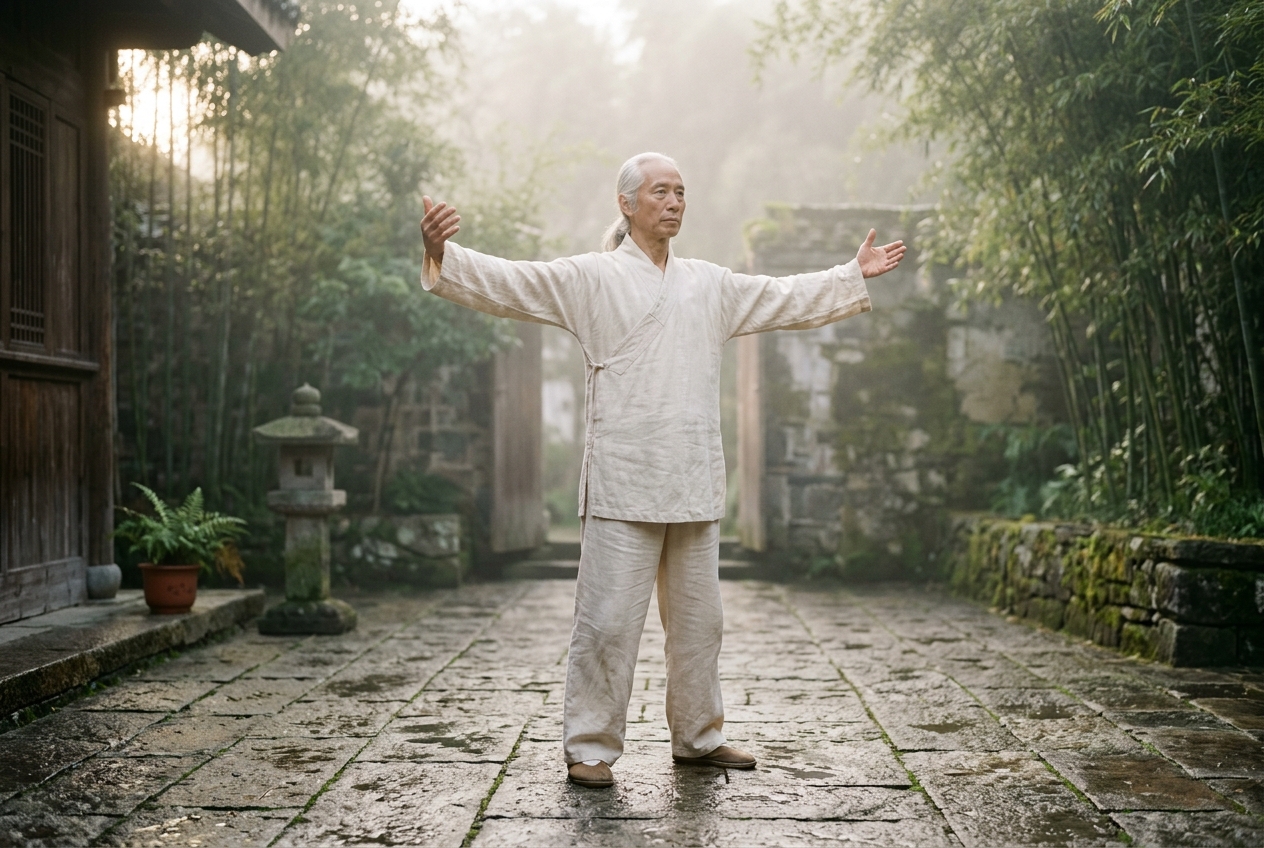
To understand its framework without esoteric jargon, imagine your spine not as a rigid pillar, but as a supple suspension bridge whose individual segments require rhythmic decompression to keep the nerve pathways clear. In traditional Chinese somatic theory, the body's functional vitality is stored in the lower belly—an anatomical region referred to as the Lower Dantian (下丹田), situated roughly two inches below the navel and three inches inward. By coordinating diaphragmatic respiration with continuous, undulating movements of the neck, spine, scapulae, and hips, Soaring Crane Qigong gently mobilizes fluid through spinal tissues, releases chronic myofascial restriction, and facilitates autonomic balance.
As documented across modern clinical literature cataloged on the National Center for Biotechnology Information (NCBI PubMed) and recognized by institutions such as the National Qigong Association, practices within the broader umbrella of Qigong represent standardized mind-body exercise systems that systematically downregulate sympathetic nervous system hyperactivity while promoting musculoskeletal restoration.
The Biomechanical Architecture: Step-by-Step Practice Guide
The complete system of He Xiang Zhuang comprises five core dynamic routines. Each section isolates and integrates distinct kinetic chains, progressing from micro-cervical articulation to full-body weight transfers and unilateral balance. Below is the actionable, step-by-step methodology for executing the primary modules of the form safely and effectively at home.
1. Foundational Posture: Establishing the Neutral Axis (Wuji)
Before movement begins, somatic stability must be cultivated through structural alignment.
- Foot Placement and Plantar Grounding: Position your feet parallel, hip-to-shoulder width apart. Direct your weight evenly across the tripod of each foot: the base of the first metatarsal, the base of the fifth metatarsal, and the calcaneus (heel). Sense the center of the sole—known in classical topography as Yongquan (涌泉, Kidney 1)—releasing down into the earth.
- Pelvic and Lumbar Unloading: Soften the knee joints to approximately 5–10 degrees of flexion. Allow your pelvis to settle into a neutral tilt, dropping the sacrum vertically. This action gently flattens an exaggerated lumbar lordosis, opening the lumbosacral junction (Mingmen, 命门).
- Axial Suspension: Imagine a gentle upward traction applied to the crown of your head (Baihui, 百会), lifting the occiput away from the atlas (C1 vertebra). Let the chin tuck backward slightly (subtle cervical retraction), relaxing the suboccipital musculature and drawing the chest into an open, unstrained position.
2. Routine One: Tong Bei Shuang Fei (Through the Back Both Wings Fly)
This sequence establishes fluid connectivity across the shoulder girdle, rib cage, and upper extremities.
- The Movement Sequence: 1. From the neutral posture, inhale slowly through the nose over 4 to 5 seconds. Float your arms outward and upward along the coronal plane. 2. Initiate the ascent entirely from the dorsal side of the wrists, keeping the fingers draped loosely downward like soft feathers. 3. Allow the scapulae to glide smoothly upward and outward along the rib cage without shrugging the upper trapezius toward the ears. 4. As your hands reach shoulder height, smoothly invert the movement: begin the exhalation, leading the descent with the elbows dropping first, followed by the wrists settling, and finally the fingers extending gently forward and downward.
- Breathing Coordination: Synchronize the upward flight phase with the inhalation, feeling your thoracic cage expand laterally. Match the descent phase with a smooth, passive exhalation through the nose, feeling the center of your palm (Laogong, 劳宫, Pericardium 8) soften and expand.
3. Routine Two: He Shou Diao Xi (Crane Head Breathing & Cervical Articulation)
The signature movement of Soaring Crane Qigong involves a three-dimensional sagittal wave through the cervical and upper thoracic vertebrae.
- The Movement Sequence: 1. Stand centered in the foundational posture with your hands resting gently on your hips or floating naturally at your sides. 2. Phase 1 (Retraction & Extension): Gently draw your chin straight back toward your spine, creating a mild double chin. From this retracted position, lift the base of your skull upward and tilt the crown slightly back, opening the anterior throat without compressing the posterior neck. 3. Phase 2 (Protraction & Flexion): Glide your chin forward in an arc, reaching forward as though dipping the beak of a crane into water. 4. Phase 3 (Scooping Return): Lower the chin down toward the sternal notch, flexing the cervical spine one vertebra at a time from C1 down through C7 and T1. 5. Phase 4 (Axial Re-stacking): Draw the chin upward along the midline of the chest, re-stacking the cervical vertebrae sequentially from the bottom up until the head returns to the suspended neutral position.
- Repetition: Complete 9 to 18 slow, continuous cycles. Maintain an uninterrupted, serpentine rhythm.
4. Routine Three: Du Li Qi Fei (Single-Leg Stance and Soaring)
This routine trains vestibular adaptation, unilateral balance, and deep core integration.
- The Movement Sequence: 1. Inhale and shift your center of mass entirely into the right foot, ensuring the right knee remains micro-flexed and the hip does not jut laterally. 2. As the left foot becomes weightless, peel the left heel, ball, and toes off the floor, raising the left knee until the thigh is parallel to the ground (45 to 90 degrees of hip flexion). 3. Simultaneously, raise both arms laterally to shoulder height, spreading the fingers softly with the palm centers hollowed. 4. Exhale as you extend the left leg gently forward at a 45-degree angle, pointing the toes downward, then dorsiflexing the foot to draw energy through the calf. 5. Retract the leg, place the foot softly back on the floor without impact, shift your center of gravity across to the left leg, and repeat the sequence on the opposite side.
5. Routine Four & Five: Pelvic Rocking and Lower Dantian Consolidation
The closing routines synchronize the lower extremities with the abdominal core to ground the nervous system.
- Front-to-Back Rocking (Qian Hou Yao Bai): Shift the body weight smoothly between the balls of the feet and the heels in a continuous sagittal pendulum. As weight shifts forward, the spine extends subtly and the arms float back; as weight moves into the heels, the pelvis posterior-tilts, the spine gently rounds, and the arms float forward to naval height.
- Returning Qi to the Origin (Hui Qi Gui Yuan): Collect both palms in wide lateral arcs, bringing them overhead. Guide the hands down the central vertical axis of the body, palms facing inward toward the chest, throat, and solar plexus, finally resting both hands directly over the lower abdomen (left hand over right for men, right over left for women, per classical tradition). Stand motionless for 2 to 3 minutes, resting your attention in the deep pelvis.
Common Practitioner Mistakes & Immediate Corrections
| Movement Phase | Common Error | Biomechanical Consequence | Actionable Correction |
|---|---|---|---|
| Foundational Stance | Hyperextending (locking) the knees. | Lumbar shear stress; impedes venous and lymphatic return from the lower limbs. | Maintain 5° of active micro-flexion; sense the patellae floating upward via light quad engagement. |
| Crane Head Motion | Hinging exclusively at the C5–C6 junction. | Cervical nerve impingement; localized vascular compression; dizziness. | Initiate the wave from the atlas (C1) and occiput; visualize drawing a circular wheel with the tip of the chin. |
| Wing Flapping | Elevating the clavicles and shrugging upper trapezius. | Chronic neck tension; restricts brachial plexus and subclavian artery. | Stabilize the scapulae downward; initiate the arm lift strictly from the latissimus and serratus anterior. |
| Single-Leg Stance | Collapsing the medial arch of the standing foot; hip dropping. | Lateral knee instability; loss of vestibular equilibrium. | Press the base of the big toe down; actively recruit the stance-side gluteus medius to level the pelvis. |
| Breath Coordination | Forcing inhalation; chest breathing. | Sympathetic over-activation; elevation of blood pressure; mental agitation. | Breathe diaphragmatically; expand the 360-degree lower rib perimeter silently and without strain. |
Perceptual Markers: What Sensations to Look For
As you practice, you will encounter distinct somatic landmarks. Recognizing these signals helps you gauge physiological progress:
- Distal Erythema and Thermal Shifts (Warmth in Palms and Soles): Within several minutes of gentle spinal waving and scapulothoracic movement, a noticeable sensation of radiant heat typically arises in the palms (Laogong) and the soles (Yongquan). This reflects peripheral vasodilation driven by local nitric oxide release and parasympathetic down-regulation of vascular tone.
- Micro-Paresthesia (Tingling at the Fingertips): A light, effervescent "electric" or tingling sensation at the tips of the fingers marks the stimulation of the cutaneous digital nerves and microcapillary beds adjacent to the classical Jing-Well acupuncture points.
- Somatic Heaviness (The "Lead Sinker" Sensation): As muscular bracing drops away from the shoulders and lower back, the pelvis and lower limbs feel rooted and weighted. This indicates the descent of your center of mass and functional stabilization of the postural core.
- Spontaneous Myofascial Unwinding: You may experience subtle, involuntary micro-adjustments along the thoracic spine or deep spontaneous sighs. This reflects your deep postural stabilizers releasing chronic hypertonicity.
Why It Works: The Anatomy and Neurophysiology of the Form
The clinical efficacy of He Xiang Zhuang rests upon solid biomechanical, neurological, and myofascial foundations. Modern biomedical research—detailed through resources such as the World Health Organization Traditional Medicine portal and Traditional Chinese Medicine scholarship—increasingly demonstrates how deliberate, multi-planar mind-body movements foster systemic neuro-visceral regulation.
1. Spinal Undulation and Intervertebral Foraminal Decompression
The human spine is subject to relentless axial loading throughout daily sedentary and upright life. This constant gravity-driven compression diminishes intervertebral disc hydration and narrows the intervertebral foramina—the lateral bony apertures through which spinal nerve roots and radicular blood vessels pass.
The continuous, serpentine articulation of the "Crane Head" and sagittal torso waves introduces gentle, rhythmic traction across every spinal motion segment (the functional unit composed of two adjacent vertebrae, the intervening intervertebral disc, and paired facet joints). During the flexion-extension wave:
$$\text{Axial Motion} \longrightarrow \text{Hydrostatic Pressure Gradients} \longrightarrow \text{Fluid Imbibition into Nucleus Pulposus}$$
This cyclic mobilization produces several therapeutic effects: * It facilitates fluid exchange into the avascular nucleus pulposus and annulus fibrosus of the disc. * It decompresses the exiting spinal nerve roots within the intervertebral foramina. * It mobilizes the spinal dura mater, releasing meningeal tensions that contribute to cervicogenic headaches and upper quadrant postural pain.
2. Autonomic Vagal Tone and Baroreflex Sensitivity
He Xiang Zhuang coordinates slow, rhythmic physical movement with resonant diaphragmatic breathing at roughly 6 breaths per minute (a frequency of approximately 0.1 Hz). This tempo coincides with the body's natural cardiovascular Mayer wave oscillation.
Deep diaphragmatic excursions generate positive intra-abdominal pressure during inspiration and negative intrathoracic pressure, which activates pulmonary stretch receptors and cardiac mechanoreceptors. These sensory signals travel along afferent pathways to the nucleus tractus solitarii (NTS) in the brainstem, prompting the dorsal motor nucleus of the vagus nerve (Cranial Nerve X) to increase parasympathetic output:
- Reduction of Sympathetic Outflow: Decreases resting heart rate, reduces systemic peripheral vascular resistance, and suppresses excess cortisol and catecholamine secretion.
- Enhancement of Heart Rate Variability (HRV): Increases high-frequency (HF) power bands and elevates root mean square of successive differences (RMSSD), validated biometric indicators of robust autonomic flexibility and stress resilience.
3. Myofascial Kinetic Chains and Distal Microvascular Perfusion
In contemporary myofascial anatomy (such as the structural models popularized by Thomas Myers), the arms and upper torso are linked via distinct fascial lines: the Superficial Front Arm Line, Deep Front Arm Line, Superficial Back Arm Line, and Deep Back Arm Line.
During the "Wing Flapping" motions of Tong Bei Shuang Fei, dynamic tension and release ripple through the pectoralis minor, serratus anterior, latissimus dorsi, and forearm flexor/extensor compartments. This continuous fascial glide generates shear strain across connective tissue envelopes, activating endothelial nitric oxide synthase (eNOS). The resulting release of nitric oxide relaxes vascular smooth muscle, dilating downstream arterioles and driving microvascular perfusion through the palmar capillary beds directly to the distal Jing-Well points located at the corners of the nail beds.
+-------------------------------------------------------------------------------+
|                       CLINICAL THERAPEUTIC SPOTLIGHT                          |
|                                                                               |
| Comparative physiological trials evaluating slow-wave Qigong interventions   |
| have demonstrated marked therapeutic efficacy across three primary domains:   |
|                                                                               |
| 1. Chronic Fatigue Syndrome (CFS/ME): Rhythmic low-metabolic movement         |
|    enhances cellular adenosine triphosphate (ATP) efficiency and lowers serum |
|    interleukin-6 (IL-6) and tumor necrosis factor-alpha (TNF-a) inflammatory  |
|    markers without triggering post-exertional malaise (PEM).                  |
|                                                                               |
| 2. Cervical Spondylosis & Postural Rehabilitation: Sagittal wave mechanics    |
|    strengthen the longus colli and longus capitis (deep neck flexors) while   |
|    inhibiting hyperactive scalenes and upper trapezius muscles, decreasing    |
|    cervical pain indices by up to 45% in controlled cohorts.                  |
|                                                                               |
| 3. Autonomic Dysregulation & Hypertension: Sustained practice yields          |
|    clinically significant reductions in systolic and diastolic blood pressure |
|    through baroreflex stabilization and parasympathetic upregulation.         |
+-------------------------------------------------------------------------------+
Comparative Biomechanical Profile: Soaring Crane vs. Wild Goose Qigong
Within the spectrum of zoomorphic Chinese movement traditions, He Xiang Zhuang (Soaring Crane) and Dayan Qigong (大雁气功, Wild Goose Qigong) stand as the two preeminent avian lineages. While both emulate water birds to promote health and longevity, their biomechanical strategies, movement choreographies, and therapeutic emphases diverge significantly.
| Biomechanical / Energetic Parameter | He Xiang Zhuang (Soaring Crane Qigong) | Dayan Qigong (Wild Goose Qigong) |
|---|---|---|
| Primary Movement Geometry | Linear-to-sagittal waves, continuous vertical axis expansion/contraction, open coronal wing arcs. | Multi-directional spiraling, rotational torso coils, diagonal stepping, complex lateral zig-zags. |
| Spinal Articulation Focus | Segmental sagittal wave of cervical spine ("Crane Head") and lumbosacral flexion/extension. | Rotational, twisting, and lateral lateral-flexion undulations of the whole thoracic cage. |
| Stance and Footwork | Predominantly stationary, wide-based tripod grounding; slow, deliberate unilateral balance lifts. | Highly dynamic footwork; rapid weight-shifting, crossing steps (Cha Bu), heel taps, and jumping/fluttering. |
| Energetic and Acupoint Strategy | Open-loop projection through Laogong (PC8) and Jing-Well points; sinks excess Yang fire to Yongquan (KD1). | Direct acupoint tapping, sweeping along channel trajectories, shaking/purging techniques (Pai Da). |
| Curricular Structure | Five concise, modular dynamic routines followed by standing meditation (Zhan Zhuang). | Two extensive, theatrical forms of 64 movements each (128 movements total in foundational syllabus). |
| Primary Clinical Application | Spinal decompression, chronic fatigue recovery, autonomic dysregulation, joint mobility. | Cardiovascular stamina, complex multi-planar balance, coordination, neuro-motor agility. |
Classical Lineage, Historical Context & The Prevention of "Yang Fire"
The cultural and historical roots of Soaring Crane Qigong trace back to classical Chinese somatic philosophy. The crane (He, 鹤) has stood for millennia in Daoist iconology as an emblem of longevity, lightness, and spiritual transcendence. Excavations of the famous Han Dynasty Mawangdui silk texts (dated to 168 BCE) reveal pictorial depictions of early Daoyin (导引, guiding and pulling) exercises, including explicit illustrations of figures emulating the long-necked, soaring postures of cranes to draw breath into the body and stretch stiff sinews.
In its modern, standardized form, He Xiang Zhuang was synthesized and introduced to the public in Beijing in 1980 by Master Zhao Jinxiang (赵金香). Zhao, who had survived severe, debilitating pulmonary tuberculosis during his youth through intensive Daoyin and meditation practices, distilled his extensive study of traditional lineage methods into an accessible, five-part clinical exercise system. During the height of China’s late-twentieth-century "Qigong Wave," Soaring Crane attracted millions of practitioners throughout hospitals, universities, and public parks due to its clear structure and rapid therapeutic benefits.
Grounding the Circuit: Preventing "Ascendant Yang Fire"
A central tenet of classical Chinese medicine is the delicate equilibrium between Yin (substance, cooling, grounding) and Yang (activity, warmth, ascending force). When practitioners engage in upper-body energetic exercises or focus intensely on moving energy without adequate structural rooting, they risk triggering what classical texts call Shang Huo (上火, Ascendant Yang Fire) or Qi Deviation (Zou Huo Ru Mo).
In modern neurological terms, this phenomenon corresponds to excessive sympathetic arousal, cranial vasodilation, and sensory overload caused by improper postural bracing, hyperventilation, or ungrounded mental focus. Symptoms manifest as tension headaches, dizziness, tinnitus, irritability, or elevated blood pressure.
Soaring Crane Qigong systematically mitigates this risk through built-in anatomical and attentional safeguards:
- The Role of the Lower Dantian: Every movement routine consistently routes attention and dynamic momentum back to the lower abdomen, consolidating internal pressure within the pelvic basin rather than the head or upper chest.
- Opening the Laogong Palms: By extending and releasing the palm centers (Laogong, PC8), the form prevents thermal and vascular pooling in the thoracic cavity, allowing microvascular warmth to vent smoothly through the extremities.
- Plantar Rooting through Yongquan (KD1): Every upward reach is counterbalanced by an intentional rooting into the Yongquan point on the soles of the feet. This conscious downward engagement anchors the practitioner's kinetic chain, stabilizing posture and keeping the autonomic nervous system calm and grounded.
Today’s Practice Commitment: The 10-Minute Morning Routine
To translate this biomechanical and energetic framework into practical somatic benefit, integrate this simple, ten-minute morning protocol into your daily routine before checking your digital devices or drinking your first coffee.
As you step away from this practice each morning, take note of objective somatic shifts: the ease of nasal airflow, the drop in your resting pulse rate, the warm tingling across your fingers, and the spacious, uncompressed freedom along the length of your spine. In this deliberate union of classical movement and contemporary physiology, the body discovers its innate capacity for effortless, grounded vitality.