Single-Meridian Point Combination: Navigating Intra-Channel Synergy, Ipsilateral Qi Conduction, and Focused Acupressure Protocols
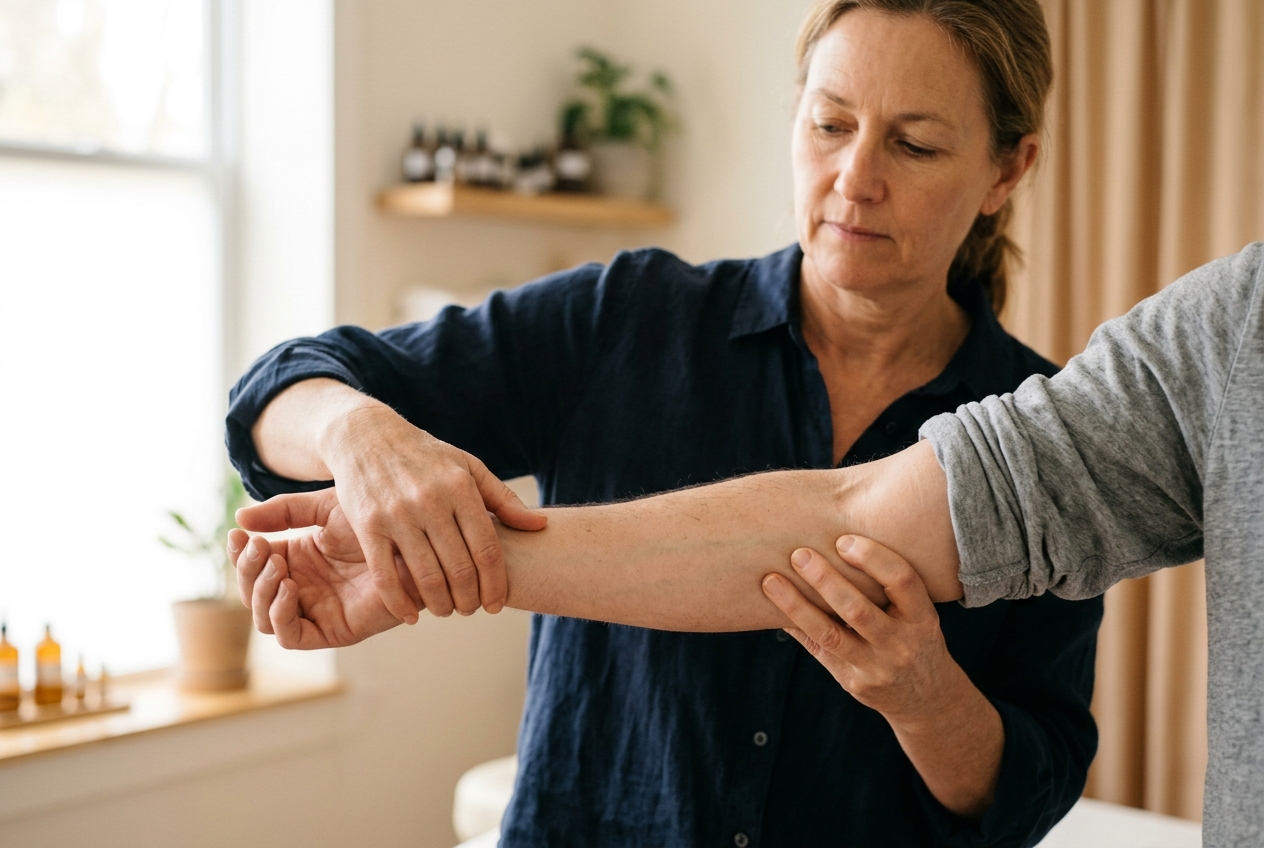
If you have ever experienced an afternoon marked by refractory epigastric fullness, an irritating dry cough that reverberates through the upper chest, or a sudden surge of sympathetic hyperarousal accompanied by thoracic constriction, you have encountered an isolated channel bottleneck. In contemporary life, physiological distress frequently localizes along specific anatomical tracks. When metabolic waste, postural strain, or emotional stress disrupts biological homeostasis, the body does not always suffer from diffuse, multi-systemic breakdown; rather, pathology often manifests as an acute or subacute stagnation confined to a single functional vector.
Traditional Chinese Medicine (TCM) provides a remarkably sophisticated diagnostic and therapeutic framework for addressing this exact phenomenon: Single-Meridian Point Combination (Ben Jing Pei Xue, 本经配穴法). While multi-channel strategies and Interior-Exterior pairings (Biao-Li, 表里配穴法) distribute therapeutic inputs across vast physiological networks, Ben Jing Pei Xue operates on the principle of focused linear coherence. By stimulating two or more distinct loci situated along the same energetic and morphological conduit, the practitioner concentrates therapeutic momentum, enhances neurofascial signal transduction, and swiftly clears obstructions within the targeted organ-meridian axis without risking cross-channel dispersion.
1. Classical Epistemology: The Foundations of Ben Jing Pei Xue
The conceptual architecture of single-meridian pairing originates in the foundational canons of East Asian medicine. In the Huangdi Neijing (Inner Canon of the Yellow Emperor), specifically within the Ling Shu (Spiritual Pivot, 灵枢), the energetic pathways are described not as isolated, static points, but as dynamic, uninterrupted rivers of vital substance (Huangdi Neijing Historical Overview). Chapter 10 of the Ling Shu (Jing Mai, 经脉) emphasizes that each meridian governs a discrete continuum of tissue, organ function, and affective resonance. When pathogen invasion or internal dysregulation affects a specific channel, the text advocates treating the specific conduit directly to restore its unimpeded flow (Tong Jing Zhi Qi, 通经致气).
[Distal Locus: Transport / Clearing] <==== Spatial Vector ====> [Proximal Locus: Organ Tonicity / Source Qi]
                                    \                        /
                                     \                      /
                             UNIFIED MERIDIAN FASCIA & DERMATOME
This foundational premise was further codified during the Ming Dynasty by Yang Jizhou in his seminal compendium, the Zhen Jiu Da Cheng (Great Compendium of Acupuncture and Moxibustion, 针灸大成). Yang Jizhou articulated that pairing acupoints on a single channel leverages the intrinsic hierarchy of the Five Shu (Wu Shu Xue) and Yuan-Source points. By combining a distal point (which exerts a powerful pulling, venting, or clearing dynamic) with a proximal point (which anchors, tonifies, or regulates the home organ), the clinician creates an uninterrupted energetic current.
Unlike broad, systemic prescriptions that disperse somatosensory stimuli across disparate spinal segments, Ben Jing Pei Xue concentrates the input within a closed loop. The classical literature refers to this as "concentrating the arrow's tip"—unifying the channel's vector to penetrate stubborn blood stasis (Yu Xue), phlegm-damp (Tan Shi), or counterflow Qi (Qi Ni).
2. Neurophysiological and Myofascial Mechanics of Intra-Channel Synergism
Modern biomedical research has begun to illuminate the precise biophysical substrates that underpin these ancient clinical observations. Rather than viewing meridians as mystical conduits, contemporary physiology increasingly correlates meridian trajectories with planes of cleavage in connective tissue, longitudinal neurovascular bundles, and specific dermatomal-myotomal distributions.
Myofascial Continuity and Mechanotransduction
Research pioneered by Dr. Helene Langevin and colleagues demonstrates that acupuncture points frequently correspond to intermuscular or intramuscular connective tissue cleavages rich in sensory nerve endings (Langevin et al., Subcutaneous Tissue Fibroblast Remodeling). Mechanical stimulation—whether via needle rotation or sustained, directional acupressure—deforms the extracellular matrix (ECM). This physical deformation triggers cellular mechanotransduction: fibroblasts undergo cytoskeletal remodeling, releasing adenosine triphosphate (ATP), adenosine, and nitric oxide into the interstitial space.
When two points are stimulated along the same continuous myofascial plane (such as the Deep Front Arm Line corresponding to the Lung meridian, or the Superficial Front Line corresponding to the Stomach meridian, as described in contemporary myofascial anatomy), an interstitial wave of shear strain propagates along the fascial track (Anatomical Principles of Fascia). This longitudinal continuity acts as a physical waveguide, amplifying mechanosensitive signaling and accelerating fluid drainage and cellular repair along the entire structural axis.
Dermatomal Distribution and Spinal Spatial Summation
From a neuroanatomical perspective, single-meridian point combinations often engage the same or contiguous spinal segments. According to the principles of neural integration, when action potentials from primary afferent fibers (A-beta, A-delta, and unmyelinated C-fibers) arrive at the dorsal horn from loci situated within the same dermatome or myotome, they induce spatial summation (Neurobiological Mechanisms of Acupuncture).
- Amplified Central Gating: Two sensory inputs arriving simultaneously or sequentially from the same dermatome generate a higher synaptic potential in dorsal horn interneurons than an isolated input. This triggers robust presynaptic inhibition of nociceptive projection neurons (the gate control mechanism).
- Segmental Viscerosomatic Reflex Modulation: Because the somatic afferents of a single meridian often converge onto spinal segments that share sympathetic or parasympathetic innervation with the corresponding visceral organ, single-channel pairing exerts a concentrated, coherent autonomic reflex, free from competing autonomic signals from distant, unrelated spinal segments.
3. Four Core Intra-Channel Pairings: Classical Rationale and Clinical Evidence
To appreciate the functional precision of Ben Jing Pei Xue, we examine four quintessential point pairings across major yin and yang channels, grounded in both classical energetic theory and modern empirical observation.
========================================================================================
CHANNEL               PAIRING             CLASSICAL MECHANISM     BIOMEDICAL CORRELATE
========================================================================================
Hand Taiyin (Lung)    LU5 + LU9           Clear Heat, Nourish Yin Pulmonary vagal reflex,
                                          Descend Lung Qi         ECM shear along arm
----------------------------------------------------------------------------------------
Foot Yangming (Stomach) ST36 + ST44       Purge Stomach Fire,     Vagal-gastric motility,
                                          Restore Peristalsis     substance P modulation
----------------------------------------------------------------------------------------
Foot Taiyin (Spleen)  SP6 + SP9           Drain Dampness,         Microvascular perfusion,
                                          Enhance Fluid Metabolism interstitial lymphatic flow
----------------------------------------------------------------------------------------
Hand Jueyin (Pericardium) PC3 + PC6       Unbind Chest Qi,        Cardiac autonomic balance,
                                          Regulate Shen (Spirit)  HRV parasympathetic shift
========================================================================================
1. Lung Channel (Hand Taiyin): LU5 (Chize) and LU9 (Taiyuan)
- Classical Architecture: LU5 is the He-Sea and Water point of the Lung channel, situated at the cubital crease; LU9 is the Shu-Stream, Yuan-Source, and Earth point located at the radial end of the wrist crease (WHO Standard Acupuncture Point Locations).
- Energetic Synergism: LU5 possesses a distinct downward-draining dynamic, purging Phlegm-Heat and suppressing rebellious Lung Qi (manifesting as spasmodic cough, wheezing, and throat fullness). Conversely, LU9 acts as the primary tonification point, strengthening the pectoral Qi (Zong Qi) and moistening pulmonary tissue. When paired, LU5 vents the acute pathological excess while LU9 anchors and nourishes the underlying organ reserve, preventing the exhaustion that often follows aggressive clearing techniques.
- Neurofascial Substrate: Both points lie along the brachioradialis and flexor carpi radialis fascial margins, innervated by cutaneous branches of the radial and lateral antebrachial nerves (C5–C7 segments). Their coordinated stimulation optimizes local tissue perfusion and downregulates pro-inflammatory cytokines in upper respiratory airways via somatic-vagal reflex arcs.
2. Stomach Channel (Foot Yangming): ST36 (Zusanli) and ST44 (Neiting)
- Classical Architecture: ST36 is the He-Sea and Earth point, situated on the anterolateral leg below the patella; ST44 is the Ying-Spring and Water point, situated in the web margin between the second and third toes.
- Energetic Synergism: Yangming channels are characterized by abundant Qi and Blood. However, when Stomach fire flares, it manifests as hyperacidity, epigastric burning, toothache, voracious appetite, and mental restlessness. ST44 serves as a physiological heat-sink, draining Yangming fire from the uppermost reaches of the channel. Concurrently, ST36 stabilizes the middle burner, harmonizes gastric secretions, and directs Qi downward (Jiang Qi).
- Neurofascial Substrate: ST36 and ST44 track the anterior compartment of the lower leg along the tibialis anterior muscle down to the deep fibular (peroneal) nerve distribution (L4–S1). Clinical electrophysiological studies confirm that co-stimulating these points significantly accelerates gastric emptying and modulates vagal efferent activity, restoring normal gastric slow-wave rhythms (Vagal and Gastrointestinal Modulation).
3. Spleen Channel (Foot Taiyin): SP6 (Sanyinjiao) and SP9 (Yinlingquan)
- Classical Architecture: SP6 is the junction point of the three lower Yin channels (Spleen, Liver, Kidney), located above the medial malleolus; SP9 is the He-Sea and Water point of the Spleen, located in the depression beneath the medial condyle of the tibia.
- Energetic Synergism: This pairing represents the premier intra-channel synergy for resolving Dampness and metabolic stagnation. SP9 acts as a hydraulic valve, opening the water pathways and directing pathological damp downward into the urinary bladder for excretion. SP6 tonifies Spleen transformation and transportation (Yun Hua), ensuring that new dampness is not generated.
- Neurofascial Substrate: Both loci lie along the medial tibial border, tracking the saphenous nerve and branches of the tibial nerve (L3–S1). Mechanical pressure along this fascial plane enhances venolymphatic return, reduces interstitial edema in the lower extremities, and modulates autonomic innervation to the pelvic viscera.
4. Pericardium Channel (Hand Jueyin): PC3 (Quze) and PC6 (Neiguan)
- Classical Architecture: PC3 is the He-Sea and Water point located on the transverse cubital crease; PC6 is the Luo-Connecting point located two inches proximal to the wrist crease between the tendons of palmaris longus and flexor carpi radialis.
- Energetic Synergism: The Pericardium protects the Heart and governs the vascular bed and affective stability (Shen). When emotional constraint or vascular spasm induces chest tightness, palpitations, or nausea, PC3 clears heat and toxic stagnations from the blood level, while PC6 unbinds thoracic constriction, regulates coronary hemodynamics, and settles the stomach.
- Neurofascial Substrate: Tracking directly along the median nerve corridor (C6–T1), this combination provides potent somatosensory input that projects directly to the nucleus tractus solitarii (NTS) in the brainstem. Co-activation of PC3 and PC6 induces a marked shift toward parasympathetic predominance, augmenting heart rate variability (HRV) and suppressing stress-induced sympathetic overdrive (Autonomic Mechanisms in Acupuncture).
4. Strategic Differential: Intra-Channel versus Complex Network Paradigms
A critical hallmark of clinical mastery in East Asian medicine is knowing when to select single-meridian pairing over multi-channel or Interior-Exterior (Biao-Li) combinations.
When Single-Meridian Pairing is Indicated
- Isolated Pathological Vectors: When the clinical presentation correlates precisely with the trajectory or internal organ of one channel (e.g., an acute unilateral Yangming headache, or acute gastric cramping without systemic multi-organ involvement).
- Acute Functional Excess: In conditions of sudden stagnation (e.g., acute respiratory phlegm-heat or acute food stagnation), single-channel pairing concentrates energetic momentum to quickly disperse the blockage.
- Patients Vulnerable to Somatosensory Overload: Highly sensitive, frail, or neurodivergent patients frequently experience nervous system exhaustion or paradoxical aggravation when presented with complex multi-channel treatments. Single-meridian therapy delivers an uncluttered, coherent neurological signal.
- Targeted Musculoskeletal and Fascial Rehabilitation: Post-stroke hemiparesis, localized tendinopathies, and focal neuralgias benefit immensely from linear intra-channel stimulation, which restores longitudinal fascial gliding and clears local perineural entrapment.
When Complex Network Strategies are Indicated
Conversely, Ben Jing Pei Xue is insufficient when the pathology involves: * Complex Multi-Organ Depletion: Conditions such as dual Spleen-Heart deficiency or Liver-Kidney Yin deficiency require multi-meridian tonification to nourish diverse physiological substrates simultaneously. * Interior-Exterior (Biao-Li) Imbalances: When an external pathogen trapped in the Taiyang bladder channel requires venting via the Shaoyin kidney channel, or when chronic Liver Qi stagnation invades the Stomach, an Interior-Exterior pairing is structurally mandatory.
5. Step-by-Step Clinical Acupressure Protocol
The following step-by-step clinical protocol applies the single-meridian strategy to the Stomach Channel (Foot Yangming), utilizing ST36 (Zusanli) and ST44 (Neiting) to resolve acute digestive stagnation, epigastric heat, and sympathetic gastrointestinal distress.
Phase 1: Patient Positioning and Structural Alignment
- Seat the patient comfortably in a semi-reclined posture with the knees flexed at approximately 120 degrees and the lower legs supported, allowing the anterior compartment muscles (tibialis anterior) to remain entirely slack.
- The practitioner sits laterally, establishing palpatory contact with the patient's lower extremity to assess temperature variations and fascial tension along the Yangming meridian corridor.
Phase 2: Distal Clearing at ST44 (Neiting)
- Precise Anatomical Location: Located on the dorsum of the foot, in the proximal depression of the interdigital web between the second and third metatarsophalangeal joints.
- Tactile Verification: Palpate with the tip of the thumb. The correct locus yields a distinctive, slightly aching, tender, or distending sensation (De Qi).
- Application Technique: 1. Apply firm, perpendicular pressure using the tip or radial border of the thumb. 2. Maintain a compressive force of 2.5 to 3.5 kg/cm² (firm enough to engage the deep fascial layer without causing protective muscular guarding). 3. Execute subtle counterclockwise micro-rotations (sedation dynamic) for 120 to 180 seconds. 4. Coordinate with the patient's respiration: exert deeper compression during the exhalation phase; gently maintain depth during inhalation.
Phase 3: Longitudinal Fascial Stroking (Tui Fa)
- Before engaging the proximal point, perform directional, linear stroking (Tui Fa) along the anterior tibial margin from ST36 down toward ST44.
- Using the palmar surface of the thumb with a light lubricant, stroke downward with moderate pressure 12 to 18 times. This maneuver mechanically primes the myofascial pathway and establishes directional momentum.
Phase 4: Proximal Regulation at ST36 (Zusanli)
- Precise Anatomical Location: Located on the anterior aspect of the lower leg, four finger-widths (3 cun) inferior to the lateral eye of the patella (Dubi, ST35), and one finger-breadth lateral to the anterior crest of the tibia, within the belly of the tibialis anterior muscle.
- Tactile Verification: Gentle pressure reveals a deep, radiating, pleasantly dull ache that may propagate down toward the dorsum of the foot.
- Application Technique: 1. Apply deep, sustained, perpendicular-to-inferior pressure using the flexed interphalangeal joint of the thumb or an elbow tip for larger patients. 2. Apply a depth of 3.5 to 4.5 kg/cm². 3. Execute rhythmic, clockwise compressions (tonification and harmonization dynamic) at a rate of 1 cycle every 2 seconds for 180 seconds. 4. Synchronize with the breath: encourage slow, diaphragmatic breaths (4 seconds in, 6 seconds out), intensifying downward pressure on the exhalation.
Phase 5: Simultaneous Harmonization
- Conclude the protocol by placing one thumb on ST36 and the other on ST44 simultaneously.
- Hold static, balanced, medium-depth pressure for 60 seconds, visualizing and allowing the unified bioelectrical and neurovascular current to equilibrate across the entire lower extremity.
6. Safety, Sensory Boundaries, and Clinical Contraindications
While acupressure is inherently a non-invasive modality, rigorous clinical practice demands adherence to biological safety standards and precise sensory boundaries.
- Sensory Discrimination: The practitioner must distinguish between true therapeutic sensations and pathological tissue trauma. The arrival of Qi (De Qi) is characterized by deep sourness (Suan), numbness (Ma), distension (Zhang), or heavy warmth (Zhong). If the patient reports sharp, lancinating, or burning pain, the pressure is either excessive or irritating a superficial cutaneous nerve branch. Immediate recalibration is required.
- Absolute Anatomical Contraindications: * Never apply deep acupressure over areas of localized dermatitis, active infections, unhealed surgical incisions, or acute bone fractures. * Avoid direct pressure over prominent varicose veins, aneurysm sites, or in patients with confirmed deep vein thrombosis (DVT), as compressive shear forces can dislodge emboli.
- Obstetric Precautions: Points that exert powerful descending, pelvic-decongesting, or uterine-contractile dynamics—most notably SP6 (Sanyinjiao), LI4 (Hegu), and BL60 (Kunlun)—are strictly contraindicated during pregnancy unless deployed by a licensed professional during active labor management.
- Clinical Escalation Red Flags: Acupressure is an adjunctive and restorative therapy. Patients presenting with acute "red flag" symptoms—such as unexplained crushing substernal chest pain radiating to the jaw or left arm, acute rigid abdomen, high unremitting fever, sudden neurological deficits, or progressive motor weakness—must be directed immediately to emergency biomedical facilities.
7. Practitioner Takeaway: The 2-Minute Autonomic Recalibration Protocol
For immediate clinical application or personal reset during moments of acute autonomic hyperarousal, thoracic tightness, or work-induced mental fatigue, execute this rapid Pericardium Intra-Channel Integration Protocol:
- Locate PC6 (Neiguan): Measure three finger-widths proximal to the distal wrist crease on the inner forearm, nestled directly between the two prominent tendons (palmaris longus and flexor carpi radialis).
- Locate PC3 (Quze): Locate the deep depression on the inner elbow crease, immediately medial to the thick biceps tendon.
- The 120-Second Technique: * Rest your forearm palm-up on a desk or lap. * Place your opposite thumb on PC6 and middle finger on PC3. * Take a slow, 4-second diaphragmatic inhalation through the nose. * As you exhale smoothly for 6 seconds, apply simultaneous, firm, inward-and-upward pressure on both points (achieving a dull, spreading warmth). * Continue this breath-synchronized compression for 120 seconds (12 complete breath cycles).
- Somatic Result: A perceptible opening of the chest cavity, lowering of resting heart rate, relief of diaphragmatic tension, and clear mental stabilization—demonstrating the profound therapeutic power of single-channel point combination.