Twelve Shu-Stream Points: Navigating Articular Joint Topography, Damp-Bi Syndrome, and Distal Acupressure Protocols
1. OPENING — A PROBLEM THIS SOLVES TODAY
THE SENSATION OF GRAVITATIONAL WEIGHT
If you have ever awakened to find your fingers stiff and resistant to flexion, experienced an inexplicable heaviness throughout your limbs after hours at a desk, or felt a dull, waterlogged ache settle into your knees and ankles on humid afternoons, you are experiencing what traditional East Asian medicine terms the intrusion of dampness and articular obstruction. In modern terms, this state reflects interstitial fluid stasis, low-grade myofascial inflammation, and reduced microcirculatory perfusion within the delicate periarticular connective tissues.
When systemic fatigue converges with local musculoskeletal strain, the body feels dense, unyielding, and mechanically compromised. Western clinical paradigms often categorize these non-specific, sub-inflammatory complaints as postural fatigue, tension arthralgia, or early-stage rheumatic discomfort. Conversely, classical Chinese medicine offers a targeted, physiologically coherent map designed to resolve this exact constellation of somatic weight and joint stagnation: the Twelve Shu-Stream Points (Shu Xue, 输穴).
Rather than treating systemic lethargy and localized joint tenderness as isolated phenomena, the classical canon recognized that the structural transitions of the human body—the carpal, tarsal, metacarpophalangeal, and metatarsophalangeal junctions—act as functional sluice gates. By understanding the biomechanical, neurofascial, and bioenergetic principles of these twelve points, one can deploy precise, non-invasive acupressure protocols to clear chronic stagnation, mobilize fluid dynamics, and restore structural ease across the locomotor system.
2. THE MERIDIAN PATH — A JOURNEY THROUGH THE BODY
THE HYDRODYNAMICS OF THE FIVE ANTIQUE NODES
To comprehend the clinical power of the Shu-Stream points, one must first visualize the classical architectural model of the Five Antique Transport Points (Wu Shu Xue, 五输穴). Formulated systematically in the foundational treatises of the Huangdi Neijing Ling Shu and expanded in the Nan Jing, the circulation of Qi and blood within the twelve primary channels is conceptualized through the dynamic metaphor of water traversing a river basin:
- Jing-Well (井): At the extreme distal tips of the digits, Qi bubbles forth like a subterranean mountain spring.
- Ying-Spring (荥): Moving toward the web spaces, the volume accelerates, trickling through narrow channels and clearing heat.
- Shu-Stream (输): Approaching the carpal and tarsal articular complexes, the current widens dramatically, transitioning from a shallow brook into a deep, pouring stream that irrigates internal organs and sinks into adjacent tissues.
- Jing-River (经): Traveling up the forearms and lower legs, the hydrodynamic force moves like a broad river across muscular planes.
- He-Sea (合): Reaching the expansive elbow and knee joints, the channel current plunges inward, converging into the visceral deep ocean.
The word Shu (输) translates literally as "to transport," "to pour," or "to convey." As channels traverse the extremities, they navigate complex bony prominences, retinacula, and multi-layered tendinous sheaths. The Shu-Stream points reside exclusively at these anatomical thresholds: immediately proximal or distal to the metacarpophalangeal (MCP) and metatarsophalangeal (MTP) joints, or nested directly within the carpal and tarsal depressions.
THE DUAL MECHANISM: FIVE-PHASE ATTRIBUTIONS & YUAN-SOURCE INTEGRATION
The diagnostic and therapeutic versatility of the Shu-Stream points hinges upon two vital theoretical doctrines codified in the Nan Jing (Difficulties 65–68):
1. The Yin Channels: Earth Phase and Primordial Source Convergence
On the six Yin channels (Lung, Spleen, Heart, Kidney, Pericardium, Liver), the Shu-Stream point holds an elemental attribution of Earth (Tu, 土). In Five-Phase correspondence, Earth governs the Spleen, muscle flesh, and the systemic transformation and transportation of fluids. Consequently, when pathological dampness infiltrates the body—manifesting as heavy limbs, visceral distension, and soft-tissue boggy swelling—the Yin Shu-Stream points serve as the primary clinical switchboard to drain turbidity and reinforce the body's structural matrix.
Crucially, the Nan Jing established that on the Yin meridians, the Shu-Stream points are simultaneously the Yuan-Source points (Yin jing yi shu wei yuan, 阴经以输为原). The Yuan-Source points are the somatic portals where congenital, primordial Qi (Yuan Qi)—originating in the renal-adrenal Mingmen complex and distributed via the Triple Burner (Sanjiao)—surfaces on the body's exterior. Thus, palpating or stimulating a Yin Shu-Stream point simultaneously addresses localized joint stagnation (Shu function) while tonifying the deepest constitutional reserves of the associated internal organ (Yuan function).
2. The Yang Channels: Wood Phase and Kinetic Dispersion
On the six Yang channels (Large Intestine, Stomach, Small Intestine, Bladder, Sanjiao, Gallbladder), the Shu-Stream points are attributed to the Wood (Mu, 木) element. Wood embodies the physiological dynamics of smooth coursing, kinetic movement, growth, and the venting of stagnation. In the context of pathology, environmental Wind (Feng) and Dampness (Shi) combine to generate Bi syndromes (痹证)—manifesting as migratory, shooting, or fixed joint pain. Yang Shu-Stream points leverage Wood dynamics to unblock obstructed fascia, course stagnant regional Qi, and dismantle articular immobility.
3. THE TWELVE SHU-STREAM POINTS: SYSTEMATIC ANATOMY & CLINICAL LOCALIZATION
To locate these points accurately, practitioner palpation must transition from abstract geometric measurements to exact, tactile bone-and-tendon landmarks as cataloged by the World Health Organization (WHO) Standard Acupuncture Point Locations.
GROUP A: THE SIX YIN SHU-STREAM (YUAN-SOURCE) EARTH POINTS
1. LU9 — Taiyuan (太渊, Great Abyss)
- Meridian System: Hand Taiyin (Lung).
- Elemental & Canonical Status: Earth (Mother point for tonification), Yuan-Source Point, Hui-Meeting Point of the Vessels (Mai Hui).
- Exact Anatomical Localization: Located on the radial aspect of the ventral wrist crease, in the anatomical depression lying between the radial artery and the tendon of the abductor pollicis longus, immediately proximal to the scaphoid bone.
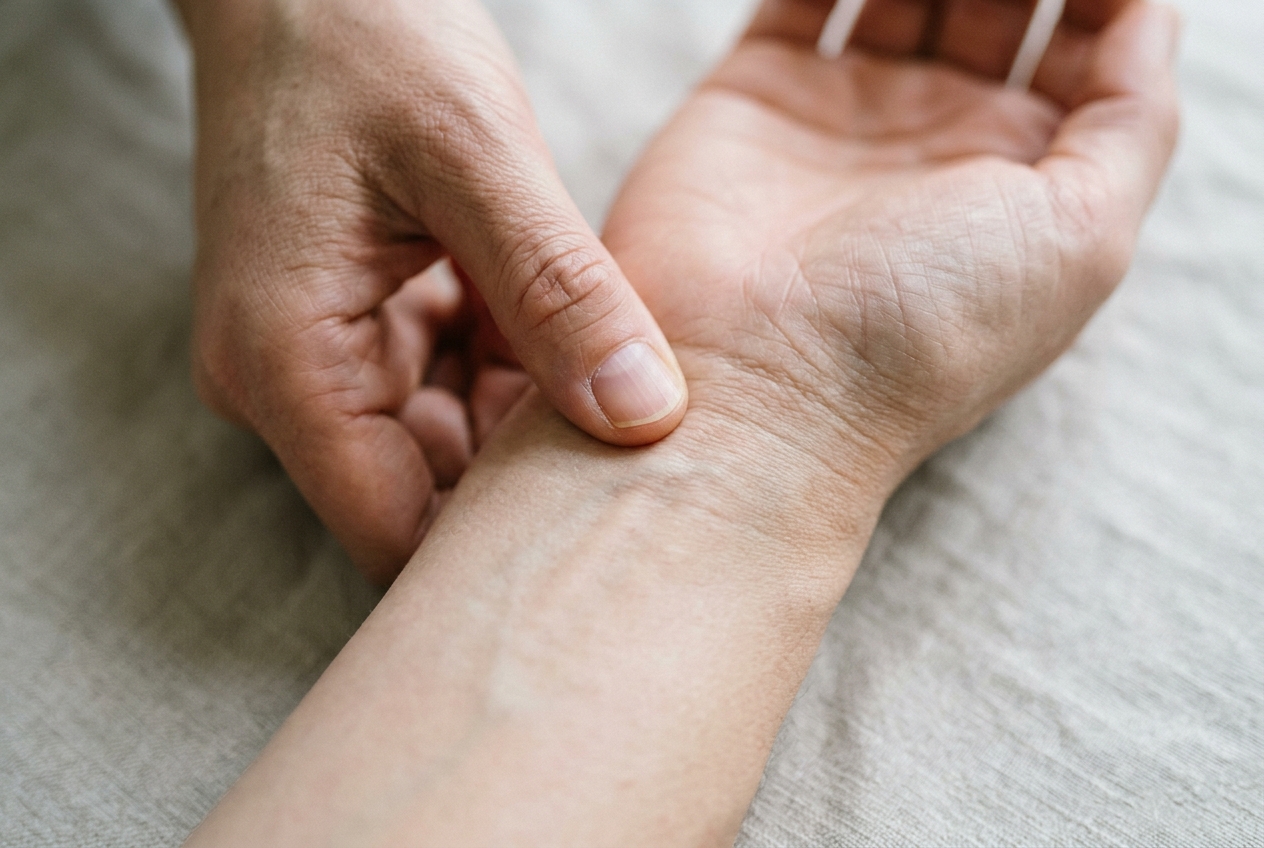
- Somatic Landmark Description: Turn your hand palm-up. Follow the base of your thumb down to the primary crease of your wrist. Feel for the pulsating radial artery; LU9 sits in the small, deep notch immediately to the thumb-side (radial side) of this arterial pulse.
- Deqi & Palpatory Sensation: A distinct, localized spreading distension or warm, pulsating sensation that radiates slightly along the thenar eminence.
- Biomechanical Application: Resolves vascular and fascial constriction of the forearm, improves vital capacity, relieves chronic cough, and tonifies fundamental Lung Qi.
2. SP3 — Taibai (太白, Supreme White)
- Meridian System: Foot Taiyin (Spleen).
- Elemental & Canonical Status: Earth (Self-Earth Point), Yuan-Source Point.
- Exact Anatomical Localization: On the medial aspect of the foot, in the depression situated proximal and inferior to the head of the first metatarsophalangeal (MTP) joint, precisely at the junction of the pigmented dorsal skin and the non-pigmented plantar skin (the "red and white border").
- Somatic Landmark Description: Run your finger along the inside edge of your foot, starting from the big toe toward the heel. As you pass the large, rounded ball of the big toe joint (the prominent knuckle), your finger will drop into a pronounced hollow just behind the bone.
- Deqi & Palpatory Sensation: A heavy, aching soreness that travels along the medial longitudinal arch of the foot.
- Biomechanical Application: The primary systemic point for resolving endogenous dampness, gastrointestinal distension, post-prandial lethargy, and generalized bodily heaviness.
3. HT7 — Shenmen (神门, Spirit Gate)
- Meridian System: Hand Shaoyin (Heart).
- Elemental & Canonical Status: Earth (Son point for sedation), Yuan-Source Point.
- Exact Anatomical Localization: At the ulnar end of the transverse crease of the wrist, in the articular depression radial to the flexor carpi ulnaris (FCU) tendon, directly proximal to the pisiform bone.
- Somatic Landmark Description: Look at your palm-up wrist. Trace down the edge of your little finger to the wrist crease. Feel the hard pea-shaped bone (the pisiform) on the outside corner. HT7 lies in the soft indentation right along the inside edge of the tight tendon anchored to that bone.
- Deqi & Palpatory Sensation: A profound, soothing, slightly radiating numbness or warmth tracking into the palm or proximal forearm.
- Biomechanical Application: Modulates autonomic nervous system tone, terminates severe insomnia, stabilizes cardiac palpitations, and clears emotional agitation.
4. KI3 — Taixi (太溪, Supreme Stream)
- Meridian System: Foot Shaoyin (Kidney).
- Elemental & Canonical Status: Earth, Yuan-Source Point.
- Exact Anatomical Localization: In the medial tarsal region, located in the deep depression equidistant between the prominent tip of the medial malleolus (inner ankle bone) and the medial border of the calcaneal (Achilles) tendon.
- Somatic Landmark Description: Place your thumb on the highest point of your inner ankle bone and your index finger on your Achilles tendon at the back of the heel. KI3 resides precisely at the deepest point of the valley midway between these two structures.
- Deqi & Palpatory Sensation: A deep, dull, grounding ache that often transmits warmth downward toward the sole of the foot (to point KI1) or upward along the posteromedial calf.
- Biomechanical Application: Tonifies systemic Yin and Yang, supports adrenal-renal function, resolves chronic lumbar soreness, clears tinnitus, and nourishes articular cartilage throughout the lower extremities.
5. PC7 — Daling (大陵, Great Mound)
- Meridian System: Hand Jueyin (Pericardium).
- Elemental & Canonical Status: Earth (Son point), Yuan-Source Point.
- Exact Anatomical Localization: In the midpoint of the transverse crease of the wrist, situated directly between the distinct tendons of the palmaris longus and flexor carpi radialis.
- Somatic Landmark Description: Clench your fist and flex your wrist slightly toward you so two prominent cables (tendons) stand out down the center of your wrist. PC7 is directly on the wrist crease, precisely in the cleft between these two taut bands.
- Deqi & Palpatory Sensation: A sharp, electric-tingling sensation (due to adjacent proximity to the median nerve) that quickly softens into a spreading, calming distension across the central palm.
- Biomechanical Application: Clears pericardial and cardiac heat, resolves acute gastroesophageal reflux, alleviates carpal tunnel compression, and arrests panic attacks.
6. LR3 — Taichong (太冲, Great Surge)
- Meridian System: Foot Jueyin (Liver).
- Elemental & Canonical Status: Earth, Yuan-Source Point.
- Exact Anatomical Localization: On the dorsum of the foot, in the prominent structural hollow distal to the junction of the bases of the first and second metatarsal bones.
- Somatic Landmark Description: Place your finger in the web space between your big toe and second toe. Slide your finger upward along the groove between the two long bones toward the ankle. About two finger-widths up, your finger will naturally wedge into a distinct triangular bony valley before the bones meet.
- Deqi & Palpatory Sensation: Highly reactive; typically elicits a sharp, spreading, achy soreness that rapidly unwinds systemic muscle tension.
- Biomechanical Application: The premier somatic site for smoothing constrained Liver Qi, mitigating hypertension, terminating temporal headaches, and breaking up somatic spasms.
GROUP B: THE SIX YANG SHU-STREAM WOOD POINTS
7. LI3 — Sanjian (三间, Third Space)
- Meridian System: Hand Yangming (Large Intestine).
- Elemental & Canonical Status: Wood.
- Exact Anatomical Localization: On the radial side of the index finger, in the anatomical depression lying immediately proximal to the head of the second metacarpal bone (second MCP joint), along the radial margin of the tendon of the first dorsal interosseous muscle.
- Somatic Landmark Description: Make a loose fist. Locate the large knuckle at the base of your index finger. Move your thumb just slightly back toward your wrist along the side of the index finger bone; feel for the soft pocket right behind the knuckle head.
- Deqi & Palpatory Sensation: A crisp, focal ache that radiates along the radial aspect of the index finger toward the thumb web.
- Biomechanical Application: Clears acute toothaches, alleviates pharyngitis, dispels heat stagnation in the Yangming channel, and eases dorsal hand arthralgia.
8. ST43 — Xiangu (陷谷, Sunken Valley)
- Meridian System: Foot Yangming (Stomach).
- Elemental & Canonical Status: Wood.
- Exact Anatomical Localization: On the dorsum of the foot, in the interosseous depression situated distal to the junction of the second and third metatarsal bones, proximal to the second and third MTP joints.
- Somatic Landmark Description: Slide your finger up the top of your foot starting from the web space between your second and third toes. As you move toward the ankle, drop into the long, deep depression between the two metatarsal shafts.
- Deqi & Palpatory Sensation: A dull, pervasive ache that relieves regional swelling across the foot dorsum.
- Biomechanical Application: Highly effective for reducing generalized facial and lower-extremity edema, treating generalized abdominal pain, and draining damp-heat from the gastrointestinal tract.
9. SI3 — Houxi (后溪, Back Stream)
- Meridian System: Hand Taiyang (Small Intestine).
- Elemental & Canonical Status: Wood, Confluent/Master Point of the Governing Vessel (Du Mai).
- Exact Anatomical Localization: On the ulnar border of the hand, in the prominent fleshy depression located immediately proximal to the head of the fifth metacarpal bone (fifth MCP joint), at the junction of the palmar and dorsal skin.
- Somatic Landmark Description: Make a tight fist. Look at the outer edge of your hand below the pinky finger. You will see a prominent skin fold flare out just behind the pinky knuckle. SI3 sits directly at the end of this crease, on the side of the hand.
- Deqi & Palpatory Sensation: A sharp, reverberating ache that frequently travels up the ulnar nerve pathway toward the elbow and posterior shoulder girdle.
- Biomechanical Application: Unlocks the entire cervical spine and occiput, resolves scapular rigidity, treats acute torticollis, relieves tension headaches, and stabilizes spinal biomechanics via the Du Mai.
10. BL65 — Shugu (束骨, Bundled Bone)
- Meridian System: Foot Taiyang (Bladder).
- Elemental & Canonical Status: Wood (Son point for sedation).
- Exact Anatomical Localization: On the lateral aspect of the foot, in the distinct depression located posterior and inferior to the head of the fifth metatarsal bone, at the border between the dorsal and plantar skin.
- Somatic Landmark Description: Run your finger along the outside edge of your foot, starting from the little toe toward the heel. Pass over the bony knuckle of the little toe; BL65 lies in the soft hollow immediately behind this bone on the outer edge.
- Deqi & Palpatory Sensation: A localized, slightly tender pressure that releases tension upward along the entire posterior myofascial chain.
- Biomechanical Application: Clears occipital cephalea, drains excess heat from the urinary tract, treats posterior leg cramping, and alleviates cervical-lumbar stiffness.
11. SJ3 / TB3 — Zhongzhu (中渚, Central Islet)
- Meridian System: Hand Shaoyang (Sanjiao / Triple Burner).
- Elemental & Canonical Status: Wood (Mother point for tonification).
- Exact Anatomical Localization: On the dorsum of the hand, between the fourth and fifth metacarpal bones, in the deep groove located approximately one finger-width proximal to the fourth metacarpophalangeal joint.
- Somatic Landmark Description: On the back of your hand, find the valley between the knuckles of your ring finger and little finger. Slide your finger back about an inch toward your wrist into the natural groove between the long hand bones.
- Deqi & Palpatory Sensation: A spreading, buzzing ache that ascends the dorsal forearm and posterior aspect of the neck to the retroauricular region.
- Biomechanical Application: The primary distal point for temporal tension headaches, lateral neck stiffness, shoulder impingement, tinnitus, and acute ear pain.
12. GB41 — Zulinqi (足临泣, Foot Governor of Tears)
- Meridian System: Foot Shaoyang (Gallbladder).
- Elemental & Canonical Status: Wood, Confluent/Master Point of the Girdling Vessel (Dai Mai).
- Exact Anatomical Localization: On the dorsum of the foot, in the depression situated distal to the junction of the bases of the fourth and fifth metatarsal bones, lying in the groove immediately lateral to the tendon of the extensor digitorum longus (branch to the little toe).
- Somatic Landmark Description: Trace upward along the top of your foot from the web space between your fourth and fifth toes. Move toward the outer ankle along the groove between the two outer bones until your finger drops into a deep hollow before the bone junction.
- Deqi & Palpatory Sensation: Highly tender and reactive; elicits an expansive sensation traveling along the lateral line of the leg to the hip and ribcage.
- Biomechanical Application: Regulates the lateral myofascial line, resolves intercostal neuralgia, treats migraine headaches, relieves premenstrual breast tenderness, and unblocks the Dai Mai.
NEUROFASCIAL MECHANISMS: THE BIOLOGY OF "DEQI" AND TRANSITORY FLUID CLEARANCE
Modern biomechanical investigations elucidate why the Shu-Stream points exert such disproportionate clinical effects on joint pain and systemic heaviness. Pioneering research led by Dr. Helene Langevin at the National Center for Biotechnology Information (NCBI) on Fascial Mechanotransduction demonstrates that acupoints located at intermuscular and peritendinous cleavage planes possess an exceptionally high density of unmyelinated nerve endings, mast cells, and interstitial collagen fibrils.
When manual pressure is applied to a Shu-Stream site (such as SP3, LR3, or SI3), the mechanical force deforms the extracellular matrix (ECM). This physical deformation triggers: 1. Cellular Cytoskeletal Remodeling: Fibroblasts dynamically alter their surface area, generating downstream cellular signaling that reduces tissue stiffness. 2. Purinergic Signaling: Local cells release adenosine triphosphate (ATP), which rapidly degrades into adenosine. Studies published in PubMed on Adenosine Receptor Activation confirm that adenosine binds to peripheral $A_1$ receptors to suppress local pain signaling. 3. Fluid Matrix Redistribution: The high hydrostatic pressure generated within carpal and tarsal retinacula drives stagnant, high-viscosity interstitial fluids back into the lymph-venous circulation, resolving the somatic "heaviness" (Zhuo Bi) documented in classical literature on Rheumatic Bi Syndromes.
4. CLINICAL SYNERGY: PROTOCOLS FOR COMMON SYNDROMES
The clinical efficacy of Shu-Stream points multiplies when combined using classical structural pairings, such as the Host-Guest Method (Yuan-Luo Combination, 原络配穴法) or the Bilateral Quad-Point Synergy.
5. SAFETY, CONTRAINDICATIONS & PHYSIOLOGICAL BOUNDARIES
While manual acupressure is a non-invasive, conservative modality, precise clinical guardrails must be observed to avoid adverse tissue reactions or physiological compromise.
6. TODAY’S TAKEAWAY: THE TWO-MINUTE RESET
THE EMERGENCY RESET FOR MENTAL EXHAUSTION AND CERVICAL RIGIDITY
You do not need an hour of leisure or specialized tools to change your physiological state. If you are reading this while seated at your desk, fatigued and experiencing an aching neck, perform this two-minute protocol right now:
By consciously engaging the Shu-Stream network, you translate ancient medical theory into an immediate biological reality—unlocking joint articulation, venting stagnant stress, and restoring systemic ease.
AUTHORITATIVE REFERENCES & FURTHER READING
- World Health Organization (WHO) Guidelines on Standard Acupuncture Nomenclature
- NCBI PMC: Fascial Mechanotransduction and Cellular Remodeling
- PubMed: Purinergic Signalling and Adenosine $A_1$ Receptor Activation at Acupoints
- NCBI PMC: Neurobiological Mechanisms of Acupuncture in Chronic Arthralgia and Bi Syndromes
- Wikipedia: Comprehensive Overview of the Five Shu Points System