Shi Er Duan Jin Twelve Section Brocade Qigong: Seated Spinal Decompression, Cranial Percussion, and Visceral Micro-Mobilization in Classical Medical Daoyin
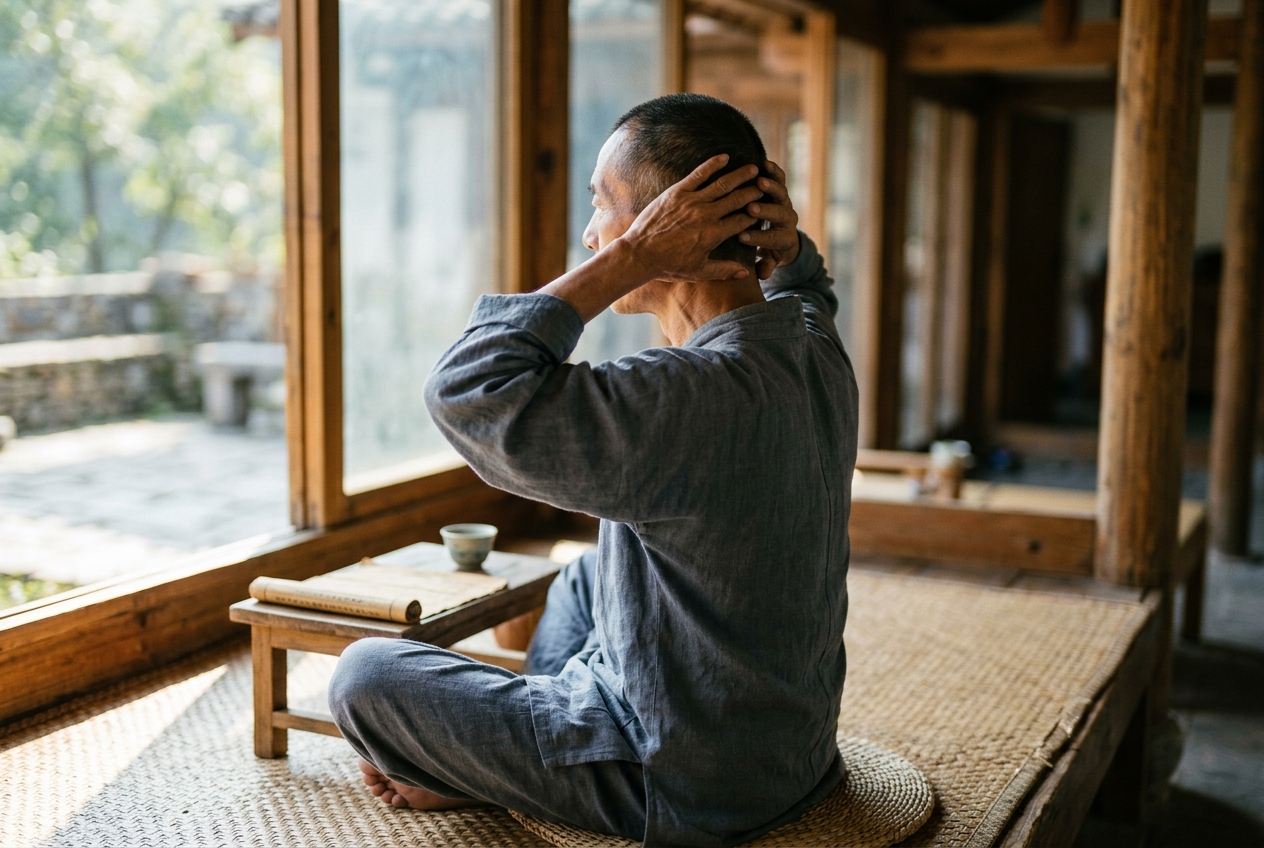
In essence, the sequence is a sophisticated routine of seated therapeutic movements, precise self-applied acoustic percussion, rhythmic cranial and visceral micro-mobilizations, and specialized breath regulation. Practitioners rhythmically click their teeth to stimulate cranial reflex pathways, tap the back of their skulls with vibrating fingers to induce acoustic bone conduction, rotate the cervical spine to decompress suboccipital nerve roots, and fold the torso forward to mobilize the thoracolumbar fascia and massage the kidneys. Classical texts describe this method as an internal alchemy intended to gather essence (Jing), circulate vital energy (Qi), and stabilize the spirit (Shen); modern clinical biomechanics reveals it as a potent system for autonomic re-tuning, cerebrospinal fluid hydrodynamic regulation, and microvascular decompression.
Step-by-Step Practice Guide
The modern standardized protocol codified by the World Health Organization and traditional lineages comprises twelve interconnected movements. Below is the clinical movement blueprint detailing the primary therapeutic sequences, breath-motion synchronization, error corrections, and somatic markers.
+-------------------------------------------------------------------------------+
|                      SHI ER DUAN JIN CLINICAL OVERVIEW                        |
+-------------------+-----------------------------------+-----------------------+
| Sequence Phase    | Primary Biomechanical Action      | Neurovascular Target  |
+-------------------+-----------------------------------+-----------------------+
| 1. Cranial Entry  | Kou Chi (36x) & Tongue Churning   | Trigeminal / sIgA     |
| 2. Acoustic Drum  | Ming Tian Gu (24x percussive tap) | Auditory / Brainstem  |
| 3. Cervical Pivot | Yao Tian Zhu (Rotational Shear)   | Suboccipital / Verteb.|
| 4. Axial Stretch  | Tuo Tian & Kai Gong               | Thoracic Duct / Phren.|
| 5. Lumbosacral    | Pan Zu Gu Shen & Renal Friction   | Renal Artery / Fascia |
| 6. Integration    | Dantien Respiration & Jade Swallow| Vagal Trunk / CSF     |
+-------------------+-----------------------------------+-----------------------+
Phase 1: Grounding and Cranial Activation (Kou Chi & Yan Yu Ye)
1. Baseline Seated Posture
Sit tall with your pelvis anchored. If seated cross-legged on a mat, use a firm zafu to ensure your hips are elevated 2–3 inches above your knees, allowing your lumbar lordosis to remain natural without posterior pelvic tilt. If seated on a chair, keep your feet flat, parallel, and hip-width apart, with your knees positioned at an exact 90-degree angle. Place your tongue lightly against the hard palate directly behind your upper incisors.
2. Knocking the Teeth (Kou Chi)
- Movement Sequence: Relax the facial musculature and masticatory muscles. Bring your upper and lower dental arches together in a rhythmic, light tapping motion. First, click the bilateral molars together 36 times with a crisp, audible resonance. Next, click the canine and premolar teeth 36 times. Finally, tap the anterior incisors 36 times.
- Tongue Churning (Chi Long Jiao Hai): Keeping the lips closed, circle the tip of the tongue along the buccal space (the groove between your teeth and inner cheeks and lips) 12 times clockwise, then 12 times counter-clockwise.
- Swallowing the Jade Liquid (Yan Yu Ye): Allow the pooling saliva to fill your oral cavity. Divide the accumulated fluid into three distinct portions. Inhale through your nose into your lower abdomen (about two inches below the navel). On a forceful, deliberate swallow, send each bolus down through the esophagus, visualizing the fluid plunging into the lower abdominal core (Dantian), accompanied by a complete abdominal exhalation.
- Common Mistakes: Clenching the jaw forcefully rather than executing a crisp, elastic percussion; swallowing air (aerophagia); failing to pause and collect adequate salivary fluid.
- Somatic Indicators: A sudden surge of warmth across the temporomandibular joint, increased parotid and submandibular salivation, and a descending sensation of gastrointestinal warmth and peristaltic relaxation.
Phase 2: Cranial Resonance and Cervical Mobilization (Ming Tian Gu & Yao Tian Zhu)
3. Sounding the Heavenly Drum (Ming Tian Gu)
- Movement Sequence: Elevate both arms bilaterally into abduction and external rotation. Cup the palms of both hands tightly over your ears so that the external auditory canals are fully sealed, with your fingers pointing directly toward the occiput at the base of your skull. Rest your index fingers across your middle fingers. In a snapping, downward motion, slide the index fingers off the middle fingers to firmly flick the suboccipital bone (occiput) on both sides simultaneously. Perform this percussive flick exactly 24 times.
- Breath Coordination: Maintain a continuous, gentle 4-second nasal inhalation and 6-second nasal exhalation throughout the tapping sequence without holding your breath.
- Common Mistakes: Allowing the palms to lose their airtight acoustic seal over the ear canals; tapping the cervical vertebrae directly rather than the occipital ridges; holding residual tension in the trapezius and levator scapulae muscles.
- Somatic Indicators: A deep, bell-like internal acoustic resonance echoing within the cranium, immediate reduction in mental chatter, and a clearing sensation across the optical field.
4. Turning the Heavenly Column (Yao Tian Zhu)
- Movement Sequence: Interlace your fingers lightly and rest your hands across your lower abdomen. Inhale slowly as you axially rotate your head and neck to the left, directing your gaze over your left shoulder as far as comfort allows without lifting the right shoulder or tilting the chin. Hold for an end-range pause of 2 seconds. Exhale smoothly as you return to midline. Repeat the movement smoothly to the right. Complete 12 to 18 alternating repetitions.
- Common Mistakes: Extending or flexing the cervical spine during rotation (keep the cervical axis purely vertical); hiking the contralateral shoulder to fake range of motion.
- Somatic Indicators: Gentle fascial shearing along the sternocleidomastoid, scalene, and splenius capitis muscles, accompanied by a release of tension at the C1–C2 atlantoaxial junction.
Phase 3: Spinal Distraction and Visceral Mobilization (Tuo Tian, Kai Gong & Pan Zu)
5. Supporting Heaven to Regulate the Triple Burner (Shuang Shou Tuo Tian)
- Movement Sequence: Interlace your fingers at the lower abdomen with palms facing upward. Inhale smoothly over 5 seconds while raising the hands along the anterior midline of the chest. At the level of the throat, rotate the palms outward and upward, pressing the hands vertically toward the ceiling until the elbows are fully extended without shrugging the shoulders. Gently look upward at the backs of your hands. Maintain this axial longitudinal traction for 3 seconds while your sit-bones press downward into the cushion. Exhale over 5 seconds, separating the palms and tracing two sweeping lateral arcs back down to the sides of the hips. Repeat 6 to 9 times.
- Somatic Indicators: Broad fascial expansion across the ribcage, elevation of the costal margins, and a distinct sensation of space opening throughout the thoracic and lumbar intervertebral spaces.
6. Arching the Back and Grasping the Feet (Pan Zu Gu Shen)
- Movement Sequence: Extend both legs straight out in front of you along the floor, keeping the knees soft (micro-bent) to avoid hamstring avulsion, with feet dorsiflexed. Inhale, sweeping both arms upward overhead into axial extension. Exhale as you hinge forward from the coxafemoral (hip) joints, maintaining an elongated lumbar spine as long as possible before allowing the thoracic spine to curve naturally forward. Grasp the lateral borders of your feet or the soles (Yongquan, Kidney 1) with your palms. Inhale deeply into the posterior aspect of your ribcage and kidneys (Shenshu, BL23), feeling the lower back expand horizontally. Exhale, releasing deeper into the forward flexion. Hold for 3 to 6 slow respiratory cycles, then gently roll upward vertebra-by-vertebra on an inhalation. Repeat 3 to 5 times.
- Common Mistakes: Forcibly jerking the spine to touch the toes; collapsing the chest and hunching the neck without hip flexion; locking the knee joints in hyperextension.
- Somatic Indicators: Deep longitudinal tension running along the superficial back fascial line (from the plantar fascia through the calves, hamstrings, and erector spinae to the epicranial aponeurosis), paired with warmth radiating through the bilateral renal beds.
Why It Works: The Neuro-Fascial and Visceral Science
The clinical efficacy of the Twelve Section Brocade lies at the intersection of modern neuroanatomy, fascial tensegrity, and autonomic physiology. Far from mystical conjecture, its actions correspond to demonstrable biophysical mechanisms confirmed across contemporary research hosted by the National Center for Biotechnology Information (NCBI).
+-------------------------------------------------------------------------------+
|                      SYSTEMIC PHYSIOLOGICAL MECHANISMS                        |
+--------------------------+----------------------------------------------------+
| Physiological Pathway    | Clinical Mechanism & Biomarkers                    |
+--------------------------+----------------------------------------------------+
| Trigeminal-Vagal Reflex  | Periodontal mechanoreceptor firing; salivary sIgA   |
| Acoustic Bone Conduction | Temporal-occipital sound waves; alpha-wave entrain.|
| Glymphatic Hydrodynamics | Cervical C1-C2 shear; subarachnoid CSF flow pump   |
| Thoracolumbar Shearing   | Deep lumbosacral decompression; BL23 perfusion     |
| Vagal Afferent Tone      | Diaphragmatic excursion; heart rate variability    |
+--------------------------+----------------------------------------------------+
1. Trigeminal-Vagal Reflex Arcs and Salivary Mucosal Immunology
The rhythmic percussive impact of Kou Chi (Knocking the Teeth) directly stimulates the high-density periodontal mechanoreceptors embedded within the alveolar bone and periodontium. These mechanoreceptors transmit rapid afferent sensory volleys through the mandibular and maxillary divisions of the trigeminal nerve (Cranial Nerve V) directly into the trigeminal sensory nucleus in the brainstem.
Simultaneously, the continuous circling of the tongue engages the hypoglossal nerve (CN XII) and the glossopharyngeal nerve (CN IX). This synchronized cranial nerve stimulation triggers parasympathetic reflex efferents via the salivatory nuclei, driving significant production of saliva enriched with salivary alpha-amylase and secretory immunoglobulin A (sIgA). Research indexed in PubMed Central on mind-body exercise mechanisms demonstrates that deliberate salivary cultivation and controlled deglutition (swallowing) stimulate vagal afferents along the esophageal plexus, downregulating systemic sympathetic tone and promoting gastrointestinal mucosal barrier defense.
2. Acoustic Bone Conduction and Suboccipital Neural Entrainment
The percussive flicking action of Ming Tian Gu (Sounding the Heavenly Drum) produces a calibrated acoustic wave that bypasses the tympanic membrane entirely. Because the palms hermetically seal the auricles, the kinetic energy of the fingers striking the occipital bone propagates directly through the squama occipitalis and the petromastoid portion of the temporal bone via solid-state acoustic bone conduction.
This localized sound resonance vibrates the perilymph and endolymph within the cochlea and semicircular canals, transmitting rhythmic electrical impulses across the vestibulocochlear nerve (CN VIII) into the superior olivary complex and primary auditory cortex. The repetitive, rhythmic nature of this acoustic stimulus exerts an entrainment effect upon cortical oscillations, dampening high-frequency beta-band stress patterns and shifting neural activity toward synchronous alpha (8–12 Hz) and theta (4–8 Hz) states. Somatically, this manifests as the immediate calming of the Shen (cognitive hyperactivity and emotional agitation) and a sharp decline in central hypothalamic-pituitary-adrenal (HPA) axis reactivity.
3. Cervical Biomechanics, Suboccipital Decompression, and Glymphatic Circulation
The human craniocervical junction—specifically the atlanto-occipital (C0–C1) and atlantoaxial (C1–C2) joints—represents an anatomical crossroad where muscular hypertonicity frequently impedes cerebral hemodynamics. The suboccipital triangle (formed by the rectus capitis posterior major, rectus capitis posterior minor, and obliquus capitis superior and inferior) contains the highest density of muscle spindles anywhere in the human body.
During Yao Tian Zhu (Turning the Heavenly Column), slow, unforced axial rotational shear gently mobilizes these suboccipital attachments. This decompresses the vertebral arteries as they traverse the suboccipital groove to enter the foramen magnum, optimizing basilar cerebral blood flow. Furthermore, modern neurological models highlight that cyclic cervical rotation and diaphragmatic respiration serve as an auxiliary mechanical pump for cerebrospinal fluid (CSF) hydrodynamics. The gentle pressure oscillations within the subarachnoid space accelerate metabolic waste clearance through the newly discovered glymphatic system, flushing neurotoxic interstitial solutes such as amyloid-beta and tau proteins from the brain parenchyma.
+-------------------------------------------------------------------------------+
|               CERVICAL ROTATION & CSF HYDRODYNAMICS DYNAMICS                  |
+-----------------------+-------------------------------------------------------+
| Biomechanical Event   | Neurological & Fluid-Dynamic Consequence             |
+-----------------------+-------------------------------------------------------+
| Axial Rotation (C1-C2)| Releases suboccipital myodural bridges & rectus caps. |
| Vertebral Unkinking   | Augments vertebrobasilar perfusion to cerebellum      |
| Intrathecal Pumping   | Fluctuates CSF hydrostatic pressure gradients         |
| Glymphatic Clearance  | Enhances interstitial metabolic solute wash-out       |
+-----------------------+-------------------------------------------------------+
4. Lumbosacral Fascial Traction and Bilateral Renal Perfusion
In the standing Eight Section Brocade, spinal flexion is distributed across the hips, knees, and ankle joints. In seated Twelve Section Brocade movements such as Pan Zu Gu Shen, the pelvic floor is mechanically constrained against the ground or chair. This seated ground reaction base fixes the ischial tuberosities, compelling the entire anterior pelvic hinge to stretch the thoracolumbar fascia and erector spinae musculature in complete isolation.
This deep longitudinal traction exerts a mechanical shear strain on the dense fascial planes enveloping the psoas major, quadratus lumborum, and renal fascia (Gerota's fascia). As detailed in studies on neuro-fascial shear and autonomic regulation, cyclic compression and elongation of these fascial envelopes stimulate embedded Ruffini endings and Pacini corpuscles, generating systemic sympathovagal inhibition. Moreover, the alternating intra-abdominal pressure differentials created during the flexion and extension phases act as a mechanical siphon, increasing pulsatile blood flow through the bilateral renal arteries and veins, clearing vascular congestion within the renal parenchyma, and supporting what classical somatic medicine terms the preservation of Mingmen (the gate of vitality).
Classical Lineage & Textual Context
The historical development of Shi Er Duan Jin reflects a fascinating centuries-long synthesis of early Daoist internal hygiene (Neidan), Chan Buddhist monastic gymnastics, and Ming dynasty medical scholarship. While popular folklore often attributes all Brocade exercises to the legendary Song Dynasty general Yue Fei (1103–1142 CE), historical textual analysis reveals a much more nuanced lineage.
The Song Dynasty Daoist Foundations
The earliest structural components of seated Daoyin appear in the Southern Song Dynasty (1127–1279 CE), preserved within the monumental Daozang (Daoist Canon). Early treatises, such as the Xiuzhen Shishu (Ten Books on Cultivating Perfection), documented sitting exercises that utilized cranial percussion, tooth tapping, and spinal rotations as monastic methods to counteract the somatic stagnations caused by prolonged seated meditation. These practices were designed not as cardiovascular athletics, but as energetic clearing rituals performed at dawn to awaken the cognitive and sensory faculties.
Gao Lian and the Zun Sheng Ba Jian (1591 CE)
The definitive textual crystallization of the Twelve Section Brocade occurred during the late Ming Dynasty under the eminent scholar-connoisseur and medical theorist Gao Lian (高濂). In his 1591 masterwork, Zun Sheng Ba Jian (Eight Treatises on Following the Principles of Life), Gao Lian compiled, refined, and systematically organized the disparate seated Daoyin verses into an elegant, coherent twelve-step regime.
Gao Lian recognized that scholars, officials, and sedentary practitioners suffered from chronic stagnation of the San Jiao (Triple Burner), cerebral fatigue, and lower back degeneration resulting from long hours of reading and brushwork. His text paired poetic instructional mnemonics with precise somatic explanations, establishing the core sequence: beginning with tooth tapping, proceeding through cranial drumming and spinal twisting, and concluding with deep abdominal gathering.
"When sitting quietly at dawn, first knock the teeth to summon the spirit, sound the heavenly drum to awaken the brain, and swallow the sweet spring to moisten the five viscera. Thus, the real fire circulates, and all illnesses disperse." — Gao Lian, Zun Sheng Ba Jian (1591)
Late Qing Refinements to Modern Standardization
During the late Qing Dynasty, martial artist and scholar Wang Zuyuan further popularized the system in his 1895 publication Neigong Tu Shuo (Illustrated Exposition of Internal Work), integrating the seated brocades directly with the restorative regimens of the Shaolin Temple.
In the modern era, the practice underwent clinical evaluation and standardization through the Chinese Health Qigong Association in collaboration with national sports and medical universities. Today, Shi Er Duan Jin stands as one of the four core standardized health Qigong forms, celebrated internationally for its therapeutic applicability in clinical rehabilitation, geriatric care, and stress-induced autonomic dysregulation.
Today's Practice Commitment & Clinical Protocol
To integrate the restorative power of the Twelve Section Brocade into your daily regimen, commit to the following structured, evidence-based clinical sequence. Perform this routine once daily—ideally at dawn or after prolonged sedentary screen work.
+-------------------------------------------------------------------------------+
|                       DAILY CLINICAL DOSING PROTOCOL                          |
+--------------------------+-------------------+--------------------------------+
| Movement Phase           | Repetitions/Time  | Breath Ratio (In:Hold:Ex:Hold) |
+--------------------------+-------------------+--------------------------------+
| 1. Kou Chi (Tooth Tap)   | 36 molars/incisors| Natural Resting Nasal Breath   |
| 2. Yan Yu Ye (Swallow)   | 3 distinct boluses| 4 : 0 : 6 : 0 (Vagal Exhale)   |
| 3. Ming Tian Gu (Drum)   | 24 snaps          | 4 : 0 : 4 : 0 (Rhythmic Coher.)|
| 4. Yao Tian Zhu (Twist)  | 12-18 alternations| 4 : 2 : 4 : 2 (Pause at Range) |
| 5. Tuo Tian (Reach)      | 6-9 cycles        | 5 : 3 : 5 : 0 (Axial Traction) |
| 6. Pan Zu (Back Forward) | 3-5 holds (30s ea)| 4 : 0 : 6 : 0 (Parasympathetic)|
+--------------------------+-------------------+--------------------------------+
Absolute Contraindications and Clinical Modifications
- Severe Cervical Disc Herniation / Acute Radiculopathy: In cases of diagnosed posterolateral cervical disc extrusion or active arm paresthesia, eliminate all extreme end-range rotation during Yao Tian Zhu (Turning the Heavenly Column). Restrict cervical movement to a gentle 15-to-20-degree pain-free arc without axial compression.
- Acute Lumbar Disc Sequestration: During Pan Zu Gu Shen (Arching the Back and Grasping the Feet), avoid deep lumbar flexion. Maintain a straight spine and hinge exclusively from the hips with deeply bent knees, or substitute with a gentle seated supine knee-to-chest stretch.
- Temporomandibular Joint (TMJ) Inflammatory Flares: In the presence of acute TMJ synovitis or disc displacement, replace forceful Kou Chi tooth tapping with gentle isometric jaw stabilization exercises and tongue-to-palate resting pressures.
Key Clinical Takeaways
+-------------------------------------------------------------------------------+
|                             SUMMARY OF FINDINGS                               |
+-------------------------------------------------------------------------------+
|  1. Axial Isolation: The seated ground reaction base isolates the spine,      |
|     eliminating lower-limb postural compensation.                             |
|  2. Cranial Stimulation: Tooth percussion and occipital tapping stimulate    |
|     trigeminal (CN V), auditory (CN VIII), and vagal (CN X) pathways.         |
|  3. Fluid Dynamics: Micro-rotations facilitate suboccipital decompression,    |
|     optimizing glymphatic waste clearance and CSF circulation.                |
|  4. Visceral Mobilization: Controlled forward hinges cycle intra-abdominal    |
|     pressures, enhancing renal perfusion and thoracolumbar fascial shear.     |
+-------------------------------------------------------------------------------+
Your Immediate 5-Minute Action Step
Tomorrow morning, before opening your computer or drinking your first caffeinated beverage, sit at the edge of your bed or a sturdy chair. Complete 36 taps of the teeth, churn the tongue to swallow three mouthfuls of jade liquid, and flick the base of your skull for 24 beats of the heavenly drum.
Observe the immediate shift in your mental clarity, the slackening of tension in your suboccipital muscles, and the gentle descent of your breath into the lower abdominal basin. In less than five minutes, you will have engaged a 400-year-old lineage of somatic neuroscience—transforming ancient internal alchemy into modern, quantifiable vitality.