Ascending, Descending, Floating, and Sinking (Sheng Jiang Chen Fu) Directional Dynamics: Governing Movement Tendencies, Visceral Vector Alignment, and Pathological Counter-Flow Regulation in Traditional Chinese Medicine
1. Opening Scene — A Moment You'll Recognise
Consider two familiar, everyday physical sensations that seem entirely unrelated. In the first, you have just finished a rushed lunch at your desk; within thirty minutes, an invisible anchor pulls at your eyelids, your limbs feel heavy as wet sand, and your thoughts drift into a sluggish, postprandial stupor. In the second scenario, you are caught in an escalating traffic jam before a crucial meeting; your jaw tightens, heat rushes upward into your cheeks, a throbbing ache takes root behind your temples, and an acidic burn creeps up the back of your throat.
In conventional Western medicine, these events are categorized under disparate silos: postprandial somnolence, gastroesophageal reflux, and stress-induced tension cephalalgia. In the classical framework of Traditional Chinese Medicine (TCM), however, both phenomena represent failures of internal biomechanics—specifically, the breakdown of directional movement known as Sheng Jiang Chen Fu (升降沉浮), or the ascending, descending, floating, and sinking dynamics of physiological Qi.
Every living organism is an open thermodynamic system governed by directional vectors. When the body’s upward propulsion fails to lift clarity to the brain, we experience heavy fatigue; when downward containment collapses, digestive juices and physiological heat rebel upward against gravity. Understanding these four directional pathways provides an elegant, clinically validated map of how our viscera interact, how disease takes shape, and how balance can be systematically restored.
2. What This Organ System Does: The Dynamic Axis of Sheng, Jiang, Chen, and Fu
At the core of classical East Asian physiology lies a fundamental premise: life is motion, and health is the harmonic coordination of directional energetic vectors. The seminal medical canon, the Huangdi Neijing (The Yellow Emperor’s Inner Classic, c. 2nd century BCE), articulates this foundational law in the Suwen (Plain Questions, Chapter 68):
"Without ascending and descending, there can be no birth, growth, transformation, gathering, or storing... Hence, the movements of exiting and entering, ascending and descending, are the essential mechanisms of all life."
In this systemic model, the internal organs (Zang-Fu) do not operate as isolated metabolic units, but rather as paired energetic pumps and levers that establish internal spatial balance through four basic trajectories:
- Ascending (Sheng 升): Upward movement from the lower and middle torso toward the chest, head, and sensory orifices. It lifts clear nutrients, elevates consciousness, and maintains structural suspension of the organs.
- Descending (Jiang 降): Downward movement that carries digested food, fluids, and metabolic waste toward the excretory channels, while anchoring physiological fire so it does not scorch the upper body.
- Floating (Fu 浮): Outward, centrifugal movement spreading from the deep interior toward the skin, musculature, and peripheral capillaries, opening the pores and maintaining immune defense (Wei Qi).
- Sinking (Chen 沉): Inward, centripetal movement that guides energies into the deep reservoirs of the viscera and bone marrow, consolidating vital substances and anchoring mental focus.
The Central Spleen-Stomach Pivot (Pi-Wei)
In the 13th century, the master physician Li Dongyuan formulated the "School of the Earth" in his groundbreaking text Pi Wei Lun (Treatise on the Spleen and Stomach, 1249 CE). Li demonstrated that systemic directional equilibrium depends entirely on the digestive center—the Middle Jiao—which functions as the mechanical pivot of the entire body.
The Spleen (Pi) is responsible for extracting the subtle essence from food and fluid and propelling this "Clear Yang" (Qing Qi) upward to the heart and lungs, which then oxygenate and circulate it to nourish the brain, eyes, and sensory organs. Concurrently, the Stomach (Wei) governs the decomposition of food and must bear the "Turbid Yin" (Zhuo Qi) downward into the small and large intestines for separation and evacuation.
If the Spleen fails to ascend, the brain is deprived of metabolic fuel, and the unprocessed essence sinks into the bowels, causing bloating and diarrhea. If the Stomach fails to descend, food stagnates, generating fermentation, halitosis, belching, and upward gastric reflux.
The Peripheral Canopy: Liver, Lung, Heart, and Kidney
Around this central digestive axis, the remaining organs form complementary directional polarities: 1. The Liver (Gan) and Lung (Fei): The Liver oversees the smooth, expansive coursing of blood and Qi (Shuxie), directing vitality upward and outward from the left side of the torso. The Lung, residing at the anatomical zenith, acts as a canopy: it diffuses fluids outward to the skin (Xuanfa) while forcefully descending (Sujiang) inspired air and waste fluids downward toward the urinary bladder and Kidneys. 2. The Heart (Xin) and Kidney (Shen): The Heart, representing imperial Fire in the Upper Jiao, must send its warmth downward to prevent the lower body from becoming cold and stagnant. Simultaneously, the Kidney, representing primeval Water in the Lower Jiao, must vaporize its fluids upward to moisten and cool the Heart, preventing emotional agitation and insomnia.
Recognized globally across integrative care frameworks by the World Health Organization, this closed-loop directional choreography ensures that our physiological systems remain resilient against physical, environmental, and emotional stressors.
3. How You Can Feel It — Signs of Balance and Imbalance
When directional dynamics are harmonious, the body feels light, mentally sharp, emotionally stable, and digestively quiet. When these vector forces lose synchronization, distinct clinical syndromes emerge.
Sinking Pathologies: Failure of Ascent (Zhong Qi Xia Xian)
When middle-burner Qi is chronically depleted through overwork, chronic worry, or poor nutrition, the upward lifting mechanism collapses. Clear Yang drops downward instead of rising: * Physical Sensation: Profound post-meal exhaustion, brain fog, heavy sensations in the lower abdomen, pelvic floor laxity, uterine or hemorrhoidal prolapse, and chronic, undigested loose stools. * Mental-Emotional State: Lethargy, lack of motivation, apathy, and a sensation of sinking depression where even minor challenges feel insurmountable.
Counterflow Rebellion Pathologies (Qi Ni)
When the descending mechanisms are blocked by emotional constraint, heat, or dietary excess, Qi moves in reverse against its natural gradient: * Stomach Qi Rebellion: Instead of descending, the Stomach surges upward, manifesting as nausea, belching, intractable hiccups, acid indigestion, and functional dyspepsia. * Lung Qi Rebellion: When the Lung canopy fails to downbear, respiratory Qi rebels upward, resulting in dry coughing, wheezing, bronchial tightness, and shallow breathing. * Liver Yang Rising (Gan Yang Shang Kang): When the soothing descent of Kidney water fails to anchor Liver wood, the Liver's ascending energy surges violently upward. This manifests as throbbing temple migraines, tinnitus resembling rushing water, facial flushing, bloodshot eyes, irritability, and sudden spikes in blood pressure.
Directional Self-Assessment Matrix
To evaluate your current vector balance, assess your symptoms across the following table:
| Vector State | Dominant Everyday Symptoms | Primary Organ Pattern | Underlying Mechanical Cause |
|---|---|---|---|
| Normal Balance | Energetic clarity upon waking, smooth digestion, warm feet, cool head. | Harmonious Zang-Fu | Balanced ascending/descending axis |
| Pathological Sinking | Postprandial exhaustion, pelvic heaviness, chronic loose stools, brain fog. | Spleen Qi Sinking (Pi Qi Xia Xian) | Insufficient Clear Yang ascent |
| Pathological Rebellion (Upper) | Acid reflux, frequent belching, nausea, globus sensation in throat. | Stomach Qi Rebellion (Wei Qi Ni) | Impaired digestive downward bearing |
| Pathological Rising (Hyper-Ascent) | Throbbing headaches, red eyes, sudden anger, dizziness, hypertension. | Liver Yang Rising (Gan Yang Shang Kang) | Loss of downward containment / anchoring |
| Pathological Dispersion (Floating) | Spontaneous daytime sweating, vulnerability to catching colds, restless anxiety. | Unstable Wei Qi / Heart Fire floating | Failure of inward consolidation and sinking |
4. Qigong & Movement Practice: Separating Heaven and Earth (Tiao Li Pi Wei Xu Dan Ju)
To restore the central vertical axis and regulate the opposing vectors of the Spleen and Stomach, traditional Chinese medicine utilizes specific mindful movement practices. The classical routine Separating Heaven and Earth (also known as Regulating the Spleen and Stomach by Lifting a Single Hand) is the third movement of the ancient Eight Section Brocade (Ba Duan Jin), documented in biomedical research on NCBI PMC for improving autonomic tone and gastrointestinal motility.
Step-by-Step Instructions
1. Starting Position & Setup
- Stand with feet shoulder-width apart, parallel to one another.
- Allow your knees to soften slightly, unlocking the joints.
- Relax your pelvis, letting the tailbone sink gently toward the floor.
- Rest your tongue lightly against the roof of your mouth just behind your upper teeth.
- Bring both hands in front of your navel, palms facing upward, fingers loosely curled as if cradling a sphere of warm light at the solar plexus (Zhongwan, CV-12).
2. The Bi-Directional Expansion
- Inhale slowly through your nose for 4 seconds: As you inhale, turn your left palm upward and begin raising it along the midline of your chest. Simultaneously, turn your right palm downward and press it toward the floor at your right hip.
- Hold & Extend (2 seconds): As the left hand clears your head, rotate the palm outward and press firmly upward toward the sky ("Heaven"), fingers pointing inward to the right. Concurrently, press the right palm firmly downward toward the floor ("Earth"), fingers pointing forward.
- Biomechanical Vector: Feel a gentle, opposing vertical traction throughout your rib cage, stretching the epigastrium and opening the space between the stomach and spleen. Keep your shoulders down and avoid arching your lower back.
3. Return to the Center
- Exhale smoothly through your nose for 4 seconds: Soften the elbows and wrists. Slowly bring both hands back toward the solar plexus, rotating the palms until they cradle each other once again at the midline.
4. Alternate and Repeat
- Inhale: Now press the right hand up to the heavens while the left hand presses down to the earth.
- Exhale: Return both hands gently to the center.
Practice Parameters
- Duration & Frequency: Perform 8 to 12 repetitions on each side (approximately 5 to 7 minutes daily).
- Optimal Timing: Best performed in the morning or approximately one hour after meals to stimulate healthy peristalsis and disperse abdominal distension.
- Sensations to Observe: As you establish the rhythm, you may notice a release of tension in the diaphragm, gurgling in the digestive tract (peristaltic activation), and a warming sensation radiating from the abdomen outward toward the hands and feet. This indicates that the central pivot is clearing and the ascending and descending pathways have reopened.
5. Acupressure Points You Can Try Today
Acupressure applies mechanical stimulation to specific neurovascular nodes along meridian pathways, activating autonomic reflexes that recalibrate visceral motility. The following three points directly modulate the body's directional vectors.
1. Baihui (GV-20) — "Hundred Convergences"
- Directional Vector: Strongly Ascending (Sheng). It lifts prolapsing, sunken Yang energy up to the brain.
- Location: Located on the exact vertex of the head. To find it, trace your thumbs up from the tips of your ears to the top of your skull; the point sits in a small, soft depression along the midline.
- Application Technique: Use your middle or index finger to apply moderate, upward-directed circular pressure. Maintain steady, gentle pressure for 2 to 3 minutes while taking slow, deep abdominal breaths.
- Primary Clinical Indications: Postprandial lethargy, chronic brain fog, orthostatic lightheadedness, mental fatigue, and prolapse sensations in the lower abdomen.
2. Zusanli (ST-36) — "Leg Three Miles"
- Directional Vector: Primarily Descending (Jiang) and Centering. It anchors rebellious upward energy, supports Stomach downbearing, and reinforces digestive transformation.
- Location: On the outer side of the lower leg. Place your four fingers horizontally across your shin directly below the bottom of your kneecap. ST-36 is located one finger-width outward from the prominent crest of the shinbone (tibia), in the belly of the tibialis anterior muscle.
- Application Technique: Apply firm, deep pressure using your thumb or knuckle. Knead the muscle in small circles for 2 to 3 minutes per leg until an aching sensation (De Qi) radiates down the meridian.
- Primary Clinical Indications: Epigastric fullness, acid reflux, nausea, constipation, generalized exhaustion, and poor nutrient absorption. Extensive clinical research on NCBI PubMed validates ST-36 for modulating gastric myoelectric activity and reducing systemic inflammation.
3. Neiguan (PC-6) — "Inner Gate"
- Directional Vector: Downbearing and Centering. It unbinds thoracic constriction, calms emotional agitation, and forces rebellious Stomach Qi to descend.
- Location: On the palmar aspect of the forearm, two proportional finger-widths (the width of your index and middle fingers together) above the distal wrist crease, situated directly between the two prominent flexor tendons (palmaris longus and flexor carpi radialis).
- Application Technique: Press deeply into the groove between the tendons using your thumb. Hold steady, firm pressure for 90 seconds while gently flexing and extending your wrist.
- Primary Clinical Indications: Nausea, motion sickness, stress-induced heartburn, chest tightness, palpitations, and situational anxiety.
6. Food, Pharmacology, and Formula Architecture: Modulating Vectors Through Herbology and Diet
In classical pharmacology, the directional motion of medicinal substances is not arbitrary. It is governed by a rigorous matrix integrating botanical physical characteristics, the Four Natures (Si Qi), the Five Flavors (Wu Wei), and specialized pharmaceutical processing methods (Pao Zhi).
Botanical Morphology and Physical Density
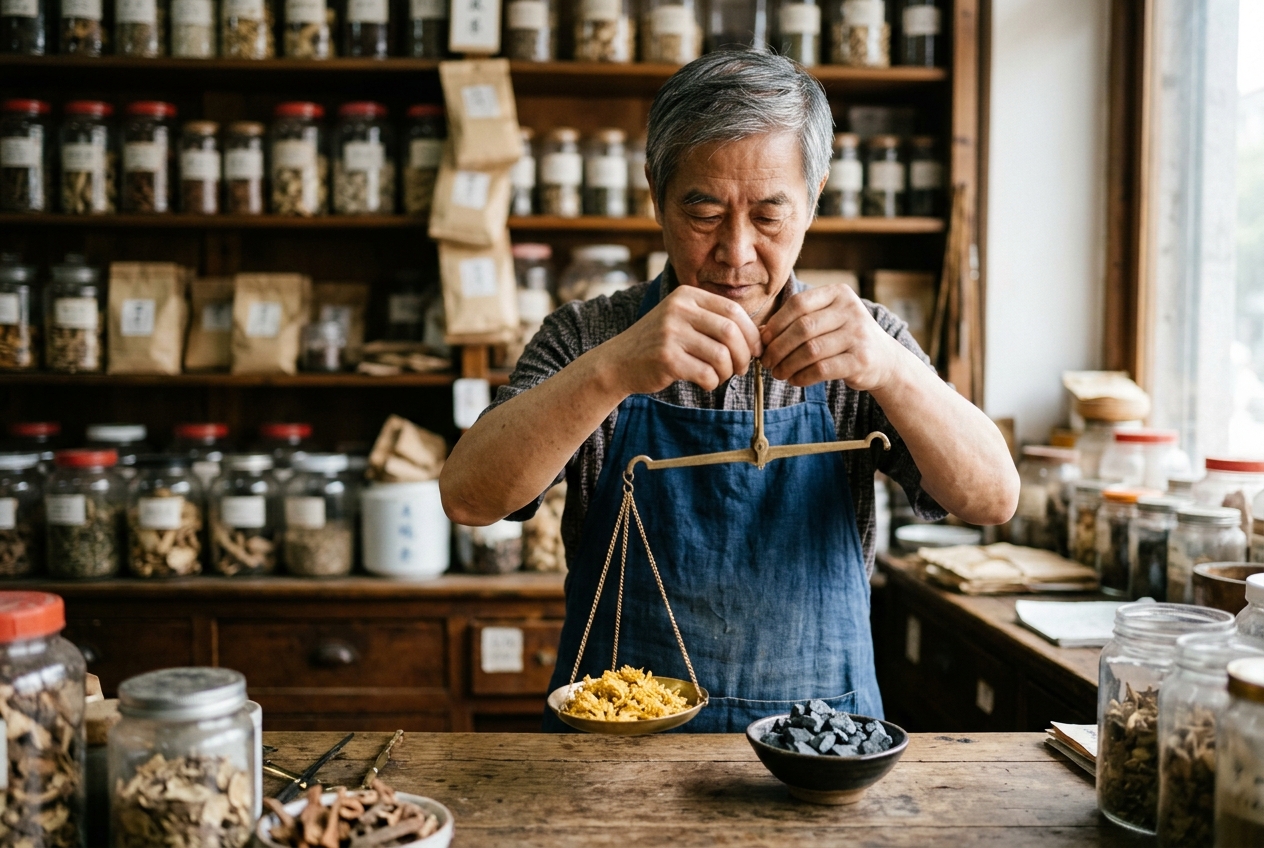
The intrinsic physical properties of plants and minerals determine their energetic trajectory through the human body: * Light, Aerial Parts (Flowers, Leaves, Twigs): Because they grow toward the sun and possess minimal density, they disperse outward and travel upward. Examples include peppermint (Bo He), chrysanthemum flowers (Ju Hua), and cinnamon twigs (Gui Zhi). * Heavy, Dense Parts (Roots, Barks, Minerals, Shells): Because of their mass and downward geotropism, roots and minerals descend toward the lower body and anchor rising pathologies. Examples include magnetitum (Ci Shi), oyster shell (Mu Li), achyranthes root (Niu Xi), and hematite stone (Dai Zhe Shi).
The Four Natures and Five Flavors (Si Qi Wu Wei)
The thermodynamic and gustatory profiles of substances directly govern cellular and visceral vector mechanics: 1. Acrid (Xin) & Sweet (Gan) Flavors paired with Warm (Wen) or Hot (Re) Natures: These substances possess expansive, buoyant energy. Acrid flavors scatter outward (Floating), while sweet flavors tonify and lift (Ascending). 2. Bitter (Ku), Sour (Suan), & Salty (Xian) Flavors paired with Cold (Han) or Cool (Liang) Natures: These substances possess contractive, grounding energy. Bitter flavors clear heat and force drainage downward (Descending); sour flavors astringe and bind; salty flavors soften hardness and purge downward (Sinking).
The Art of Directional Processing (Pao Zhi)
One of the most sophisticated achievements of Chinese medicine is the ability to fundamentally redirect an herb’s vector through specific alchemical preparation (Pao Zhi), as documented in historical compendia and indexed in the NCBI Bookshelf on Herbal Medicine:
- Wine Processing (Jiu Zhi): Frying an herb with yellow rice wine confers a light, rising quality, guiding compounds upward toward the head and upper limbs (e.g., wine-fried Huang Lian clears fire from the eyes and throat rather than purging the intestines).
- Ginger Juice Processing (Jiang Zhi): Macerating or frying with fresh ginger juice adds an acrid, warm quality that enhances the dispersion of phlegm and counteracts vomiting by forcing Stomach Qi downward (e.g., ginger-processed Ban Xia).
- Salt-Water Processing (Yan Zhi): Baking an herb with brine directs its pharmacodynamics downward toward the Kidneys and urinary bladder in the Lower Jiao (e.g., salt-baked Du Zhong or Huang Bo).
- Vinegar Processing (Cu Zhi): Frying with rice vinegar imparts an astringent, sour character that guides constituents directly into the Liver meridian, stabilizing pain and arresting bleeding.
Classical Formula Architecture: Two Master Vector Formulations
To observe these vector dynamics in clinical practice, consider two landmark formulas designed around the mechanics of ascending and descending.
1. Bu Zhong Yi Qi Tang (Tonify the Middle and Augment the Qi Decoction)
Formulated by Li Dongyuan (1249 CE) to treat Spleen Qi sinking, chronic fatigue, and visceral organ prolapse.
| Medicament (Pin Yin) | Botanical / Zoological Identity | Directional Vector | Role in Classical Hierarchy | Modern Pharmacological Action |
|---|---|---|---|---|
| Huang Qi | Astragalus membranaceus (Root) | Ascending / Floating | Sovereign (Jun) | Immunomodulatory; elevates central blood pressure; enhances organ suspension tone. |
| Ren Shen | Panax ginseng (Root) | Ascending / Centering | Minister (Chen) | Improves mitochondrial ATP synthesis; enhances myocardial contractile efficiency. |
| Bai Zhu | Atractylodes macrocephala | Ascending / Drying | Minister (Chen) | Accelerates gastric fluid clearance; resolves intestinal mucosal edema. |
| Chai Hu | Bupleurum chinense (Root) | Pure Upward Ascent | Assistant (Zuo) | Modulates hepatic glucose output; acts as an energetic elevator vector. |
| Sheng Ma | Cimicifuga heracleifolia | Pure Upward Ascent | Assistant (Zuo) | Synergizes with Chai Hu to guide clear Yang upward to the cerebral vasculature. |
| Chen Pi | Citrus reticulata (Peel) | Descending / Regulating | Assistant (Zuo) | Promotes gastric emptying; prevents middle-burner fullness caused by tonics. |
2. Ban Xia Xie Xin Tang (Pinellia Epigastrium-Draining Decoction)
Formulated by Zhang Zhongjing in the Shanghan Lun (c. 220 CE) to treat the "Middle Jiao Glomus" (Pi Zheng)—a state where hot and cold are tangled across the diaphragm, causing concurrent vomiting (upward rebellion) and diarrhea (downward collapse).
| Medicament (Pin Yin) | Botanical Identity | Flavor & Thermal Nature | Directional Vector | Pharmacodynamic Mechanism |
|---|---|---|---|---|
| Ban Xia | Pinellia ternata | Acrid, Warm | Descending (Jiang) | Antiemetic; regulates gastric pacing via neurokinin receptor pathways. |
| Gan Jiang | Zingiber officinale (Dried) | Acrid, Hot | Ascending / Warming | Stimulates mesenteric arterial flow; dispenses digestive cold. |
| Huang Qin | Scutellaria baicalensis | Bitter, Cold | Descending / Draining | Broad-spectrum anti-inflammatory; drains mucosal heat and reduces bacterial enterotoxins. |
| Huang Lian | Coptis chinensis | Bitter, Cold | Descending / Draining | Berberine-rich constituent; suppresses dysbiosis and inhibits mucosal hypersecretion. |
| Ren Shen / Da Zao / Gan Cao | Ginseng, Jujube, Licorice | Sweet, Warm/Neutral | Centering / Tonifying | Buffers the gastrointestinal lining; provides essential amino acids and oligosaccharides. |
Dietary Vector Therapeutics: Accessible Home Modifications
You do not need rare botanical compounds to influence your directional dynamics. Everyday foods follow the exact same directional laws:
To Lift Sinking Energy (Clear Post-Meal Fatigue and Pelvic Sinking)
- Add: Naturally sweet, lightly cooked root vegetables (sweet potatoes, parsnips, carrots), whole oats, aromatic herbs (basil, rosemary, dill), and warming spices (cardamom, ginger, fennel).
- Reduce: Heavy, icy, cold, and uncooked foods (smoothies, raw salads, iced beverages) which extinguish the digestive fire and cause dampness to sink into the lower abdomen.
To Descend Rebellious Energy (Ease Acid Reflux, Belching, and Tension)
- Add: Slightly bitter, downward-draining foods such as lightly steamed dandelion greens, chicory, radishes (which contain sinigrin, actively accelerating downward peristalsis), celery, and peppermint-chamomile infusions.
- Reduce: High-proof alcohol, deep-fried greasy foods, excessively hot chili oils, and late-night meals, which generate upward-surging heat and overwhelm the Stomach's downbearing capacity.
7. Today's Takeaway
Directional balance is the hidden foundation of vitality. If you do nothing else today, take five minutes to reset your central pivot using this simple, zero-cost protocol: