San Xin Bing Zhan Zhuang Three Centers Merge Standing Meditation: Yongquan, Laogong, and Baihui Polarity Integration in Classical Zhineng Neigong
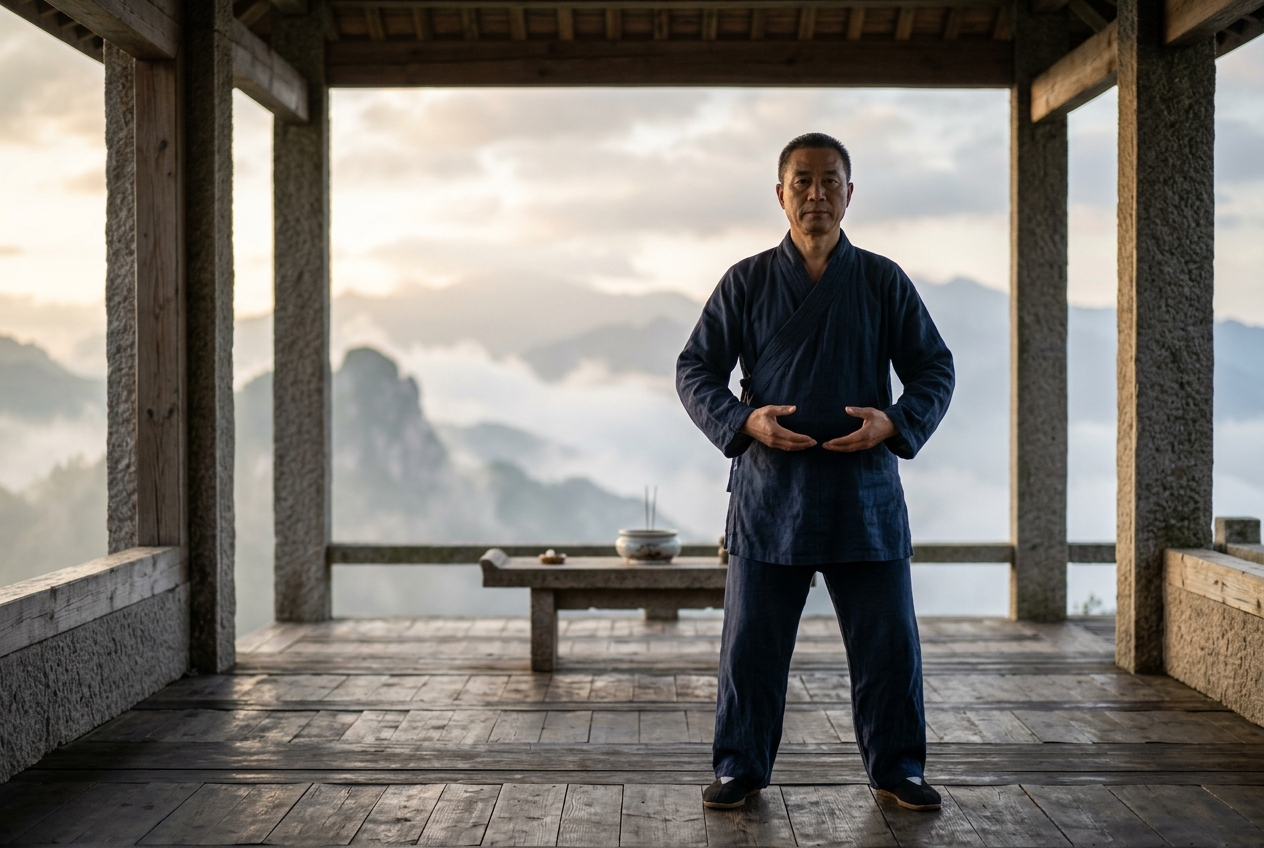
Within the theoretical paradigms of classical Daoist Daoyin and 20th-century Zhineng Qigong systematized by Dr. Pang Ming, the "Three Centers" represent the body's primary transductive bio-energetic and neuromuscular gateways: the cranial vertex (Baihui or Tianmen, located at the highest point of the skull), the bilateral palm centers (Laogong, situated in the depression between the second and third metacarpal bones), and the bilateral bubbling springs of the feet (Yongquan, located in the depression of the anterior plantar sole). In traditional energetics, Baihui interfaces with celestial Yang (Tian Qi), Yongquan draws upon terrestrial Yin (Di Qi), and Laogong modulates environmental and interpersonal bio-electromagnetic vitality (Ren Qi). The operational objective of San Xin Bing Zhan Zhuang is to unify these three dual-polarity gateways, guiding their somatic and perceptual vectors inward to converge within the lower abdominal crucible known as the Lower Dantian (Shenque / Guanyuan axis).
Step-by-Step Practice Guide
Mastering San Xin Bing Zhan Zhuang requires an exact synthesis of biomechanical tensegrity, diaphragmatic breath regulation, and intentional neurological vectoring (Yi Nian Daoyin). Follow this numbered protocol to construct the posture from the ground upward.
1. Foundational Grounding: The Plantar Base and Inguinal Crease (Kua)
Begin by establishing parallel foot placement, precisely hip-to-shoulder width apart, with the lateral borders of the feet tracking forward. Subtly engage the intrinsic muscles of the feet through an internal coiling (Kou Bu), gently drawing the medial longitudinal arches upward while maintaining three-point contact: the base of the first metatarsal, the base of the fifth metatarsal, and the calcaneus (heel). This muscular suction mechanically unweights and opens Yongquan (Kidney-1).
Micro-flex the knee joints between 5 and 15 degrees, ensuring the patellae track precisely over the second toes without drifting inward. Release and soften the Kua—the bilateral inguinal creases where the thighs meet the pelvis. Rather than squatting, imagine sitting lightly on the edge of a tall stool. This mechanical folding of the coxofemoral joints decompresses the femoral neurovascular bundle and roots your center of mass firmly into the Earth.
2. Pelvic Suspension, Axial Decompression, and the Thoracic Hollow
Level the pelvic basin by subtly tucking the ischial tuberosities downward and forward, allowing the coccyx to hang suspended as if anchored by a lead plumb line (Chen Zhou). This movement flattens excessive lumbar lordosis and widens the anatomical lumbar hinge, effectively opening the energetic "Gate of Life" (Mingmen, Governing Vessel 4) between the second and third lumbar vertebrae.
Concurrently, gently elevate the cranial vertex at Baihui (Governing Vessel 20) as if the entire axial skeleton were suspended from above by a delicate silk filament (Ding Tou Xuan). Draw the chin slightly inward to lengthen the suboccipital space and decompress the cervical lordosis.
Broaden the scapulae laterally across the ribcage to execute Han Xiong Ba Bei (hollow the chest, round the upper back). Do not slump; instead, relax the sternalis and pectoralis major muscles downward, allowing the intercostal spaces to yield while the serratus anterior and rhomboid muscles maintain a buoyant, rounded dome across the posterior thoracic wall.
3. The Toroidal Embracive Arm Loop
Float both arms upward from the shoulders, forming a continuous, embracive toroidal loop in front of the abdomen. The elbows remain lower than the shoulders and softly sink outward and downward (Chen Jian Zhui Zhou), preserving an open hollow beneath the axillae—traditionally described as "holding a fragile bird’s egg under each armpit."
Position the hands so the palms (Laogong, Pericardium 8) face directly inward toward the sub-umbilical space, approximately two to three finger-widths below the navel (Guanyuan, Conception Vessel 4). The fingers remain naturally separated, relaxed, and slightly curved, with the thumbs uncurled and the index fingers pointing subtly toward one another, separated by a distance of roughly ten to fifteen centimeters.
4. Intentional Vectoring: The Three Centers Dynamic Merge (Yi Nian Daoyin)
Once structural stability is locked into stillness, redirect your focal attention (Yi) through a continuous, four-phase somatic cycle: * The Celestial Inflow: As you initiate a soft, unforced diaphragmatic inhalation, perceive the crown vertex (Baihui) dilating. Direct an invisible stream of cool, luminous, descending atmospheric clarity downward through the cranial vault, brainstem, and central channel (Zhong Mai), guiding it directly into the core of the Lower Dantian. * The Terrestrial Ascent: Simultaneously feel the plantar bubbling springs (Yongquan) drawing dense, warm, supportive terrestrial energy upward through the medial arches, calves, inner adductor chains, and pelvic floor, ascending into the same sub-umbilical reservoir. * The Metacarpal Condensation: Maintain awareness of the gentle bio-magnetic thermal pulsation radiating between the palms (Laogong). Direct this palm field straight through the abdominal fascia, projecting inward toward the retro-peritoneal core. * The Triple Synthesis: During exhalation, mentally fuse these three vectors—the descending celestial stream, the ascending terrestrial current, and the embracing palm field—into a dense, highly concentrated sphere of vitality situated in the physical center between your navel, Mingmen, and pelvic floor.
5. Somatic Sensation Matrix: Interpreting Somatosensory Signals
As you sustain the posture, you will encounter distinct somatosensory milestones. Understanding their biological underpinnings prevents alarm and guides your practice:
- Thermogenic Surges (Warmth): A noticeable sensation of gentle heat across the palm centers, lower abdomen, or spinal column indicates peripheral vasodilation caused by parasympathetic-induced arteriole relaxation.
- Micro-Vascular Paresthesia (Tingling / Fullness): Sensation of electric tingling, fullness, or magnet-like resistance between the fingers and palms signals the activation of low-threshold mechanoreceptors and enhanced microvascular capillary perfusion.
- Somatic Tremors (Neurogenic Fasciculations): Fine, involuntary muscular quivering in the quadriceps or spinal stabilizers reflects the progressive discharge of chronic tension patterns and motor unit recruitment shifts under isometric load. Allow these tremors to ripple through without muscular bracing.
- Fascial Unwinding and Heaviness: A profound sense of structural density, as if your legs have turned to rooted iron while your upper torso feels weightless as silk, denotes optimal biotensegrity alignment where gravitational forces transfer directly through the skeletal columns.
6. Common Faults and Clinical Self-Correction Matrix
| Structural / Energetic Fault | Neuromuscular Consequence | Clinical Cue for Self-Correction |
|---|---|---|
| Plantar Arch Collapse (Pronation) | Knee valgus stress, compression of medial meniscus, inhibition of Yongquan. | Grip the ground lightly with the toes; gently rotate the knees outward without shifting the foot base to lift the medial arch. |
| Anterior Pelvic Tilt (Lumbar Hyperextension) | Lumbar facet jamming, psoas hypertonicity, occlusion of Mingmen gateway. | Drop the tailbone straight down toward the heels; draw the pubic symphysis slightly upward toward the navel. |
| Elevated Clavicles / Shoulders | Hyperactivity of upper trapezius, restriction of phrenic nerve and brachial plexus. | Inhale deeply into the back ribs; exhale and imagine the shoulder blades sliding down the back into rear pockets. |
| Hyper-Cephalic Energetic Rise (Cranial Fullness) | Sensation of dizziness, hypertension, somatic restlessness, or headache. | Release all focus on the upper body. Direct 100% of sensory attention into the soles of the feet (Yongquan) and deep into the floor. |
7. Sealing and Consolidating the Crucible (Shou Gong)
Never terminate standing meditation abruptly. Conclude your session with intentional Qi consolidation: 1. Slowly withdraw the arms from their embracive ring, placing the palms directly over the navel (Shenque, CV-8). Men traditionally place the left palm against the skin with the right palm layered over; women place the right palm against the skin with the left palm over. 2. Inhale smoothly into the lower abdomen beneath your hands, visualizing the expanded bio-magnetic field condensing inward like a closing aperture, packing warmth directly into the retroperitoneal space. 3. Perform nine subtle circular smoothing motions with your overlapped palms over the abdomen (expanding outward clockwise, then condensing inward counter-clockwise). 4. Lower the arms to the sides, straighten the legs smoothly, and take three normal breaths while gently walking in place to re-establish dynamic locomotive circulation.
Why It Works — The Neuro-Fascial and Physiological Science
The profound health transformations reported across centuries of Zhan Zhuang practice are grounded in measurable human anatomy, neurobiology, and biomechanics. Far from being a passive rest, isometric standing meditation represents an active neuromuscular recalibration.
Biotensegrity and Myofascial Continuity
Human structural integrity is governed by the principles of biotensegrity—a structural paradigm wherein rigid compression struts (bones) float within a continuous, pre-stressed tension network of connective tissue (muscles and fascia).
San Xin Bing Zhan Zhuang systematically recruits and harmonizes two primary myofascial meridians documented by modern anatomists like Thomas Myers: 1. The Deep Front Line (DFL): Ascending from the intrinsic plantar flexors through the tibialis posterior, adductor group, psoas major, iliacus, pelvic floor diaphragm, respiratory diaphragm, and anterior longitudinal ligament to the suboccipital region. The inward coiling of the feet and softening of the Kua specifically engage the DFL, creating an internal hydraulic core that suspends the skeleton from within. 2. The Superficial Back Line (SBL): Extending from the plantar fascia up the gastrocnemius, hamstrings, sacrotuberous ligament, erector spinae, and epicranial aponeurosis to the supraorbital ridge. Elevating Baihui while dropping the coccyx places the SBL under an optimal, uniform elastic pre-tension, distributing mechanical load across the entire posterior chain and completely abolishing localized spinal compression.
Research cataloged on the National Center for Biotechnology Information (NCBI PubMed) demonstrates that static isometric postures generate continuous, low-amplitude mechanotransductive signaling within fibroblasts. This mechanical stimulation modulates collagen synthesis, improves fascial hydration, and triggers piezoelectric liquid-crystal signaling throughout the extracellular matrix (ECM).
Autonomic Vagal Tone and Cardiovascular Remodeling
Sustained motionless standing paired with diaphragmatic breathing down-regulates the sympathetic fight-or-flight response while selectively up-regulating the parasympathetic branch of the autonomic nervous system via the vagus nerve (Cranial Nerve X).
As the lower abdomen expands against a relaxed pelvic floor during low-frequency respiration (approximately 4.5 to 6 breaths per minute), intra-abdominal pressure (IAP) rhythmically fluctuates. This dynamic pressure wave stimulates the dense baroreceptor networks nestled within the aortic arch, carotid sinuses, and mesenteric vasculature. The resulting sensory feedback triggers a cascade of neurobiological adaptations: * Elevation of Heart Rate Variability (HRV), serving as a direct biomarker of autonomic flexibility, stress resilience, and physiological longevity. * Suppression of pro-inflammatory cytokines and circulating serum cortisol. * Enhanced venous return to the right atrium via the respiratory muscle pump, optimizing stroke volume without requiring a compensatory rise in resting heart rate.
Organizations such as the World Health Organization (WHO) Traditional Medicine Programme and the National Qigong Association (NQA) have emphasized mind-body practices precisely because they systematically retrain the central nervous system out of chronic adrenergic hyper-reactivity and into restorative somatic homeostasis.
Classical Lineage and Historical Context
The architectural principles embodied in San Xin Bing Zhan Zhuang represent the culmination of millennia of empirical somatic research across classical Chinese medicine, monastic Daoism, and martial arts.
The earliest historical records of standing postures as therapeutic and spiritual technologies appear in the foundational canon of Chinese medicine, the Huangdi Neijing (The Yellow Emperor's Inner Classic, c. 300–100 BCE). In the opening chapter of the Suwen, the text describes the ancient masters (Zhenren) who "stood quietly, holding the heaven and earth in their embrace, grasping Yin and Yang, breathing refined essence, standing independently with their spirits preserved within, their muscles and flesh operating as one unified whole."
During the Han Dynasty, archaeological excavations at Mawangdui unearthed silk funerary banners illustrating over forty distinct Daoyin therapeutic postures, demonstrating that standing alignments were systematically employed to regulate the twelve primary meridian pathways and prevent visceral stagnation.
In the 19th and early 20th centuries, standing meditation underwent a profound martial renaissance through internal martial traditions such as Xingyiquan, Baguazhang, and Taijiquan. Grandmaster Wang Xiangzhai (1885–1963), the founder of Yiquan (Dachengquan), stripped away complex choreographed forms to elevate motionless standing (Zhan Zhuang) to the pinnacle of martial internal power (Neijin) and radiant health cultivation.
The specific protocol of San Xin Bing Zhan Zhuang was rigorously refined, systematized, and democratized in the late 20th century by Dr. Pang Ming, a master of both Western biomedical medicine and Traditional Chinese Medicine. Dr. Pang integrated classical Daoist alchemical theory with modern biomechanics and group-field science within Zhineng Qigong, establishing the world-renowned Huaxia Zhineng Qigong Center. In this clinical setting, hundreds of thousands of practitioners utilized Three Centers Merge Standing as the core method to cultivate internal vitality, reverse degenerative disease, and awaken human somatic potential.
Today’s Practice Commitment: The Progressive Standing Protocol
To translate these theoretical foundations into tangible neuromuscular adaptations, commit to the structured implementation schedule outlined below. Consistency of daily practice is far more impactful than intermittent long sessions.
Your Morning Starter Protocol
Tomorrow morning, before opening your digital devices or consuming caffeine, complete this foundational seven-minute routine:
- Setup (1 Minute): Execute the structural alignment checklist—feet parallel, arches lifted, Kua soft, Mingmen open, chin tucked, Baihui suspended.
- Postural Hold (5 Minutes): Float the arms into the embracive toroidal loop. Inhale cool atmospheric clarity through Baihui and warm grounding stability through Yongquan; exhale and consolidate both currents along with your palm field into the Lower Dantian.
- Sealing (1 Minute): Place hands over your navel, inhale three slow diaphragmatic breaths, and compress the gathered warmth deep into your core.
Notice the clarity of your mental focus, the drop in baseline muscular tension, and the sustained quality of your physical energy throughout the hours that follow. As your structural stamina deepens over subsequent weeks, progressively extend your standing time by two to three minutes each week until you can comfortably sustain thirty minutes of uninterrupted, tranquil, and rooted stillness.