San Ti Shi Three Body Posture Qigong: Tri-Planar Kinetic Alignment, Helical Tendon Loading, and Ground Reaction Force Vectoring in Classical Martial Daoyin
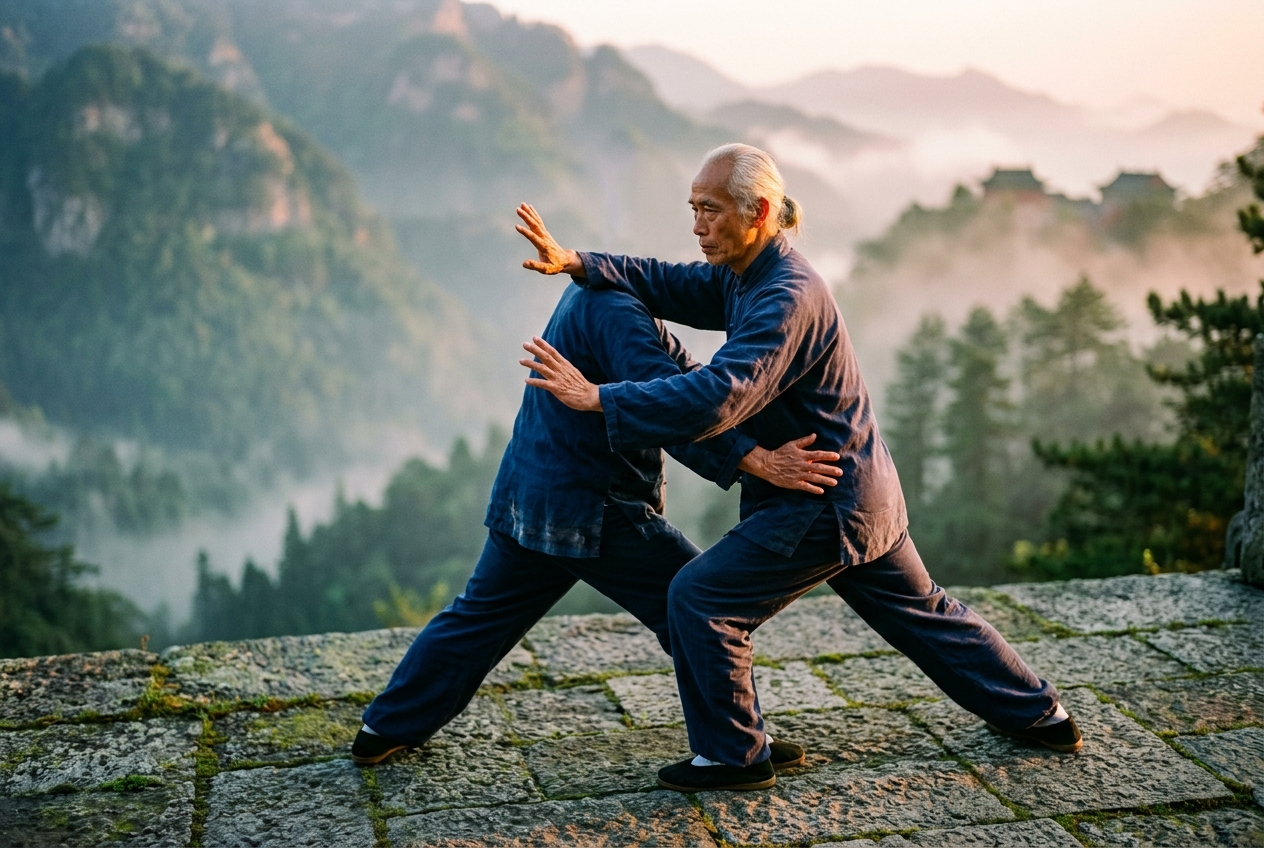
In traditional terminology, the posture embodies San Cai (三才)—the "Three Powers" of Heaven, Earth, and Humanity—which physically map to the three primary segments of the body: the head and upper limbs (Heaven), the feet and lower limbs (Earth), and the central torso with its vital organs (Humanity). In contemporary biomechanical terms, it is a tri-planar, closed-chain isometric exercise that optimizes ground reaction force transmission, re-patterns neuromuscular efficiency, and conditions the deep fascial webbing of the human body.
       [Baihui / Vertex Suspended Upward]
                     ^
                     | (Spinal Bow / Shen Gong)
                     v
   [Front Palm: Laogong] <--- (Arm Bow) ---> [Scapular Girdle]
             \                                      /
              \                                    /
          [Front Kua]                           [Rear Kua]
          (30% Load)                            (70% Load)
              |                                     |
              | (Leg Bow / Tui Gong)                |
              v                                     v
       [Front Foot: 0°]                     [Rear Foot: 45°]
       [Yongquan Rooted]                    [Yongquan Rooted]
Step-by-Step Practice Guide
Mastering the Three Body Posture requires methodical, millimeter-level somatic precision. The posture is asymmetrical, demanding acute proprioception to prevent compensatory collapse.
+-------------------------------------------------------------------------+
|                  SAN TI SHI POSTURAL GEOMETRY AT A GLANCE               |
+-------------------+-----------------------------------------------------+
| Weight Ratio      | 70% Rear Leg / 30% Front Leg                        |
| Base Alignment    | Front heel tracks directly into rear heel/arch line |
| Angular Vector    | Rear foot 45° outward; Front foot 0° forward        |
| Spinal State      | Flattened lumbar lordosis (Mingmen expanded)        |
| Primary Bows      | Leg Bow (Root), Spinal Bow (Axis), Arm Bow (Vector) |
| Focal Meridians   | Kidney-1 (Yongquan), Du-4 (Mingmen), PC-8 (Laogong) |
+-------------------+-----------------------------------------------------+
1. Base Geometry and Lower-Limb Spiraling
Begin by standing upright with feet together. Turn your right foot outward forty-five degrees, keeping the right heel anchored. Step your left foot straight forward along a single linear track, setting a stance length of approximately two to two-and-a-half of your own foot-lengths.
Settle your pelvis straight downward without leaning forward, shifting approximately 70 percent of your total body weight onto the rear right leg, leaving only 30 percent resting lightly on the front left foot. The front heel should align directly with the rear heel or the rear medial arch.
Both knees must remain bent and resilient. The rear right knee must track precisely along the line of the right toes—never collapsing inward. To achieve this, recruit your deep hip external rotators: consciously spiral the rear thigh outward (wai chan) while simultaneously anchoring the ball of the right big toe firmly into the floor. Conversely, wrap the front left hip and thigh slightly inward (nei chan), drawing the front femur head back into its hip socket. This creates a powerful counter-torsion through the pelvis that locks the lower limbs into a stable structural tripod.
2. Sinking the Kua and Axial Decompression
The Kua—the inguinal creases at the junction of the thighs and the pelvis—must be actively folded and hollowed (Song Kua). Imagine sitting down onto a high barstool. This hip-hinge action allows the pelvis to level out horizontally.
Concurrently, slightly tuck the tailbone by gently drawing the pubic bone upward toward the navel. This subtle posterior pelvic tilt flattens the excessive inward curve of the lower back (lumbar lordosis), opening the anatomical space around the second and third lumbar vertebrae—classically termed the Mingmen (命门, DU-4) or "Gate of Life."
From this rooted base, extend the spine upward. The crown of the head at Baihui (百会, DU-20) must lift gently toward the sky, as if suspended by an unseen cord, subtly tucking the chin to lengthen the suboccipital musculature. The spine becomes a vertical bow drawn taut between the downward vector of the sacrum and the upward suspension of the cranium.
3. Upper-Limb Vectoring and Palm Architecture
From the dropped center of gravity, elevate both hands. The front left arm projects forward at chest-to-shoulder height with the elbow bent at an obtuse angle of roughly 120 to 135 degrees. The elbow must never lock straight, nor should it collapse tight against the ribs; it hangs heavy toward the earth (Chen Jian Zhui Zhou—sink the shoulders, drop the elbows).
The left palm extends forward with the fingers spread, naturally rounded, and slightly curved like hooks (Hu Kou, the "Tiger’s Mouth," held wide and open). The index finger stands vertically erect (Ding), establishing the terminal line of structural intent, while the palm center—the Laogong (劳宫, PC-8) point—is gently cupped and hollowed.
The rear right hand rests anchored beside the lower abdomen or solar plexus, palm facing downward or slightly forward, with its fingers pointing toward the crook of the front left elbow. The chest is naturally relaxed and slightly concave (Han Xiong), allowing the scapulae to glide laterally across the ribcage to broaden the upper back (Ba Bei), engaging the serratus anterior and latissimus dorsi.
4. The Six Harmonies (Liu He)
Classical methodology demands the precise alignment of the Six Harmonies (Liu He, 六合), divided into three external and three internal structural couplings:
                      THE SIX HARMONIES (LIU HE)
  ===================================================================
  EXTERNAL HARMONIES (Wai San He)  |  INTERNAL HARMONIES (Nei San He)
  ---------------------------------+---------------------------------
  1. Wrists align with Ankles      |  1. Heart/Mind unifies with Will
     (Coordinate distal load lines)|     (Xin Yu Yi He)
  2. Elbows align with Knees       |  2. Will unifies with Breath/Qi
     (Maintain middle-joint vectors|     (Yi Yu Qi He)
  3. Shoulders align with Hips/Kua |  3. Breath unifies with Power/Li
     (Unify proximal root cylinders|     (Qi Yu Li He)
  ===================================================================
- The Three External Harmonies (Wai San He):
- Wrists align with Ankles: The forward-pressing vector of the lead wrist reflects the grounding vector of the lead ankle.
- Elbows align with Knees: The vertical drop and lateral spring of the front elbow matches the angle and loading of the front knee; the rear elbow corresponds directly to the rear knee.
- Shoulders align with Hips (Kua): The shoulder girdle sits squarely over the pelvic girdle, eliminating lateral spinal tilting or excessive rotational distortion.
- The Three Internal Harmonies (Nei San He):
- Heart/Mind unifies with Will (Xin Yu Yi He): Emotional agitation is subordinated to clear, concentrated cognitive focus.
- Will unifies with Vital Energy (Yi Yu Qi He): Focused structural intent guides the respiratory cadence and somatic sensation.
- Vital Energy unifies with Physical Force (Qi Yu Li He): Coordinated intra-abdominal pressure and fascial tension generate functional structural power without brute muscular strain.
5. Respiratory Cadence
Breathe exclusively through the nose with the tip of the tongue resting lightly against the hard palate behind the upper incisors. Employ slow, silent diaphragmatic respiration (Dantian breathing). On the inhalation, expand the entire circumferential cylinder of the lower abdomen, lateral flanks, and lumbar region without elevating the ribcage. On the exhalation, maintain the structural expansion of the torso while allowing the breath to settle downward, feeling the weight drop through the pelvic floor into the soles of the feet.
6. Common Structural Compensations and Direct Corrections
+-----------------------------------------------------------------------------------+
|                        STRUCTURAL COMPENSATION PROTOCOL                           |
+-----------------------+-----------------------------+-----------------------------+
| Fault / Compensation  | Biomechanical Breakdown     | Corrective Intervention     |
+-----------------------+-----------------------------+-----------------------------+
| Medial Knee Collapse  | Hip internal rotators over- | Externally rotate rear hip; |
| (Valgus Stress)       | active; gluteus medius weak | screw heel/toe into floor   |
+-----------------------+-----------------------------+-----------------------------+
| Lumbar Hyperlordosis  | Anterior pelvic tilt;       | Lengthen tailbone downward; |
| (Mingmen Compression) | hip flexors hypertonic      | expand lower back backward  |
+-----------------------+-----------------------------+-----------------------------+
| Shoulder Elevation    | Hyperactive upper traps;    | Depress scapulae; engage    |
| (Apical Breathing)    | collapsed serratus anterior | lats and sink elbows down   |
+-----------------------+-----------------------------+-----------------------------+
| Forward Weight Drift  | Quadriceps fatigue in rear  | Re-fold rear Kua; verify    |
| (50/50 Stance Error)  | leg causing anterior shift  | 70% rear weight retention   |
+-----------------------+-----------------------------+-----------------------------+
- Medial Knee Collapse (Valgus Shear): The rear knee drops inward toward the midline, placing dangerous shearing forces on the medial collateral ligament and meniscus. Correction: Consciously abduct and externally rotate the rear hip, pushing the knee outward over the third toe while rooting the medial arch of the foot.
- Lumbar Lordotic Pinching: The practitioner arches the lower back, causing anterior pelvic tilt and compressive load on the lumbar facets. Correction: Draw the lower abdominal wall inward and upward, sinking the coccyx downward to open the space of the Mingmen.
- Shoulder Girdle Elevation: The shoulders creep upward toward the ears, inducing apical (chest) breathing and thoracic spine tension. Correction: Actively depress the scapulae and engage the serratus anterior, visualizing the shoulder blades sliding downward into the back pockets of your trousers.
- Stance Weight Creep: Under the strain of muscular fatigue, the practitioner unconsciously shifts weight forward into a 50/50 distribution. Correction: Periodically test the front foot by briefly unweighting it; if you cannot lift the front foot without rocking your torso backward, your weight has drifted forward.
7. Somatic Milestones and Proprioceptive Sensations
As you sustain the posture for two to five minutes per side, distinct physiological markers typically emerge: * Warmth (Re): A noticeable thermal flush in the palms, soles, and lower abdomen, produced by peripheral vasodilation and down-regulated sympathetic tone. * Tingling (Ma): Mild, bubbling micro-sensations in the fingertips and toes, reflecting microvascular perfusion and uncompressed peripheral nerve conduction. * Heaviness (Chen): An unmistakable sense of physical density, as if the skeleton has rooted deep into the earth, signaling that structural loading has shifted from voluntary muscular contraction to passive skeletal support. * Elastic Buoyancy (Peng): A spring-like, three-dimensional fullness throughout the fascial suit, wherein the body resists external pressure not through rigidity, but through internal hydrostatic and elastic tension.
Why It Works: The Somatic Science and Fascial Mechanics
To understand the profound structural and physiological efficacy of San Ti Shi, we must bridge classical Daoist somatic models with contemporary biomechanics, myofascial topology, and neurobiology.
                           THE KINETIC TRANSMISSION PATHWAY
  =================================================================================
  [Earth / GRF] ---> [Yongquan (KID-1)] ---> [Posterior Deep Compartment]
                                                         |
  [Spiral Line Helical Wrap] <--- [Pelvic Girdle / Kua Torsion] <-------+
              |
              v
  [Mingmen (DU-4) Lumbar Fulcrum] ---> [Thoracolumbar Fascia & Serratus Sling]
                                                         |
                                                         v
                                [Laogong (PC-8) Projecting Palm]
  =================================================================================
Biotensegrity and the Myofascial Web
The human body does not operate purely as a system of continuous compression levers; it is a self-stabilizing biotensegrity structure where rigid compression struts (bones) are suspended within a continuous network of elastic tension cables (myofascia). San Ti Shi is an engineered protocol designed to optimize this pre-stressed state.
By arranging the limbs in counter-spiraling vectors, the posture recruits two foundational myofascial pathways mapped in modern somatic science: the Spiral Line (SPL) and the Deep Front Line (DFL), as detailed in Anatomy Trains research published on NCBI.
The Deep Front Line—which ascends from the plantar surface of the foot through the deep posterior compartment of the lower leg, passes through the adductor group and pelvic floor, traverses the psoas and anterior spine, and terminates at the craniomandibular fascia—is fully engaged through the structural rooting of Yongquan (湧泉, KID-1) and the hollowed Kua.
Concurrently, the rotational shear of the rear and front limbs preloads the Spiral Line across the torso, linking the contralateral hip to the opposite shoulder via the broad sheet of the thoracolumbar fascia. This cross-body tension creates a continuous elastic sheath that supports the spine without relying on hypertonic contractions of the superficial erector spinae muscles.
      +-------------------------------------------------------------------+
      |             THE THREE-BOW STRUCTURAL TENSEGRITY SYSTEM            |
      +===================================================================+
      |  1. THE SPINAL BOW (Shen Gong)                                    |
      |     • Root: Coccyx / Sacral base                                  |
      |     • Apex: Mingmen (DU-4) expanded posteriorly                   |
      |     • Tip:  Atlas / Occiput (Baihui DU-20 suspended)              |
      +-------------------------------------------------------------------+
      |  2. THE LEG BOW (Tui Gong)                                        |
      |     • Roots: Left & Right Yongquan (KID-1)                        |
      |     • Apex:  Pelvic floor / Huiyin (REN-1)                        |
      |     • Vector: 70/30 weight distribution via counter-rotated Kua   |
      +-------------------------------------------------------------------+
      |  3. THE ARM BOW (Bi Gong)                                         |
      |     • Tips:  Fingertips / Laogong (PC-8)                          |
      |     • Apex:  Dazhui (DU-14) / Interscapular thoracic hinge        |
      |     • Vector: Dropped elbows and broad serratus anterior support  |
      +-------------------------------------------------------------------+
Ground Reaction Force (GRF) Transmission
In the biomechanical analysis of internal movement, all structural power originates from the floor. When standing in San Ti Shi, the practitioner creates a closed kinetic chain. Gravity pulls mass downward, and the earth pushes back with an equal and opposite Ground Reaction Force.
Because the joints are not locked at rigid ninety- or one-hundred-and-eighty-degree angles, this incoming force does not concentrate as joint compression. Instead, it is converted into helical strain energy across the fascial network.
The force enters through the Yongquan point on the sole, spirals upward through the tibia and fibula, winds around the femoral helix into the hip socket (Kua), unifies across the sacrum at the Mingmen lumbar fulcrum, travels across the thoracic myofascial sling of the serratus anterior and latissimus dorsi, and projects outward through the humerus, radius, and ulna into the Laogong point of the forward palm. The static posture acts as a blueprint for dynamic, shock-absorbent kinetic transmission.
Bone Remodeling and Piezoelectric Transduction
Sustained isometric loading in an asymmetrical base imposes significant mechanical strain on the femoral neck, tibial shaft, and trabecular architecture of the lumbar vertebrae. Under Wolff's Law, bone tissue remodels and densifies in direct response to the mechanical stresses placed upon it.
Furthermore, bone behaves as a piezoelectric material: sustained mechanical deformation generates micro-electrical streaming potentials that stimulate osteoblastic bone deposition while inhibiting osteoclastic resorption. Practitioners of long-term static stance training consistently demonstrate elevated bone mineral density and enhanced joint structural integrity, mitigating the onset of osteopenia and degenerative joint disease.
Autonomic Nervous System Regulation and Cardiovascular Load
Although holding San Ti Shi creates significant metabolic demand within the skeletal musculature, the mandatory cadence of slow, deep diaphragmatic respiration directly modulates the autonomic nervous system.
Sustained slow nasal breathing with lengthened exhalations stimulates the pulmonary stretch receptors and the vagus nerve, promoting parasympathetic tone despite high somatic effort. According to clinical evaluations on Heart Rate Variability and slow breathing indexed on PubMed, this state of "relaxed alertness" enhances baroreflex sensitivity, optimizes heart rate variability (HRV), lowers systemic cortisol, and stabilizes arterial blood pressure.
The posture acts as a form of neurological resilience training: the brain learns to maintain parasympathetic dominance and cognitive stillness in the presence of intense physiological discomfort.
+---------------------------------------------------------------------------+
|               NEURO-PHYSIOLOGICAL & BIOMECHANICAL CASCADE                 |
+------------------------------------+--------------------------------------+
| Somatic / Energetic Mechanism      | Western Physiological Manifestation  |
+------------------------------------+--------------------------------------+
| Grounded Yongquan (KID-1) Rooting  | Co-contraction of deep foot flexors; |
|                                    | increased sensory plantar feedback   |
+------------------------------------+--------------------------------------+
| Sunk Kua & Counter-Spiraled Legs   | Gluteal activation; alignment of the |
|                                    | hip acetabulum; DFL stimulation      |
+------------------------------------+--------------------------------------+
| Flattened Mingmen (DU-4)           | Elimination of lumbar shear forces;  |
|                                    | activation of transverse abdominis   |
+------------------------------------+--------------------------------------+
| Extended Laogong (PC-8) Vector     | Pre-tensioning of the arm lines;     |
|                                    | lateral expansion of serratus muscle |
+------------------------------------+--------------------------------------+
| Dantian Diaphragmatic Respiration  | Vagal nerve stimulation; enhanced    |
|                                    | HRV; elevated intra-abdominal press. |
+------------------------------------+--------------------------------------+
Classical Lineage and Historical Context
The Three Body Posture does not exist in isolation as a modern exercise invention; it represents the convergence of centuries of Daoist internal cultivation (Neidan), therapeutic longevity exercises (Daoyin), and battlefield martial engineering.
According to historical records and lineage documentation maintained across Chinese martial traditions—and cataloged in historical studies on Xingyiquan lineage on Wikipedia—the foundational concepts of internal body unification crystallized during the late Ming and early Qing Dynasties. While martial mythology frequently attributes the seminal roots of the art to the Song Dynasty general Yue Fei (1103–1142 CE), historical scholarship traces the systematic codification of the art to the visionary master Ji Longfeng (姬隆丰, also known as Ji Jike) of Shanxi Province during the seventeenth century.
                      HISTORICAL TRANSMISSION AXIS
  ====================================================================
  [17th Century]  Ji Longfeng (Ji Jike)
                  Codifies Xinyi Liuhe Quan (Heart-Mind Six Harmonies)
                            |
                            v
  [18th Century]  The Dai Family of Pingyao (Shanxi)
                  Synthesizes Internal Alchemy (Neigong) & Stance Holding
                            |
                            v
  [19th Century]  Li Luoneng (Li Feiyu, "Old Farmer Li")
                  Formalizes the art as Xingyiquan; Establishes San Ti Shi
                  as the indispensable energetic and structural engine
                            |
                            v
  [Modern Era]    Integration into Global Somatics & Integrative Medicine
                  Recognized by the World Health Organization and NQA
  ====================================================================
Ji Longfeng combined spear mechanics with Daoist somatic gymnastics, creating an explosive combat system originally termed Xinyi Liuhe Quan (Heart-Mind Six Harmonies Boxing). The system was guarded as a secretive discipline, passed down through the Dai family of Pingyao in Shanxi Province. It was within the Dai family tradition that internal alchemical methodologies (Neigong) and prolonged isometric standing (Zhan Zhuang) were fully merged into the martial framework.
In the mid-nineteenth century, master Li Luoneng (李洛能, widely revered as "Old Farmer Li") learned the art from the Dai family and subsequently popularized it under the name Xingyiquan (Form and Mind Boxing). Li Luoneng recognized that without a solid structural and energetic foundation, dynamic martial movement devolved into superficial, disconnected flailing.
He established San Ti Shi as the non-negotiable entry point and perpetual refining ground for all internal cultivation. Traditional masters famously required students to stand in static San Ti Shi for up to three years before learning a single dynamic stepping form or punch.
In the broader context of integrative health recognized by organizations such as the World Health Organization Traditional Medicine Programme and the National Qigong Association, San Ti Shi stands as a premier example of classical Daoyin (导引)—the ancient science of "guiding the Qi and extending the limbs." It bridges the gap between purely therapeutic, stationary relaxation practices and high-performance structural biomechanics.
       TRADITIONAL PARADIGM                    BIOMECHANICAL TRANSLATION
+-----------------------------------+     +-----------------------------------+
| San Cai (Heaven, Earth, Humanity) | <-> | Three Functional Body Segments    |
| Opening the Mingmen (DU-4)        | <-> | Lumbar Lordosis Reduction         |
| Rooting at Yongquan (KID-1)       | <-> | Plantar GRF Shock Absorption      |
| Sinking into the Kua              | <-> | Hip-Hinge Acetabular Seating      |
| Projection through Laogong (PC-8) | <-> | Kinetic Vector Distal Terminal    |
| Nei San He (Internal Harmonies)   | <-> | Neuromuscular Coherence           |
+-----------------------------------+     +-----------------------------------+
Today's Practice Commitment
To experience the transformative physiological and neuromuscular effects of the Three Body Posture, avoid overextending yourself with unsustainable initial training durations. Integrate this precise five-minute protocol into your daily routine:
+-------------------------------------------------------------------------+
|                  THE DAILY 5-MINUTE INTEGRATION PROTOCOL                |
+-------+---------------+-------------------------------------------------+
| Phase | Duration      | Focus & Execution                               |
+-------+---------------+-------------------------------------------------+
| 1     | Minute 0:00   | Set up Left-Lead San Ti Shi; calibrate 70/30    |
|       | to 2:00       | weight split, flatten Mingmen, sink rear Kua    |
+-------+---------------+-------------------------------------------------+
| 2     | Minute 2:00   | Slow transitional step through Wuji (neutral);  |
|       | to 2:30       | three neutral diaphragmatic cleansing breaths   |
+-------+---------------+-------------------------------------------------+
| 3     | Minute 2:30   | Set up Right-Lead San Ti Shi; calibrate counter-|
|       | to 4:30       | spiraling lower limbs and open Tiger's Mouth    |
+-------+---------------+-------------------------------------------------+
| 4     | Minute 4:30   | Return to neutral stance; rest hands on lower   |
|       | to 5:00       | Dantian; integrate sensations of heat and pulse |
+-------+---------------+-------------------------------------------------+
The Progressive Overload Pathway
Perform this protocol once daily, ideally in the early morning before ingesting stimulants or engaging with digital screens. As your neuromuscular endurance and fascial elasticity develop: 1. Weeks 1–2: Hold for 2 minutes per side (5 minutes total including transition). Focus purely on correcting medial knee collapse and maintaining a flat lumbar spine. 2. Weeks 3–4: Increase to 3.5 minutes per side (8 minutes total). Direct your attention to slowing your respiratory cycle to under six breaths per minute while feeling the counter-torsion across the Kua. 3. Month 2 and Beyond: Progressively build toward 10 to 15 minutes per side. At this stage, the voluntary effort of the large muscle groups gives way to the elastic suspension of the biotensegrity web, unlocking a profound state of immovable root, physiological calm, and unified whole-body power.