San Jiao Differentiation (San Jiao Bian Zheng) Meridian Dynamics: Governing Upper-to-Lower Burner Pathogen Transmission, Damp-Heat Resolution, and Systematic Warm Disease Triage in Traditional Chinese Medicine
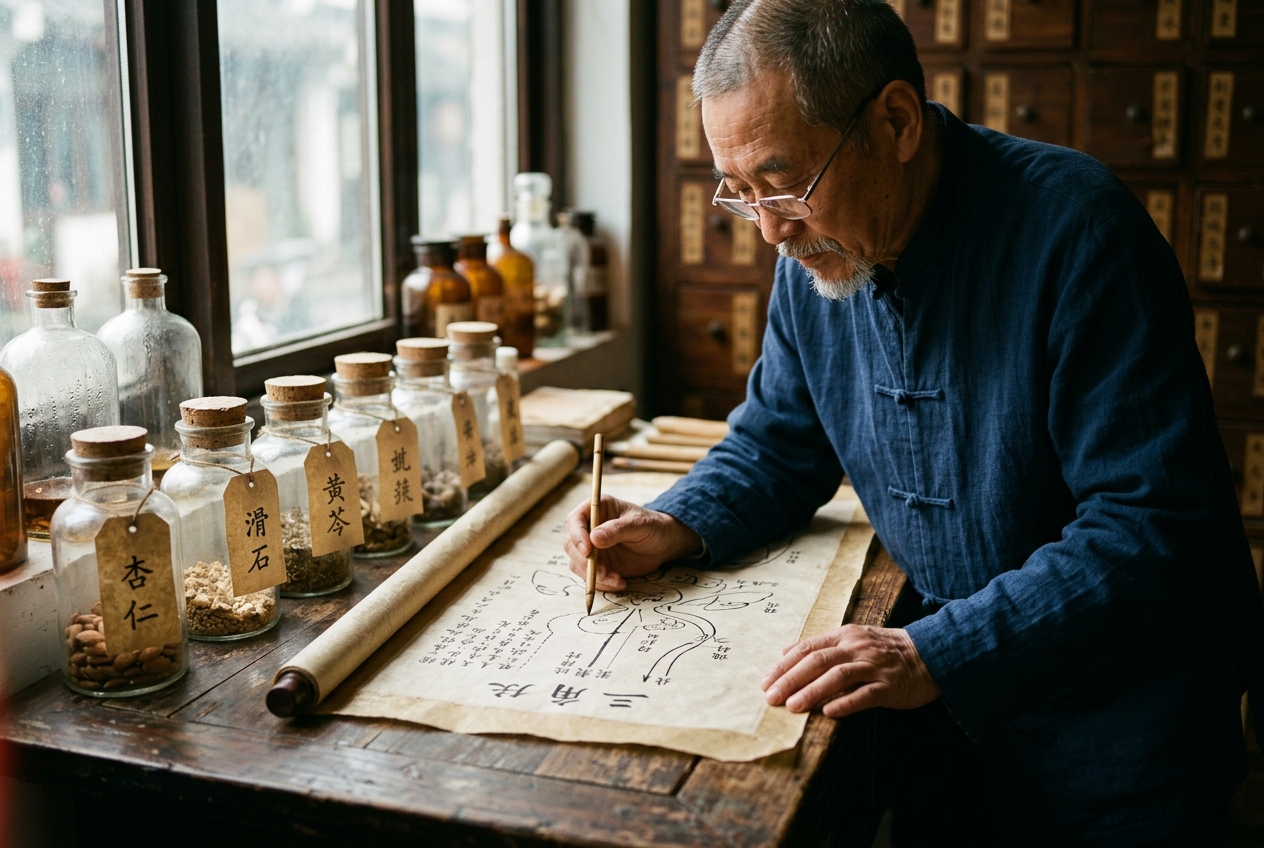
1. Opening Scene — A Moment You’ll Recognise
On a heavy, overcast August afternoon, a distinct and pervasive lethargy often takes hold. You have eaten a sensible lunch, yet your limbs feel as though they have been cast in wet sand. A dense, persistent fogginess wraps around your forehead like a damp towel, rendering concentration an uphill battle. Your chest feels vaguely constricted, your stomach bloated and sluggish, and despite a sticky, unpleasant dryness in your mouth, the thought of drinking a cold glass of water is unappealing. When you do drink, the fluid seems to slosh passively in your epigastrium without quenching your cellular thirst.
In modern Western clinical terms, this state is frequently dismissed as postprandial fatigue, atmospheric pressure sensitivity, or non-specific malaise. In the diagnostic framework of Traditional Chinese Medicine (TCM), however, you are experiencing an acute functional impairment of the most misunderstood visceral network in Eastern medicine: the San Jiao (三焦), traditionally rendered as the Triple Burner, Triple Heater, or Triple Energizer.
This familiar visceral stagnation is not an arbitrary collection of symptoms; it represents a traffic jam within the body’s primary metabolic irrigation conduit. When the San Jiao’s capacity to distribute vital vapor, transform physiological fluids, and vent metabolic heat is compromised, systemic fluid pathways become congested. What begins as a subtle sensation of heaviness is, in classical pathophysiology, the foundational stage of vertical damp-heat transmission—an internal climate where metabolic fluids lose their vitality and curdle into an obstructive, pathogenic mist.
2. What This Organ System Does: The Metaphysics and Physiology of the Triple Burner
The San Jiao occupies an enigmatic position within classical East Asian medicine. In the foundational text Huangdi Neijing (The Yellow Emperor's Inner Classic, circa 2nd century BCE), the Triple Burner is famously categorized as an organ that possesses "a name but no physical form" (you ming wu xing, 有名无形). Far from being a tangible anatomical structure like the liver or kidneys, the San Jiao is conceived as a functional meta-system—a unifying, poly-visceral terrain governing systemic thermodynamics, cellular respiration, and water metabolism.
Classical theory designates the San Jiao as the "Official in Charge of Irrigation" (Jue Du Zhi Guan, 决渎之官), responsible for dredging the body’s Water Pathways (Shui Dao, 水道). It acts as the grand highway through which Yuan Qi (Original, Primordial Qi)—the foundational thermodynamic force stored in the Kidneys—is broadcast to every organ, tissue, and meridian. Simultaneously, it serves as the interstitial network through which interstitial fluids (Jin Ye) are transformed, circulated, and excreted.
========================================================================================
                          THE THREE TIER ARCHITECTURE (SAN JIAO)
========================================================================================

[ UPPER BURNER / Shang Jiao ]  ===>  "LIKE A MIST" (Ru Wu, 如雾)
    ------------------------------------------------------------------------------------
    Organs: Lung (Fei), Heart (Xin), Pericardium (Xin Bao)
    Function: Disseminates defensive Qi (Wei Qi), vaporizes fluids, circulates warmth.
    Pathological Dynamic: Pathogenic damp-heat settles as a suffocating aerosol or cloud.

||
                                          \/  (Vertical Descent of Fluids)

[ MIDDLE BURNER / Zhong Jiao ] ===>  "LIKE A MACERATION VAT" (Ru Ou, 如沤)
    ------------------------------------------------------------------------------------
    Organs: Spleen (Pi), Stomach (Wei)
    Function: Ferments food, separates clear essence from turbid waste, churns nutrients.
    Pathological Dynamic: Damp-heat forms a viscous, macerating slurry or "oil mixed in flour."

||
                                          \/  (Drainage to the Sluice Gates)

[ LOWER BURNER / Xia Jiao ]    ===>  "LIKE A DRAINAGE DITCH" (Ru Du, 如渎)
    ------------------------------------------------------------------------------------
    Organs: Kidney (Shen), Urinary Bladder (Pang Guang), Liver (Gan), Intestines
    Function: Separates clear fluid from turbid waste, discharges urine/stool, anchors Yin.
    Pathological Dynamic: Exhaustion of true Yin fluids, thermal burning of renal reserves.
========================================================================================
To render this systemic engine clinically operational, classical physicians divided the human trunk into three functional metabolic zones:
- The Upper Burner (Shang Jiao, 上焦 — Diaphragm to Throat): Housing the Heart and Lungs, its physiological action is likened to a "dispersing mist" (Ru Wu, 如雾). It atomizes refined fluid essences and sprays them outward to the skin, muscles, and sensory orifices, supplying defensive immunity (Wei Qi).
- The Middle Burner (Zhong Jiao, 中焦 — Diaphragm to Umbilicus): Encompassing the Spleen and Stomach, its dynamic is described as a "fermentation vat" or "maceration chamber" (Ru Ou, 如沤). It acts as the digestive cauldron, churning nutrients, separating pure fluids from turbid residue, and generating fresh blood and metabolic energy.
- The Lower Burner (Xia Jiao, 下焦 — Umbilicus to Perineum): Encompassing the Kidneys, Urinary Bladder, Liver, and Intestines, its dynamic functions like a "drainage ditch" or "sluice gate" (Ru Du, 如渎). It filters waste products, regulates downward elimination, and preserves the deep, cooling reserves of renal essence (Jing).
The Historical Paradigm Shift: Wu Jutong and the Wen Bing Revolution
For over fifteen centuries, Chinese medical diagnosis was dominated by the Six Channel framework (Liu Jing Bian Zheng, 六经辨证) formulated by Zhang Zhongjing in his Han Dynasty classic, the Shanghan Lun (Treatise on Cold Damage). Zhang’s model conceptualized disease as a linear, inward progression of cold pathogens attacking from the surface (Taiyang) to the deepest interior (Jueyin).
However, during the devastating epidemics of the Ming and Qing Dynasties, physicians observed that subtropical, humid diseases behaved in a fundamentally different manner. Cold contracts, but heat expands; more critically, when heat binds with atmospheric humidity, it creates Damp-Heat (Shi Re, 湿热)—a sticky, tenacious, and heavy pathogen that clogs interstitial pathways rather than straightforwardly penetrating the channels.
In his 1798 medical treatise Wen Bing Tiao Bian (Systematic Differentiation of Warm Diseases), the Qing Dynasty physician Wu Jutong (吴鞠通) synthesized clinical observations to establish San Jiao Differentiation (San Jiao Bian Zheng, 三焦辨证). Drawing upon and refining the Four Levels (Wei-Qi-Ying-Xue) theory of his predecessor Ye Tianshi, Wu Jutong demonstrated that warm-damp epidemics do not travel purely from exterior to interior; instead, they transmit vertically downward through the three burners.
+---------------------------------------------------------------------------------------+
|                 DIAGNOSTIC FRAMEWORK COMPARISON IN CLASSICAL MEDICINE                 |
+---------------------------------------------------------------------------------------+
| Diagnostic System      | Primary Architect    | Core Pathogen | Vector of Disease     |
+------------------------+----------------------+---------------+-----------------------+
| Six Channels (Liu Jing)| Zhang Zhongjing      | Cold (Han)    | Surface to Interior   |
| Four Levels (Wei-Ying) | Ye Tianshi           | Dry Warmth    | Superficial to Deep   |
| San Jiao Differentiation| Wu Jutong           | Damp-Heat     | Vertical (Top to Bottom)|
+------------------------+----------------------+---------------+-----------------------+
As documented in contemporary analyses indexed on NCBI PubMed Central, the San Jiao model provided the first comprehensive pathophysiological system capable of addressing illnesses characterized by severe fluid stagnation, lingering systemic inflammation, and metabolic endotoxemia.
3. How You Can Feel It — Signs of Balance and Imbalance Across the Three Burners
Damp-heat trapped within the Triple Burner behaves like oil mixed into flour (Ru You Ru Mian, 如油入面): it is exceedingly difficult to separate. Heat accelerates metabolic agitation, while dampness glues the heat to somatic tissues, creating prolonged, low-grade inflammatory states. Understanding which burner is compromised allows for precise clinical differentiation.
========================================================================================
                      SAN JIAO CLINICAL DIFFERENTIATION MATRIX
========================================================================================

BURNER TIER   PATHOLOGY & SENSATION        TONGUE PRESENTATION      PULSE PROFILE
 ---------------------------------------------------------------------------------------
 UPPER         - Sensation of head wrapped   Pale red body; thin,     Soggy, floating,
 (Shang Jiao)    in a wet cloth.             sticky white or light    soft pulse
               - Oppression in the chest.    yellow coating.          (Ru Mai / 濡脉).
               - Clouded sensorium.
               - Sticky thirst; low fever.

MIDDLE        - Epigastric fullness/bloat.  Swollen body, tooth-     Soggy, slippery,
 (Zhong Jiao)  - Nausea, loss of appetite.   marked edges; thick,     moderate pulse
               - Heavy, aching limbs.        greasy yellow coating    (Ru Hua Mai / 濡滑脉).
               - Sticky, incomplete stools.  (Huang Ni Tai / 黄腻苔).

LOWER         - Dark, burning, scanty urine. Deep crimson body;      Deep, thready,
 (Xia Jiao)    - Low-grade afternoon fever.  peeled, dry, or scanty   rapid, weak pulse
               - Flushed cheeks; night sweats.coating (Jiang She Shao (Chen Xi Shuo / 沉细数).
               - Tremors or calf cramps.     Tai / 绛舌少苔).
========================================================================================
Upper Burner (Shang Jiao) Pattern: The Encumbered Mist
When damp-heat invades the Upper Burner, it attacks the territory of the Lungs and the protective envelope of the Heart (the Pericardium). Because the Lung governs the skin and exterior pores, its ability to spray protective Qi and vaporize fluids is immediately paralyzed.
- Clinical Symptoms: The patient exhibits an aversion to cold accompanied by fever that does not abate after sweating; the body feels heavy, and the head aches with a distinct sensation of being constricted by a heavy wet turban (Tou Zhong Ru Guo). The chest feels tight, speech may be sluggish, the voice muffled, and the mental faculties clouded by an oppressive brain fog.
- Tongue & Pulse: The tongue body is typically pale-red or normal, overlaid with a thin, distinctly sticky, white or pale-yellow coating. The pulse is characteristically soggy and floating (Ru Mai, 濡脉)—feeling like a soft, silk thread floating over water that yields completely under deep pressure.
- Classical Herbal Strategy: To treat the Upper Burner, one must open the Lung’s descending mechanism to clear the canopy. The quintessential formula is San Ren Tang (Three-Nut Decoction, 三仁汤).
- Prunus armeniaca (Xing Ren, Apricot seed) unblocks the Lung Qi in the Upper Burner;
- Amomum kravanh (Bai Dou Kou, White Cardamom) transforms dampness in the Middle Burner;
- Coix lacryma-jobi (Yi Yi Ren, Job’s Tears) percolates dampness downward through the Lower Burner. By simultaneously addressing all three levels, it lifts the metabolic mist.
Middle Burner (Zhong Jiao) Pattern: The Swamped Cauldron
If the pathogen is not cleared from the Upper Burner, it descends into the Middle Burner, lodging in the digestive hub of the Spleen and Stomach. The Spleen prefers dryness and loathes dampness (Pi Xi Zao Er E Shi); when flooded, its enzymatic and transportive capacities collapse.
- Clinical Symptoms: Patients experience severe epigastric distension and focal fullness (Pi Men, 痞闷) that worsens after eating. The abdomen feels tight yet soft to the touch. Nausea, dry heaving, a bitter or sweet-sticky taste in the mouth, complete loss of appetite, and profound physical exhaustion dominate. Stools are foul, loose, and adhesive—clinging stubbornly to the porcelain. The fever exhibits a distinct diurnal rhythm: low in the morning, rising inexorably in the humid late afternoon, yet remaining refractory to antipyretics.
- Tongue & Pulse: The tongue provides unmistakable confirmation: swollen, scalloped along the margins, covered by a thick, turbid, greasy, butter-like yellow coating (Huang Ni Tai, 黄腻苔). The pulse is soggy and slippery (Ru Hua Mai, 濡滑脉), reflecting the viscous resistance in the microcirculation.
- Classical Herbal Strategy: The guiding prescription is Lian Po Yin (Coptis and Magnolia Bark Decoction, 连朴饮).
- Coptis chinensis (Huang Lian) drains pathogenic Stomach heat;
- Magnolia officinalis (Hou Po) slices through epigastric distension and dries dampness;
- Acorus calamus (Shi Chang Pu) and Pinellia ternata (Ban Xia) dispel turbid phlegm and harmonize the gastric descending axis.
Lower Burner (Xia Jiao) Pattern: Sinking Heat and Scorched Reserves
In the final, chronic stage of vertical transmission, the lingering damp-heat settles into the pelvic basin, inflaming the urogenital apparatus and exhausting the deep Yin reserves of the Kidneys and Liver. The moist dampness gradually bakes into a dry, smoldering heat, leaving tissues parched while structural drainage channels remain blocked.
- Clinical Symptoms: The clinical presentation transitions into severe urogenital dysfunction: dysuria, dark, concentrated, burning urine, or cloudy, turbid urination. Systemically, the patient suffers from lingering, low-grade tidal fevers in the evening (Chao Re), five-palm heat (hot sensation in the chest, palms, and soles), night sweats, parched lips, dry throat, lower back soreness, and, in severe cases, fine involuntary muscle tremors or calf twitches (Xu Feng Nei Dong, Internal Wind stirring due to Yin depletion).
- Tongue & Pulse: The tongue body is deep red or crimson (Jiang She, 绛舌), contracted, and dry, with the coating completely stripped or peeled (Guang Bo Tai). The pulse becomes deep, thread-like, and rapid (Chen Xi Shuo Mai, 沉细数脉), indicating profound depletion of blood and interstitial fluids against an underlying ember of systemic heat.
- Classical Herbal Strategy: Treatment requires nourishing Kidney Yin while venting lingering deep-seated heat through prescriptions such as San Jia Fu Mai Tang (Three-Shell Pulse-Restoring Decoction) or Zhi Bai Di Huang Wan (Anemarrhena, Phellodendron, and Rehmannia Pill), utilizing cooling, mineral-rich agents like Turtle Plastron (Gui Ban) and Radix Rehmanniae (Sheng Di Huang) to anchor ascending heat.
+---------------------------------------------------------------------------------------+
|                    SAN JIAO SELF-ASSESSMENT: IDENTIFY YOUR LEVEL                      |
+---------------------------------------------------------------------------------------+
| Check all that apply to determine where fluid stagnation is currently localized:      |
|                                                                                       |
| [ ] Level 1 (Upper): Heaviness in forehead; chest congestion; sticky thirst.          |
| [ ] Level 2 (Middle): Postprandial bloat; greasy tongue coating; sluggish digestion.  |
| [ ] Level 3 (Lower): Dark, scanty urination; hot palms/soles; evening restlessness.   |
|                                                                                       |
| Diagnostic Rule: If you check 2+ items in any tier, prioritize the targeted           |
| somatic and lifestyle protocols outlined below for that specific burner.              |
+---------------------------------------------------------------------------------------+
4. Qigong & Movement Practice: Regulating the Triple Burner
To actively clear metabolic stagnation, the ancient Chinese longevity system of Qigong utilizes specific mechanical stretches that create reciprocal pressure differentials across the thoracic, abdominal, and pelvic cavities.
The premier movement for this purpose is the foundational posture from the Ba Duan Jin (Eight Brocades, 八段锦): "Holding Up the Heavens with Two Hands to Regulate the Triple Burner" (Shuang Shou Tuo Tian Li San Jiao, 双手托天理三焦).
========================================================================================
             BIOMECHANICAL ARCHITECTURE: TWO HANDS HOLD UP THE HEAVENS
========================================================================================

[ PALMS PUSH HEAVENS ]  <--- Traction through Thoracic Cavity
                         \     /               (Vaporizes Upper Mist)
                          \ _ /
                           | |
                          [ O ]  <--- Axial Elongation of Spine
                           | |
                       /--[   ]--\  <--- Diaphragmatic Vacuum / Epigastric Lift
                      |   |   |   |      (Churns Middle Fermentation Vat)
                      |   |   |   |
                       \--[   ]--/
                           | |
                          /   \   <--- Pelvic Floor Engagement / Perineal Lift
                         /     \       (Opens Lower Sluice Gates)
                       [WUJI STANCE]
========================================================================================
Step-by-Step Somatic Protocol
1. Starting Position & Grounding Setup (Wuji Stance)
- Stand with feet parallel, shoulder-width apart. Unlock your knees slightly.
- Sink your physical weight down into the soles of your feet, sensing the Yongquan (Kidney 1) point bubbling against the floor.
- Tuck the sacrum gently downward to flatten the lumbar curve; suspend the crown of the head from above as if drawn by a silk thread, aligning the Baihui (Governing Vessel 20) point with the sky.
- Rest your hands naturally in front of the lower abdomen (Dan Tian), palms facing upward, fingers loosely pointing toward one another.
2. Phase I: Drawing the Mist Upward (Inhalation — Upper Burner Activation)
- Begin a smooth, quiet, nasal inhalation over a 4-second count.
- Slowly raise your hands along the midline of the body. As your hands reach the level of the chest (Danzhong, CV17), rotate the wrists inward so the palms turn facing forward, and then continue turning them upward toward the ceiling.
- Push the palms firmly toward the sky, interweaving the fingers or keeping them separated by an inch. Fully extend your arms without locking the elbows.
- Feel the traction stretching your intercostal muscles, lifting the rib cage off the diaphragm, and expanding the thoracic cavity. This mechanical decompression relieves the Upper Burner.
3. Phase II: Churning the Vat (Isometric Elongation — Middle Burner Activation)
- Hold the breath smoothly for 2 seconds at the peak of extension.
- Gently draw the chin slightly inward, lengthen the posterior cervical spine, and maintain an upward press through the heels of the palms while rooting downward through the feet.
- This dynamic vertical stretch creates a vacuum in the retroperitoneal space, gently massaging the Spleen, Stomach, Liver, and pancreas, stimulating visceral perfusion.
4. Phase III: Opening the Sluice Gates (Exhalation — Lower Burner Drainage)
- Exhale slowly through the nose over a 6-second count.
- Unlock your fingers; let the arms separate and sweep downward in a wide, expansive, circular arc along the lateral coronal plane of the body.
- As your hands descend past the hips, visualize the turbid, heavy damp-heat flushing downward through the pelvic floor, down the inner medial aspects of the legs, and discharging into the earth.
- Return the hands to the starting position beneath the navel.
5. Dosage, Repetitions & Internal Sensations
- Dosage: Perform 8 to 12 continuous repetitions daily, ideally upon waking or during the mid-afternoon metabolic slump (between 3:00 PM and 5:00 PM, the urinary bladder and kidney channel hours).
- Sensory Feedback: Within 4 to 6 repetitions, you should observe an involuntary deep sigh or yawn (indicating vagal nerve activation), an audible gurgling sound in the abdomen (borborygmi, indicating the resumption of peristalsis), and a gentle sensation of warmth radiating down into your fingertips and toes.
5. Acupressure Points You Can Try Today
Targeted stimulation of classical acupoints directly modulates the bioelectrical and fascial networks corresponding to the Triple Burner. Modern anatomical research highlighted by the World Health Organization (WHO) and the National Center for Complementary and Integrative Health (NCCIH) affirms that these specific loci correspond to areas of concentrated neurovascular bundles and dense connective tissue planes.
========================================================================================
                      PRECISION ACUPRESSURE ANATOMY FOR SAN JIAO
========================================================================================

1. UPPER BURNER DRAINAGE: DANZHONG (CV17)
    Location: Center of sternum, 4th intercostal space, directly between nipples.
    Pressure: Moderate, flat-thumb downward sweeping strokes (1-2 minutes).
    Clinical Action: Unbinds thoracic fascia, regulates Lung Qi, relieves chest pressure.

2. MIDDLE BURNER METABOLIC RESET: ZHONGWAN (CV12)
    Location: Abdominal midline, exactly 4 finger-widths (3 inches) above the navel.
    Pressure: Deep, gentle, rhythmic circular kneading with fingertips (2-3 minutes).
    Clinical Action: Front-Mu point of Stomach; clears dampness, halts postprandial bloat.

3. LOWER BURNER SLUICE OPENER: YINLINGQUAN (SP9)
    Location: Depression behind and below the inner knee bone (medial tibial condyle).
    Pressure: Firm, sustained angled pressure with thumb tip (2 minutes per leg).
    Clinical Action: He-Sea water point; drains pelvic dampness, resolves fluid heaviness.

4. MERIDIAN CONDUIT UNBLOCKER: WAIGUAN (TE5)
    Location: Outer forearm, 3 finger-widths above the dorsal wrist crease, between bones.
    Pressure: Firm, piercing pinch-and-release thumb pressure (1-2 minutes per arm).
    Clinical Action: Luo-connecting point of San Jiao; expels exterior pathogens, clears fog.
========================================================================================
Point 1: Danzhong (CV17 / Ren 17) — Front-Mu Point of the Pericardium & Hui-Meeting Point of Qi
- How to Find It: Locate the horizontal line connecting both nipples in men, or the level of the fourth intercostal space along the anterior midline of the sternum in women. Feel for a shallow, tender indentation on the bone.
- Application: Place the flat pad of your right thumb on the point. Apply gentle to moderate pressure in slow, downward sweeping strokes toward the solar plexus for 1.5 to 2 minutes.
- Clinical Efficacy: Disperses the "mist" of the Upper Burner. Relieves emotional constriction, sighing, functional dyspnea, palpitations, and the sensation of a physical weight pressing upon the chest.
Point 2: Zhongwan (CV12 / Ren 12) — Front-Mu Point of the Stomach & Hui-Meeting Point of the Fu Organs
- How to Find It: Place the edge of your hand horizontally over your navel. Measure exactly four finger-widths (approximately 3 inches) straight upward along the midline of the abdomen. The point lies midway between the base of your sternum and the umbilicus.
- Application: Using the pads of your index and middle fingers, apply soft, steady, circular pressure in a clockwise direction. Sink into the abdominal tissue on your exhalations without causing sharp discomfort. Maintain for 2 to 3 minutes while breathing deeply into your belly.
- Clinical Efficacy: The master switch for the Middle Burner. It harmonizes the Stomach, drains retained damp-heat from the digestive tract, alleviates bloating, and clears morning nausea.
Point 3: Yinlingquan (SP9) — He-Sea (Water) Point of the Spleen Channel
- How to Find It: Run your thumb up the inside of your shinbone (tibia) along the inner side of your lower leg. As your thumb reaches the top of the calf, it will slip into a deep, tender hollow just underneath the large bony flare of the knee (the medial condyle of the tibia).
- Application: Angle your thumb slightly upward into the underside of the bone. Apply firm, steady, perpendicular pressure. This point is frequently very tender when dampness is present. Hold firmly for 90 seconds to 2 minutes per leg.
- Clinical Efficacy: The primary point in the body for opening the lower water gates. It promotes the excretion of excess interstitial fluid, relieves heavy, swollen legs, and drains metabolic waste through the bladder.
Point 4: Waiguan (TE5) — Luo-Connecting Point of the Triple Burner & Master Point of the Yang Wei Mai
- How to Find It: Turn your forearm so the palm faces downward. Measure three finger-widths up from the crease of your wrist along the top of the forearm. The point lies in the distinct valley between the two forearm bones (the radius and ulna).
- Application: Use the tip of your opposite thumb to apply direct, vertical, penetrating pressure into the groove between the bones. Maintain a firm, vibrating pulse for 1 to 2 minutes on each arm.
- Clinical Efficacy: Clears heat along the Triple Burner channel pathway, relieves temporal tension headaches, unblocks stiff neck and shoulder fascia, and sharpens a dull, clouded sensorium.
6. Food & Lifestyle — Small Changes for Today: Clearing the Internal Swamp
Dietary therapy (Shi Liao, 食疗) for San Jiao disharmonies focuses on altering the internal microclimate from cold-swampy or hot-stagnant to clean, fluid, and dynamically flowing. The therapeutic objective is not caloric restriction, but the strategic selection of foods with aromatic, bitter, and bland-leaching properties.
========================================================================================
                      SAN JIAO THERAPEUTIC NUTRITION PROTOCOL
========================================================================================

THERAPEUTIC ACTION     RECOMMENDED INGREDIENTS               PATHOPHYSIOLOGICAL MECHANISM
 ---------------------------------------------------------------------------------------
 Aromatic Damp-         - Cardamom pods, Fresh ginger,        Aromatic volatiles pierce
 Transformation         - Citrus peel (Chen Pi), Fennel seed, through digestive turbid-
 (Middle Burner)        - Fresh mint, Coriander.              ity and awaken Spleen Yang.

Bland-Leaching Fluid    - Job's Tears / Pearl barley,         Absorbs interstitial edem-
 Drainage               - Adzuki beans, Winter melon,         atous fluid and routes it
 (Lower Burner)         - Daikon radish, Cucumber.            outward via the kidneys.

Heat-Draining Bitter   - Dandelion greens, Chicory,          Clears inflammatory heat
 Principles             - Celery, Light green tea,            without paralyzing diges-
 (All Burners)          - Bitter melon.                       tive enzymatic action.
========================================================================================
What to Add: The Triple Burner Drainage Diet
+---------------------------------------------------------------------------------------+
|                       DAILY DRAINAGE INFUSION: CLINICAL RECIPE                        |
+---------------------------------------------------------------------------------------+
| Simmer 2 crushed Green Cardamom Pods, 3 thin slices of Fresh Ginger Root, and         |
| 1 tablespoon of Pearl Barley (Job's Tears) in 500ml of water for 15 minutes.          |
| Strain and sip warm throughout the late morning to continuously dredge the San Jiao.  |
+---------------------------------------------------------------------------------------+
- Incorporate Bland-Leaching Grains: Introduce Job’s Tears (Chinese Pearl Barley / Yi Yi Ren) and Adzuki beans (Chi Xiao Dou) into your weekly diet. When simmered into a light broth, these ingredients gently leach out dampness through the urinary tract without depleting your electrolyte balance or stripping mucosal linings.
- Utilize Aromatic Culinary Carminatives: Season your meals with crushed green cardamom, dried citrus peel (Chen Pi), fresh ginger, fennel seeds, and fresh cilantro. The essential oils in these botanicals "wake up" the Middle Burner, transforming viscous stomach fluids into light, easily assimilated vapors.
- Include Mild Bitters to Vent Heat: Regularly consume cooked bitter greens such as dandelion, endive, chicory, radicchio, and steamed daikon radish. Their light bitter profile drains smoldering damp-heat downward while stimulating healthy bile synthesis and liver metabolism.
What to Reduce: Starving the Internal Dampness
+---------------------------------------------------------------------------------------+
|                               FOODS TO TEMPORARILY ELIMINATE                          |
+---------------------------------------------------------------------------------------+
| [X] Iced liquids and refrigerated raw salads (freezes the Middle Burner fire).        |
| [X] Heavy dairy: cow's milk, aged cheeses, ice cream (creates viscous dampness).      |
| [X] Deep-fried, greasy, and processed fatty meats (binds heat with oil).              |
| [X] Refined sugar and concentrated high-fructose syrups (clogs the water channels).   |
| [X] Late-night heavy dining within 3 hours of sleep (macerates in the Middle Burner). |
+---------------------------------------------------------------------------------------+
- Eliminate Iced and Raw Foods: Consuming iced water, smoothies, and cold raw salads instantly drops the enzymatic temperature of the stomach below its functional threshold of 37°C. The Middle Burner must expend massive amounts of metabolic fire (Yang Qi) merely to warm the bolus, causing ingested fluids to pool into cold, pathogenic dampness.
- Curtail Sticky, High-Fat, and Mucogenic Foods: Cow’s milk dairy, deep-fried oils, processed nut butters, and concentrated refined sugars act like industrial glue within the human digestive tract, directly feeding the greasy tongue coating and sluggish lymphatic return of a San Jiao blockage.
Circadian and Environmental Alignment
- Avoid Damp Environments: Sitting for extended hours on damp ground or residing in unventilated, high-humidity basements allows environmental dampness to invade through the skin and meridians.
- Practice Thermal Hygiene: Never wear damp, sweat-soaked gym clothing after exercising. Change into dry, breathable fabrics immediately to prevent ambient dampness from entering through open pores (Piao Li).
- Engage in Mild Diaphoresis: Engage in low-intensity movement (such as brisk walking or restorative yoga) that induces a light, uniform sheen of perspiration (Wei Wei Chu Han). Never push into profuse, dripping sweat, which depletes precious Yin fluids while leaving the stubborn damp-heat behind.
7. Today’s Takeaway
========================================================================================
                          FIVE-MINUTE SAN JIAO MORNING RESET
========================================================================================
 1. DRINK: One mug of warm water with a slice of fresh ginger and a pinch of cardamom.
 2. BREATHE: 8 deliberate cycles of "Holding Up the Heavens with Two Hands" Qigong.
 3. PRESS: 60 seconds of gentle circular massage directly over Zhongwan (CV12).
========================================================================================
If you do only one thing today to liberate your body's irrigation channels, perform the Five-Minute San Jiao Morning Reset: upon rising, bypass the cold iced drink in favor of a warm mug of water infused with two crushed cardamom pods and a thin slice of fresh ginger; stand quietly in your room and complete eight slow, continuous repetitions of "Two Hands Hold Up the Heavens," consciously feeling your rib cage lift and your pelvic floor drain on every breath; then conclude with sixty seconds of firm, circular palm pressure over your Zhongwan (CV12) point. This simple somatic trifecta immediately fires the metabolic cauldron, clears the mental mist from your canopy, and opens the master sluice gates for the rest of your day.