Saam Four-Needle Protocol: Navigating Five-Phase Generation-Control Vectors, Korean Meridian Architecture, and Quad-Point Acupressure Protocols
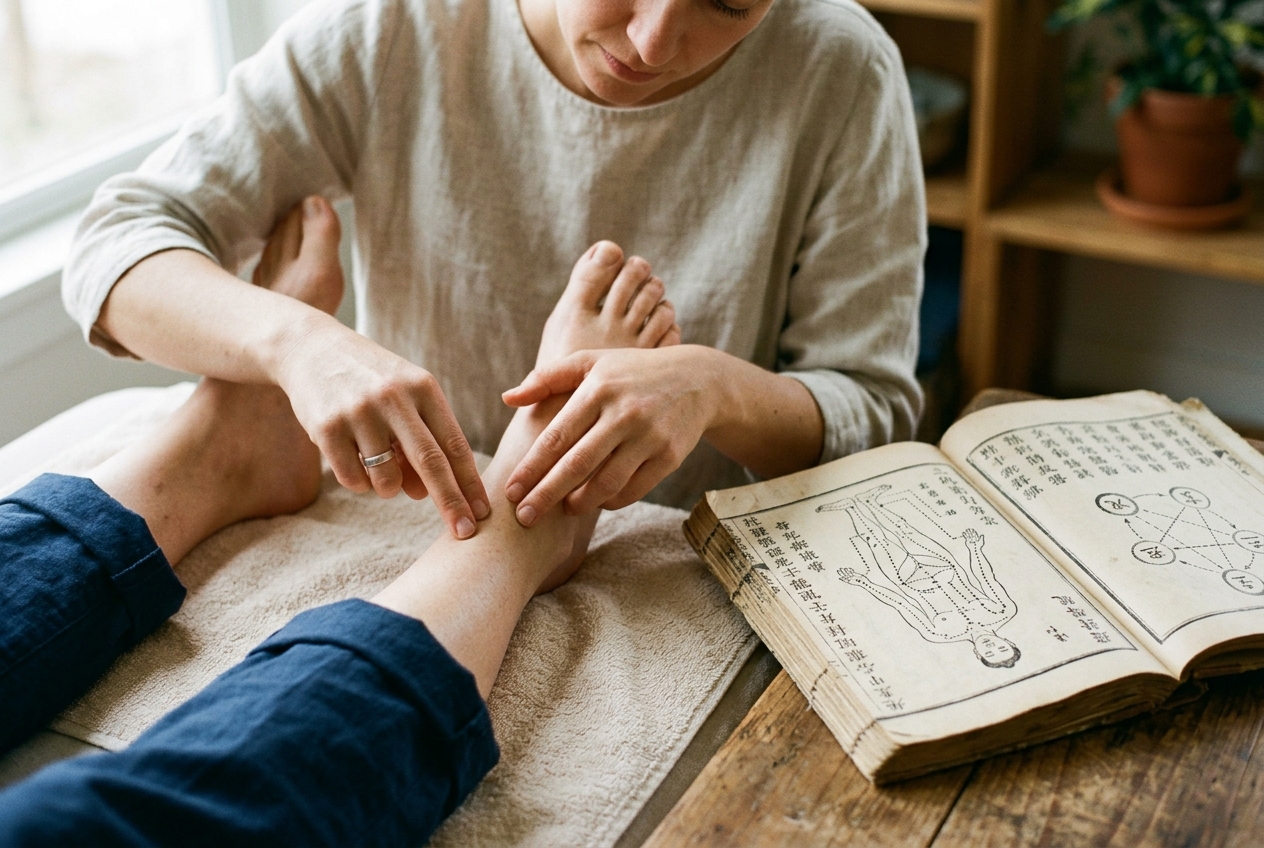
If you regularly wake between two and four in the morning with a racing pulse, carry an unyielding tightness in the solar plexus after meals, or experience a chronic, low-grade cognitive fog paired with emotional irritability, your nervous system is trapped in a classic pattern of autonomic disharmony. In contemporary biomedical terminology, this state reflects sympathetic hyperarousal accompanied by impaired vagal tone and visceral dysmotility. In the sophisticated clinical language of Traditional East Asian Medicine (TEAM), however, you are living within the conflicted territory of the Liver and Spleen meridian networks—where energetic congestion (Qi stagnation) collides with metabolic insufficiency (Spleen Qi deficiency).
While modern somatic therapies frequently treat these manifestations as isolated neurochemical imbalances, 16th-century Korean medical scholar-monks developed an extraordinary, mathematically rigorous paradigm capable of resetting these visceral feedback loops using only four distal points on the extremities. Known as Saam Four-Needle Technique (사암침법, Saam Chimbeop), this clinical system represents one of the most intellectually elegant syntheses of classical meridian dynamics, fascial tensegrity, and bioelectric feedback ever codified. By systematically pairing the generative (Sheng) and regulatory (Ke) dynamics of the Five Phases, the Saam methodology offers modern individuals a powerful roadmap for somatic restoration.
1. Opening — A Problem This Solves Today: The Neurovisceral Trap of Modern Exhaustion
The human body under chronic digital stress operates in a perpetual state of split attention. When mental exertion remains consistently divorced from physical movement, vascular resistance increases in the somatic periphery while mesenteric and splanchnic blood flow diminishes. This manifest state—characterized by tense neck musculature, epigastric bloating within thirty minutes of eating, cold hands and feet, and a restless mental agitation known classically as Shen disturbance—is precisely the systemic knot the Saam protocol was engineered to untangle.
+---------------------------------------------------------------------------------------+
|                                 THE MODERN STRESS CASCADE                             |
|                                                                                       |
|   Digital Overstimulation  -->  Sympathetic Tone Surge  -->  Mesenteric Constriction  |
|                                                                      |                |
|   Digestive Hypomotility   <--  Hepatosplenomegaly &    <--  Fascial Tension in       |
|   & Epigastric Stasis           Biliary Micro-Stasis         Subdiaphragmatic Plane   |
+---------------------------------------------------------------------------------------+
Rather than applying localized, symptomatic treatment directly to the painful shoulder or bloated abdomen—which often yields only transient relief—the Saam methodology intervenes distally. By stimulating high-density neurofascial junctions situated below the elbows and knees, this protocol communicates directly with the central nervous system and the organ parenchymas via long-loop somatovisceral reflexes. Understanding this system requires examining the historical and philosophical matrix from which it emerged.
2. Canonical Lineage & Mathematical Architecture: Synthesizing the 69th and 75th Difficulties
The origins of the Saam protocol trace to the late Joseon Dynasty of Korea (circa 1544–1610). The system is attributed to the legendary ascetic monk known as High Priest Saam (Saam Doin, literally "The Cave-Dwelling Master"), who, according to medical history preserved in the Saam Do-in Eum-yang O-haeng Chim-ju-hae (사암도인음양오행침주해), spent thirteen years meditating in a limestone cave on the subtle mechanics of the Nan Jing (Classic of Difficult Issues) and the Wuxing Five-Phase cosmological framework.
                      +-------------------+
                      |     FIRE (火)     |
                      |  Heart / Sm. Int. |
                      +---------+---------+
                               / \
                   Generates  /   \  Generates
                             /     \
                            /   *   \
                           v     |   v
              +----------------+ | +----------------+
              |   WOOD (木)    | | |   EARTH (土)   |
              | Liver / Gall B.|<--+ | Spleen / Stom. |
              +--------+-------+ | +-------+--------+
                        \        |        /
                   Generates \   |   / Generates
                              \  |  /
                               v v v
             +-------------------+   +-------------------+
             |    WATER (水)     |<--|    METAL (金)     |
             | Kidney / Bladder  |   |  Lung / Lg. Int.  |
             +-------------------+   +-------------------+
Prior to Master Saam, standard acupuncture prescriptions relied predominantly on the classical rule of the 69th Difficulty of the Nan Jing: $$\text{"In deficiency, tonify the mother; in excess, sedate the child." (虛則補其母, 實則瀉其子)}$$
While clinically functional, single-channel mother-child manipulation frequently led to systemic rebound effects. Tonifying a deficient mother phase could inadvertently cause that phase to over-restrain another vital organ, creating collateral energetic depletion. Master Saam resolved this systemic vulnerability by synthesizing the 69th Difficulty with the profound insights of the 75th Difficulty of the Nan Jing, which governs the restraining (Ke) cycle: $$\text{"When the East (Wood) is in excess and the West (Metal) is deficient, sedate the South (Fire) and tonify the North (Water)." (東方實, 西方虛, 瀉南方, 補北方)}$$
Master Saam realized that to permanently stabilize an organ network, one must simultaneously manage two interdependent circulatory loops: 1. The Generating (Sheng) Circuit: Dictates internal energetic replenishment and metabolic progeny. 2. The Controlling (Ke) Circuit: Dictates homeostatic restraint and prevents catastrophic energetic escalation.
               THE SAAM BALANCED FOUR-POINT POLARITY MATRIX

      [ SELF CHANNEL (Affected) ]           [ CONTROLLING CHANNEL (Partner) ]

      +-------------------------+           +-------------------------------+
      | 1. Tonify Mother Point  | <=======> | 2. Tonify Mother-Element Pt.  |
      |    (Generates Energy)   | (Coupled) |    (Bolsters Counter-Control) |
      +-------------------------+           +-------------------------------+
                   ^                                        ^
                   |               HOMEOSTATIC              |
                   |               EQUILIBRIUM              |
                   v                                        v
      +-------------------------+           +-------------------------------+
      | 3. Sedate Control Point | <=======> | 4. Sedate Child-Element Pt.   |
      |    (Releases Restraint) | (Coupled) |    (Exhausts Excessive Force) |
      +-------------------------+           +-------------------------------+
This mathematical synthesis yielded the Saam Four-Needle Matrix, where every clinical formula deploys precisely two tonification (Bu) points and two sedation (Xie) points across two coupled meridians. As documented in contemporary clinical reviews indexed in NCBI PubMed's Saam Acupuncture literature, this dual-vector regulation creates a self-damping biofeedback circuit that prevents energetic overshoots and optimizes physiological autoregulation.
3. The Meridian Path & Five-Shu Transport Topography: Somatic Geography
To apply this theoretical framework, one must understand the somatic geography through which these energetic currents flow. Traditional medicine maps twelve primary channels across the body, each terminating in specialized neurofascial control points situated distally from the elbows to the fingertips, and from the knees to the toes. These are the Five-Shu (Wu Shu) Transport Points:
- Jing-Well (井): Where energy bubbles up from deep fascia (Wood on Yin channels, Metal on Yang channels). Located at the nail corners.
- Ying-Spring (滎): Where energy trickles like a shallow mountain brook (Fire on Yin, Water on Yang). Located on the web margins of hands and feet.
- Shu-Stream (輸): Where energy pours and cascades through larger fascial planes (Earth on Yin, Wood on Yang). Located at the wrists and ankles.
- Jing-River (經): Where energy flows swiftly like an open current (Metal on Yin, Fire on Yang). Located on the forearms and lower legs.
- He-Sea (合): Where energy collects, deepens, and enters the internal viscera (Water on Yin, Earth on Yang). Located at the cubital and popliteal creases.
 DISTAL-TO-PROXIMAL HYDRODYNAMIC GRADIENT OF THE FIVE-SHU TRANSPORT POINTS

 [Nail Corner] ---> [Web Margin] ---> [Wrist/Ankle] ---> [Forearm/Calf] ---> [Elbow/Knee]
   JING-WELL          YING-SPRING        SHU-STREAM         JING-RIVER          HE-SEA
   (Bubbling)         (Trickling)         (Pouring)          (Flowing)        (Deep Union)
The anatomical locations of these points have been rigorously codified in the World Health Organization Standard Acupuncture Point Locations, ensuring universal clinical replicability.
4. Exhaustive Step-by-Step Point Formulas for Key Organ Patterns
The following protocols provide the classical five-shu point assignments for four paramount clinical syndromes.
+-----------------------------------------------------------------------------------------------+
|                        MASTER SAAM FOUR-POINT CLINICAL PRESCRIPTIONS                          |
+=========================+===================================+=================================+
| ORGAN PATTERN           | TONIFICATION PAIR (BU / +)        | SEDATION PAIR (XIE / -)         |
+-------------------------+-----------------------------------+---------------------------------+
| 1. Liver Deficiency     | • LR8 (Ququan / Water-Sea)        | • LR4 (Zhongfeng / Metal-River) |
|    (Gan Jung-Gyeok)     | • KI10 (Yingu / Water-Sea)        | • LU8 (Jingqu / Metal-River)    |
+-------------------------+-----------------------------------+---------------------------------+
| 2. Liver Excess         | • LR4 (Zhongfeng / Metal-River)   | • LR2 (Xingjian / Fire-Spring)  |
|    (Gan Seung-Gyeok)    | • LU8 (Jingqu / Metal-River)      | • HT8 (Shaofu / Fire-Spring)    |
+-------------------------+-----------------------------------+---------------------------------+
| 3. Spleen Deficiency    | • SP2 (Dadu / Fire-Spring)        | • SP1 (Yinbai / Wood-Well)      |
|    (Pi Jung-Gyeok)      | • HT8 (Shaofu / Fire-Spring)      | • LR1 (Dadun / Wood-Well)       |
+-------------------------+-----------------------------------+---------------------------------+
| 4. Lung Yin Deficiency  | • LU9 (Taiyuan / Earth-Stream)    | • LU10 (Yuji / Fire-Spring)     |
|    (Fei Jung-Gyeok)     | • SP3 (Taibai / Earth-Stream)     | • HT8 (Shaofu / Fire-Spring)    |
+-------------------------+-----------------------------------+---------------------------------+
Pattern A: Liver Deficiency Protocol (Gan Jung-Gyeok)
Clinical Presentation: Chronic dry eyes, muscular tremors, tendon stiffness, brittle nails, nocturnal waking at 1:00–3:00 AM, deep postural exhaustion, and emotional indecisiveness.
- Tonification Vector (+): * LR8 (Ququan): Water point on the Liver Channel (Mother on Self). Location: At the medial end of the popliteal crease, superior to the semimembranosus tendon. * KI10 (Yingu): Water point on the Kidney Channel (Mother on Generating Channel). Location: At the medial aspect of the popliteal fossa, between the semitendinosus and semimembranosus tendons.
- Sedation Vector (−): * LR4 (Zhongfeng): Metal point on the Liver Channel (Controller on Self). Location: 1 cun anterior to the medial malleolus, in the depression medial to the tibialis anterior tendon. * LU8 (Jingqu): Metal point on the Lung Channel (Controller on Restraining Channel). Location: On the radial aspect of the forearm, 1 cun proximal to the wrist crease, in the groove between the radial artery and radial styloid.
Pattern B: Liver Excess / Stagnation Protocol (Gan Seung-Gyeok)
Clinical Presentation: Temporal migraines, costal distension, severe PMS, explosive anger, bitter taste in the mouth, bounding pulse, and hypertension.
- Sedation Vector (−): * LR2 (Xingjian): Fire point on the Liver Channel (Child on Self). Location: On the dorsum of the foot, proximal to the margin of the web between the first and second toes. * HT8 (Shaofu): Fire point on the Heart Channel (Child on Fire Phase). Location: On the palm, between the 4th and 5th metacarpal bones, where the tip of the little finger rests when making a fist.
- Tonification Vector (+): * LR4 (Zhongfeng): Metal point on the Liver Channel (Restraining Controller). * LU8 (Jingqu): Metal point on the Lung Channel (Metal Source).
Pattern C: Spleen Deficiency & Damp Accumulation (Pi Jung-Gyeok)
Clinical Presentation: Postprandial lethargy, chronic loose stools, heavy limbs, epigastric fullness, brain fog, metabolic sluggishness, and water retention.
- Tonification Vector (+): * SP2 (Dadu): Fire point on the Spleen Channel (Mother on Self). Location: On the medial side of the great toe, in the depression distal and inferior to the first metatarsophalangeal joint. * HT8 (Shaofu): Fire point on the Heart Channel (Mother on Generating Channel).
- Sedation Vector (−): * SP1 (Yinbai): Wood point on the Spleen Channel (Controller on Self). Location: On the medial aspect of the great toe, 0.1 cun posterior to the corner of the nail base. * LR1 (Dadun): Wood point on the Liver Channel (Wood Source). Location: On the lateral aspect of the great toe, 0.1 cun posterior to the corner of the nail base.
Pattern D: Lung Yin Deficiency (Fei Jung-Gyeok)
Clinical Presentation: Chronic dry non-productive cough, malar flushing, evening hot flashes, night sweats, hoarseness, cutaneous dehydration, and respiratory vulnerability.
- Tonification Vector (+): * LU9 (Taiyuan): Earth point on the Lung Channel (Mother on Self). Location: At the radial end of the wrist crease, in the depression between the radial artery and the abductor pollicis longus tendon. * SP3 (Taibai): Earth point on the Spleen Channel (Earth Source). Location: On the medial aspect of the foot, in the depression proximal and inferior to the head of the first metatarsal bone.
- Sedation Vector (−): * LU10 (Yuji): Fire point on the Lung Channel (Controller on Self). Location: On the thenar eminence of the hand, midpoint of the first metacarpal bone, at the border of the red and white skin. * HT8 (Shaofu): Fire point on the Heart Channel (Fire Source).
5. Modern Neurofascial, Biophysical, and Autonomic Correlates
For centuries, Western medical literature struggled to contextualize how puncturing an ankle or wrist point could alter hepatic perfusion or gastric acid secretion. Contemporary biomechanical and neurophysiological research has now unveiled the precise structural pathways underlying this phenomenon.
       MULTI-TIERED NEUROFASCIAL TRANSMISSION OF THE SAAM CIRCUIT

  Manual / Mechanical Stimulus (Compression & Vector Rotation)
                      |
                      v
  [1. Fascial Mechanotransduction]
      Deformation of interstitial collagen & proteoglycan matrix
      --> Piezoelectric signaling & ATP release via fibroblasts
                      |
                      v
  [2. Afferent Neural Recruitment]
      Activation of A-beta, A-delta, and unmyelinated C-fibers
      --> Transmission through Dorsal Root Ganglia (DRG)
                      |
                      v
  [3. Central & Autonomic Modulation]
      Signal integration at Nucleus Tractus Solitarius (NTS) & Hypothalamus
      --> Vagal nerve efferent activation & Sympathetic down-regulation
                      |
                      v
  [4. Visceral & Parenchymal Response]
      Nitric oxide release, mesenteric perfusion & reduction of TNF-a / IL-6
Fascial Tensegrity and Mechanotransduction
As established by research on connective tissue mechanics published in NCBI PMC's Fascial Matrix Biophysics, meridians closely trace continuous inter- and intra-muscular fascial cleavage planes. Five-shu points represent sites of high connective tissue density where fascial sheets converge around neurovascular bundles. When manual pressure or needle rotation is applied, mechanical shear stresses deform local fibroblasts, triggering cytoskeletal remodeling, extracellular ATP release, and downstream purinergic signaling that travels along continuous fascial planes.
Somatovisceral Reflex Arcs
Distal extremity points possess exceptionally dense receptive fields of low-threshold myelinated $A\beta$ mechanoreceptors and high-threshold $A\delta$ and $C$ sensory fibers. When stimulated with specific directional vectors, these afferents project to the dorsal horn of the spinal cord, ascending via spinothalamic tracts to the Nucleus Tractus Solitarius (NTS) and the Rostral Ventrolateral Medulla (RVLM). As detailed in NCBI PubMed's studies on Autonomic Nervous System Regulation, this inputs directly into the central autonomic network, driving parasympathetic efferent outflow via the vagus nerve while suppressing sympathetic peripheral vasoconstriction.
6. Three Foundational Points You Can Palpate Right Now
To bridge high-level theory with direct tactile reality, explore these three pivotal Five-Shu loci using everyday body landmarks.
        SP3 (Taibai)                      LR8 (Ququan)                    LU9 (Taiyuan)
    [ Medial Foot Arch ]              [ Inner Knee Crease ]            [ Radial Wrist Crease ]
           o                                   o                                  o
           |                                   |                                  |
           v                                   v                                  v
+-----------------------+           +-----------------------+          +-----------------------+
| Palpate along the     |           | Bend your knee 90°.   |          | Turn your palm upward.|
| inside edge of your   |           | Locate the inner soft |          | Feel the crease at    |
| foot behind the big   |           | valley just above the |          | the base of your      |
| toe joint.            |           | crease behind tendon. |          | thumb, near pulse.    |
+-----------------------+           +-----------------------+          +-----------------------+
Point 1: Spleen 3 (Taibai / Great White) — Earth Point on the Spleen Channel
- Anatomical Landmark: Run your thumb along the inside edge of your foot, moving backward from the big toe. Slip over the rounded bony ball of the joint; your thumb will fall into a distinct, tender hollow along the foot's inner arch right where the skin tone changes from pale bottom to darker top.
- Palpation Sensation (Deqi): A deep, spreading, dull ache that often radiates across the plantar fascia and upward toward the inner ankle.
- Manual Technique: Apply firm, sustained pressure using the tip of your thumb at a 90-degree perpendicular angle. Maintain for 2 to 3 minutes while taking slow, deep abdominal breaths.
- Daily Clinical Indications: Postprandial lethargy, sweet cravings, acute abdominal distension, and circular rumination (worry).
Point 2: Liver 8 (Ququan / Spring at the Bend) — Water Point on the Liver Channel
- Anatomical Landmark: Sit comfortably and bend your knee to 90 degrees. Trace your fingers to the innermost crease of the knee bend. Just above the prominent tendon on the inner knee, you will feel a soft, deep anatomical valley.
- Palpation Sensation (Deqi): A subtle, sweet numbness or localized electric sensation that often travels upward along the inner thigh fascial line.
- Manual Technique: Angle your thumb slightly upward toward your hip (a 45-degree tonifying vector). Apply rhythmic, pulsing compressions matching your natural exhalation cycle for 2 minutes per side.
- Daily Clinical Indications: Medial knee pain, ocular dryness from screen fatigue, tight pelvic floor musculature, and unexpressed frustration.
Point 3: Lung 9 (Taiyuan / Great Abyss) — Earth Point on the Lung Channel
- Anatomical Landmark: Rest your hand palm-up on a desk. Look at the wrist crease closest to the hand. Place your opposite thumb on the crease right at the base of your thumb, on the outside of the pulsing radial artery.
- Palpation Sensation (Deqi): A localized, clear ache that sends a spreading wave of warmth into the thenar eminence (the muscular ball of the thumb) and up the radial forearm.
- Manual Technique: Gently anchor the radial artery slightly inward with your index finger, then press the thumb into the depression toward the bone with steady, non-oscillating pressure for 90 seconds.
- Daily Clinical Indications: Shallow breathing, chronic throat tickling, grief-induced chest constriction, and vascular fatigue.
7. Dual-Handed Bu-Xie Manual Acupressure Protocol
In clinical acupuncture, tonification (Bu) and sedation (Xie) are executed using needle insertion angles, rotation direction, and retention timing. In self-care manual therapy, we translate these dynamics into an integrated Dual-Handed Polarity Protocol synchronizing manual pressure vectors with respiratory phases.
+=======================================================================================+
|                   THE DUAL-HANDED BU-XIE MANUAL COMPRESSION METHOD                    |
+=======================================================================================+
| TECHNIQUE        | ROTATION VECTOR      | BREATH SYNCHRONY   | PRESSURE PROFILE       |
+------------------+----------------------+--------------------+------------------------+
| TONIFICATION     | Clockwise / Following| Inhale: Hold steady| Gentle, continuous,    |
| (Bu / +)         | channel trajectory   | Exhale: Light sink | non-fatiguing pressure |
+------------------+----------------------+--------------------+------------------------+
| SEDATION         | Counter-Clockwise /  | Inhale: Release    | Firm, dynamic, rapid   |
| (Xie / -)        | Against channel path | Exhale: Drive deep | dispersional release   |
+------------------+----------------------+--------------------+------------------------+
STEP-BY-STEP DUAL-HANDED EXECUTION FOR LIVER-SPLEEN DISHARMONY

[LEFT HAND: Tonify SP3]                        [RIGHT HAND: Sedate LR2]
(Thumb anchors medial foot arch)               (Index finger hooks 1st web space)
          |                                               |
          |=======> [ INHALE (4 Seconds) ] <==============|
          |  Light, stabilizing anchor contact            |  Gentle lift; allow Qi to gather
          |                                               |
          |=======> [ EXHALE (6 Seconds) ] <==============|
          |  Slow clockwise micro-rotation                |  Firm, linear dispersion toward toes
          |  (Directing energy upward into Spleen)        |  (Purging heat & excess from Liver)
- Patient Posture: Assume a relaxed seated position with feet flat on the floor or sit cross-legged with the spine upright and unconstrained.
- Left-Hand Anchor (Tonification at SP3): Position your left thumb over SP3 on your left foot. As you breathe in for 4 seconds, maintain a steady, gentle contact. As you exhale for 6 seconds, introduce a slow, clockwise micro-rotation with the thumb tip, directing the mechanical vector upward along the medial tibia.
- Right-Hand Counter (Sedation at LR2): Simultaneously position your right index knuckle or thumb on LR2 (between the big and second toes) of the same foot. During inhalation, lessen pressure slightly. During exhalation, press firmly and stroke distally toward the web margin and out through the toes (against the meridian's upward flow), actively dispersing tension.
- Duration & Repetition: Perform this synchronized dual compression for 3 minutes on the left extremity, then switch hands and mirror the sequence on the right extremity for 3 minutes.
8. Complete "Do This Tonight" Sequence: The Evening Autonomic Reset
If you have spent your day seated before screens, experiencing digestive stagnation paired with cognitive overstimulation, execute this complete 8-minute restorative protocol tonight before bed.
+---------------------------------------------------------------------------------------+
|                    THE 8-MINUTE EVENING SOMATOVISCERAL RESET                          |
+---------------------------------------------------------------------------------------+
|  Minute 0:00 - 2:00 | Bilateral SP3 Activation (Tonify Earth -> Calms Digestion)      |
|  Minute 2:00 - 4:00 | Bilateral LR8 Compression (Tonify Water -> Replenishes Yin)     |
|  Minute 4:00 - 6:00 | Bilateral LR2 Dispersion (Sedate Fire -> Clears Head Heat)      |
|  Minute 6:00 - 8:00 | Diaphragmatic Breath Integration with LU9 Radial Hold           |
+---------------------------------------------------------------------------------------+
- Phase 1: Grounding the Middle Burner (Minutes 0:00–2:00) * Sit on the edge of your bed. Grasp your left foot and locate SP3 (Taibai). Press firmly with your thumb. Close your eyes and direct your breath deep into the lower abdomen. After 60 seconds, repeat on the right foot.
- Phase 2: Quenching Somatic Irritability (Minutes 2:00–4:00) * Slide your hands up to the inner knee creases to locate LR8 (Ququan). Hook both thumbs into the inner knee depressions simultaneously. Apply a steady, upward-angled pressure while inhaling for 4 seconds and exhaling for 7 seconds. Feel the release of tension in the hamstrings and lower pelvis.
- Phase 3: Draining the Upper Burner (Minutes 4:00–6:00) * Shift your focus to the web space between the big and second toes on both feet to locate LR2 (Xingjian). Apply firm, pinching pressure between your thumb and index finger, massaging firmly outward toward the edge of the toes to clear residual mental chatter and lower arterial pressure.
- Phase 4: Settling the Shen (Minutes 6:00–8:00) * Lie flat on your back. Rest your right thumb gently on the left LU9 (Taiyuan) pulse point at the wrist crease. Place your left hand over your navel. Breathe naturally without effort. Allow the systemic vascular bed to dilate as peripheral perfusion returns.
9. Safety, Contraindications & Clinical Vigilance
While manual acupressure is inherently safe and non-invasive, precise clinical boundaries must be respected:
> [!WARNING]
> ### CLINICAL SAFETY WARNINGS & PRECAUTIONS
> * **Pregnancy Considerations:** Strong distal sedation techniques—particularly on points like SP1, LR1, and LR2, as well as powerful reflex loci like LI4 (*Hegu*) and SP6 (*Sanyinjiao*)—are strictly contraindicated during pregnancy due to their capacity to induce uterine contractions and downward bearing-down vectors.
> * **Pressure Boundaries:** Therapeutic *Deqi* sensation should feel like a deep, satisfying ache, gentle distension, or mild warmth. Sharp, lancinating, or burning pain indicates direct mechanical impingement on a cutaneous nerve branch. Immediately reduce pressure or adjust angle.
> * **Red Flag Symptoms:** Self-care acupressure must never replace immediate emergency medical intervention. If you experience sudden unilateral numbness, severe crushing substernal chest pain, acute unremitting abdominal rigidity, or a sudden thunderclap headache, seek hospital emergency care immediately.
When managing complex, multi-system chronic illnesses—such as autoimmune disorders, chronic inflammatory syndromes, or clinical cardiac conditions—self-care should always be coordinated with a licensed acupuncturist and your primary care physician. You can explore clinical standards and international research through Wikipedia's Saam Acupuncture Reference.
10. Today's Takeaway: A 2-Minute Desk Reset
You do not need an hour of leisure or specialized equipment to change your physiological state. Before you close this window, execute this singular, 2-minute reset right at your desk:
+---------------------------------------------------------------------------------------+
|                                YOUR 2-MINUTE DESK PROTOCOL                            |
|                                                                                       |
|   Target Point: LU9 (Taiyuan / Great Abyss) at the radial wrist crease                |
|   Target Complaint: Midday Brain Fog, Shoulder Elevation, Shallow Breathing           |
|                                                                                       |
|   1. Place your left thumb into the wrist hollow on the thumb side of your right arm. |
|   2. Inhale deeply through your nose for 4 counts, feeling your belly expand.         |
|   3. Exhale smoothly through parted lips for 6 counts while applying firm pressure.  |
|   4. Repeat for 6 complete breath cycles (approx. 60 seconds), then switch wrists.   |
+---------------------------------------------------------------------------------------+
By intentionally stimulating this pivotal Earth point on the Metal channel, you supply generative support to the respiratory architecture, recruit vagal parasympathetic tone, and restore hemodynamic balance to the vascular tree—demonstrating the timeless physiological genius of High Priest Saam's 16th-century paradigm.