Rou Fu Gong Abdominal Rubbing Qigong: Visceral Peristalsis, Enteric Fascial Unwinding, and Lower Dantian Thermogenesis in Classical Daoist Daoyin
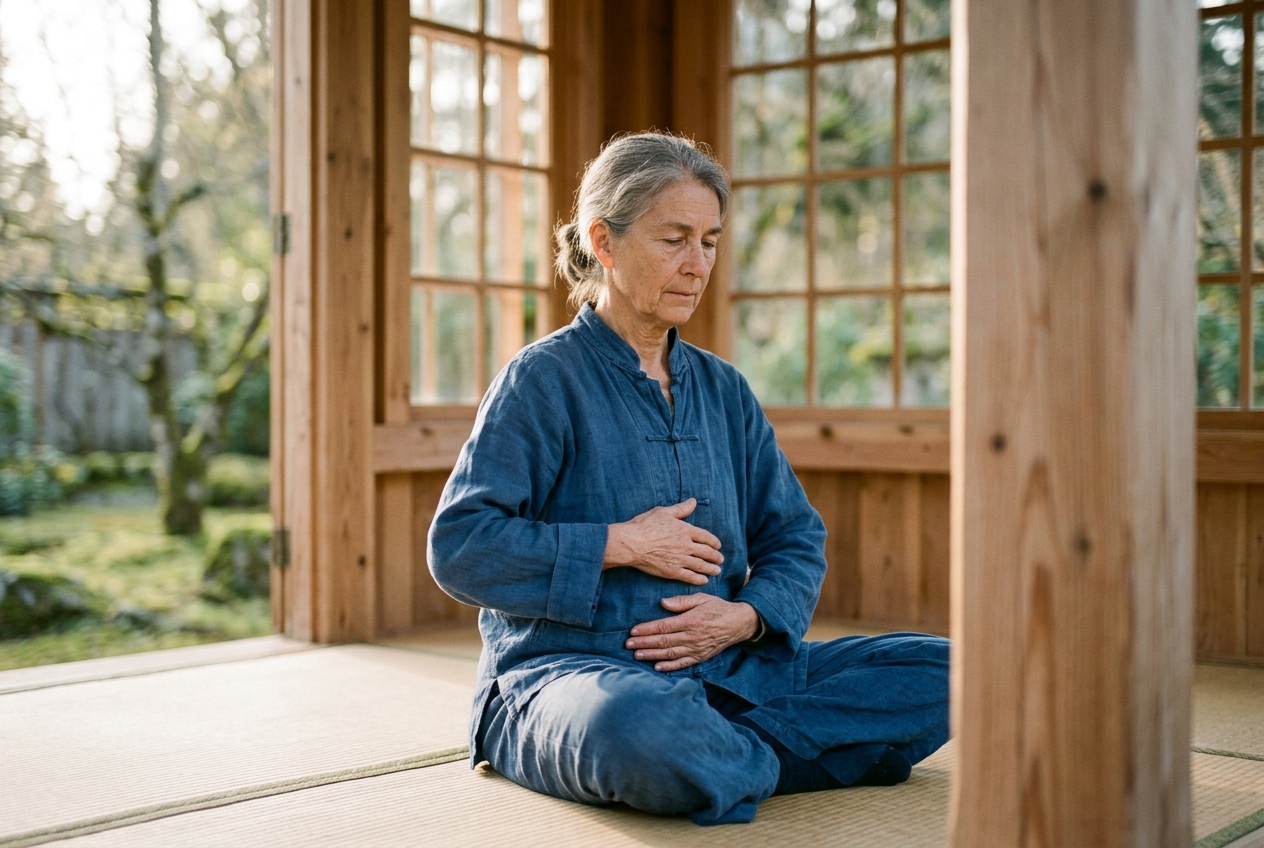
When translated into contemporary somatic language, the practice acts as a conscious mechanical and neurological recalibration of the abdominal cavity. By tracing structured spirals over the surface of the belly with specific pressure gradations, the practitioner manually releases restrictions within the abdominal fascia, stimulates the intrinsic rhythms of the digestive tract, and shifts the autonomic nervous system out of chronic fight-or-flight reactivity into deep restorative calm.
Classical Lineage and Historical Context
The practice of abdominal manipulation occupies a revered position within the lineage of Chinese health preservation (Yang Sheng 養生). Archaeological discoveries have traced therapeutic self-massage and breath-directed movement to the Han Dynasty (206 BCE – 220 CE). The silk manuscript known as the Daoyin Tu (Guiding and Pulling Chart), excavated from the Mawangdui tombs in 1973, along with the bamboo-slip medical treatise Yinshu (Pulling Book, ca. 186 BCE), document early therapeutic sequences designed to purge pathogenic blockages from the viscera through physical mobilization. Practitioners can contextualize these classical forms through resources documented by the National Qigong Association and broad historical surveys of Daoist Daoyin.
During the Tang Dynasty, the legendary physician Sun Simiao (581–682 CE), often referred to as China’s King of Medicine, canonized abdominal rubbing in his monumental compendium Qianjin Yaofang (Essential Formulas Worth a Thousand Gold Pieces). Sun Simiao famously observed that performing gentle circular friction over the umbilical region after meals and before sleep could resolve chronic stagnation, facilitate the unobstructed movement of the "Grain Qi" (Gu Qi), and prolong functional lifespan beyond one hundred years.
By the Qing Dynasty (1644–1912 CE), the methodology was systematized into distinct esoteric and exoteric protocols. Master Fang Tingyu and later scholar Pan Weiru synthesized these methods in texts such as the Weisheng Yijian (Simple Guide to Preserving Health). In classical internal alchemy (Neidan), the abdomen is not merely a biological container for food assimilation, but a sacred cauldron (Lu) wherein Jing (essence) is transmuted into Qi (vital breath). Rou Fu Gong was practiced as an essential preliminary art (Zhu Ji, building the foundation) to clear the Ren Mai (Conception Vessel) and Chong Mai (Thrusting Vessel), ensuring that subsequent meditative practices would not encounter physical stasis or trapped metabolic heat in the lower abdomen.
The Body Science: Anatomical and Physiological Substrates
To understand why simple circular friction over the belly produces profound systemic transformations, modern medicine looks to the interplay between neurogastroenterology, fascial tensegrity, and vascular-lymphatic hemodynamics.
+---------------------------------------------------------------------------------------+
|                 SYSTEMIC MECHANISMS OF ROU FU GONG INTERVENTION                       |
+=======================================================================================+
| 1. ENTERIC NERVOUS SYSTEM (ENS) ENTRAINMENT                                           |
|    - Tactile shear stimulates ~500 million submucosal and myenteric neurons           |
|    - Enhances bidirectional communication along the Vagus Nerve (Cranial Nerve X)     |
|    - Downregulates systemic cortisol while upregulating gut-derived serotonin         |
+---------------------------------------------------------------------------------------+
| 2. MESENTERIC FASCIAL MOBILIZATION                                                    |
|    - Releases micro-adhesions along Toldt's fascia and the greater omentum            |
|    - Restores physiological visceral sliding velocity during diaphragmatic excursion  |
|    - Triggers cellular mechanotransduction via interstitial fibroblast signaling      |
+---------------------------------------------------------------------------------------+
| 3. LYMPHATIC HEMODYNAMICS & FLUID RETURN                                              |
|    - Decompresses the Cisterna Chyli situated at the L1-L2 vertebral juncture         |
|    - Accelerates peritoneal lymphatic drainage through the thoracic duct              |
|    - Relieves hepatic portal congestion and optimizes inferior vena cava return       |
+---------------------------------------------------------------------------------------+
1. Enteric Nervous System Entrainment and Vagal Activation
The human gastrointestinal tract is lined with approximately 500 million neurons, an intrinsic network known as the enteric nervous system (ENS), or the "second brain." The ENS operates in continuous bidirectional dialogue with the central nervous system via the vagus nerve (Cranial Nerve X). Chronic psychological stress drives sustained sympathetic activation, shunting blood away from the splanchnic circulation, inhibiting digestive enzyme secretions, and causing hypertonicity in the smooth musculature of the gut wall.
The application of rhythmic, low-frequency manual shearing across the dermatomes of the abdominal wall directly excites tactile mechanoreceptors and Ruffini endings. This input provides a strong afferent stimulus that upregulates parasympathetic tone. Clinical investigations indexed on PubMed Central demonstrate that targeted abdominal massage reduces transit time, stimulates peristalsis, and elevates Heart Rate Variability (HRV), a primary metric of autonomic adaptability and systemic stress recovery.
2. Mesenteric Fascial Tensegrity and Visceral Motility
Anatomically, the internal organs are suspended within continuous sheets of specialized connective tissue—the mesentery, the greater and lesser omenta, and Toldt’s fascia. Under healthy conditions, these organs demonstrate two distinct types of movement: visceral motility (the intrinsic, physiological motion of an organ driven by its own cellular metabolism) and visceral mobility (the movement of an organ in response to somatic activity and the piston-like descent of the thoracic diaphragm).
Prolonged sedentary postures, inflammatory diets, or psychological bracing create micro-adhesions and dehydration within the visceral fascial layers. When the sliding surfaces between the peritoneal membranes lose their fluid lubrication, the digestive tract becomes mechanically restricted. Rou Fu Gong introduces gentle, multidirectional shear stress to these tissues. Through the process of mechanotransduction, mechanical deformation stimulates resident fibroblasts to remodel the extracellular matrix, restoring hydration and fluid gliding between adjacent visceral structures.
3. Lymphatic Hemodynamics and the Cisterna Chyli
The abdominal cavity houses the body's primary lymphatic reservoirs. Situated immediately anterior to the bodies of the first and second lumbar vertebrae, deep to the abdominal aorta, lies the cisterna chyli—a dilated sac that collects lipid-rich lymph (chyle) from the lower limbs, pelvis, and intestinal trunks.
Rhythmic variations in intra-abdominal pressure generated by the combination of deep diaphragmatic respiration and external manual compression act as a mechanical suction pump. This dynamic decompresses the cisterna chyli, accelerating the upward return of lymph through the thoracic duct into the left subclavian vein. The systemic result is enhanced clearance of metabolic waste from the interstitial fluid, reduced abdominal bloating, and optimized immunological surveillance across the gut-associated lymphoid tissue (GALT), a key mechanism recognized in research supported by the World Health Organization Traditional Medicine initiatives.
Step-by-Step Practice Guide
To reap the full therapeutic benefits of Rou Fu Gong, the exercise must be executed with technical precision, conscious sensory engagement, and careful breath coordination.
                    PROGRESSIVE VECTOR EXPANSION PROTOCOL

      Stage 1: Cutaneous Warmth      Stage 2: Mesenteric Shear      Stage 3: Visceral Depth
          (Epidermal Friction)          (Subcutaneous Rolling)         (Intra-Abdominal Glide)

                ( • )                        (  •  )                      (   •   )
              Diameter:                    Diameter:                    Diameter:
              3-4 inches                   6-8 inches                  Full Abdomen
Step 1: Postural Alignment and Sensory Centering
- Position: Lie supine on a firm, comfortable surface (such as a yoga mat or bed) with a small pillow supporting your head. If your lower back feels strained, place a rolled bolster beneath your knees to relax the psoas and abdominal wall. Alternatively, you may sit upright on the front half of a chair with both feet flat on the floor, spine tall, and perineum grounded.
- Centering: Place your hands together in front of your chest and rub your palms vigorously for 15 to 20 seconds until substantial heat is generated in the Laogong (Pericardium 8) acupuncture points situated in the centers of your palms.
Step 2: Hand Stacking and Contact
- Place one palm directly over your navel (Shenque, CV8).
- Place your other palm directly over the back of the first hand, interleaving your fingers slightly or stacking them flat. In classical tradition, practitioners often place the dominant or left hand down first to stimulate metabolic clearing, or the right hand down to foster warming tonification; for beginners, simply select whichever hand configuration feels most natural and relaxed.
- Allow the weight of your arms and shoulders to settle into the abdominal wall without actively pushing downward with muscular force.
Step 3: Clockwise Spiral Rotation (The Expelling and Regulating Phase)
- Direction: Begin circling your hands around the navel in a clockwise direction (moving up the right side of the abdomen, across the upper epigastrium below the ribcage from right to left, down the left flank, and across the lower pelvic brim from left to right). This pathway mirrors the physiological transit of the ascending, transverse, and descending colon.
- Vector Dynamics: Start with small, compact circles approximately 3 inches in diameter around the navel. Over the course of 36 continuous revolutions, progressively widen the spiral outward until your hands trace the widest perimeter of your abdominal cavity—brushing just below the costal margins of the ribs at the top and the pubic bone at the bottom.
- Breath Integration: Synchronize the movement with your breath. Inhale for half of the circle (as the hands travel upward along the right side), allowing the abdomen to inflate softly against the palms; exhale for the remaining half (as the hands descend along the left side), letting the abdominal wall gently sink toward the spine.
- Pressure Grading:
- Revolutions 1–12: Cutaneous warming (light surface friction to bring blood flow to the skin).
- Revolutions 13–24: Subcutaneous fascial shear (moderate pressure to move the skin and superficial adipose layer over the muscle).
- Revolutions 25–36: Gentle visceral mobilization (deeper, rhythmic compression that gently shifts the underlying digestive organs).
Step 4: Counterclockwise Spiral Rotation (The Tonifying and Gathering Phase)
- Direction: Pause at the widest outer boundary of the abdomen, then reverse the trajectory into a counterclockwise direction (moving down the right side, across the lower pelvic basin to the left, up the left flank, and across the upper epigastrium from left to right).
- Vector Dynamics: Begin at the wide outer perimeter and, over 36 smooth revolutions, gradually contract the spiral inward, making each circle smaller than the last, until both hands return to rest directly over the center of the navel.
- Energetic Rationale: In Daoist physiological theory, clockwise motion disperses stagnation and clears post-heaven turbid Qi (Zhuo Qi), whereas counterclockwise motion consolidates pre-heaven vitality (Yuan Qi), drawing dispersed warmth back into the protective storage of the Xia Dantian.
Step 5: Energetic Sealing and Stillness (Zhen Dantian)
- Bring both palms to rest silently over the lower abdomen, nested between the navel and the pubic bone.
- Close your eyes and breathe naturally for 1 to 2 minutes.
- Direct your mental focus (Yi) inward, visualizing the accumulated heat and vitality condensing into a glowing, warm sphere deep within the pelvic core, midway between the navel and the lumbar spine. Feel the tissues soften and assimilate the practice.
Common Beginner Errors and Corrective Adjustments
| Beginner Mistake | Biomechanical / Energetic Impact | Corrective Adjustment |
|---|---|---|
| Abdominal Bracing (tensing the rectus abdominis against the hands) | Prevents penetration of mechanical shear forces; blocks vagal afferent signaling. | Soften your jaw, release the pelvic floor, and reduce hand pressure until the abdominal wall remains completely pliable beneath your touch. |
| Shoulder and Neck Strain (elevating shoulders during circling) | Traps muscular tension in the upper cervical spine, triggering sympathetic nervous arousal. | Keep elbows resting close to the sides of your torso; let the circular vector originate from the forearms and wrists rather than the upper back. |
| Excessive Speed (rushing through the 36 repetitions) | Bypasses the natural frequency of enteric smooth muscle contraction (3–12 cycles/min). | Slow your pace to roughly 4 to 6 seconds per complete circle, matching your natural, unhurried respiratory rhythm. |
| Pushing Past Pain (forcing deep pressure into sharp discomfort) | May aggravate underlying inflammation, spasms, or vascular structures. | Stay within a pain-free range. If a tender zone is encountered, pause, hold light static contact, and breathe gently into that point until it softens. |
Interoceptive Somatic Cues: What Sensations to Look For
As you practice Rou Fu Gong, subtle physiological shifts indicate that the nervous system and visceral fascia are responding to the intervention:
- Thermal Radiance (Re Qi): A gentle, expanding sensation of warmth beneath the palms. Physiologically, this reflects local vasodilation and increased capillary perfusion across the cutaneous and mesenteric vascular beds.
- Borborygmi and Acoustic Release: Gurgling, bubbling, or rumbling sounds emerging from the intestines. This is a primary somatic indicator of the gastrocolic reflex and migrating motor complex (MMC) activating under parasympathetic dominance.
- Spontaneous Sighing or Yawning: A sudden, reflexive impulse to take a deep, spontaneous breath or yawn. This reflects the down-regulation of the sympathetic nervous system and the resetting of the respiratory centers in the brainstem.
- Tissue Softening (Myofascial Release): A perceptible change in abdominal tissue compliance, transforming dense, drum-like tension into a supple, dough-like elasticity.
Clinical Contraindications and Safe Practice Boundaries
While Rou Fu Gong is a safe, restorative modality for the vast majority of individuals, specific clinical presentations require caution or strict contraindication:
- Absolute Contraindications:
- Acute abdominal conditions (such as appendicitis, peritonitis, diverticulitis, or bowel obstruction).
- Known abdominal aortic aneurysms.
- Pregnancy (especially during the first and third trimesters; deep abdominal manipulation must be avoided).
- Recent abdominal surgery (within 8 to 12 weeks, or until full structural tissue healing is verified by a physician).
- Active gastrointestinal bleeding, ulcers, or unexplained acute abdominal pain.
- Relative Contraindications & Timing Rules:
- Postprandial Timing: Avoid practicing within 45 to 60 minutes after consuming a heavy meal. Allow preliminary gastric processing to complete before applying manual pressure.
- Full Bladder: Always empty your bladder before beginning to avoid discomfort during lower pelvic circling.
Today’s Practice Commitment: Your Daily Cultivation Protocol
To experience the cumulative therapeutic benefits of Rou Fu Gong, integrate the following simple, structured routine into your daily schedule over the coming week:
+---------------------------------------------------------------------------------------+
|                    THE 7-DAY ABDOMINAL RESTORATION ROUTINE                            |
+=======================================================================================+
|  MORNING UPON WAKING (5 to 7 Minutes):                                                |
|  - Lie in bed before looking at your phone or getting up.                             |
|  - Perform 36 clockwise rotations (expanding from navel to outer perimeter).          |
|  - Perform 36 counterclockwise rotations (contracting from perimeter to navel).       |
|  - Rest for 1 minute in static stillness over the lower abdomen.                      |
|  - Drink a warm glass of water immediately afterward to support metabolic clearance. |
+---------------------------------------------------------------------------------------+
|  EVENING BEFORE SLEEP (5 Minutes):                                                    |
|  - Repeat the 36-expansion and 36-contraction protocol while lying supine in bed.     |
|  - Focus on extending the length of your exhalations to prepare for deep sleep.       |
+---------------------------------------------------------------------------------------+
By dedicating ten minutes a day to this classical Daoyin practice, you actively participate in the self-regulation of your internal terrain. For additional research regarding the physiological benefits of mind-body cultivation and integrative somatic therapies, consult clinical databases such as the National Center for Biotechnology Information (NCBI). Through the union of modern physiological insight and timeless Daoist methodology, Rou Fu Gong transforms the simple act of touching your own belly into a profound practice of visceral rejuvenation and holistic health.