Root and Knot Points: Navigating Ling Shu Channel Terminations, Distal-Proximal Polarity, and Classical Acupressure Protocols
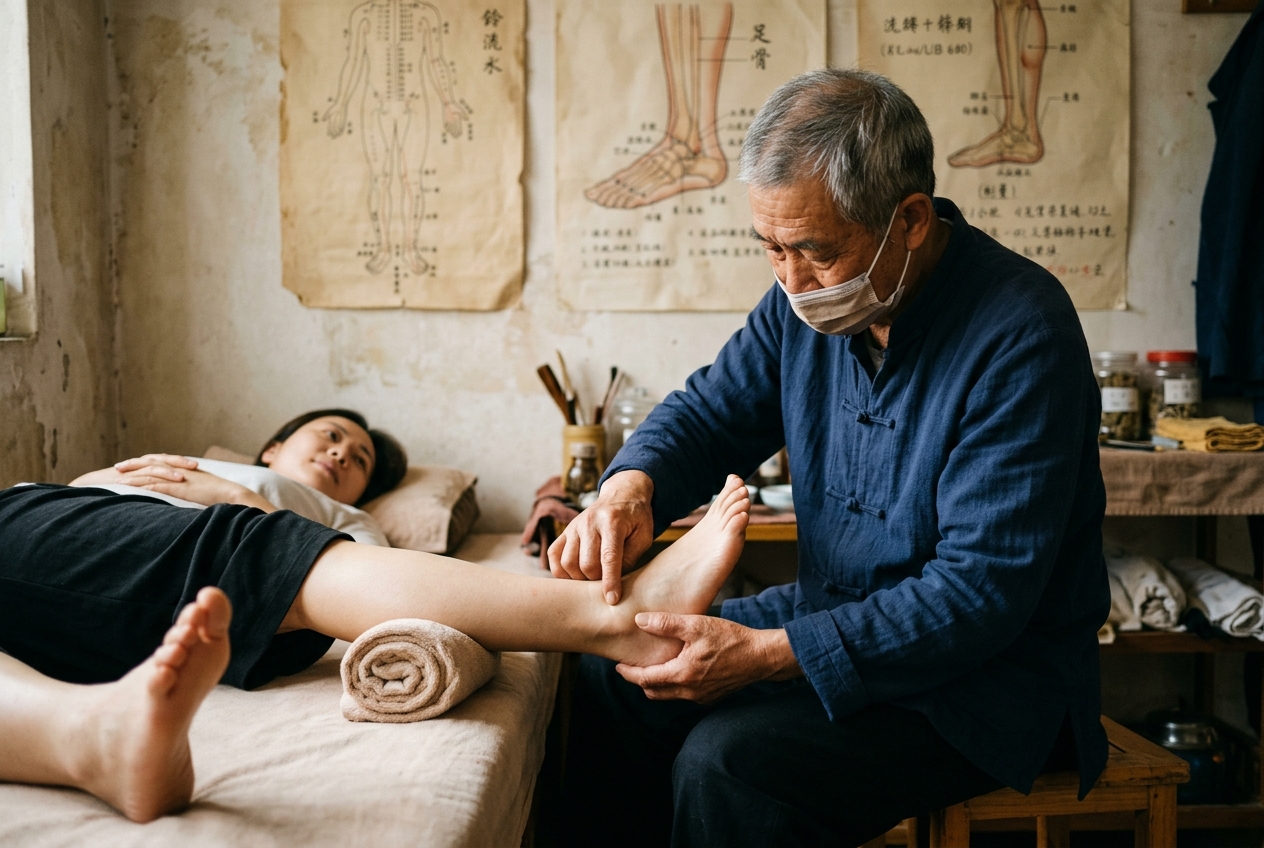
The failure of localized massage reveals an elementary physiological truth: where pain speaks is rarely where its governing architecture resides. More than two millennia ago, the foundational canon of East Asian medicine, the Huangdi Neijing Ling Shu (The Miraculous Pivot), codified this phenomenon within a sophisticated diagnostic and therapeutic framework known as Gen-Jie (根結), or the doctrine of "Roots and Knots."
Recorded principally in Chapter 5 of the Ling Shu, this classical principle posits that the body’s primary energetic and neuromuscular pathways behave like dynamic hydraulic conduits. Force, sensory signals, and metabolic momentum originate at the distal extremities—the tips of the toes and fingers—before traveling through physiological rapids to terminate at designated somatic hubs, or "knots," anchored within the head, thorax, and abdomen. By understanding this polarity, one unlocks a profound, counterintuitive mechanism of bodily self-regulation: the most potent lever for releasing a compressed cranial vault or a knotted stomach is situated at the margins of the feet.
+-----------------------------------------------------------------------------------+
|                              THE GEN-JIE CONTINUUM                                |
|                                                                                   |
|  [ GEN : Root ]       -->  [ LIU : Flow ]   -->  [ ZHU : Pour ]  --> [ JIE : Knot]|
|  Distal Extremity          Shaft/Tendon          Major Joints        Cranial/Axial|
|  (Jing-Well Points)        (Metatarsals)         (Knee/Elbow)        Convergence  |
+-----------------------------------------------------------------------------------+
1. The Meridian Path: A Journey Through the Body’s Fourfold Continuum
In the classical architecture of the World Health Organization standard meridian nomenclature, the flow of vitality (qi) along the twelve primary channels is not an undifferentiated stream. Rather, Chapter 5 of the Ling Shu outlines a distinct four-stage hydrological and kinematic progression:
- Gen (根 — The Root): The generative origin situated at the furthest extremities (the Jing-Well points at the tips of the toes and fingers), where energy surfaces with high dynamism and directional velocity.
- Liu (流 — The Stem or Flow): The channel where the current gathers volume, gliding along the long bones of the hands and feet.
- Zhu (注 — The Pouring or Infusion): The broader confluence where the pathway deepens, cascading across the articular landscapes of the ankles, wrists, and knees.
- Jie (結 — The Knot or Convergence): The ultimate cranial, thoracic, or abdominal terminus where multiple fascial planes, autonomic nerve plexuses, and channel currents consolidate into a profound physiological nexus.
             ====================================================
                       THE SIX CONFORMATION VECTORS
             ====================================================

CONFORMATION          GEN (ROOT)                     JIE (KNOT)
      ------------------------------------------------------------------
      TAIYANG (Greater Yang)  BL67 (Zhiyin / Little Toe)     --> BL1 (Inner Canthus)
      YANGMING (Bright Yang)  ST45 (Lidui / Second Toe)      --> ST8 (Temple Vault)
      SHAOYANG (Lesser Yang)  GB44 (Zuqiaoyin / 4th Toe)     --> GB2 (Pre-Auricular)
      TAIYIN (Greater Yin)    SP1  (Yinbai / Medial Big Toe) --> CV12 (Epigastrium)
      SHAOYIN (Lesser Yin)    KI1  (Yongquan / Sole)         --> CV23 (Hyoid Notch)
      JUEYIN (Terminal Yin)   LV1  (Dadun / Lateral Big Toe) --> CV18 (Sternum Center)
      ====================================================
The Yang Conformations: Vectors of the Senses and Cranium
-
Taiyang (Greater Yang — The Posterior Shield): The pathway originates at the root (Gen) on the outer corner of the smallest pinky toe at BL67 (Zhiyin). It traverses the lateral blade of the foot, ascends the Achilles tendon, climbs the calf and the back of the thigh, ascends parallel along the entire length of the spine, over the crest of the skull, and terminates at its knot (Jie) at BL1 (Jingming) at the inner corner of the eye. Taiyang governs our structural posterior myofascial line; when it tightens, the entire backline contracts like an overdrawn archer’s bow, pinning the base of the skull into chronic compression.
-
Yangming (Bright Yang — The Anterior Ingestion Line): Beginning at the root on the lateral corner of the second toe nail at ST45 (Lidui), this pathway surges across the top of the foot, up the front of the shinbone—the sharp edge that aches after miles of walking—along the anterior thigh, through the belly muscles, over the throat, and ascends into its cranial knot (Jie) at ST8 (Touwei), nestled in the temple notch at the corner of the hairline, while maintaining deep visceral convergence at CV12 (Zhongwan) in the solar plexus. Yangming directs down-bearing force; disharmony yields reflux, jaw clenching, and searing frontal headaches.
-
Shaoyang (Lesser Yang — The Lateral Pivot): Rooting at the outer edge of the fourth toe at GB44 (Zuqiaoyin), this line winds over the outer ankle bone, zigzags up the lateral seam of the leg, ribs, and flank, ascends the side of the neck, and wraps in an intricate arc around the ear before knitting its knot (Jie) at GB2 (Tinghui) in the hollow immediately in front of the earlobe, as well as the thoracic center at CV17 (Shanzhong). Shaoyang governs rotational movement, lateral neck mobility, and systemic stress modulation.
The Yin Conformations: Deep Cavitary Reservoirs
-
Taiyin (Greater Yin — The Metabolic Core): Rooting at SP1 (Yinbai) on the inside corner of the big toe nail, this pathway traces the medial arch of the foot, skirts behind the inner ankle bone, ascends the inner shin, and enters the deep abdominal basin to form its knot (Jie) at CV12 (Zhongwan). It regulates fluid distribution, postprandial fatigue, and muscular tone.
-
Shaoyin (Lesser Yin — The Root of Vitality): Originating at KI1 (Yongquan) in the central depression on the sole of the foot, Shaoyin ascends through the inner heel, the deep posterior compartment of the calf, traverses the pelvic floor, and ascends along the midline of the chest to weave its knot (Jie) at CV23 (Lianquan) at the upper border of the hyoid bone, deeply anchoring speech, respiration, and autonomic equilibrium.
-
Jueyin (Terminal Yin — The Neurovascular Hinge): Rooting at LV1 (Dadun) on the outer aspect of the big toe nail, Jueyin climbs the inner thigh, loops the pelvic basin, ascends through the hypochondrium, and anchors its knot (Jie) at CV18 (Yutang) along the sternal midline. Jueyin mediates smooth microvascular tone, emotional irritability, and the unhindered flow of peripheral circulation.
       [CRANIAL / THORACIC KNOTS]
              BL1, ST8, GB2, CV12, CV18, CV23
                          ^
                          |  Kinetic Vector /
                          |  Fascial Tension Line /
                          |  Sensory Afference
                          |
             [DISTAL EXTREMITY ROOTS]
              BL67, ST45, GB44, SP1, KI1, LV1
Classical Distinction: Gen-Jie vs. Biao-Ben
To understand the genius of Gen-Jie, one must contrast it with another central tenet of acupuncture theory: Biao-Ben (Root and Branch), documented across NCBI clinical literature on Chinese medical theory.
While Biao-Ben classifies hierarchical relationships between primary underlying etiologies (Ben, the root cause) and surface symptoms (Biao, the manifesting branch), Gen-Jie is an explicitly spatial, hydraulic, and biomechanical model. Biao-Ben maps disease states; Gen-Jie charts kinematic transmission vectors.
Modern bio-mechanics provides a compelling explanation for this ancient map. As demonstrated by Dr. Helene Langevin's landmark research on connective tissue planes, acupuncture meridians co-localize remarkably with intermuscular and subcutaneous cleavage planes. When mechanical force is introduced at a distal extremity point (Gen), mechanotransduction initiates a wave of cytoskeletal remodeling and cellular signaling along continuous collagenous fascial sheaths. The distal point acts as a mechanical anchor, magnifying its tensile vector across long lever arms to decompress distant, hyper-concentrated convergence hubs (Jie). Concurrently, stimulation of distal dermatomes modulates central somatosensory processing via viscerocutaneous and somatosensory reflex arcs, altering cerebral blood flow and resetting autonomic hyper-reactivity.
2. Three Classical Points You Can Engage Right Now
To directly experience the regulatory polarity of Gen-Jie, you do not need needles or clinical instruments. Precise, focused manual pressure applied to these loci engages the same neurofascial architecture.
+------------------------------------------------------------------------------------+
|                                KEY ACUPRESSURE LOCI                                |
|                                                                                    |
|  1. BL67 (Zhiyin)   : Lateral little toe nail base  --> Clears occipital headache  |
|  2. ST8  (Touwei)   : Temple hairline corner angle  --> Softens jaw/frontal ache   |
|  3. KI1  (Yongquan) : Plantar sole anterior hollow  --> Down-regulates agitation   |
+------------------------------------------------------------------------------------+
1. Zhiyin (BL67) — "Reaching the Yin" (The Taiyang Gen)
- Everyday Landmark Location: Find the outer corner of the nail bed on your fifth (smallest) toe. The point sits approximately one millimeter behind and to the outside of the nail corner.
- Sensation of Activation: Unlike fleshy muscular zones, this point feels exquisitely crisp, sharp, and localized when pressed—often triggering a faint, reflexive tingling sensation that sparks up the outer ankle or back of the calf.
- Manual Application: Use the edge of your thumbnail or the rounded tip of an unsharpened pencil. Apply steady, moderate compression angled slightly inward toward the center of the toe. Hold for 90 to 120 seconds while taking slow, deep diaphragmatic breaths.
- Therapeutic Application: Provides swift relief for occipital migraines, heavy tension at the base of the skull, digital eye strain, and postural fatigue along the entire spinal column.
2. Touwei (ST8) — "Head’s Corner" (The Yangming Cephalic Jie)
- Everyday Landmark Location: Place your fingers at your temples. Slide them upward and slightly outward until you reach the natural corner of your hairline, approximately two finger-widths above the lateral eyebrow tail. When you clench your jaw teeth together, you will feel a muscle swell beneath your fingertips; the point resides in the slight indentation at the upper edge of this muscular swell.
- Sensation of Activation: A deep, dull, expansive ache that feels simultaneously tender and relieving, often spreading warmth downward through the jaw and cheeks.
- Manual Application: Use the pads of your middle fingers. Apply firm, circular, upward-directed pressure. Maintain this rhythmic, circular traction for two minutes, consciously unclamping your teeth and allowing your tongue to rest on the floor of the mouth.
- Therapeutic Application: Alleviates throbbing forehead headaches, temporal pressure, jaw tension (bruxism), orbital pain from prolonged screen focus, and dizziness associated with digestive stagnation.
3. Yongquan (KI1) — "Gushing Spring" (The Shaoyin Gen)
- Everyday Landmark Location: Look at the sole of your foot. Curl your toes downward; you will observe a distinct indentation appear on the upper third of the plantar surface, directly along the midline between the two muscular pads of the ball of the foot.
- Sensation of Activation: A deep, resonant, heavy tenderness that radiates into the arch of the foot and up into the inner ankle.
- Manual Application: Place the tip of your thumb directly into the center of the hollow. Apply deep, firm, perpendicular pressure while flexing your foot slightly toward your knee. Hold for two to three minutes per foot, synchronizing the compression with your exhalations.
- Therapeutic Application: The preeminent grounding point in East Asian medicine. It rapidly drains excess mental energy, reduces acute stress and nocturnal anxiety, settles hot flashes, and promotes restorative sleep.
3. The Evening Reset: A Master Protocol for Digital Fatigue and Occipital Strain
When hours of continuous computational work induce the classic triad of cervicogenic headache, dry and burning eyes, and an agitated, overstimulated nervous system, pairing distal Gen origins with their proximal Jie convergence zones produces systemic somatic decompression.
========================================================================================
             STEP-BY-STEP EVENING GEN-JIE RELEASE PROTOCOL
========================================================================================

[PHASE 1: DISTAL ANCHOR]
  Sit comfortably; apply firm pressure to BL67 (Little Toe) for 90 seconds per side.
  --> Draws tension downward from the head via the long posterior myofascial sheath.
                           |
                           v
  [PHASE 2: INTERMEDIATE DRAINAGE]
  Grip BL40 (Center of the Knee Crease) with thumbs; sustain dynamic pulses for 60 sec.
  --> Opens the conduit (*Liu/Zhu*) through the hamstring and calf compartments.
                           |
                           v
  [PHASE 3: CEPHALIC KNOT RELEASE]
  Place index pads on BL1 (Inner Canthus) and middle fingers on GB20 (Occipital Base).
  --> Dissolves the cranial convergence knot; restores balanced ocular microcirculation.
========================================================================================
The Step-by-Step Procedure
- Environmental Preparation: Sit in an upright, supportive chair with your bare feet flat on the floor. Take three slow, expansive breaths through the nose, extending the exhale to double the length of the inhale.
- Step 1 — The Distal Anchor (BL67): Cross your right foot over your left knee. Using your right thumb and forefinger, pinch the outer corner of the smallest toe (BL67). Apply firm, unwavering pressure for 90 seconds. Notice how your breathing naturally deepens as the distal anchor pulls the energetic pressure gradient away from the head. Repeat on the left foot.
- Step 2 — The Knee Conduit (BL40): Locate the precise center of the crease at the back of your knee (BL40, Weizhong). Support your knee with both hands and drive the tips of your middle fingers into this central hollow. Apply rhythmic, pulsing upward pressure for 60 seconds. This step unblocks the Zhu (infusion) zone, facilitating the smooth transit of neurovascular tension through the posterior kinetic chain.
- Step 3 — The Cranial Knot Dissolution (BL1 to GB20): Close your eyes. Rest your elbows on a desk surface. Place the pads of your thumbs at the base of your skull in the hollows on either side of the thick neck muscles (GB20, Fengchi), and gently rest your index fingertips against the inner corners of your eye sockets just above the tear ducts (BL1, Jingming). Do not press into the eyeball; instead, direct gentle, upward traction toward the ceiling. Hold this dual connection for two minutes. Feel the cranial knot soften as microvascular circulation floods the visual cortex and the occiput relaxes.
4. Clinical Safety, Contraindications, and Sensible Practice
While manual acupressure is an extraordinarily safe, non-invasive discipline, working with potent classical regulatory points requires discernment and anatomic literacy.
+-----------------------------------------------------------------------------------+
|                           CRITICAL SAFETY GUIDELINES                              |
|                                                                                   |
|  * PREGNANCY CONTRAINDICATION: Strictly avoid vigorous stimulation of BL67,       |
|    SP6, LI4, and GB21 during pregnancy, as they provoke uterine down-bearing.     |
|  * CAROTID TRIANGLE CAUTION: Never compress anterior neck vessels or carotid      |
|    bifurcation zones when working with upper cervical or hyoid knots (CV23/ST9).  |
|  * SENSATION THRESHOLD: Aim for a rich, dull "Deqi" ache—never sharp, burning,    |
|    or lancinating nerve pain.                                                     |
+-----------------------------------------------------------------------------------+
The Sensation Profile: Decoding Deqi
Effective acupressure relies on stimulating deep mechanoreceptors and proprioceptors within the fascial matrix. The desired sensation, termed Deqi (得氣) in traditional Chinese acupuncture, feels like a deep, dull, spreading ache, a sense of heavy warmth, or a mild, localized throb. If you encounter sharp, stinging, electric, or lancinating discomfort, you are compressing a cutaneous nerve trunk or irritating a superficial blood vessel. Immediately soften your pressure and adjust your finger placement by a few millimeters.
Contraindications and Anatomical Boundaries
- Pregnancy: Distal Jing-Well points—most notably BL67 (Zhiyin)—possess potent downward-draining properties and are classically used to correct fetal malposition or stimulate labor. Consequently, vigorous stimulation of BL67, along with points such as SP6, LI4, and GB21, is strictly contraindicated during pregnancy except under the direct management of a qualified obstetric acupuncturist.
- Vascular Vulnerabilities: Avoid deep or forceful pressure along the anterior neck triangles (particularly near the carotid pulse adjacent to the thyroid cartilage) and over varicose veins, bruised tissues, open skin lesions, or acutely inflamed joints.
- When to Seek Immediate Medical Care: Acupressure is an adjunct practice for functional tension and self-regulation. It is not an emergency intervention. Sudden, thunderclap headaches, visual field loss, unexplained unilateral weakness, chest pain, or radiating arm numbness demand immediate emergency neurological and medical evaluation.
5. Today's Takeaway: The Two-Minute Reset for Midday Overload
If you only have two minutes before stepping into your next meeting or returning to a challenging task, execute this single, elegant down-regulating technique:
+-----------------------------------------------------------------------------------+
|                        THE 120-SECOND SOMATIC ANCHOR                              |
|                                                                                   |
|  1. Slip off your right shoe.                                                     |
|  2. Place your thumb on KI1 (Yongquan)—the soft central hollow of the sole.       |
|  3. Apply firm, steady pressure while taking four deep, five-second breaths.      |
|  4. Switch to the left foot and repeat.                                           |
|                                                                                   |
|  Result: Clears cognitive congestion, lowers pulse rate, and anchors your center. |
+-----------------------------------------------------------------------------------+
By consciously directing mechanical attention to the body’s deepest distal roots (Gen), you actively liberate the tangled knots (Jie) of modern cognitive and sensory exhaustion—restoring equilibrium from the ground up.
Authoritative References and Classical Texts
- World Health Organization. WHO Standard Acupuncture Point Locations in the Western Pacific Region. Manila: WHO Regional Office for the Western Pacific, 2008. Available via WHO IRIS Repository.
- Langevin, H. M., & Yandow, J. A. "Relationship of acupuncture points and meridians to connective tissue planes." The Anatomical Record, 269(6), 257–265, 2002. PubMed ID: 12410886.
- Huangdi Neijing Ling Shu (The Miraculous Pivot / Spiritual Pivot). Classical foundational text of East Asian medicine, Chapter 5: Gen Jie (Roots and Knots), Han Dynasty recension.
- National Center for Biotechnology Information (NCBI). "Neurobiological Mechanisms of Acupoint Specificity and Neuromodulation." PMC Free Article Repository, 2022. PMC8900609.
- Frontiers in Neuroscience. "Neural Substrates of Viscerosomatic Convergence and Acupoint Stimulation in Autonomic Modulation." PMC Research Article, 2019. PMC6447871.