Qi, Blood, and Body Fluids Differentiation (Qi Xue Jin Ye Bian Zheng) Meridian Dynamics: Governing Vital Substance Pathologies, Stasis-Stagnation Vectors, and Fluid Homeostasis in Traditional Chinese Medicine
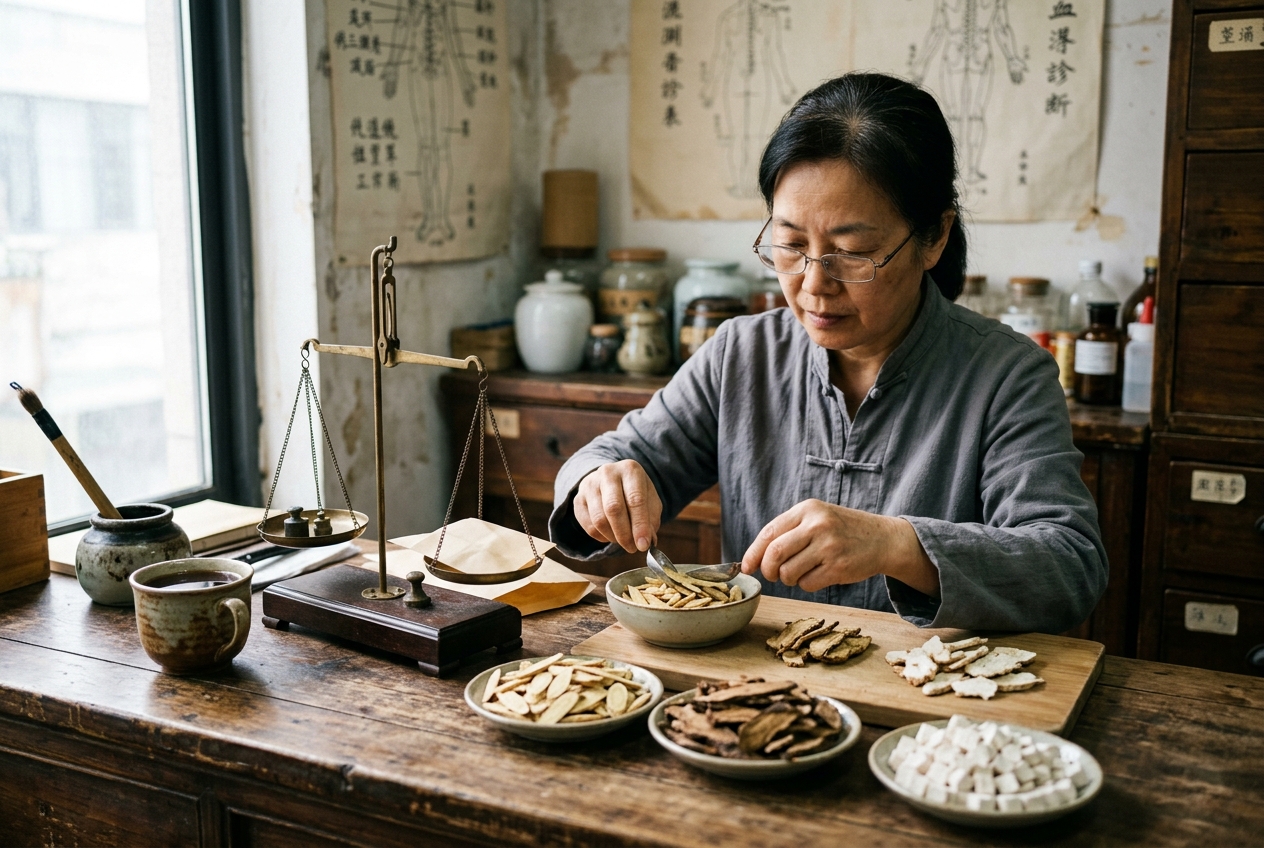
It is 3:30 in the afternoon. You are seated at your desk, gripped by a sudden, heavy lethargy that seems disproportionate to your physical output. Your limbs feel leaden, an elusive brain fog clouds your cognitive focus, and your hands have turned noticeably cool to the touch. Simultaneously, an uneasy distension tightens across your epigastrium, accompanied by an instinctive desire to draw a long, shuddering sigh. You might dismiss this familiar constellation of symptoms as mere overwork, an inevitable consequence of prolonged screen exposure, or a postprandial dip in blood glucose.
In the diagnostic paradigm of Traditional Chinese Medicine (TCM), however, this moment represents a dynamic, observable event: a subtle dysregulation in the tripartite continuum of Qi (metabolic energy and functional motility), Xue (Blood; nutrient-dense vascular perfusion and tissue trophic support), and Jin Ye (Body Fluids; interstitial fluid dynamics, mucosal hydration, and lymphatic clearance). Rather than viewing the body as a collection of isolated mechanical parts, classical Chinese medicine understands human physiology as a fluid matrix of interrelated functional substances. When Qi stagnates or fails to push, Blood fails to nourish the periphery; when fluids fail to transform, dampness pools, generating that distinctive sensation of physical heaviness and cognitive inertia. By understanding this triad, we unlock a sophisticated clinical map that bridges classical wisdom with modern systemic physiology.
2. What This Dynamic Substrate Matrix Does: Classical Foundations & Modern Physiological Correlates
To master pattern differentiation (Bian Zheng), the clinician and scholar must first examine the classical canons that established this bio-energetic taxonomy: the Huangdi Neijing (The Yellow Emperor's Inner Classic) and the Nan Jing (Classic of Difficult Issues).
In Su Wen (Basic Questions), Chapter 5 (Yin Yang Ying Xiang Da Lun), the text sets forth the fundamental polarity:
"Yang transforms into Qi; Yin constitutes the material structure."
Furthermore, Su Wen Chapter 10 (Wu Zang Sheng Cheng) establishes how these substrates sustain the viscera (Zang-Fu) and animate the sensory orifices. In Nan Jing (Chapter 22), the functional distinction is codified with razor-sharp clarity:
"Qi governs warming and movement; Blood governs nourishment and moistening."
The Tripartite Architecture
-
Qi (氣): The Vector of Functional Motility and Thermogenesis Far from an esoteric or mystical abstraction, Qi represents the summation of biological work, cellular respiration, electromagnetic potential, and kinetic transformation across organ systems. It executes five primary physiological actions: - Actuation (Tui Dong): Driving circulation, physical growth, and metabolic transformation. - Warming (Wen Xu): Regulating thermogenesis and basal metabolic heat. - Defense (Wei Hu): Immune surveillance, barrier integrity, and resistance to exogenous pathogens (Xie Qi). - Containment (Gu She): Maintaining hemodynamic containment within vascular walls, preventing excessive loss of bodily fluids, and securing organ positioning against gravitational prolapse. - Transformation (Qi Hua): Catalyzing enzymatic conversion of nutritive inputs (Gu Qi) and atmospheric oxygen (Tian Qi) into viable physiological substrates.
-
Xue (血 - Blood): The Nutritive and Grounding Substrate Blood in TCM is inseparable from Qi. While Qi is the active, Yang force of motility, Blood is the dense, Yin, nutrient-rich carrier that irrigates muscles, sinews, bones, and the internal organs. Crucially, classical theory posits that Xue serves as the material anchor for the Mind (Shen). When Blood is abundant and circulating smoothly, consciousness is clear, sleep is restorative, and emotional equilibrium is sustained. If Blood becomes deficient or heated, the Shen floats, manifesting as insomnia, cognitive agitation, and palpitations.
-
Jin Ye (津液 - Body Fluids): The Fluid Homeostasis and Interstitial Matrix Jin Ye encompasses all physiological fluids—including interstitial fluid, lymphatic fluid, synovial fluid, cerebrospinal fluid, gastric juices, saliva, sweat, and tears. Classical theory categorizes these into two distinct fractions: - Jin (津 - Clear/Thin Fluids): Light, mobile, watery fluids distributed across the exterior skin, mucous membranes, and subcutaneous tissue under the control of the Lung and Defensive Qi (Wei Qi). - Ye (液 - Turbid/Thick Fluids): Viscous, dense, slow-moving fluids that lubricate the joint capsules, nourish the bone marrow, cushion the brain, and moisturize the sensory orifices under the stewardship of the Spleen and Kidney.
+----------------------------------------------------------------------------------------------------+
|                               THE PHYSIOLOGICAL INTERPLAY OF THE TRIAD                             |
+----------------------------------------------------------------------------------------------------+
|  "Qi is the commander of Blood; where Qi moves, Blood follows.                                     |
|   Blood is the mother of Qi; where Blood resides, Qi is anchored."                                 |
|                                                                                                    |
|  • Qi generates Blood (Metabolic extraction of Gu Qi by Spleen/Stomach).                           |
|  • Qi moves Blood (Cardiovascular pumping and Liver uninhibited coursing).                         |
|  • Qi holds Blood (Spleen command preventing extravasation and hemorrhage).                        |
|  • Blood carries Qi (Hemoglobin and plasma matrix preventing Yang dissipation).                    |
|  • Jin Ye and Blood share a common origin (Fluid loss depletes Blood; hemorrhage induces dryness). |
+----------------------------------------------------------------------------------------------------+
Modern Biomedical Correlates
Contemporary integrative physiology provides compelling structural and biological parallels for this triad: - Qi Dynamics correlate with endothelial nitric oxide signaling, mitochondrial ATP generation, autonomic nervous system tone, and neuromuscular transmission. - Blood (Xue) correlates directly with functional hematopoiesis, erythrocyte volume, serum ferritin, plasma oncotic pressure, and microvascular capillary perfusion. - Body Fluids (Jin Ye) align with the extracellular fluid matrix, interstitial hydrodynamics, lymphatic clearance pathways, and the newly characterized glymphatic network of the central nervous system, as outlined by the World Health Organization Traditional Medicine Strategy.
3. How You Can Feel It: Signs of Balance, Imbalance & Comprehensive Differential Diagnostics
When Qi, Blood, and Body Fluids circulate in balance, the human organism exhibits vital endurance, glowing complexion, sharp cognitive acuity, supple joints, and seamless emotional adaptability. However, when disrupted by emotional distress, dietary irregularity, constitutional weakness, or environmental pathogens, predictable pathological patterns emerge.
1. Qi Syndromes (Qi Bing Bian Zheng)
- Qi Deficiency (Qi Xu): Hypometabolic, exhausted state.
- Manifestations: Chronic fatigue, spontaneous daytime sweating (Zi Han), shortness of breath (Duan Qi), weak voice, reluctance to speak, post-exertional exhaustion, pale face.
- Tongue: Pale, flabby, with tooth marks along the lateral margins; thin white coat.
- Pulse: Weak (Ruo), Empty (Xu), or Soft (Ru).
- Qi Sinking (Qi Xian): Severe failure of the Spleen's uplifting functional dynamic.
- Manifestations: Sensation of downward bearing or pelvic heaviness, chronic prolapse (rectal, uterine, or gastric), chronic refractory diarrhea, orthostatic dizziness.
- Tongue: Pale with an indented, sunken central midline.
- Pulse: Weak and sunken (Chen Ruo).
- Qi Stagnation (Qi Zhi): Impaired movement and localized pressure accumulation, predominantly mediated by the Liver.
- Manifestations: Distending, migratory pain in the hypochondrium, epigastrium, or lower abdomen; sensation of a lump in the throat (Mei He Qi / globus hystericus); frequent sighing; emotional irritability; premenstrual breast tenderness.
- Tongue: Normal or slightly dusky hue, thin white coating.
- Pulse: Wiry (Xian) or Taut.
- Rebellious Qi (Qi Ni): Inversion of the natural directional flow of visceral Qi.
- Manifestations:
- Lung Qi Ni: Paroxysmal cough, dyspnea, wheezing (failure to descend).
- Stomach Qi Ni: Nausea, vomiting, belching, hiccuping, acid regurgitation (failure to descend).
- Liver Qi Ni: Severe vertex headache, sudden vertigo, tinnitus, red face, acute emotional outbursts (excessive upward surge).
- Tongue & Pulse: Variable depending on the affected organ; typically Wiry (Xian) and Rapid (Shuo).
2. Blood Syndromes (Xue Bing Bian Zheng)
- Blood Deficiency (Xue Xu): Depletion of circulating volume and trophic substrates.
- Manifestations: Dull, sallow, or pale complexion; pale inner palpebral conjunctiva and nail beds; dizziness, orthostatic lightheadedness; blurred vision, visual floaters; dry hair and brittle nails; palpitations, poor memory, dream-disturbed sleep; oligomenorrhea or amenorrhea.
- Tongue: Pale, thin, dry; little or no coating.
- Pulse: Thin/Threaded (Xi) and Hesitant (Se) or Weak (Ruo).
- Blood Stasis (Xue Yu): Microvascular obstruction, coagulation, and tissue ischemia.
- Manifestations: Sharp, fixed, stabbing, or localized pain that worsens at night; palpable abdominal masses or fixed lumps; purplish, dusky lips, nails, and complexion; petechiae, dry scaly skin (Ji Fu Jia Cuo); dark menstrual flow with large purplish clots.
- Tongue: Purple, dark dusky, with purplish petechial stasis spots (Yu Dian) on the margins; distended, tortuous sublingual veins.
- Pulse: Choppy/Hesitant (Se) or Knotted/Bound (Jie).
- Blood Heat (Xue Re): Pathogenic heat entering the vascular level, accelerating circulation and driving extravasation.
- Manifestations: Acute skin eruptions with bright red maculopapular lesions (psoriasis, eczema flares); sensation of visceral heat; dry mouth without desire to swallow large volumes; epistaxis, hemoptysis, hematuria; early, heavy, bright red menstrual bleeding; severe mental agitation.
- Tongue: Deep red or Crimson (Jiang), prickles/erythematous papillae on tip and edges.
- Pulse: Rapid (Shuo), Slippery (Hua), or Floating-Rapid.
- Blood Loss / Hemorrhage (Wang Xue): Overt mechanical or pathological breach of the vascular walls.
- Manifestations: Massive acute or chronic slow bleeding (hematemesis, melena, menorrhagia), leading to acute exhaustion, cold extremities, pallor, and diaphoresis.
3. Combined Qi and Blood Disharmonies
- Qi and Blood Dual Deficiency (Qi Xue Liang Xu): Concomitant systemic exhaustion and tissue starvation. Manifests as extreme fatigue, emaciation, palpitations, dizziness, pale-sallow skin, spontaneous sweating, pale tongue, and a fine, frail pulse.
- Qi Stagnation with Blood Stasis (Qi Zhi Xue Yu): Prolonged constraint where functional stagnation leads directly to structural microcirculatory stasis. Classic presentation: hypochondriac distension transitioning into sharp, fixed intercostal pain, dysmenorrhea with dark clots, dusky-purple tongue.
- Qi Failing to Contain Blood (Qi Bu She Xue): Profound Spleen Qi deficiency rendering the vascular bed leaky. Manifests as chronic low-grade petechiae, purpura, bruising from minimal trauma, prolonged spotting, pale tongue, and an empty pulse.
- Qi Collapse Following Hemorrhage (Qi Sui Xue Tuo): Acute medical crisis where sudden massive blood loss causes the unanchored Yang Qi to detach and dissipate. Manifests as profound shock, cold clammy extremities, pale cyanotic lips, imperceptible respiration, and a Scattering (San) or Minute (Wei) pulse.
4. Body Fluid Pathologies (Jin Ye Bing Bian Zheng)
- Fluid Deficiency and Dryness (Jin Ye Bu Zu): Dehydration, mucosal atrophy, and tissue desiccation.
- Manifestations: Parched lips, dry mouth, cracked tongue, dry throat, hard dry stools/constipation, oliguria with dark urine, dry withered skin.
- Tongue: Red, dry, peeling coat or geographic cracks.
- Pulse: Fine (Xi) and Rapid (Shuo).
- Phlegm-Rheum (Tan Yin): Pathological accumulation of congealed, inspissated metabolic waste.
- Substantial Phlegm: Productive cough with copious sputum, audible rattles in the airway.
- Non-Substantial Phlegm: Subcutaneous lipomas, scrofula, lymphatic nodules, atheromatous plaques, severe vertigo (Ménière’s syndrome), cognitive clouding, or manic-depressive behavior (Dian Kuang).
- Tongue: Swollen with a thick, greasy, turbid coating (N膩 Tai).
- Pulse: Slippery (Hua) or Wiry-Slippery.
- Damp-Edema (Shui Zhong): Failure of the Lung, Spleen, and Kidney to filter and excrete fluids.
- Yang Edema: Rapid-onset facial and palpebral puffiness, spreading downward, pitting on pressure, bright skin luster.
- Yin Edema: Insidious-onset lower extremity edema, ankle swelling, cold sensations in the lumbar region and legs, dull skin luster, pitting edema that resolves slowly.
- Tongue: Pale, swollen, marked scalloping on margins, wet coating.
- Pulse: Deep (Chen), Slow (Chi), or Soggy (Ru).
Comparative Differential Diagnostic Rubric
| Pattern Category | Primary Pathophysiology | Key Physical Signs | Tongue Characteristics | Pulse Quality |
|---|---|---|---|---|
| Qi Deficiency (Qi Xu) | Hypofunction of Spleen/Lung; failure of metabolic actuation | Fatigue, voice weakness, spontaneous sweat, pale face | Pale, flabby, scallops / toothmarks | Weak (Ruo), Empty (Xu) |
| Qi Stagnation (Qi Zhi) | Liver constraint; loss of free-flowing functional motility | Distending, moving pain; sighing; emotional tension | Dusky pink, thin white coat | Wiry (Xian), Taut |
| Blood Deficiency (Xue Xu) | Marrow & nutrient depletion; tissue starvation | Pale conjunctiva, dry hair/nails, insomnia, dizziness | Pale, thin, dry, little coating | Thin/Threaded (Xi), Hesitant |
| Blood Stasis (Xue Yu) | Microvascular thrombosis, ischemia, fixed obstruction | Sharp, fixed, stabbing pain; dark clots; petechiae | Purple, dark, stasis spots, engorged sublinguals | Choppy (Se), Knotted (Jie) |
| Blood Heat (Xue Re) | Hyperdynamic vascular state; toxic heat extravasation | Erythematous rashes, bleeding, thirst, extreme agitation | Crimson (Jiang), red prickles | Rapid (Shuo), Slippery (Hua) |
| Fluid Deficiency (Jin Ye Xu) | Hyperosmolar desiccation; mucosal/cutaneous dehydration | Parched lips, dry throat, constipation, oliguria | Red, dry, fissures, absent coat | Fine (Xi), Rapid (Shuo) |
| Phlegm-Damp (Tan Shi) | Impaired water metabolism; lipid/mucus stagnation | Chest oppression, heavy limbs, lipomas, brain fog | Swollen body, thick greasy coat | Slippery (Hua), Soggy (Ru) |
Clinical Case Study: Chronic Pelvic Pain and Exhaustion
Patient Presentation: A 38-year-old corporate attorney presents with an 8-month history of debilitating premenstrual pain, severe post-exertional fatigue, and persistent mid-afternoon brain fog. She reports sharp, stabbing left-lower-quadrant pelvic pain radiating to the sacrum 3 days prior to menses, resolving only after passing substantial dark purplish clots. Simultaneously, she suffers from chronic loose stools, spontaneous cold sweating during client meetings, a pale-sallow facial complexion with prominent periorbital dark rings, and brittle, ridged fingernails.
Clinical Findings: - Tongue: Pale-lavender body with scalloped lateral margins, dusky purple petechial stasis spots on the left border, thin greasy white coating in the posterior third. - Pulse: Deep, Threaded (Chen Xi), and noticeably Choppy (Se) on the left middle (Liver/Gallbladder) position.
Therapeutic Trajectory & Resolution: 1. Weeks 1–3 (Unbind Qi & Invigorate Blood): Primary needle protocol focused on Taichong (LR3) paired with Hegu (LI4) (The Four Gates / Si Guan) to open microvascular perfusion, combined with Xuehai (SP10) and Geshu (BL17) to resolve pelvic venous congestion. By cycle one, menstrual pain decreased by 40%, and clot size was reduced by half. 2. Weeks 4–8 (Consolidate Spleen Qi & Generate Blood): Switched emphasis to tonification protocols utilizing Zusanli (ST36), Qihai (CV6), and Sanyinjiao (SP6) with moxibustion. Dietary modifications (bone broths, steamed root vegetables, warm hawthorn-infused infusions) were introduced. 3. Outcome at Week 12: Complete resolution of stabbing dysmenorrhea, normalization of bowel transit (formed daily stool), elimination of daytime sweating, elevation of energy levels to 8.5/10, and normalization of tongue body to a healthy pink with total resolution of stasis spots.
4. Qigong & Movement Practice: The Dual Flow Substrate Harmonizer
To directly experience and regulate the dynamics of Qi, Blood, and Body Fluids, somatic practices must leverage diaphragmatic excursions, myofascial stretching, and conscious kinetic sequencing. The following clinical Qigong routine—adapted from the classical Ba Duan Jin (Eight Pieces of Brocade) and Liu Zi Jue (Six Healing Sounds)—specifically targets the Spleen-Stomach axis, opens the Liver meridian, and pumps the lymphatic network.
Step-by-Step Somatic Protocol: "Separating Heaven and Earth to Regulate the Spleen and Circulate Blood"
-
Starting Position and Biomechanical Setup: - Stand with feet parallel, shoulder-width apart, knees unlocked with a slight 5-degree flexion. - Rest your weight evenly over the Yongquan (KI1) point (the depression behind the balls of your feet). - Tuck the coccyx gently down to flatten the lumbar lordosis; suspend the crown of your head from above (Baihui GV20), tucking your chin slightly to lengthen the cervical spine. - Rest your tongue gently against the hard palate behind the upper incisors to bridge the Ren (Conception) and Du (Governing) vessels. - Rest both palms over the Lower Dantian (two inches below the navel), breathing naturally into the pelvic bowl.
-
Movement and Breath Sequencing: - Step 1 (Inhalation - 4 seconds): Inhale deeply through the nose into the lower abdomen. Slowly bring both hands up along the midline to the level of the chest (Tanzhong CV17), palms facing upward. - Step 2 (The Extension - 2 seconds): Rotate the left palm to face upward and push it straight up above your head, fingertips pointing toward the right. Concurrently, press the right palm downward toward the earth alongside your hip, fingertips pointing forward. Feel a gentle, comprehensive myofascial stretch along the entire left anterior-lateral torso, opening the Spleen, Stomach, and Liver channels. - Step 3 (The Micro-Hold - 2 seconds): Hold this posture gently without muscular strain. Direct your attention to the stretch along the hypochondriac margins and axillary lymph nodes. - Step 4 (Exhalation - 6 seconds): Exhale smoothly through the mouth with a soft, sub-audible "Huuu" sound (the classical resonant frequency for Spleen regulation). Slowly bring both hands back toward the midline chest, rotating the palms to face one another, then glide them down to the lower abdomen. - Step 5 (Alternate Side): Repeat the movement, pressing the right palm skyward and the left palm toward the earth, opening the right hypochondriac region and the gallbladder/liver pathways.
-
Dosage, Duration, and Frequency: - Perform 8 complete cycles (4 on each side) every morning upon waking or during the mid-afternoon slump (between 3:00 PM and 5:00 PM). - Total duration: 8–10 minutes.
-
Somatic Feedback Markers & Clinical Meaning: - Warmth and tingling in the fingertips: Indicates peripheral microvascular vasodilation and the mobilization of Wei Qi and Xue. - Gurgling or borborygmi in the abdomen: Demonstrates the activation of the parasympathetic nervous system, peristaltic stimulation, and the resolution of middle-jiao Qi stagnation. - Salivation (The "Jade Fluid" / Yu Ye): Secretion of thin, sweet saliva indicates the restoration of Jin Ye generation by the Spleen and Stomach. Swallow this fluid down into the lower abdomen to nourish Kidney essence (Jing).
5. Acupressure Points & Meridian Dynamics You Can Apply Today
Acupressure acts directly on neurovascular nodes where cutaneous nerves, lymphatic vessels, and microcirculatory networks converge. Applying sustained, perpendicular thumb pressure activates mechanically sensitive afferent fibers, regulating autonomic tone and channel dynamics.
1. Zusanli (ST36 - "Leg Three Miles") — The Master Point for Qi & Blood Tonification
- Anatomical Landmark: Sit with knees bent at 90 degrees. Place your four fingers horizontally across the lower border of your patella (kneecap). The point lies one finger-width lateral to the anterior crest of the tibia, in the belly of the tibialis anterior muscle.
- Biomechanical Action & Sensation: Apply deep, firm, circular perpendicular pressure with your thumb. You should elicit a distinctive dull, radiating ache (De Qi sensation) that travels down the anterior ankle.
- Duration: 2–3 minutes per leg.
- Clinical Utility: Tonifies Spleen and Stomach Qi, stimulates erythropoiesis and nutrient absorption, lifts systemic fatigue, resolves abdominal bloating, and stabilizes peripheral blood pressure.
2. Qihai (CV6 - "Sea of Qi") — The Reservoir of Motile Power
- Anatomical Landmark: Located on the anterior midline of the lower abdomen, precisely 1.5 cun (approximately two finger-widths) directly below the center of the umbilicus (navel).
- Biomechanical Action & Sensation: Use the pads of your index and middle fingers together. Apply gentle, progressive inward and slightly downward pressure coordinated with exhalation. Maintain steady, warm pressure without sharp prodding.
- Duration: 2–3 minutes of continuous rhythmic pressing while practicing slow abdominal breathing.
- Clinical Utility: Directly supplements Original Qi (Yuan Qi), remedies organ prolapse and Qi sinking (Qi Xian), warms the lower abdomen, relieves chronic lower back fatigue, and treats loose stools.
3. Xuehai (SP10 - "Sea of Blood") paired with Sanyinjiao (SP6) — The Blood Regulators
- Anatomical Landmark (Xuehai SP10): With your knee flexed, place your right palm over the patient's left patella with your thumb resting on the medial side of the thigh. The point is located where your thumb tip naturally lands, roughly 2 cun (two finger-widths) superior to the medial superior border of the patella, on the bulge of the vastus medialis muscle.
- Anatomical Landmark (Sanyinjiao SP6): On the medial aspect of the lower leg, exactly four finger-widths (3 cun) directly above the prominence of the medial malleolus (inner ankle bone), just posterior to the medial border of the tibia.
- Biomechanical Action & Sensation: Press firmly with the thumb tip. Xuehai is frequently tender; apply steady pressure that borders on a therapeutic ache.
- Duration: 1.5–2 minutes per point bilaterally.
- Clinical Utility: Clears Heat from the Blood, breaks Blood Stasis, resolves menstrual cramping, dissipates hives and eczema flare-ups, and promotes restful, restorative sleep.
+----------------------------------------------------------------------------------------------------+
|                         MERIDIAN PROTOCOLS FOR SYSTEMIC DISHARMONIES                               |
+----------------------------------------------------------------------------------------------------+
|  • Qi Tonification & Uprising:       Zusanli (ST36) + Qihai (CV6) + Baihui (GV20)                  |
|  • Blood Nourishing & Invigorating:  Geshu (BL17) + Xuehai (SP10) + Sanyinjiao (SP6)               |
|  • Qi Stagnation Relief:             Taichong (LR3) + Tanzhong (CV17) + Hegu (LI4)                 |
|  • Fluid & Dampness Resolution:      Yinlingquan (SP9) + Shuifen (CV9) + Pishu (BL20)              |
+----------------------------------------------------------------------------------------------------+
4. Taichong (LR3 - "Great Surge") — The Master Unbinder of Constrained Qi
- Anatomical Landmark: On the dorsum of the foot, in the hollow distal to the junction of the 1st and 2nd metatarsal bones (slide your finger backward from the web between your big toe and second toe until it settles into the bony depression).
- Biomechanical Action & Sensation: Press downward and slightly toward the ankle with your thumb nail or tip. Expect a sharp, sensitive sensation.
- Duration: 1–2 minutes per side while releasing tension through deep exhalations.
- Clinical Utility: Smooths Liver Qi, lowers vascular resistance, alleviates tension headaches, clears eye strain, mitigates irritability, and breaks up premenstrual stagnation.
6. Food, Herbal Principles & Lifestyle: Restoring Substrate Balance
Nutritional intervention in Chinese medicine (Shi Liao) relies on the thermal nature, flavor profiles, and organ tropisms of everyday, whole-food ingredients. The objective is to fuel the Spleen’s transformative fire (Pi Yang) without producing sticky, turbid dampness (Shi) or aggravating systemic heat.
Targeted Dietary Protocols by Pathological Pattern
-
For Qi Deficiency (Qi Xu): - Primary Goal: Fortify the middle burner (Zhong Jiao) and minimize digestive expenditure. - Foods to Emphasize: Slow-simmered root vegetables (sweet potatoes, parsnips, carrots), kabocha squash, warm oats, well-cooked brown rice congee, lean poultry, and warming spices such as cardamom, cinnamon, and fresh ginger. - Foods to Avoid or Eliminate: Icy beverages, raw salads, unpasteurized cold juices, and excessive refined sugars, all of which extinguish the digestive fire (Ming Men Fire).
-
For Blood Deficiency (Xue Xu): - Primary Goal: Deliver concentrated micronutrients, amino acids, and iron substrates to nourish tissue synthesis. - Foods to Emphasize: Slow-cooked bone broths, black sesame seeds, organic grass-fed beef, pastured egg yolks, steamed spinach, beetroot, black beans, dried longan fruit, and goji berries (Gou Qi Zi). - Foods to Avoid: Overly dehydrating, bitter diuretics (excessive black coffee) and extremely pungent drying spices that deplete vital fluids.
-
For Blood Stasis and Qi Stagnation (Qi Zhi Xue Yu): - Primary Goal: Promote microvascular vasodilatation, fibrinolysis, and free hepatic coursing. - Foods to Emphasize: Fresh turmeric root (Jiang Huang), grated ginger, hawthorn berries (Shan Zha), fresh scallions, leeks, wild garlic, fermented black vinegar, and light infusions of culinary rosebuds (Mei Gui Hua). - Foods to Avoid: Deep-fried foods, trans-fats, processed meats, and chilled dairy, which congeal circulation.
-
For Fluid Retention, Phlegm, and Dampness (Tan Shi & Shui Zhong): - Primary Goal: Activate diuresis, drain the interstitium, and clear lymphatic stagnation. - Foods to Emphasize: Adzuki beans (Chi Xiao Dou), pearl barley / Job's tears (Yi Yi Ren), steamed pumpkin, daikon radish, celery, fennel bulbs, and aged tangerine peel (Chen Pi). - Foods to Avoid: Cow’s milk, cheeses, ice cream, beer, highly salted snacks, and sweetened commercial dairy products.
+----------------------------------------------------------------------------------------------------+
|                                CIRCADIAN SUBSTRATE SYNCHRONIZATION                                 |
+----------------------------------------------------------------------------------------------------+
|  Align your metabolic rhythms with the Chinese Organ Clock (Ziwu Liuzhu):                          |
|                                                                                                    |
|  • 07:00 – 09:00 (Stomach Time): Consume your most substantial, warm, protein-rich meal.          |
|    Digestive enzyme output and Spleen transformation are at their thermodynamic zenith.             |
|                                                                                                    |
|  • 13:00 – 15:00 (Small Intestine Time): Peak nutrient assimilation; avoid cold beverages.         |
|                                                                                                    |
|  • 23:00 – 03:00 (Gallbladder/Liver Time): Absolute recumbency and deep sleep are mandatory.       |
|    "When lying down, the Blood returns to the Liver" (Su Wen Ch. 10), enabling hepatic detox,      |
|    endothelial repair, and emotional grounding.                                                    |
+----------------------------------------------------------------------------------------------------+
7. Today's Takeaway
To immediately balance your Qi, Blood, and Body Fluids today, perform this 5-Minute Reset Routine: Sit upright away from your screen, rub your palms together briskly until they radiate heat, and place them firmly over your lower abdomen (Qihai CV6). Inhale deeply through your nose for 4 counts, expanding the pelvic bowl, and exhale for 6 counts with a soft sigh while releasing muscular tension in your shoulders and jaw. As you breathe, use your right thumb to apply 60 seconds of firm, circular pressure to Zusanli (ST36) on your left leg, followed by 60 seconds on Taichong (LR3) on your left foot; then repeat on the right leg. Drink a single cup of warm, ginger-infused water to immediately ignite your digestive fire, dilate your peripheral microvasculature, and clear the afternoon fog.
Authoritative References and Scholarly Reading
- World Health Organization: Traditional, Complementary and Integrative Medicine
- National Center for Biotechnology Information: Microvascular Perfusion & Acupuncture
- Huangdi Neijing: Historical & Canonical Translations
- Hematopoiesis & Blood Physiology Overview
- Classical Acupuncture Points & Meridian Pathways