Pulse Diagnosis (Mai Zhen) Meridian Diagnostics: Governing Cun-Guan-Chi Radial Positions, Twenty-Eight Pathological Waveforms, and Visceral Hemodynamics in Traditional Chinese Medicine
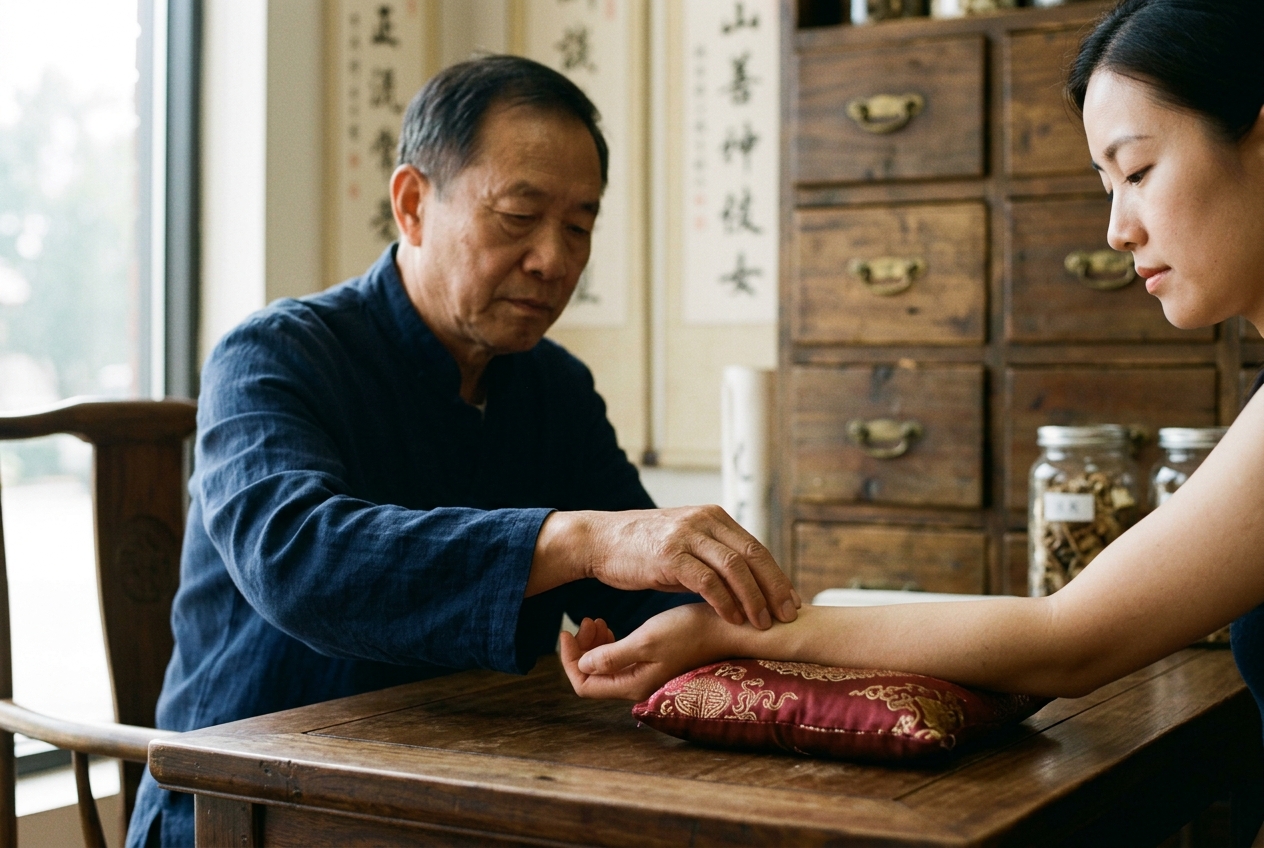
Place your index, middle, and ring fingers gently upon the groove of your inner wrist, just beneath the thumb at the base of the radial styloid bone. Close your eyes. At first, you encounter only a steady, rhythmic tap—the familiar sixty to seventy beats per minute taught in basic biology. But if you hold your breath slightly, soften your fingertips, and adjust the pressure from a feather-light touch down to the firm resistance of the radial bone, the sensation changes. The beat is no longer a simple mechanical click. It swells, widens, slips, or resists; it may feel taut like a plucked nylon guitar string, soft and buoyant like a submerged cotton ball, or rapid and tumbling like pearls rolling through a porcelain basin.
+-----------------------------------------------------------------------------------+
| CLINICAL AXIOM: THE CUN KOU AS A SYSTEMIC MICROCOSM                              |
| "The vessels are the residence of the Blood. When they are restrained and long,  |
|  the Qi is harmonious; when they are short and choppy, the Qi is diseased."      |
|  — Huangdi Neijing (Suwen, Chapter 17: Mai Yao Jing Wei Lun)                     |
+-----------------------------------------------------------------------------------+
In Traditional Chinese Medicine (TCM), this tactile landscape is known as Mai Zhen (脉诊, Pulse Palpation). Rather than treating the pulse as a mere frequency counter for heart rate, classical East Asian medicine views the radial artery as a high-fidelity systemic oscilloscope. Within this three-centimetre band of tissue, the hydrodynamic interplay of cardiovascular force, autonomic nervous system tone, vascular compliance, and microcirculatory perfusion reflects the functional state of every major organ system in the human body.
2. Classical Foundations & Radial Topography: What This System Does
The Classical Canon: Huangdi Neijing and Nan Jing
The foundational justification for radial palpation is articulated in the inner canon of East Asian medicine, the Huangdi Neijing (The Yellow Emperor’s Classic of Internal Medicine, c. 2nd century BCE), and systematically standardized in the Nan Jing (The Classic of Difficult Issues, c. 1st–2nd century CE).
Prior to the Nan Jing, systemic assessment required a cumbersome, multi-site palpation technique known as the classical San Bu Jiu Hou (Three Regions and Nine Indicators), which required taking arterial pulses across the temporal, facial, upper extremity, and pedal arteries (including the dorsalis pedis and posterior tibial). The revolutionary conceptual breakthrough of the Nan Jing (Difficulties 1 through 5) was the doctrine of Du Qu Cun Kou (独取寸口)—"exclusively utilizing the Inch Opening" at the wrist.
                          RADIAL PALPATION TOPOGRAPHY
  =========================================================================
  DISTAL (Wrist Crease) <------------------------------> PROXIMAL (Elbow)

            [ CUN / 寸 ]            [ GUAN / 关 ]          [ CHI / 尺 ]
          "Inch" Position        "Gate" / Styloid      "Cubit" Position
  -------------------------------------------------------------------------
  DEPTHS:
   - Tian (天) Heaven: Superficial / Wei Qi / Fu Organs (Ext. Perfusion)
   - Ren  (人) Human:  Middle Depth / Ying Qi & Spleen-Stomach Dynamics
   - Di   (地) Earth:   Deep Bone Level / Jing, Blood & Zang Viscera
  =========================================================================
Why does the radial artery at the Cun Kou possess this systemic diagnostic privilege? In classical physiological theory, the radial artery courses along the Lung Taiyin channel (Hand Major Yin). The Suwen (Chapter 10) dictates: "Bai Mai Chao Fei" (百脉朝肺)—"All the hundred vessels converge in the Lung."
Physiologically: 1. The Lung Governs Qi and Dominates Respiration: It gathers the Zong Qi (Pectoral or Gathering Qi) from atmospheric air and combines it with Gu Qi (Food Essence) extracted by the Spleen and Stomach. 2. Qi is the Commander of Blood: Blood is the mother of Qi. While the Heart governs the physical movement of Blood, the Lung distributes systemic Qi through the vascular network (Mai), acting as the primary regulator of circulatory hydrodynamics. 3. The Yuan-Source Point: The Cun Kou directly overlays acupuncture point LU-9 (Taiyuan), designated the Hui-Meeting Point of the Vessels (Mai Hui), making it the anatomical and bioenergetic terminus where visceral Qi and systemic circulation intersect.
Anatomical Topography: The Three Positions (Cun, Guan, Chi)
Palpation is conducted along three adjacent arterial segments situated over the radial artery:
- Guan (关 - The Gate): The diagnostic pivot. It is located directly medial to the styloid process of the radius.
- Cun (寸 - The Inch): The distal position, situated between the Guan and the transverse crease of the wrist.
- Chi (尺 - The Cubit / Foot): The proximal position, situated immediately proximal to the Guan, extending toward the elbow along the belly of the pronator quadratus and flexor carpi radialis.
Bilateral Visceral Correspondences
The bilateral assignment of the Zang-Fu (internal viscera) across the radial segments follows a precise physiological logic based on the anatomical heights of the Triple Burner (San Jiao):
| Position | Depth / Level | Left Wrist (Yin / Blood / Structural Axis) | Right Wrist (Yang / Qi / Functional Axis) |
|---|---|---|---|
| Cun (Distal) | Upper Burner (Shang Jiao) | Heart (Xin) & Small Intestine / Pericardium | Lung (Fei) & Large Intestine / Thorax |
| Guan (Middle) | Middle Burner (Zhong Jiao) | Liver (Gan) & Gallbladder (Smooth Flow/Bile) | Spleen (Pi) & Stomach (Digestion/Transformation) |
| Chi (Proximal) | Lower Burner (Xia Jiao) | Kidney Yin (Shen Yin) & Urinary Bladder | Kidney Yang (Shen Yang) & Mingmen / Vital Gate |
The Three Depths (San Hou): Heaven, Human, and Earth
Each of the six radial positions is assessed across three discrete tactile depths: - Heaven Level (Tian) — Superficial Depth: Assessed with minimal cutaneous contact. Evaluates the state of Wei Qi (Defensive Qi), exterior pathogens, acute surface conditions, and the hollow Fu organs (e.g., Stomach, Bladder). - Human Level (Ren) — Middle Depth: Assessed with moderate arterial compression. Evaluates nutritional Qi (Ying Qi), digestive processing, vascular elasticity, and metabolic equilibrium governed by the Spleen and Stomach. - Earth Level (Di) — Deep Depth: Assessed by pressing firmly to the periosteum of the radius. Evaluates deep Yin, Blood volume, Kidney Essence (Jing), structural integrity, and the solid Zang organs (e.g., Liver, Kidneys).
3. The 28 Classical Waveforms (Mai Xiang) & Modern Hemodynamic Correlates
Systematic pulse diagnosis requires categorizing the palpated arterial impulse along distinct biomechanical parameters: Depth, Velocity, Amplitude/Strength, Contour/Shape, and Rhythm. Classical literature recognizes 28 Pathological Pulse Waveforms, cataloged below alongside their biomedical circulatory mechanisms.
                     THE FIVE HEMODYNAMIC AXES OF MAI ZHEN
                                       |
    +-----------------+----------------+----------------+----------------+
    |                 |                |                |                |
  DEPTH            VELOCITY        AMPLITUDE         CONTOUR          RHYTHM
 (Fu / Chen)     (Chi / Shuo)     (Xu / Shi)     (Hua, Xian, Se)   (Jie, Cu, Dai)
    |                 |                |                |                |
Capillary        Sympathetic /    Stroke Vol /    Vascular Tone /    Cardiac
Refraction       Vagal Balance    Total Output    Shear Impedance    Conduction
Axis 1: Depth (Vertical Location)
1. Floating Pulse (Fu Mai / 浮脉)
- Tactile Quality: Felt distinctly with superficial touch; weakens upon deeper compression, like wood floating on water.
- Clinical Significance: Exterior invasion (e.g., early viral upper respiratory infection) or Yin failing to anchor Yang in chronic exhaustion.
- Hemodynamic Correlate: Elevated peripheral superficial microvascular perfusion driven by acute autonomic response; reduced arterial wall tension.
2. Sinking / Deep Pulse (Chen Mai / 沉脉)
- Tactile Quality: Indiscernible at superficial and middle levels; felt clearly only with heavy pressure near the bone.
- Clinical Significance: Interior syndromes; metabolic hypofunction; deep visceral stagnation.
- Hemodynamic Correlate: Increased systemic peripheral vasoconstriction; centralized venous return; low stroke volume displacing the primary pulse pressure wave deeper beneath peripheral tissue edema.
3. Hidden Pulse (Fu Mai / 伏脉)
- Tactile Quality: Extremely deep; requires intense pressure down to the periosteum to detect a faint pulse.
- Clinical Significance: Severe internal blockage, syncope, excruciating visceral pain, or collapse of Yang.
- Hemodynamic Correlate: Severe hypovolemia, circulatory shock, or pronounced arteriolar spasm.
4. Confined / Firm Pulse (Lao Mai / 牢脉)
- Tactile Quality: Deep, hard, forceful, and long; unyielding under strong pressure.
- Clinical Significance: Deep cold accumulations, abdominal masses, structural stagnation.
- Hemodynamic Correlate: High systemic vascular resistance combined with stiff, non-compliant arterial walls.
Axis 2: Velocity and Rate
5. Slow Pulse (Chi Mai / 迟脉)
- Tactile Quality: Fewer than four beats per respiratory cycle (< 60 beats per minute).
- Clinical Significance: Cold patterns (deficient or excess), metabolic depression, bradycardia.
- Hemodynamic Correlate: High parasympathetic (vagal) tone, hypothyroidism, athletic cardiac hypertrophy, or sinoatrial nodal deceleration.
6. Rapid Pulse (Shuo Mai / 数脉)
- Tactile Quality: More than five beats per respiratory cycle (> 90 beats per minute).
- Clinical Significance: Heat syndromes, inflammatory cascades, hyperactivity of Yang.
- Hemodynamic Correlate: Sympathovagal imbalance with sympathetic dominance, elevated core temperature accelerating enzymatic and electrophysiological conduction, hyperdynamic circulation.
7. Swift / Racing Pulse (Ji Mai / 疾脉)
- Tactile Quality: Very rapid, seven to eight beats per breath (> 120–140 bpm), agitated.
- Clinical Significance: Extreme heat consuming Yin, imminent exhaustion of vital Qi.
- Hemodynamic Correlate: Supraventricular tachycardia, severe systemic inflammatory response syndrome (SIRS), decompensated shock.
8. Moderate / Relaxed Pulse (Huan Mai / 缓脉)
- Tactile Quality: Four beats per breath (60–72 bpm), balanced, gentle, with normal tension.
- Clinical Significance: Normal, healthy pulse (with Shen, Wei, and Gen), or Spleen dampness when soft.
- Hemodynamic Correlate: Optimal autonomic homeostasis, normal baroreflex sensitivity, healthy arterial compliance.
Axis 3: Amplitude, Volume, and Strength
9. Vacuous / Deficient Pulse (Xu Mai / 虚脉)
- Tactile Quality: Generalized sensation of softness, large diameter but lacking force; collapses under moderate pressure.
- Clinical Significance: Dual deficiency of Qi and Blood; constitutional fatigue.
- Hemodynamic Correlate: Reduced stroke volume, low circulating intravascular volume, diminished myocardial contractility ($dP/dt$).
10. Replete / Full Pulse (Shi Mai / 实脉)
- Tactile Quality: Forceful, hard, and broad across all three positions and all three depths.
- Clinical Significance: Internal full heat, stagnation, strong pathogenic struggle.
- Hemodynamic Correlate: High cardiac output coupled with elevated vascular resistance and robust myocardial inotropy.
11. Surging / Flooding Pulse (Hong Mai / 洪脉)
- Tactile Quality: Arrives with forceful, wide momentum and departs smoothly, like breaking waves.
- Clinical Significance: Extreme interior heat (Four Bigs syndrome: Big Fever, Big Thirst, Big Sweat, Big Pulse).
- Hemodynamic Correlate: Hyperdynamic state, high pulse pressure ($P_{systolic} - P_{diastolic}$), massive stroke volume with low systemic peripheral resistance.
12. Fine / Thready Pulse (Xi Mai / 细脉)
- Tactile Quality: Thin like a silk thread, yet continuous, distinct, and pliable under the fingers.
- Clinical Significance: Blood deficiency, Yin deficiency, internal dampness constricting the vessels.
- Hemodynamic Correlate: Reduced arterial caliber, hypovolemia, low stroke volume with compensatory arteriolar vasoconstriction.
13. Faint / Minute Pulse (Wei Mai / 微脉)
- Tactile Quality: Extremely fine, soft, and indistinct; easily vanishes upon slight pressure.
- Clinical Significance: Severe depletion of Yang and primal Qi; circulatory collapse.
- Hemodynamic Correlate: Critical drop in pulse pressure and arterial pulse energy, borderline cardiogenic shock.
14. Big Pulse (Da Mai / 大脉)
- Tactile Quality: Wide vessel lumen filling the finger pads, twice the width of a normal pulse.
- Clinical Significance: Pathogenic heat excess (when forceful) or internal emptiness with outward Yang floating (when weak).
- Hemodynamic Correlate: Increased arterial diameter dilation driven by nitric oxide or vascular relaxation, high stroke volume.
Axis 4: Tactile Contour, Shape, and Elasticity
15. Slippery / Rolling Pulse (Hua Mai / 滑脉)
- Tactile Quality: Smooth, rounded, fluid; feels like pearls rolling smoothly across a porcelain basin ("Ru Zhu Zou Pan").
- Clinical Significance: Phlegm, food stagnation, damp accumulation, normal healthy pregnancy.
- Hemodynamic Correlate: High cardiac output with low blood viscosity and high arterial elasticity; low vascular impedance with unimpeded wave reflection. Modern pulse wave studies on PubMed demonstrate elevated harmonic energy ratios in Slippery waveforms.
                 PULSE WAVEFORM COMPARISON: SLIPPERY VS. WIRY

    SLIPPERY (Hua Mai)                      WIRY (Xian Mai)
    - Rapid dP/dt ascending limb           - Broad, elevated tidal wave (P2)
    - Distinct dicrotic notch              - Stiff vascular wall, early reflection
    - Fluid, unimpeded oscillation         - High Augmentation Index (AIx)

       /\                                      /\__
      /  \   /\                               /    \
     /    \_/  \                             /      \
    /           \                           /        \
16. Wiry / String-like Pulse (Xian Mai / 弦脉)
- Tactile Quality: Taut, straight, and unyielding, like pressing the tuned string of a zither or violin.
- Clinical Significance: Liver and Gallbladder disharmonies, emotional constraint, pain, hypertension, phlegm.
- Hemodynamic Correlate: Sympathetic neurovascular hypertonia, high peripheral arterial resistance, increased vascular stiffness (elevated Pulse Wave Velocity / PWV), and early return of reflected arterial pressure waves during systole (elevated Augmentation Index).
17. Tight / Tense Pulse (Jin Mai / 紧脉)
- Tactile Quality: Taut, hard, vibrating like a twisted cord or thick rope being snapped.
- Clinical Significance: Severe cold patterns, acute spasms, intense somatic pain.
- Hemodynamic Correlate: Intense arteriolar vasoconstriction induced by norepinephrine release; acute spike in vascular resistance.
18. Choppy / Hesitant Pulse (Se Mai / 涩脉)
- Tactile Quality: Jagged, rough, thin, and uneven; feels like scraping a bamboo stalk with a small knife.
- Clinical Significance: Blood stasis, Essence depletion, fluid exhaustion.
- Hemodynamic Correlate: Increased blood viscosity (high hematocrit, hyperfibrinogenemia), altered erythrocyte deformability, irregular endothelial shear stress.
19. Soft / Soggy Pulse (Ru Mai / 濡脉)
- Tactile Quality: Superficial, fine, extremely soft; disappears under deeper pressure.
- Clinical Significance: Dampness coexisting with Qi deficiency.
- Hemodynamic Correlate: Interstitial fluid retention (dampness) dampening tactile transmission; low intravascular tone.
20. Weak Pulse (Ruo Mai / 弱脉)
- Tactile Quality: Deep, soft, fine; impossible to detect at superficial depths.
- Clinical Significance: Dual deficiency of Yang and Qi.
- Hemodynamic Correlate: Hypovolemia coupled with impaired left ventricular inotropic response and reduced preload.
21. Hollow / Scallion-Stalk Pulse (Kou Mai / 芤脉)
- Tactile Quality: Superficial and deep edges are tangible, but the center is completely empty, like the stem of a green onion.
- Clinical Significance: Massive acute hemorrhage, catastrophic fluid loss.
- Hemodynamic Correlate: Acute hypovolemic shock where arterial walls remain momentarily dilated while central blood volume falls rapidly.
22. Leather / Drumskin Pulse (Ge Mai / 革脉)
- Tactile Quality: Hard and taut on the surface like a stretched drumskin, but empty underneath.
- Clinical Significance: Severe loss of Essence (Jing), miscarriage, severe postpartum depletion.
- Hemodynamic Correlate: Arterial wall stiffness combined with severe hypovolemia.
23. Scattered Pulse (San Mai / 散脉)
- Tactile Quality: Floating, broad, irregular, completely without root; disperses and becomes chaotic under pressure.
- Clinical Significance: Impending failure of Zang-Fu Yuan Qi; critical state.
- Hemodynamic Correlate: Progressive circulatory collapse, severe cardiac dysrhythmia, microvascular leakage.
24. Long Pulse (Chang Mai / 长脉)
- Tactile Quality: Extends straight through and beyond the Cun and Chi boundaries; straight and supple.
- Clinical Significance: Abundant Yang Qi (if smooth) or pathogenic heat excess (if hard).
- Hemodynamic Correlate: Robust stroke volume with excellent aortic compliance.
25. Short Pulse (Duan Mai / 短脉)
- Tactile Quality: Fails to fill all three finger spaces; often felt only at the Guan position.
- Clinical Significance: Qi deficiency (if soft) or severe Qi stagnation (if hard).
- Hemodynamic Correlate: Low stroke volume, premature closure of the aortic valve, high vascular impedance.
26. Stirred / Spinning Bean Pulse (Dong Mai / 动脉)
- Tactile Quality: Short, round, slippery, rapid, and bouncing like a vibrating bean; felt only at the Guan.
- Clinical Significance: Extreme fright, severe shock, intense acute pain.
- Hemodynamic Correlate: Acute massive catecholamine surge causing localized arterial turbulence.
Axis 5: Rhythmic Regularity and Intermittence
27. Knotted / Bound Pulse (Jie Mai / 结脉)
- Tactile Quality: Slow rate, with irregularly irregular dropped beats or pauses.
- Clinical Significance: Yin excess, cold phlegm, Blood stasis, heart Qi deficiency.
- Hemodynamic Correlate: Sinus bradycardia with premature ventricular contractions (PVCs) or wandering atrial pacemakers.
28. Hurried / Hasty Pulse (Cu Mai / 促脉)
- Tactile Quality: Rapid rate, with irregularly irregular dropped beats or pauses.
- Clinical Significance: Blazing heat, Qi and Blood stagnation, toxic accumulation.
- Hemodynamic Correlate: Atrial fibrillation, frequent premature contractions during hypermetabolic or tachycardic states.
29. Intermittent Pulse (Dai Mai / 代脉)
- Tactile Quality: Halts at predictable, regularly irregular intervals, with long pauses; weak upon return.
- Clinical Significance: Visceral Zang Qi exhaustion, severe emotional trauma, organic heart disease.
- Hemodynamic Correlate: Regularly dropped beats, such as Second-Degree AV Block (Mobitz I/II) or ventricular bigeminy/trigeminy.
4. Somatic Mind-Body Practice: Regulating Lung-Heart Hemodynamics
Because the radial pulse reflects the convergence of the hundred vessels (Bai Mai Chao Fei), daily somatic and breathing practices directly alter arterial wave dynamics. The following evidence-informed medical Qigong practice modulates autonomic tone, lowering peripheral resistance and softening a Wiry (Xian) or Tight (Jin) pulse.
+-----------------------------------------------------------------------------------+
| EVIDENCE-BASED SOMATIC REGULATION PROTOCOL                                        |
| Focus: Lung Taiyin Diaphragmatic Entrainment (Ba Duan Jin Variant)                |
| Target: Vagal Nerve Stimulation, Pulse Wave Velocity Normalization               |
+-----------------------------------------------------------------------------------+
Exercise: "Opening the Chest and Harmonizing the Hundred Vessels"
     1. Inhale (4s)           2. Pause (2s)            3. Exhale (6s)
   [ Expand Thorax ] ----> [ Stillness at Peak ] ----> [ Sinking to Dan Tian ]
   Pyloric/Vascular Softening   Baroreflex Reset      Vagal Parasympathetic Surge
Step-by-Step Instructions:
-
Starting Position & Posture: - Stand with feet parallel, shoulder-width apart. Soften your knees and tuck the tailbone slightly to release the lumbar spine. - Let your shoulders drop away from your ears. Rest the tongue lightly against the hard palate behind the upper teeth. - Rest your hands over the Lower Dan Tian (two inches below the navel), right hand resting over left (for men) or left over right (for women).
-
Movement & Breath Synchronization: - Inhale (4 Seconds — Diaphragmatic Expansion): Slowly raise both hands up along the centerline of the chest to the level of the Zhongfu (LU-1) points below the collarbones. Rotate the palms outward and open the arms wide to a 45-degree angle, gently expanding the thoracic cavity. Feel the stretch across the anterior chest and along the inner arms (the path of the Lung Taiyin channel). - Retention / Stillness (2 Seconds): Hold the breath softly without straining. Focus your awareness on the rhythmic throb of the radial artery at both wrists. - Exhale (6 Seconds — Vagal Parasympathetic Activation): Turn the palms downward. Slowly press both hands down along the centerline of the body back to the Lower Dan Tian, visualizing warm Qi and arterial Blood descending smoothly through the abdomen, hips, and soles of the feet (Kidney-1, Yongquan).
-
Dosage & Repetition: - Perform 9 to 18 continuous cycles each morning between 7:00 AM and 9:00 AM (during the peak metabolic hours of the Stomach channel) or during times of emotional tension.
-
Sensory Feedback & Diagnostic Shift: - What to feel for: Within 5 minutes, you should notice a gentle warmth or tingling sensation spreading to the fingertips, a softening of muscle tension in the jaw and neck, and an accumulation of thin saliva in the mouth (Jin Ye). - Pulse Alteration: If your pulse felt Wiry (Xian) or Rapid (Shuo) prior to practice, re-palpation will reveal a broader, softer, and more moderate (Huan) contour, reflecting reduced vascular tone and improved heart rate variability.
5. Targeted Acupressure Points for Arterial and Organ Balance
To modulate visceral Qi and balance radial pulse irregularities, apply self-administered acupressure to these three clinically validated points:
                  DISTAL INNER FOREARM & WRIST ACUPOINTS

                (Palm Facing Upwards toward Body)

       ================== WRIST CREASE ==================
      |                                                  |
     [LU-9]                                            [HT-7]
    Taiyuan                                           Shenmen
  (Radial Artery Groove)                            (Ulnar Flexor Crease)
      |                                                  |
      |                    [PC-6]                        |
      |                   Neiguan                        |
      |            (2 Thumb-Widths Up,                   |
      |            Between Two Tendons)                  |
      |                                                  |
1. Taiyuan (LU-9) — "Great Abyss"
- Anatomical Location: On the transverse crease of the wrist, in the depression on the radial side of the radial artery, directly between the artery and the tendon of abductor pollicis longus.
- Classical Classification: Yuan-Source Point of the Lung Channel; Hui-Meeting Point for the Vessels (Mai Hui).
- Application Method: Use the tip of the opposite thumb to apply gentle, vertical pressure directly into the groove adjacent to the arterial pulsation. Maintain pressure for 2 to 3 minutes per wrist while taking slow, deep diaphragmatic breaths.
- Clinical Indication: Regulates arterial volume, resolves chronic coughing, strengthens a Vacuous (Xu) or Fine (Xi) pulse, and stabilizes pulmonary circulation, as detailed in research on LU-9 and vascular hemodynamics.
2. Neiguan (PC-6) — "Inner Gate"
- Anatomical Location: On the palmar aspect of the forearm, exactly two finger-widths (the width of the interphalangeal joint of the thumb) proximal to the distal wrist crease, situated directly between the tendons of palmaris longus and flexor carpi radialis.
- Application Method: Apply firm, perpendicular pressure using your thumb until a mild, spreading sensation of heaviness or distension (De Qi) radiates into the palm or up the forearm. Hold for 90 to 120 seconds, rotating the thumb in micro-circles.
- Clinical Indication: Balances rapid (Shuo), knotted (Jie), or wiry (Xian) pulses caused by emotional stress, autonomic dysregulation, nausea, palpitations, and chest oppression.
3. Shenmen (HT-7) — "Spirit Gate"
- Anatomical Location: At the wrist crease, on the radial side of the tendon of flexor carpi ulnaris, in the palpable depression posterior to the pisiform bone.
- Classical Classification: Yuan-Source and Shu-Stream point of the Heart Meridian.
- Application Method: Press gently with your thumbnail or the pad of your index finger in an inward and slightly proximal direction for 2 minutes before sleep.
- Clinical Indication: Calms Shen (the spirit/mind), alleviates insomnia, and steadies irregular or agitated pulse rhythms.
6. Dietary Therapy and Lifestyle for Vascular and Visceral Harmony
In classical Chinese internal medicine, the arterial pulse is nourished by the Gu Qi generated by the Middle Burner (Spleen and Stomach). To preserve vessel elasticity, blood volume, and metabolic balance, consider the following dietary adjustments:
+-----------------------------------------------------------------------------------+
| NUTRITIONAL MATRIX FOR VASCULAR INTEGRITY                                         |
| "The Spleen is the source of Blood production; the Liver stores the Blood;        |
|  the Heart circulates it; the Lung governs the vessels."                          |
+-----------------------------------------------------------------------------------+
1. Foods to Emphasize (Pliant Vessels & Blood Nourishment)
- Warm, Moisture-Rich Soups and Congees: Long-simmered grain porridges (such as white rice, millet, or barley congee cooked with ginger and jujube dates) nourish Spleen Qi and generate bodily fluids (Jin Ye), preventing the development of a Choppy (Se) or Vacuous (Xu) pulse.
- Dark, Iron-Rich Leafy Greens and Root Vegetables: Steamed spinach, Tuscan kale, beets, black sesame seeds (Hei Zhi Ma), and goji berries (Gou Qi Zi) nourish Liver Blood, maintaining the smooth, supple quality of the radial pulse.
- Pungent and Circulating Herbs: Light culinary additions of fresh ginger (Sheng Jiang), scallions, and crushed garlic disperse internal cold, promoting vasodilation and preventing the arterial constriction typical of Tight (Jin) pulses.
- Hawthorn Berry Tea (Shan Zha): Mild, regular consumption of hawthorn infusion helps break down arterial stagnation and improve circulation, counteracting Slippery-Full (Hua-Shi) and Choppy (Se) pulses related to metabolic and lipid imbalances.
2. Dietary Habits to Reduce or Avoid
- Excessive Raw, Cold, and Iced Consumables: Consuming iced beverages and raw vegetables places thermal and metabolic stress on the Spleen Yang (Pi Yang), leading to damp accumulation and creating a Soggy (Ru) or Deep-Slow (Chen-Chi) pulse.
- Hyper-Pungent, Inflammatory, and Greasy Foods: Deep-fried foods, refined sugars, and excessive alcohol create damp-heat and systemic inflammation, which can cause the pulse to feel Wiry-Rapid (Xian-Shuo) or Surging (Hong).
3. Chronobiological Lifestyle Recommendations
- Sleep Schedule for Blood Regeneration: Ensure you are resting in bed by 11:00 PM (the onset of the Gallbladder/Liver time according to the Chinese Organ Clock). The Liver stores and cleanses the blood during deep rest; chronic late-night activity stiffens arterial walls and promotes a Wiry pulse.
- Hydration at Body Temperature: Drink warm or room-temperature water throughout the day to support blood volume without constricting the visceral microvasculature.
7. Clinical Synthesis: Cross-Validating Pulse and Tongue Findings
The primary clinical utility of Mai Zhen lies in resolving contradictory symptoms through four-pillar cross-validation (Si Zhen He Shen—Combining the Four Examinations). Pulse palpation provides immediate insight into dynamic, functional changes in the body, which can be cross-referenced with the more stable, structural state reflected by tongue inspection (She Zhen).
+---------------------------------------------------------------------------------------+
| CLINICAL RESOLUTION MATRIX: CROSS-VALIDATING TONGUE & PULSE                           |
+----------------------+--------------------+---------------------+---------------------+
| Presentation         | Tongue Inspection  | Radial Pulse        | Clinical Diagnosis  |
+----------------------+--------------------+---------------------+---------------------+
| Complex Heat & Cold: | Red body with dry, | Deep, slow, faint   | True Cold /         |
| Facial flushing,     | pale margins and   | at Earth level      | False Heat          |
| thirst, restless     | white coating      | (Chen, Chi, Wei)    | (Yin Sheng Ge Yang) |
+----------------------+--------------------+---------------------+---------------------+
| Digestive Distress:  | Pale, scalloped,   | Left Guan: Wiry     | Liver-Spleen        |
| Bloating, acid       | swollen with thin  | (Xian);             | Disharmony          |
| reflux, irritability | white coating      | Right Guan: Soggy   | (Gan Pi Bu He)      |
+----------------------+--------------------+---------------------+---------------------+
| Acute Exhaustion:    | Crimson body, no   | Superficial, large, | Yin Exhaustion /    |
| Sweating, agitation, | coating, central   | hollow, floating    | Floating Yang       |
| bounding pulse       | deep fissures      | (Fu, Kou, Xu)       | (Xu Yang Fu Yue)    |
+----------------------+--------------------+---------------------+---------------------+
Demonstrative Diagnostic Scenario: True Cold / False Heat (Yin Sheng Ge Yang)
Consider a patient presenting with high subjective fever, flushed cheeks, and agitation. If a practitioner were to rely solely on the patient's symptoms, they might administer cold-natured, heat-clearing herbs like Huang Lian (Coptis).
However, systematic four-pillar assessment reveals: 1. The Tongue: Pale, swollen body with tooth marks, coated by a moist, white layer. 2. The Pulse: Despite the rapid surface rate, when the clinician presses down to the deep (Di / Earth) level, the pulse vanishes entirely into a faint, thready beat (Chen-Wei-Wu-Li).
This reveals a state of True Cold with False Heat (Internal Yin Excess Repelling Yang to the Exterior). The deep radial pulse confirms the underlying reality: the patient's Yang Qi is exhausted, not blazing. Rather than administering cooling herbs, the correct therapeutic approach is to rescue the Yang with warming formulas like Si Ni Tang (Aconite Decoction). In this way, radial pulse palpation helps distinguish superficial symptoms from true systemic pathophysiology.
8. Today's Takeaway
Take five minutes right now to sit in an upright, relaxed chair with both feet flat on the floor. Rest your left forearm comfortably on a desk or cushion at heart level, palm facing upward. Using the middle three fingers of your right hand, find the radial styloid bone at the base of your thumb and let your fingers settle across the Cun, Guan, and Chi positions. Close your eyes, take three deep diaphragmatic breaths through your nose, and feel the pulse gently push up against your fingertips. Pay attention to its depth, rhythm, and tension: is it taut like a wire, soft like water, or steady like a pendulum? By checking in with this arterial window daily, you develop direct, real-time awareness of your autonomic balance, cardiovascular ease, and internal vitality.