Bone-Proportional Cun Measurement: Navigating Skeletal Landmarks, Dimensional Scaling, and Precision Acupoint Localization Protocols
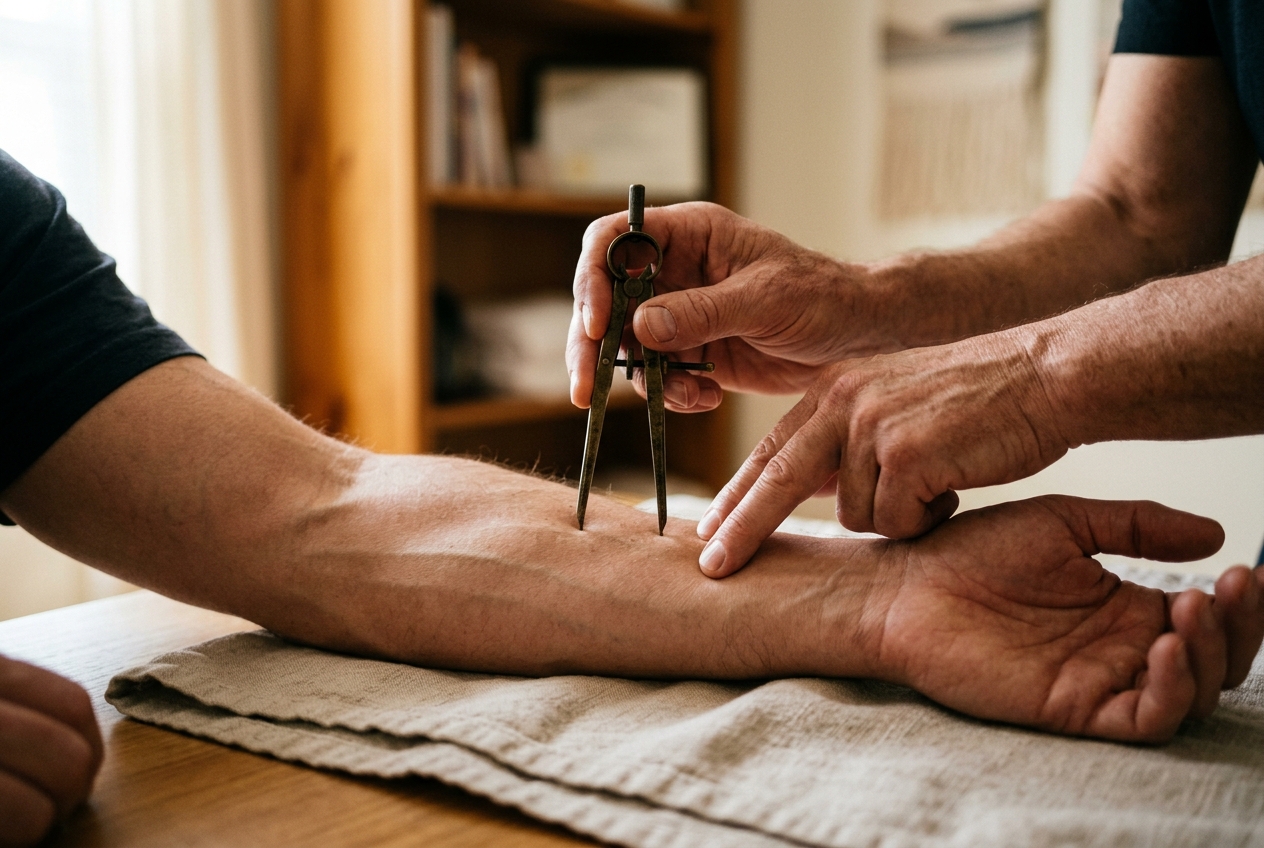
1. Opening — A Problem This Solves Today
Consider a physical experience familiar to millions: it is late afternoon, and beneath the fluorescent lighting of an office or the ambient glow of a laptop screen, a dull, band-like tension begins to constrict the temples. Simultaneously, the stomach feels tight and bloated—a lingering consequence of a rushed midday meal—accompanied by a restless, low-grade hyperarousal that makes sustained focus nearly impossible. In modern clinical parlance, this state reflects sympathetic autonomic overdrive coupled with functional gastrointestinal stasis.
When people attempt to alleviate these pervasive somatic complaints using acupressure, they frequently encounter flat, two-dimensional diagrams in self-help manuals. These illustrations superimpose static dots upon idealized bodies. A user attempts to locate a point such as Zusanli (ST36) or Neiguan (PC6) by measuring an arbitrary two or three inches with a household ruler or estimating with their fingertips, only to experience nothing more than the dull sensation of pressing ordinary subcutaneous fat. Frustrated by the lack of perceptible clinical effect, many dismiss the modality altogether as pseudoscience.
+-----------------------------------------------------------------------------------+
|               THE CORE CHALLENGE OF SOMATIC SELF-CARE                             |
|                                                                                   |
|   Standard 2D Charts (Fixed Inches)     VS.     Bone-Proportional Cun (Gudu)      |
|   ---------------------------------             ----------------------------      |
|   * Ignores limb length variability             * Dynamic biological ratio        |
|   * Misses deep fascial clefts                  * Triangulates skeletal landmarks |
|   * Fails across body somatotypes               * Reliable across all habitus     |
+-----------------------------------------------------------------------------------+
The fault lies not in the therapeutic potential of the nervous and fascial networks, but in the cartographic error of applying rigid, absolute linear metrics to variable biological organisms. The human body is neither uniform nor static. A tall individual with an elongated torso and slender limbs possesses an entirely different anatomical distribution than an individual of stocky, endomorphic build.
Over two thousand years ago, classical Chinese physicians recognized this fundamental truth. In response, they engineered a proportional, scalable coordinate system known as Gudu Fencun (骨度分寸), or the Bone-Proportional Cun System. Rooted in the foundational medical treatise Huangdi Neijing (The Yellow Emperor’s Inner Classic), this framework treats the skeleton not merely as passive structural scaffolding, but as an individualized biological compass. By learning to decode these bone-proportional ratios, anyone can navigate the living terrain of their own body to locate therapeutic neurovascular nodes with millimeter accuracy, irrespective of height, weight, or morphological variation.
2. The Meridian Path — A Journey Through the Body
To understand how acupressure points function, one must first visualize the meridian channels not as mystical conduits, but as continuous myofascial and neurovascular pathways that trace continuous tracks through the musculoskeletal architecture.
                                [ Head / Cranium ]
                         (Glabella to Hairline = 12 Cun)
                                      |
                                      v
                             [ Torso / Abdomen ]
                      (Sternocostal Angle to Umbilicus = 8 Cun)
                      (Umbilicus to Pubic Crest = 5 Cun)
                                      |
                 +--------------------+--------------------+
                 |                                         |
                 v                                         v
       [ Upper Extremities ]                     [ Lower Extremities ]
  (Axillary to Cubital = 9 Cun)            (Trochanter to Popliteal = 19 Cun)
  (Cubital to Wrist = 12 Cun)              (Popliteal to Lateral Malleolus = 16 Cun)
Consider the Stomach Channel of Foot Yangming, one of the most clinically potent energetic and physiological highways in Traditional Chinese Medicine (TCM). Its journey begins beneath the orbit of the eye, descending across the cheek and wrapping around the angle of the jaw before dropping along the muscular column of the sternocleidomastoid in the neck. Crossing the collarbone, it charts a vertical line down through the chest along the mamillary line, descending over the abdominal wall two finger-widths lateral to the midline.
From the pelvic brim, the pathway plunges down the anterior aspect of the thigh, passing directly over the rectus femoris muscle, running along the outer border of the kneecap, and tracing down the muscular groove just outside the sharp crest of the shinbone—the exact area that aches after hours of continuous standing or walking. Continuing down the ankle joint, it terminates at the lateral corner of the second toenail.
Running parallel in functional synergy along the interior aspect of the leg is the Spleen Channel of Foot Taiyin. This pathway commences at the medial tip of the great toe, glides along the inner arch of the foot, ascends immediately behind the prominent medial ankle bone, and tracks upward along the posterior margin of the tibia. It traverses the inner knee, ascends the anteromedial thigh, and penetrates the lower abdomen to interface directly with the digestive viscera.
Along the upper limbs, the Pericardium Channel of Hand Jueyin emerges from the deep chest, traverses the axilla, and courses down the absolute center of the inner arm. It runs between the biceps tendon at the elbow crease, descends the anterior forearm precisely between the two prominent flexor tendons that stand out when clenching a fist, crosses the center of the palm, and concludes at the tip of the middle finger.
Reciprocally, the Large Intestine Channel of Hand Yangming commands the outer arm, beginning at the radial corner of the index fingernail, traversing the muscular web between thumb and forefinger, scaling the lateral wrist and forearm along the radius bone, crossing the lateral aspect of the elbow, ascending the shoulder cap, and culminating beside the opposite nostril.
When viewed through modern fascia research—such as studies documented in the National Center for Biotechnology Information (NCBI) on Fascial Continuity and Acupuncture—these classical meridian pathways correspond with remarkable fidelity to plane-cleaving intermuscular septa, perineural sheaths, and superficial fascial lines.
3. The Geometry of the Living Frame: Bone-Proportional Cun vs. Finger Approximations
The anatomical localization of therapeutic nodes across these pathways hinges upon the concept of the Cun (寸, pronounced "tsoon"). In contemporary vernacular, a cun is often carelessly translated as "a Chinese inch." This is an error. A cun is not an absolute unit of imperial or metric length; it is a modular, dimensionless ratio of an individual’s own physical anatomy.
+---------------------------------------------------------------------------------------------+
|                               FINGER CUN MEASUREMENT PROTOCOLS                              |
|                                                                                             |
|   1. Middle Finger Cun (Zhongzhi) : Distance between medial ends of interphalangeal creases |
|   2. Thumb Cun (Muzhi)            : Maximum transverse width at the interphalangeal joint   |
|   3. Four-Finger / 3 Cun (Yizhang): Transverse width across 4 fingers at PIP level          |
+---------------------------------------------------------------------------------------------+
Classical Origins: The Ling Shu (Chapter 14)
The foundational methodology for establishing these somatic coordinates is codified in Chapter 14 (Gudu 骨度, "Bone Lengths") of the ancient Han Dynasty classic, the Ling Shu (Spiritual Pivot). The authors of the Ling Shu recognized that while the absolute height of adults varies dramatically across populations, the relative mathematical proportions between specific bony landmarks remain extraordinarily constant.
The text established that every major anatomical zone—the cranium, thorax, abdomen, back, and upper and lower extremities—possesses a fixed quantity of proportional cun. To locate a point, the practitioner divides the total distance between two immutable skeletal landmarks into the classically prescribed number of equal units.
       CLINICAL SKELETAL ANCHOR POINTS FOR BONE-PROPORTIONAL SCALING

[Sternal Angle / Xiphisternal Synchondrosis]
                                  |
                                  |   8 Cun (Epigastrium)
                                  v
                             [Umbilicus]
                                  |
                                  |   5 Cun (Hypogastrium)
                                  v
                     [Pubic Crest / Symphysis]
Proportional Metrics Across Major Anatomical Divisions
According to the international standards established by the World Health Organization in the WHO Standard Acupuncture Point Locations in the Western Pacific Region, the canonical bone-proportional divisions are mapped as follows:
| Anatomical Region | Skeletal Boundary Landmarks | Proportional Value | Clinical Significance |
|---|---|---|---|
| Cranium (Longitudinal) | Anterior Hairline (or Glabella) to Posterior Hairline | 12 Cun | Standard for neuro-cranial and vertex points |
| Cranium (Transverse) | Between Bilateral Mastoid Processes (Processus mastoideus) | 9 Cun | Calibrates occipital and temporal margins |
| Thorax / Upper Abdomen | Sternocostal Angle (Xiphisternal joint) to Umbilicus | 8 Cun | Epigastric and central digestive calibration |
| Lower Abdomen | Center of Umbilicus to Superior Border of Pubic Symphysis | 5 Cun | Hypogastric, urogenital, and pelvic base |
| Thorax (Transverse) | Inter-mamillary Line (Between bilateral nipples) | 8 Cun | Standard transverse chest reference |
| Upper Arm | Anterior Axillary Fold to Transverse Cubital Crease | 9 Cun | Biceps/brachialis longitudinal scaling |
| Forearm | Transverse Cubital Crease to Distal Transverse Wrist Crease | 12 Cun | Flexor/extensor forearm compartment scaling |
| Thigh | Superior Border of Greater Trochanter to Popliteal Crease | 19 Cun | Lateral/anterior quadriceps segment scaling |
| Lower Leg (Lateral) | Popliteal Crease to Prominence of Lateral Malleolus | 16 Cun | Peroneal and tibialis anterior scaling |
| Lower Leg (Medial) | Inferior Border of Medial Condyle of Tibia to Medial Malleolus | 13 Cun | Gastrocnemius/soleus/tibial margin scaling |
Bone Proportionality vs. Finger-Cun Approximations
In clinical practice, practitioners also employ Zizhi Tongcun (自指同身寸), or finger-proportional measurements: 1. Middle Finger Cun (Zhongzhi Tongcun): The distance between the medial ends of the distal and proximal interphalangeal creases when the middle finger is flexed into a loop equals 1 cun. 2. Thumb Cun (Muzhi Tongcun): The maximum transverse width of the interphalangeal joint of the patient's own thumb equals 1 cun. 3. Four-Finger / Three Cun Method (Yizhang / Hengzhi Tongcun): The combined transverse breadth of the index, middle, ring, and little fingers aligned at the level of the proximal interphalangeal joint of the middle finger equals 3 cun.
       FINGER-CUN VS. BONE-PROPORTIONAL PRECISION DYNAMICS

+-----------------------+              +---------------------------------+
  |   FINGER-CUN METHOD   |              |     BONE-PROPORTIONAL CUN       |
  |  (Subject to Hand/    |              |   (Derived from Patient's Own   |
  |   Trunk Discrepancy)  |              |       Skeletal Geometry)        |
  +-----------+-----------+              +----------------+----------------+
              |                                           |
              v                                           v
    [ Rapid Approximation ]                     [ Structural Calibration ]
              |                                           |
              +-------------------+-----------------------+
                                  |
                                  v
               [ Triangulation in Fascial Cleft ]
                                  |
                                  v
                   [ Deqi Somatosensory Evocation ]
4. Triangulation & Clinical Palpation: Key Acupressure Nodes
Locating an acupressure point is a three-tiered physical process: 1. Metric Scaling: Establish the proportional cun coordinate along the skeletal axis. 2. Structural Triangulation: Identify the neurovascular groove, intermuscular septum, or osseous depression at that coordinate. 3. Palpatory Confirmation: Palpate for the subtle change in tissue compliance—often described as a microscopic valley or "hole" in the deep fascia (Xuekong)—and confirm the elicitation of Deqi (得气), a distinct subjective sensation characterized by a dull ache, distention, or heavy warmth.
+------------------------------------------------------------------------------------+
|                         THE 3-TIERED LOCALIZATION MATRIX                           |
|                                                                                    |
|   Step 1: Scale Proportional Cun  --> Identify mathematical distance along bone    |
|   Step 2: Triangulate Landmarks   --> Drop into intermuscular septum or groove     |
|   Step 3: Palpate for Deqi        --> Elicit local distention, ache, or warmth     |
+------------------------------------------------------------------------------------+
Below are four primary systemic nodes calibrated via bone-proportional scaling:
                      PRIMARY ACUPOINT SKELETAL TOPOGRAPHY

[LI4 - Hegu]                           [PC6 - Neiguan]
    Midpoint 2nd Metacarpal               2 Cun Proximal to Wrist Crease
    Between 1st & 2nd Metacarpals          Between FCR & Palmaris Longus
               \                                    /
                \                                  /
                 +--------------------------------+
                 |   SOMATOSENSORY AXIS OF TCM    |
                 +--------------------------------+
                /                                  \
               /                                    \
        [ST36 - Zusanli]                       [SP6 - Sanyinjiao]
   3 Cun Distal to Patella Level          3 Cun Superior to Medial Malleolus
   1 Fingerbreadth Lateral to Crest       Posterior to Medial Tibial Border
Point 1: Zusanli (ST36) — "Leg Three Miles"
          ST36 (ZUSANLI) TRIANGULATION MAP

[Patella / Inferior Border] (ST35 / Dubi)
        |
        |  3 Cun (Scaled from 16-cun lower leg metric)
        v
   [ST36] <--- 1 Fingerbreadth Lateral to Anterior Crest of Tibia
   (Located in the belly of M. Tibialis Anterior)
- Proportional Localization: The distance from the center of the patella (or the popliteal crease) to the tip of the lateral malleolus is strictly 16 cun. Mentally divide this segment into quarters: one quarter of this distance from the infrapatellar border yields precisely 3 cun. Drop one finger-breadth (transverse thumb width) lateral to the sharp anterior crest of the tibia.
- Anatomical Triangulation: The point sits directly within the fleshy belly of the tibialis anterior muscle, overlying the deep peroneal nerve and anterior tibial artery branches.
- Somatosensory Validation (Deqi): Upon pressing perpendicularly into the muscle bed, the practitioner encounters a firm, springy resistance. The subject will report a radiating, deep ache that frequently travels down the lateral shin into the dorsum of the foot.
- Biomechanical Application Protocol: Apply direct, vertical pressure using the reinforced thumb or knuckle. Maintain firm, steady pressure with small circular kneading oscillations for 2 to 3 minutes.
- Clinical Indications: Documented extensively in biomedical trials, such as this PubMed Investigation on ST36 and Autonomic Neuro-Immune Reflexes, ST36 stimulates vagal nerve activity, enhances gastric motility, alleviates postprandial fatigue, and relieves lower-limb exhaustion.
Point 2: Neiguan (PC6) — "Inner Gate"
          PC6 (NEIGUAN) TRIANGULATION MAP

[Transverse Cubital Crease]
        |
        |  10 Cun
        v
   [PC6]  <--- 2 Cun Proximal to Transverse Wrist Crease
        |
        |  2 Cun
        v
   [Distal Transverse Wrist Crease] (P7 / Daling)
   (Deep between Flexor Carpi Radialis & Palmaris Longus tendons)
- Proportional Localization: The longitudinal distance between the transverse cubital crease of the elbow and the distal wrist crease equals 12 cun. Divide this total length into six equal parts; measure one-sixth (2 cun) proximally from the wrist crease along the central axis of the inner forearm.
- Anatomical Triangulation: Ask the individual to clench their fist and slightly flex the wrist. Two thick cord-like tendons will instantly emerge: the flexor carpi radialis (lateral) and the palmaris longus (medial). PC6 lies in the deep fascial valley directly between these tendons, immediately superficial to the median nerve.
- Somatosensory Validation (Deqi): Direct perpendicular palpation elicits a distinct tingling distention or mild electrical buzz that radiates into the palm and middle fingertips.
- Biomechanical Application Protocol: Compress perpendicularly between the tendons with the pad of the thumb. Apply moderate, sustained pressure for 90 to 180 seconds while taking deep diaphragmatic breaths.
- Clinical Indications: Recognized by the World Health Organization Acupuncture Benchmarks as a premier antiemetic and anxiolytic locus. Highly effective for motion sickness, acute nausea, gastroesophageal reflux, cardiac palpitations, and situational anxiety.
Point 3: Hegu (LI4) — "Joining Valleys"
          LI4 (HEGU) TRIANGULATION MAP

[Radial Metacarpal Edge] (Index finger side)
                   \
                    \   Midpoint of 2nd Metacarpal Bone
                     v
                   [LI4] <--- In the 1st Dorsal Interosseous Muscle
                     ^
                    /
        [1st Metacarpal Bone] (Thumb side)
- Proportional Localization: On the dorsal surface of the hand, locate the second metacarpal bone (the long bone supporting the index finger). Identify the exact longitudinal midpoint of this bone along its radial (outer) edge.
- Anatomical Triangulation: In the fleshy web space between the first and second metacarpal bones, find the highest prominence of the first dorsal interosseous muscle when the thumb and index finger are held tightly together. Relax the hand and palpate inward toward the radial shaft of the second metacarpal.
- Somatosensory Validation (Deqi): A profound, spreading ache or dull tenderness is provoked when pressure is directed against the bone margin rather than into empty soft skin.
- Biomechanical Application Protocol: Pinch the web space between your opposing thumb and index finger, pressing your thumb firmly against the radial border of their second metacarpal bone. Apply cyclical, pulsing pressure for 1 to 2 minutes per hand.
- Clinical Indications: The master point for the cranium and sensory orifices. Indicated for tension headaches, temporomandibular joint (TMJ) distress, frontal sinus congestion, toothaches, and systemic stress reduction.
Point 4: Sanyinjiao (SP6) — "Three Yin Intersection"
          SP6 (SANYINJIAO) TRIANGULATION MAP

[Inferior Border of Medial Condyle of Tibia]
        |
        |  10 Cun (Scaled from 13-cun medial lower leg metric)
        v
   [SP6]  <--- 3 Cun Superior to Tip of Medial Malleolus
        |
        |  3 Cun
        v
   [Prominence of Medial Malleolus]
   (Directly posterior to the medial border of the tibia)
- Proportional Localization: The distance from the inferior border of the medial tibial condyle to the apex of the medial malleolus is 13 cun. Measure 3 cun (approximately one-fourth of this segment, or the patient's four-finger breadth) directly superior from the highest prominence of the inner ankle bone.
- Anatomical Triangulation: Locate the rear (posterior) edge of the shinbone (tibia). The point is seated in the shallow trough immediately behind the bone, within the anterior portion of the soleus and flexor digitorum longus muscles.
- Somatosensory Validation (Deqi): Pressing flat against the posterior tibial margin generates a tender, deep muscular ache that travels up the medial aspect of the calf.
- Biomechanical Application Protocol: Press the thumb pad obliquely against the posterior border of the tibia, angling slightly forward toward the bone. Maintain moderate pressure for 2 minutes.
- Clinical Indications: The point of convergence for the Spleen, Liver, and Kidney meridians. Excellent for regulating menstrual cramps, pelvic floor tension, nighttime restlessness, insomnia, and sluggish lower-bowel transit.
5. A Point Combination for One Common Issue
Clinical Scenario: The "Desk-Worker's Evening Crash"
(Characterized by: Epigastric Fullness, Mental Agitation, Tight Temples, and Inability to Transition into Rest)
+-----------------------------------------------------------------------------------+
|               EVENING RESET: SEQUENTIAL POINT PROTOCOL MATRIX                     |
|                                                                                   |
|   Step 1: PC6 (Neiguan)   --> Bilateral (90s each) --> Down-regulates Sympathetic |
|   Step 2: LI4 (Hegu)      --> Bilateral (90s each) --> Releases Craniofacial Strain|
|   Step 3: ST36 (Zusanli)  --> Bilateral (2m each)  --> Activates Vagal Digestion  |
|   Step 4: SP6 (Sanyinjiao)--> Bilateral (2m each)  --> Settles Pelvic & Sleep Axis |
+-----------------------------------------------------------------------------------+
90 sec/arm
Diaphragmatic Breathing] B --> C[Step 2: LI4 Hegu
90 sec/hand
Jaw Relaxation] C --> D[Step 3: ST36 Zusanli
2 min/leg
Vagal Gastric Reset] D --> E[Step 4: SP6 Sanyinjiao
2 min/leg
Pelvic/Parasympathetic Consolidation] E --> F[Rest in Stillness for 5 Minutes]
Step-by-Step Treatment Protocol
- Positioning & Breath Entrainment: Seat yourself in a comfortable recliner or lie supine on a firm surface. Loosen restrictive waistbands. Close your eyes and establish a 4-second inhalation and 6-second exhalation cadence through the nose.
- Phase 1: Down-Regulate Sympathetic Tone via PC6 (Neiguan): * Measure 2 proportional cun from the wrist crease between the flexor tendons. * Apply sustained perpendicular thumb pressure on the left forearm for 90 seconds. * Switch and repeat on the right forearm for 90 seconds. * Physiological intention: Decreases heart rate variability stress index and relieves diaphragmatic constriction.
- Phase 2: Clear Craniofacial & Jaw Tension via LI4 (Hegu): * Grip the left second metacarpal midpoint from the radial margin. * Apply circular, firm compression for 90 seconds, directing force toward the bone. * Switch and repeat on the right hand for 90 seconds. * Physiological intention: Inhibits trigeminal pain pathways, softens the masseter muscles, and clears ocular fatigue.
- Phase 3: Ignite Parasympathetic Digestion via ST36 (Zusanli): * Measure 3 proportional cun down from the knee joint, 1 finger-breadth lateral to the tibial crest. * Using knuckles or reinforced thumbs, press deeply with rhythmic downward-tilted pressure for 2 minutes per leg. * Physiological intention: Stimulates subdiaphragmatic vagal efferent activity, initiating gastric gurgling (borborygmi) and relieving abdominal bloating.
- Phase 4: Settle the Nervous System and Lower Gate via SP6 (Sanyinjiao): * Measure 3 proportional cun up from the inner ankle, tucking the thumb pad behind the tibial border. * Apply calm, steady pressure for 2 minutes on each leg. * Physiological intention: Releases pelvic floor tension, smooths arterial inflow to the lower extremities, and initiates somnolence.
6. Safety, Sense, and Somatosensory Cautions
While non-invasive acupressure carries an exceptional safety profile, rigorous mechanical discernment must govern every application.
+------------------------------------------------------------------------------------+
|                         CRITICAL CLINICAL CAUTIONS                                 |
|                                                                                    |
|   ! PREGNANCY CONTRAINDICATIONS : LI4 & SP6 (Strong Oxytocic Uterine Stimulants)   |
|   ! VASCULAR PRECAUTIONS        : Avoid Carotid/Femoral Pulses, Varicosities       |
|   ! DEQI vs. NERVE COMPRESSION  : Dull Ache (Correct) vs. Electric Shock (Reposition)|
+------------------------------------------------------------------------------------+
Absolute Obstetric Contraindications
Certain acupressure points exert powerful descending and uterotonic actions. The points LI4 (Hegu) and SP6 (Sanyinjiao) are strictly contraindicated during all trimesters of pregnancy, as their deep stimulation can trigger premature uterine contractions or induce labor. They are utilized safely only under licensed medical supervision during active post-date labor induction.
Discerning Therapeutic Deqi from Tissue Damage
A common error among novices is equating clinical efficacy with physical pain. The therapeutic sensation of Deqi is characteristically a diffuse, heavy, spreading ache, a warm distention, or a mild sensation of muscular tiredness.
It must never feel like: * A sharp, lancinating, needle-like prick * An agonizing, breath-stopping shock * An electric jolt racing down an extremity (indicative of direct, unbuffered mechanical compression of a major nerve trunk)
If a sharp or electric sensation occurs, immediately ease pressure and shift your contact point 2 to 3 millimeters into the adjacent muscular groove.
Tissue Integrity and Medical Red Flags
- Local Lesions: Never apply pressure over open wounds, burns, localized skin infections, acute hematomas, or prominent varicose veins.
- Coagulation Profiles: Patients taking anticoagulant medications (e.g., Warfarin, direct oral anticoagulants) or those with advanced thrombocytopenia should receive only gentle, broad contact rather than deep, focal ischemic compression to avoid bruising.
- When to Seek Immediate Biomedical Care: Acupressure is an integrative regulatory tool, not a substitute for emergency medicine. Severe, crushing chest pain radiating to the jaw or arm, sudden thunderclap headaches, unexplained acute abdominal rigidity, high fever with neck stiffness, or unilateral neurological deficits demand immediate emergency evaluation.
7. Today's Takeaway: The Two-Minute Desk Reset
If you have only two minutes right now, perform this immediate reset to dissolve mental fog and calm a racing pulse before closing this article.
+------------------------------------------------------------------------------------+
|                         THE 2-MINUTE PC6 (NEIGUAN) RESET                           |
|                                                                                    |
|   1. Find Crease   --> Place 3 opposite fingers on inner wrist crease              |
|   2. Find Valley   --> Drop thumb between the two central cord-like tendons        |
|   3. Compress      --> Apply firm, steady, perpendicular pressure                  |
|   4. Breathe       --> Inhale 4 seconds, Exhale 6 seconds for 60 seconds per side  |
+------------------------------------------------------------------------------------+
- Locate Your Coordinates: Place your right arm palm-up on your desk. Lay the index, middle, and ring fingers of your left hand flat across your right wrist crease. The outer edge of your index finger marks the 2-cun line.
- Find the Groove: Clench your right fist slightly until two prominent cords pop up in the center of your forearm. Place the tip of your left thumb directly between them at that 2-cun mark.
- Engage the Point: Relax your right hand. Press your left thumb firmly downward into that central groove until you feel a distinct, heavy, dull ache (PC6 Neiguan).
- Breathe & Hold: Hold this exact pressure without rubbing. Close your eyes. Inhale slowly through your nose for a count of 4, then exhale through your mouth for a count of 6. Continue for 60 seconds, then switch hands and repeat on the left wrist.
You have just performed bone-proportional triangulation on your own body—engaging the median nerve sheath and its associated fascial web to reset autonomic tone.
Authoritative References & Academic Resources
- World Health Organization: WHO Standard Acupuncture Point Locations in the Western Pacific Region
- National Center for Biotechnology Information (NCBI): The Anatomical and Physiological Basis of Acupoints and Meridians
- PubMed: Neuroanatomical Basis of ST36 (Zusanli) in Autonomic Anti-Inflammatory Signaling
- World Health Organization: Standard Acupuncture Nomenclature Guidelines
- Wikipedia Encyclopedia: Huangdi Neijing (The Yellow Emperor's Inner Classic) Historical Overview