Pai Da Gong Meridian Patting Qigong: Percussive Acoustic Resonance, Cutaneous Microvascular Perfusion, and Wei Qi Fortification in Classical Medical Daoyin
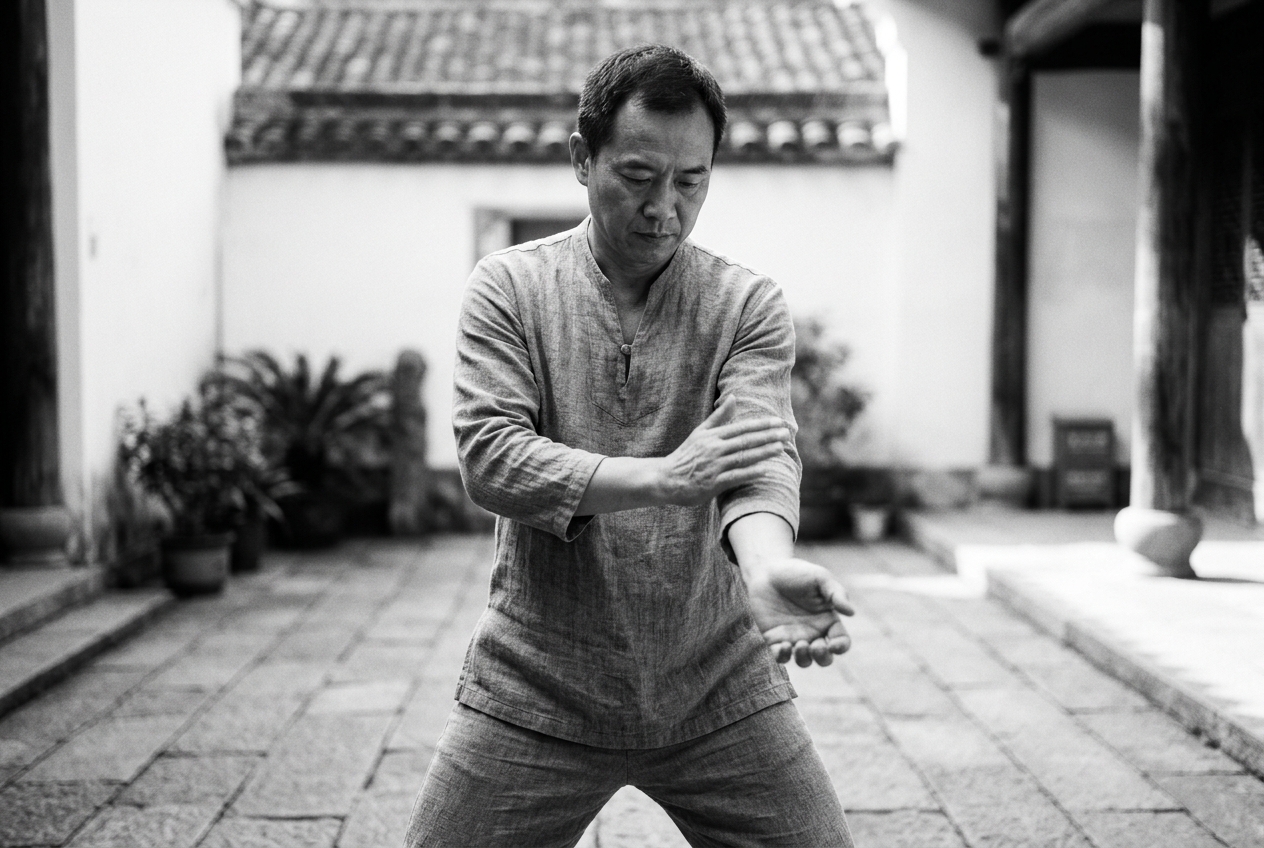
The Step-by-Step Practice Protocol
To extract the maximum physiological and energetic benefit from Pai Da Gong, the practitioner must abandon brute mechanical slapping in favor of calibrated, resonant cupping. The technique relies on the creation of a miniature vacuum beneath a curved palm (Kong Zhang), which produces an acoustic pressure wave that penetrates deep into muscular and visceral layers without bruising superficial capillaries.
       [ HOLLOW PALM / KONG ZHANG ARCHITECTURE ]
                ____---''''''---____
             .-'                    '-.
           .'    AIR RESONANCE CAVITY   '.
          /       (Negative Pressure)     \
         |      ======================     |
    [Thumb / Heel]                      [Fingertip Seal]
         \                                /
          '.                            .'
            '-.______________________.-'
           VVVVVVVVVVVVVVVVVVVVVVVVVVVVVV
           Skin -> Fascia -> Microvasculature
Follow this traditional top-to-bottom channel sequence, coordinating each strike with smooth, diaphragmatic breathing.
1. Postural and Somatic Alignment (Wuji Stance)
Begin in the primordial resting posture (Wuji). Stand with feet parallel and hip-width apart, knees micro-bent so the joint never locks, the pelvis neutral with the sacrum sinking naturally toward the earth, and the crown of the head (Baihui, GV-20) suspended gently toward the ceiling as if drawn upward by a thread of silk. Relax the jaw, rest the tip of your tongue against the upper palate behind the front teeth to bridge the Conception and Governing vessels, and settle your awareness into the Dantian—the body's physical and energetic center of gravity situated roughly two inches below the navel and three inches deep within the pelvic basin.
2. Upper Extremity Sequence: Arm Meridians
Extend your left arm forward at chest height with the palm facing upward, keeping the shoulder soft and dropped. * The Inner Yin Channels (Lung, Pericardium, Heart): With the right hand shaped into a relaxed hollow cup (Kong Zhang), begin patting from the anterior deltoid and upper chest (Zhongfu, LU-1), moving progressively down the inner bicep, over the cubital fossa (Chize, LU-5 and Quze, PC-3), along the anterior forearm, across the inner wrist (Neiguan, PC-6), and into the palm. Execute 18 to 36 rhythmic, springy pats. * The Outer Yang Channels (Large Intestine, Sanjiao, Small Intestine): Rotate the left forearm so the back of the hand faces upward. Begin patting from the webbing between the index finger and thumb (Hegu, LI-4) and the dorsal wrist, ascending the posterior forearm, over the lateral elbow, up the triceps, and across the top of the shoulder (Jianjing, GB-21). Repeat for 18 to 36 cycles. * Switch sides: Repeat the identical protocol with the left hand patting the right arm.
3. Cranial, Cervical, and Thoracic Activation
- Crown and Occiput: Relax both hands into loose, soft fingertips. Gently tap the top of the head along the midline Governing Vessel (Du Mai), cascading down to the base of the skull (Fengchi, GB-20).
- The Great Vertebra (Dazhui, GV-14): Reach across with the right cupped palm to gently pat the prominent vertebra at the base of the cervical spine (C7/T1 juncture). This vital intersection of all six Yang meridians serves as a primary thermoregulatory and immunomodulatory node.
- The Chest and Solar Plexus (Danzhong, CV-17): Using relaxed hollow palms, alternate gentle, rhythmic pats across the sternum and pectoral fascia. Maintain soft, slow exhalations to prevent thoracic guarding.
4. Abdominal and Lumbar Foundation
- The Lower Abdomen and Inguinal Crease: Gently pat the lower abdomen around Guanyuan (CV-4) in a circular, clockwise rhythm, stimulating digestion and mobilizing abdominal lymphatic cisterns. Move outward to rhythmically pat the inguinal creases (Chongmen, SP-12), where deep femoral neurovascular bundles and major lymph nodes reside.
- The Gate of Vitality (Mingmen, GV-4) and Kidneys (Shenshu, BL-23): Form soft, relaxed fists with empty centers ("hollow fists"). Reach behind the back and rhythmically tap the lumbar spine and the muscular beds over the kidneys, generating a deep, warming vibration throughout the posterior pelvic girdle.
5. Lower Extremity Sequence: Leg Meridians
- The Lateral and Posterior Yang Channels (Gallbladder, Urinary Bladder, Stomach): Stand with knees softly bent. Using both cupped palms simultaneously, begin at the lateral crest of the hips (Huantiao, GB-30) and the buttocks. Pat rhythmically down the outer thighs along the iliotibial band, down the lateral aspect of the knees, over the anterior-lateral tibial crest at Zusanli (ST-36), descending along the calves to the lateral ankles and tops of the feet.
- The Medial Yin Channels (Kidney, Liver, Spleen): Shift the cupped palms to the inner ankles behind the medial malleolus (Taixi, KI-3), ascending the inner lower legs across Sanyinjiao (SP-6), rising along the vastus medialis of the inner knees (Xuehai, SP-10), and proceeding up the inner thighs back to the lower abdomen. Perform 9 to 18 full downward-and-upward passes.
6. Integrating Stillness: Post-Percussive Zhan Zhuang
Never terminate a session of Pai Da Gong abruptly. Percussion mobilizes dormant fluids, releases trapped mechanical strain, and excites the nervous system. To integrate these changes, immediately transition into Zhan Zhuang (Standing Like a Tree). Lower your arms, curve them in front of your navel as if embracing a wide wooden barrel, relax the diaphragm, and stand in absolute stillness for three to five minutes. Observe the internal sensations: the rushing rivers of warmth, the micro-vibrations across the fascial sheets, and the slow, deep descent of the heart rate.
| Somatic Marker | Underlying Mechanism | Clinical / Energetic Interpretation |
|---|---|---|
| Pervasive Erythema & Heat | Capillary recruitment & Nitric Oxide synthesis | Mobilization of stagnant Xue (Blood) and Wei Qi |
| Fine Electrical Tingling | Mechanoreceptor depolarization & axon reflex | Arrival of Deqi (neural & energetic flow) |
| Deep Spontaneous Sighing | Parasympathetic switch & vagal deceleration | Release of diaphragm myofascial restriction |
| Heavy, Rooted Sensation | Proprioceptive down-regulation & visceral settling | Sinking of scattered Qi into the lower Dantian |
Common Beginner Errors and Corrections
- Error: Rigid Flat Slapping. Striking with a flat, rigid hand delivers sharp, stinging superficial impact that damages capillary walls, causes cutaneous bruising, and induces muscular guarding.
- Correction: Keep the palm concave and the wrist completely loose and supple, acting like a leather mallet head on a flexible handle. The sound produced must be a deep, thudding hollow "pop," never a sharp, high-pitched "clack."
- Error: Breath Holding. Tensing the chest and holding the breath during percussion spikes systemic arterial pressure and prevents mechanical vibration from penetrating deep tissues.
- Correction: Match the rhythm of the patting to a continuous, unforced nasal breathing cycle—inhaling for four strikes, exhaling smoothly for four strikes.
- Error: Impacting Bony Prominences. Directly striking vulnerable bony landmarks (e.g., the patella, floating ribs, or spinous processes) with excessive force.
- Correction: Focus percussion on muscular tissue, soft fascial planes, tendon junctures, and designated acupoint depressions.
Why It Works: The Physiology of Percussive Daoyin
Modern somatic physiology and connective tissue research have begun to elucidate the profound mechanisms underlying what classical texts described as "awakening the meridians." The efficacy of Pai Da Gong does not rely on mystical abstraction; it is grounded in the demonstrable principles of mechanotransduction, neurovascular dynamics, and fluid hydrodynamics.
1. Mechanotransduction and Fascial Rehydration
The human body is bound together by a continuous, highly organized extracellular matrix of collagen and elastin: the fascial matrix. Under conditions of physical inactivity, postural distortion, or chronic psychological stress, fascial sheets lose their dynamic hydration; the lubricating ground substance rich in hyaluronan thickens into a gelatinous state, creating dense cross-linked adhesions that restrict range of motion and entrap neurovascular bundles.
When a cupped palm strikes the tissue, the rhythmic compression-rebound cycle generates localized mechanical shear stress. Research cataloged by the National Center for Biotechnology Information (NCBI / PubMed) demonstrates that mechanical loading of fibroblasts triggers mechanotransduction—the biochemical cascade wherein mechanical physical forces are converted into intracellular chemical signals. This oscillatory mechanical deformation stimulates fibroblasts to synthesize fresh, un-crosslinked collagen and upregulates hyaluronan production. The acoustic pressure wave acts as a thixotropic agent: it liquefies the densified interstitial matrix, rehydrating fascial glide planes and liberating entrapped micro-nerves.
2. Endothelial Shear Stress and Nitric Oxide Vasodilation
The rapid rhythmic displacement of tissue beneath the hollow palm exerts cyclical laminar shear stress across the endothelial cells lining the microvasculature. In response to this mechanical stimulus, endothelial nitric oxide synthase (eNOS) is acutely activated, catalysing the synthesis and release of nitric oxide (NO) gas into the surrounding vascular smooth muscle.
Nitric oxide triggers the dephosphorylation of myosin light chains, prompting rapid, profound vasodilation of closed precapillary sphincters. This sudden expansion of the microvascular bed manifests visually as diffuse, healthy cutaneous erythema and subjectively as a warm, spreading wave. Tissues that were chronically ischemic and hypoxic receive an immediate influx of oxygenated red blood cells, nutrient-rich plasma, and metabolic substrates, accelerating cellular repair and clearing inflammatory debris.
3. Cutaneous Mechanoreceptor Reset and Pain Modulation
The skin and subcutaneous tissue contain a dense array of specialized mechanoreceptors: * Pacinian Corpuscles: Rapidly adapting receptors nestled in deep dermal and fascial layers, exceptionally sensitive to transient mechanical vibrations in the 200–300 Hz frequency band generated by the hollow-palm pop. * Meissner’s Corpuscles: Superficial receptors responsive to low-frequency tapping and skin flutter (10–50 Hz). * Ruffini Endings and Merkel Discs: Receptors tuned to sustained lateral stretch and tissue displacement.
The dense barrage of rhythmic, non-nociceptive tactile signals triggered by Pai Da Gong travels along large-diameter, myelinated A-beta nerve fibers directly into the dorsal horn of the spinal cord. In accordance with the classical Gate Control Theory of Pain, these robust mechanoreceptive inputs activate inhibitory interneurons, effectively closing the presynaptic neural "gate" to slow-conducting, unmyelinated C-fibers that transmit chronic ache and dull muscular discomfort. Furthermore, this rhythmic stimulation activates the vagal parasympathetic axis, shifting the autonomic nervous system out of chronic sympathetic hyper-arousal and down-regulating baseline cortisol levels.
4. Lymphatic Propulsion and Interstitial Fluid Dynamics
Unlike the cardiovascular system, which relies on the muscular pumping of the heart, the lymphatic system depends entirely on external mechanical pressures, deep diaphragmatic respiration, and skeletal muscle contraction to propel lymph fluid through its network of one-way valvular vessels.
Percussive Daoyin acts as an external hydrodynamic pump. The transient positive pressure of the cupped impact compresses superficial and deep lymphatic channels, driving stagnant lymph fluid past interior bicuspid valves toward regional drainage stations (such as the axillary, cubital, and inguinal lymph nodes). The subsequent elastic rebound of the tissue generates a transient negative pressure that draws fresh interstitial fluid into initial lymphatic capillaries, preventing fluid stasis, reducing localized edema, and enhancing systemic metabolic clearance.
5. Translating Ancient Metaphor: Wei Qi as the Neuro-Immune-Fascial Barrier
Classical Chinese medical epistemology describes Wei Qi as a dynamic energetic vapor derived from digested nutrition (Gu Qi) and atmospheric breath (Kong Qi), circulating outside the meridians within the cutaneous spaces, skin, and fascia (Biao). Its stated functions are to warm the organs, moisten the skin and hair, adjust the opening and closing of sweat pores, and repel external pathogenic factors (Xie Qi—such as Cold, Wind, and Dampness).
When scrutinized through modern integrative biology, the historical construct of Wei Qi corresponds to the coordinated triad of: 1. The cutaneous microvascular thermoregulatory reflex. 2. The cutaneous neuro-immune barrier (mast cells, Langerhans cells, and dermal macrophages). 3. The superficial fascial sheath that serves as a continuous structural and metabolic organ.
By enhancing peripheral perfusion, mobilizing immune cells sequestered in peripheral capillaries, and maintaining the structural fluidity of the sub-dermal connective tissue, Pai Da Gong provides an authentic, physical fortification of this protective barrier.
Classical Lineage and Historical Context
The practice of percussive self-massage is among the oldest therapeutic techniques in Asian somatic culture. Its foundational principles appear in the earliest surviving medical compendiums, including the Huangdi Neijing (The Yellow Emperor’s Classic of Internal Medicine, compiled circa 2nd century BCE), which explicitly advocates for Anmo (massage) and Daoyin (guiding movement) to treat conditions of paralysis, circulation blockages, and internal pathogenic accumulation.
The historical roots of percussive Daoyin were illuminated by the 1973 archaeological excavation of the Han dynasty Mawangdui tomb (sealed in 168 BCE) in Hunan Province. Among the recovered treasures was the famous Daoyin Tu (Daoyin Illustration Chart), a painted silk scroll depicting 44 distinct somatic figures engaged in therapeutic exercises. Several figures are depicted actively patting their limbs, striking their hips, and percussing specific thoracic regions to dispel trapped pathogenic vapors and harmonize breath flow.
During the Tang Dynasty, the legendary physician Sun Simiao (581–682 CE), honored as China's "King of Medicine," integrated percussive Daoyin into his foundational text, Qianjin Yaofang (Essential Formulas Worth a Thousand Pieces of Gold). Sun Simiao advocated daily morning percussion of the limbs and the skull—a technique known as "Beating the Heavenly Drum" (Ming Tian Gu)—to preserve sensory acuity, sharpen cognition, and prevent the joint calcification of old age.
Concurrently, the practice underwent a martial evolution within the Shaolin monastic tradition. The apocryphal texts attributed to Bodhidharma (Damo), most notably the Yi Jin Jing (Muscle-Tendon Change Classic) and Xi Sui Jing (Marrow Washing Classic), formalized deep structural percussion. Martial practitioners utilized bundles of copper wires, smooth river stones, and wooden mallets to strike the limbs and torso, progressively remodeling periosteal bone density, strengthening fascial sheaths, and training the nervous system to absorb kinetic shocks.
Over centuries, Daoist hermits and physicians distilled these rigorous martial techniques back into gentle, internal somatic medicine. The harsh iron and wood tools were replaced by the practitioner’s own living, cupped hand—the Kong Zhang—transforming a martial hardening drill into a gentle, restorative art. Today, modern somatic frameworks endorsed by the World Health Organization and the National Qigong Association recognize percussive Qigong as a low-cost, non-pharmacological self-care intervention for chronic myofascial pain, autonomic dysregulation, and circulatory insufficiency. For a broader overview of the foundational philosophy and global spread of these arts, explore Wikipedia's overview of Qigong.
Safety Parameters and Clinical Contraindications
While Pai Da Gong is intrinsically safe when practiced with relaxed, hollow-palm mechanics, its dynamic impact on vascular and fluid systems requires adherence to clear clinical boundaries.
Today’s Practice Commitment: The 7-Minute Morning Circuit
Theoretical knowledge finds its true value in direct physical application. Tomorrow morning, before checking your phone, sitting at your desk, or taking your first sip of coffee, commit to this streamlined seven-minute percussive sequence:
- Minute 1: Stand in Wuji stance. Take ten slow, diaphragmatic nasal breaths, resting your awareness in your lower belly (Dantian).
- Minutes 2–3: Form the hollow palm (Kong Zhang). Spend one minute percussing the left arm (inner Yin channels down, outer Yang channels up), then one minute on the right arm.
- Minute 4: Gently alternate cupped-palm percussion across the sternum, ribs, and lower abdomen, followed by soft hollow-fist tapping over the lumbar spine and Mingmen.
- Minutes 5–6: Percuss the lower extremities simultaneously using both cupped palms, descending the lateral hips and legs to the feet, then ascending the medial legs to the groin. Perform twelve complete fluid passes.
- Minute 7: Settle immediately into Zhan Zhuang standing stillness. Rest your arms in a circular embrace in front of your navel, close your eyes to a soft slit, breathe deeply, and observe the fine electrical hum and blooming warmth circulating throughout your body.
Notice the clarity of your mental focus, the warmth in your extremities, and the subtle ease with which your breath moves for the remainder of your morning. Through the rhythmic, acoustic wisdom of your own hands, the ancient science of Daoyin becomes your immediate, living reality.