Nei Jing Tu Inner Landscape Chart: Alchemical Somatotopy, Triple Dantian Topography, and Daoist Microcosmic Mapping in Classical Neidan
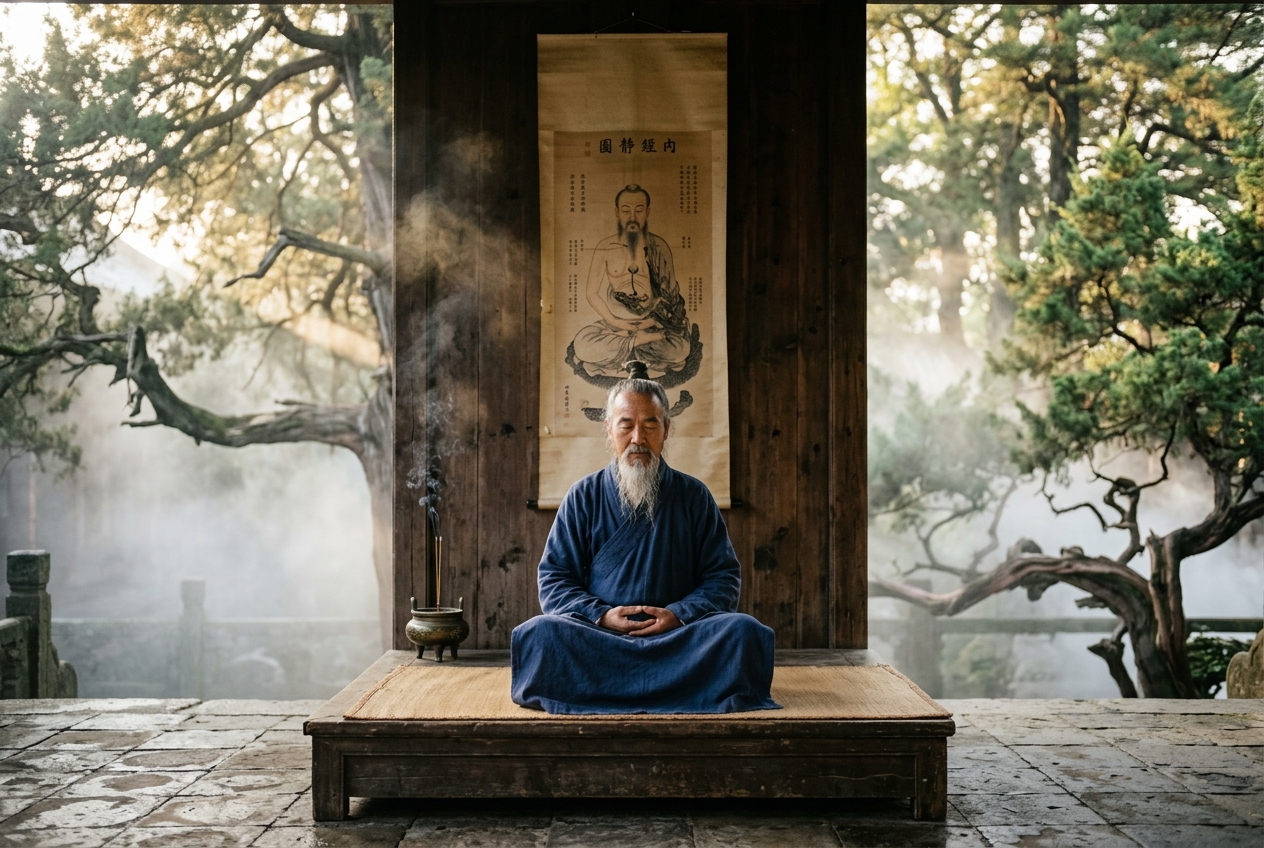
This vision culminated in the celebrated Neijing Tu (內經圖), or Chart of the Inner Landscape, a nineteenth-century visual synthesis engraved on a stele at the White Cloud Temple (Baiyun Guan, 白雲觀) in Beijing. The chart translates subjective, interoceptive sensations into an intricate landscape painting: the spinal column becomes a rushing mountain river; the pelvic basin is rendered as a fertile agricultural valley plowed by an iron ox; the heart appears as a sacred courtyard where a weaver maiden spins silk; and the brain transforms into the nine craggy peaks of Mount Kunlun.
In everyday language, this practice uses rhythmic abdominal breathing, gentle postural alignment, and focused interoceptive attention to circulate heat, fluid, and neural relaxation throughout the body. By guiding awareness down the front centerline of the torso (the Conception Vessel or Ren Mai, 任脈) and up the posterior chain of the spine (the Governing Vessel or Du Mai, 督脈), the practitioner harmonizes the autonomic nervous system, alleviates chronic axial tension, and enters a state of deep physiological coherence. The National Qigong Association recognizes these traditional circulation techniques as fundamental pillars of self-cultivation, combining physical posture, breath regulation, and focused mental intention.
Somatotopic Architecture of the Inner Landscape
The Neijing Tu is organized into three distinct alchemical basins known as the Three Dantians (San Dantian, 三丹田). Each basin represents a specific anatomical region, a stage of bioenergetic refinement, and a physiological nexus of neurovascular and fascial structures.
===================================================================
                   THE THREE ALCHEMICAL BASINS
===================================================================

[ UPPER DANTIAN: Niwan Palace & Mt. Kunlun ]
  - Pineal, Pituitary & Ventricular Fluid Dynamics
  - Laozi / Unified Shen (Spiritual Radiance)
  - Sun & Moon (Bilateral Ocular-Optic Tracts)
  - Upper Magpie Bridge (Sublingual-Palatal Seal)
                     |
                     |  [Du Mai / Spinal Ascent]
                     v
 [ MIDDLE DANTIAN: Yellow Court & Heart Furnace ]
  - Cardiac Plexus, Vagal Innervation, HRV
  - Weaver Girl Spinning Crimson Silk (Li / Heart-Fire)
  - Thoracic Gateway (Jiaji Gate, T5-T11)
                     |
                     |  [Ren Mai / Descent]
                     v
 [ LOWER DANTIAN: The Pelvic Crucible & Iron Ox ]
  - Enteric Nervous System, Perineal Myofascia
  - Water Wheel (Reversing Fluid Propulsion)
  - Weaver Boy & Tailbone Gate (Weilu, Coccyx/Sacrum)
  - Transmutation of Jing (Essence) into Qi (Vital Energy)
===================================================================
1. The Lower Basin: The Pelvic Crucible (Xia Dantian, 下丹田)
At the bottom of the Neijing Tu, two figures operate a treadle waterwheel at the base of a roaring cascade, while an iron ox plows a dark, fertile field. This lower reservoir encompasses the pelvic floor, the sacrum, the lower abdomen (two to three inches below the navel), and the perineal center (Huiyin, 會陰, CV-1).
- The Iron Ox Plowing the Field (Tie Niu Geng Di, 鐵牛耕地): The ox represents primal vitality, the earth element, and the deep, instinctual life force anchored within the pelvic bowl and enteric fascia. Plowing signifies the active cultivation of Jing (精)—the physical substratum of vitality, hormonal reserves, and reproductive potential. In modern biomechanics, this corresponds to the engagement of the transversus abdominis, the iliopsoas complex, and the pelvic diaphragm, which stabilize the lumbopelvic core and pressurize the lower peritoneal cavity.
- The Waterwheel (Shuiche, 水車) and the Coccygeal Gate (Weilu, 尾閭): The waterwheel represents the intentional reversal of descending fluids and downward energetic dissipation. By gently contracting the perineum and coordinating diaphragmatic inhalation, the practitioner pumps vital fluid and neural impulses upward through the coccygeal gateway (Weilu, GV-1) into the sacral canal.
- The Boy and Girl Working the Wheel: These twin alchemical laborers symbolize the harmonious integration of Yin (water, cooling fluids, parasympathetic brake) and Yang (fire, kinetic warmth, sympathetic drive) at the perineal base.
2. The Middle Basin: The Thoracic Hearth (Zhong Dantian, 中丹田)
Ascending along the spinal column, the landscape widens into the Middle Field, centered at the solar plexus and the cardiac center (Tanzhong, 膻中, CV-17).
- The Weaver Maiden Spinning Silk (Zhinü, 織女): In Chinese mythology, the Weaver Girl spins the radiant threads of the cosmos. In the Neijing Tu, she sits at the Heart-Fire furnace (Li, 離卦), continually weaving the fine threads of emotional perception and conscious breath into a unified matrix. This corresponds anatomically to the cardiac plexus, the vagal innervation of the sinoatrial node, and the myofascial expansiveness of the thoracic cavity.
- The Yellow Court (Huangting, 黃庭): Located in the epigastric space between the stomach, spleen, and diaphragm, the Yellow Court is the central earthen hub of digestion, assimilation, and emotional stability. Here, the heat generated in the lower crucible meets the nourishment extracted from food and air, transmuting Jing into refined Qi (氣).
- The Spinal Gateway (Jiaji, 夾脊): Opposite the heart along the posterior spine (spanning thoracic vertebrae T5 through T11) lies the narrow mountain pass known as the Jiaji Gate. Practitioners often experience this region as a bottleneck where chronic postural slouching and emotional shielding restrict the upward propagation of warmth and cerebrospinal fluid.
3. The Upper Basin: The Cranial Citadel (Shang Dantian, 上丹田)
At the zenith of the chart rise the craggy, mist-shrouded Nine Peaks of Mount Kunlun (Kunlun Shan, 崑崙山), representing the convoluted cerebral hemispheres and the upper cranial vaults.
- The Mud Pill Palace (Niwan Gong, 泥丸宮): Located deep within the center of the brain—corresponding to the third ventricle, the pineal gland, and the hypothalamic-pituitary axis—the Niwan Gong is the seat of Shen (神), the spiritual radiance and meta-awareness of the human being.
- The Old Sage with Long Eyebrows: Seated serenely beneath the peaks, the immortal figure (traditionally associated with Laozi or the inner master) personifies the culmination of internal alchemy: the return of consciousness to stillness, clarity, and unconditioned presence (Wuji, 無極).
- The Sun and Moon: Depicted as glowing celestial orbs in the upper skull, these correspond to the left and right eyes, the optic chiasm, and the diurnal neuroendocrine rhythms governed by melatonin and light exposure.
- The Magpie Bridge (Queqiao, 鵲橋): Connecting the upper cranium to the throat is a delicate bridge over which water cascades. In practice, this bridge is formed physically by placing the tip of the tongue against the hard and soft palate, closing the bio-circuit between the Governing Vessel ascending the spine and the Conception Vessel descending the chest.
Step-by-Step Practice Guide: Circulating the Microcosmic Orbit
This guided sequence utilizes the Neijing Tu as an internal roadmap. Practice this sequence seated comfortably on a cushion or a firm chair with your spine upright and unsupported.
                    THE MICROCOSMIC ORBIT
                 (Xiao Zhoutian Circulation)

[ Mt. Kunlun / Crown ]
                        (Baihui - GV-20)
                             /     \
    [Du Mai: Spinal Ascent] /       \ [Ren Mai: Frontal Descent]
    - Upward pump of warmth/         \ - Downward shower of cooling nectar
    - Sacrum to Crown                 \ - Palate to Pelvic Floor
                           |         |
      [Jiaji / Mid-Spine]  |         |  [Yellow Court / Tanzhong]
      (Thoracic Gateway)   |         |  (Heart / Middle Dantian)
                           |         |
      [Weilu / Tailbone]   \         /  [Xia Dantian / Navel Center]
      (Pelvic Crucible)     \       /   (Lower Belly Crucible)
                             \     /
                           [ Huiyin ]
                         (Perineal Base)
Step 1: Establishing the Vessel and Root (3 Minutes)
- Sit with your spine naturally elongated, as if the crown of your head (Baihui, 百會, GV-20) is suspended by a delicate silk thread from the sky.
- Rest your hands gently in your lap, right palm cupped inside the left, with the tips of your thumbs lightly touching to form an unbroken oval.
- Relax the muscles of your face, soften your jaw, and rest your tongue lightly against the upper palate just behind your front teeth.
- Breathe slowly and evenly through your nose. Allow each inhalation to gently expand the lower abdomen, the lower back, and the lateral waist simultaneously.
Step 2: Igniting the Lower Crucible (4 Minutes)
- Bring your focused awareness to the lower belly, approximately two inches below your navel and two inches inward toward the core of your body (Xia Dantian).
- With every slow, unforced inhalation, visualize and feel a warm, glowing amber light gathering in this space.
- As you exhale, gently draw the lower belly slightly inward, consolidating the warmth into a dense, radiant core.
- Maintain this rhythmic breathing until a distinct sensation of gentle heat, tingling, or magnetic fullness begins to emerge in the pelvic bowl.
Step 3: Engaging the Waterwheel and Ascending the Spine (5 Minutes)
- On your next steady inhalation, gently engage the muscles of your pelvic floor (Huiyin), lifting them slightly upward as if operating the waterwheel of the Neijing Tu.
- Guide the warmth and awareness backward through the sacral space and the tailbone gate (Weilu).
- Continue drawing the breath and sensory awareness upward along the spinal column, passing through the lumbar gate (Mingmen, 命門, GV-4), ascending through the mid-back thoracic gate (Jiaji), and reaching the base of the skull (Yuzhen, 玉枕, GV-16).
- Allow the sensation of warmth and fluid motion to crest over the top of the head into the Nine Peaks of Mount Kunlun (Baihui and the Niwan center).
Step 4: Crossing the Bridge and Descending the Front Line (5 Minutes)
- As you begin a slow, smooth exhalation, allow the energy to pool at the third eye (Yintang, 印堂) and flow downward through the nose into the palate.
- Feeling the moist contact of your tongue against the palate (the Magpie Bridge), allow the energy to dissolve into a cool, nourishing sensation—traditionally described as "sweet dew" or "liquid jade" (Yuye, 玉液).
- Let this cooling sensation cascade effortlessly down the throat, washing through the cardiac center and the Yellow Court (Tanzhong), passing through the navel, and settling deeply back into the Lower Dantian.
- Pause for a natural, unforced moment of stillness at the end of the exhalation before beginning the next cycle.
Step 5: Sealing and Consolidating (3 Minutes)
- Conclude the circulation by resting your hands over your lower belly, left hand over right (or right over left).
- Breathe naturally into the space beneath your palms without any visualization, allowing all gathered heat and awareness to sink, condense, and store quietly in the pelvic reservoir.
- Gently rub your face and neck with warm palms to reintegrate outward sensory awareness.
Practitioner Diagnostics: Sensations, Milestones, and Error Corrections
| Somatic Marker | Underlying Mechanism | Meaning & Clinical Action |
|---|---|---|
| Deep Warmth in Lower Belly | Increased splanchnic perfusion and pelvic vasodilation | Optimal sign: The lower crucible is active. Continue gentle, rhythmic respiration without forcing. |
| Spontaneous Spinal Elongation | Deep spinal stabilization and tonic decompression | Optimal sign: The postural core is aligning. Allow the crown to float upward without muscular strain. |
| Cool Fluid Sensation on Palate | Salivary reflex activation via lingual-vagal stimulation | Optimal sign: Parasympathetic dominant state achieved. Swallow the saliva mindfully down to the navel. |
| Cranial Tension or Throbbing Temples | Excessive cognitive effort, forced breath, or upward Qi stagnation | Correction: Discontinue upward visualization. Drop all attention immediately into the feet (Yongquan, K-1) and exhale out the soles. |
| Tightness in Throat or Chest | Incomplete palatal contact or shallow apical breathing | Correction: Ensure tongue rests softly on the roof of the mouth; relax the ribcage downward on exhalation. |
| Pelvic Floor Cramping or Clenching | Over-contracting the perineum during the "waterwheel" phase | Correction: Reduce muscular engagement to a 10% energetic lift; prioritize relaxation over tension. |
Why It Works: The Neuro-Fascial Science
Modern physiological and biomedical research provides compelling frameworks that demystify the allegories of the Neijing Tu. Far from being mere mystical poetry, the pathways depicted in the chart correspond closely to demonstrable neural networks, fascial tensegrity lines, and fluid dynamics.
+-----------------------------------------------------------------------------------+
|                        NEURO-SOMATIC CORRELATES SUMMARY                           |
+-----------------------------------------------------------------------------------+
|  1. Autonomic Regulation: Parasympathetic dominance via vagus nerve stimulation  |
|  2. Fascial Continuity: Myers' Deep Front Line (Ren) & Superficial Back Line (Du) |
|  3. Fluid Propulsion: Diaphragm-driven respiratory pump of cerebrospinal fluid    |
|  4. Heart Rate Variability (HRV): Vagal brake modulation at Middle Dantian       |
|  5. Enteric Coherence: Splanchnic vasodilation and abdominal neural integration   |
+-----------------------------------------------------------------------------------+
1. Autonomic Nervous System Regulation and Vagal Down-Regulation
The slow, diaphragmatic rhythm practiced during Microcosmic Orbit meditation (typically 4 to 6 breaths per minute) directly stimulates the baroreceptor reflex and increases parasympathetic outflow via the vagus nerve (Cranial Nerve X). Clinical reviews indexed on NCBI PubMed consistently demonstrate that slow-paced breathing enhances heart rate variability (HRV), optimizes respiratory sinus arrhythmia (RSA), and significantly reduces systemic levels of cortisol and inflammatory cytokines. The weaver maiden spinning silk in the Middle Dantian is an allegory for this delicate, balanced tuning of the autonomic nervous system.
2. Fascial Tensegrity and Meridians
The primary energetic pathways of the Neijing Tu—the posterior Du Mai and the anterior Ren Mai—align precisely with the primary myofascial chains described in modern functional anatomy. As documented in Thomas Myers' Anatomy Trains, the Superficial Back Line (spanning from the plantar fascia of the feet, up the calves, hamstrings, sacrotuberous ligament, erector spinae, and epicranial aponeurosis to the brow) mirrors the anatomical trajectory of the Du Mai and the Bladder meridian.
Similarly, the Deep Front Line (encompassing the pelvic floor, psoas, diaphragm, pericardial fascia, and deep hyoid musculature) corresponds directly to the internal trajectory of the Ren Mai. Slow, undulating movements and rhythmic breathing mechanically stretch these continuous collagenous sheets, triggering piezoelectric signaling and releasing chronic myofascial restriction.
3. Cerebrospinal Fluid (CSF) Propulsion and Craniosacral Dynamics
The allegorical waterwheel at the base of the spine pumping water to the cranium reflects the physiological propulsion of cerebrospinal fluid (CSF). The human respiratory diaphragm and the pelvic diaphragm act as reciprocal hydraulic pistons. With each deep inhalation and exhalation, intra-abdominal and intrathoracic pressures shift, exerting a rhythmic pumping force on the dural sheath enclosing the spinal cord. This mechanical wave encourages CSF circulation through the ventricular system of the brain, facilitating metabolic waste clearance via the glymphatic system and bathing the central nervous system in nutrient-rich fluid.
4. The Enteric Nervous System ("Second Brain")
The depiction of the lower abdomen as a fertile, tilled field resonates with modern neurobiology's understanding of the enteric nervous system (ENS). Containing over 100 million neurons and producing more than 90% of the body's serotonin, the enteric plexus within the gut wall regulates immune function, visceral sensation, and emotional intuition. Deep abdominal breathing increases blood flow to the mesenteric vascular bed, reducing gut hyperpermeability and sending afferent calming signals to the brainstem via the nodose ganglion.
Classical Lineage, Epigraphy, and Historical Context
The Neijing Tu is not the product of a single author, but the culmination of a centuries-long evolutionary lineage of Daoist physiological mysticism, internal alchemy (Neidan), and traditional Chinese medicine. Global public health institutions, including the World Health Organization Traditional Medicine Programme, recognize the historic role these integrated mind-body systems have played in East Asian preventative healthcare.
                    HISTORICAL LINEAGE TIMELINE

Tang Dynasty (618–907 CE)
  - Lü Dongbin & Early Neidan Poetry
  - Synthesis of Inner Landscape Metaphors
             |
             v
  Song Dynasty (960–1279 CE)
  - Zhang Boduan's "Wuzhen Pian" (Awakening to Reality)
  - Consolidation of the Three Dantians & Three Treasures (Sanbao)
             |
             v
  Ming Dynasty (1368–1644 CE)
  - Development of Woodblock Alchemical Illustrations
  - Emergence of the "Xiuzhen Tu" (Chart of Cultivating Perfection)
             |
             v
  Qing Dynasty (1886 CE)
  - Abbot Liu Chengyin Engraves the "Neijing Tu" Stele
  - Preserved at White Cloud Temple (Baiyun Guan), Beijing
The earliest visual and conceptual roots of the chart appear in the internal alchemical literature of the Tang Dynasty (618–907 CE), notably in poems attributed to the immortal Lü Dongbin (呂洞賓). During the Song Dynasty (960–1279 CE), master alchemists such as Zhang Boduan (張伯端), author of the seminal Wuzhen Pian (Awakening to Reality, 悟真篇), codified the precise methodology of transmuting the Three Treasures (Sanbao, 三寶): converting Jing (essence) into Qi (energy), Qi into Shen (spirit), and Shen into Xu (the primordial void).
The physical stele rubbing known today was carved in 1886 (the twelfth year of the Guangxu reign in the Qing Dynasty) under the direction of Daoist Abbot Liu Chengyin (劉誠印, religious name Yonghezi), belonging to the Longmen (Dragon Gate, 龍門派) lineage of the Quanzhen (Complete Perfection, 全真道) sect. Abbot Liu discovered an ancient, damaged scroll in a mountain sanctuary, restored its intricate calligraphy and iconography, and had it engraved on stone at the White Cloud Temple in Beijing so that the esoteric teachings of internal alchemy would not be lost to posterity.
The Neijing Tu is historically and philosophically paired with the Xiuzhen Tu (修真圖, Chart for the Cultivation of Perfection). While the Xiuzhen Tu is a more technical, cosmological schematic featuring hexagrams, lunar phases, and acupuncture points, the Neijing Tu was intentionally designed as an intuitive, poetic, and somatic contemplative mandala—a mirror in which the meditating adept can directly perceive their own living biology as a sacred macrocosmic realm.
Today's Practice Commitment
To translate the wisdom of the Neijing Tu from intellectual theory into embodied reality, commit to the following structured protocol starting today:
- Daily Commitment: Dedicate 10 minutes each morning before checking your phone, computer, or drinking coffee.
- Core Action: Sit upright, rest your tongue softly against your palate, and perform 12 complete, slow cycles of the Microcosmic Orbit as outlined in the Step-by-Step Practice Guide above.
- Progressive Milestones:
- Week 1: Focus entirely on establishing natural diaphragmatic breathing and feeling distinct warmth in the Lower Dantian.
- Week 2: Introduce the gentle upward lift of the pelvic floor and consciously track the spinal ascent through the Weilu, Jiaji, and Yuzhen gates.
- Week 3: Experience the effortless descent from the palate to the heart and navel, noticing the emergence of deep physical ease and mental stillness.
- Week 4 & Beyond: Integrate the entire circuit into an unbroken, fluid loop of awareness, allowing the inner landscape to nourish your physical vitality and emotional resilience throughout the day.