Nasal Meridian Microsystem: Navigating Rhino-Facial Somatotopy, Ling Shu Visceral Projections, and Precision Acupressure Protocols
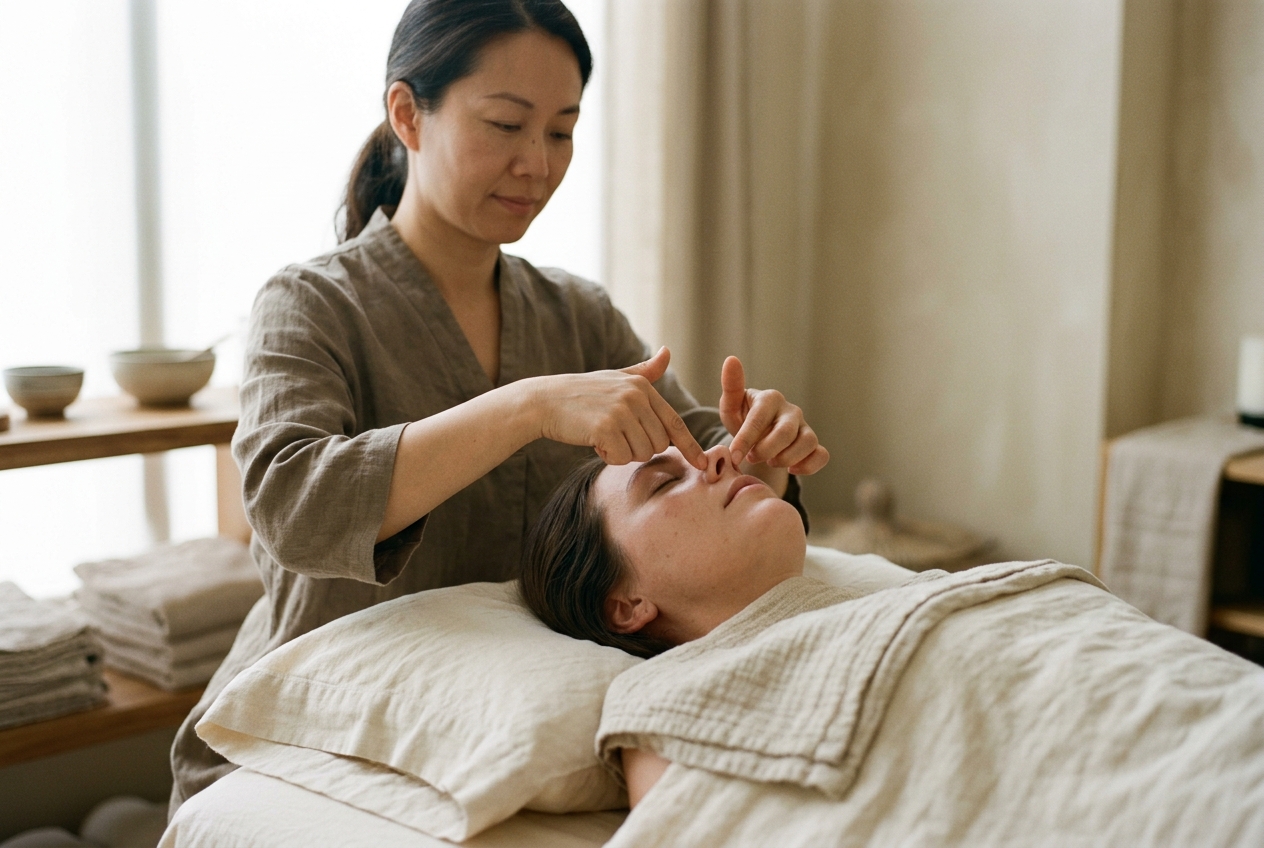
For millennia, classical physicians viewed the nose not merely as a conduit for olfactory perception and respiration, but as an intricately mapped somatic dashboard. Known classically as Bi Zhen (鼻针, or Nasal Acupuncture Microsystem), this discipline posits that the entirety of the human organism—from the cervical vertebrae to the deepest visceral organs—is projected holographically upon the nasal pyramid. When fatigue, digestive stagnation, or emotional distress disturb your systemic equilibrium, subtle tactile changes, vascular shifts, and tenderness manifest along this central facial ridge.
By understanding the physiological bridge between the classical texts of the Huangdi Neijing and modern cranial neuroanatomy, we can unlock a remarkably precise, non-invasive method for somatic regulation. Armed only with your fingertips, you can leverage the nasal microsystem to stimulate autonomic balance, alleviate cranial congestion, and restore systemic vitality within minutes.
================================================================================
                    THE NASAL HOLOGRAPHIC PROJECTION (BI ZHEN)
================================================================================

[Shan Gen / Mountain Root] -------- Heart & Shen (Emotional Calming)
               (Between Eyes)               Trigeminal V1 (Infratrochlear)
                     |
       [Shou Shang / Upper Bridge] ------- Liver & Gallbladder (Stress Regulation)
               (Upper Dorsum)               Mid-Thoracic Spine Correlation
                     |
       [Nian Shou / Lower Bridge] -------- Spleen & Stomach (Digestive Vitality)
               (Lower Dorsum)               Lower Thoracic & Lumbar Spine
                     |
       [Zhun Tou / Nasal Apex] ----------- Spleen / Visceral Core (Metabolic Fire)
                (Nose Tip)                  V1/V2 Anastomosis & Microcirculation
                    / \
   [Bi Yi / Alae]     [Bi Yi / Alae] ----- Lungs & Large Intestine (Respiration)
    (Left Nostril)     (Right Nostril)      Trigeminal V2 (Infraorbital) & Autonomic
================================================================================
1. Classical Lineage Meets Modern Neuroanatomy: The Ling Shu and Trigeminal Reflexes
The foundational doctrine of the nasal microsystem is rooted in the Han Dynasty medical classic, the Huangdi Neijing Ling Shu (The Yellow Emperor's Classic of Medicine: Spiritual Pivot). In Chapter 49, titled Wu Se (五色, "The Five Colors"), the text describes how the central facial topography serves as an external mirror for internal physiological states:
"The nose is the mountain of the face; its center reflects the viscera, its ridges correspond to the spine, and its colors reveal the movements of Qi and Blood." — Huangdi Neijing Ling Shu, Chapter 49 (Wu Se)
In this classical somatotopic mapping, the vertical midline of the nose represents the primary vertical axis of the human body. The uppermost root between the eyes corresponds to the head and the Heart; the descent along the nasal bone and septal cartilage maps the thoracic viscera, Liver, and digestive organs; the apex represents the pelvic basin and Spleen; and the lateral alae (the nostrils) correspond to the respiratory network of the Lungs and Large Intestine.
+------------------------------------------------------------------------------+
|                          CLASSICAL SOMATOTOPIC MAP                           |
+==============================================================================+
| Topographical Zone | Classical Name | Visceral / Somatic Correlation         |
+--------------------+----------------+----------------------------------------+
| Nasal Root         | Shan Gen       | Heart, Brain, Cervical Spine, Shen     |
| Upper Dorsum       | Shou Shang     | Liver, Gallbladder, Upper Thorax       |
| Lower Dorsum       | Nian Shou      | Spleen, Stomach, Lumbar Spine          |
| Nasal Apex (Tip)   | Zhun Tou       | Spleen, Digestion, Pelvic Floor        |
| Nasal Alae (Wings) | Bi Yi          | Lungs, Large Intestine, Diaphragm      |
+------------------------------------------------------------------------------+
From the perspective of contemporary neuroscience and embryology, this ancient holographic model finds compelling alignment in cranial nerve architecture. The human face develops from the frontonasal prominence and branchial arches, creating a dense intersection of neural crest-derived structures. The nasal pyramid receives sensory innervation primarily through the terminal branches of the fifth cranial nerve, the Trigeminal Nerve (CN V): - The Ophthalmic division (CN V1) supplies the upper nasal root and dorsum via the infratrochlear and external nasal branches of the anterior ethmoidal nerve. - The Maxillary division (CN V2) supplies the lateral alae and lower nasal margins via the infraorbital nerve.
When tactile or micro-circular pressure is applied to these zones, it stimulates somatic afferent fibers that project directly into the Trigeminal Spinal Nucleus in the brainstem. This brainstem interface does not operate in isolation; it establishes polysynaptic reflexes with the solitary tract nucleus (NTS) and the superior salivatory nucleus, which modulate autonomic tone through the Pterygopalatine Ganglion.
As demonstrated in modern investigations into the neurobiological mechanisms of acupressure published on NCBI PMC, manual stimulation of trigeminal cutaneous receptors triggers local nitric oxide release, reduces local microvascular resistance, and promotes systemic parasympathetic rebound. This profound convergence of sensory innervation and autonomic regulation makes the nasal surface one of the most therapeutically reactive areas on the human body.
2. The Meridian Highway: The Great Convergence of Facial Channels
Beyond its status as an independent somatotopic microsystem, the nose serves as the primary meeting ground for the body's most dynamic energetic channels. In classical meridian theory, the nose is the pivotal junction where the Yang meridians of the hand—which govern the upper limbs and sensory organs—transition into the Yang meridians of the foot, which traverse the abdomen and lower extremities.
       [Hand Yangming / Large Intestine] -------> Terminates at Nasal Alae (LI20)
                                                       |
       [Foot Yangming / Stomach] <--------------- Originates at Lateral Nasal Bridge (ST1)
                                                       |
       [Foot Taiyang / Bladder] <---------------- Originates at Medial Root (BL1)
                                                       |
       [Governing Vessel / Du Mai] -------------> Descends along Nasal Midline (DU25)
- The Governing Vessel (Du Mai): The great energetic reservoir of Yang energy travels up the posterior spinal midline, arcs over the crown of the head, and descends directly down the central ridge of the nose, terminating at the philtrum and upper gum. Stimulating the nasal midline directly accesses this central axis of postural and neural stability.
- The Large Intestine Meridian (Hand Yangming): Ascending from the index finger through the shoulder and neck, this pathway crosses the cheek to terminate beside the opposite nostril flare at point Yingxiang (LI20), establishing an intimate link between colonic function, sinus drainage, and nasal mucosal immunity.
- The Stomach Meridian (Foot Yangming): Originating immediately adjacent to the nose near the lower orbital ridge (Chengqi, ST1), this channel cascades down the throat, chest, and anterior abdomen down to the second toe. Tension along the nasal borders frequently mirrors stagnation within the stomach and digestive tract.
- The Bladder Meridian (Foot Taiyang): Arising at the inner corners of the eye adjacent to the nasal root at Jingming (BL1), this channel spans the occiput and the paraspinal muscles of the back, linking nasal root tension to cervical tightness and mental fatigue.
According to standardized definitions by the World Health Organization Standard Acupuncture Point Locations, this concentration of primary channel convergence makes the nasal architecture uniquely potent for bidirectional treatment: treating internal viscera via the face, and clearing cranial sensory orifices via distal pathways.
3. Key Somatotopic Acupressure Points You Can Activate Today
To apply this microsystem non-invasively, you do not need complex needles or diagnostic instruments. Your index and middle fingertips provide the ideal surface for sustained micro-circular pressure. When you locate an active zone, you will typically feel a sensation known as Deqi—characterized not by sharp pain, but by a distinct, spreading tenderness, a mild dull ache, or a radiating warmth that indicates neurological engagement.
+------------------------------------------------------------------------------+
|                     SUMMARY OF KEY NASAL ACUPRESSURE ZONES                   |
+==============================================================================+
| Point Zone | Common Landmark        | Primary Mechanism      | Best For      |
+------------+------------------------+------------------------+---------------+
| Shan Gen   | Dip between eyes       | Sedates Shen; CN V1    | Stress, Eyes, |
| (山根)     | at bridge root         | infratrochlear input   | Insomnia      |
+------------+------------------------+------------------------+---------------+
| Zhun Tou   | Soft fleshy tip of     | Enhances digestion;    | Bloating,     |
| (准头)     | the nose               | local capillary flux   | Low Energy    |
+------------+------------------------+------------------------+---------------+
| Bi Yi /    | Crease where nostril   | Vasomotor decongestion;| Sinusitis,    |
| Yingxiang  | flare meets cheek      | infraorbital reflex    | Brain Fog     |
+------------------------------------------------------------------------------+
Point 1: Shan Gen (山根, "Mountain Root") — The Center of Shen and Stillness
           ( O )                      ( O )
             \                          /
              \____  [ SHAN GEN ]  ____/
                     (Deep Notch)
- Everyday Physical Landmark: Locate the small, distinct horizontal dip or saddle on the bridge of your nose, situated precisely along the midline between your inner eye corners (the medial canthi).
- What You Will Feel: A deeply soothing, dull, heavy ache that may radiate upward into the center of your forehead (the Yintang area) or behind your eyes.
- How to Stimulate: Rest your thumb or index fingertip against the midline groove. Apply gentle, perpendicular inward pressure directed toward the center of your skull. Maintain steady firmness while performing subtle, micro-circular oscillations (1–2 mm radius) for 60 to 90 seconds. Breathe slowly through the abdomen.
- Therapeutic Action: Systemically calms the Heart Shen (mental and emotional spirit), lowers sympathetic over-activation, eases frontal headaches caused by intense screen focus, and relieves insomnia and ocular strain.
Point 2: Zhun Tou (准头, "The Standard Apex") — The Metabolic Core
                         /\
                        /  \
                       /    \
                      ( [ZT] )
                      Nose Tip
- Everyday Physical Landmark: The soft, rounded apex right at the very tip of your nose, directly on the midline cartilage.
- What You Will Feel: A noticeable tingling sensation accompanied by localized warmth, which often triggers an immediate urge to swallow or take a spontaneous diaphragmatic breath.
- How to Stimulate: Using the soft pad of your index finger, apply light-to-medium pressure directly backward into the nasal tip cartilage. Avoid pinching or flattening the nostrils. Execute a slow, rhythmic clockwise circular kneading technique for 60 to 90 seconds.
- Therapeutic Action: Tonifies the Spleen and Stomach Qi, activates gastrointestinal microcirculation, combats post-prandial afternoon lethargy, and clears digestive stagnation.
Point 3: Bi Yi / Yingxiang Zone (鼻翼 / LI20, "Nasal Wings & Welcome Fragrance") — The Respiratory Gateway
                       /|      |\
                      / |      | \
                     /  ( [BY] )  \
                    (   Nostril   )
                     \__ Flare __/
- Everyday Physical Landmark: Place your index fingertips on either side of your nose, resting in the soft natural furrow where the flare of each nostril meets the tissue of your cheek.
- What You Will Feel: A distinct, sharp-yet-pleasurable tenderness, accompanied by a rapid sensation of cool air moving through the nasal mucosa and an audible drainage in the posterior pharynx.
- How to Stimulate: Angle your fingertips at a 45-degree inward and upward vector toward the bridge of the nose. Press firmly and perform bilateral synchronous upward-sweeping circles for 90 seconds.
- Therapeutic Action: Rapidly clears sinus congestion, treats seasonal allergic rhinitis, alleviates facial tension, and engages cranial parasympathetic vasomotor reflexes via the Trigeminal and Autonomic Pathways documented on NCBI.
4. The Digital Decompression Protocol: An Evening Somatic Reset
For desk workers, digital commuters, and individuals carrying the accumulated tension of urban sensory overload, this five-minute sequence systematically drains facial stagnant Qi, clears the sinuses, and signals the central nervous system to shift from defensive alertness into restorative parasympathetic recovery.
================================================================================
           EVENING 5-MINUTE DIGITAL DECOMPRESSION FLOWCHART
================================================================================

[STEP 1: Centering] ---> Sit upright, palms warm, 3 physiological sighs
          |
  [STEP 2: Shan Gen] ----> 90s Inward Micro-Circles (Sedates Shen & Brain Fog)
          |
  [STEP 3: Bridge Sweep] -> 60s Downward Linear Stroke (Clears Visceral Stagnation)
          |
  [STEP 4: Zhun Tou] ----> 60s Rhythmic Pulse at Apex (Activates Digestion)
          |
  [STEP 5: Bi Yi Gate] --> 90s Bilateral 45° Upward Circular Kneading (Opens Airways)
          |
  [STEP 6: Integration] -> Full nasal inhale, slow oral exhale (Parasympathetic Lock)
================================================================================
Step-by-Step Procedure:
+------------------------------------------------------------------------------+
|                         STEP-BY-STEP EVENING PROTOCOL                        |
+==============================================================================+
| Phase  | Target Zone         | Technique & Mechanics    | Target Sensation   |
+--------+---------------------+--------------------------+--------------------+
| 01     | Preparation         | Rub hands to generate    | Calming warmth in  |
|        |                     | friction warmth          | the palms          |
| 02     | Shan Gen (Root)     | 90s inward micro-circles | Spreading heaviness|
|        |                     | toward center of skull   | behind forehead    |
| 03     | Bridge of Nose      | 60s downward gentle      | Soft fascial       |
|        | (Shou Shang/Nian)   | bilateral sweep          | relaxation         |
| 04     | Zhun Tou (Apex)     | 60s gentle pulsating tip | Local capillary    |
|        |                     | compressions             | warmth             |
| 05     | Bi Yi / Yingxiang   | 90s upward-angled 45°    | Immediate airway   |
|        | (Nasal Alae)        | circular kneading        | patency / drainage |
+------------------------------------------------------------------------------+
-
Phase 1: Preparation and Alignment (30 Seconds) - Sit upright in a comfortable chair with your feet flat on the floor and your shoulders dropped away from your ears. - Rub your palms together briskly for 10 seconds until friction generates noticeable warmth. - Take two "physiological sighs" (two rapid inhalations through the nose followed by one long, unforced exhalation through relaxed lips).
-
Phase 2: Sedating the Shen at Shan Gen (90 Seconds) - Place your right middle finger directly into the saddle dip of Shan Gen between your eyes. - Rest your left hand over your lower abdomen. - Apply a steady, comfortable inward pressure. Initiate continuous, slow, micro-circular kneading (approximately one rotation per second). - Internal Focus: Feel the tension across your brow melt into a sensation of grounded weight.
-
Phase 3: The Midline Visceral Sweep (60 Seconds) - Using the pads of both index fingers, gently sweep down the lateral sides of the nasal bridge from Shan Gen, over Shou Shang and Nian Shou, down to the lateral alae. - Use light, downward, fluid strokes to drain vascular stagnation from the facial veins into the facial lymphatics. Repeat 20 to 30 continuous downward strokes.
-
Phase 4: Reigniting the Visceral Center at Zhun Tou (60 Seconds) - Place the tip of your index finger onto the fleshy apex (Zhun Tou). - Press softly backward with moderate pressure, executing small clockwise pulses. - Notice the sensation of saliva gathering in your mouth—a direct indicator of parasympathetic gastrointestinal reactivation.
-
Phase 5: Clearing the Airway at Bi Yi (90 Seconds) - Place both index fingertips into the nasolabial grooves bordering the nostril flares (Bi Yi / LI20). - Press inward and slightly upward at a 45-degree angle. - Perform firm, rhythmic circular rotations for 90 seconds. - Take three deep, expansive nasal inhalations, feeling the newly cleared airway cool the back of your throat.
5. Safety, Contraindications, and Clinical Boundaries
While manual stimulation of the nasal microsystem is inherently gentle and non-invasive, applying mechanical pressure to cranial structures demands clinical discernment. Adhere strictly to the safety guidelines established in the WHO Guidelines on Basic Training and Safety in Acupuncture:
+------------------------------------------------------------------------------+
|                          CLINICAL SAFETY GUIDELINES                          |
+==============================================================================+
| Category         | Contraindication / Caution  | Clinical Rationale          |
+------------------+-----------------------------+-----------------------------+
| Tissue Integrity | Open cuts, acne, boils,     | Avoid spreading local       |
|                  | or active herpes simplex    | micro-infections            |
| Vascular Risk    | Active, acute epistaxis     | Direct pressure may         |
|                  | (nosebleeds)                | aggravate fragile vessels   |
| Pregnancy        | Vigorous, downward          | Strong downward Yangming    |
|                  | stimulation on LI20         | dispersion is contraindicated|
| Neurological     | Severe, shooting trigeminal | Sharp neuropathic pain      |
|                  | electric shocks             | warrants medical workup     |
+------------------------------------------------------------------------------+
- The Rule of Pressure Modulation: Acupressure must never cause bruising, sharp stinging pain, or tissue trauma. The correct sensation is a dull, satisfying, therapeutic ache. If you feel dizzy, lightheaded, or experience visual flashes, immediately release all pressure and rest quietly.
- Avoid Local Lesions: Never apply manual acupressure over areas with active inflammatory skin conditions, pustules, open wounds, sunburns, or broken nasal capillaries.
- Pregnancy Considerations: While light touch on Shan Gen is entirely safe and deeply calming during pregnancy, avoid aggressive, deep, downward-dispersing stimulation on the Bi Yi / Yingxiang area, as points connected to the Large Intestine channel possess strong descending Qi actions.
- When to Seek Professional Medical Care: Self-administered acupressure is a powerful somatic hygiene tool, but it is not a substitute for medical diagnosis. If you experience chronic, unyielding unilateral nasal obstruction, unexplained recurrent nosebleeds, loss of smell accompanied by severe neurological symptoms, or severe sinus pain with high fever, consult an ear, nose, and throat (ENT) physician or a licensed acupuncturist.
6. Today's Takeaway: The Two-Minute Nasal Apex Reset
You do not need to wait for a full evening routine to harness the power of this ancient microsystem. If you are reading this while feeling a wave of afternoon brain fog, sluggish digestion, or mental fatigue, take two minutes right now to recalibrate:
+------------------------------------------------------------------------------+
|                     YOUR 2-MINUTE DESK RECUPERATION CIRCUIT                  |
+==============================================================================+
| 00:00 - 01:00 | Close your eyes. Place your middle finger at SHAN GEN        |
|               | (between the eyes). Apply steady inward micro-circles.       |
|               | Feel your eye strain release and your breath deepen.         |
|---------------+--------------------------------------------------------------|
| 01:00 - 02:00 | Move your index finger to the nasal tip (ZHUN TOU).          |
|               | Apply gentle circular pressure. Inhale deeply through both   |
|               | nostrils, feeling a wave of fresh oxygenated clarity         |
|               | wash through your prefrontal cortex.                         |
+------------------------------------------------------------------------------+
By claiming these two minutes of intentional tactile connection with the central axis of your face, you step out of passive sensory overwhelm and engage a 2,000-year-old lineage of bodily harmony—reconnecting your brain, your breath, and your viscera through the elegant architecture of the nose.
Authoritative References and Further Reading
- World Health Organization: Standard Acupuncture Point Locations in the Western Pacific Region
- NCBI PubMed Central: Neurobiological Mechanisms of Acupressure and Autonomic Balance
- NCBI PubMed Central: Trigeminal Autonomic Reflexes and Cranial Neural Dynamics
- Wikipedia: Neuroanatomy of the Human Trigeminal Nerve (CN V)
- Wikipedia: The Pterygopalatine Ganglion and Vasomotor Regulation
- World Health Organization: Guidelines on Basic Training and Safety in Acupuncture