Mother-Child Points (Mu Zi Xue) Meridian Dynamics: Governing Five Phase Generating-Inhibiting Vectors, Organ Tonification-Sedation, and Nan Jing Chapter 69 Protocols in Traditional Chinese Medicine
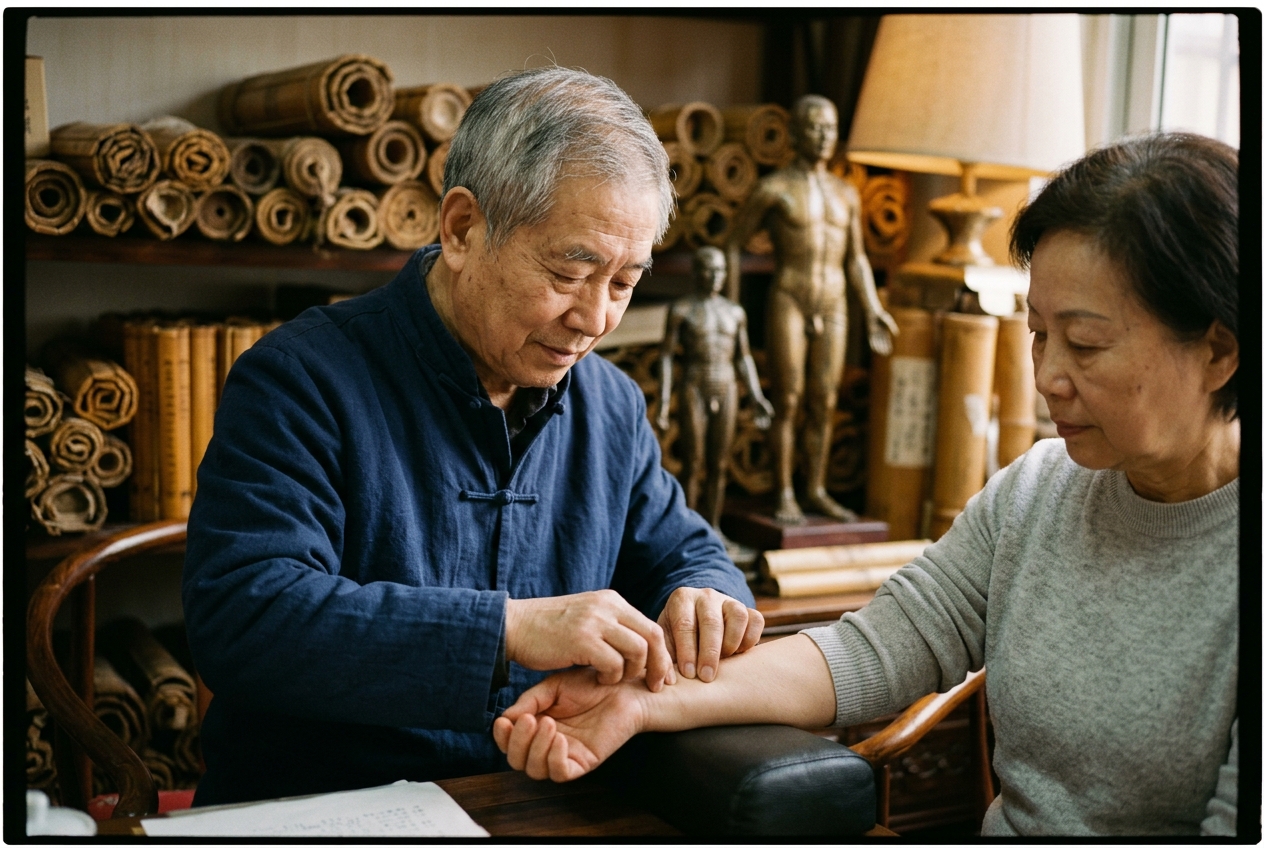
Consider an experience common to clinical medicine and everyday life alike: after months of relentless psychological stress, your digestion abruptly fails. You experience chronic epigastric distension, postprandial fatigue, and an inability to concentrate, accompanied by persistent muscular tension across the trapezius and suboccipital ridges. Standard biochemical screens return unremarkable findings, yet your subjective vitality is fractured. When a clinician skilled in classical East Asian medicine evaluates your state, they do not merely palpate your abdomen. Instead, they insert a fine filiform needle into a point near your medial knee crease or apply deep, directional pressure to your wrist. Within minutes, your breathing deepens, abdominal borborygmi signal the restoration of peristalsis, and muscular rigidity dissolves.
+-------------------------------------------------------------------------------+
|                       THE DYNAMIC HOMEOSTATIC CONTINUUM                       |
|                                                                               |
|   Constitutional Exhaustion (Xu)  <-------->  Hyperactive Repletion (Shi)     |
|   "Nourish the Generating Mother"             "Drain the Overburdened Child"  |
|         (Nan Jing Axiom: 虛則補其母)               (Nan Jing Axiom: 實則瀉其子)     |
+-------------------------------------------------------------------------------+
This phenomenon illustrates a profound foundational principle of Traditional Chinese Medicine (TCM): the body operates not as an aggregate of isolated mechanical parts, but as an interconnected hydrodynamic network governed by reciprocal metabolic relationships. In this theoretical model, an organ system under strain rarely suffers solely from intrinsic failure. Instead, it is either starved of vital resources by its upstream progenitor or congested by downstream impedance. Understanding how to regulate these energetic vector pathways through specific distal nodes—known in classical acupuncture as Mother-Child Points (Mǔ Zǐ Xué, 母子穴)—provides a systematic methodology for restoring physiological equilibrium.
THE CORE THEORETICAL ARCHITECTURE: FIVE PHASE DYNAMICS AND NAN JING CHAPTER 69
At the heart of classical Chinese clinical jurisprudence lies the Nan Jing (難經, The Classic of Difficult Issues), a pivotal Han Dynasty medical canon that codified diagnostic and therapeutic methodologies. Chapter 69 of this text articulates an axiom that has governed meridian dynamics for over two millennia:
「虛則補其母,實則瀉其子。」
"In cases of deficiency (vacuity), tonify the mother; in cases of excess (repletion), sedate (drain) the child."
To understand the mechanics of this directive, one must analyze the mathematical and physiological architecture of the Five Phases (Wǔ Xíng, 五行): Wood (Mù), Fire (Huǒ), Earth (Tǔ), Metal (Jīn), and Water (Shuǐ).
1. The Generating (Shēng) and Controlling (Kè) Vectors
The Five Phases interact through two perpetual closed-loop feedback mechanisms: * The Generating Cycle (Shēng Chéng, 生程): A continuous anabolic sequence where each phase nurtures and gives birth to the subsequent phase. Wood feeds Fire; Fire creates ash (Earth); Earth compresses into minerals and ores (Metal); Metal condenses moisture into dew and enriches springs (Water); Water irrigates and germinates vegetation (Wood). In this dynamic, the preceding phase is designated the Mother (Mǔ), and the succeeding phase is designated the Child (Zǐ). * The Controlling Cycle (Kè Chéng, 克程): A catabolic, regulatory sequence preventing any single phase from unchecked hyperproliferation. Wood parts Earth; Earth dams Water; Water extinguishes Fire; Fire melts Metal; Metal cleaves Wood.
2. The Hydrodynamics of the Five Shu-Transport Points (Wǔ Shū Xué, 五輸穴)
Every primary Acupuncture Meridian possesses five specific energetic transfer nodes located distally between the fingers and elbows, or toes and knees. These are the Five Shu-Transport Points, categorized via classical hydrologic metaphors that describe the progressive emergence, acceleration, widening, and deep visceral convergence of Qi (bioelectrical and hemodynamic flow):
- Jǐng-Well (井穴): Located at the distal ungual angles of the digits. Here, Qi emerges like water bubbling from a subterranean spring. Highly dynamic, indicated for acute mental revival and clearing visceral heat.
- Yíng-Spring (滎穴): Located along the metacarpophalangeal or metatarsophalangeal joints. Qi glides smoothly like a trickling rivulet. Indicated for febrile states and inflammatory excess.
- Shū-Stream (輸穴): Located at the wrists and ankles. Qi pours forth like a rapid stream, gaining momentum and depth. Indicated for heaviness of the body, arthralgia, and internal organ tonification.
- Jīng-River (經穴): Located along the forearms and lower legs. Qi flows like a wide, navigable river. Indicated for respiratory deviations, cough, dyspnea, and vocal cord disorders.
- Hé-Sea (合穴): Located at the elbow and knee joints. Qi converges deeply inward, entering the internal Zang-Fu organs like a river emptying into the ocean. Indicated for digestive dysfunction, counterflow Qi, and metabolic repletion.
+----------------------------------------------------------------------------------------------------+
|                         ELEMENTAL ATTRIBUTIONS OF FIVE SHU-TRANSPORT POINTS                         |
+-------------------+----------------+------------------+------------------+----------------+--------+
| Channel Polarity  | Jǐng-Well (井) | Yíng-Spring (滎) | Shū-Stream (輸)  | Jīng-River (經) | Hé-Sea |
+-------------------+----------------+------------------+------------------+----------------+--------+
| Yin Channels      | Wood (木)      | Fire (火)        | Earth (土)       | Metal (金)     | Water  |
| Yang Channels     | Metal (金)     | Water (水)       | Wood (木)        | Fire (火)      | Earth  |
+-------------------+----------------+------------------+------------------+----------------+--------+
Because Yin channels commence their distal sequence with Wood, while Yang channels commence with Metal, the elemental identity of each transport point on a given channel is fixed. Consequently, every channel contains one point whose elemental classification matches its own phase (the Ben Xue or Horary Point), one point corresponding to its Mother phase, and one point corresponding to its Child phase.
SIGNS OF BALANCE AND IMBALANCE: DIAGNOSTIC DIFFERENTIATION
In applying the Mother-Child principle, therapeutic success depends entirely on distinguishing between true visceral excess (Shí, 實) and constitutional vacuity (Xū, 虛). An error in differentiation—such as sedating an already depleted system or tonifying an inflammatory stasis—violates the fundamental laws of meridian mechanics.
+----------------------------------------------------------------------------------------------------+
|                     DIAGNOSTIC MATRIX: VISCERAL EXCESS (SHÍ) VS. VACUITY (XŪ)                      |
+-------------------------+------------------------------------+-------------------------------------+
| Clinical Diagnostic Tier| Visceral Repletion / Excess (Shí)  | Constitutional Vacuity / Empty (Xū) |
+-------------------------+------------------------------------+-------------------------------------+
| Pain Characteristics    | Sharp, acute, aggravated by touch, | Dull, chronic, lingering, relieved  |
|                         | distending, fixed location         | by gentle pressure and warmth       |
| Voice and Respiration   | Loud, forceful, coarse breathing,  | Feeble, quiet, shallow respiration, |
|                         | barking cough, restlessness        | spontaneous shortness of breath     |
| Mental / Affective State| Agitation, explosive anger, mania, | Depression, listlessness, lethargy, |
|                         | persistent insomnia, hypervigilance| somatic fatigue, mild anxiety       |
| Tongue Topography       | Crimson or dusky body, thick rough | Pale, flabby body, tooth marks,     |
|                         | yellow/white coating, dry center   | thin peeled or absent coating       |
| Radial Pulse Palpation  | Surging (*Hóng*), Wiry (*Xián*),   | Thready (*Xì*), Weak (*Ruò*), Deep  |
|                         | Slippery (*Huá*), Forceful (*Shí*) | (*Chén*), Empty (*Xū*), Hesitant    |
+-------------------------+------------------------------------+-------------------------------------+
Self-Assessment Matrix for Everyday Observation
To evaluate your own systemic equilibrium: 1. Tissue Rigidity vs. Flaccidity: Palpate the subcostal margin and the soft tissue lateral to the umbilicus. Hard, resistant knots that reject pressure indicate localized stagnation or visceral repletion (Shí). Soft, yielding depressions where fingers sink without resistance indicate baseline Qi vacuity (Xū). 2. Diurnal Energy Fluctuations: Sudden energetic crashes between 1:00 PM and 3:00 PM (Small Intestine time) or 7:00 PM and 9:00 PM (Pericardium time) point toward an empty Mother phase failing to nourish the next metabolic stage. Conversely, intense nocturnal heat, agitation, and vivid dreaming between 1:00 AM and 3:00 AM (Liver time) signal unvented Fire accumulating in a congested Child phase.
SOMATOSENSORY NEUROBIOLOGY AND DISTAL LIMB CONDUCTION
The clinical efficacy of distal Mother-Child stimulation is robustly corroborated by contemporary Neurophysiology. When an acupoint on the distal extremity (e.g., LU9 on the radial wrist or LV2 on the first interdigital cleft) is mechanically stimulated via needle manipulation or precise acupressure, it engages intricate somatosensory and autonomic feedback loops.
1. Neuroanatomical Substrates of Distal Transport Points
Distal extremities possess an exceptionally high density of specialized neural structures, including Pacinian corpuscles, Meissner's corpuscles, Ruffini endings, and free nerve endings (A-delta and C-fibers). Mechanical deformation creates localized interstitial shear stress, stimulating connective tissue fibroblasts and triggering piezoelectric calcium wave signaling across fascial planes.
2. Segmental Gating and Propriospinal Signaling
According to the Gate Control Theory, intense non-noxious mechanical stimulation of high-threshold mechanoreceptors (A-beta and A-delta fibers) activates inhibitory GABAergic interneurons in the substantia gelatinosa of the spinal dorsal horn. This suppresses nociceptive transmission through ascending spinothalamic tracts. Propriospinal long-loop reflexes simultaneously transmit neuromodulatory signals across multiple spinal cord segments, explaining why distal points below the elbows and knees exert potent regulatory effects on deep splanchnic organs located many dermatomes away.
3. Somatotopic Cortical Magnification
On the primary somatosensory cortex (the Penfield homunculus), the hands, wrists, feet, and ankles occupy a disproportionately large area of neural representation compared to the trunk. Consequently, manual or electrical stimulation of distal points (Jǐng-Well, Yíng-Spring, Shū-Stream) evokes larger, more robust cortical hemodynamic responses than local points on the abdomen or back, enabling system-wide autonomic recalibration.
THE COMPREHENSIVE TWELVE-CHANNEL MOTHER-CHILD POINT REFERENCE
The following master reference tables catalog the exact point selections across all twelve primary meridians, detailing both same-channel (Běn Jīng, 本經) and cross-channel (Tā Jīng, 他經) pairings under Nan Jing Chapter 69 principles.
+========================================================================================================================+
|                                    YIN MERIDIANS: MOTHER-CHILD REGULATION MATRIX                                       |
+----------------+---------+---------------+------------------------+---------------+------------------------------------+
| Primary        | Phase   | Mother Phase  | Tonification Point     | Child Phase   | Sedation Point                     |
| Channel        | Element | (Tonify Xu)   | Ben Jing / Ta Jing     | (Sedate Shi)  | Ben Jing / Ta Jing                 |
+----------------+---------+---------------+------------------------+---------------+------------------------------------+
| Lung (LU)      | Metal   | Earth (土)    | LU9 (Tàiyuān)          | Water (水)    | LU5 (Chǐzé)                        |
| 手太陰肺經     |         |               | Ta Jing: SP3 (Tàibái)  |               | Ta Jing: KI10 (Yīngǔ)              |
+----------------+---------+---------------+------------------------+---------------+------------------------------------+
| Spleen (SP)    | Earth   | Fire (火)     | SP2 (Dàdū)             | Metal (金)    | SP5 (Shāngqiū)                     |
| 足太陰脾經     |         |               | Ta Jing: HT8 (Shǎofǔ)  |               | Ta Jing: LU8 (Jīngqú)              |
+----------------+---------+---------------+------------------------+---------------+------------------------------------+
| Heart (HT)     | Fire    | Wood (木)     | HT9 (Shàochōng)        | Earth (土)    | HT7 (Shénmén)                      |
| 手少陰心經     |         |               | Ta Jing: LV1 (Dàdūn)   |               | Ta Jing: SP3 (Tàibái)              |
+----------------+---------+---------------+------------------------+---------------+------------------------------------+
| Kidney (KI)    | Water   | Metal (金)    | KI7 (Fùliū)            | Wood (木)     | KI1 (Yǒngquán)                     |
| 足少陰腎經     |         |               | Ta Jing: LU8 (Jīngqú)  |               | Ta Jing: LV1 (Dàdūn)               |
+----------------+---------+---------------+------------------------+---------------+------------------------------------+
| Pericardium    | Fire    | Wood (木)     | PC9 (Zhōngchōng)       | Earth (土)    | PC7 (Dàlíng)                       |
| 手厥陰心包經   |         |               | Ta Jing: LV1 (Dàdūn)   |               | Ta Jing: SP3 (Tàibái)              |
+----------------+---------+---------------+------------------------+---------------+------------------------------------+
| Liver (LV)     | Wood    | Water (水)    | LV8 (Qūquán)           | Fire (火)     | LV2 (Xíngjiān)                     |
| 足厥陰肝經     |         |               | Ta Jing: KI10 (Yīngǔ)  |               | Ta Jing: HT8 (Shǎofǔ)              |
+========================================================================================================================+
+========================================================================================================================+
|                                    YANG MERIDIANS: MOTHER-CHILD REGULATION MATRIX                                      |
+----------------+---------+---------------+------------------------+---------------+------------------------------------+
| Primary        | Phase   | Mother Phase  | Tonification Point     | Child Phase   | Sedation Point                     |
| Channel        | Element | (Tonify Xu)   | Ben Jing / Ta Jing     | (Sedate Shi)  | Ben Jing / Ta Jing                 |
+----------------+---------+---------------+------------------------+---------------+------------------------------------+
| Large Intestine| Metal   | Earth (土)    | LI11 (Qūchí)           | Water (水)    | LI2 (Èrjiān)                       |
| 手陽明大腸經   |         |               | Ta Jing: ST36 (Zúsānlǐ)|               | Ta Jing: BL66 (Zútōnggǔ)           |
+----------------+---------+---------------+------------------------+---------------+------------------------------------+
| Stomach (ST)   | Earth   | Fire (火)     | ST41 (Jiěxī)           | Metal (金)    | ST45 (Lìduì)                       |
| 足陽明胃經     |         |               | Ta Jing: SI5 (Yǎnglǎo) |               | Ta Jing: LI1 (Shāngyáng)           |
+----------------+---------+---------------+------------------------+---------------+------------------------------------+
| Small Intestine| Fire    | Wood (木)     | SI3 (Hòuxī)            | Earth (土)    | SI8 (Xiǎohǎi)                      |
| 手太陽小腸經   |         |               | Ta Jing: GB41 (Zúlínqì)|               | Ta Jing: ST36 (Zúsānlǐ)            |
+----------------+---------+---------------+------------------------+---------------+------------------------------------+
| Bladder (BL)   | Water   | Metal (金)    | BL67 (Zhìyīn)          | Wood (木)     | BL65 (Shùgǔ)                       |
| 足太陽膀胱經   |         |               | Ta Jing: LI1 (Shāngyáng|               | Ta Jing: GB41 (Zúlínqì)            |
+----------------+---------+---------------+------------------------+---------------+------------------------------------+
| San Jiao (TE)  | Fire    | Wood (木)     | TE3 (Zhōngzhǔ)         | Earth (土)    | TE10 (Tiānjǐng)                    |
| 手少陽三焦經   |         |               | Ta Jing: GB41 (Zúlínqì)|               | Ta Jing: ST36 (Zúsānlǐ)            |
+----------------+---------+---------------+------------------------+---------------+------------------------------------+
| Gallbladder(GB)| Wood    | Water (水)    | GB43 (Xiáxī)           | Fire (火)     | GB38 (Yángfǔ)                      |
| 足少陽膽經     |         |               | Ta Jing: BL66 (Zútōnggǔ|               | Ta Jing: SI5 (Yǎnglǎo)             |
+========================================================================================================================+
CLINICAL POINT FOCUS: ESSENTIAL MOTHER-CHILD PAIRS
To translate these complex meridian networks into effective practice, let us examine three essential Acupressure Points and their clinical pairs.
1. Lung Metal: LU9 (Tàiyuān) vs. LU5 (Chǐzé)
       LU5 (Chǐzé) - Elbow Crease [Water / Child / Sedation]
           \
            \======== (Lung Meridian - Forearm Radial Border) ========
                                                                     \
                                                     LU9 (Tàiyuān) - Radial Wrist [Earth / Mother / Tonification]
- LU9 (Tàiyuān, 太淵 — Great Abyss):
- Classification: Earth Point (Mother) on a Metal Channel; Shū-Stream Point; Hui-Meeting Point for the Vessels.
- Anatomical Landmark: In the radial depression at the wrist crease, between the radial artery and the tendon of the abductor pollicis longus muscle.
- Application Vector: Apply perpendicular, rhythmic pressure directed toward the ulna for 2–3 minutes using the tip of the thumb. Firm, pulsation-synchronized pressure.
- Clinical Indication: Constitutional Lung vacuity, shallow breathing, chronic clear phlegm, spontaneous sweating, low speaking volume, and emotional grief.
- LU5 (Chǐzé, 尺澤 — Cubit Marsh):
- Classification: Water Point (Child) on a Metal Channel; Hé-Sea Point.
- Anatomical Landmark: On the cubital crease of the elbow, in the radial depression lateral to the thick tendon of the biceps brachii muscle.
- Application Vector: Deep static pressure with circular friction against the tendon edge for 2 minutes.
- Clinical Indication: Acute Lung heat, barking productive cough with yellow phlegm, hemoptysis, pleuritic chest oppression, and tidal fever.
2. Liver Wood: LV8 (Qūquán) vs. LV2 (Xíngjiān)
- LV8 (Qūquán, 曲泉 — Spring at the Bend):
- Classification: Water Point (Mother) on a Wood Channel; Hé-Sea Point.
- Anatomical Landmark: On the medial side of the knee, in the depression superior to the medial end of the popliteal crease, posterior to the medial epicondyle of the femur.
- Application Vector: Gentle, sustained upward pressure angled at 45 degrees along the line of the tendon for 3 minutes.
- Clinical Indication: Liver Blood and Yin deficiency, dry eyes, nocturnal muscular spasms, dizziness, amenorrhea, and emotional fragility.
- LV2 (Xíngjiān, 行間 — Moving Between):
- Classification: Fire Point (Child) on a Wood Channel; Yíng-Spring Point.
- Anatomical Landmark: On the dorsum of the foot, between the first and second toes, 0.5 cun proximal to the margin of the interdigital web.
- Application Vector: Strong, pinching pressure using the thumb and index finger, pressing proximally against the first metatarsal bone for 1–2 minutes.
- Clinical Indication: Liver Fire blazing upward, temporal migraines, red eyes, sudden outbursts of rage, bitter taste in the mouth, and hypertension.
3. Spleen Earth: SP2 (Dàdū) vs. SP5 (Shāngqiū)
- SP2 (Dàdū, 大都 — Great Metropolis):
- Classification: Fire Point (Mother) on an Earth Channel; Yíng-Spring Point.
- Anatomical Landmark: On the medial side of the great toe, in the depression distal and inferior to the first metatarsophalangeal joint, at the junction of the red and white skin.
- Application Vector: Firm, targeted pressure with the edge of the thumbnail or a rounded probe for 90 seconds.
- Clinical Indication: Spleen Yang deficiency, abdominal coldness, poor appetite, watery diarrhea, and extreme lethargy after meals.
- SP5 (Shāngqiū, 商丘 — Shang Hill):
- Classification: Metal Point (Child) on an Earth Channel; Jīng-River Point.
- Anatomical Landmark: In the depression distal and inferior to the medial malleolus, midway between the tuberosity of the navicular bone and the tip of the medial malleolus.
- Application Vector: Sustained dispersing pressure rotated counter-clockwise for 2 minutes.
- Clinical Indication: Dampness accumulation, heavy limbs, systemic edema, abdominal distension with borborygmi, and sluggish bowels.
SOMATOSENSORY MOVEMENT & BREATH PRACTICE: WU XING CHANNEL CONDUCTION
To integrate Five Phase meridian hydrodynamics into the living neuromuscular architecture, perform the following step-by-step somatic practice. This sequence utilizes diaphragmatic pacing and distal joint articulation to mobilize the Generating (Shēng) cycle across the primary channels.
       [STAGE 1: Grounding]             [STAGE 2: Upward Wood/Fire]          [STAGE 3: Descent to Water]
         (Jǐng-Well Focus)                  (He-Sea Convergence)                 (Centering in Dan Tian)
              O                                    \ O /                                  O
             /|\                                     |                                   /|\
             / \                                    / \                                  / \
     (Weight on KI1/LV1)                   (Wrists Extended, LU9)                 (Sinking Breath)
Protocol: The Five-Phase Hydrodynamic Circulation Cycle
- Starting Setup: Stand barefoot on a level surface with feet parallel, shoulder-width apart. Unlock your knees slightly, drop your coccyx toward the earth, and suspend the crown of your head (Bǎihuì, GV20) as if drawn upward by a silk thread. Rest your tongue gently against the upper palate behind the incisors to bridge the Conception (Rén) and Governing (Dū) vessels.
- Phase 1: Water-to-Wood Inception (Kidney to Liver)
- Movement: Inhale deeply through the nose over a 4-second count. Shift your center of gravity slightly forward onto the balls of your feet, pressing the Yǒngquán (KI1) points into the floor while gently curling your toes downward to activate the Jǐng-Well points.
- Intention: Draw kinetic and bioelectrical tension upward through the medial arches of the feet and along the inner calves (Kidney, Spleen, Liver pathways).
- Phase 2: Wood-to-Fire Elevation (Liver to Heart)
- Movement: As the inhalation peaks, raise both arms slowly along your midline up to mid-chest level (Dànzhōng, CV17), with elbows relaxed and palms facing upward. Flex your wrists backward, gently tensioning the Shū-Stream points of the wrist crease (HT7, PC7, LU9).
- Intention: Open the pericardial compartment and decompress the thoracic spine, allowing the ascending Wood phase to feed the expressive Fire of the upper burner.
- Phase 3: Fire-to-Earth Centering (Heart to Spleen)
- Movement: Retain the breath comfortably for 2 seconds. Rotate your palms downward and draw your elbows slightly outward, settling your hands at the level of the solar plexus.
- Intention: Feel the warmth of the chest descend and consolidate in the upper epigastrium, grounding metabolic fire into the digestive center.
- Phase 4: Earth-to-Metal Expansion and Descent (Spleen to Lung/Kidney)
- Movement: Exhale slowly through slightly parted lips over a 6-second count. Press your hands forward and gently downward toward your lower abdomen (Dāntián), extending your fingers outward so that your wrists create a clear horizontal angle. Sink your hips 2 inches lower into a rooted squat.
- Intention: Condense the physiological Qi downward, guiding vital energy from the chest down through the limbs to the distal Hé-Sea nodes of the knees and elbows.
- Repetitions and Duration: Perform 9 complete cycles (approx. 3–5 minutes) once or twice daily, ideally at sunrise or during the post-work transition.
- Somatic Feedback: You should feel a distinct sensation of warmth and tingling across your palms and fingertips, accompanied by gentle abdominal gurgling, deep relaxation of the diaphragm, and a clear, focused mental state.
CLINICAL MODULATION VECTORS: NEEDLE TECHNIQUES, THERMAL ENERGETICS & DIETARY THERAPEUTICS
In specialized clinical practice, activating Mother-Child points involves specific manual vectors, thermal adaptations, and targeted nutritional strategies designed to rebalance the Five Phase cycle.
+====================================================================================================+
|                    NEEDLE MANIPULATION MECHANICS FOR MOTHER-CHILD REGULATION                       |
+---------------------+---------------------------------------+--------------------------------------+
| Vector Dimension    | Tonification (*Bǔ*, 補) — Mother Point| Sedation (*Xiè*, 瀉) — Child Point   |
+---------------------+---------------------------------------+--------------------------------------+
| Lifting & Thrusting | Heavy, forceful thrust; light, slow   | Light, gentle thrust; rapid, forceful|
| (*Tí Chā*, 提插)    | lifting (*Heavy in, Light out*)       | upward lift (*Light in, Heavy out*)  |
+---------------------+---------------------------------------+--------------------------------------+
| Twirling / Rotation | Small amplitude (<180°), clockwise /  | Large amplitude (>360°), counter-    |
| (*Niān Zhuǎn*, 撚轉)| forceful forward rotation             | clockwise / forceful backward twist  |
+---------------------+---------------------------------------+--------------------------------------+
| Respiration Timing  | Insert needle on patient's EXHALE;    | Insert needle on patient's INHALE;   |
| (*Hū Xī*, 呼吸)     | withdraw needle on patient's INHALE   | withdraw needle on patient's EXHALE  |
+---------------------+---------------------------------------+--------------------------------------+
| Needle Angle & Flow | Insert point along the direction of   | Insert point opposing / against the  |
| (*Yíng Suí*, 迎隨)  | meridian flow (pointing downstream)   | meridian flow (pointing upstream)    |
+---------------------+---------------------------------------+--------------------------------------+
| Metallic Energetics | Gold-plated needles (exerts mild      | Silver-plated needles (exerts mild   |
| (Biophysical Charge)| electropositive, tonifying stimulus)  | electronegative, sedating stimulus)  |
+====================================================================================================+
Five-Phase Dietary Therapeutics
Dietary therapy works synergistically with acupoint stimulation by providing biochemical precursors that nourish or drain target phases through the Five Flavors (Wǔ Wèi, 五味):
+----------------------------------------------------------------------------------------------------+
|                         FIVE-PHASE NUTRITIONAL CORRESPONDENCE & MODULATION                         |
+-------------+---------------+----------------------------------+-----------------------------------+
| Phase       | Flavor        | Therapeutic Action               | Common Functional Foods           |
+-------------+---------------+----------------------------------+-----------------------------------+
| Wood (木)   | Sour (酸)     | Astringes, gathers, prevents     | Organic lemon water, umeboshi,    |
|             |               | leakage of Liver Yin and Blood   | unpasteurized apple cider vinegar |
+-------------+---------------+----------------------------------+-----------------------------------+
| Fire (火)   | Bitter (苦)   | Clears heat, dries dampness,     | Dandelion greens, endive, cacao,  |
|             |               | descends hyperactive Heart Fire  | bitter melon, chicory root tea    |
+-------------+---------------+----------------------------------+-----------------------------------+
| Earth (土)  | Sweet (甘)    | Tonifies, harmonizes, nourishes  | Roasted kabocha squash, yams,     |
|             |               | Spleen *Qi* and stomach fluids   | cooked parsnips, millet, carrots  |
+-------------+---------------+----------------------------------+-----------------------------------+
| Metal (金)  | Pungent (辛)  | Disperses stagnation, opens pores| Fresh ginger, scallions, radish,  |
|             |               | and circulates Lung *Qi*         | garlic, daikon, watercress        |
+-------------+---------------+----------------------------------+-----------------------------------+
| Water (水)  | Salty (鹹)    | Softens hardness, enters Kidney, | Kombu, wakame, sea salt, black    |
|             |               | guides energy to the deep core   | sesame seeds, wild-caught salmon  |
+-------------+---------------+----------------------------------+-----------------------------------+
Practical Dietary Strategies
- To Tonify Spleen Earth via Fire (Feed the Mother): When digestion is weak and cold (pale tongue, postprandial fatigue), add warming, mildly bitter spices like cardamom, cinnamon, and roasted ginger to sweet root vegetables (sweet potatoes, stewed squash). Avoid cold, raw salads and iced liquids, which extinguish the digestive fire.
- To Sedate Liver Wood via Fire (Drain the Child): When Liver Fire flares upward (tension headaches, bloodshot eyes, irritability), reduce pungent, inflammatory foods (chili peppers, high-proof alcohol, greasy meats) and introduce bitter, heat-draining foods like steamed dandelion greens, steamed broccoli rabe, and light chrysanthemum tea.
TODAY'S TAKEAWAY
The fundamental lesson of Nan Jing Chapter 69 is that balance is an active, dynamic process: internal organs never struggle in isolation, and lasting vitality is achieved not through brute force, but by working with the body's natural energetic pathways.
+-------------------------------------------------------------------------------+
|                       YOUR FIVE-MINUTE DAILY RESET                            |
|                                                                               |
|   1. Identify your state: Exhaustion (Xu) vs. Tension/Irritability (Shi).     |
|   2. If exhausted: Apply 2 minutes of gentle circular pressure to LU9         |
|      (wrist crease) or LV8 (inner knee) to nourish your core reserves.        |
|   3. If tense or agitated: Apply 2 minutes of firm dispersing pressure        |
|      to LV2 (toe web) or LU5 (elbow crease) to release excess heat.           |
|   4. Pair with 9 slow, diaphragmatic breaths, sinking your awareness into     |
|      your lower abdomen.                                                      |
+-------------------------------------------------------------------------------+
By understanding and applying these classical principles, you transform a ancient meridian model into a practical, empowering tool for everyday health.