Lower He-Sea Points (Xia He Xue) Meridian Dynamics: Governing Six Fu Visceral Pathologies, Intestinal Motility, and Distal Lower-Limb Regulation in Traditional Chinese Medicine
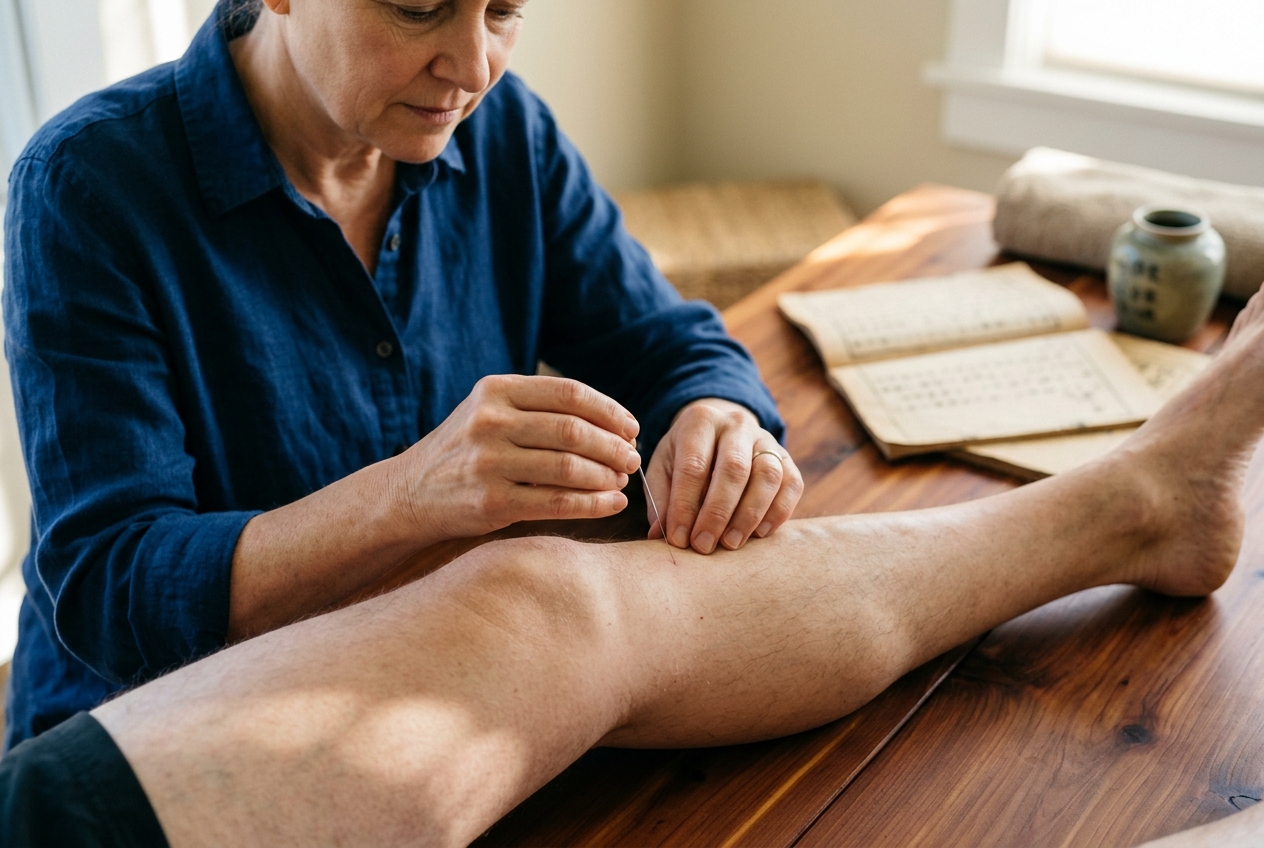
You sit back from an intense dinner, and within minutes, an uncomfortable tightening grips your midsection. Your epigastrium feels hard and distended, a sour burning sensation creeps up behind your sternum, and your lower abdomen aches with heavy, immobilising pressure. Instinctively, your shoulders hunch, your breathing turns shallow, and your fingers press into the tense muscle beneath your ribcage. Yet, if an experienced acupuncturist or neuromuscular specialist were to examine you in this moment, they would barely touch your stomach. Instead, their fingers would travel down your lower leg, exploring the firm muscular ridge of the anterior tibialis just below your knee.
There, along the outer border of the shin, they would locate a distinct, tender nodule. As firm pressure is applied to this specific crural junction, a sudden cascade of physiological sensations unfolds: a dull, radiating ache travels down the leg into the second toe, your diaphragm spontaneously drops, an audible rumble echoes through your intestines, and the crushing fullness in your upper abdomen dissolves.
This rapid visceral release is neither placebo nor mystical abstraction. It is the direct activation of the Six Lower He-Sea Points (Xia He Xue, 下合穴)—an ancient, mathematically precise system of distal neurological gates described over two millennia ago that modern electrophysiology now recognises as potent somatovisceral reflex arcs governing the human autonomic nervous system.
2. What This Organ System Does: Canonical Architecture and Biomechanical Necessity
To understand why the hollow organs of digestion and excretion are governed by points on the lower extremities, we must examine the physiological definition of the Fu organs (Fǔ, 腑). In Traditional Chinese Medicine (TCM), the body is divided into solid Yin viscera (Zàng, 脏—Liver, Heart, Spleen, Lung, Kidney, Pericardium) and hollow Yang receptacles (Fǔ, 腑—Stomach, Large Intestine, Small Intestine, Triple Burner/San Jiao, Urinary Bladder, Gallbladder).
While the solid Zang organs store essential physiological substances (Jing, Blood, Fluids) without discharging them, the hollow Fu organs operate under an opposing physiological mandate: they receive, digest, transform, conduct, and excrete. The canonical axiom states: "The Fu organs function smoothly when they are unobstructed; their nature is to descend" (腑以通为用,胃以降为和). Whenever a Fu organ suffers from stagnation, Qi counterflow (Qi Ni), spasm, or inflammation, digestive contents cannot descend, resulting in pain, reflux, constipation, biliary colic, or urinary retention.
The fundamental classical blueprint for treating these hollow structures is established in Chapter 4 of the classical medical canon, the Huangdi Neijing Ling Shu (The Spiritual Pivot), which declares:
「合治内府」 ("He zhi nei fu" — "The He-Sea points treat the internal Fu organs.")
While each of the twelve primary channels possesses an antique Five Shu He-Sea point located near the elbows or knees, clinical reality reveals a functional asymmetry. The three Arm Yang channels (Large Intestine, Small Intestine, San Jiao) have Five Shu He-Sea points on the upper limb (LI-11 Quchi, SI-8 Xiaohai, SJ-10 Tianjing), but these upper points primarily treat external channel pathoconditions, febrile states, and local joint biomechanics. They lack the potent, direct descending force required to unblock visceral gastrointestinal colic or lower urinary tract dysfunction.
Why do all six Fu organs project their primary autonomic control switches exclusively onto the three Yang channels of the lower leg (Zu San Yang)?
- Gravitational Vector and Mechanical Shear: The functional motion of all digestive and urogenital Fu viscera is fundamentally descending (Jiang). The lower extremity channels provide the longest distal mechanical lever arm. Stimulation along the crural muscular kinetic chain leverages myofascial tension lines described in modern biotensegrity, creating downward mechanical and neurological proprioceptive vectors.
- Somatotopic Neurovisceral Convergence: As demonstrated in contemporary neurobiological research indexed on NCBI PubMed, primary afferent nerve fibres from crural dermatomes and myotomes (deep peroneal, superficial peroneal, and tibial nerves) project to spinal cord segments (L4–S2) that share interneuronal collateral pathways with the enteric nervous system (ENS) and pelvic splanchnic parasympathetic efferents.
- Vagal-Autonomic Long-Loop Circuits: The lower leg musculature—specifically the tibialis anterior, extensor digitorum longus, and gastrocnemius—possesses a dense concentration of muscle spindles and encapsulated mechanoreceptors. When stimulated with specific acupuncture manipulation or deep manual shear, these receptors trigger spinomedullary-vagal reflex loops that modulate the dorsal motor nucleus of the vagus nerve (DMV), instantaneously altering gastrointestinal smooth muscle tone.
3. How You Can Feel It: Signs of Balance, Imbalance, and Crural Palpation Diagnostics
When your Fu organs are in homeostatic equilibrium, your gastrointestinal and urogenital tracts operate beneath conscious perception. Digestion is silent, peristalsis is rhythmic and painless, bile flows smoothly into the duodenum to emulsify fats, the bladder fills and empties completely without resistance, and systemic water passages remain clear.
When a Fu organ falls into disharmony, characteristic functional symptoms emerge alongside distinct physical changes along the crural pathways of the lower leg.
Palpation Diagnostic Protocol Along the Anterior Tibialis and Popliteal Fossa
In classical clinical practice, the Lower He-Sea points serve as diagnostic windows as well as therapeutic gates. You can perform a differential self-palpation assessment along the crural margin:
- The Epigastric & Stomach Zone (Zusanli, ST-36): Sit with your knee bent at 90 degrees. Place your palm over your patella; your ring finger rests naturally on the outer edge of the shin bone, in the muscular groove of the tibialis anterior, approximately 3 cun (four finger-widths) below the lower border of the kneecap. Press firmly inward toward the tibia. If the Stomach Qi is rebellious or inflamed (gastritis, acid reflux, functional dyspepsia), this point will feel exquisitely tender, often presenting with a distinct, ropy myofascial taut band.
- The Colonic & Large Intestine Zone (Shangjuxu, ST-37): Move 3 cun (another four finger-widths) directly downward along the same muscle groove. Palpate deeply. Sharp tenderness, deep graininess, or flaccid emptiness indicates dysregulation of the large bowel—such as spastic colon, irritable bowel syndrome (IBS), or fecal impaction.
- The Small Intestinal & Mesenteric Zone (Xiajuxu, ST-39): Move another 3 cun down the anterior tibialis (approximately 1 cun below the midpoint between the patella and lateral malleolus). Deep pressure here reflects small intestinal absorption dynamics, mesenteric circulatory stagnation, or lower abdominal distension.
- The Biliary & Sinew Gate (Yanglingquan, GB-34): Locate the bony prominence on the outer side of your leg just below the knee (the head of the fibula). Slide your thumb forward and downward into the soft depression immediately anterior and inferior to this bony head. Tenderness here indicates Gallbladder Qi constraint, biliary stasis, lateral hypochondriac tightness, or generalized neuromuscular stiffness.
- The Sacral & Lumbar Reservoirs (Weiyang, BL-39 and Weizhong, BL-40): Palpate the crease behind your knee (popliteal fossa). Weizhong sits dead centre, while Weiyang lies on the outer edge, medial to the tendon of the biceps femoris. Tenderness, spider veins (telangiectasias), or deep indurations here signal bladder Qi transformation deficits, fluid retention, or chronic lumbar-pelvic nerve compression.
4. Qigong & Movement Practice: The Yang-Descending Crural Grounding Sequence
To restore descending peristalsis and harmonize the Six Fu organs without needles, practice this targeted Qigong sequence designed to dynamically stretch, compress, and mechanically pump the three Yang channels of the lower leg.
Step-by-Step Exercise Instructions
- Starting Position: Stand with feet parallel, shoulder-width apart. Unlock your knees slightly, drop your tailbone toward the earth, and relax your shoulders. Rest your palms gently over your lower abdomen (Dan Tian).
- Step 1: The Ascending Breath (Bladder and San Jiao Drainage):
- Inhale slowly through your nose for a count of 4, expanding your lower abdomen in all directions.
- As you inhale, slowly rise onto the balls of your feet, lifting your heels 2–3 inches off the ground.
- Simultaneously sweep both arms out to the sides and overhead, palms facing downward.
- Feel a continuous stretch elongating the posterior superficial line—running through the popliteal fossa (Weizhong BL-40 and Weiyang BL-39), up through the sacrum, and along the spine.
- Step 2: The Descending Sink (Stomach and Intestinal Propulsion):
- Exhale smoothly through your mouth for a count of 6.
- Slowly lower your heels back to the floor while simultaneously bending your knees into a half-squat (keep your spine upright, do not lean forward).
- Bring your hands down the front of your body, palms facing the floor, guiding the breath and Qi downward past the navel and down the front of the shins.
- As your knees bend, pull your toes slightly upward inside your shoes (dorsiflexion), creating eccentric engagement across the tibialis anterior muscle belly (Zusanli ST-36, Shangjuxu ST-37, Xiajuxu ST-39).
- Step 3: The Lateral Spiral (Gallbladder Dredge):
- At the bottom of the squat, pause your breath for 2 seconds. Gently rotate your torso 30 degrees to the left, directing your gaze over your left shoulder.
- Feel the fascial tension load along the lateral fibular margin of your right knee (Yanglingquan GB-34).
- Inhale as you return to centre, straightening your legs to return to the starting position.
- Repeat the rotation to the right side on the next cycle.
- Repetitions and Duration: Perform 8 to 12 continuous, fluid cycles (approximately 5 to 8 minutes daily), preferably before your largest meal or 60 minutes afterward.
- Sensations to Monitor: You should feel a warm, tingling wave spreading down the anterior shins into the feet, followed by spontaneous abdominal gurgling (borborygmi), a release of tension across the solar plexus, and a sensation of deep structural grounding.
5. Acupressure & Clinical Point Science: The Six Lower He-Sea Gates
1. Zusanli (ST-36, 足三里) — The Upper Gastrointestinal Regulator
- Anatomical Location: 3 cun inferior to the lateral infrapatellar depression (Dubi, ST-35), one finger-breadth lateral to the anterior crest of the tibia, within the belly of the tibialis anterior.
- Underlying Neuroanatomy: Branches of the deep peroneal nerve; overlying cutaneous distribution of the lateral sural cutaneous nerve; anterior tibial artery and vein.
- Biomedical & Somatovisceral Mechanism: Seminal research published in Nature by Ma et al. demonstrated that electroacupuncture at ST-36 selectively activates PROKR2-Cre-marked sensory neurons projecting to the spinal cord and the vagal-adrenal axis. This somatosensory stimulation drives the release of acetylcholine from vagal efferents, binding to $\alpha7$ nicotinic acetylcholine receptors ($\alpha7\text{nAChR}$) on splenic macrophages, suppressing systemic pro-inflammatory cytokines ($\text{TNF}-\alpha$, $\text{IL}-1\beta$, $\text{IL}-6$). Centrally, ST-36 modulates gastric smooth muscle via dual autonomic pathways: it accelerates delayed gastric emptying via non-adrenergic, non-cholinergic (NANC) vagal pathways while inhibiting gastric hyperactivity through sympathetic modulation.
- Classical Function: Harmonizes the Stomach, supports Spleen transport, descends counterflow Qi, clears damp-heat, and enriches post-heaven vitality.
- Manual Acupressure: Apply the distal tip of your thumb perpendicularly into the muscle belly. Execute circular friction-kneading with a pressure depth sufficient to trigger a distinct Deqi sensation (dull ache, numbness, distension radiating down to the dorsum of the foot) for 2–3 minutes.
- Clinical Needle Depth & Moxibustion: Perpendicular puncture 1.0–2.0 cun. Moxibustion (direct with moxa cones or indirect with moxa stick for 10–20 minutes) is renowned for systemic tonification and immune upregulation.
2. Shangjuxu (ST-37, 上巨虚) — The Great Upper Void for Large Intestine Conduction
- Anatomical Location: 6 cun inferior to ST-35 (3 cun directly inferior to ST-36), one finger-breadth lateral to the anterior crest of the tibia.
- Underlying Neuroanatomy: Deep peroneal nerve; anterior tibial artery and vein.
- Biomedical & Somatovisceral Mechanism: ST-37 possesses specific reflexogenic connections to the colonic myenteric and submucosal (Auerbach and Meissner) plexuses via the L4–S1 spinal pathways and lumbar splanchnic nerves. Stimulation of ST-37 normalizes colonic transit velocity: in hypomotile states (slow-transit constipation), it enhances rhythmic peristaltic contractions; in hypermotile, inflammatory states (spastic colitis, infectious diarrhea), it downregulates mucosal 5-hydroxytryptamine (5-HT) secretion, dampening smooth muscle hyperreactivity.
- Classical Function: Rectifies the intestines, clears damp-heat, unblocks stagnation in the large bowel, and arrests dysenteric diarrhea and intestinal abscesses (Chang Yong / appendicitis).
- Manual Acupressure: Press firmly with sustained thumb pressure directed slightly inward toward the lateral edge of the tibial bone. Hold for 90 seconds while practicing deep abdominal exhalations.
- Clinical Needle Depth & Moxibustion: Perpendicular puncture 1.0–1.5 cun. Moxibustion is applied with moxa stick (5–15 minutes) for cold-damp diarrhea, or needle retention with clearing technique for acute dysenteric syndromes.
3. Xiajuxu (ST-39, 下巨虚) — The Lower Void for Small Intestine Separation of Clear and Turbid
- Anatomical Location: 9 cun inferior to ST-35 (3 cun directly inferior to ST-37, or 1 cun inferior to the crural midpoint), one finger-breadth lateral to the anterior crest of the tibia.
- Underlying Neuroanatomy: Deep peroneal nerve; anterior tibial branch.
- Biomedical & Somatovisceral Mechanism: The Small Intestine bears the classical responsibility of "separating the clear from the turbid" (Mi Bie Qing Zhuo), extracting nutrients while passing liquid waste to the bladder and solid waste to the large bowel. Mechanistically, ST-39 activates visceral afferent reflex arcs that regulate the superior mesenteric vascular bed and duodeno-jejunal motility. It treats lower abdominal ischemic stagnation, small intestinal bacterial overgrowth (SIBO), and mesenteric lymphadenitis.
- Classical Function: Transforms stagnation in the Small Intestine, clears damp-heat from the lower burner, drains turbidity, and relieves acute lower abdominal colic (Xiao Chang Qi).
- Manual Acupressure: Use the knuckle of your index or middle finger to apply rhythmic, deep, upward-angled pressure into the lower tibialis anterior for 2 minutes.
- Clinical Needle Depth & Moxibustion: Perpendicular puncture 1.0–1.5 cun. Moxibustion is highly indicated for deficient, cold cramping pain of the periumbilical region.
4. Weiyang (BL-39, 委阳) — The Lateral Gateway to Triple Burner Fluid Metabolism
- Anatomical Location: On the lateral side of the popliteal crease, just medial to the tendon of the biceps femoris muscle.
- Underlying Neuroanatomy: Common peroneal nerve passing along the medial margin of the biceps femoris tendon; lateral superior genicular artery and vein.
- Biomedical & Somatovisceral Mechanism: The San Jiao (Triple Burner) oversees total-body fluid pathways (Shui Dao). BL-39 acts directly upon the retroperitoneal lymphatics, renal interstitial fluid exchange, and renal sympathetic nerve activity (RSNA). Through spinal reflex segments (L4–S2), stimulation of BL-39 induces mild peripheral vasodilation of renal arterioles, promoting glomerular filtration, sodium excretion, and the resolution of lower-extremity lymphedema and ascites.
- Classical Function: Opens the water passages of the lower burner, harmonizes the San Jiao, unblocks urination, and drains fullness in the hypochondrium and lower abdomen.
- Manual Acupressure: Grasp your knee with both hands, hooking your index fingers behind the outer corner of the popliteal crease. Apply gentle, sustained upward-hooking pressure against the tendon for 2 minutes.
- Clinical Needle Depth & Moxibustion: Perpendicular puncture 0.5–1.0 cun. Moxibustion is indicated for lower burner cold edema and urinary retention.
5. Weizhong (BL-40, 委中) — The Central Reservoir for Bladder Qi Transformation
- Anatomical Location: Exact midpoint of the transverse popliteal crease, situated between the tendons of the biceps femoris and semitendinosus muscles.
- Underlying Neuroanatomy: Directly over the tibial nerve; popliteal vein and popliteal artery deeply situated; medial and lateral sural cutaneous nerves.
- Biomedical & Somatovisceral Mechanism: As the primary Lower He-Sea point of the Urinary Bladder and the Supreme Command Point for the Lumbar Region and Back ("Yao Bei Weizhong Qiu"), BL-40 modulates the micturition reflex centre in the sacral cord (S2–S4) and the pontine micturition centre (PMC). Stimulation restores detrusor-sphincter coordination, easing spastic urinary hesitation, neurogenic bladder, and nocturnal enuresis. Furthermore, its direct contact with the tibial nerve provides potent antidromic neuro-inhibition of sciatic and lumbar paraspinal myofascial nociception.
- Classical Function: Clears systemic heat and summerheat, cools the blood, drains blood stasis (Xue Yu), resolves toxic dampness, frees the lumbar spine, and restores bladder Qi transformation (Qi Hua).
- Manual Acupressure: Support your kneecap with your palm while pressing the tip of your thumb or middle finger directly into the exact centre of the popliteal crease. Apply firm, pulsing pressure for 1–2 minutes until a mild electric sensation travels down the calf.
- Clinical Needle Depth & Moxibustion: Perpendicular puncture 0.5–1.5 cun. Bleeding Technique (Pricking Luò): For acute lumbar disc herniation, heat stroke, or severe eczema, the superficial venous capillaries surrounding BL-40 are pricked with a three-edged lancet to express 5–10 drops of dark, stagnant blood—a classic, high-potency clinical maneuver.
6. Yanglingquan (GB-34, 阳陵泉) — The Spring of the Yang Mound for Biliary Dredging and Sinew Elasticity
- Anatomical Location: On the lateral aspect of the lower leg, in the soft depression situated approximately 1 cun anterior and inferior to the head of the fibula.
- Underlying Neuroanatomy: At the critical bifurcation point of the common peroneal nerve into the superficial and deep peroneal nerves; inferior lateral genicular artery and recurrent tibial artery.
- Biomedical & Somatovisceral Mechanism: GB-34 is both the Lower He-Sea point of the Gallbladder and the authoritative Hui-Meeting Point for Sinews and Tendons (Jin Hui Yanglingquan). Neurophysiologically, stimulation of the common peroneal trunk at GB-34 triggers vagal-cholecystic reflexes that promote smooth muscle contraction of the gallbladder fundus while simultaneously inducing relaxation of the Sphincter of Oddi via non-adrenergic non-cholinergic (NANC) nitric oxide release. This facilitates smooth bile ejection into the duodenum, relieving biliary colic, cholecystitis, and functional dyspepsia. Concurrently, it resets neuromuscular spindle sensitivity across the lateral myofascial kinetic train, alleviating widespread tendonitis and muscular spasm.
- Classical Function: Dredges Liver and Gallbladder Qi, harmonizes Shaoyang, clears damp-heat from the hepatobiliary network, relaxes the sinews, frees joint articulation, and relieves hypochondriac distension.
- Manual Acupressure: Place your thumb in the soft depression below and in front of the fibular head. Angle the pressure slightly backward and upward toward the bone, applying continuous deep circular pressure for 2–3 minutes.
- Clinical Needle Depth & Moxibustion: Perpendicular puncture 1.0–1.5 cun. Moxibustion (moxa stick 10–15 minutes) is utilized for chronic biliary deficiency or cold-contracted sinew stiffness.
6. Food, Lifestyle & Advanced Clinical Synergy: The He-Mu Combination Strategy
The He-Mu Pairing Protocol (合募配穴法)
In clinical acupuncture, the Six Lower He-Sea points are paired with their corresponding Front-Mu Points (Mu Xue, 募穴)—the anterior gathering gates situated on the chest and abdomen where the visceral Qi of each respective Fu organ collects. This pairing is known as the He-Mu Combination Method (合募配穴).
The Front-Mu point addresses the local, acute, subjective distress and structural tension of the affected organ, while the Lower He-Sea point provides the systemic neuro-electrical leverage to drive the descending movement and restore long-loop autonomic motility.
According to evidence outlined by the World Health Organization Traditional Medicine Strategy, integrating point combinations that link ventral segmental targets with distal crural sites produces significantly higher clinical efficacy in treating functional gastrointestinal disorders than using localized abdominal points in isolation.
Dietary Bioenergetics for Fu Organ Motility
To ensure the hollow viscera maintain their physiological descending motion, your daily dietary regimen must emphasize thermal equilibrium, digestive kinetic ease, and the preservation of gastrointestinal fluid:
- Hydration and Fluid Dynamics: The hollow Fu organs require adequate fluid (Jin Ye) to transport solids. Consume warm fluids—such as gentle ginger decoctions, roasted barley tea (Mai Cha), or light bone broths. Avoid iced drinks, which induce acute vasospasm in the gastric submucosal microcirculation and arrest the descending propulsion of Stomach Qi.
- Aromatic and Bitter Carminatives: Incorporate mildly bitter and aromatic herbs that naturally dredge the Liver-Gallbladder and descend Stomach Qi:
- Orange Peel (Chen Pi): Resolves damp phlegm and descends rebellious stomach Qi.
- Fennel Seed (Xiao Hui Xiang): Warms the Middle Burner and dispels painful cramping from the Small and Large Intestines.
- Radish / Daikon (Lai Fu Zi): Highly effective at clearing food stagnation, breaking up abdominal fullness, and promoting bowel descent.
- Foods to Strictly Limit:
- Cold, Raw, and Damp-Forming Foods: Excessive uncooked salads, raw dairy, refined sugars, and iced smoothies extinguish the Spleen's digestive fire (Pi Yang), generating pathological dampness that settles in the Lower He-Sea zones of the intestines and bladder.
- Deep-Fried, Acrid, and Carbonized Foods: Over-stimulate the Gallbladder and Stomach, provoking damp-heat that manifests as biliary stasis, acid regurgitation, and inflammatory bowel disorders.
Lifestyle Rhythms for Autonomic Coherence
- Postprandial Ambulation ("Walking a Hundred Steps"): The ancient Chinese medical proverb advises: "Take one hundred steps after a meal, and you will live to ninety-nine" (饭后百步走,活到九十九). Walking slowly for 10–15 minutes following a meal activates the skeletal muscle pump of the lower extremities, gently stimulating Zusanli (ST-36) and Shangjuxu (ST-37) via dynamic foot strike, enhancing the vagal somatosensory reflex and accelerating postprandial gastric clearance.
- Circadian Meal Windows: Align food consumption with the physiological peak of the Yangming channels. The Stomach channel's highest energetic window occurs between 7:00 AM and 9:00 AM (Chen hour), while the Large Intestine peaks between 5:00 AM and 7:00 AM (Mao hour). Consuming your primary caloric meal during the early part of the day allows the Fu organs to conduct and transform nutrients with maximum energetic efficiency.
7. Today's Takeaway: The 5-Minute Crural Visceral Reset
Whenever you feel digestive heaviness, intestinal bloating, or midday mental fatigue, perform this simple crural acupressure reset: sit comfortably, locate Zusanli (ST-36) four finger-widths below your outer kneecap in the anterior tibialis muscle, and place both thumbs directly onto the points.
Apply steady, firm, circular pressure while breathing slowly into your lower abdomen—inhaling for four seconds, holding for two, and exhaling for six.
After two minutes, slide your thumbs three finger-widths further down the shin to engage Shangjuxu (ST-37), maintaining the same rhythmic breathing for an additional two minutes. Conclude with a warm glass of water or fennel tea.
This simple, five-minute somatic intervention directly engages your vagal-enteric reflex arcs, drains stagnation from the hollow viscera, and anchors your central nervous system into clear, grounded, and restorative equilibrium.