Liu He Ba Fa Water Style Qigong: Fluid Kinetic Hydrodynamics, Spiral Tensegrity, and Multi-Planar Fascial Undulation in Classical Internal Daoyin
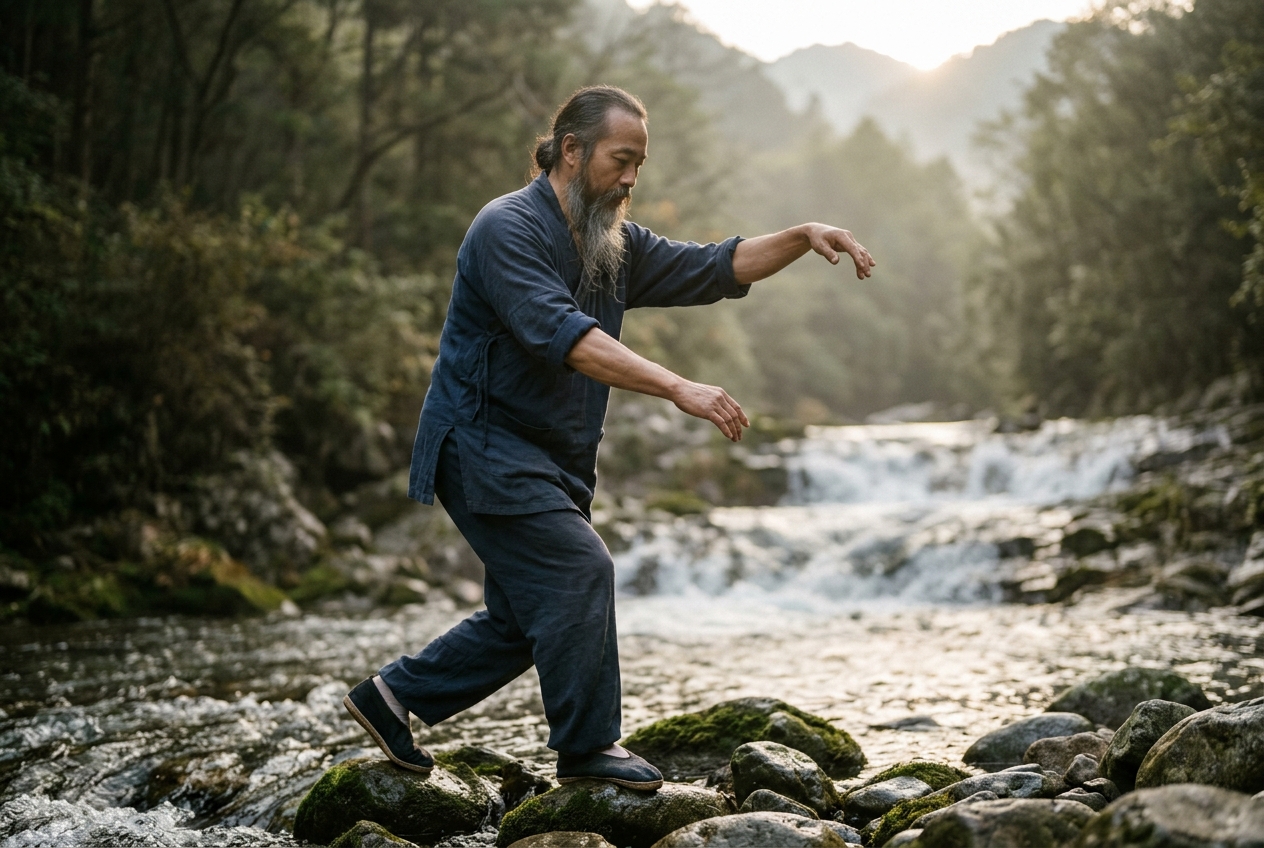
To understand this system, one must look past the mystification often surrounding ancient traditions and examine the two structural pillars embedded in its name: the Six Harmonies (Liu He), which govern internal coherence and biomechanical geometry, and the Eight Methods (Ba Fa), which articulate the kinetic strategies and physiological dynamics of water itself.
The Six Harmonies (Liu He)
The Six Harmonies are partitioned into three internal integrations (Nei San He) and three external anatomical alignments (Wai San He):
- Xin and Yi (Emotional Mind Harmonizes with Directed Intent): The volatile, reactive mind (Xin) is quieted and brought under the steady, purposeful focus of spatial awareness and somatic intent (Yi). Movement ceases to be reactive and becomes consciously guided.
- Yi and Qi (Intent Harmonizes with Vital Propulsion): Wherever the neurological intent (Yi) settles, neuromuscular activation, microvascular perfusion, and energetic mobilization (Qi) immediately follow without hesitation.
- Qi and Li (Energy Harmonizes with Physical Manifestation): The mobilized breath and internal fluid pressure (Qi) directly express through the musculoskeletal structure as unified elastic power (Li), rather than raw, isolated muscular contraction.
- Shoulders Harmonize with Hips (Jian Yu Kua He): The shoulder girdle aligns dynamically over the pelvic basin (Kua), ensuring that the torso functions as an undivided column capable of transmitting ground reaction forces without compressive shear on the lumbar vertebrae.
- Elbows Harmonize with Knees (Zhou Yu Xi He): The mid-limb levers maintain parallel structural angles throughout dynamic motion, preserving constant tensegrity and preventing the collapse of joint space during extension and flexion.
- Hands Harmonize with Feet (Shou Yu Zu He): The distal extremities operate as terminal reflections of one another; the palms mirror the plantar arches, ensuring that every reach of the fingers is anchored into the earth through the root of the feet.
The Eight Core Methods (Ba Fa)
Complementing these structural vectors are the Eight Methods, which govern the dynamic expression of the internal fluid state:
- Qi (Breath/Vital Propulsion): Regulating continuous diaphragmatic expansion to mobilize intra-abdominal pressure and drive systemic fluid movement.
- Gu (Bone/Skeletal Architecture): Aligning the skeletal frame along axes of optimal weight transmission so that the bones float within an elastic web of balanced fascial tension.
- Xing (Form/Morphology): Embodying shapes that are neither slack nor brittle, moving through postures that morph smoothly like flowing water conforming to its riverbed.
- Sui (Follow/Continuity): Cultivating instantaneous somatic adaptability; every limb and tissue responds unhesitatingly to the shifts of the center, leaving no dead space or static holding patterns.
- Che (Turn/Rotational Shear): Generating movement through helical, multi-planar rotations of the spine and hips rather than linear push-pull mechanics.
- Yuan (Roundness/Tensegrity): Maintaining spherical volume across every joint cavity, ensuring there are no sharp, broken angles that compromise kinetic transmission.
- Jing (Stillness in Motion): Establishing an unshakeable, calm somatic baseline at the physical center of gravity, even as the periphery moves with rapid, wave-like dynamism.
- Fu (Concealment/Potential): Storing kinetic potential deep within the fascial matrix, allowing movement to emerge spontaneously without preliminary wind-up or muscular pre-tension.
Step-by-Step Practice Guide
The foundational movement sequence of Liu He Ba Fa translates these classical treatises into tangible somatic experience. The following protocol introduces the foundational dynamic wave: The Tide Rises and Recedes (Chao Qi Chao Luo), integrated with Lower Dantian breathing.
Phase 1: Foundational Hydrodynamic Stance (Wuji to Shui Xing)
- Setting the Root: Stand with your feet parallel, spaced precisely hip-to-shoulder width apart. Direct your weight evenly through the soles, emphasizing the tripod of the foot: the base of the big toe, the base of the little toe, and the calcaneus (heel). Feel the center of the sole—the Yongquan point (Kidney 1 on the acupuncture meridian)—draw up softly like a suction cup.
- Releasing the Pelvic Floor: Release the tailbone straight downward as though weighted by a pendulum. Allow the anterior hip creases (Kua) to fold inward by a millimeter. This prevents anterior pelvic tilt, gently lengthening the lordotic curve of the lumbar spine.
- Suspending the Crown: Elongate the cervical spine by lifting the vertex of your head (Baihui) upward toward the ceiling, while softly retracting the chin. The throat remains relaxed; the tongue rests naturally against the upper palate behind the front teeth, connecting the governing and conception vessels.
- Emptying the Chest: Drop the sternum slightly inward and downward. Allow the armpits to feel hollow, as though resting over two delicate bird eggs, encouraging the scapulae to glide laterally across the posterior rib cage.
Phase 2: The Rising Tide (Chao Qi) — The Wave Ascends
- The Inhalation: Begin a slow, deep inhalation through the nose over 5 to 6 seconds. Direct the breath down through the diaphragm into the lower abdomen, expanding the belly, the lateral waist, and the lumbar back (Mingmen) simultaneously in a 360-degree cylindrical expansion.
- The Ground Impulse: As the intra-abdominal pressure builds, press lightly down into the earth through the Yongquan points. Do not straighten the legs forcefully; instead, let the ground reaction force roll upward through the ankles, rotating the tibiae slightly outward to open the knees.
- The Spinal Undulation: Let this upward wave ripple through the sacrum, articulating each lumbar, thoracic, and cervical vertebra in sequential, micro-flexion. The movement resembles a deep oceanic swell traveling up through the spinal column.
- The Limb Float: As the wave passes the thoracic spine, allow the arms to float upward in front of your chest. The wrists remain soft, elbows pointing downward toward the earth. The hands rise to shoulder height, palms angled downward at a 45-degree angle, fingers open and gently curved as though resting on the surface of rising water.
Phase 3: The Receding Wave (Chao Luo) — The Return to the Depths
- The Exhalation: Begin a smooth, unforced exhalation through the nose over 6 to 8 seconds. Maintain the gentle 360-degree core cylinder without allowing the lower abdomen to collapse abruptly.
- The Sinking Kua: Release deeper into the hip creases (Kua), letting the pelvis sink downward as if you were descending onto a tall stool. Ensure your knees do not migrate forward beyond the tips of your toes.
- The Hydrodynamic Drawdown: As the pelvis drops, the elbows lead the downward return, drawing the forearms and palms down in front of the lower abdomen. The palms turn downward to face the floor, pressing gently through the imaginary resistance of viscous water.
- Re-centering in the Lower Dantian: As the hands settle at hip level, feel the buoyant weight of your entire bodily structure condense into the pelvic basin—two inches below the navel and two inches inward—at the lower Dantian.
Somatosensory Benchmarks: What You Should Feel
- Micro-paresthesia (Tingling in Distal Extremities): Within 3 to 5 minutes of continuous wave-motion, a distinct tingling or effervescent sensation often appears in the palms and fingertips. This indicates peripheral vasodilation and down-regulated sympathetic tone.
- Hydrodynamic Heaviness and Plumpness: The limbs will begin to feel remarkably heavy yet weightless, like inflated hydraulic tubes drifting underwater. This is the subjective felt sense of myofascial hydration and tensegral balance.
- Warmth in the Perineum and Lumbar Region: A gentle, radiating thermal sensation across the lower back (Mingmen) and lower abdomen signals the mobilization of deep visceral microcirculation.
- Spontaneous Autonomic Sighing: A natural impulse to swallow or take a deep somatic sigh confirms that the central nervous system has shifted out of sympathetic vigilance into restorative parasympathetic dominance.
Biomechanical Pitfalls and Diagnostic Corrections
| Common Mechanical Error | Underlying Cause | Somatic Correction & Benchmark |
|---|---|---|
| Joint Hyperextension / Locking | Relying on bone-on-bone skeletal stacking instead of fascial tensegrity | Maintain a perpetual 5% micro-bend in knees and elbows. Imagine joint capsules filled with pressurized fluid that cannot be pinched. |
| Mechanical Segmentation | Driving arm movement with isolated deltoid and trapezius contraction | Freeze the shoulders. Initiate all arm elevation strictly from the downward press of the feet through the lumbar spine. |
| Valgus Knee Collapse | Collapsing the medial longitudinal arches of the feet; weak hip external rotators | Ground through the lateral heel and first metatarsal head; spiral the knees subtly outward to keep them tracking directly over the second toe. |
| Apical (Chest) Breathing | Chronic bracing of the transversus abdominis and diaphragm | Place both hands on the lower floating ribs. Breathe exclusively into your hands, ensuring the chest and collarbones remain motionless. |
Why It Works: The Physiology of Fluid Mechanics in Motion
The traditional metaphors of Liu He Ba Fa—treating the body as an ocean, a river, or a suspended drop of water—find precise validation in modern biophysics, connective tissue mechanics, and autonomic neuroscience. The system does not merely train muscles; it reshapes the physical behavior of the organism's fluid matrix.
1. Fascial Hydrodynamics and Interstitial Fluid Shearing
The human body is over 60 percent water, with a substantial portion of that fluid residing within the extracellular matrix (ECM) of the fascial network. Fascia is not an inert biological wrapping; it is a specialized, liquid-crystalline communication system. Between the collagenous sheets of superficial and deep fascia lies a lubricant composed primarily of hyaluronan. Under chronic stress or sedentary habits, this fluid undergoes densification, turning sticky and gelatinous—a physical state known in polymer physics as high viscosity.
When practicing the slow, multi-planar, non-linear undulations of Liu He Ba Fa, the practitioner applies dynamic shearing forces across these connective tissue layers. This movement exploits the thixotropic property of fascia: under continuous, rhythmic, temperature-elevating shear stress, viscous gels transition into low-viscosity fluids. Research accessible through NCBI PubMed highlights how dynamic fascial shearing mobilizes interstitial fluids, flushes inflammatory cytokines from stagnant tissues, and restores frictionless sliding between muscle groups. The result is a total-body sensation of effortless, hydraulic glide.
2. Biotensegrity and Kinetic Wave Propagation
Conventional exercise typically views the musculoskeletal frame as a series of classical levers, where bones act as rigid beams pivoting around joint fulcrums powered by localized motor units. In contrast, Water Style Qigong operates on the principles of biotensegrity—a structural model in which rigid compression elements (bones) float within a continuous, self-stabilizing network of tension elements (fascia, muscles, and tendons).
Because water is fundamentally incompressible, pressure applied at any point in a fluid system is transmitted undiminished in all directions (Pascal’s Principle). By maintaining unbroken roundness (Yuan) and structural alignment (Gu), the practitioner transforms the fascial web into a pressurized hydraulic conduit. When the feet press into the floor, that kinetic wave does not get absorbed or dissipated by a locked joint or a collapsed arch; instead, it travels through the entire fascial web to the fingertips with minimal metabolic expenditure.
3. Deep Intervertebral Micro-Articulation
Sedentary living and repetitive linear exercises frequently lead to functional "amnesia" in the deep intrinsic stabilizers of the axial spine—specifically the rotatores, intertransversarii, and multifidi. These deep muscles possess an extraordinarily high density of muscle spindles, making them crucial sensory hubs for spatial proprioception.
The serpentine, figure-eight, and rotational vectors of Liu He Ba Fa require sequential, segment-by-segment micro-articulation of the vertebral column. As each vertebra rotates and translates relative to its neighbors, it exerts a gentle, rhythmic pumping action on the intervertebral discs and the spinal dural sheath. This micro-articulation enhances the circulation of cerebrospinal fluid, reduces mechanical pressure on exiting nerve roots, and stimulates deep mechanoreceptors, restoring natural flexibility to the central axis.
4. Autonomic Regulation, Vagal Tone, and Heart Rate Variability (HRV)
The slow, wave-synchronized diaphragmatic respiration used in Liu He Ba Fa directly influences the autonomic nervous system. The phrenic and vagus nerves travel directly through the esophageal hiatus of the respiratory diaphragm. Deep, rhythmic, cylindrical breathing acts as a mechanical stimulant to the vagal nerve complex, activating the parasympathetic "rest, digest, and repair" branch of the nervous system.
Studies recognized by the World Health Organization's Traditional Medicine Framework and academic journals specializing in physiological science emphasize that slow-paced respiration (approximately 0.1 Hz, or 6 breaths per minute) maximizes Respiratory Sinus Arrhythmia (RSA) and optimizes Heart Rate Variability (HRV). This cardiovascular resonance balances baroreflex sensitivity, lowers systemic arterial blood pressure, and reduces the production of cortisol and pro-inflammatory catecholamines.
Classical Lineage: The Legacy of Sage Chen Tuan and Mount Hua
The origins of Liu He Ba Fa are rooted in the classical era of Chinese internal cultivation. The genesis of the art is traditionally attributed to the legendary Daoist hermit and philosopher Chen Tuan (陈抟, c. 871–989 CE), also revered by his honorific title Chen Xiyi (Master of the Invisible and Inaudible), who lived and practiced on the sheer granite peaks of Mount Hua (Huashan) during the Five Dynasties and early Song Dynasty.
Chen Tuan was a master of Neidan (internal Daoist alchemy), the Yijing (Book of Changes), and Daoyin therapeutic movement systems. Renowned throughout Chinese history as the "Sleeping Immortal," Chen Tuan developed specialized sleeping meditation methods (Shui Gong) designed to quiet the conscious mind and allow the body's internal energies to circulate unimpeded. Drawing from his deep immersion in the natural hydrodynamics of mountain streams, waterfalls, and mist, he formulated a movement system that synthesized the structural principles of internal martial movement with the restorative practices of longevity qigong.
For centuries, the teachings of Liu He Ba Fa remained closely guarded within Daoist cloisters and elite internal martial circles. It was not until the early 20th century that the art was systematically organized and brought to the modern public by the grandmaster Wu Yihui (吴翼翚, 1887–1961). Teaching at the prestigious Central Guoshu Institute in Nanjing and later in Shanghai, Wu Yihui was widely celebrated by his contemporaries across Taijiquan, Baguazhang, and Xingyiquan for his fluid skill. He codified the core movement system into its classical 66-movement curriculum, preserving its internal alchemy while presenting it as a comprehensive vehicle for somatic restoration, martial utility, and human development.
Today, global health organizations such as the National Qigong Association celebrate Liu He Ba Fa as one of the apex arts of internal movement, bridging centuries of empirical somatic observation with contemporary movement science.
Today’s Practice Commitment: The 15-Minute Daily Hydrodynamic Regimen
You do not need decades in a mountain hermitage to experience the restorative benefits of Water Style Qigong. Consistency and mindful presence create real somatic transformation. Commit to the following 15-minute daily practice protocol each morning, ideally before your first coffee or screen exposure:
- Minutes 0–3 (Grounding the Vessel): Stand in the basic Wuji posture. Place both hands over your lower belly. Focus on establishing smooth, unhurried, 360-degree lower abdominal breathing. Release all residual tension in your face, traps, and ankles.
- Minutes 3–11 (The Fluid Wave): Perform the Rising and Receding Tide sequence continuously. Allow each cycle of rising and descending to take approximately 12 to 14 seconds (6 seconds rising on the inhale, 6 to 8 seconds sinking on the exhale). Focus entirely on feeling the movement originate from the pressure in your feet and lower abdomen rather than lifting your arms with your shoulders.
- Minutes 11–15 (Condensing the Reservoir): Bring the hands to rest gently over the lower abdomen (left hand against the body, right hand stacked over left for men; right hand against the body, left hand over right for women). Close your eyes by half. Feel the radiant warmth, tingling, and fluid vitality you have mobilized gather back into your pelvic core, leaving you grounded, centered, and physically refreshed for the day ahead.
By approaching your body not as an assemblage of isolated mechanical levers, but as a living, interconnected fluid landscape, you unlock an innate biological capacity for resilient vitality, effortless strength, and deep somatic calm. Step into the stream, soften your structure, and let the water move.