Ling Gui Ba Fa: Navigating Eight Turtle Chronobiological Open Points, Bagua Magic Square Resonance, and Extraordinary Vessel Acupressure Protocols
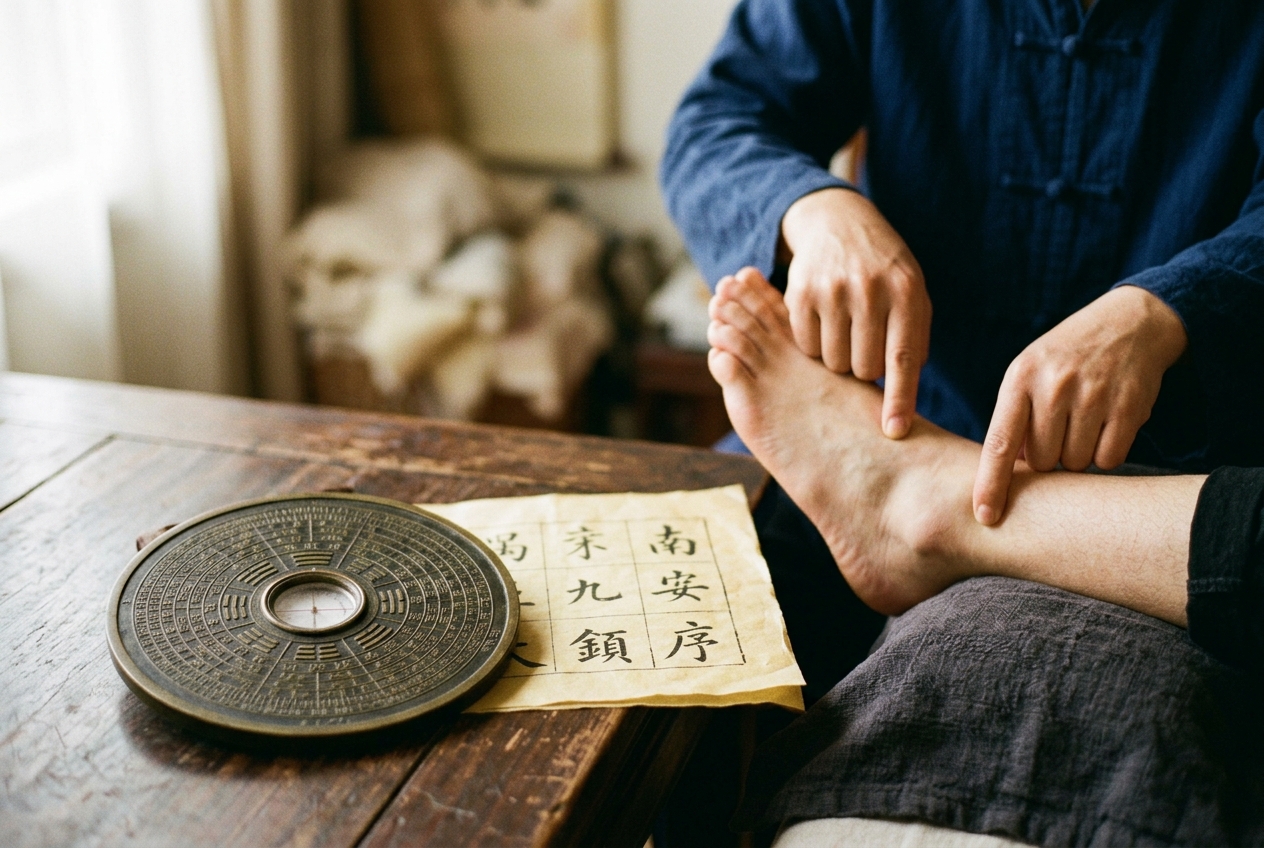
Codified during the Song and Jin-Yuan dynasties and preserved through foundational treatises such as Dou Hanqing’s Zhen Jing Zhi Nan (Guide to the Classics of Acupuncture, c. 1295 CE) and Xu Feng’s Zhen Jiu Da Cheng (Great Compendium of Acupuncture and Moxibustion, 1601 CE), Ling Gui Ba Fa represents the zenith of classical chronopuncture (Zi Wu Liu Zhu). Rather than treating the human meridian network as a static plumbing infrastructure, this methodology views the living organism as a dynamic, open-loop bio-electromagnetic resonator. By synthesizing the astronomical Sexagenary (Ganzhi) Cycle, the topological number theory of the Luoshu Magic Square, and the somatic switchboards of the Eight Confluent Points of the Extraordinary Vessels, Ling Gui Ba Fa provides a deterministic algorithm to calculate the precise two-hour window (Shichen) during which specific macroscopic energetic conduits open to maximum physiological permeability.
Below is the definitive academic and clinical exposition of Ling Gui Ba Fa, bridging ancient computational sinology with contemporary neurophysiology, complete with modular proofs, step-by-step navigational algorithms, and non-invasive acupressure protocols for home and clinical application.
1. Cosmological & Mathematical Foundations: The Architecture of Time-Space Resonance
The theoretical scaffolding of Ling Gui Ba Fa operates on the foundational axiom of Tian Ren Xiang Ying (天人相应)—the structural and functional correspondence between macrocosmic spatio-temporal dynamics and microcosmic human biophysics. To translate cyclical planetary and solar rhythms into targeted somatosensory therapeutics, the system establishes a mathematical bridge across three classical domains:
- The Sexagenary Calendar (Ganzhi 干支): A 60-element combinatorial cycle generated by the permutation of the 10 Heavenly Stems (Tiangan) and 12 Earthly Branches (Dizhi), encoding both solar ephemeris and diurnal circadian phases.
- The Nine Palaces Luoshu Magic Square (九宫洛书): A $3 \times 3$ magic matrix whose orthogonal and diagonal vectors resolve to the invariant mathematical constant of $15$, establishing a spatial coordinate system tied to the Eight Trigrams (Bagua).
- The Eight Confluent Points (Ba Mai Jiao Hui Xue 八脉交会穴): Eight designated acupoints situated distal to the elbows and knees that act as master regulatory interfaces for the Eight Extraordinary Vessels (Qi Jing Ba Mai).
Numerical Weight Assignments: Heavenly Stems & Earthly Branches
In the computational engine of Ling Gui Ba Fa, each temporal coordinate (Day Stem, Day Branch, Hour Stem, Hour Branch) is converted into a discrete numerical integer coefficient. These values are derived from classical Yijing stem-branch cosmological numerology:
Table 1: Heavenly Stem (Tiangan) Conversion Coefficients
| Heavenly Stem | Pin-Yin / Character | Polarity & Element | Numerical Coefficient |
|---|---|---|---|
| Stem 1 & 6 | Jia (甲) / Ji (己) | Yang Wood / Yin Earth | 9 |
| Stem 2 & 7 | Yi (乙) / Geng (庚) | Yin Wood / Yang Metal | 8 |
| Stem 3 & 8 | Bing (丙) / Xin (辛) | Yang Fire / Yin Metal | 7 |
| Stem 4 & 9 | Ding (丁) / Ren (壬) | Yin Fire / Yang Water | 6 |
| Stem 5 & 10 | Wu (戊) / Gui (癸) | Yang Earth / Yin Water | 5 |
Table 2: Earthly Branch (Dizhi) Conversion Coefficients
| Earthly Branch | Pin-Yin / Character | Zodiac / Diurnal Double-Hour | Numerical Coefficient |
|---|---|---|---|
| Branch 1, 7, 3, 9 | Zi (子), Wu (午), Yin (寅), Shen (申) | Rat (23-01h), Horse (11-13h), Tiger (03-05h), Monkey (15-17h) | 9 |
| Branch 2, 8, 4, 10 | Chou (丑), Wei (未), Mao (卯), You (酉) | Ox (01-03h), Goat (13-15h), Rabbit (05-07h), Rooster (17-19h) | 8 |
| Branch 5, 11, 6, 12 | Chen (辰), Xu (戌), Si (巳), Hai (亥) | Dragon (07-09h), Dog (19-21h), Snake (09-11h), Boar (21-23h) | 4 |
The Modular Arithmetic Algorithms
To determine which of the Nine Palaces—and consequently which Extraordinary Vessel Confluent Point—is dynamically "open" during a given double-hour window, the sum of the four temporal coefficients is processed through a modular congruence formula. The choice of modulus depends upon whether the Day Stem is categorially Yang or Yin.
Let: - $C_{DS}$ = Numerical Coefficient of the Day Stem - $C_{DB}$ = Numerical Coefficient of the Day Branch - $C_{HS}$ = Numerical Coefficient of the Hour Stem - $C_{HB}$ = Numerical Coefficient of the Hour Branch - $S = C_{DS} + C_{DB} + C_{HS} + C_{HB}$
$$\text{Sum } (S) = C_{DS} + C_{DB} + C_{HS} + C_{HB}$$
1. Yang Day Algorithm (Applicable to Jia 甲, Bing 丙, Wu 戊, Geng 庚, Ren 壬 days)
Because Yang principles reflect the complete nine-fold celestial geometry of the Luoshu, the sum $S$ is divided by $9$:
$$R \equiv S \pmod 9$$
- Rule: If the division yields no remainder ($R = 0$), the remainder is defined as $9$ (Palace 9, Li).
2. Yin Day Algorithm (Applicable to Yi 乙, Ding 丁, Ji 己, Xin 辛, Gui 癸 days)
Because Yin principles reflect the earthly hexagrammatic foundation ($6$ phases of earth/water), the sum $S$ is divided by $6$:
$$R \equiv S \pmod 6$$
- Rule: If the division yields no remainder ($R = 0$), the remainder is defined as $6$ (Palace 6, Qian).
Luoshu Palace to Confluent Point Topological Mapping
The calculated integer remainder $R$ directly indexes a specific palace within the Luoshu matrix, corresponding to one of the Eight Confluent Acupoints (World Health Organization Standard Acupuncture Point Locations).
| Remainder ($R$) | Luoshu Palace | Trigram & Element | Extraordinary Vessel | Open Confluent Point | Coupled Vessel / Point |
|---|---|---|---|---|---|
| 1 | Kan (坎) | Water (North) | Yangqiao Mai (阳峤脉) | BL62 (Shenmai) | Dumai / SI3 (Houxi) |
| 2 | Kun (坤) | Earth (Southwest) | Yinqiao Mai (阴峤脉) | KI6 (Zhaohai) | Renmai / LU7 (Lieque) |
| 3 | Zhen (震) | Wood (East) | Yangwei Mai (阳维脉) | SJ5 (Waiguan) | Daimai / GB41 (Zulinqi) |
| 4 | Xun (巽) | Wood (Southeast) | Daimai (带脉) | GB41 (Zulinqi) | Yangwei Mai / SJ5 (Waiguan) |
| 5 | Central Palace (中宫) | Earth (Center) | Polarity Shift | Male $\rightarrow$ KI6 (Kun 2) | Female $\rightarrow$ PC6 (Gen 8) |
| 6 | Qian (乾) | Metal (Northwest) | Chongmai (冲脉) | SP4 (Gongsun) | Yinwei Mai / PC6 (Neiguan) |
| 7 | Dui (兑) | Metal (West) | Dumai (督脉) | SI3 (Houxi) | Yangqiao Mai / BL62 (Shenmai) |
| 8 | Gen (艮) | Earth (Northeast) | Yinwei Mai (阴维脉) | PC6 (Neiguan) | Chongmai / SP4 (Gongsun) |
| 9 | Li (离) | Fire (South) | Renmai (任脉) | LU7 (Lieque) | Yinqiao Mai / KI6 (Zhaohai) |
Step-by-Step Mathematical Calculation Proof
To ground this theoretical calculus in clinical reality, let us demonstrate a complete calculation:
- Clinical Scenario: A patient presents for treatment on a Jia-Zi (甲子) Day during the Bing-Yin (丙寅) Double-Hour ($03:00 - 05:00$ True Solar Time).
- Step 1: Identify Day Polarity:
- The Day Stem is Jia (甲), which is a Yang Stem. Therefore, we will employ the Modulo 9 algorithm.
- Step 2: Retrieve Conversion Coefficients:
- Day Stem: Jia (甲) $\rightarrow C_{DS} = \mathbf{9}$ (Table 1)
- Day Branch: Zi (子) $\rightarrow C_{DB} = \mathbf{9}$ (Table 2)
- Hour Stem: Bing (丙) $\rightarrow C_{HS} = \mathbf{7}$ (Table 1)
- Hour Branch: Yin (寅) $\rightarrow C_{HB} = \mathbf{9}$ (Table 2)
- Step 3: Calculate the Total Arithmetic Sum ($S$): $$S = 9 + 9 + 7 + 9 = 34$$
- Step 4: Execute Modular Congruence: $$34 \div 9 = 3 \text{ with a remainder of } 7 \quad (34 \equiv 7 \pmod 9)$$ $$R = 7$$
- Step 5: Translate Remainder to Luoshu Palace & Confluent Point:
- Remainder $7$ corresponds to Palace 7 (Dui 兑, Metal).
- Primary Open Point (Master Point): SI3 (Houxi), commanding the Dumai (Governing Vessel).
- Synergistic Coupled Point (Guest Point): BL62 (Shenmai), commanding the Yangqiao Mai (Yang Motility Vessel).
2. The Meridian Path — A Journey Through the Body
While the twelve standard organ meridians course through linear, predictable channels, the Eight Extraordinary Vessels governed by Ling Gui Ba Fa function as vast deep-sea reservoirs of ancestral essence (Yuan Qi), neuro-endocrine communication, and neurovascular tone. Understanding their physical trajectories allows the clinician and patient to conceptualize exactly where sensation and therapeutic intent travel.
The Central Vertical Axis: Dumai & Renmai
The Dumai (Governing Vessel), accessed via SI3 (Houxi), ascends directly along the posterior midline. It originates deep in the lower abdomen, emerges at the tailbone, climbs the dorsal groove of the spinal column between the paraspinal muscles, crests the occipital ridge at the base of the skull, traverses the cranial vertex, and terminates at the inner aspect of the upper lip. It governs the entirety of somatic Yang, spinal biomechanics, neuro-axial clarity, and central nervous system excitability.
Directly mirroring this is the Renmai (Conception Vessel), opened via LU7 (Lieque). It ascends the anterior midline of the body from the pelvic floor, gliding over the pubic bone, up the center of the abdomen and sternum, across the throat, and circling the mouth. It regulates parasympathetic restoration, respiratory excursion, thoracic decompression, and the entire yin-fluid continuum.
The Deep Core & The Horizontal Belt: Chongmai & Daimai
The Chongmai (Penetrating Vessel), unlocked through SP4 (Gongsun), is the central vascular and energetic vortex. Co-originating with the uterine and prostatic vascular beds, it surges upward through the retroperitoneal space, hugging the abdominal aorta, branching through the digestive epigastrium, dispersing across the chest, and anchoring into the throat. It is the master regulator of digestive motility, portal hemodynamics, and cardiac pacing.
Wrapping horizontally around the waist like a structural corset is the Daimai (Girdling Vessel), accessed via GB41 (Zulinqi). It is the only transverse channel in the body, binding all twelve vertical meridians together at the waistline, stabilizing the sacroiliac joint, and regulating the free lateral rotation of the torso and biliary flow.
The Motility & Reticular Networks: Qiao Mai & Wei Mai
The Motility Vessels—Yangqiao Mai (via BL62) and Yinqiao Mai (via KI6)—run up the lateral and medial margins of the legs, respectively, governing musculoskeletal lateral balance, postural extensor/flexor tone, and the ocular sleep-wake cycle.
The Linking Networks—Yangwei Mai (via SJ5) and Yinwei Mai (via PC6)—connect the outer defenses and deep inner emotional-visceral structures of the body, anchoring autonomic adaptability and psychological coherence.
3. Key Points You Can Press Right Now
To utilize the Ling Gui Ba Fa matrix without invasive filiform needles, one can apply precise Acupressure and Manual Reflex Modulation to the master confluent points. When stimulated, these points elicit the classic neuro-somatic sensation termed Deqi (得气)—experienced as a subtle deep ache, micro-pulsation, or radiating warmth along fascial planes.
Point 1: PC6 (Neiguan 内关) — "The Inner Gate"
- Confluent Vessel: Yinwei Mai (Yin Linking Vessel)
- Luoshu Coordinate: Palace 8 (Gen 艮, Mountain / Earth)
Somatic Localization
Turn your forearm palm-up. Locate the primary transverse crease of your wrist. Measure approximately two thumb-widths up the arm toward the elbow. You will feel two prominent, cord-like tendons: the flexor carpi radialis and the palmaris longus. Neiguan rests directly in the soft valley between these two tendons.
Proprioceptive Sensation (Deqi)
A distinctly heavy, sweet ache that frequently radiates down into the palm or gently up the medial forearm toward the chest.
Manual Application Mechanics
Apply firm, perpendicular pressure using the tip of your thumb. Maintain static compression combined with micro-clockwise rotations for 120 to 180 seconds. Pacing should be synchronized with deep diaphragmatic breathing (4-second inhale, 6-second exhale).
Clinical Indications
- Acute situational anxiety, panic sensations, and sympathetic hyper-arousal.
- Gastroesophageal reflux, motion sickness, nausea, and epigastric constriction.
- Insomnia characterized by nocturnal rumination and racing heart.
Point 2: SP4 (Gongsun 公孙) — "The Grandfather-Grandson"
- Confluent Vessel: Chongmai (Penetrating Vessel)
- Luoshu Coordinate: Palace 6 (Qian 乾, Heaven / Metal)
Somatic Localization
On the inner side of your foot, trace the edge of your big toe backward along the prominent arch bone until you pass the rounded knuckle joint at the ball of your foot. Just behind and below this bone flare, in the soft depression along the boundary where the red skin of the sole meets the white skin of the top of the foot, lies Gongsun.
Proprioceptive Sensation (Deqi)
A pronounced, tender, electrical or spreading warmth that moves along the inner arch of the foot and up the medial calf.
Manual Application Mechanics
Hook your thumb firmly upward into the inferior border of the metatarsal bone. Exert deep, sustained, upward-angled pressure for 2 to 3 minutes per foot.
Clinical Indications
- Postprandial bloating, abdominal distension, and functional dyspepsia.
- Menstrual cramping, pelvic vascular congestion, and lower abdominal dull ache.
- Chronic visceral fatigue associated with metabolic lethargy.
Point 3: SI3 (Houxi 后溪) — "The Back Stream"
- Confluent Vessel: Dumai (Governing Vessel)
- Luoshu Coordinate: Palace 7 (Dui 兑, Lake / Metal)
Somatic Localization
Make a loose fist with your hand. Look at the outer pinky side. Locate the prominent transverse skin crease that forms right next to the knuckle of your little finger (the 5th metacarpophalangeal joint). Houxi is located directly at the outer edge of this crease, in the muscular cushion between the skin of the palm and the back of the hand.
Proprioceptive Sensation (Deqi)
A sharp, satisfying, localized soreness that releases tension upward through the wrist and outer edge of the forearm.
Manual Application Mechanics
Press the edge of your opposite thumb nail or knuckle deeply into this crease toward the center of the hand. Alternatively, rub the point vigorously along the edge of a wooden desk or table for 90 to 120 seconds.
Clinical Indications
- Acute neck stiffness, cervical facet strain, and "tech-neck" posture.
- Occipital tension headaches radiating from the base of the skull over the vertex.
- Lumbar rigidity caused by prolonged static sitting.
4. A Point Combination for One Common Issue: The Evening Vagal Reset Protocol
Modern industrial living imposes a profound, non-physiological burden: prolonged sympathetic overdrive throughout the workday followed by acute cognitive hyperactivity at night. This results in the classic syndrome of being "tired but wired"—characterized by mental restlessness, upper cervical tension, and sluggish gastrointestinal motility.
To resolve this, we utilize the ancient Master-Couple Pairing of the Chongmai and Yinwei Mai (SP4 Gongsun + PC6 Neiguan). In classical theory, this pair commands the Heart, Chest, Epigastrium, and Abdomen (Xin, Xiong, Wei), acting as a powerful biological brake on the sympathetic nervous system and upregulating vagal tone.
The Step-by-Step "Do This Tonight" Protocol
Positioning
Sit comfortably on a supportive couch or lie semi-reclined in bed with pillows elevating your knees to relax the rectus abdominis muscle. Dim artificial overhead lights.
Phase 1: Unlocking the Master Port (SP4 Gongsun — Left Side First for Men, Right Side for Women)
- Grasp your foot with the opposite hand and seat your thumb directly into SP4 (Gongsun) on the medial arch.
- Incline your pressure upward into the bone at an angle of 45 degrees until you feel a distinct dull ache (target intensity: 4 to 5 on a 10-point discomfort scale).
- Hold this static pressure while breathing slowly through your nose for 120 continuous seconds. As you exhale, imagine releasing visceral holding patterns in your stomach.
Phase 2: Engaging the Synergistic Coupled Port (PC6 Neiguan — Contralateral Side)
- Immediately switch your focus to the opposite forearm (e.g., if you pressed Left SP4, now move to Right PC6).
- Seat your thumb firmly between the two flexor tendons at PC6 (Neiguan).
- Exert a rhythmic, pulsing compression (press for 3 seconds, ease slightly for 1 second) for 120 seconds.
- Observe the physiological shift: a spontaneous deep sigh, swallowing reflex, or warming of the hands indicates parasympathetic re-engagement.
Phase 3: Reciprocal Balance
- Repeat the exact pairing on the alternate side (Right SP4 + Left PC6) for 90 seconds each.
- Lie fully flat on your back, place both palms over your navel, and rest in silence for 5 minutes before sleeping.
5. Safety, Contraindications & Clinical Sense
While acupressure on the Eight Confluent Points is intrinsically safe and non-invasive, exact clinical discernment is mandatory to prevent adverse somatic responses.
1. Pregnancy Contraindications
Certain confluent points possess strong downward-bearing, pelvic-circulatory, and oxytocic actions. Specifically: - SP4 (Gongsun) strongly invigorates blood flow in the pelvic basin. - GB41 (Zulinqi) and BL62 (Shenmai) possess strong downward-draining and Qi-descending vectors. - Strict Rule: Pregnant individuals should avoid aggressive, deep manual stimulation of SP4, GB41, and BL62, particularly during the first and third trimesters, unless administered by a licensed doctoral-level acupuncturist.
2. Calibrating Manual Force
Acupressure should never produce sharp, electric-shock nerve pain, petechiae, or tissue bruising. - The desired sensation is Deqi (dull, heavy, spreading ache rated 3 to 5 out of 10 on the Visual Analog Scale). - If you feel a sharp, tingling shock radiating directly into your fingertips (especially at PC6), you are directly compressing the median nerve; immediately back off the pressure and shift your thumb 1–2 millimeters laterally.
3. Structural Red Flags
Do not apply acupressure over areas of open skin lesions, acute localized phlebitis, deep vein thrombosis, or acute fractures. Acupressure is an integrative regulatory therapy—it is not an emergency intervention for unstable angina, sudden neurological deficits, severe acute abdomen, or systemic infections.
6. Today's Takeaway: The 120-Second Vagal Brake
If you have only two minutes right now before closing this article, perform this single, highly effective chronobiological reset:
+-----------------------------------------------------------------------------+
|                     120-SECOND NEIGUAN (PC6) RESET                          |
+-----------------------------------------------------------------------------+
| 1. PLACE your right thumb 2 thumb-widths above your left inner wrist crease.|
| 2. SINK firmly between the two central tendons until a deep ache registers. |
| 3. INHALE through your nose for 4 seconds; EXHALE slowly for 6 seconds.     |
| 4. MAINTAIN continuous, steady pressure for exactly 120 seconds.            |
|                                                                             |
| RESULT: Rapid down-regulation of autonomic arousal, lowering of peripheral  |
| vascular resistance, and restoration of immediate mental clarity.           |
+-----------------------------------------------------------------------------+
By understanding Ling Gui Ba Fa not as an archaic astrological curiosity, but as an elegant, historically sophisticated system of rhythmic bio-energetic computation, we reclaim an extraordinary map of human chronobiology. The clock of the body is perpetually ticking; through these eight master points, we possess the keys to harmonize its gears with the larger rhythms of time and space.