Lian Gong Shi Ba Fa Eighteen Postures Qigong: Orthopedic Myofascial Mobilization, Joint Kinematics, and Musculoskeletal Rehabilitation in Clinical Daoyin
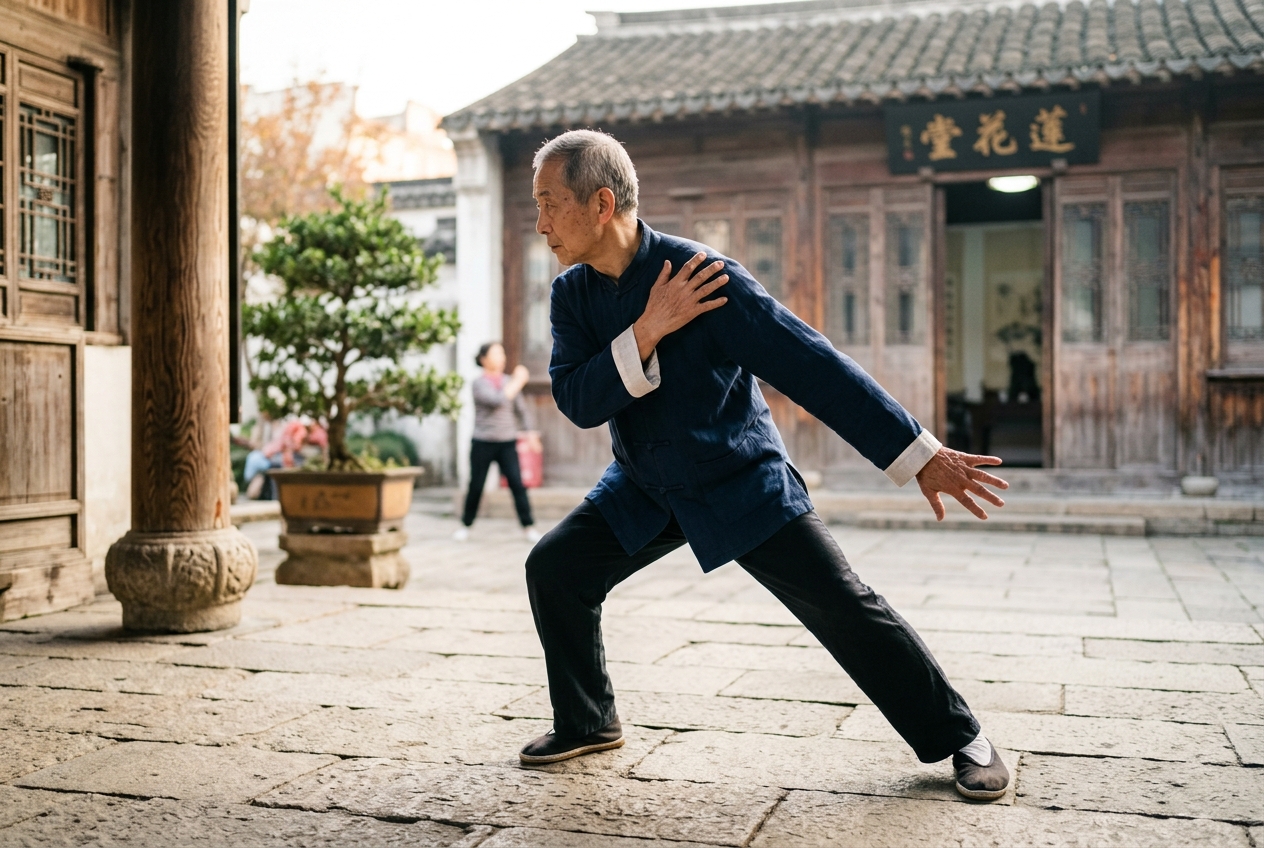
Recognizing that enduring structural integrity requires active motor re-education, Dr. Zhuang spent over a decade analyzing ancient systems of Daoyin (the classical Chinese art of guiding breath and stretching the body documented as early as the 2nd century BCE Mawangdui silk manuscripts), the tendon-transforming exercises of the Yijinjing, and traditional martial arts body mechanics. He systematically cross-referenced these ancient postures with modern joint kinematics, skeletal anatomy, and soft-tissue traumatology.
The resulting synthesis, formally codified between 1974 and 1979 as documented in clinical retrospectives available through NCBI PubMed, organized therapeutic exercise into a modular, eighteen-posture protocol divided into three distinct anatomical tiers of six movements each: 1. The First Tier: Mobilizing the neck, upper back, and shoulder girdle. 2. The Second Tier: Decompressing the lumbar spine, sacrum, and iliopsoas complex. 3. The Third Tier: Restoring articulation, alignment, and load distribution throughout the hips, knees, ankles, and lower extremities.
By establishing standardized biomechanical vectors, continuous diaphragmatic respiration, and precise ranges of motion, Dr. Zhuang transformed intuitive folk healing into an empirically reproducible physical medicine system. The practice quickly spread from Shanghai factories to municipal clinics, gaining formal recognition from the Chinese Ministry of Health and international health bodies studying integrative health frameworks, including initiatives later cataloged by the World Health Organization Traditional Medicine global database. Today, clinical researchers and somatic practitioners worldwide, supported by organizations such as the National Qigong Association, recognize the historical genius of Lian Gong as a bridge between ancient somatic wisdom and modern musculoskeletal rehabilitation.
Step-by-Step Clinical Practice Guide
The foundational set of Lian Gong Shi Ba Fa requires no equipment, minimal space, and an uncompromising dedication to slow, deliberate somatic awareness. Perform each movement in a continuous, unhurried cadence where the velocity remains constant from initiation to terminal extension, avoiding ballistic momentum or sudden stops.
================================================================================
                    CORE BIOMECHANICAL ALIGNMENT METRICS
================================================================================
  1. BASE OF SUPPORT   : Feet parallel, tripod contact (heel, 1st & 5th metatarsals)
  2. KNEE ANGLE        : Micro-flexed (3–5°), tracking strictly over second toe
  3. PELVIC TILT       : Neutral (slight posterior tuck, flattening lumbar lordosis)
  4. AXIAL ELONGATION  : Crown (Baihui) elevated, chin retracted, sacrum grounded
  5. BREATH VECTOR     : Continuous nasal-diaphragmatic cycle (4s in / 6s out)
================================================================================
Establishing the Neutral Orthopedic Stance (Wu Ji)
Before initiating any movement, establish the universal structural baseline: - Stand upright with your medial malleoli (inner ankle bones) separated by the exact width of your hip joints. - Verify that the lateral borders of your feet are completely parallel to one another; do not splay the toes outward. - Distribute your body weight evenly across three structural pillars on each foot: the calcaneus (heel), the first metatarsal head (ball of the foot), and the fifth metatarsal head (outer ball). - Micro-flex the knee joints by two to three degrees, releasing tension from the popliteal fossae behind the knees. - Drop your sacrum straight down toward the floor as if suspending a plumb line from your coccyx, subtly engaging the lower abdominal wall to prevent anterior pelvic tilt and hyper-lordosis. - Elevate the vertex of your cranium (Baihui, GV-20) toward the sky while gently drawing your chin inward to lengthen the suboccipital region of the cervical spine. - Rest the tip of your tongue softly against the hard palate just behind your upper incisors, relaxing the masseter muscles of the jaw.
Protocol I: Decompressing the Cervical Spine and Scapulothoracic Joint
Exercise 1: Neck Rotation and Gaze (Zuo You Wang Fa)
Target Anatomy: Cervical vertebrae C1–C7, sternocleidomastoid, levator scapulae, upper trapezius.
- Initiation: From the neutral stance, place both hands comfortably on your hips, resting the thumbs along the posterior lumbar musculature and fingers along the anterior iliac crests.
- Inhalation (4 Seconds): Maintain an elongated vertical spine while slowly rotating your head to the left over a four-second span. Do not elevate the shoulders or tilt the chin upward. Direct your gaze over your left shoulder toward an imaginary point on the horizon behind you, gently bringing the cervical spine to its comfortable end-range of rotation.
- Terminal Traction: At the end of the rotation, actively depress your right shoulder downward to produce an eccentric fascial stretch along the contralateral sternocleidomastoid and upper trapezius.
- Exhalation (6 Seconds): Over six slow seconds, rotate the head smoothly back to the neutral midline, feeling the release of cervical compression.
- Repetition: Repeat the sequence to the right side, coordinating the movement with an identical inhalation and exhalation rhythm. Perform four complete alternating cycles.
Common Beginner Error: Tilting the head backward or leading the turn with an elevated chin, which jams the posterior cervical facet joints.
Correction: Keep the horizontal plane of the jaw strictly parallel to the floor throughout the entire rotational arc.
Exercise 2: Expanding the Chest and Mobilizing the Scapulae (Kai Kuo Xiong Huai)
Target Anatomy: Pectoralis major and minor, rhomboids, middle trapezius, anterior deltoids, intercostals.
- Initiation: Stand in the neutral stance with arms resting at your sides.
- Inhalation (4 Seconds): Slowly raise both forearms across the front of your chest until your elbows are at shoulder height, forming relaxed, hollow fists facing inward toward your sternum. As the inhalation peaks, draw both elbows and fists outward and backward in a broad horizontal arc. Retract and depress the scapulae, bringing the medial borders of the shoulder blades toward the thoracic spine while expanding the anterior ribcage.
- Terminal Traction: Lift the sternum upward at a 45-degree angle without arching the lower back, feeling a deep, broad fascial stretch across the pectoral fascia and anterior chest wall.
- Exhalation (6 Seconds): Smoothly reverse the trajectory, bringing the arms forward across the chest, gently rounding the upper thoracic spine (protraction of the scapulae), and releasing the muscular contraction as you return to neutral.
- Repetition: Complete four to six repetitions with fluid, unbroken transitions.
Common Beginner Error: Flaring the lower ribs outward and hyperextending the lumbar spine to simulate chest expansion.
Correction: Anchor the pelvis and maintain light engagement of the transversus abdominis; allow the movement to isolate purely within the thoracic spine and scapulothoracic gliding planes.
Protocol II: Rehabilitating Lumbar, Thoracic, and Sacroiliac Alignment
Exercise 3: Torso Rotation with Extended Horizon (Zhuan Yao Wang Zhang)
Target Anatomy: Thoracolumbar fascia, erector spinae, internal/external obliques, quadratus lumborum, sacroiliac joints.
Movement Phase: Inhale & Rotate Torso
Left Hand: Pushes Upward-Outward at Eye Level (Contralateral Spiral)
Right Hand: Anchors at Hip/Sacrum
Spine: True Axial Rotation without Pelvic Sway
Cadence: 4-second expansion / 1-second isometric hold / 6-second return
- Initiation: Widen your stance slightly to 1.5 times shoulder-width, ensuring feet remain parallel.
- Inhalation (4 Seconds): Begin a rotational spiral initiating from the pelvic waist (Dai Mai). Rotate the torso 90 degrees to the left. As your torso turns, extend your left arm upward and diagonally outward, pressing the heel of the left palm outward with fingers pointing upward at eye level. Simultaneously, rest the back of your right hand against the right posterior iliac crest. Turn your head to fix your gaze intently on the raised left palm.
- Terminal Traction: Anchor the opposite (right) heel firmly into the ground, creating a functional diagonal myofascial sling from the right calcaneus, across the right gluteus maximus, through the thoracolumbar fascia, to the left latissimus dorsi and left palm.
- Exhalation (6 Seconds): Unwind the spiral from the ground up, retracting the left arm and returning the torso smoothly to the front-facing neutral position.
- Repetition: Alternate immediately to the right side. Perform four full alternating cycles.
Common Beginner Error: Allowing the contralateral knee to collapse inward during rotation, destabilizing the medial collateral ligament.
Correction: Maintain active abduction and external rotation torque at both hip joints, ensuring the knees remain anchored over the second toes throughout the torso rotation.
Exercise 4: Sagittal Spinal Flexion and Extension (Fu Yang Yun Dong)
Target Anatomy: Posterior superficial myofascial line, hamstrings, gastrocnemius, erector spinae, anterior longitudinal ligament.
- Initiation: Return to hip-width stance. Interlace your fingers in front of your lower abdomen with palms facing upward.
- Inhalation (4 Seconds): Raise the interlaced palms along the midline of the body past the chest, rotating the wrists outward at throat level to push the palms vertically toward the sky. Extend the arms fully, gently looking upward toward the backs of your hands to induce full-body axial traction from heels to palms.
- Exhalation (6 Seconds): Unclasp the hands and hinge forward strictly from the hip creases (Kua), maintaining an elongated, flat back during the first half of descent. As you pass horizontal, allow the spine to gently curve into natural flexion. Reach down toward your feet, guiding the fingertips toward the dorsum of the feet or ankles according to individual hamstring compliance.
- Ascent / Inhalation (4 Seconds): Engage the gluteal muscles and hamstrings, unrolling the spine vertebra by vertebra from the sacrum upward to the cervical spine, returning to the erect posture with the head arriving last.
- Repetition: Complete four to six cycles, continuously syncing movement with the breath.
Protocol III: Lower-Extremity Articulation, Pelvic Integrity, and Kinetic Chains
Exercise 5: The Archer Bow Stance for Hip Capsule Mobility (Gong Bu Zhan Chi)
Target Anatomy: Iliopsoas, tensor fasciae latae, adductor magnus, gluteus medius, gastrocnemius-soleus complex.
- Initiation: From neutral stance, step your left foot laterally into a wide bow-and-arrow stance (Gong Bu). Turn the left foot 90 degrees outward while keeping the right foot angled inward at roughly 15 degrees.
- Inhalation (4 Seconds): Flex the left knee to approximately 90 degrees, ensuring the patella tracks directly over the second toe and does not translate anterior to the left malleolus. Keep the right trailing leg completely straight, driving the lateral border of the right heel firmly into the floor. Simultaneously, extend both arms outward horizontally at shoulder height, left arm reaching over the front knee and right arm reaching backward over the trailing leg.
- Terminal Traction: Sink the pelvis vertically downward while drawing the pubic bone slightly upward. This loads the anterior hip capsule of the trailing leg, inducing an intense elongation of the right iliopsoas and femoral nerve sheath.
- Exhalation (6 Seconds): Push through the left heel to straighten the front leg, step the left foot back to center, and lower the arms smoothly to your sides.
- Repetition: Alternate to the right side. Execute four balanced repetitions per side.
Somatic Biofeedback: Interpreting Sensation in Practice
As you execute these eighteen postures, your sensory nervous system will register distinct somatic signals. Differentiating beneficial therapeutic adaptations from harmful tissue strain is essential for safe independent practice.
| Somatic Sensation | Physiological & Energetic Translation | Clinical Meaning & Action |
|---|---|---|
| Deep Radiant Warmth | Local microvascular vasodilation; capillary bed perfusion driven by parasympathetic tone. | Optimal Adaptation: Indicates release of sympathetic arteriolar constriction; continue smooth cadence. |
| Pithy Heaviness (Chen) | Gravitational structural grounding; skeletal load transfer bypassing muscular tension. | Optimal Adaptation: Confirms myofascial recruitment is yielding to bone-stacking mechanics. |
| Fine Distal Tingling | Deqi phenomenon; peripheral neurovascular decompression and uninhibited cutaneous nerve conduction. | Optimal Adaptation: Signifies restoration of axonal transport and interstitial fluid circulation. |
| Sharp, Focal Pinching | Structural impingement; articular cartilage compression or facet joint jamming. | Pathological Sign: Immediately reduce range of motion by 20–30%; re-verify neutral joint alignment. |
| Tremulous Shivering | Fast-twitch muscle fiber fatigue or neuromuscular rate-coding reset. | Sub-optimal Adaptation: Slow the movement cadence; reduce depth of stance until stability returns. |
The Biomechanical and Neuromuscular Science
To understand why Lian Gong Shi Ba Fa produces profound clinical outcomes in patients with chronic spinal and joint degeneration, one must examine its mechanics through contemporary orthopedic physical medicine, fascial histology, and neurophysiology.
1. Slow-Velocity Myofascial Traction and Viscoelastic Creep
Human connective tissue—encompassing deep muscular fascia, aponeuroses, and tendons—is inherently viscoelastic. When subjected to rapid, ballistic stretching, the stretch reflex (mediated by muscle spindle primary afferents) triggers protective contractile resistance to prevent tissue tearing. Lian Gong avoids this reflex entirely by utilizing an unhurried, four-to-six-second movement cadence.
This sustained, low-load traction engages the mechanical phenomenon known as viscoelastic creep: the gradual, time-dependent elongation of collagen fibers under constant tensile stress. Furthermore, slow movements alter the ground substance within the fascial matrix from a viscous, dehydrated gel state to a fluid sol state (thixotropy). This permits adjacent myofascial planes—such as the sliding interface between the latissimus dorsi, thoracolumbar fascia, and gluteus maximus—to glide frictionlessly against one another, breaking up micro-adhesions formed during prolonged sedentary immobility.
2. Synovial Fluid Hydrodynamics and Cartilage Imbibition
Articular cartilage covering the ends of synovial joints (such as the glenohumeral, intervertebral facet, and patellofemoral joints) is entirely avascular. It possesses no direct capillary blood supply and relies exclusively on the mechanical diffusion of synovial fluid for nutrient delivery and metabolic waste clearance.
Under static postures, cartilage experiences sustained focal compression, starving compressed chondrocytes of oxygen and glucose. The rotational, multi-planar motions of Lian Gong act as an alternating compression-decompression pump. As a joint moves through its complete, non-weight-bearing rotational arc, fluid is squeezed out of the articular cartilage sponge; as the joint unloads at end-range, nutrient-rich synovial fluid is drawn back into the matrix. This process, termed synovial imbibition, halts degenerative cartilage fraying and promotes joint longevity.
3. Reciprocal Inhibition and Neuromuscular Reset
Chronic postural distortions, such as Upper Crossed Syndrome (hypertonic pectorals and suboccipitals paired with inhibited deep neck flexors and rhomboids), are governed by faulty neurological firing patterns. Lian Gong leverages Sherrington’s Law of Reciprocal Innervation, which dictates that when an agonist muscle group receives an excitatory motor command to contract, its opposing antagonist muscle group is automatically sent an inhibitory signal via spinal interneurons to relax.
In movements such as Expanding the Chest, the active, conscious contraction of the rhomboids and posterior deltoids sends immediate inhibitory volleys to the hypertonic pectoralis major and minor. This releases chronic anterior chest tightness far more effectively than passive stretching alone, permanently reprogramming the resting baseline length of postural muscles.
4. The Jingjin and Anatomy Trains: Fascial Meridian Continuity
Classical Chinese medicine conceptualizes movement rehabilitation through the twelve Jingjin (Sinew Meridians)—pathways of continuous structural tension that wrap the skeleton from the distal extremities to the trunk. Modern fascial researchers, notably Thomas Myers in his Anatomy Trains paradigm, have validated this continuous architectural model through anatomical dissection.
Lian Gong postures do not isolate single muscles; they trace these unbroken myofascial meridians. For example, Torso Rotation with Extended Horizon tensions the precise anatomical trajectory of the Spiral Line (incorporating the splenius capitis, contralateral rhomboids, serratus anterior, external obliques, and tensor fasciae latae down to the fibularis longus). By restoring balanced biotensegrity along the entire kinetic line, localized pathology at vulnerable transition zones—such as the L5-S1 lumbar junction or the C5-C6 cervical segment—is completely unloaded.
5. Autonomic Regulation, Diaphragmatic Excursion, and Vagal Tone
Lian Gong integrates continuous nasal-diaphragmatic respiration with every movement phase. Descent of the respiratory diaphragm increases intra-abdominal pressure (IAP), which structurally splints the anterior surface of the lumbar spine, protecting intervertebral discs during rotation and flexion.
Simultaneously, prolonged exhalation (ratio of 4 seconds inhalation to 6 seconds exhalation) stimulates the pulmonary stretch receptors and cardiac vagal efferents. This augments respiratory sinus arrhythmia (RSA), increases heart rate variability (HRV), and downregulates the sympathetic fight-or-flight axis. As systemic sympathetic tone drops, global resting muscle spindle sensitivity decreases, dissolving stress-induced somatic hypertonicity across the trapezial and paracervical muscle beds.
Clinical Applications in Modern Somatic Medicine
In modern clinical practice, the therapeutic mechanisms of Lian Gong Shi Ba Fa provide direct, conservative interventions for prevalent musculoskeletal syndromes:
1. Cervical Spondylosis and Forward Head Posture ("Tech Neck")
Prolonged screen use forces the cranium into anterior translation, dramatically increasing the effective gravitational load of the head upon the cervical spine (shifting from approximately 5 kg in neutral alignment to over 27 kg at a 60-degree forward tilt). This causes severe strain on the posterior ligamentous complex, levator scapulae hypertonicity, and suboccipital nerve compression. - Lian Gong Application: Section I movements systematically restore axial cervical elongation (Baihui suspension), re-educate the deep longus colli flexors, and mobilize restricted C1-C2 atlantoaxial rotation without compressive facet loading.
2. Adhesive Capsulitis (Frozen Shoulder) and Scapular Dyskinesis
Glenohumeral hypomobility frequently stems from chronic inflammation and adhesion of the axillary fold of the joint capsule, accompanied by loss of coordinated scapulothoracic rhythm. - Lian Gong Application: Movements such as Expanding the Chest and Pushing Up the Heavens gently tension the inferior and anterior joint capsule through varying planes of elevation, abduction, and external rotation. This stimulates lubricating hyaluronan synthesis while retraining the serratus anterior and lower trapezius force couple.
3. Chronic Lumbar Facet Syndrome and Sacroiliac Dysfunction
Sedentary sitting places the pelvis in persistent posterior tilt, deconditioning the multifidus and gluteal complexes while shortening the psoas major, resulting in shear stress across the lumbosacral junction. - Lian Gong Application: Section II and III postures utilize hip-hinge mechanics (Kua folding) and multi-planar pelvic rotations to decompress the L4-L5 and L5-S1 foramina, mobilize the sacroiliac joint through safe physiological ranges, and restore reciprocal length-tension relationships across the anterior and posterior hip musculature.
Today’s Practice Commitment: The 7-Minute Daily Protocol
To transform theoretical biomechanical knowledge into tangible physiological change, consistency of practice takes precedence over duration. Commit to executing this foundational seven-minute decompression ritual every morning before your first cup of coffee or at midday when desk fatigue peaks:
Observe your somatic state immediately following completion. Note the subjective sensation of warmth spreading across the shoulder blades, the spontaneous deepening of your basal breathing pattern, the lightening of structural load across the lumbar spine, and an acute mental clarity induced by balanced autonomic tone. Through seven minutes of conscious orthopedic movement each day, you reclaim active stewardship over your structural health, embodying the enduring clinical insight of Dr. Zhuang Yuanming: that the body’s most potent medicine is the precision of its own mindful movement.