Jing Jin Sinew Meridians: Myofascial Kinetic Chains, Tendinomuscular Elongation, and Elastic Recoil Dynamics in Classical Daoyin
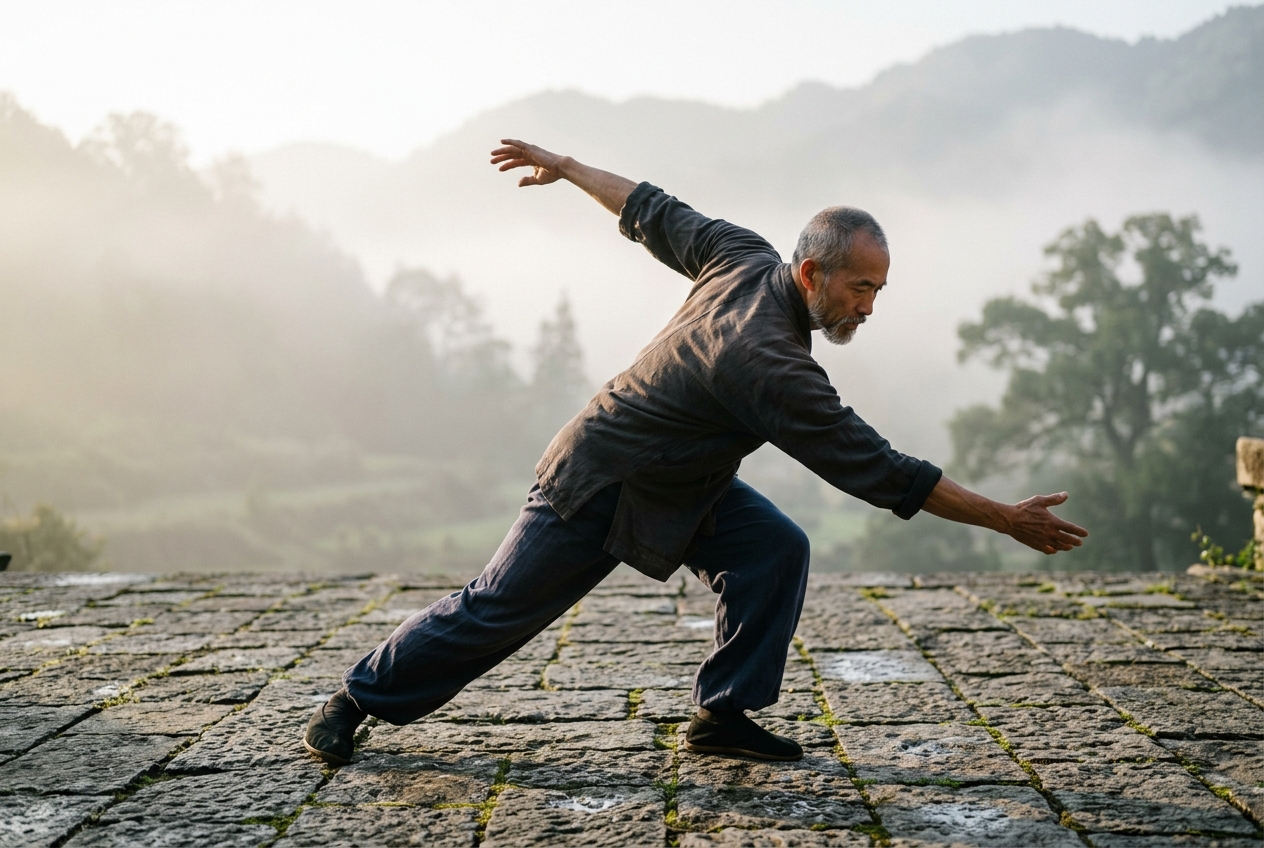
In the formal lexicon of classical Chinese medicine, these pathways are designated as the Twelve Jing Jin (經筋)—variously translated as the Sinew Meridians, Tendinomuscular Channels, or Myofascial Conduits. First systematically codified in Chapter 13 of the foundational medical treatise, the Huangdi Neijing Lingshu (The Yellow Emperor’s Classic of Medicine: Spiritual Pivot, circa 1st century BCE), the Jing Jin represent an anatomical and physiological framework distinct from the twelve primary vascular meridians (Jing Mai).
Where the primary Jing Mai course deeply into the visceral organs (Zang-Fu) and exhibit bidirectional energy flow, the sinew channels are explicitly centripetal: they invariably originate at the distal extremities—the Jing-Well points at the tips of the toes and fingers—and course inward and upward toward the major joints, trunk, spine, and cranium.
The Jing Jin do not penetrate the interior visceral organs; instead, they broaden into wide myofascial sheets, binding (Jie, 結) securely into bony prominences, retinacula, and articular capsules. Functionally, they govern structural locomotion, biomechanical articulation, postural equilibrium, and the dynamic distribution of Wei Qi (defensive energy)—the body’s protective, thermoregulatory, and immunologically active energetic layer that courses through the superficial fascial matrix.
Step-by-Step Practice Guide: The Three-Plane Sinew Daoyin
The following three-stage Daoyin protocol systematically unbinds the primary dorsal, lateral, and deep anterior sinew tracts. Practice these movements in sequence, maintaining smooth, unhurried nasal respiration.
1. Unfurling the Dorsal Sinew (Foot Taiyang / Superficial Back Line)
The Foot Taiyang sinew channel originates at the fifth toe, binds at the heel, ascends the Achilles tendon and calves, knots at the popliteal fossa of the knee, traverses the gluteals and erector spinae, ascends the neck, and anchors into the occiput before capping the skull at the cranial aponeurosis.
- Setup: Stand with your feet parallel, spaced precisely hip-width apart. Rest your hands on your lower abdomen (Xia Dantian). Unlock your knees so they remain buoyant, never hyperextended.
- Inhalation (Pre-tensioning): Inhale slowly through your nose over four counts. Press your toes and heels gently into the floor, sensing the activation of your plantar fascia. As the breath fills your lower belly and lower back, lengthen the crown of your head upward toward the ceiling, creating axial elongation through your cervical vertebrae.
- Exhalation (Articulation): Exhale through your nose over six counts. Tuck your chin slightly toward your throat, and slowly roll your spine downward, vertebra by vertebra, beginning at the atlas (C1) and moving through the thoracic and lumbar segments. Allow your arms to hang like heavy ropes. Keep your knees bent at approximately 15 degrees to prevent hamstring strain and maintain pelvic mobility.
- The Uncoiling: At the bottom of your comfortable range—whether your hands reach your shins, ankles, or the floor—pause for two seconds. Inhale deeply into the posterior ribs and thoracolumbar fascia. On the subsequent exhale, press firmly through the bubbling spring point (Yongquan, Kidney 1, located in the depression behind the ball of the foot) and unroll your spine upward from the sacrum to the crown, re-stacking each vertebra until you return to vertical standing.
- Repetitions: Perform six smooth cycles.
2. The Helical Dragon Spiral (Foot Shaoyang / Lateral & Spiral Lines)
The Foot Shaoyang sinew channel originates at the fourth toe, binds at the lateral malleolus of the ankle, ascends the fibular tract and iliotibial band, traverses the lateral flanks and ribs, crosses the clavicular region, and ascends around the ear to the temple.
- Setup: Assume a stance slightly wider than shoulder-width. Rest your left hand behind your back on your sacrum, palm facing outward. Extend your right arm out to the side at shoulder height, palm facing forward.
- Inhalation (Loading the Spiral): Inhale into your lower abdomen while simultaneously shifting 70% of your body weight onto your left leg. Externally rotate your right hip and spiral your right arm outward so the palm turns upward and backward, opening the chest and intercostal spaces.
- Exhalation (Releasing the Torque): Exhale smoothly as you initiate movement from your left foot: drive through the ground, turn your hips (Kua) 45 degrees to the left, and sweep your right arm across your body in a rising, helical arc. As your hand reaches chest level, rotate your right wrist internally so the fingertips lead the spiral toward the upper left quadrant.
- Somatic Checkpoint: Feel the continuous line of tensile transmission originating at the lateral edge of the right foot, traveling up the lateral thigh, crossing the abdominal wall diagonally, and extending through the right shoulder, forearm, and little finger.
- Repetitions: Execute eight alternating repetitions per side.
3. Deep Core Expansion (Foot Taiyin & Shaoyin / Deep Front Line)
The deep Yin sinew channels originate at the big toe and sole of the foot, ascend the medial compartment of the leg, bind at the inner knee and pubic ramus, envelop the pelvic floor, blend into the psoas and respiratory diaphragm, and ascend through the thoracic cavity to the deep structures of the throat and tongue.
- Setup: Stand with feet shoulder-width apart, toes turned outward roughly 15 degrees. Place both palms face up in front of your navel, elbows soft.
- Inhalation (Core Lift): Inhale deeply into your pelvic floor and lower back. As you inhale, draw your hands upward along the midline of your torso to the center of your chest (Shanzhong, Ren 17). Simultaneously, lightly engage the arches of your feet and draw the pelvic floor (Huiyin, Ren 1) subtly upward without tensing your buttocks.
- Exhalation (Rooting and Suspension): Exhale as you turn your palms downward and press them slowly toward the earth until your wrists reach hip height. Simultaneously, sit down two inches into your hips while keeping your spine vertical. Imagine your pelvic floor sinking downward while your cranial vertex (Baihui, Du 20) remains suspended from above by a golden thread.
- Repetitions: Perform nine cycles, cultivating an internal sensation of vertical biotensegrity between your feet and your skull.
+-------------------------------------------------------------------------+
|                      COMMON ERRORS & CORRECTIONS                        |
+-------------------------------------------------------------------------+
| Error: Locking the knees and compressing the lumbar spine.             |
| Correction: Maintain a micro-bend in the knees; allow the pelvis to hang|
| freely like a heavy plumb line suspended from the sacrum.               |
|                                                                         |
| Error: Lifting the shoulders toward the ears during arm extension.      |
| Correction: Relax the upper trapezius; initiate all arm movements from   |
| the latissimus dorsi, thoracolumbar fascia, and lower dantian.          |
|                                                                         |
| Error: Straining or holding the breath during torsional load.           |
| Correction: Keep respiration continuous and diaphragmatic; match the    |
| movement velocity strictly to the natural cadence of your breath.       |
+-------------------------------------------------------------------------+
During these protocols, you will encounter distinct somatic markers classically categorized in Chinese medicine:
- Warmth (Re, 熱): A gentle, radiating thermal sensation across the skin and deep tissues, indicating vasodilation and increased microvascular perfusion in the connective tissue beds.
- Tingling (Ma, 麻): An effervescent, buzzing sensation along the extremities, representing the discharge of peripheral neural compression and the flow of bioelectric currents across hydrated fascial sheaths.
- Expansion (Zhang, 脹): A feeling of hydrostatic fullness or plumper internal volume, stemming from fluid redistribution within the interstitial matrix.
- Heaviness (Zhong, 重): A sensation of grounded structural mass, reflecting authentic muscular relaxation and effective skeletal load-bearing.
Why It Works — The Body Science
Modern orthopedic and physiological research provides a compelling explanatory framework for the classical mechanics of the Jing Jin. In contemporary biomechanics, the body is increasingly understood through the paradigm of biotensegrity—a structural principle wherein discontinuous rigid compression elements (the bones) are suspended within a continuous, tensioned network of elastic cables (the myofascial matrix).
When manual therapist Thomas Myers delineated myofascial meridians in his landmark work Anatomy Trains, he mapped continuity lines across the human body that correspond closely with the trajectories outlined in Lingshu Chapter 13:
+--------------------------------------------------------------------------+
|            FASCIAL MERIDIAN / JING JIN CORRELATION MATRIX                |
+--------------------------------------------------------------------------+
| Classical Sinew Channel   | Myers' Fascial Meridian | Anatomical Structures Involved      |
|---------------------------+-------------------------+-------------------------------------|
| Foot Taiyang (Urinary Bl) | Superficial Back Line   | Plantar fascia, Achilles,           |
|                           | (SBL)                   | gastrocnemius, hamstrings, sacrotuberous|
|                           |                         | ligament, erectors, galea           |
|                           |                         | aponeurotica.                       |
|---------------------------+-------------------------+-------------------------------------|
| Foot Yangming (Stomach)   | Superficial Front Line  | Tibialis anterior, patellar         |
|                           | (SFL)                   | tendon, rectus femoris, rectus      |
|                           |                         | abdominis, sternocleidomastoid.     |
|---------------------------+-------------------------+-------------------------------------|
| Foot Shaoyang (Gallblddr) | Lateral & Spiral Lines  | Peroneals, iliotibial band (ITB),   |
|                           | (LL / SL)               | tensor fasciae latae, obliques,     |
|                           |                         | intercostals, splenius capitis.     |
|---------------------------+-------------------------+-------------------------------------|
| Foot Taiyin / Shaoyin     | Deep Front Line (DFL)   | Tibialis posterior, popliteus,      |
| (Spleen / Kidney)         |                         | adductors, pelvic floor, psoas,     |
|                           |                         | diaphragm, pericardium, scalenes.   |
+--------------------------------------------------------------------------+
At the microscopic scale, connective tissue consists of collagen fibril bundles embedded within an amorphous, water-binding ground substance rich in glycosaminoglycans and hyaluronic acid. When sedentary habits or chronic psychological stress cause this tissue to become dehydrated and stagnant, adjacent fascial layers develop pathological cross-links and densified adhesions—a state classically diagnosed as Bi Syndrome (痹症, painful obstruction and energetic stagnation).
Daoyin exercises utilize dynamic rotational torque (Chan Si Jin, 纏絲勁, or silk-reeling energy) and isometric pre-stretching to remediate this dysfunction through three physiological mechanisms:
- Thixotropic Shear and Hyaluronan Mobilization: Rotational movement subjects the fascial sheaths to multi-directional shear stresses. This mechanical action alters the viscosity of the ground substance from a thick gel to a fluid sol, breaking down restrictive cross-links and restoring low-friction gliding between sliding fascial planes.
- Mechanotransduction and Piezoelectricity: When collagen fibers undergo tensile elongation and helical twisting, mechanical forces deform the cellular membrane of embedded fibroblasts. Through mechanotransduction, these fibroblasts upregulate the synthesis of healthy collagen and elastin. Furthermore, because collagen is a semi-crystalline macromolecule, mechanical deformation generates tiny electric voltages via the piezoelectric effect. These streaming electrical potentials propagate along connective tissue pathways, providing a bioelectric foundation for what classical masters described as the conduction of Qi through the sinew lattice.
- Autonomic Recalibration and Fascial Tone: The fascial system is innervated with millions of sensory nerve endings, including Ruffini corpuscles and interstitial mechanoreceptors. Slow, diaphragmatic breathing coupled with fluid postural transitions downregulates the sympathetic nervous system and activates the ventral vagal complex of the parasympathetic branch. This shift reduces baseline resting myofascial tone, preventing chronic protective holding patterns and optimizing whole-body heart rate variability (HRV).
For further clinical context on these mechanisms, explore research hosted by the National Institutes of Health (NCBI PubMed) and current publications from the World Health Organization on Traditional Medicine.
Classical Lineage & Context
The systematic cultivation of the sinew channels is among the oldest lineages of therapeutic somatic science in human history. Long before the standardization of rigid acupuncture point charts, Neolithic and Bronze Age Chinese movement practitioners practiced Daoyin (導引)—which translates literally as "guiding the Qi and stretching the sinews."
In 1973, archaeologists excavating the Mawangdui Han Dynasty Tombs in Hunan province (dating to 168 BCE) discovered the famous Daoyin Tu—a silk manuscript containing 44 illustrated figures engaged in dynamic postures. These figures depict people stretching, bending, and twisting their limbs to emulate the natural movements of animals: birds unfurling their wings, dragons coiling their spines, and bears expanding their torsos.
During the Eastern Han dynasty, the legendary physician Hua Tuo synthesized these early movement traditions into the Wuqinxi (Five Animal Frolics), teaching that physical stagnation was the root of disease, and that dynamic, spiraling movement was the ultimate preventative medicine:
"The bodily frame requires labor and motion, yet it must not be driven to exhaustion. Movement shakes off the turbidity of grain and water, ensures the free circulation of blood through the vessels, and prevents the onset of disease—much as a doorway hinge never rots because it is constantly swinging."
By the late medieval era, these biomechanical insights coalesced into the celebrated Yijin Jing (易筋經, Sinew Transformation Classic or Muscle/Tendon Changing Classic), preserved within both Buddhist Shaolin traditions and Daoist internal alchemical (Neidan) circles. The foundational premise of the Yijin Jing was revolutionary: the human physical structure is not fixed or immutable. Through methodical, helical Daoyin practice, brittle tendons can be rendered resilient as tempered steel, tight fascial sheaths can be transformed into elastic conduits of vitality, and the entire human frame can be reorganized into an integrated, self-healing biotensegrity structure.
To explore this living lineage today, consult resources preserved by the National Qigong Association.
Somatic Checkpoints for Structural Alignment
To ensure that your Daoyin practice decompresses joints rather than creating friction, use these somatic checkpoints to calibrate your alignment:
- The Crown Suspension (Baihui, Du 20): Keep the highest point of your skull gently buoyant. Do not tilt your head backward; subtly retract your chin toward your cervical spine to decompress the suboccipital triangle.
- Sinking the Shoulders and Elbows (Chen Juan Zhui Zhou): Allow your scapulae to glide down your ribcage. Never lift your shoulders toward your ears; maintain an open, rounded space in both axillae (armpits) as though holding a soft bird’s egg under each arm.
- Relaxing the Inguinal Fold (Song Kua): Avoid tucking your pelvis forward aggressively or arching your lower back into anterior pelvic tilt. Instead, release your hip creases (Kua) and allow your sacrum to settle downward naturally, decompressing the L5-S1 junction.
- The Triangular Foot Foundation: Distribute your body weight evenly across three structural pillars on the sole of each foot: the base of the big toe (first metatarsal head), the base of the little toe (fifth metatarsal head), and the center of the heel calcaneus. Keep the arch light and responsive.
Today's Practice Commitment
To experience the restorative benefits of sinew channel cultivation firsthand, commit to a simple seven-day micro-practice:
The Seven-Minute Morning Sinew Awakening:
+--------------------------------------------------------------------------+
|                  7-MINUTE MORNING AWAKENING SCHEDULE                     |
+--------------------------------------------------------------------------+
| Minute 0:00 - 1:00 | Natural Stance & Diaphragmatic Breath Setup         |
| Minute 1:00 - 3:00 | Dorsal Unfurling (Foot Taiyang / 4 repetitions)     |
| Minute 3:00 - 5:00 | Dragon Spiral (Foot Shaoyang / 4 reps per side)     |
| Minute 5:00 - 6:30 | Deep Core Expansion (Foot Taiyin / 4 repetitions)   |
| Minute 6:30 - 7:00 | Quiet Standing Integration (Zhan Zhuang)            |
+--------------------------------------------------------------------------+
Tomorrow morning, before having your first coffee or checking your phone, stand beside your bed and perform this sequence: 1. Complete four slow cycles of the Dorsal Unfurling to release sleep-induced spinal compression. 2. Follow with four cycles per side of the Helical Dragon Spiral to open your lateral ribs and hips. 3. Finish with four cycles of Deep Core Expansion, standing in quiet stillness for thirty seconds afterward.
Notice how your body moves throughout the rest of your day—the lightness in your gait, the ease in your spine, and the renewed sense of grounded vitality circulating through your refreshed connective tissue matrix.