Herbal Decoction and Administration (Jian Fu Fa) Extraction Dynamics: Governing Pre-Decocting, Post-Adding, Thermal Ingestion Vectors, and Chronopharmacology in Traditional Chinese Medicine
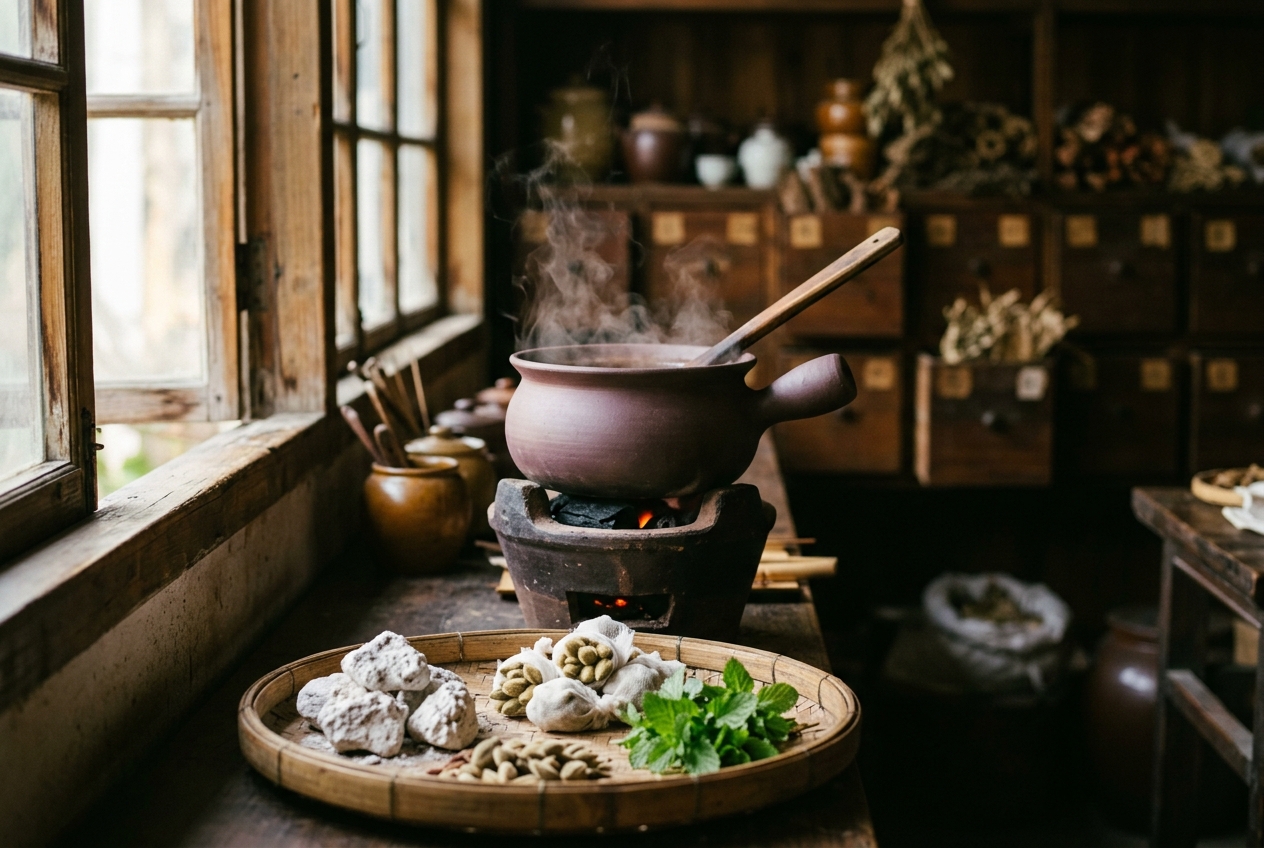
1. Classical Canon Foundations & The Epistemology of Jiān Fú Fǎ
In classical Chinese pharmacology (Zhongyao Xue, 中藥學), a medicinal formula is never conceptualized merely as a static aggregation of crude botanicals, minerals, and zoological substances. Rather, it is understood as a dynamic, reactive chemical system whose ultimate therapeutic phenotype is dictated by the physics of extraction and the chronobiology of delivery. This alchemical transformation is encapsulated in the ancient canon of Herbal Decoction and Administration (Jiān Fú Fǎ, 煎服法). As the Qing Dynasty physician Xu Dachun (徐大椿, 1693–1771) famously declared in his Yixue Yuanliu Lun (醫學源流論, On the Origin and Development of Medicine):
"Even if a prescription is chosen with absolute diagnostic precision, if the method of decoction is lost, or if the rules of administration are violated, the medicine will fail to cure the disease, and may instead engender new catastrophes."
The systematic codification of decoction dynamics traces back to the Han Dynasty foundational text, the Shanghan Lun (Treatise on Cold Damage Diseases, c. 220 CE) by Zhang Zhongjing (張仲景). Zhang did not merely catalog herbal combinations; he formulated exact thermodynamic recipes specifying water volumes (measured in sheng 升), targeted reduction volumes, heating durations, foam skimming, multi-stage decoction cycles, and thermal vectors of ingestion. For example, in the preparation of Guizhi Tang (Cinnamon Twig Decoction), Zhang specifically instructed gentle simmering over low heat, post-decoction administration of warm rice porridge (re xi zhou, 熱稀粥) to augment gastric fluids (wei qi), and deliberate thermal insulation to induce a mild, continuous diaphoresis (wei wei fa han, 微微發汗) without precipitating electrolyte or fluid exhaustion.
Centuries later, Li Shizhen (李時珍) expanded this mechanistic rigor in the Ming Dynasty masterpiece Bencao Gangmu (Compendium of Materia Medica, 1596 CE). Li classified decoction dynamics according to solvent purity (distinguishing rain water, spring water, and well water), vessel metallurgy, and combustion fuel sources (such as charcoal, mulberry wood, or rice straw), recognizing that volatile terpenes, phenolic glycosides, and heavy mineral matrices require fundamentally disparate thermal and solvent environments to achieve therapeutic bioavailability.
Modern pharmacokinetic investigations archived through the National Center for Biotechnology Information (NCBI) have validated these classical observations. Aqueous decoction is now understood as a complex liquid-solid phase extraction governed by Fick’s second law of diffusion, hydrodynamic boundary layer mechanics, high-temperature hydrolysis, co-precipitation, complexation, and colloidal solubilization. The ultimate chemical composition of a finished decoction (tang ji, 湯劑) diverges profoundly from the simple mathematical sum of its isolated dry ingredients.
+---------------------------------------------------------------------------------------+
|                CANONICAL FOUNDATIONS OF EXTRACTION DYNAMICS                           |
+---------------------------------------------------------------------------------------+
|  Historical Text      | Canonical Focus             | Modern Pharmacokinetic Reality  |
+-----------------------+-----------------------------+---------------------------------+
|  Shānghán Lùn         | Exact solvent reduction,    | Thermal vector modulation and   |
|  (Zhang Zhongjing)    | multi-stage boiling,        | bioavailability enhancement via |
|                       | post-prandial adjuvants     | starch/glycan vehicle binding   |
+-----------------------+-----------------------------+---------------------------------+
|  Běncǎo Gāngmù        | Fuel source thermokinetics, | Solvent-solute thermodynamics,  |
|  (Li Shizhen)         | solvent mineral content,    | extraction vessel inertness,    |
|                       | vessel metallurgical choice | prevention of tannin-chelation  |
+---------------------------------------------------------------------------------------+
2. Vessel Material Physics: Thermodynamic Inertia vs. Metallurgical Chelation
The physical vessel utilized for aqueous extraction represents an active chemical boundary. Classical literature strictly dictates the use of unglazed earthenware pottery (sha guo, 砂鍋), purple-clay vessels (zisha, 紫砂), or enameled porcelain, while issuing severe prohibitions against the use of iron (tie, 鐵), aluminum (lv, 鋁), and copper (tong, 銅) cookware. This mandate is rooted in fundamental principles of thermodynamics and coordination chemistry.
Thermodynamic Inertia and Heat Distribution
Clay and ceramic materials possess a high specific heat capacity combined with low thermal conductivity. When exposed to an external heat source, an earthenware vessel absorbs caloric energy slowly and radiates it uniformly across its entire internal surface area via far-infrared wavelengths. This prevents localized "hot spots" at the vessel base, eliminating the risk of pyrolysis or destructive thermal degradation of delicate bioactive macromolecules.
Furthermore, during the transition from active boiling to passive simmering, ceramic vessels retain heat efficiently, maintaining an isothermal extraction environment that optimizes the steady diffusion of dense glycosides and polysaccharides from woody lignified matrices (e.g., Radix Astragali, Radix Rehmanniae).
The Perils of Metallurgical Catalysis and Chelation
Conversely, metallic vessels—specifically iron and low-grade aluminum—are chemically reactive in the presence of boiling, mildly acidic aqueous plant extracts (which typically possess a pH range of 4.5–6.2 due to organic acids such as citric, malic, and caffeic acids).
-
Tannin-Iron Complexation: Many medicinal herbs are rich in hydrolyzable and condensed tannins, catechins, and polyphenolic flavonoids (e.g., Radix Paeoniae Alba, Fructus Chebulae, Radix Sanguisorbae). In the presence of free ferric ($Fe^{3+}$) or ferrous ($Fe^{2+}$) ions leached from an iron pot, these polyphenols undergo rapid coordination reactions, forming insoluble iron-tannate complexes (ink compounds): $$\text{Polyphenol}{(\text{aq})} + \text{Fe}^{3+}{(\text{aq})} \longrightarrow [\text{Fe}(\text{Polyphenol})n]^{3-n}{(\text{ppt})} \downarrow$$ This reaction not only discolors the decoction to a turbid, blackish sludge but also permanently precipitates active therapeutic flavonoids, rendering them unabsorbable across the intestinal epithelium while inducing severe gastric mucosal irritation, nausea, and emesis.
-
Aluminum Leaching and Neurotoxicity: Aluminum vessels react with botanical organic acids to produce soluble aluminum salts (e.g., aluminum citrate, aluminum acetate). Boiling acidic formulas like Xiao Chaihu Tang or Yinqiao San in aluminum vessels results in significant aluminum mobilization into the extract, posing chronic neurotoxic and nephrotoxic risks upon prolonged administration.
-
Heavy Metal Ion Catalysis: Copper and iron ions act as potent Fenton catalysts, generating reactive oxygen species (ROS) such as hydroxyl radicals ($\cdot\text{OH}$) in the boiling broth: $$\text{Fe}^{2+} + \text{H}_2\text{O}_2 \longrightarrow \text{Fe}^{3+} + \cdot\text{OH} + \text{OH}^-$$ These hydroxyl radicals rapidly oxidize thermolabile monoterpenes, sesquiterpenes, and phenolic glycosides, destroying the aromatic and anti-inflammatory properties of the prescription.
+-----------------------------------------------------------------------------------------+
|                  VESSEL MATERIAL DYNAMICS & CHEMICAL COMPATIBILITY                      |
+--------------------+----------------------+---------------------+-----------------------+
| Vessel Material    | Thermal Profile      | Chemical Reactivity | Clinical Suitability  |
+--------------------+----------------------+---------------------+-----------------------+
| Earthenware/Clay   | High thermal inertia | Completely inert;   | Gold Standard; ideal  |
| (Shā Guō / Zǐshā)  | Far-infrared emitter | zero ion leaching   | for all TCM formulas  |
+--------------------+----------------------+---------------------+-----------------------+
| Borosilicate Glass | Isothermal; uniform  | Chemically inert;   | Excellent for modern  |
| / Porcelain        | moderate heat flux   | zero chelation risk | clinical extractions  |
+--------------------+----------------------+---------------------+-----------------------+
| Cast/Carbon Iron   | High conductivity;   | Severe; forms toxic | CONTRAINDICATED;      |
| (Tiě Guō)          | prone to hot-spots   | iron-tannate ppt    | destroys polyphenols  |
+--------------------+----------------------+---------------------+-----------------------+
| Aluminum           | High conductivity;   | Reactive with plant | CONTRAINDICATED;      |
| (Lǚ Guō)           | rapid temp swings    | acids; neurotoxic   | leaches toxic salts   |
+-----------------------------------------------------------------------------------------+
3. The Thermal Continuum: Martial Fire (Wǔ Huǒ) vs. Civil Fire (Wén Huǒ)
The kinetic rate of mass transfer during aqueous extraction is directly proportional to temperature, solvent agitation, and time. Classical TCM mechanics operationalizes this through the rigorous binary modulation of flame intensity: Martial Fire (Wǔ Huǒ, 武火—high heat, rapid convective boiling) and Civil Fire (Wén Huǒ, 文火—low heat, steady diffusive simmering).
Kinetic Dynamics of Martial Fire (Wǔ Huǒ)
Martial fire provides intense caloric input that rapidly brings the solvent system to a violent, turbulent boil ($100^\circ\text{C}$). The physical cavitation and turbulent shear forces accelerate the dissolution of superficial, readily soluble active constituents while minimizing total thermal exposure time.
- Target Formulas: Exterior-releasing (Jie Biao, 解表), wind-heat clearing, and aromatic dampness-transforming formulas (e.g., Yinqiao San, Sangju Yin, Huoxiang Zhengqi San).
- Chemical Preservation: Monoterpenoids (such as menthol in Mentha haplocalyx and cinnamaldehyde in Cinnamomum cassia) and volatile phenylpropanoids possess high vapor pressures and low boiling points. Prolonged heating causes their steam distillation out of the system and into the atmosphere. Decocting under Wǔ Huǒ for an abbreviated period (10–15 minutes) maximizes convective mass transfer from the surface layers of the parenchyma while terminating extraction before thermal stripping and evaporative loss of essential aromatics occur.
Diffusive Equilibrium of Civil Fire (Wén Huǒ)
Civil fire establishes a low-energy, steady convective regime ($85^\circ\text{C} - 95^\circ\text{C}$), preventing the solvent from boiling vigorously. This low-shear, isothermal state promotes Fickian diffusion of dense macromolecules across heavily lignified cell walls without inducing excessive water evaporation.
- Target Formulas: Tonifying (Bu Yi, 補益), nourishing Yin, enriching Blood, and warming Kidney Yang formulas (e.g., Liuwei Dihuang Wan decoctions, Buzhong Yiqi Tang, Shiquan Dabu Tang).
- Chemical Hydrolysis and Solubilization: Dense roots and barks contain high-molecular-weight polysaccharides (e.g., astragalus polysaccharides, lentinan) and steroidal/triterpenoid saponins (e.g., ginsenosides). Prolonged exposure to civil fire (45–60 minutes or more) is required to hydrolyze rigid hemicellulosic cell walls, swell the intracellular starch matrices, and allow dense saponin complexes to dissolve into the aqueous phase without undergoing thermal pyrolysis.
+---------------------------------------------------------------------------------------+
|                    FIRE MODULATION PHARMACOKINETIC SPECTRUM                           |
+---------------------+-------------------+---------------------+-----------------------+
| Parameter           | Martial Fire Only | Martial -> Civil    | Civil Fire Dominant   |
|                     | (Wǔ Huǒ)          | (Standard Paradigm) | (Wén Huǒ)             |
+---------------------+-------------------+---------------------+-----------------------+
| Boiling Duration    | 10–15 minutes     | 25–35 minutes       | 50–90 minutes         |
+---------------------+-------------------+---------------------+-----------------------+
| Primary Extraction  | Volatile oils,    | Flavonoids, water-  | Dense glycosides,     |
| Yield               | monoterpenes      | soluble alkaloids   | polysaccharides       |
+---------------------+-------------------+---------------------+-----------------------+
| Therapeutic Class   | Diaphoretic,      | Harmonizing, Qi-    | Blood/Yin Tonics,     |
|                     | Exterior Clearing | Regulating          | Yang Warming          |
+---------------------------------------------------------------------------------------+
4. Didactic Protocols for the Five Specialized Decoction Methods
The complex phytochemistry of a multi-herb prescription often contains constituents with conflicting thermodynamic requirements: some are insoluble or lethal toxins requiring prolonged degradation, while others are volatile molecules destroyed by excess heat. Classical Chinese medicine resolves this through five specialized decoction modalities (Te Shu Jian Fa, 特殊煎法).
1. Pre-Decocting (Xiān Jiǎn, 先煎)
Xiān Jiǎn is mandated for two distinct classes of Materia Medica: dense, crystalline mineral/shell substances, and highly toxic aconitum alkaloid-bearing botanicals.
A. Dense Minerals and Shells
Substances such as Shí Gāo (Gypsum Fibrosum, $CaSO_4 \cdot 2H_2O$), Cí Shí (Magnetitum, $Fe_3O_4$), Lóng Gǔ (Fossilia Ossis Mastodi), and Mǔ Lì (Concha Ostreae, $CaCO_3$) possess extremely dense mineral matrices with minimal surface porosity. * Mechanism: Water-soluble calcium, magnesium, and trace mineral ions diffuse at a very low rate into the solvent. * Protocol: Pulverize the mineral into fine granules ($<2\text{ mm}$), place in the vessel with the full solvent volume, bring to a boil under Wǔ Huǒ, and simmer for 30–60 minutes prior to introducing the standard botanical mass.
B. Toxic Alkaloid Hydrolysis (Radix Aconiti)
The raw roots of the Aconitum genus (Fù Zǐ 附子, Chuān Wū 川烏, Cǎo Wū 草烏) contain lethal diester diterpenoid alkaloids (DDA): aconitine, mesaconitine, and hypaconitine. These compounds bind with high affinity to voltage-gated sodium channels ($Na_V1.5$) in cardiac myocytes, inducing persistent depolarization, fatal ventricular arrhythmias, and neurotoxicity.
As detailed in toxicological research on Aconitum Hydrolysis (PMC3576592), prolonged hydrothermal exposure ($100^\circ\text{C}$ for 60–120 minutes) hydrolyzes the toxic C-8 acetyl ester group, converting lethal diester alkaloids into monoester diterpenoid alkaloids (MDA) such as benzoylaconine, and subsequently into completely non-toxic unesterified lipo-alkaloids. The toxicity drops by a factor of 100 to 1,000, while the cardiotonic and anti-inflammatory actions (mediated by monoester alkaloids and higenamine) are fully preserved.
- Protocol: Pre-decoct Fù Zǐ or Chuān Wū alone in boiling water for 60 to 120 minutes. The clinical endpoint is empirically confirmed when a drop of the boiling liquid placed on the tip of the tongue produces zero tingling, numbing, or acrid sensation (bu ma she, 不麻舌). Only then are the remaining herbs added.
2. Post-Adding (Hòu Xià, 后下)
Hòu Xià is indicated for botanical agents containing volatile essential oils, thermolabile terpenes, or heat-sensitive purgative glycosides.
A. Volatile Aromatics
Herbs such as Bò Hé (Mentha haplocalyx), Shā Rén (Fructus Amomi), Chén Xiāng (Aquilaria), and Qīng Hāo (Artemisia annua) contain essential monoterpenes (menthol, camphor, artemisinin) that undergo rapid volatilization and thermal degradation if boiled beyond 5–10 minutes.
B. Anthraquinone Cleavage Dynamics in Dà Huáng (Radix et Rhizoma Rhei)
The clinical action of Dà Huáng is fundamentally determined by its boiling duration: * Purgative Action (Xià Xǐ, 下瀉): The primary purgative compounds are sennosides A and B (dianthrone glycosides). Sennosides are heat-labile; prolonged boiling hydrolyzes them into aglycone rhein-anthrones, which oxidize and lose their ability to stimulate colonic peristalsis. To achieve potent purgation (as in Dachengqi Tang), Dà Huáng must be added during the final 5–10 minutes of decoction (Hòu Xià). * Blood-Invigorating & Heat-Clearing Action (Huó Xuè Qīng Rè, 活血清熱): If the clinical objective is to clear deep damp-heat or dispel blood stasis (as in Xiexin Tang or Taohuchengqi Tang), Dà Huáng is decocted together with the main herbs for 30 minutes, destroying the purgative sennosides while extracting stable, anti-inflammatory, and antimicrobial free anthraquinones (emodin, chrysophanol, physcion).
+---------------------------------------------------------------------------------------+
|                    DÀ HUÁNG (RHEI RADIX) EXTRACTION DIVERGENCE                        |
+--------------------+-------------------------+----------------------------------------+
| Decoction Time     | Dominant Phyto-Fraction | Primary Clinical Action                |
+--------------------+-------------------------+----------------------------------------+
| 5–10 min (Hòu Xià) | Sennosides A & B        | Potent Purgation & Bowel Evacuation    |
|                    | (Intact Dianthrones)    | (Clearing Full Fire in Yangming Organ) |
+--------------------+-------------------------+----------------------------------------+
| 30–45 min (Simmer) | Emodin, Chrysophanol,   | Blood Invigoration, Endotoxin Binding, |
|                    | Free Anthraquinones     | Microcirculatory Anti-Inflammation     |
+---------------------------------------------------------------------------------------+
3. Bag-Wrapping (Bāo Jiǎn, 包煎)
Bāo Jiǎn involves enclosing specific medicinal substances inside a porous, lint-free muslin or cotton sachet prior to immersing them into the decoction vessel. This is strictly required for three distinct classes of substances:
- Pubescent Trichomes and Micro-Hairs: Botanicals such as Xīn Yí Huā (Flos Magnoliae) and Pí Pā Yè (Folium Eriobotryae) possess dense, microscopic trichome hairs on their surfaces. If decocted freely, these hairs detach into the fluid, remain suspended in the broth, and directly irritate the pharyngeal and laryngeal mucosa upon swallowing, triggering severe intractable coughing, throat edema, and reflex spasm.
- Micro-Particulate and Floating Spores: Granular powders and tiny spores such as Pǔ Huáng (Pollen Typhae) and Hǎi Jīn Shā (Spora Lygodii) are hydrophobic and light. They float on the surface of the water, resisting wetting, preventing uniform solvent contact, and forming an unpalatable, gritty suspension that induces gag reflexes.
- Viscous Insoluble Clays and Silicates: Fine mineral clays like Chì Shí Zhī (Halloysitum Rubrum) and Huá Shí (Talcum) precipitate rapidly to the bottom of the vessel, forming a dense sludge that insulates the base of the ceramic pot, causing focal superheating, pot cracking, and scorching of the entire herbal mass.
- Protocol: Secure the substance inside a double-layered, unbleached cotton bag, tie the neck tightly, and submerge it alongside the main botanical mass.
4. Melting and Dissolving (Yáng Huà / Róng Huà, 烊化 / 溶化)
Yáng Huà is reserved for highly purified, high-molecular-weight animal collagens, gelatins, and viscous saccharide resins: Ē Jiāo (Colla Corii Asini), Lù Jiǎo Jiāo (Colla Cornus Cervi), Guī Bǎn Jiāo (Colla Plastri Testudinis), and Fēng Mì (Mel).
- Mechanism: These gelatins consist of triple-helical, hydrolyzed collagen peptide networks. If added directly to the main herbal mass during the boil, two fatal extraction failures occur: 1. The gelatinous matrix adheres to the porous surface of dry roots and leaves, forming an impermeable, sticky hydrophobic coating that halts Fickian diffusion and mass-transfer extraction of active constituents from the surrounding herbs. 2. The collagen settles to the bottom of the vessel and chars rapidly (jiao hua, 焦化), creating carcinogenic pyrolytic byproducts and ruining the formula.
- Protocol: Prepare the main herbal decoction separately, strain the hot liquid to remove all solid plant debris, and transfer the boiling-hot strained broth into a separate bowl. Introduce the pulverized gelatin into the hot liquid and stir continuously until completely melted and homogeneously dissolved. Alternatively, melt the gelatin in a double boiler (ge shui dun, 隔水炖) with a small amount of warm water or yellow rice wine (huangjiu), then stir the melted solution into the strained herbal broth.
5. Separate Co-Administration (Chōng Fú, 冲服)
Chōng Fú is designated for rare, expensive, highly volatile, or thermally fragile substances that must never be subjected to direct heat extraction: * Precious Tonics and Hemostatics: Sān Qī (Radix Notoginseng powder), Rén Shēn (micronized Ginseng powder), Xī Yáng Shēn (Panax quinquefolius powder). * Volatile/Fragile Aromatic Resins: Shè Xiāng (Moschus), Bīng Piàn (Borneolum Syntheticum), Niǔ Huáng (Calculus Bovis), Zhū Shā (Cinnabaris).
- Mechanism: The active saponins in San Qi (notoginsenosides) and delicate aromatic compounds (muscone in She Xiang, borneol) are either thermally destroyed or adhere permanently to the fibrous, lignocellulosic marc of other boiled herbs, resulting in a 70–90% loss of the active dose.
- Protocol: Grind the precious substance into a fine, ultra-micronized powder (200–300 mesh). Measure the exact sub-gram therapeutic dose (typically 1.0–3.0 grams for San Qi; 0.03–0.1 grams for She Xiang). Place the powder directly into a cup, pour the hot, strained herbal decoction over the powder, stir vigorously to create a micro-suspension, and consume immediately.
+-----------------------------------------------------------------------------------------+
|                  SPECIALIZED DECOCTION METHODS (DIDACTIC MATRIX)                        |
+---------------------+-------------------------+-----------------------------------------+
| Method Name         | Classic Target Herbs    | Chemical Rationale & Fatal Error if     |
|                     |                         | Omitted                                 |
+---------------------+-------------------------+-----------------------------------------+
| Xiān Jiǎn (先煎)    | Fù Zǐ, Chuān Wū,        | Hydrolyzes toxic DDA into non-toxic MDA;|
| (Pre-Decoct)        | Shí Gāo, Mǔ Lì          | Omission causes lethal arrhythmia!      |
+---------------------+-------------------------+-----------------------------------------+
| Hòu Xià (后下)      | Bò Hé, Shā Rén,         | Prevents steam stripping of terpenes;   |
| (Post-Add)          | Dà Huáng (purgative)    | Omission eliminates purgative power.    |
+---------------------+-------------------------+-----------------------------------------+
| Bāo Jiǎn (包煎)     | Xīn Yí Huā, Pí Pā Yè,   | Traps irritant trichome hairs/spores;   |
| (Bag-Wrap)          | Pǔ Huáng, Huá Shí       | Omission causes severe coughing/emesis. |
+---------------------+-------------------------+-----------------------------------------+
| Yáng Huà (烊化)     | Ē Jiāo, Lù Jiǎo Jiāo,   | Prevents gelatin from coating herbs     |
| (Melting/Dissolve)  | Guī Bǎn Jiāo            | and charring to the pot base.           |
+---------------------+-------------------------+-----------------------------------------+
| Chōng Fú (冲服)     | Sān Qī, Shè Xiāng,      | Preserves expensive, heat-labile, and   |
| (Direct Co-Admin)   | Bīng Piàn, Niǔ Huáng    | volatile compounds from waste in marc.  |
+-----------------------------------------------------------------------------------------+
5. Chronopharmacology and Visceral Ingestion Dynamics
The efficacy of an optimally prepared decoction is governed by the timing, gastric milieu, and thermodynamic vector of its clinical administration (Fú Yào Fǎ, 服藥法). In the classical paradigm of Midnight-Noon Ebb-Flow (Zǐ Wǔ Liú Zhù, Zi Wu Liu Zhu), the human physiological matrix undergoes rhythmic circadian shifts in visceral perfusion, metabolic enzyme expression, and meridian Qi flow. Integrating this chronobiology with gastrointestinal pharmacokinetics is crucial for clinical efficacy, a synergy recognized in global complementary medicine frameworks such as the WHO Traditional Medicine Strategy.
1. Meal Proximity and Visceral Targeting (Upper vs. Lower Burner)
The anatomical location of the pathology dictates the exact relationship between herb ingestion and food intake:
-
Ante-Prandial Administration (Empty Stomach, Kōng Fù Fú, 空腹服): * Target: Pathologies of the Lower Burner (Xià Jiāo, 下焦)—Kidneys, Bladder, Intestines, Uterus—and deep tonifying formulas (Bǔ Yì Jì). * Pharmacokinetics: On an empty stomach, gastric emptying is rapid ($t_{1/2} \approx 10-20\text{ minutes}$). The liquid decoction bypasses stomach digestion without mixing with food chyme, traveling directly into the small intestine where high-surface-area mucosal absorption occurs. Furthermore, anthelmintic formulas (Qū Chóng Jì) and downward-draining purgatives (Xie Xia Ji) require unhindered, concentrated contact with intestinal parasites and luminal walls to exert their pharmacodynamic actions.
-
Post-Prandial Administration (Full Stomach, Bǎo Shí Fú, 飽食服): * Target: Pathologies of the Upper Burner (Shàng Jiāo, 上焦)—Lungs, Head, Neck, Throat, Heart—and formulas containing gastric-irritating botanicals. * Pharmacokinetics: Ingestion 30–60 minutes after a meal slows gastric emptying. The formula remains in the upper gastrointestinal region longer. Food buffers the gastric mucosa against irritating constituents such as heavy metal salts, resinous minerals, or strong acrid compounds (Zingiber, Asarum), preventing nausea and vomiting.
-
Nocturnal Administration (Pre-Bedtime, Shuì Qián Fú, 睡前服): * Target: Formulas designed to calm the Spirit (An Shen, 安神), anchor erratic Yang, resolve insomnia, or lubricate the lower bowel for morning evacuation (e.g., Suanzaoren Tang, Tianwang Buxin Dan, Runzhang Wan). Administered 30–45 minutes prior to sleep to align peak plasma concentrations with the parasympathetic restorative state.
2. Thermal Vectors of Ingestion (Wēn, Rè, Lěng Fú)
The physical temperature of the decoction at the moment of ingestion serves as a thermodynamic vector that directs the physiological response:
+-----------------------------------------------------------------------------------------+
|                  THERMAL VECTORS OF INGESTION (CLINICAL ACTIONS)                        |
+---------------------+-------------------+---------------------+-------------------------+
| Ingestion Temp      | Chinese Name      | Primary Indication  | Clinical Mechanism      |
+---------------------+-------------------+---------------------+-------------------------+
| Scalding / Hot      | Rè Fú (熱服)      | Severe Interior/    | Accelerates peripheral  |
| (45°C – 55°C)       |                   | Exterior Cold       | vasodilation & diaphoresis|
+---------------------+-------------------+---------------------+-------------------------+
| Tepid / Warm        | Wēn Fú (溫服)     | Harmonizing, Middle | Standard physiological  |
| (35°C – 40°C)       |                   | Burner, Tonics      | temperature; zero shock |
+---------------------+-------------------+---------------------+-------------------------+
| Cold / Refrigerated | Lěng Fú (冷服)    | Severe Fire/Toxicity| Direct cooling; stops   |
| (10°C – 20°C)       |                   | & False-Heat States | bleeding; counter-treats|
+-----------------------------------------------------------------------------------------+
- Hot Ingestion (Rè Fú, 熱服): Prescribed for exterior Wind-Cold patterns (Feng Han) and Interior Devastating Cold patterns (Zhong Han). Hot ingestion induces immediate vasodilation of cutaneous microvascular beds, accelerating diaphoresis (fa han) and opening sweat glands to expel exogenous pathogens.
- Warm Ingestion (Wēn Fú, 溫服): The standard baseline protocol for the vast majority of internal formulas. Administered at approximately core body temperature ($37^\circ\text{C}-40^\circ\text{C}$), warm ingestion prevents thermal shock to the gastric microcirculation, avoids distressing Spleen-Yang, and optimizes passive gastrointestinal absorption.
- Cold Ingestion (Lěng Fú, 冷服): Indicated for intense toxic Heat, severe hematemesis, epistaxis, or conditions of "True Heat with False Cold" (Zhen Re Jia Han). In extreme internal heat patterns, the Stomach Heat rejects bitter-cold herbal formulas, triggering reflex emesis. Administering the bitter-cold decoction chilled deceives the upper esophageal and gastric thermoreceptors, allowing smooth entry into the stomach where its potent cold-clearing constituents are absorbed without rejection.
6. Clinical Case Formulations & Degradation Analysis
The clinical consequences of violating decoction and administration mechanics are illustrated through the following two clinical degradation analyses.
Case Study A: Fatal Degradation of Sì Nì Tāng (四逆湯) via Omission of Xiān Jiǎn
Diagnostic Scenario & Error
A 68-year-old male with chronic congestive heart failure presents with Shao-Yin cold transformation: profound exhaustion, cold extremities extending past the elbows and knees, imperceptible thready pulse, and aversion to cold. The physician correctly prescribes Sì Nì Tāng. However, the dispensing instructions fail to mandate Xiān Jiǎn for Zhì Fù Zǐ. The patient places all three herbs into a steel saucepan together and boils the mixture for only 20 minutes under high heat before consuming the entire hot broth.
Toxicological & Pharmacokinetic Failure
- Incomplete Aconitine Cleavage: The 20-minute rapid boil is insufficient to cleave the C-8 acetyl ester group from diester diterpenoid alkaloids. The finished broth contains elevated concentrations of toxic, unhydrolyzed aconitine and mesaconitine.
- Failure of Glycyrrhizin Complexation: When Fù Zǐ is decocted for prolonged periods together with Zhì Gān Cǎo, the triterpene saponin glycyrrhizin forms an insoluble, non-toxic supra-molecular complex with aconitine alkaloids, significantly reducing free systemic alkaloid absorption as documented on NCBI PubMed extraction dynamics. By shortening the boil time, this protective complexation fails to occur.
- Clinical Outcome: Thirty minutes post-ingestion, the patient develops severe perioral and limb paresthesia, dizziness, extreme nausea, projectile vomiting, followed by ventricular bigeminy and polymorphic ventricular tachycardia. The formula, intended to save the patient from Yang collapse, precipitates an iatrogenic cardiotoxic crisis solely due to the violation of Xiān Jiǎn extraction mechanics.
Case Study B: Therapeutic Erasure of Yīnqiáo Sǎn (銀翹散) via Prolonged Decocting
Diagnostic Scenario & Error
A 28-year-old female presents with acute early-stage Wind-Heat infection: sudden fever, scratchy and swollen sore throat, slight sweating, headache, and a floating rapid pulse. The practitioner prescribes Yīnqiáo Sǎn. The patient misinterprets the decoction instructions, believing that a longer cooking time yields a stronger medicine. She places the ingredients, including Bò Hé and Jīng Jiè Suì, into an unglazed clay pot and simmers the formula on low heat (Wén Huǒ) for 75 minutes, reducing the fluid from 1000 mL to a concentrated 150 mL brown sludge.
Phytochemical & Pharmacokinetic Failure
- Aromatic Stripping: The therapeutic diaphoresis and antiviral properties of Yīnqiáo Sǎn rely on volatile monoterpenes and phenylpropanoids: menthol, menthone, limonene (from Bò Hé), and schizonepetone, $\beta$-pinene (from Jīng Jiè). By boiling the mixture for 75 minutes, 95% of these volatile fractions undergo steam distillation and are lost to the surrounding room air.
- Polyphenolic Oxidation: The delicate chlorogenic acid from Jīn Yín Huā and forsythin from Lián Qiào undergo thermal oxidation and polymerization over 75 minutes, converting light, volatile anti-inflammatory molecules into dense, bitter, heavy tannins.
- Clinical Outcome: The patient consumes a thick, bitter liquid devoid of its acrid, exterior-opening volatile fraction. The medication completely fails to induce diaphoresis, open the peripheral interstitial spaces, or clear the throat heat. By the following morning, the pathogen has penetrated into the interior, presenting as a high-grade fever, productive yellow cough, and severe purulent tonsillitis—an avoidable progression caused by converting an acrid-light exterior formula into a stagnant, over-decocted residue.
7. Master Decoction & Administration Flowchart
8. Clinical Takeaway Protocol: The 5-Minute Practical Rule
For every prescription dispensed, the clinical outcome hinges upon communicating the following critical steps to the patient:
+---------------------------------------------------------------------------------------+
|                    THE 5-MINUTE DISPENSING CHECKLIST PROTOCOL                         |
+---------------------------------------------------------------------------------------+
| 1. Vessel Choice      | Use clay pot (Shā Guō), borosilicate glass, or enamel. NEVER  |
|                       | use iron, cast iron, or aluminum.                             |
| 2. Pre-Soak           | Always soak herbs in cold water for 20–30 minutes before      |
|                       | turning on the flame to open cellular channels.               |
| 3. Sequence Identity  | Separate out any Xiān Jiǎn (boil first), Hòu Xià (add last 5  |
|                       | min), Bāo Jiǎn (keep in bag), or Yáng Huà (melt into liquid). |
| 4. Thermal Vector     | Drink warm (Wēn Fú) for tonics; drink hot (Rè Fú) to sweat;  |
|                       | drink cold (Lěng Fú) for severe bleeding or heat rejection.   |
| 5. Meal Proximity     | Lower-body issues & tonics: empty stomach (before meals).     |
|                       | Upper-body issues & throat: full stomach (after meals).       |
+---------------------------------------------------------------------------------------+
By adhering strictly to these thermodynamic, metallurgical, and chronopharmacological principles, the practitioner transitions from basic empirical herbal prescribing to the precise mastery of multi-component aqueous extraction kinetics, safeguarding patient safety and maximizing therapeutic efficacy.