Jiaji Cavity Squeeze Spine Gate: Mid-Thoracic Decompression, Sympathetic Trunk Modulation, and Dorsal Du Mai Propulsion in Classical Daoist Neigong
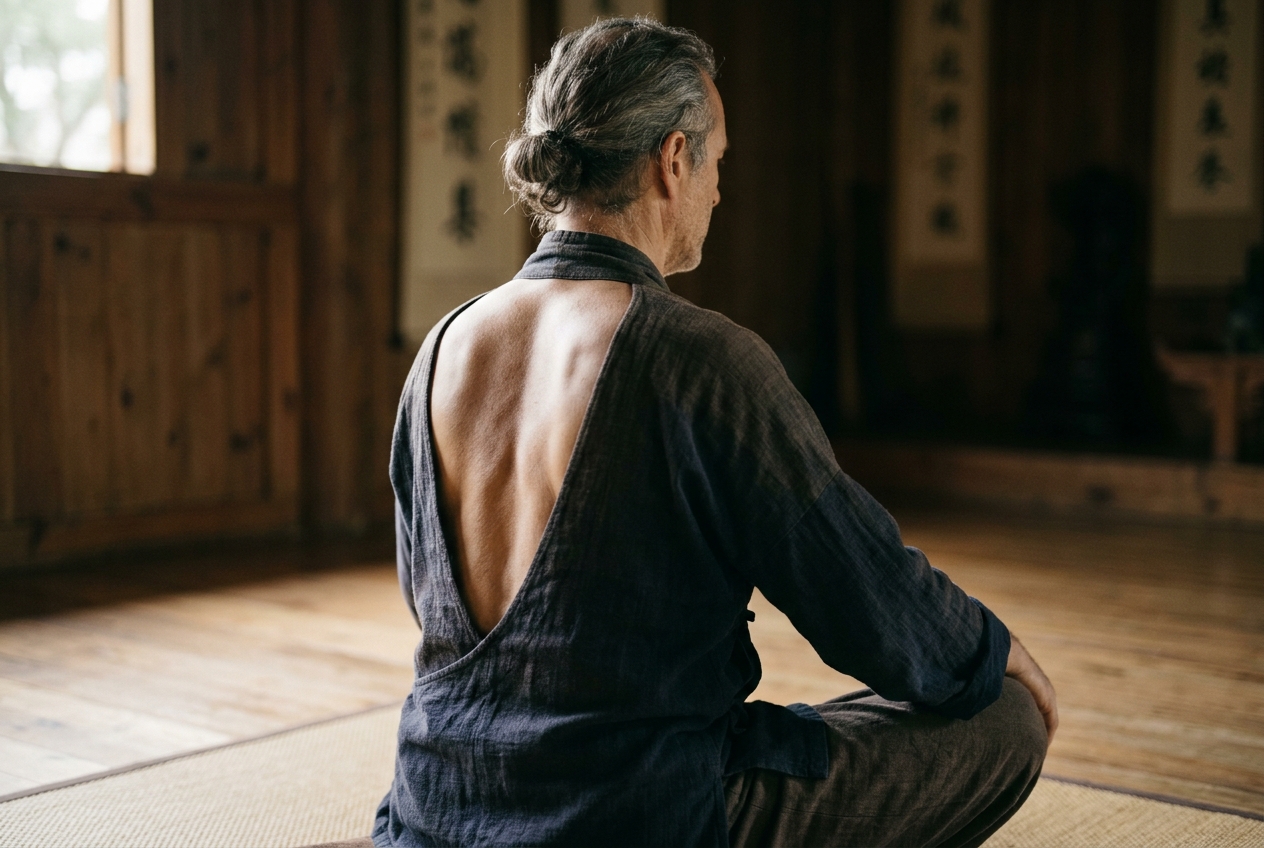
Classical Lineage & Historical Context: The Middle Gate of Neidan
The systematic investigation of the spine's energetic gateways emerged out of early medieval Chinese inner alchemy (Neidan), codified across centuries within the master lineages of the Shangqing (Supreme Purity) and Quanzhen (Complete Perfection) traditions. Within seminal textual collections like the Daozang (the Daoist Canon), the human spinal column is conceptualized not merely as an osseous structural column, but as a dynamic energetic highway known as the "River Vehicle" (Heche 河車). The ascent of refined vitality (Qi and Jing) along this dorsal axis requires traversing three notoriously dense physiological bottlenecks collectively termed the San Guan (三關), or the "Three Back Gates."
The foundational threshold is the Weilu (尾閭) or "Coccygeal Gate" at the base of the sacrum, where primary ancestral energy is pressurized through the pelvic floor. The terminal cranial threshold is the Yuzhen (玉枕) or "Jade Pillow Gate" at the suboccipital hinge (C1–C2/foramen magnum), through which refined consciousness ascends to enter the upper brain centers (Niwan). Yet classical treatises, such as Zhang Boduan’s eleventh-century Wuzhen pian (Awakening to Reality) and the later esoteric Ming-Qing manual Taiyi Jinhua Zongzhi (The Secret of the Golden Flower), repeatedly caution the practitioner that neither the lower pump of the coccyx nor the cranial clarity of the crown can function if the intermediary hinge—the Jiaji gate—remains calcified and energetically obstructed.
Historically, Daoist hermit-physicians recognized that the mid-back corresponds internally to the physiological transition zone between the visceral fires of the lower body and the cooling faculties of the upper body. In classical Chinese medical theory, Jiaji serves as the functional fulcrum for the harmony of Kan (Water / Kidneys) and Li (Fire / Heart). When the Jiaji cavity is constricted by emotional holding patterns, sedentary collapse, or martial over-tightening, the upward-rising heat of the heart is prevented from grounding downward, while the nourishing vital fluids of the lower abdomen cannot ascend along the spine. The consequence is what classical texts describe as Qi Ni (adverse energetic counter-flow)—manifesting somatically as hypertension, palpitations, mental anxiety, upper-body inflammation, and chronic coldness in the lower extremities. The deliberate physical and energetic opening of Jiaji was thus taught as an indispensable prerequisite for both longevity and martial internal power (Neijin).
Biomechanical & Myofascial Architecture: Decompressing the Dorsal Hinge
To understand why the Jiaji gate is so universally susceptible to chronic stagnation, one must examine the complex kinetic and myofascial chains of the posterior thoracic cage. Anatomically centered between the fifth and sixth thoracic vertebrae (T5–T6) and extending through the interscapular region from T3 to T7, Jiaji sits directly beneath the crossing fibers of the middle trapezius, rhomboid major and minor, latissimus dorsi aponeurosis, and the deeper intrinsic spinal stabilizers, including the erector spinae (longissimus thoracis, iliocostalis thoracis) and transversospinalis muscle groups (multifidus and rotatores).
In standard sedentary posture, people habitually fall into one of two dysfunctional biomechanical extremes:
- Thoracic Kyphosis with Protraction: The upper back rounds excessively into a slumped C-curve, overstretching and fatiguing the posterior fascial sheet of the superficial back line while causing the anterior pectoral fascia (pectoralis major and minor) to become pathologically shortened and ischemic.
- Postural Hyper-Retraction ("Military Chest"): The subject aggressively pulls the shoulder blades together and flares the anterior lower ribs outward, forcing the thoracic spine into rigid extension. While masquerading as "good posture," this habit creates persistent mechanical compression across the T4–T8 vertebrae, locking the facet joints, impinging the intercostal nerves, and strangulating the dorsal microvasculature.
Classical Daoist martial and health systems solve this structural dilemma through the foundational biomechanical maxim: Han Xiong Ba Bei (含胸拔背), traditionally rendered as "Hollowing the Chest to Round and Suspend the Back." Far from advocating a pathological slump, Han Xiong Ba Bei describes a sophisticated biomechanical release. The sternum is allowed to sink downward and slightly inward through the gravitational relaxation of the pectoralis minor and costal cartilages, which immediately triggers a reciprocal relaxation of the hyper-contracted rhomboids and middle trapezius.
Simultaneously, the serratus anterior muscles engage subtly to glide the scapulae laterally across the rib cage—a movement known as scapular abduction and upward rotation without elevation. This lateral broadening expands the thoracolumbar and deep interscapular fascia into a resilient, pressurized dome. As the interscapular distance widens, the compressive forces on the T5–T6 vertebral disc spaces are neutralized. The deep spinal rotators and multifidi are granted the mechanical clearance required to lengthen, releasing long-standing myofascial adhesions and restoring multi-planar articulation to the thoracic vertebrae.
Neuro-Physiological and Autonomic Dynamics: The Sympathetic Fulcrum and Fluid Drive
The therapeutic potency of opening Jiaji extends far beyond superficial muscular relaxation; it operates as a profound modulator of the human autonomic nervous system and neuro-hydraulic mechanics, as documented across contemporary somatic and National Library of Medicine / PubMed studies on spinal biomechanics.
+-----------------------------------------------------------------------------------------+
|                  NEURO-PHYSIOLOGICAL DYNAMICS OF JIAJI OPENING                          |
+------------------------------------+----------------------------------------------------+
| Physiological Mechanism            | Clinical & Somatic Transformation                  |
+------------------------------------+----------------------------------------------------+
| Sympathetic Paravertebral Chain    | Decompression of T1-T5 sympathetic ganglia down-   |
| Ganglia Modulation                 | regulates systemic fight-or-flight hyperarousal;   |
|                                    | restores Heart Rate Variability (HRV).             |
+------------------------------------+----------------------------------------------------+
| Craniosacral CSF Hydraulic Pump    | Oscillatory thoracic flexion-extension vectors     |
| Transduction                       | drive upward cerebrospinal fluid hydrodynamic flux |
|                                    | toward the suboccipital cisterns.                  |
+------------------------------------+----------------------------------------------------+
| Visceral Autonomic Balance         | Relieves mechanical impedance along greater        |
| (Splanchnic Pathways)              | splanchnic nerves (T5-T9), optimizing digestive,   |
|                                    | renal, and hepatic perfusion.                      |
+------------------------------------+----------------------------------------------------+
| Dissolution of Pathological Heat   | Eliminates vasomotor thoracic constriction,        |
| (*Qi Ni* Downregulation)           | preventing cranial hypertension and somatic        |
|                                    | hyper-thermal congestion.                          |
+------------------------------------+----------------------------------------------------+
1. Sympathetic Paravertebral Chain Modulation
Anterior to the heads of the ribs, immediately flanking the thoracic vertebral bodies, lies the thoracic sympathetic trunk—the bilateral chain of paravertebral ganglia responsible for governing systemic fight-or-flight arousal, cardiac acceleration, and vasomotor constriction. The middle thoracic segments (specifically T1 through T5) supply sympathetic cardiac and pulmonary plexuses, while T5 through T9 give origin to the greater splanchnic nerve, which innervates the stomach, liver, spleen, and adrenal glands.
When the mid-back is frozen in chronic postural compression or emotional stress, the persistent mechanical torsion creates sustained background stimulation of these sympathetic ganglia. By actively decompressing the T5–T6 interspace through conscious myofascial release, the practitioner dampens aberrant sympathetic outflow. This parasympathetic rebound stimulates vagal tone, increases heart rate variability (HRV), lowers systemic blood pressure, and restores optimal blood flow to the digestive viscera, confirming the observations supported by research from the National Center for Complementary and Integrative Health (NCCIH).
2. Cerebrospinal Fluid (CSF) Hydrodynamic Vectoring
In classical Daoist somatic literature, the Du Mai is celebrated for conveying the "marrow-nourishing fluid" from the sacral cauldron to the cranial vault. Modern neuro-anatomy identifies a direct biological correlate in the circulation of cerebrospinal fluid (CSF) within the spinal subarachnoid space. CSF circulation is not driven by an active internal pump within the brain; rather, it relies fundamentally on the hydraulic respiratory-cardiac wave generated by the diaphragm, pelvic floor, and oscillatory micro-movements of the vertebral column.
The thoracic spine, with its twelve vertebrae and associated rib articulations, represents the longest and mechanically most resistant segment of the neural canal. A rigid, immobile Jiaji zone acts as an internal hydraulic dam, creating turbulent resistance that impairs the cephalad (upward) transit of CSF. When the Jiaji cavity is mobilized through breath-synchronized spinal undulation, the dynamic expansion and recoil of the thoracic dura mater restores laminar flow, ensuring efficient fluid exchange, metabolic clearance of neurotoxic waste, and optimal nutrient delivery to the spinal cord and cerebral cortex.
3. Prevention of Upper-Body Heat Trapping (Qi Ni)
In energetic terms, the microvascular and fascial liberation of the mid-back acts as a thermo-regulatory safety valve. When practitioners engage in vigorous lower-body cultivation (such as deep horse stance, intense abdominal breathing, or seated Neidan heat generation) without first clearing the Jiaji gateway, the accumulated kinetic and metabolic energy meets a dorsal blockage at T5. Blocked from circulating smoothly over the head and down the front of the body via the Ren Mai (Conception Vessel), the energy rebounds upward into the neck, head, and facial capillaries. Practitioners then experience throbbing headaches, tinnitus, irritability, ocular pressure, and disturbed sleep. Opening Jiaji dissolves this anatomical dam, allowing thermal energy to spread evenly across the dorsal myofascial sheet and descend smoothly into the visceral reservoirs.
Step-by-Step Somatic Daoyin Methodology: Mobilizing the Jiaji Cavity
The following somatic sequence, titled Zhan Chi Kai Jiaji (展翅開夾脊 / "Spreading the Wings to Open the Squeeze Spine Gate"), is an authentic Daoyin exercise synthesized from classical Neigong protocols. It can be performed standing or seated upright on a firm stool.
Step 1: Foundational Structural Setup (Zheng Ti)
- Stand with your feet parallel, precisely hip-to-shoulder width apart. Balance your weight evenly across the tripod of each foot (base of the big toe, base of the little toe, and center of the calcaneus).
- Soften your knees by releasing the popliteal tension at the back of the joints, allowing your pelvis to settle into a neutral, suspended orientation. Imagine your sacrum is a plumb line sinking straight toward the earth.
- Lightly touch the tip of your tongue to the hard palate behind the upper front teeth, completing the circuit between the Du Mai and Ren Mai channels.
- Suspend the crown of your head from the vertex point (Baihui, DU-20) as if lightly drawn upward by a celestial cord, allowing the cervical lordosis to gently lengthen without tucking the chin aggressively.
Step 2: The Preparatory Arm Positioning (Huan Bao)
- Inhale softly into your lower abdomen (Xia Dantian), allowing your belly and lower ribs to expand 360 degrees.
- As you exhale, float both arms upward to chest height, forming an open, rounded circle as if lightly embracing a wide, buoyant wooden barrel or tree trunk.
- Ensure your elbows rest slightly lower than your shoulders, and your wrists remain slightly lower than your elbows. Keep the fingers softly elongated and alive, leaving an open space of roughly two fist-widths between your fingertips.
Step 3: Phase One — The Breath-Directed Interscapular Expansion (Inhalation)
- Begin a slow, 5-second inhalation through your nose, directing your somatic attention directly to the T5–T6 vertebrae between your shoulder blades.
- As the air fills your lungs from the bottom up, initiate a subtle, micro-sagittal flexion of your thoracic spine: allow your sternum to sink softly inward by one centimeter while simultaneously engaging the serratus anterior to wrap your shoulder blades forward and outward away from the spine.
- Visualize the Jiaji point opening outward like the blooming petals of a night lotus, or like an archer's bow being drawn backward behind your heart.
- Critical Internal Kinetic: Do not drop your head forward or collapse your lumbar spine. The lower back remains stable and elongated; the movement is strictly an isolated lateral expansion and slight posterior rounding of the middle rib cage. Feel the deep interscapular myofascial tissues stretch and warm under the gentle internal air pressure.
Step 4: Phase Two — The Micro-Spinal Undulation and Wave Release (Exhalation)
- Begin a smooth, unforced 6-second exhalation through your nose.
- Initiate the movement from your feet: press gently into the ground, let the wave rise through your soft knees, allow the sacrum to settle down, and let the thoracic vertebrae stack sequentially back upward into vertical alignment.
- As the spine realigns, gently draw the elbows slightly outward and back to their neutral resting position in the circle, allowing the shoulder blades to glide smoothly back toward their resting anatomical alignment without ever pinching or clamping them together.
- Feel a warm, cascading release of pressure radiating from the T5–T6 region, traveling down the inner surface of the ribs into the lower abdomen and downward through the soles of your feet into the earth (Yongquan, KD-1).
Step 5: Repetition and Sensation Milestones
- Perform this undulating breathing cycle for 12 to 24 continuous, unbroken repetitions.
- Milestone Sensations to Notice:
- Cycles 1–6: A localized sensation of tight stiffness, stretching, or dull resistance between the scapulae, followed by spontaneous audible clicks or micro-adjustments in the thoracic facet joints as fascial adhesions release.
- Cycles 7–12: A spreading sensation of biological warmth (Re 熱) and prickling, effervescent tingling across the mid-back and down the medial aspects of both arms (along the Heart and Pericardium meridians).
- Cycles 13–24: A profound sensation of structural lightness—often described as feeling "empty in the chest and solid in the back"—accompanied by spontaneous deepening of spontaneous diaphragmatic excursion, salivation under the tongue, and a marked mental calm.
Common Pathological Errors and Troubleshooting
Mastering the Jiaji opening requires diagnosing and correcting several subtle somatic errors that frequently derail beginner and intermediate practitioners alike.
+-----------------------------------------------------------------------------------------+
|                  SOMATIC DIAGNOSTICS & PATHOLOGICAL TROUBLESHOOTING                     |
+--------------------------+------------------------------+-------------------------------+
| Pathological Error       | Structural & Somatic Impact  | Corrective Cue                |
+--------------------------+------------------------------+-------------------------------+
| Scapular Hyper-          | Mechanically pinches T5-T6   | "Broaden the space between    |
| Retraction               | facet joints; spikes blood   | your shoulder blades as if    |
| ("Pinching Blades")      | pressure and sympathetic tone| expanding a parasol."         |
+--------------------------+------------------------------+-------------------------------+
| Anterior Costal          | Induces thoracolumbar        | "Soften the bottom front ribs |
| Flaring                  | hyperextension; compresses   | downward into the pelvic      |
| ("Popping the Ribs")     | adrenal-renal junction.      | bowl upon exhalation."        |
+--------------------------+------------------------------+-------------------------------+
| Kyphotic Slumping        | Collapses the anterior       | "Keep the crown suspended;    |
| ("Dropping the Chest")   | pericardial cavity; creates  | hollow the chest from the     |
|                          | visceral and cardiac stasis. | inside without curling down." |
+--------------------------+------------------------------+-------------------------------+
| Shoulder Elevation       | Activates upper trapezius;   | "Drop your armpits onto the   |
| ("Armpit Clamping")      | strangles suboccipital and   | cushions of the latissimus    |
|                          | cranial blood perfusion.     | dorsi like empty silk."       |
+--------------------------+------------------------------+-------------------------------+
Diagnostic 1: The Scapular Hyper-Retraction Trap
The most pervasive error occurs when practitioners attempt to "open the chest" by pulling the shoulder blades backward toward each other. This activates the rhomboids and middle trapezius in an isometric vice grip, driving the spinous processes together and directly compressing the Jiaji cavity. Correction: Imagine your back is a wide kite sail or an umbrella opening from the center outward. The front chest does not open through backward pulling; it opens because the back widens and creates a structural foundation for the rib cage to suspend effortlessly.
Diagnostic 2: Anterior Costal Flaring (Rib-Cage Popping)
When instructed to stand upright, many practitioners unintentionally hinge backward at the T12–L1 junction, pushing the lower front ribs forward through the abdominal wall. This breaks the fascial continuity between the thoracic cage and the pelvis, dumping shear stress into the lumbar spine and locking the mid-back in compensatory spasm. Correction: Place one hand flat on your lower sternum. Exhale fully and feel the lower ribs melt downward into the abdominal wall without rounding your shoulders. Maintain this settled, connected feeling as you resume normal breathing.
Diagnostic 3: Somatic Kyphosis vs. True Han Xiong
Some students over-correct by rounding their entire upper body forward, dropping the chin and slumping the thoracic spine into a passive hunch. This compresses the heart and lungs, restricting the descent of the respiratory diaphragm. Correction: The suspension of the crown point (Baihui) must never be lost. Han Xiong Ba Bei is an internal release, not an external collapse. The spine lengthens vertically toward the heavens even as the sternum softens and the interscapular region broadens horizontally.
Restorative Integration Protocols: Zhan Zhuang and Seated Meditation
Once the Jiaji gate has been dynamically mobilised through Daoyin, its decompressed state must be stabilized and integrated into static foundational practices: standing stake (Zhan Zhuang) and seated meditation (Jingzuo), honoring the broad clinical frameworks for mind-body therapies recognized by the World Health Organization Traditional, Complementary and Integrative Medicine.
Protocol A: Standing Post Integration (Zhan Zhuang — "Embracing the Tree")
- Assume the foundational standing posture (Cheng Bao Zhuang): feet parallel, knees relaxed, arms embracing the spherical energy field at heart height.
- Direct 70% of your somatic attention to the Jiaji point between your shoulder blades.
- On every slow inhalation, feel the space between your shoulder blades expand three-dimensionally, pushing gently outward against the air behind you.
- On every slow exhalation, allow the energy released from the mid-back to drain down the posterior surface of your spine, wrapping around the waist into the lower abdomen (Xia Dantian) and dropping down the legs into the bubbling spring points (Yongquan) on the soles of your feet.
- Stand for 10 to 20 minutes daily. If tension begins to build in your upper trapezius or shoulders, immediately visualize your shoulder blades melting downward like warm wax, widening the Jiaji gate and sinking all residual force into the earth.
Protocol B: Seated Meditation Integration (Jingzuo and Microcosmic Orbit)
- Sit cross-legged on a firm meditation cushion (Zafu) or upright on a wooden chair with your feet flat on the floor and thighs parallel to the ground. Ensure the pelvis is slightly elevated so the spine stacks naturally without muscular strain.
- Settle the breath into the lower abdomen until the breath becomes silent, slow, deep, and uniform (Xi, Chang, Shen, Yun 細長深勻).
- When performing the Microcosmic Orbit (Xiao Zhoutian / Neidan circulation), guide the internal focus from the perineum (Huiyin) up through the sacral gate (Weilu). As the energetic current reaches the mid-back, pause your active guidance.
- Rest your awareness effortlessly within the open, spacious cavern of Jiaji. Do not force the energy upward with active mental strain. Allow the decompressed T5–T6 interspace to act as an open biological conduit; the refined current will naturally gather, warm the thoracic cavity, and effortlessly pierce upward through the suboccipital gate (Yuzhen) into the cranial center (Niwan).
Today's Practice Commitment
Tomorrow morning, immediately upon rising and before taking your first sip of tea or coffee, step into an open space in your room and dedicate exactly 7 minutes to this practice.
Begin with 18 slow, rhythmic repetitions of the Zhan Chi Kai Jiaji ("Spreading the Wings") exercise described above—inhaling for 5 seconds to expand the space between your shoulder blades, and exhaling for 6 seconds to wash the release down into your feet. Conclude with 3 minutes of quiet standing or seated stillness, keeping your chest softly hollowed, your upper back broad, and your awareness resting in the warm, open space behind your heart.
Observe with calm curiosity how your posture, your breathing depth, and your mental clarity shift over the subsequent two hours. You will find that when the middle gate of the spine is open, the breath descends effortlessly, the mind settles into natural stillness, and the body moves through the day supported by a resilient column of relaxed, integrated power. For further foundational standards and professional curriculum frameworks in classical energy practices, consult the resources provided by the National Qigong Association.