Interior-Exterior Meridian Point Combination: Navigating Yin-Yang Coupled Channel Synergy, Zang-Fu Axis Resonance, and Paired Acupressure Protocols
1. OPENING — A PROBLEM THIS SOLVES TODAY: THE SPLIT-BODY PARADOX OF MODERN DYSFUNCTION
If you spend your days seated before digital terminals, you are likely intimately familiar with a peculiar somatic paradox: your neck and upper shoulders feel rigid, hyper-contracted, and ablaze with muscular tension, while simultaneously your digestion is sluggish, your breath is shallow and restricted to the clavicular zone, and your lower abdomen feels cold or distended. In Western clinical contexts, this fragmented presentation is often compartmentalized into separate pathologies—cervicogenic tension headaches, postural kyphosis, functional dyspepsia, and generalized sympathetic overdrive.
Yet the human body does not operate as an assemblage of isolated mechanical compartments. When muscular hypertonicity on the dorsal or lateral surfaces of the limbs and torso coexists with visceral hypo-functioning within the core, the nervous and fascial systems are caught in a state of uncoordinated cross-talk.
Traditional Chinese Medicine (TCM) resolved this fragmentation millennia ago through one of its most sophisticated architectural strategies: The Interior-Exterior Meridian Point Combination (Biao-Li Jing Pei Xue Fa, 表里经配穴法).
By coupling an interior (Yin/Zang—solid organ) channel with its anatomically and functionally paired exterior (Yang/Fu—hollow organ) channel, this methodology bridges deep visceral metabolic processes with superficial musculoskeletal and neurovascular conduits. Understanding this paired resonance offers clinicians and self-care practitioners a remarkably coherent blueprint for restoring homeostatic equilibrium across the somatic-visceral axis.
2. THEORETICAL FOUNDATIONS & CLASSICAL LINEAGE: THE BIAO-LI DOCTRINE
The doctrinal foundation of interior-exterior channel pairing is rooted within the foundational canons of Chinese medicine: the Huangdi Neijing (Inner Canon of the Yellow Emperor), comprising the Su Wen (Basic Questions) and Ling Shu (Spiritual Pivot), alongside the Han Dynasty classic, the Nan Jing (Classic of Difficult Issues).
The Yin-Yang Axis and Channel Pairing
In classical physiology, the twelve primary meridians (Jingmai) do not operate as autonomous conduits; rather, they form six interconnected pairs governed by the principle of Biao (the exterior, protective, dynamic Yang domain) and Li (the interior, nourishing, metabolic Yin domain). According to Ling Shu (Chapter 10, "The Meridians"), each Yin meridian belonging to a solid Zang organ (such as the Lung, Heart, or Liver) connects directly with its corresponding Yang meridian belonging to a hollow Fu organ (such as the Large Intestine, Small Intestine, or Gallbladder).
This structural union is mediated by: 1. Luo-Connecting Vessels (Luo Mai): Transverse branch lines that physically diverge from the Luo point of one meridian to terminate directly in its paired channel, creating an uninterrupted loop of information and nutrient exchange. 2. Divergent Meridians (Jing Bie): Deeper channel pathways that plunge into the internal cavities, bathing both the Yin and Yang visceral organs before resurfacing at the neck and head. 3. Yuan-Source (Yuan Xue) and Luo-Connecting (Luo Xue) Synergies: The classic "Host-Guest" (Zhu Ke) methodology, wherein the Yuan-source point of the primarily afflicted meridian is stimulated alongside the Luo-connecting point of its coupled partner, opening a bidirectional drainage and tonification corridor.
When a pathogen invades the exterior Yang boundary, it can rapidly transfer inward to compromise the interior Yin reservoir if the exterior channel is occluded. Conversely, when an internal organ suffers metabolic stagnation, toxic heat, or energetic collapse, the pathological distress registers along the trajectory of its paired exterior meridian. Paired point combination clears both the root visceral cause (Ben) and its superficial musculoskeletal branch manifestations (Biao).
3. NEUROFASCIAL & PHYSIOLOGICAL MECHANISMS OF INTERIOR-EXTERIOR RESONANCE
Modern biomedical research has increasingly illuminated the physical substrates of these ancient energetic pairings. Rather than being mystical energetic conduits, interior-exterior point combinations map precisely to conserved neuroanatomical pathways, shared dermatomes, myotomes, and contiguous fascial planes documented in NCBI research on connective tissue and acupuncture meridians.
1. Shared Spinal Cord Metameres & Viscerosomatic Reflex Arcs
Paired interior and exterior meridians on the extremities consistently correspond to overlapping spinal segments. For example, Hand Taiyin (Lung) and Hand Yangming (Large Intestine) both derive their primary sensory innervation from the C5–C7 spinal nerve roots.
When an acupressure or acupuncture stimulus is delivered simultaneously or sequentially to points across these paired channels (such as LU7 and LI4), the afferent neural inputs converge at the dorsal horn of the spinal cord. This spatial summation produces: - Central Pain Modulation: Downregulating noxious incoming signals via the gate control theory and stimulating the local release of enkephalins and dynorphins. - Somatosensory-Autonomic Reflex Coupling: Modulating sympathetic outflow via the preganglionic autonomic chain and tuning vagal parasympathetic tone to regulate visceral peristalsis, pulmonary ventilation, and microvascular perfusion, as outlined in NCBI studies on acupuncture neurobiology.
2. Antagonistic-Synergistic Muscular Couplings & Neurovascular Bundles
Anatomically, Yin channels run predominantly along the anteromedial, flexor, and protected aspects of the limbs, closely tracking major deep neurovascular bundles (e.g., the brachial artery and median nerve along the Pericardium channel). Yang channels traverse the posterolateral, extensor, and exposed surfaces.
Stimulating both the flexor and extensor aspects of a limb segment: - Normalizes reciprocal inhibition between antagonistic muscle groups (e.g., balancing forearm flexors and extensors). - Activates deep mechanoreceptors (Pacini and Meissner corpuscles, Ruffini endings) that trigger immediate vasodilation through the axon reflex release of calcitonin gene-related peptide (CGRP) and substance P.
3. Interstitial Fascial Continuity and Mechanotransduction
Interstitial connective tissue forms an unbroken, liquid-crystalline web throughout the body. Mechanical deformation (via perpendicular pressure, twisting, or needle grasp) at a Yin acupoint induces strain waves through the collagen matrix that propagate across the interosseous membranes and intermuscular septa to the paired Yang aspect. Fibroblasts respond to this mechanical tension via mechanotransduction, converting physical shear stress into biochemical signals (such as adenosine release and ATP hydrolysis), which reduces local tissue inflammation and normalizes systemic matrix viscosity.
4. THE SIX PAIRED MERIDIAN SYNERGIES & CLINICAL DYADS
The clinical power of the Interior-Exterior method is best realized through the six classical paired channel axes. Below is a didactic breakdown of the anatomical pathways, neurovascular markers, and clinical dyads for each pairing according to the WHO Standard Acupuncture Point Locations.
4.1 Hand Taiyin (Lung) & Hand Yangming (Large Intestine)
The Metal Element Axis: Respiration, Elimination, and Immune Defense
- Pathway Dynamics: Hand Taiyin originates in the middle burner, descends to the large intestine, loops past the stomach, traverses the lungs, and runs down the anterolateral aspect of the arm to the thumb. Hand Yangming starts at the index finger, ascends the posterolateral arm over the shoulder, passes through the supraclavicular fossa, plunges into the lung, and enters the large intestine.
- Primary Dyad 1: LU7 (Lieque) + LI4 (Hegu)
- Neuroanatomy: LU7 stimulates the superficial branch of the radial nerve and the lateral antebrachial cutaneous nerve; LI4 engages the first dorsal interosseous muscle, deep radial nerve, and dorsal digital nerves (C6–C8).
- Clinical Synergy: LU7 is the Luo-connecting point of the Lung and the master point of the Ren Mai (Conception Vessel); LI4 is the Yuan-source point of the Large Intestine. Together, they constitute the preeminent exterior-releasing dyad in Chinese medicine. They disperse Wind-Heat or Wind-Cold, relieve facial paralysis, clear sinusitis, abort acute tension headaches, and regulate perspiration.
- Primary Dyad 2: LU5 (Chize) + LI11 (Quchi)
- Anatomy: Located at the elbow joint across the flexor and extensor margins. LU5 lies in the radial depression of the biceps brachii tendon; LI11 lies in the depression midway between the biceps tendon and the lateral epicondyle of the humerus.
- Clinical Synergy: The He-Sea (Water) point of the Lung combined with the He-Sea (Earth) point of the Large Intestine. This pairing drains hyperactive pulmonary and systemic heat, clears acute pharyngitis, reduces bronchitis, and addresses inflammatory dermatological flares (such as acute eczema and urticaria).
4.2 Foot Taiyin (Spleen) & Foot Yangming (Stomach)
The Earth Element Axis: Digestion, Fluid Transformation, and Sarcoplasmic Vitality
- Pathway Dynamics: Foot Taiyin begins at the great toe, ascends the medial aspect of the foot and leg, runs across the anterior abdomen, and terminates on the lateral thoracic wall. Foot Yangming begins near the orbit, courses across the mandible, descends through the mamillary and abdominal lines, descends the anterolateral thigh and shin, and terminates at the second toe.
- Primary Dyad: SP9 (Yinlingquan) + ST36 (Zusanli)
- Neuroanatomy: SP9 activates the saphenous nerve and tibial nerve roots (L3–L4); ST36 engages the deep fibular (peroneal) nerve and tibialis anterior motor branches (L4–S1).
- Clinical Synergy: SP9 is the He-Sea (Water) point of the Spleen, specialized in draining accumulated dampness and edema from the lower burner and digestive tract. ST36 is the He-Sea (Earth) point of the Stomach, celebrated for its systemic tonifying, immune-enhancing, and prokinetic digestive actions. Combined, they simultaneously resolve pathological fluid retention (bloating, heavy limbs, diarrhea) while igniting the metabolic fire of the middle burner.
4.3 Hand Shaoyin (Heart) & Hand Taiyang (Small Intestine)
The Imperial Fire Axis: Psycho-Emotional Coherence and Craniocervical Alignment
- Pathway Dynamics: Hand Shaoyin emerges from the heart, traverses the axilla, descends the medial border of the anterior arm to the tip of the fifth finger. Hand Taiyang starts at the fifth finger's ulnar tip, travels up the posterior arm, zig-zags across the scapula, ascends the lateral neck, and terminates anterior to the tragus.
- Primary Dyad: HT7 (Shenmen) + SI3 (Houxi)
- Neuroanatomy: HT7 overlies the ulnar nerve and artery immediately radial to the flexor carpi ulnaris (FCU) tendon (C8–T1); SI3 lies over the abductor digiti minimi muscle and the dorsal branch of the ulnar nerve.
- Clinical Synergy: HT7 is the Yuan-source and Shu-Stream (Earth) point of the Heart, anchoring erratic mental activity (Shen), reducing tachycardia, and resolving insomnia. SI3 is the Shu-Stream (Wood) point of the Small Intestine and the master point of the Du Mai (Governing Vessel). Pairing them simultaneously calms neuropsychiatric excitation and unlocks rigid cervical and thoracic musculature along the spinal column, clearing both psychological distress and its somatic posture.
4.4 Foot Shaoyin (Kidney) & Foot Taiyang (Bladder)
The Water Element Axis: Ancestral Vitality, Fluid Homeostasis, and Axial Postural Tone
- Pathway Dynamics: Foot Shaoyin begins beneath the little toe, traverses the sole, circles behind the medial malleolus, ascends the posteromedial leg, and courses through the anterior torso to the clavicle. Foot Taiyang begins at the inner canthus of the eye, arcs over the cranium, bifurcates into two broad columns down the paraspinal musculature, descends the posterior thigh, and finishes at the lateral fifth toe.
- Primary Dyad: KI3 (Taixi) + BL23 (Shenshu) / BL40 (Weizhong)
- Neuroanatomy: KI3 activates the posterior tibial nerve and medial calcaneal branches (L5–S2); BL40 directly stimulates the tibial nerve in the central popliteal fossa; BL23 corresponds to the posterior ramus of the L2 spinal nerve.
- Clinical Synergy: KI3 (Yuan-source point of the Kidney) nourishes the core structural and hormonal reserves (Yin and Yang Essence). BL40 (He-Sea point of the Bladder and command point of the lumbar spine) clears stagnation and excess from the spinal fascial tracks. Coupled with BL23 (Back-Shu point of the Kidney), this pairing treats chronic lumbar pain, renal hypofunction, lower-limb fatigue, and systemic fluid dysregulation.
4.5 Hand Jueyin (Pericardium) & Hand Shaoyang (Triple Burner / San Jiao)
The Minister Fire Axis: Autonomic Heart-Rate Harmonization and Neurovascular Transfixion
- Pathway Dynamics: Hand Jueyin originates in the chest, passes through the pericardium, traverses the diaphragm across all three burners, and runs down the midline of the anterior arm into the palm. Hand Shaoyang starts at the fourth finger, ascends the dorsal forearm midline, crosses the shoulder, encircles the ear, and terminates at the lateral eyebrow.
- Primary Dyad: PC6 (Neiguan) + SJ5 (Waiguan)
- Neuroanatomy: PC6 stimulates the median nerve and anterior interosseous nerve (C6–T1); SJ5 lies directly opposite on the posterior compartment, stimulating the posterior interosseous nerve and deep radial branches.
- Transfixion Mechanism & Synergy: This pairing represents the quintessential "Opposing Channel Transfixion" (Tou Xue). When pressure is applied simultaneously from the anterior to posterior forearm, a compressive wave passes through the interosseous membrane. PC6 regulates parasympathetic vagal output, pacifies gastroesophageal reflux, and stabilizes cardiac arrhythmias; SJ5 opens the Dai Mai (Belt Vessel), clears temporal headaches, and dispels exterior pathogens. Together, they act as an overarching autonomic reset switch.
4.6 Foot Jueyin (Liver) & Foot Shaoyang (Gallbladder)
The Wood Element Axis: Fascial Glide, Neurochemical Flow, and Subcostal Decompression
- Pathway Dynamics: Foot Jueyin begins at the great toe, ascends the medial leg, encircles the external genitalia, and enters the liver and gallbladder before ascending to the eye and vertex of the head. Foot Shaoyang starts at the outer canthus of the eye, weaves across the temporal skull, descends the lateral torso, down the lateral aspect of the leg, and terminates at the fourth toe.
- Primary Dyad: LV3 (Taichong) + GB34 (Yanglingquan)
- Neuroanatomy: LV3 stimulates the deep peroneal (fibular) nerve and first dorsal metatarsal artery (L4–S1); GB34 stimulates the common peroneal nerve as it bifurcates around the neck of the fibula.
- Clinical Synergy: LV3 is the Yuan-source and Shu-Stream (Earth) point of the Liver, the supreme regulator of somatic Qi circulation and emotional stress-reactivity. GB34 is the He-Sea (Earth) point of the Gallbladder and the Hui-Meeting point for all tendons and sinews (Jin). Their combination resolves hepatic congestion, alleviates costal distention, relieves generalized muscle spasticity, enhances myofascial sliding mechanics, and normalizes biliary secretion.
5. DIAGNOSTIC PRIORITIZATION: YIN VS. YANG CHANNEL DOMINANCE
To execute the Interior-Exterior point combination with clinical precision, the practitioner must determine the energetic polarity of the condition. Stimulation must not be applied haphazardly; one must determine which channel serves as the Host (Zhu) and which serves as the Guest (Ke).
Clinical Rules of Engagement:
- Zang Deficiency Dominance: If a patient presents with chronic fatigue, low appetite, loose stools, and a weak pulse, the primary pathology is Spleen Qi Deficiency (Yin). Begin by applying tonification (Bu) to the Yin channel (e.g., SP9 or SP6) to fortify the internal organ, and subsequently stimulate the Yang partner (ST36) to mobilize metabolic transport.
- Fu Excess / Pathogenic Invasion Dominance: If a patient presents with an acute migraine, bitter taste, temporal throbbing, and red eyes, the primary pathology is Gallbladder Fire Excess (Yang). Begin by sedating (Xie) the Yang channel (e.g., GB34 or GB41) to disperse the acute inflammatory pressure, then anchor the energy by tonifying the paired Yin channel (LV3).
6. STEP-BY-STEP ACUPRESSURE PROTOCOL: BIOMECHANICAL PRECISION & SOMATOSENSORY FEEDBACK
When applying these combinations non-invasively through clinical acupressure, strict adherence to biomechanics and physiological feedback ensures reproducible therapeutic outcomes.
Step 1: Structural Localization
Do not rely exclusively on superficial visual markers. Slide the palpating thumb or index finger over the skin until an anatomical depression, intermuscular groove, or subtle fascial indentation is felt. The point is almost universally located within a tissue crevice or adjacent to a bone margin.
Step 2: Vector and Pressure Modulation (Bu vs. Xie)
- Perpendicular Vector: Used for fleshy, muscular points (e.g., ST36, GB34) to reach the deep muscular and neurovascular interface.
- Angled Vector (45 degrees): Used near delicate bony margins or along the channel flow (e.g., LU7, SI3).
- Tonification (Bu Fa): Apply slow, steady, sustained pressure with gentle, clockwise micro-rotations. Maintain continuous contact without abrupt interruptions. Duration: 90–120 seconds.
- Sedation / Dispersion (Xie Fa): Apply dynamic, firm, rhythmic pumping pressure with counter-clockwise rotations to break up local adhesions and disperse hypertonicity. Duration: 60 seconds.
Step 3: Respiratory Synchronization
Instruct the patient or synchronize your own breath: apply increasing pressure progressively during the exhalation phase (when the parasympathetic system is engaged and muscle spindles relax). Maintain steady baseline pressure during inhalation.
Step 4: De Qi Verification (得气)
Effective stimulation requires the elicitation of De Qi ("the arrival of vital energy"). In neurophysiological terms, this corresponds to the selective recruitment of slower-conducting A-delta and C nerve fibers. - Subjective Patient Sensation: A distinct dull ache, heavy distension, mild soreness, or electric tingling radiating along the limb. - Objective Practitioner Perception: A tactile feeling of "tissue grasp"—the sensation that the subcutaneous fascia is drawing the thumb deeper into the locus.
7. A TARGETED POINT COMBINATION FOR DAILY LIFE: THE "SCREEN FATIGUE & METABOLIC STAGNATION" RESET
For individuals experiencing the classic contemporary syndrome—tight suboccipital and shoulder muscles, dry eyes, irritability, and delayed gastric emptying after a day of computer work—apply the following sequential Biao-Li dyad protocol:
The Protocol:
- Positioning: Sit upright in a supportive chair with feet flat on the floor and shoulders relaxed.
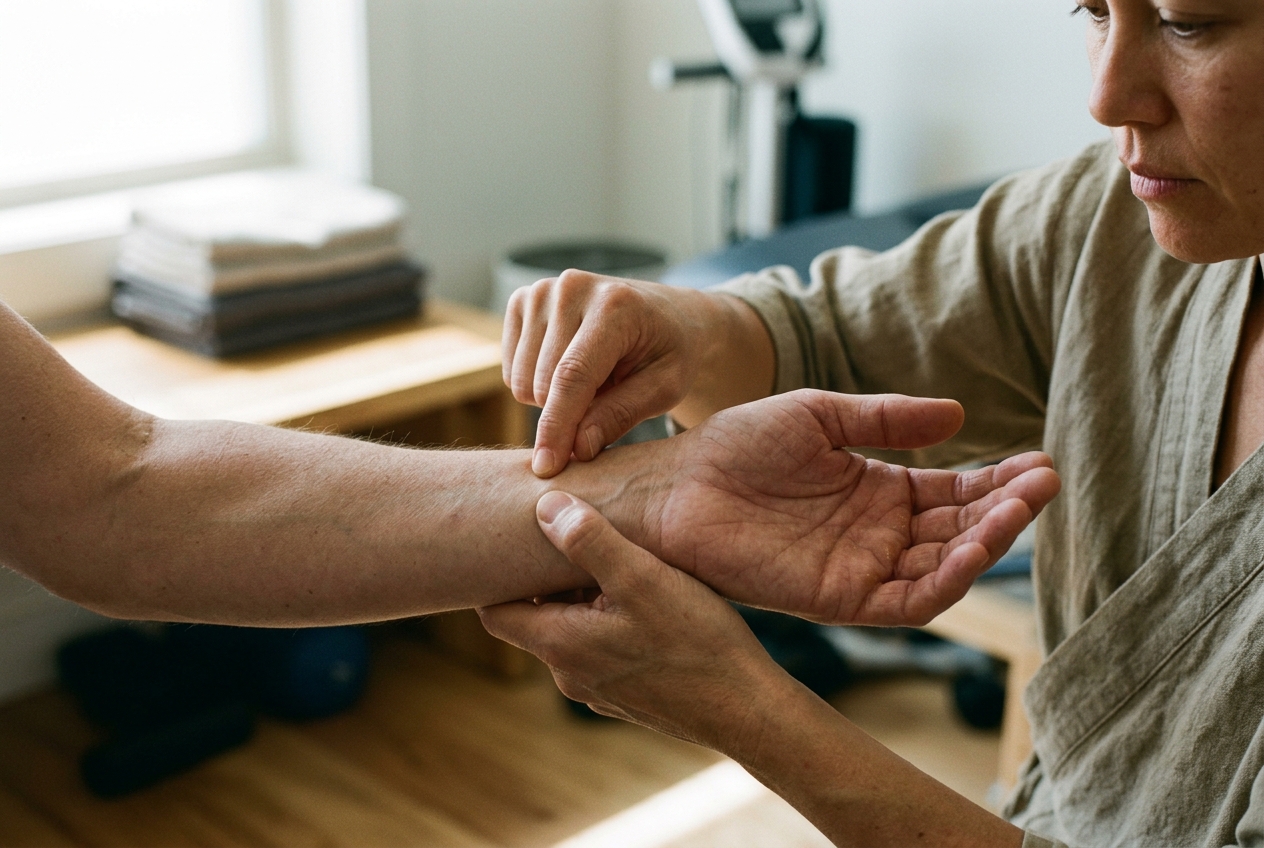
- Phase 1 (PC6 & SJ5 Dual Grip): Place your right thumb on your left PC6 (inner forearm, two thumb-widths up from the wrist) and your middle finger directly opposite on SJ5 (outer forearm). Squeeze them toward each other until you feel a synchronized dull ache. Hold for 90 seconds while breathing deeply into your lower abdomen. Repeat on the opposite arm.
- Phase 2 (LV3 to GB34 Cascade): Place your thumb on LV3 (dorsum of the foot) and apply firm pressure toward the heel for 60 seconds. Immediately transition your hand to GB34 (outer leg below the knee) and apply deep, kneading pressure for 60 seconds. Repeat bilaterally.
8. SAFETY, CLINICAL BOUNDARIES, AND NEUROLOGICAL PRECAUTIONS
While non-invasive acupressure carries an exceptional safety profile, clinical rigor demands adherence to established contraindications and physiological boundaries:
9. TODAY'S TWO-MINUTE HOMEOSTATIC TAKEAWAY
If you only have two minutes right now to experience the immediate balancing power of interior-exterior point synergy, perform the Bilateral Pericardium-Triple Burner Transfixion:
- Find the Gates: Measure two finger-widths up from your dominant wrist crease on the inside of your forearm (PC6, nestled between the two central tendons). Place your thumb there. Place your index finger directly opposite on the back of your forearm (SJ5, between the two forearm bones).
- Apply the Dynamic Grip: Squeeze thumb and index finger together with steady, firm pressure until a radiating warmth or dull heaviness spreads through the wrist and palm.
- Breathe and Release: Inhale for a count of 4, hold for 2, and exhale slowly for 6. Maintain the squeeze for 60 seconds on one arm, then switch to the other.
Within two minutes, the convergence of median and radial nerve inputs at the cervical spine shifts autonomic balance, softens neck stiffness, deepens diaphragmatic excursion, and reestablishes cross-sectional physiological coherence.
SUMMARY OF CORE BIAO-LI COMBINATIONS
| Element | Yin Channel (Interior / Li) | Yang Channel (Exterior / Biao) | Key Point Dyad | Primary Clinical Indication |
|---|---|---|---|---|
| Metal | Hand Taiyin (Lung) | Hand Yangming (Large Intestine) | LU7 + LI4 | Acute respiratory pathogens, diaphoresis regulation, craniomandibular pain |
| Earth | Foot Taiyin (Spleen) | Foot Yangming (Stomach) | SP9 + ST36 | Fluid transformation, gastrointestinal motility, metabolic deficiency |
| Fire (Imperial) | Hand Shaoyin (Heart) | Hand Taiyang (Small Intestine) | HT7 + SI3 | Insomnia, psycho-emotional agitation, cervical spine and scapular fixation |
| Water | Foot Shaoyin (Kidney) | Foot Taiyang (Bladder) | KI3 + BL40 | Lumbar sinew degeneration, renal essence depletion, water metabolism |
| Fire (Ministerial) | Hand Jueyin (Pericardium) | Hand Shaoyang (Triple Burner) | PC6 + SJ5 | Autonomic dysregulation, gastroesophageal reflux, temporal headaches |
| Wood | Foot Jueyin (Liver) | Foot Shaoyang (Gallbladder) | LV3 + GB34 | Tendon and fascial glide, hepatic Qi stagnation, biliary dysfunction |
By bridging the functional depth of the internal organs with the responsive adaptability of the exterior muscular channels, the Interior-Exterior Meridian Point Combination remains one of the most clinically elegant frameworks in integrative medicine. Whether applied through fine-gauge filiform needles or focused manual pressure, it engages the body's native neurofascial networks to restore systemic equilibrium across all physiological planes.