Hunyuan Qigong: Primordial Energy Cultivation, Toroidal Dantian Dynamics, and Helical Fascial Spirals in Classical Daoyin
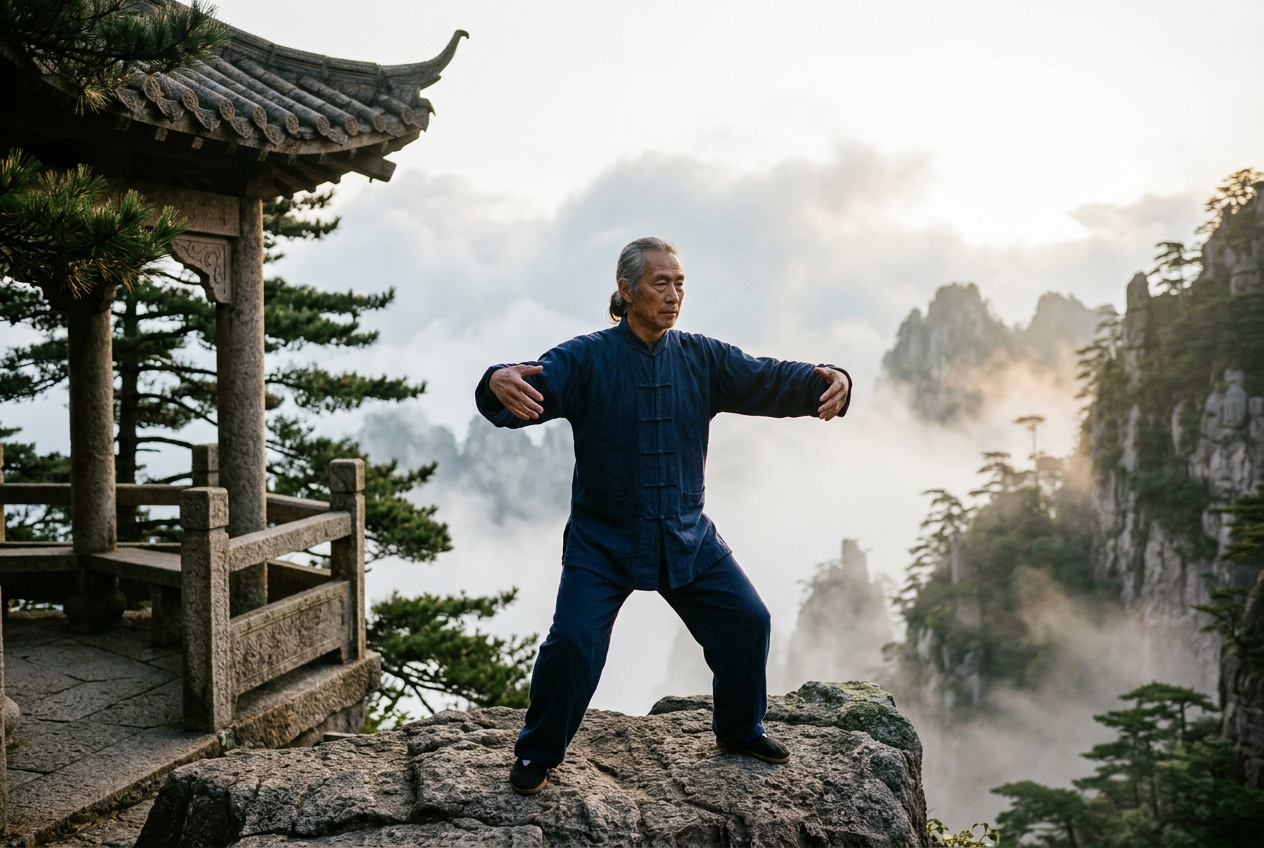
To understand the internal dynamics of this discipline, one must look to the classical Chinese medical understanding of bodily vitality. Central to this system is the concept of Qi (pronounced "chee"), which can be understood scientifically as the body’s metabolic vitality, bioelectric signaling, and continuous hemodynamic flow. Hunyuan Qigong is specifically structured around the harmonization of three primary energy centers known as Dantians—or "elixir fields"—located along the vertical axis of the torso:
- The Lower Dantian (Xia Dantian): Positioned roughly two to three finger-widths below the navel and deep within the pelvic bowl, this center governs physical equilibrium, structural grounding, and intra-abdominal hydraulic pressure.
- The Middle Dantian (Zhong Dantian): Centered in the middle of the chest behind the sternum at the level of the heart, this locus coordinates pulmonary respiration, cardiac rhythm, and emotional regulation.
- The Upper Dantian (Shang Dantian): Situated within the center of the brain behind the midpoint of the eyebrows (the region of the third eye or pituitary-hypothalamic axis), this center coordinates sensory awareness, cognitive clarity, and mental focus.
In classical Daoist physiology, health is governed by the continuous synthesis of Yuan Qi (Pre-Heaven primordial essence, inherited genetically and anchored within the renal-adrenal complex) with Post-Heaven Qi (the metabolic energy generated through diaphragmatic oxygen exchange and the assimilation of dietary nutrients). Hunyuan Qigong employs multi-planar spherical rotations to consolidate these energies, transforming constitutional fatigue into a calm, resilient vitality that circulates uninhibited through every vessel of the human frame.
Step-by-Step Practice Guide
The following core movements represent the fundamental pedagogical syllabus of Hunyuan Qigong as transmitted through classical lineage protocols. Execute each movement smoothly, without rigid stops, ensuring the transitions remain as uninterrupted as silk unfurling from a spool.
1. Postural Architecture: The Wuji Foundation (Primordial Void Stance)
Before initiating energetic movement, establish the foundational biomechanical framework:
- Grounding the Tripod of the Foot: Stand with your feet parallel, pointing directly forward, aligned with the outer edges of your shoulders. Distribute your body weight evenly across the three primary weight-bearing landmarks of each foot: the calcaneus (heel), the first metatarsal head (ball of the big toe), and the fifth metatarsal head (ball of the pinky toe). Ensure the center of the sole—the Yongquan or Kidney-1 acupoint—remains slightly vaulted and receptive.
- Suspending the Axial Spine: Imagine an invisible cord gently lifting the apex of your cranium at the Baihui point (governing vessel 20, located at the crown of the skull). Allow the chin to tuck minutely, elongating the cervical spine and opening the suboccipital spaces.
- Hollowing the Inguinal Crease (Song Kua): Soften the hip joints and allow the tailbone to settle downward as though lightly perching on the edge of a high barstool. This eliminates hyperlordosis in the lumbar spine, opening the Mingmen ("Gate of Life") acupuncture point opposite the navel.
- Suspending the Upper Appendages: Keep the armpits hollowed (Ye Xia Kong), as though cradling a fragile bird's egg beneath each shoulder. Rest your hands alongside your thighs, palms facing backward, with the fingers relaxed and slightly spaced.
2. Form I: Gathering Hunyuan Qi (Shou Qi Fa)
This movement cultivates three-dimensional atmospheric gathering, circulating breath and microvascular fluid from the periphery back into the visceral core.
- Initiation (Inhale): On a slow, quiet nasal inhalation, rotate your palms forward. With wrists supple and elbows slightly bent, sweep both arms outward and upward in a broad, expansive arc, describing a wide spherical perimeter around your body.
- Elevation to the Vertex: Continue raising the hands until they reach slightly above eye level. Turn the palms inward so they face the crown of your head (Baihui), maintaining a relaxed curvature across the clavicles and trapezius muscles.
- Condensation and Descent (Exhale): As you begin a slow, controlled exhalation, draw the palms downward along the central axis of the torso (Chong Mai). Keep the fingertips pointing toward each other without touching, roughly four inches away from the chest.
- Consolidation: Guide the hands past the Middle Dantian (chest) and settle them opposite the Lower Dantian (lower abdomen). As the hands pass the navel, allow the weight of the body to sink deeper into the heels, visualizing the gathered warmth condensing into a dense, radiant sphere within the pelvic bowl.
- Repetitions: Complete 6 to 9 continuous, fluid cycles.
3. Form II: Opening and Closing the Three Cavities (San Jiao Kai He)
This form engages the three principal myofascial cavities of the human trunk—cranial, thoracic, and abdominopelvic—harmonizing intra-thoracic and intra-abdominal pressures.
- Establishing the Sphere: Position your hands in front of your chest at the level of the heart, palms facing one another approximately six to eight inches apart, as though loosely holding an elastic energetic sphere between your palms.
- Opening the Cavities (Kai — Inhale): Inhale slowly through the nose into the lower abdomen. Gently expand the hands laterally until they are slightly wider than the shoulders. Simultaneously, allow the knees to rise a fraction of an inch and let the chest gently expand without arching the lower back. Feel the elastic tension stretching across the pectoral fascia and palmar tissues.
- Closing the Cavities (He — Exhale): Exhale softly, drawing the palms back toward one another until they return to the initial six-inch distance. Simultaneously, soften the knees, sink the tailbone, and let the chest relax inwards (Han Xiong Ba Bei), feeling the compressed air and energetic density between your palms push inward toward the heart and spine.
- Tri-Level Shift: Perform 3 cycles at the level of the Upper Dantian (face/head), 3 cycles at the Middle Dantian (sternum), and 3 cycles at the Lower Dantian (lower abdomen), maintaining a constant sense of magnetic buoyancy between the hands.
4. Form III: Turning the Wheel of Primordial Qi (Hunyuan Zhuan Lun)
This dynamic form initiates a continuous toroidal (doughnut-shaped) vortex around the central axis, mobilizing the lumbar vertebrae and stimulating deep visceral circulation.
- Palmar Orientation: Bring both hands before the lower abdomen, palms facing inward toward the navel, overlapping slightly without touching (left palm positioned over the right for women, right over the left for men).
- The Forward-Upward Arc (Inhale): On the inhalation, rotate the hands along a vertical circle: press the hands forward and upward along the midline of the body to the level of the solar plexus.
- The Inward-Downward Arc (Exhale): On the exhalation, roll the hands inward toward the torso, drawing them down along the abdomen back to the pubic bone, completing a vertical circle.
- Toroidal Mechanics: As the arms describe this vertical circular orbit, coordinate the movement with the hips and sacrum: as the hands extend forward, shift your weight slightly toward the metatarsals; as the hands draw inward and downward, sink the weight deeply into the heels while gently contracting the perineum (Huiyin point).
- Reversal: Perform 9 continuous clockwise rotations, then pause for one breath and execute 9 counter-clockwise rotations.
Common Somatic Errors and Biomechanical Corrections
- Error: Hyperextension and Locking of the Knee Joints.
- Correction: Maintain a micro-bend in the knees at all times. Verify that the patellae track directly in line with the second toe, avoiding medial collapse (valgus deviation) which restricts vascular return through the popliteal fossa.
- Error: Clavicular Elevation and Shoulder Shrugging.
- Correction: Keep the upper trapezius and levator scapulae completely soft. Direct your cognitive attention (Yi) into the descent of the elbows (Chen Juan); dropping the elbow joints naturally anchors the humeral heads securely into the glenoid cavities.
- Error: Thoracic Hyperextension (Flaring the Ribcage).
- Correction: Maintain the classical alignment of Han Xiong Ba Bei ("contain the chest, expand the back"). Gently relax the sternum inward to lengthen the thoracic spine and engage the serratus anterior muscles.
- Error: Paradoxical Apical Breathing (Shallow Chest Panting).
- Correction: Inhale exclusively into the lower three-dimensional cylinder of the torso, consciously feeling the lateral expansion of the lower floating ribs and the posterior expansion of the kidneys.
Sensory Phenomenology: Interpreting Somatic Feedback
As the neuromuscular system down-regulates and microvascular perfusion increases during Hunyuan practice, practitioners routinely encounter distinct bodily sensations:
- Thermal Radiance (Warmth in Palms and Abdomen): Indicates arteriole vasodilation triggered by local endothelial nitric oxide release and a shift away from sympathetic vasoconstriction.
- Acupoint Paresthesia (Tingling or Bioelectric Humming): Reflects cutaneous nerve decompression, heightened somatic sensory awareness, and active mechanoreceptor recruitment across palmar and plantar fascial networks.
- Hydrodynamic Heaviness (Chen): The physical sensation of bones and deep connective tissues settling under gravitational pull, signifying complete neuromuscular release of superficial stabilizing muscles.
- Buoyant Springiness (Ling): A paradoxical feeling of weightlessness and effortless dynamic support resulting from optimal myofascial tensegrity throughout the entire kinetic chain.
Why It Works — The Body Science
The physiological and therapeutic transformations observed in dedicated Hunyuan Qigong practitioners are increasingly substantiated by contemporary biomedical and biomechanical research. By shifting away from fragmented mechanical exercise toward integrated somatic cultivation, Hunyuan Qigong acts simultaneously upon several primary physiological networks.
1. Autonomic Regulation and Vagal Neuro-Modulation
Hunyuan Qigong acts as a potent non-pharmacological stimulus for autonomic nervous system re-calibration. Slow, rhythmic diaphragmatic respiration performed at a frequency of approximately 5.5 to 6 breaths per minute synchronizes respiratory sinus arrhythmia with arterial baroreceptor oscillations. This resonance directly stimulates the wandering branch of the vagus nerve (Cranial Nerve X), elevating overall heart rate variability (HRV) and signaling a systemic transition from sympathetic hyperarousal ("fight-or-flight") to parasympathetic supremacy ("rest-and-digest"). Clinical investigations indexed via the NCBI PubMed Database on Qigong Physiology demonstrate that regular internal Qigong interventions significantly decrease salivary cortisol levels, downregulate pro-inflammatory cytokines, and stabilize systemic blood pressure.
2. Biotensegrity, Fascial Glide, and Mechanotransduction
From an anatomical perspective, Hunyuan Qigong trains the human body in accordance with the laws of Biotensegrity—a structural paradigm wherein continuous tensile elements (the fascial matrix) support discontinuous compressive struts (the skeletal bones). The helical, multi-planar movements of the forms stretch and shear the continuous sheets of connective tissue outlined in modern myofascial research, notably the superficial front, back, and spiral lines.
When the joints rotate without muscular strain, the shearing action between adjacent fascial layers stimulates hyaluronan synthesis, rehydrating the interstitial matrix and restoring natural tissue glide. Moreover, through the process of cellular mechanotransduction, the physical deformation of fibroblastic cell membranes stimulates the remodeling of the extracellular matrix and triggers cellular anti-inflammatory cascades, as detailed in comprehensive studies regarding Fascial Mechanotransduction and Movement.
3. Intra-Abdominal Hydraulics and Spinal Decompression
The constant interplay of abdominal expansion (Kai) and condensation (He) transforms the abdominopelvic cavity into a dynamic hydraulic pump. The physical descent of the respiratory diaphragm during an organized inhalation creates an increase in intra-abdominal pressure that gently massages the mesenteric organs, accelerates venous blood return via the inferior vena cava, and augments lymphatic drainage through the cisterna chyli and thoracic duct.
Simultaneously, the continuous pelvic alignment and suspension of the crown (Baihui) produces gentle axial traction along the vertebral column. By systematically engaging the transverse abdominis and pelvic floor muscles while relaxing the hyperactive erector spinae, the practice relieves compressive loads from the lumbar intervertebral discs, facilitating nutrient diffusion across the cartilaginous endplates.
Classical Lineage & Context
The architecture of Hunyuan Qigong represents one of the most sophisticated syntheses of internal martial arts (Neijiaquan) and Daoist internal alchemy (Neidan) produced in twentieth-century China. The system was codified and transmitted by the renowned martial artist and traditional healer Grandmaster Feng Zhiqiang (1928–2012), who sought to preserve the internal healing aspects of traditional training that were frequently obscured by purely combative applications.
Grandmaster Feng was uniquely positioned as the direct disciple of two towering figures in Chinese martial and medical history:
- Chen Fake (1887–1957): The 17th-generation standard-bearer of Chen-style Taijiquan, from whom Feng mastered the profound principles of Chan Si Gong (Silk Reeling energy)—the continuous, three-dimensional spiraling movement patterns that allow kinetic force to flow unobstructed through every joint in the human body.
- Hu Yaozhen (1897–1973): A legendary master of Xinyiquan (Heart-Mind Boxing), an accomplished Daoist internal alchemist, and an extraordinarily gifted physician of Traditional Chinese Medicine. Hu Yaozhen, who played a central role in introducing medical Qigong into modern Chinese hospitals, imparted to Feng the deep secrets of meridian cultivation, acupoint intention, and the internal alchemy of the three Dantian Energy Centers.
Recognizing that many martial artists suffered chronic physical wear from excessive external strain, Feng Zhiqiang synthesized his teachers' knowledge into the Chen-style Xinyi Hunyuan Taiji system, with Hunyuan Qigong standing as its therapeutic core. The term Hunyuan (混元) evokes the primordial, unsegregated state of the cosmos prior to the division of Yin and Yang; structurally, it refers to the complete integration of breath, mind, and somatic form into a singular, cohesive sphere of dynamic vitality.
Today, this lineage continues to be preserved, researched, and taught globally through organizations such as the National Qigong Association and acknowledged within global frameworks evaluating traditional somatic modalities by the World Health Organization Traditional Medicine Initiatives.
Today's Practice Commitment
To translate the profound theoretical architecture of Hunyuan Qigong into concrete somatic and physiological benefits, commit to the following 10-minute micro-routine tomorrow morning immediately upon waking, prior to consuming caffeine or checking digital devices:
- Minutes 0:00 – 2:00: Stand quietly in the Wuji Stance. Tune your awareness to the ground beneath your feet, let your lower back open, and establish smooth, rhythmic diaphragmatic breathing into the lower belly.
- Minutes 2:00 – 5:00: Execute 6 slow cycles of Gathering Hunyuan Qi (Form I), synchronizing your arm arcs with unhurried inhalations and exhalations, focusing on the downward descent of warmth into the pelvic floor.
- Minutes 5:00 – 8:00: Transition into Turning the Wheel of Primordial Qi (Form III), completing 6 circular rotations clockwise followed by 6 rotations counter-clockwise, engaging the gentle forward-and-back weight transfer through the soles of your feet.
- Minutes 8:00 – 10:00: Rest your overlapping palms over the Lower Dantian (just beneath the navel). Close your eyes, breathe naturally, and stand in complete stillness, absorbing the accumulated warmth, micro-vibrations, and mental clarity before stepping forward into your day.