Horary Points: Navigating Circadian Channel Resonance, Five-Phase Ben Xue Dynamics, and Chronobiological Acupressure Protocols
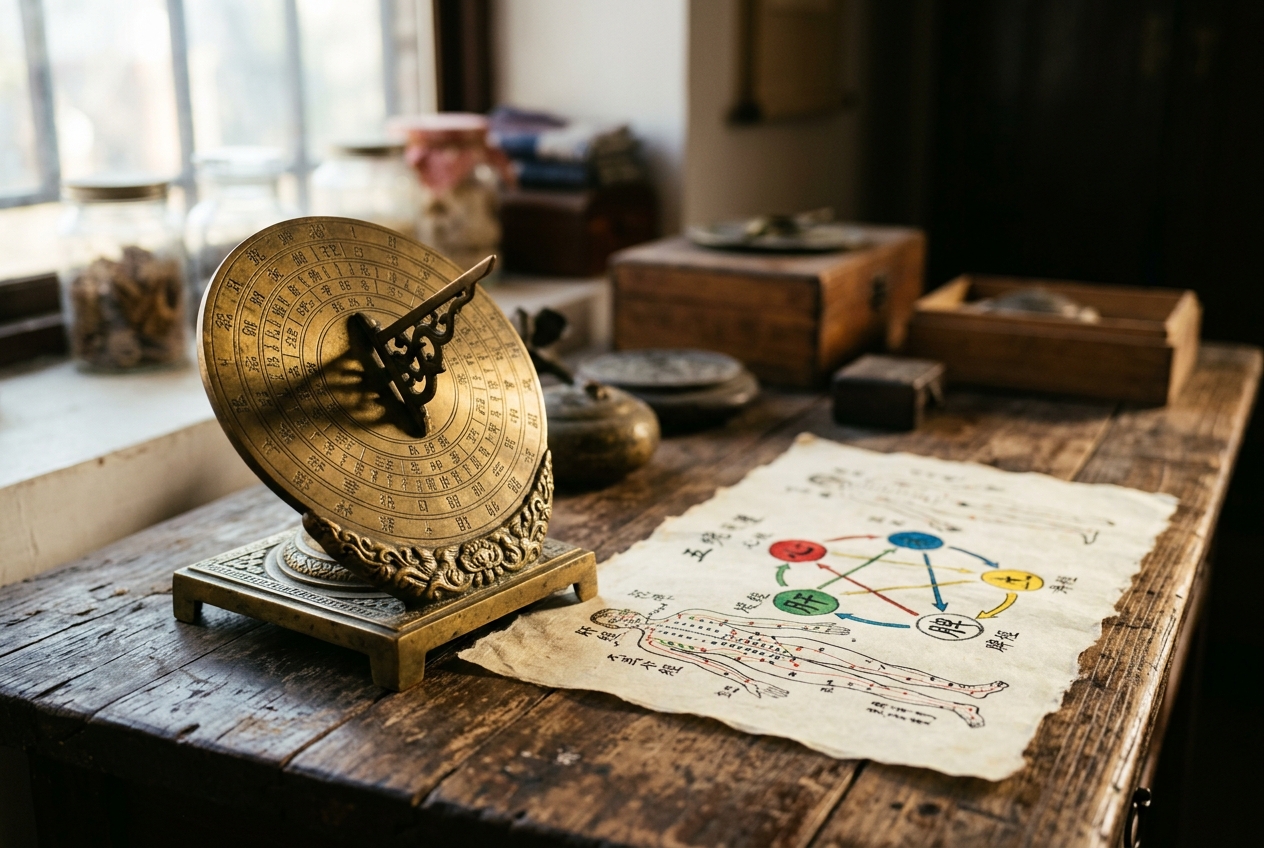
If you consistently awaken with sudden alert restlessness between 1:00 AM and 3:00 AM, experience an inexplicable cognitive slump coupled with postprandial heaviness between 9:00 AM and 11:00 AM, or suffer a surge of late-afternoon lumbar fatigue and mental exhaustion between 3:00 PM and 5:00 PM, you are experiencing the biological oscillations of your internal organ clock. In contemporary biomedicine, these chronobiological patterns are increasingly attributed to circadian clock gene expression (BMAL1, CLOCK, and PER2) within peripheral tissues and the hypothalamic suprachiasmatic nucleus (SCN). However, more than two millennia ago, classical East Asian medicine systematized this exact diurnal rhythm through the theoretical framework of the Chinese Organ Clock (Zi Wu Liu Zhu, 子午流注, or "Midnight-Noon Ebb-Flow") and the clinical application of Horary points (Ben Xue, 本穴).
Traditional Chinese Medicine (TCM) does not view human physiology as a static machine operating under constant thermodynamic equilibrium. Instead, it conceptualizes the organism as an open, rhythmic system through which Qi (bioelectrical and metabolic energy) and Xue (blood and nutrient perfusion) circulate along twelve primary meridian conduits in an invariant twenty-four-hour sequence. Within each meridian’s distinct energetic landscape lies a singular locus of elemental resonance: the Ben Xue, or Horary point. When stimulated during its corresponding peak diurnal window, this point serves as a powerful physiological lever, offering an accessible method for restoring autonomic balance, optimizing metabolic efficiency, and alleviating chronic somatic distress.
1. Classical Foundations: The Geometry of Zi Wu Liu Zhu and Ben Xue
The foundational doctrine of Horary points is rooted in two canonical pillars of Chinese medical literature: the Huangdi Neijing (黄帝内经, The Yellow Emperor's Inner Classic, c. 1st–2nd century BCE) and the Nan Jing (难经, The Classic of Difficult Issues, c. 2nd century CE). Chapter 64 of the Nan Jing establishes the structural classification of the Five Shu (Transport) points (Wu Shu Xue, 五输穴), locating them distally along the extremities between the digits and the elbows or knees. These points represent a progressive dynamic gradient of channel flow:
- Jing-Well (井): Where Qi bubbles forth like a spring at the fingertips or toes.
- Ying-Spring (荥): Where Qi begins to glide like a trickling rivulet.
- Shu-Stream (输): Where Qi pours rapidly like a cascading stream.
- Jing-River (经): Where Qi flows broadly and deeply like a navigable river.
- He-Sea (合): Where Qi converges inward, plunging deeply toward the internal Zang-Fu viscera.
According to Five Phase (Wu Xing) theory, every primary meridian is governed by an intrinsic elemental nature (Wood, Fire, Earth, Metal, or Water). Concurrently, each of the Five Shu points along that channel is also assigned an elemental phase. On Yin channels, the sequence begins at Wood at the Jing-Well point and concludes with Water at the He-Sea point. On Yang channels, the sequence begins at Metal at the Jing-Well point and concludes with Earth at the He-Sea point.
The Horary Point (Ben Xue, 本穴), translated literally as the "Root Point" or "Identity Point," is that unique Shu point whose individual elemental assignment is identical to the intrinsic elemental phase of its parent meridian. For example: * The Lung Meridian is Yin Metal; its Metal point is LU8 (Jingqu). * The Stomach Meridian is Yang Earth; its Earth point is ST36 (Zusanli). * The Heart Meridian is Yin Fire; its Fire point is HT8 (Shaofu). * The Kidney Meridian is Yin Water; its Water point is KI10 (Yingu).
When a practitioner stimulates a Ben Xue during the two-hour window when its parent meridian experiences peak cyclical perfusion (the Zi Wu tidal high), an elemental and temporal resonance occurs. In classical terminology, this is described as "gathering the tide" to reinforce constitutional vitality or drain pathogenic stagnation with minimal physiological resistance. Modern chronobiological research published via NCBI PubMed affirms that aligning therapeutic interventions with circadian peak activity enhances neurovascular response and downregulates inflammatory signaling.
2. Navigating the Meridian Pathways: A Somatosensory Journey
Rather than abstract anatomical terminology, the meridian system can be traced through familiar bodily contours, muscle grooves, and bony transitions.
- The Arm Yin Channels (Lung, Pericardium, Heart): Originating deep within the thoracic cavity, these pathways travel down the softer, sun-shielded inside surface of the arm. The Lung meridian traces the lateral muscular ridge along the biceps down to the base of the thumb. The Pericardium descends directly down the midline of the inner forearm, nestled between the two primary flexor tendons. The Heart meridian runs along the innermost border, crossing the medial elbow crease and traveling down to the tip of the little finger.
- The Arm Yang Channels (Large Intestine, Triple Energizer, Small Intestine): Emerging at the dorsal extremities of the fingers, these conduits travel up the firmer, sun-exposed exterior of the arm. The Large Intestine channel ascends along the muscular crest of the index finger and forearm radial edge to the shoulder and opposite nostril. The Triple Energizer runs up the center of the outer arm, over the shoulder girdle, and terminates at the lateral temple. The Small Intestine channel runs along the outer edge of the hand and ulnar forearm, traversing the scapular muscles before reaching the ear.
- The Leg Yang Channels (Stomach, Gallbladder, Bladder): These channels run downward from the head along the expansive posterior and lateral surfaces of the body. The Stomach channel cascades down the throat, chest, abdominal rectus sheath, down the shinbone (anterior tibialis), and terminates at the second toe. The Gallbladder channel weaves through the lateral temples, shoulders, flank, IT band, and outer ankle to the fourth toe. The Bladder channel runs as a bilateral column from the inner eye over the crown, down the spinal musculature, hamstrings, and calf, ending at the lateral pinky toe.
- The Leg Yin Channels (Spleen, Liver, Kidney): Rising from the sole and medial margins of the feet, these pathways move up the inner aspect of the legs. The Spleen channel runs along the medial foot arch, behind the inner ankle bone, up the calf, and across the anterior abdomen. The Liver channel ascends from the great toe along the instep, passing through the groin to the ribcage below the breast. The Kidney channel anchors in the arch of the foot, wraps behind the medial malleolus, ascends the deepest muscular plane of the medial calf and thigh, and travels up the anterior midline of the torso.
3. The Complete Master Reference: The Twelve Horary Points
The following systematic reference maps all twelve Acupuncture points designated as Ben Xue, standardized in accordance with the World Health Organization (WHO) Standard Acupuncture Point Locations.
| Meridian & Organ | Horary Point (Ben Xue) | Element Alignment | Diurnal Peak Window | Precise Anatomical Location | Somatosensory Deqi Sensation | Primary Energetic & Clinical Actions |
|---|---|---|---|---|---|---|
| Lung (Shoutaiyin, 手太阴肺经) | LU8 (Jingqu, 经渠) | Metal on Metal (Jing-River) | 03:00 – 05:00 (Yin / Tiger) | On the radial side of the palmar forearm, 1 thumb-width proximal to the wrist crease, in the depression between the radial artery and radial styloid process. | Distinct localized ache, spreading warmth radiating toward the base of the thenar eminence. | Clears pulmonary heat, descends rebellious lung Qi, alleviates acute bronchial spasm, dispels grief. |
| Large Intestine (Shouyangming, 手阳明大肠经) | LI1 (Shangyang, 商阳) | Metal on Metal (Jing-Well) | 05:00 – 07:00 (Mao / Rabbit) | On the radial side of the index finger, approximately 0.1 cun posterior to the corner of the nail bed. | Sharp, radiating tingling sensation; rapid neurosensory awakening. | Clears systemic heat, revives consciousness, alleviates pharyngeal swelling, promotes bowel peristalsis. |
| Stomach (Zuyangming, 足阳明胃经) | ST36 (Zusanli, 足三里) | Earth on Earth (He-Sea) | 07:00 – 09:00 (Chen / Dragon) | Four finger-widths inferior to the lateral knee eye (hollow below the patella), one finger-breadth lateral to the anterior crest of the tibia. | Deep, spreading dull ache, muscle heaviness, subtle electrical conduction down the lateral foot. | Tonifies post-natal Qi and Blood, regulates gastric acid, relieves fatigue, fortifies immunity. |
| Spleen (Zutaiyin, 足太阴脾经) | SP3 (Taibai, 太白) | Earth on Earth (Shu-Stream) | 09:00 – 11:00 (Si / Snake) | On the medial aspect of the foot, in the distinct depression proximal and inferior to the head of the first metatarsal bone. | Mildly tender, profound muscular relaxation sensation, feeling of centered grounding. | Harmonizes the digestive axis, transforms dampness, stops postprandial brain fog, stabilizes blood glucose swings. |
| Heart (Shoushaoyin, 手少阴心经) | HT8 (Shaofu, 少府) | Fire on Fire (Ying-Spring) | 11:00 – 13:00 (Wu / Horse) | On the palm of the hand, between the 4th and 5th metacarpal bones, exactly where the tip of the little finger rests when making a loose fist. | Piercing ache, soothing release of chest tightness, rhythmic micro-pulsation under the thumb. | Clears Heart Fire, stabilizes tachycardia and palpitations, calms existential anxiety, alleviates insomnia. |
| Small Intestine (Shoutaiyang, 手太阳小肠经) | SI5 (Yanggu, 阳谷) | Fire on Fire (Jing-River) | 13:00 – 15:00 (Wei / Goat) | On the ulnar border of the wrist, in the depression between the styloid process of the ulna and the triquetral bone. | Tender, spreading warmth across the ulnar aspect of the hand and forearm. | Clears heat from the sensory orifices, eases cervical and scapular tension, clears mental confusion. |
| Bladder (Zutaiyang, 足太阳膀胱经) | BL66 (Tonggu, 通谷) | Water on Water (Ying-Spring) | 15:00 – 17:00 (Shen / Monkey) | On the lateral side of the foot, in the depression anterior and inferior to the fifth metatarsophalangeal joint. | Sharp tenderness, followed by a systemic downward-draining sensation of tension. | Clears cranial heat, treats occipital headaches, calms motor agitation, relieves acute lumbar tension. |
| Kidney (Zushaoyin, 足少阴肾经) | KI10 (Yingu, 阴谷) | Water on Water (He-Sea) | 17:00 – 19:00 (You / Rooster) | On the medial side of the popliteal crease, between the semitendinosus and semimembranosus tendons when the knee is slightly bent. | Deep, spreading warmth, satisfying release of inner knee and pelvic floor tension. | Nourishes Kidney Yin, clears lower jiao damp-heat, stabilizes adrenal fatigue, eases lower back weakness. |
| Pericardium (Shoujueyin, 手厥阴心包经) | PC8 (Laogong, 劳宫) | Fire on Fire (Ying-Spring) | 19:00 – 21:00 (Xu / Dog) | In the center of the palm, between the 2nd and 3rd metacarpal bones, where the tip of the middle finger rests when closing the hand. | Warm, pulsating energetic activation; immediate subjective reduction in autonomic heart rate. | Calms the Shen (Spirit), alleviates acute emotional distress, regulates autonomic tone, relieves nausea. |
| Triple Energizer (Shoushaoyang, 手少阳三焦经) | TE6 (Zhigou, 支沟) | Fire on Fire (Jing-River) | 21:00 – 23:00 (Hai / Pig) | On the dorsal aspect of the forearm, 3 thumb-widths proximal to the dorsal wrist crease, between the radius and ulna bones. | Expanding ache moving up the forearm toward the shoulder and lateral neck. | Regulates fluid metabolism, moves stagnant Qi in the hypochondrium, alleviates constipation and side headaches. |
| Gallbladder (Zushaoyang, 足少阳胆经) | GB41 (Zulinqi, 足临泣) | Wood on Wood (Shu-Stream) | 23:00 – 01:00 (Zi / Rat) | On the dorsum of the foot, in the depression distal to the junction of the 4th and 5th metatarsal bones, lateral to the extensor digiti minimi tendon. | Sharp, dispersing distension traveling along the lateral foot and outer leg. | Spreads Liver/Gallbladder Qi, resolves temporal migraines, regulates the Dai Mai (Belt Vessel), reduces irritability. |
| Liver (Zujueyin, 足厥阴肝经) | LR1 (Dadun, 大敦) | Wood on Wood (Jing-Well) | 01:00 – 03:00 (Chou / Ox) | On the lateral aspect of the terminal phalanx of the great toe, 0.1 cun from the corner of the toenail. | Very sharp, immediate neuromuscular reflex; rapid clearing of cranial pressure. | Regulates hepatic blood storage, clears liver heat/anger, resolves pelvic floor spasm, anchors ascending Yang. |
4. Key Horary Points for Immediate Somatic Regulation
For practical daily self-care, three Horary points stand out for their profound capacity to shift autonomic and metabolic function.
                  ANATOMICAL LOCATIONS: ST36, HT8, KI10

          [ ST36 - Zusanli ]                     [ HT8 - Shaofu ]
       (Below Patella, Shin)                    (Palm, 4th/5th Metacarpal)
              ( O ) Patella                            \  /  \  /
             /     \                                    ||    ||
            |   |   |                                  (  HT8   )
        4 F [   |   ]                                   \      /
            [•ST36  ] Tibial crest                       \____/
             \     /                                     Wrist
              \   /

                         [ KI10 - Yingu ]
                      (Medial Knee Crease)
                             \     /
                           ___\___/___ (Popliteal Crease)
                          [ • KI10   ] (Between Tendons)
                              |   |
ST36 (Zusanli, 足三里) — "Leg Three Miles" (Earth on Earth)
- Physical Landmark: Sit comfortably with your knees bent at a right angle. Place the palm of your right hand over your right kneecap. Your ring finger will naturally land on the muscular prominence just outside the sharp crest of the shinbone. Slide your finger into that distinct soft groove.
- What You Will Feel: A deep, spreading, dull muscular ache accompanied by a pleasant sensation of warmth and digestive relaxation. In acupuncture nomenclature, this is known as Deqi (得气), a physiological indicator of mechanoreceptor and neurovascular activation (documented in studies on the mechanisms of Deqi).
- How to Press: Apply firm, sustained perpendicular pressure using your thumb or knuckles. Hold for 2–3 minutes while taking slow, deep abdominal breaths. If treating sluggish digestion or daytime fatigue, apply rhythmic circular pressure during its peak window (07:00–09:00 AM).
- Primary Clinical Indications: Chronic gastrointestinal distension, post-meal mental lethargy, low physical stamina, and generalized immune depletion.
HT8 (Shaofu, 少府) — "Lesser Palace" (Fire on Fire)
- Physical Landmark: Hold your hand with the palm facing upward. Curl your fingers loosely into your palm as if holding an egg. Notice where the tip of your little finger makes contact with the palm surface. That tender depression between your fourth and fifth palm bones (metacarpals) is HT8.
- What You Will Feel: An immediate, sharp tenderness that quickly yields to a soothing sensation of thoracic expansion and rhythmic release in the center of the chest.
- How to Press: Use the tip of your opposite thumb to apply direct, steady inward pressure angled slightly toward the wrist. Maintain for 90 to 120 seconds while focusing on prolonged exhalations. Ideal during the midday peak (11:00 AM–1:00 PM).
- Primary Clinical Indications: Palpitations triggered by acute cognitive overload, inner agitation, social anxiety, and mid-afternoon emotional exhaustion.
KI10 (Yingu, 阴谷) — "Yin Valley" (Water on Water)
- Physical Landmark: Sit with your knee bent. Run your fingers along the inner crease of the knee toward the back. You will feel two prominent, taut cord-like tendons (the semitendinosus and semimembranosus). KI10 sits directly in the soft, deep hollow between these two tendons right at the level of the knee bend line.
- What You Will Feel: A profound, deep-seated tenderness that feels like a weight releasing from your lower back, often sending a gentle warming sensation into the pelvic basin and soles of the feet.
- How to Press: Hook your index or middle finger deeply into the hollow. Apply steady, moderate upward-and-inward traction for 2 minutes on each leg, synchronized with diaphragmatic breathing. Excellent between 5:00 PM and 7:00 PM.
- Primary Clinical Indications: Lower back soreness after prolonged desk work, adrenal depletion, nocturnal heat sensations, and emotional vulnerability.
5. Clinical Protocol: The Evening Neuro-Visceral Reset
For individuals suffering from the ubiquitous modern triad of evening mental hyperarousal, digestive stagnation, and fragmented sleep architecture, stimulating the evening Horary axis systematically shifts the central nervous system from sympathetic fight-or-flight dominance to parasympathetic rest-and-digest recovery.
Complete Step-by-Step Evening Protocol:
- Preparation and Posture (20:00 – 21:30):
- Find a quiet, dimly lit space. Sit cross-legged on a cushion or lie semi-reclined with pillows supporting your lower back and knees.
- Adopt a 4-7-8 breathing cadence (inhale for 4 counts, hold for 7, exhale through the mouth for 8) for three full cycles to lower baseline heart rate variability.
- Phase 1: Calming Cognitive Hyper-Drive via PC8 (Laogong):
- Locate PC8 in the center of your left palm.
- Press your right thumb firmly into the point, applying a slow, clockwise circular vector.
- Breathe in for 4 seconds, and as you exhale over 6 seconds, gradually deepen your pressure to a firm 6/10 intensity threshold.
- Maintain for 90 seconds on the left hand, then switch and repeat on the right hand.
- Therapeutic Action: Discharges accumulated psychological stress and moderates autonomic cardiac tone.
- Phase 2: Anchoring Energy into the Lower Reservoir via KI10 (Yingu):
- Move your hands down to the inner crease of your bent knees.
- Hook both thumbs or index fingers simultaneously into the deep hollows of KI10 on both legs.
- Apply a steady, upward-angled static hold. Close your eyes and visualize tension draining down from your temples into the earth.
- Maintain this static hold for 2 full minutes.
- Therapeutic Action: Reinforces Kidney Water to calm the ascendant Fire of the Heart, easing nocturnal anxiety and restlessness.
- Phase 3: Harmonizing the Digestive Core via SP3 (Taibai):
- Trace the medial margin of each foot to the soft depression behind the base joint of the big toe.
- Gently grip the foot with your fingers and press your thumb straight down into SP3.
- Apply a firm, pulsing pressure (3 seconds compression, 1 second release) for 90 seconds per foot.
- Therapeutic Action: Resolves evening abdominal bloating and stabilizes nocturnal glucose metabolism to prevent early morning waking.
6. Biophysical Mechanisms, Neuroendocrinology, and Safety Considerations
Modern physiological science increasingly elucidates the pathways underlying classical acupuncture principles. Research into connective tissue mechanics demonstrates that acupuncture points correspond to anatomical convergence zones where interstitial connective tissue planes intersect with high densities of unmyelinated nerve endings, mast cells, and microvascular beds.
When sustained perpendicular pressure is applied to an acupoint: 1. Mechanotransduction: Deformation of the extracellular matrix triggers cellular release of adenosine triphosphate (ATP), adenosine, and nitric oxide, producing local vasodilation and tissue oxygenation. 2. Afferent Neurotransmission: Sensory inputs travel along A-delta and C nerve fibers to the dorsal horn of the spinal cord, modulating the spinothalamic tract and dampening central nociceptive perception (the "pain gate" mechanism). 3. Hypothalamic-Pituitary-Adrenal (HPA) Axis Regulation: Distal stimulation of Horary points has been shown to downregulate sympathetic outflow, lower elevated salivary cortisol levels, and enhance vagal nerve output, thereby stabilizing core circadian oscillations.
Safety, Boundaries, and Clinical Contraindications
- Pressure Thresholds: Effective acupressure requires firm, intentional pressure—not bruising force. The subjective sensation should always be Deqi (a dull, achey, heavy, or spreading sensation) rather than sharp, burning, or unbearable pain. If bruising occurs, pressure must be reduced.
- Critical Pregnancy Precautions: Expectant mothers must completely avoid strong stimulation on the following points due to their uterine-contractile actions:
- SP6 (Sanyinjiao): Medial lower leg.
- LI4 (Hegu): First dorsal interosseous muscle web.
- BL60 (Kunlun) & BL67 (Zhiyin): Lateral ankle and small toe.
- GB21 (Jianjing): Trapezius muscle crest.
- Skin and Vascular Integrity: Never apply acupressure over open wounds, active infections, localized edema, acute phlebitis, varicose veins, or sites of recent fractures.
- When to Seek Professional Medical Care: Acupressure is an integrative, functional self-care practice; it is not a substitute for emergency medicine or medical diagnosis. Consult a physician or licensed acupuncturist for acute, unremitting chest pain, sudden unilateral neurological weakness, severe abdominal rigidity, high fever, or chronic, unexplained weight loss.
7. Today’s Takeaway: Your 2-Minute Digestive and Energy Reset
If you take only one practical tool from this guide, use the Stomach Earth Horary Point: ST36 (Zusanli).
YOUR 2-MINUTE PROTOCOL RIGHT NOW
========================================================================================
TARGET:     ST36 (Zusanli) — 4 finger-widths below knee, 1 finger lateral to shin.
TIMING:     2 Minutes Total (60 seconds per leg).
TECHNIQUE:  Firm, circular thumb pressure with deep diaphragmatic breathing.
GOAL:       Immediate relief of postprandial fatigue and restoration of grounded clarity.
========================================================================================
- Find the Spot: Place your hand over your kneecap; feel 4 finger-widths down along the outer muscle of your shin. Locate the tender, muscular pocket alongside the bone.
- The Action: Press your thumb firmly into the point until you feel a clear, dull ache.
- The Cadence: Inhale slowly through your nose for 4 counts, allowing your belly to expand. Exhale smoothly for 4 counts while leaning your body weight into your thumb.
- Duration: Maintain for 60 seconds on the right leg, then repeat for 60 seconds on the left leg.
Perform this 2-minute reset whenever you feel an energy dip, mental fog, or digestive sluggishness. By engaging the natural rhythms of your meridian system, you align your daily well-being with the classical science of chronobiology.