Four Natures and Five Flavors (Si Qi Wu Wei) Herbal Energetics: Governing Thermal Properties, Gustatory Actions, and Visceral Directionality in Traditional Chinese Medicine
1. Opening Scene — A Moment You'll Recognise
It is 2:15 on a Tuesday afternoon. You have just finished a seemingly wholesome lunch—a large, chilled bowl of raw leafy greens, raw vegetables, a dash of vinaigrette, and a glass of iced water. Within thirty minutes, an unmistakable heaviness descends. Your eyelids feel weighted, a subtle mist seems to cloud your working memory, your lower abdomen expands with a vague, uncomfortable fullness, and your limbs feel as though they are wading through wet sand. Conventional nutrition tells you that you have just ingested a low-glycemic, micronutrient-dense meal. Yet your subjective physiological experience tells an entirely different story: one of systemic deceleration, vascular lethargy, and metabolic fatigue.
In the diagnostic paradigm of Traditional Chinese Medicine (TCM), this familiar postprandial collapse is not an inexplicable quirk of daily stress; it is your Sple–Stomach system (Pí Wèi) sounding an alarm. When we subject our internal metabolic fire to cold temperatures, raw cellulose, and emotional distraction, the digestive hub cannot vaporize, extract, or circulate life-giving energy. Instead of crisp vitality, the body produces internal "Dampness"—a viscous metabolic stagnation that bogs down both cerebral clarity and physical stamina.
Understanding how your body transforms food into vitality requires looking through the lens of ancient Chinese organ physiology and the sophisticated pharmacological matrix of the Four Natures (Sì Qì) and Five Flavors (Wǔ Wèi).
2. What This Organ System Does
In Western biomedicine, the spleen is understood primarily as a lymphoid filter for blood and a reservoir for immune cells. In Eastern medicine, however, the Spleen (Pí, 脾) represents an expansive functional sphere: the central metabolic and thermodynamic engine of the entire human organism. Paired in a classic Yin-Yang relationship with the Stomach (Wèi, 胃), the Spleen is designated in classical literature as the "Root of Post-Heaven Essence" (Hòu Tiān Zhī Běn)—the organ network responsible for extracting, manufacturing, and distributing every unit of post-natal energy (Qì) and Blood (Xuè) that sustains life.
The Spleen's Core Functional Mandates
- Governing Transportation and Transformation (Yùn Huà, 运化): The Stomach receives nourishment and begins the enzymatic breakdown (termed "rotting and ripening"), while the Spleen extracts the refined, subtle nutritive essence (Gu Qì) from food and fluids, transforming it into physiological Qi and Blood while directing waste downward.
- Ascending the Pure (Shēng Qīng, 升清): The vector of the Spleen is dynamically directed upward. It lifts the clear energetic distillate to the Lungs and Heart, where it oxygenates and nourishes the brain, sensory orifices, and upper torso. When Spleen Qi ascends correctly, cognitive function is sharp, structural tone is maintained, and internal organs remain firmly suspended in their anatomical cavities.
- Holding the Blood in the Vessels (Tǒng Xuè, 统血): The Spleen provides bioelectrical and structural integrity to the microvasculature. If Spleen Qi weakens, blood escapes its biological channels, manifesting clinically as easy bruising, petechiae, or chronic low-grade hemorrhages.
- Governing the Flesh and the Four Limbs (Zhǔ Ròu, Zhǔ Sì Zhī): Muscle mass, functional grip strength, tissue tone, and the warmth of the extremities are direct barometers of Spleen vitality.
- Housing Thought and Intention (Yì, 意): The Spleen is the somatic vessel for focused concentration, analytical synthesis, and systematic ideation. Pathological overthinking or obsessive rumination directly injures Spleen Qi, while a depleted Spleen renders sustained cognitive focus nearly impossible.
The Pharmacological Matrix: The Four Natures, Five Flavors, and Visceral Dynamics
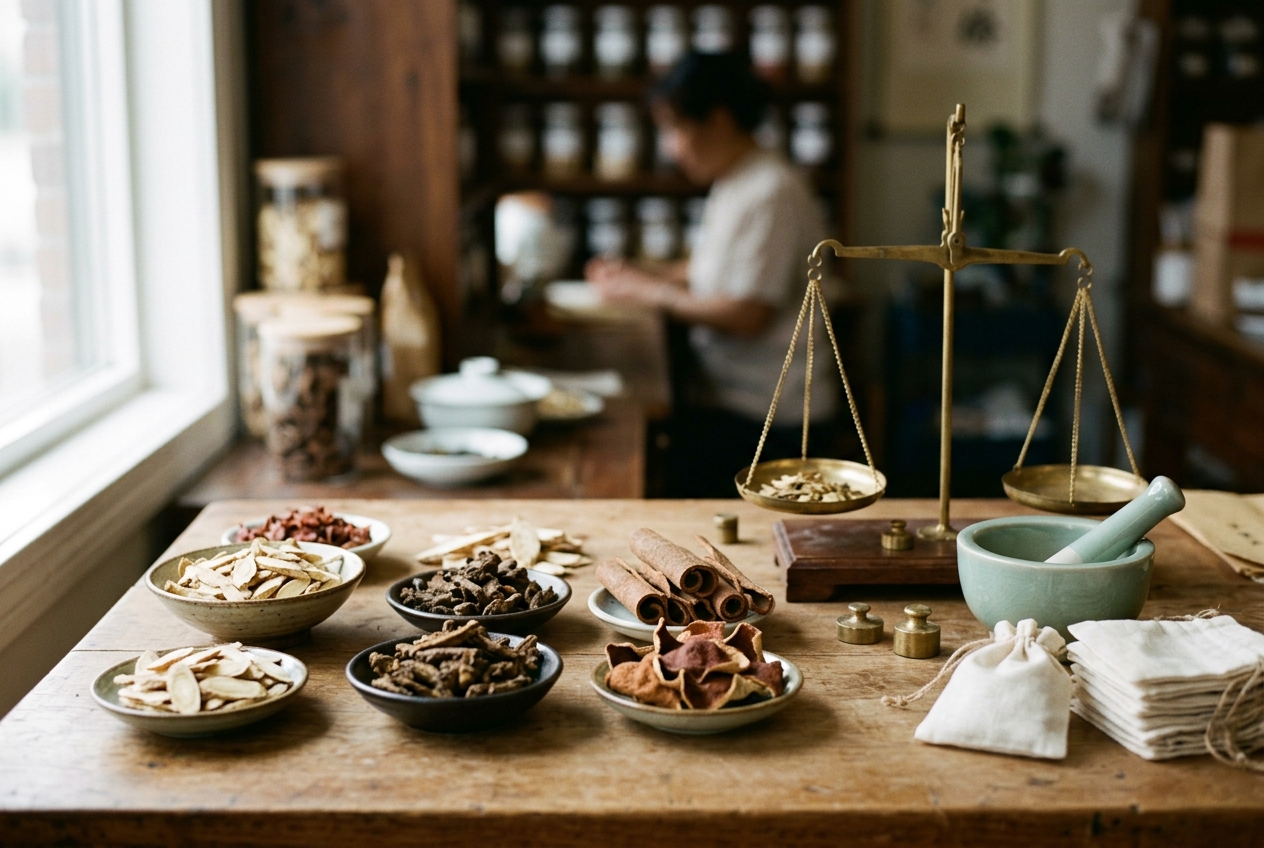
To restore and modulate this delicate visceral apparatus, Chinese herbology developed one of the most sophisticated holistic pharmacopeias in history, codified in foundational treatises such as the Huangdi Neijing (The Yellow Emperor’s Inner Classic) and the ancient Shen Nong Ben Cao Jing (Divine Farmer's Classic of Materia Medica). At the core of this system are the Four Natures (Sì Qì), the Five Flavors (Wǔ Wèi), Directional Dynamics (Shēng Jiàng Chén Fú), and Channel Tropism (Guī Jīng).
====================================================================================
                        THE FIVE FLAVORS & THERMAL SPECTRUM
====================================================================================
  Flavor     Element   Direction     Dynamic Action              Phytochemical Matrix
------------------------------------------------------------------------------------
  Acrid      Metal     Ascend/Float  Disperses, moves Qi/Blood   Volatile oils, Terpenes
  Sweet      Earth     Center/Slow   Tonifies, harmonizes, eases Polysaccharides, Glycosides
  Bitter     Fire      Descend/Sink  Clears heat, drains, dries  Alkaloids, Bitter lactones
  Sour       Wood      Contract/In   Astrings, consolidates      Organic acids, Tannins
  Salty      Water     Sink/Soft     Softens masses, purges      Minerals, Halides, Iodine
------------------------------------------------------------------------------------
  Bland      Earth     Percolates    Leaches dampness, diuresis  Neutral polysaccharides
  Astringent Wood      Binds         Prevents fluid loss         High-molecular tannins
====================================================================================
1. The Thermal Spectrum (Four Natures — Sì Qì, 四气)
Herbal substances and dietary inputs exist on a five-point thermodynamic spectrum: Cold (Hán), Cool (Liáng), Neutral (Píng), Warm (Wēn), and Hot (Rè).
- Cold and Cool agents clear febrile pathogens, reduce inflammatory cascade markers, drain internal Fire, purge toxins, and nourish Yin fluids.
- Warm and Hot agents dissipate pathogenic cold, rekindle failing metabolic fires, warm the visceral interior, revitalize microcirculation, and resurrect exhausted Yang Qi.
- Neutral substances provide balanced physiological modulation without imposing acute thermal shifts, making them ideal for long-term functional recovery.
According to the classical thermodynamic dictum of the Huangdi Neijing: "Cold diseases are treated with Hot agents; Hot diseases are treated with Cold agents" (Hán zhě rè zhī, Rè zhě hán zhī). Imbalances in the Spleen almost universally skew toward metabolic Cold and Dampness, demanding warming, Qi-fortifying intervention.
2. The Five Flavors (Wǔ Wèi, 五味) & Auxiliary Tastes
The Five Flavors are not merely sensory experiences; they represent distinct chemical affinities, energetic vectors, and metabolic mechanics:
- Acrid / Pungent (Xīn, 辛) — Metal Affinity: Disperses external pathogens, invigorates circulation, and mobilizes stagnant Qi and Blood. Modern phytochemical research indexed in NCBI PubMed illustrates that acrid herbs (e.g., Zingiber officinale, Cinnamomum cassia) are saturated with volatile essential oils, gingerols, and monoterpenes that induce peripheral vasodilation, stimulate transient receptor potential (TRP) channels, and accelerate cellular respiration.
- Sweet (Gān, 甘) — Earth Affinity (Primary Spleen Resonance): Tonifies nutritional deficiencies, harmonizes antagonistic medicinal components, moistens dry tissues, and moderates acute pain or muscular spasms. Phytochemically, sweet substances (e.g., Astragalus membranaceus, Glycyrrhiza uralensis) are rich in complex polysaccharides, saponins, and adaptogenic triterpenes that bolster immune function, modulate the hypothalamic-pituitary-adrenal (HPA) axis, and replenish depleted glycogen reserves.
- Sour (Suān, 酸) — Wood Affinity: Constricts, gathers, and consolidates leakage. Sour botanicals (e.g., Schisandra chinensis) contain concentrated organic acids and polyphenols that stabilize cell membranes, reduce excessive diaphoresis, and preserve biological fluids.
- Bitter (Kǔ, 苦) — Fire Affinity: Drains heat downward, clears pathogenic fire, purges accumulations via the bowels, and robustly dries pathological dampness. Phytochemically represented by berberine alkaloids, iridoid glycosides, and sesquiterpene lactones (e.g., Coptis chinensis), bitter agents activate gut-based bitter taste receptors (TAS2Rs), downregulate pro-inflammatory cytokines, stimulate bile and gastric secretion, and exhibit profound antimicrobial action.
- Salty (Xián, 咸) — Water Affinity: Softens hard fibrous masses, dissolves indurated tissue accumulations, and lubricates the bowels for descending evacuation. Saturated with bio-available minerals, halogen compounds, and iodine (e.g., Sargassum), salty agents modulate fluid dynamics and reduce calcified nodules.
- Auxiliary Flavors: Bland (Dàn, 淡) percolates dampness outward via the urinary pathways through neutral polysaccharides (e.g., Poria cocos), while Astringent (Sè, 涩) acts purely on physical binding to arrest diarrhea and hemorrhage via dense condensed tannins.
3. Directional Dynamics (Shēng Jiàng Chén Fú, 升降沉浮) & Channel Tropism (Guī Jīng, 归经)
Substances exert distinct directional vectors across the human meridian topography:
- Ascending (Shēng) and Floating (Fú): Typically light, acrid, sweet, warm, or hot (e.g., flower buds, aerial leaves). They direct energy upward and outward, counteracting organ prolapse, lifting cognitive fatigue, and resolving exterior pathogens.
- Descending (Jiàng) and Sinking (Chén): Typically dense, heavy, bitter, sour, salty, cool, or cold (e.g., roots, minerals, heavy seeds). They direct energy downward and inward, anchoring ascending Yang, calming psychic agitation, arresting vomiting, and purging bowel heat.
- Channel Tropism (Guī Jīng): Dictates the specific meridian and visceral network an agent preferentially targets. For example, Atractylodes macrocephala (Bái Zhú) is sweet, bitter, and warm, with direct entry into the Spleen and Stomach channels, perfectly matching the Spleen's need for warming, lifting, and moisture-drying actions.
4. Phytochemical Synergies in Classical Master Formulations
The genius of TCM pharmacology lies in pairing opposing yet complementary natures and flavors within a single matrix. Consider the gold-standard Spleen-restorative formula Six Gentlemen Decoction (Liù Jūn Zǐ Tāng):
- Sweet & Warm Tonifiers (Astragalus, Ginseng, Glycyrrhiza) deliver immune-enhancing polysaccharides and triterpenoid saponins to fuel cellular ATP production and invigorate Spleen transformation.
- Bitter & Acrid Drainers (Citrus reticulata peel / Chén Pí, Pinellia ternata / Bàn Xià) provide polymethoxyflavones and volatile alkaloids that accelerate gastric motility, eliminate damp mucosal stagnation, and prevent sweet tonics from causing cloying digestive congestion.
Through this balanced interplay of thermal, chemical, and vector dynamics, clinical herbal medicine achieves systemic physiological restoration, a strategy currently being validated across international pharmacological literature indexed in databases like NCBI PubMed Central and recognized by the World Health Organization.
3. How You Can Feel It — Signs of Balance and Imbalance
Because the Spleen commands the transformation of nutritional intake and fluid distribution, signs of its balance—or systemic distress—are palpable in daily life.
+-----------------------------------------------------------------------------------+
|                            THE SPLEEN VITALITY CHECK                              |
|                                                                                   |
|  [ HARMONIOUS SPLEEN STATE ]            [ DEFICIENT & DAMP SPLEEN STATE ]         |
|  * High postprandial energy             * Post-meal somnolence & brain fog        |
|  * Crisp mental focus & retention       * Chronic mental rumination & looping     |
|  * Firm, well-formed bowel movements    * Loose, sticky stools with food residues |
|  * Dynamic, warm extremities            * Heavy, leaden limbs & cold hands/feet   |
|  * Resilient muscle tone & taut skin    * Abdominal distension, bloating, edema   |
|  * Clean, moist tongue with thin coat   * Scalloped tongue edges with thick slime |
+-----------------------------------------------------------------------------------+
The Somatic Spectrum of Spleen Function
Rapid Self-Assessment Protocol
Take sixty seconds right now to evaluate the following parameters:
- The Post-Lunch State: Do you experience a burst of calm energy after dining, or do you crave a nap, a double espresso, or a sugary snack within forty-five minutes?
- The Muscle Check: When climbing stairs or walking briskly, do your thighs feel light and capable, or heavy, congested, and mechanically reluctant?
- The Mirror Assessment: Extend your tongue before a mirror. Are the lateral edges smooth and oval, or do they show distinct, crenulated "scallops" (teeth-marks) carved into the sides? A scalloped, pale tongue indicates that the Spleen is failing to metabolize fluids, causing the tongue tissue to swell against the dental arches.
4. Qigong & Movement Practice
To physically rehabilitate the ascending and descending axes of the Spleen and Stomach, traditional medical movement utilizes the classical Baduanjin (Eight Brocades) posture: "Regulating the Spleen and Stomach by Raising Single Arms" (Tiáo Lǐ Pí Wèi Xū Dān Jǔ, 调理脾胃须单举). This movement mechanically decompresses the upper abdominal cavity, stimulates the fascial planes of the stomach and spleen meridians along the anterior torso, and harmonizes visceral pressure gradients.
Step-by-Step Biomechanical Execution
- Starting Posture & Setup: Stand with feet parallel, shoulder-width apart. Unlock your knees slightly, tuck your tailbone beneath the spine to flatten the lumbar arch, and relax your shoulders downward. Rest your palms gently in front of your lower abdomen (the Lower Dāntián), palms facing upward, fingers loosely pointing toward one another as if holding a spherical vessel. Take two deep nasal diaphragmatic breaths.
- The Phase 1 Movement (Inhale — Visceral Stretch):
- Inhale smoothly through your nose for a count of four.
- Slowly raise your left hand up along the centerline of your chest. As it reaches the throat, rotate the palm to face the sky, gently pushing the palm upward above your head until the elbow is softly extended (do not lock the joint). The fingers point inward toward your right side.
- Simultaneously, rotate your right palm downward toward the ground, pressing firmly down by your right hip, fingers pointing forward.
- Feel an active, dynamic opposing stretch: the upper hand supports Heaven (Tiān), while the lower hand anchors to Earth (Dì). This creates a gentle diagonal shearing and fascial stretching of the stomach, liver, and spleen beds.
- The Phase 2 Hold (Retain — Micro-Suspension):
- Hold the peak posture for two seconds without muscular strain. Direct your internal awareness directly beneath your left ribcage (the anatomical seat of the spleen).
- The Phase 3 Movement (Exhale — Return & Settle):
- Exhale smoothly through your nose for a count of six.
- Slowly reverse the movement: bring the left hand descending down the centerline and sweep the right hand upward, meeting once again at the Lower Dāntián in the starting position.
- Alternating Side (Right Hand Ascending):
- Repeat the sequence immediately on the opposite side: right hand ascending toward Heaven, left hand pressing down to Earth. This massages the liver and descending stomach pathway.
5. Acupressure Points You Can Try Today
Acupressure applies concentrated mechanical pressure along meridian pathways to mobilize bio-electrical current, restore microvascular perfusion, and rebalance visceral signaling. Work each of the following points with the specified guidelines.
1. Zúsānlǐ (ST-36) — "Leg Three Miles"
- Anatomical Landmark: Sit with your knees bent at ninety degrees. Locate the lower outer edge of your kneecap. Measure four finger-widths directly downward along the anterior leg. Place your finger one thumb-width lateral (outward) from the sharp crest of the tibial bone (shinbone). You will land in a distinct muscular depression in the tibialis anterior muscle.
- Application Technique: Apply firm, deep perpendicular pressure using your thumb or knuckle. Press with sustained, rhythmic circular rotations for two to three minutes per leg. Maintain a pressure level that produces a distinct, resonant dull ache (Dé Qì sensation) that may radiate slightly down toward the ankle.
- Clinical Utility: The master point for the entire gastrointestinal system. Used globally for acute digestive lethargy, postprandial fatigue, abdominal bloating, low systemic immunity, and general physical exhaustion.
2. Yǐnlíngquán (SP-9) — "Yin Mound Spring"
- Anatomical Landmark: Run your thumb up along the inner edge of your shinbone (the medial border of the tibia) from mid-calf moving upward toward the knee. As you reach the top of the bone, your thumb will naturally slip into a deep, tender hollow just below the flare of the knee joint (the medial tibial condyle).
- Application Technique: This point is almost universally sensitive in individuals carrying dampness. Apply steady, moderate-to-firm pressure angled slightly upward into the bone contour. Hold continuously for ninety seconds while maintaining steady nasal breathing, then release and repeat three times.
- Clinical Utility: The premier acupressure point on the human body for draining and transforming pathological Dampness. Alleviates heaviness in the lower limbs, water retention in the ankles, loose stools, and foggy-headed sluggishness.
3. Tàibái (SP-3) — "Supreme White"
- Anatomical Landmark: Locate the point on the inner (medial) side of your foot. Trace your finger along the inner side of your big toe backward toward the heel. Slide over the prominent, rounded knuckle joint at the base of the big toe (the first metatarsophalangeal joint). The point lies directly behind this joint, precisely at the junction where the red-pink skin of the sole meets the white skin of the top of the foot.
- Application Technique: Use the tip of your thumb to apply firm, focused pressure directly into the bone margin. Use a gentle vibrating or kneading pulse for two full minutes on each foot.
- Clinical Utility: The Yuan-Source point of the Spleen meridian. Directly supplements native Spleen Qi, resolves deep mental exhaustion from over-studying or chronic worry, reduces post-meal gas distension, and restores appetite control.
6. Food & Lifestyle — Small Changes for Today
Dietary therapy (Shí Liáo, 食疗) is the foundational frontline of Chinese medicine. The Spleen is intrinsically averse to Cold and Dampness, thriving instead on thermal warmth, moderate dryness, and mild natural sweetness.
+-----------------------------------------------------------------------------------+
|                         THE SPLEEN DIETARY BLUEPRINT                              |
|                                                                                   |
|  [ WHAT TO ACTIVELY INTEGRATE ]           [ WHAT TO MINIMIZE OR ELIMINATE ]       |
|  * Warm, cooked, slow-simmered meals      * Iced beverages & refrigerated water   |
|  * Gentle natural sweetness (squash, oats)* Excessive raw vegetables & salads     |
|  * Warming culinary spices (ginger, cumin)* Refined sugars & artificial sweets    |
|  * Astringent/draining legumes (adzuki)   * Heavy cow dairy, cheese & milkshakes  |
|  * Chewing thoroughly to fluid consistency* Rushed, multi-tasking eating at desks |
+-----------------------------------------------------------------------------------+
The Culinary Pharmacology of Spleen Restoration
1. Shift Temperature and Preparation
- Retire the Ice-Cold Beverage: Ingesting refrigerated water drops gastric temperature rapidly, halting enzymatic activity and forcing your body to burn its own baseline Yang reserves simply to bring the liquid up to physiological core temperature (37°C / 98.6°F). Drink warm water, room-temperature infusions, or mild teas throughout the day.
- Embrace the Power of Cooking: Move away from raw, fibrous salads as lunchtime staples. The cellulolytic matrix of raw plant leaves requires heavy digestive expenditure. By steaming, boiling, roasting, or slow-simmering foods into soups, stews, and porridges (Congee), you perform external pre-digestion, allowing the Spleen to absorb nutrients with minimal metabolic friction.
2. Leverage Everyday Foods with Precise Energetic Profiles
- The Harmonizing Sweet & Warm Baseline: Incorporate naturally sweet, grounding root vegetables and grains: roasted butternut squash, sweet potatoes, carrots, parsnips, well-cooked oats, and long-grain rice. These provide complex polysaccharides and sustained cellular energy without triggering glucose spikes.
- The Aromatic Qi-Movers (Acrid / Pungent): Season meals with common culinary aromatics: fresh ginger (Zīngiber), cardamom pods, cinnamon, black pepper, rosemary, fennel seed, and cumin. These volatile-oil-rich spices mobilize stagnant Qi, stimulate enzymatic secretions, and dispel internal cold.
- The Fluid Draining Matrix (Bland / Astringent): Integrate adzuki beans, barley, and roasted pumpkin seeds. These foods draw out stagnant fluid accumulation from the interstitial tissue spaces and assist the Spleen in fluid clearance.
3. Eliminate the Prime Damp-Makers
- Dairy & Excess Refined Sugar: Pasteurized cow's milk, ice cream, aged cheeses, and refined sucrose create sticky, turbid dampness in the digestive tract, analogous to pouring wet mortar into a combustion engine.
- Chronic Overeating: Eating beyond 80% fullness (Hara Hachi Bu) overwhelms the Spleen's mechanical processing capacity, forcing undigested chyme into putrefactive stagnation.
4. Mealtime Environment & Cognitive Hygiene
- The "No Screens While Eating" Rule: The Spleen's psychic counterpart is the Yì (thought and intellect). If you process complex visual information, answer urgent emails, or browse social media while chewing, neurological and vascular resources are diverted away from the splanchnic circulation directly to the cerebral cortex. Eat in a quiet environment, seated upright, chewing each mouthful thoroughly to liquid consistency.
7. Today's Takeaway
+-----------------------------------------------------------------------------------+
|                           YOUR 5-MINUTE DAILY PROTOCOL                            |
|                                                                                   |
|  1. Pour one mug of hot or warm water.                                            |
|  2. Slice two thin coins of fresh raw ginger root; drop them into the mug.        |
|  3. Stand tall and perform 8 cycles of "Separating Heaven and Earth" Qigong.      |
|  4. Finish by holding your thumbs into ST-36 (Zúsānlǐ) for 60 seconds per leg.    |
|  5. Sip the ginger water slowly in peaceful silence.                             |
|                                                                                   |
|  Effect: Rekindles metabolic fire, ascends pure clear Qi, and dispels brain fog.  |
+-----------------------------------------------------------------------------------+
If you do only one thing today for your digestive vitality and mental clarity, enact this simple five-minute ritual right now: Brew a single mug of hot water with two slices of fresh ginger, set your phone aside, and spend sixty seconds firmly massaging Zusanli (ST-36) on both legs before taking your first warm sip. This straightforward physical intervention activates the descending stomach channel, ignites the thermal transformation of the Spleen, and clears the metabolic mist, restoring the clear, vibrant vitality that is your biological birthright.
Authoritative Scientific References & Classical Literature
- World Health Organization: Traditional, Complementary and Integrative Medicine
- National Center for Biotechnology Information: PMC Open Access Portal
- National Library of Medicine PubMed: Spleen-Qi Deficiency and Gut Microbiome Interactions
- Wikipedia Encyclopedia: Traditional Chinese Medicine
- Wikipedia Encyclopedia: Chinese Herbology & Materia Medica