Ming Tian Gu Sounding the Heavenly Drum: Cranial Acoustic Resonance, Sub-Occipital Fascial Decompression, and Auditory Shen Calming in Classical Daoist Daoyin
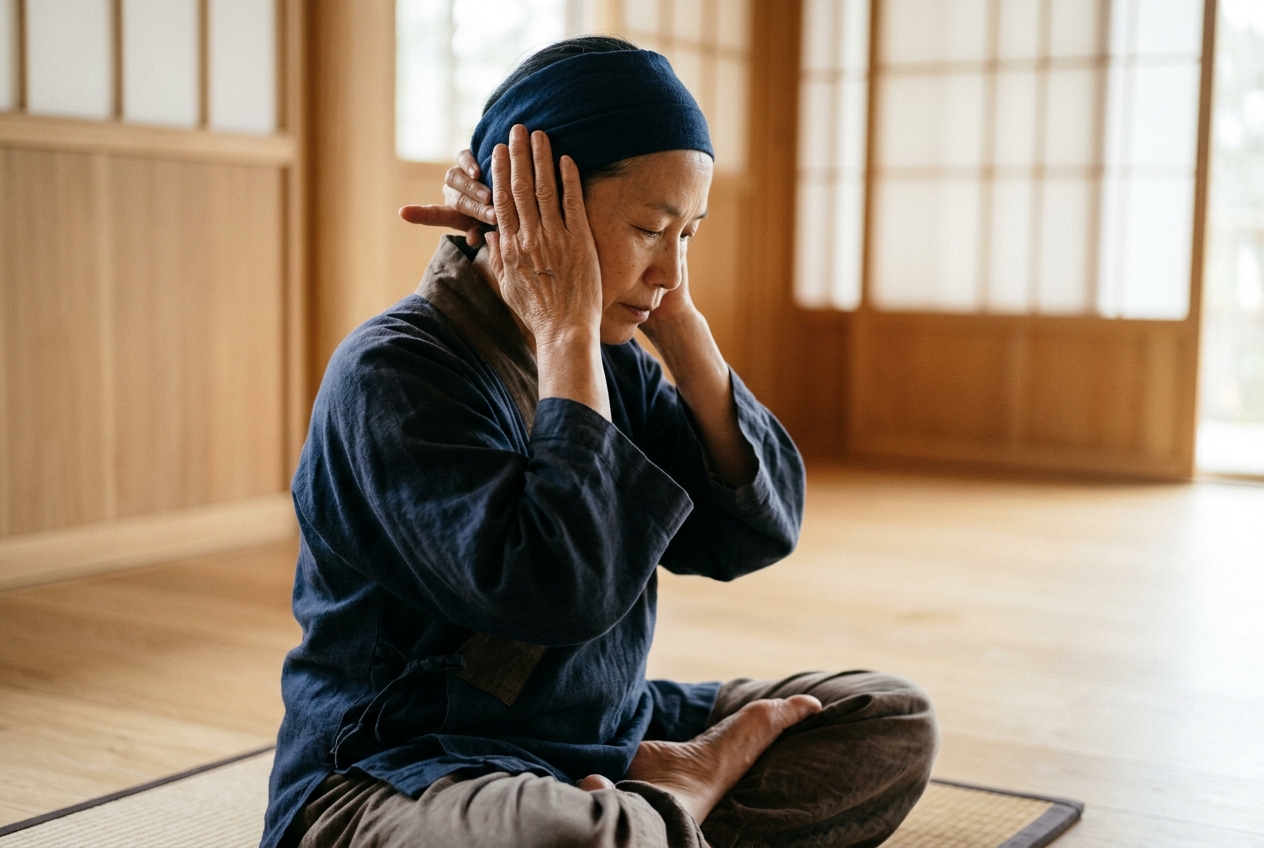
In the lexicon of Traditional Chinese Medicine and Daoist internal cultivation, this percussive vibration is applied directly to the Yuzhen Guan (玉枕關)—the "Jade Pillow Pass"—a notoriously tight energetic bottleneck located at the occipital ridge. Classical theory holds that emotional stress, postural fatigue, and excessive intellectual labor cause Yang energy and heat to become trapped in the upper head, while the true vitality (Jing) of the Kidneys fails to nourish the brain. By striking the Heavenly Drum, the practitioner vibrates the Niwan Gong (泥丸宮)—the "Palace of the Mud Ball," an ancient Daoist anatomical term corresponding to the pineal gland, thalamus, and epithalamic core—dissolving cranial stagnation, calming the Shen (spirit or conscious mind), and restoring systemic equilibrium.
       ACOUSTIC CONDUCTION AND PERCUSSIVE AXIS OF MING TIAN GU
       =======================================================

[ Calvarium / Niwan Palace ]
                         .--------.
                       /  (Brain)   \
       Palmar Seal   |   CSF Space   |   Palmar Seal
      (Laogong PC8)  |  .---------.  |  (Laogong PC8)
         [EAR] <==== | | Ventricle | | ====> [EAR]
        Air Cavity   |  '---------'  |   Air Cavity
                      \             /
                       \  Occiput  /
                        '----.----'
                             |
                   [ Percussive Strikes ]
               Index snapped over Middle Finger
               onto Tianzhu (BL10) & Fengchi (GB20)
                             |
                    [ Cervical Column ]
Step-by-Step Practice Guide: The Classical Protocol
To experience the full therapeutic depth of Sounding the Heavenly Drum, the technique must be executed with structural integrity, relaxed myofascial pathways, and precise hand mechanics. Perform the following protocol in a quiet environment, seated in upright stillness.
1. Postural Setup and Spinal Neutrality
Sit comfortably on a firm cushion or a flat-backed chair with your feet planted flat on the floor, hip-width apart. Lengthen the spine upward from the perineum to the vertex of the head (Baihui, GV20), creating gentle space between the cervical vertebrae. Tuck the chin slightly inward—a movement known in classical martial arts as "suspending the crown"—to flatten the cervical lordosis and expose the sub-occipital shelf. Rest the tip of your tongue lightly against the hard palate behind the upper incisors, closing the energetic circuit between the Conception (Ren) and Governing (Du) vessels. Allow your breath to settle into a soft, natural diaphragmatic rhythm in the lower abdomen (Xia Dantian), approximately two inches below the navel.
2. Palmar Warming and Acoustic Sealing
Rub your palms vigorously together until a deep, radiant heat gathers in the center of your hands—specifically at the Laogong acupoint (Pericardium 8) in the middle of the palm. Raise your hands and cup them firmly over your outer ears. Press the fleshy base of the palms and the Laogong points over the auricles (the external ear structures) and the external auditory meatus so that an airtight seal is formed. The ears should be folded slightly forward under the palms. You will immediately perceive an enclosed, bass-heavy acoustic silence.
3. Finger Positioning on the Occipital Shelf
Extend your fingers around the curve of the cranium toward the back of the head. The fingertips of both hands will point toward one another across the midline of the occiput, without necessarily touching. Place your index fingers on top of your middle fingers, resting them across the distal interphalangeal joints. Maintain a firm, spring-loaded tension between the crossing fingers.
4. The Percussive Snap (Sounding the Drum)
With a swift, elastic motion, snap both index fingers downward off the middle fingers so that the finger pads strike the occipital bone with a crisp, resonant impact. The target zone lies on either side of the external occipital protuberance along the superior and inferior nuchal lines—specifically stimulating the acupoints Tianzhu (Bladder 10, situated on the lateral border of the trapezius) and Fengchi (Gallbladder 20, located in the soft hollow between the trapezius and sternocleidomastoid insertions). - Execute 36 rhythmic strikes in classical Daoist numerology (or 24 strikes for a brief morning clearing). - Maintain an unhurried, metronomic cadence—approximately one strike every second. - Ensure that the palmar seal over the ears remains unbroken throughout the percussive sequence to preserve acoustic bone-conduction resonance.
5. Transitional Integration and Seated Stillness
After the final strike, do not pull your hands away abruptly. Keep your palms sealed over your ears for five deep, slow abdominal breaths, allowing the internal acoustic vibration to settle. Slowly, gently release the suction of the palms. Bring your index and middle fingers to the front and back of the ears, rubbing vigorously up and down along the auricle crease until the ears feel intensely warm. Finally, sweep your warm palms down over your face and chest, returning your hands to rest upon your thighs, palms facing upward. Sit in silent observation for two minutes, noticing the heightened sensory clarity, intracranial space, and profound auditory stillness.
Diagnostic Common Faults and Biomechanical Corrections
| Fault Pattern | Biomechanical Error | Pathophysiological Consequence | Corrective Action |
|---|---|---|---|
| Over-Pressurization | Pushing the palms aggressively into the ear canal like plungers. | Excessive hydraulic pressure against the tympanic membrane; middle-ear strain. | Cup the palms softly to create an airtight seal without compressive piston force. |
| Cervical Hyperextension | Tilting the chin upward and craning the neck backward during striking. | Compression of sub-occipital nerves and vertebral artery; restricted bone vibration. | Lengthen the back of the neck; keep the chin subtly tucked and the crown elevated. |
| Shoulder Shrugging | Elevating the scapulae and tensing the upper trapezius to reach the head. | Myofascial constriction across the thoracic outlet; reduced cerebral venous return. | Broaden the clavicles; drop the elbows naturally outward and relax the shoulder blades downward. |
| Fingertip Slapping | Tapping loosely with the pads of the fingers without loading tension. | Superficial skin contact without deep bone conduction or dural shockwave. | Use the middle finger as a spring ledge to snap the index finger with elastic force. |
Somatosensory Benchmarks: What You Should Feel
When performed with clinical precision, Sounding the Heavenly Drum produces distinct somatic and sensory milestones:
- Intracranial Resonance: The striking sound should not register as a superficial tap on the skin; it must feel like an omnidirectional, low-frequency boom echoing through the ventricular spaces of the brain.
- Sub-Occipital Warming: Within 12 to 18 strikes, a spreading sensation of warmth and myofascial release should manifest along the nuchal line, radiating down into the upper cervical spine.
- Parietal and Frontal Lightness: Following the release of the palms, practitioners typically experience an immediate sense of cranial decompression, as if a tight band around the temples has been unfastened.
- Enhanced Auditory Clarity: Ambient sounds in the room will temporarily appear sharper, more separated, and stripped of harsh high-frequency irritation, indicating autonomic dampening of the stapedius reflex and auditory cortex reset.
Classical Lineage & Historical Context: From Tang Dynasty Yangsheng to Daoist Internal Alchemy
The practice of Sounding the Heavenly Drum is rooted in the early synthesis of Daoist self-cultivation (Yangsheng, 養生) and medieval Chinese medicine. While references to cranial percussive therapeutics appear in scattered han dynasty fragments, the formal codification of Ming Tian Gu emerges prominently in the writings of the legendary Tang Dynasty physician and Daoist master Sun Simiao (581–682 CE).
In his monumental medical treatise, the Beiji Qianjin Yaofang (備急千金要方, Essential Formulas for Emergencies Worth a Thousand Gold Pieces), Sun Simiao cataloged Daoyin longevity routines designed to preserve sensory acuity into extreme old age. Sun emphasized that the ears were not merely passive organs of hearing, but the direct somatic external manifestation of the Kidneys (Shen), the reservoir of constitutional vitality (Jing). He prescribed daily cranial percussion to prevent sensory decay, alleviate vertigo, and maintain clear cognition.
       CHRONOLOGICAL TRANSMISSION OF MING TIAN GU IN CLASSICAL TEXTS
       ==============================================================

Tang Dynasty (652 CE)       Song Dynasty (960–1279 CE)     Ming Dynasty (1368–1644 CE)
   [ Sun Simiao's ]               [ Daoist Canon ]               [ Seated Eight ]
   [ Qianjin Yaofang ]  =====>    [ (Daozang) & Zuowang ] =====> [ Brocades Protocols ]
   Ear tapping for longevity     Clearing the Jade Pillow        Integration into Twelve
   and sensory preservation      Gate for Inner Alchemy          Brocades & Daily Daoyin
During the Song Dynasty (960–1279 CE), as internal alchemy (Neidan) gained doctrinal ascendancy, Ming Tian Gu transitioned from a purely preventative hygiene exercise into an indispensable prelude and closing rite for seated meditation (Zuowang, 坐忘, or "sitting in oblivion"). In Daoist meditation manuals preserved within the Daozang (Daoist Canon)—such as the Xiushen Shijian (修身十踐, Precepts for Cultivating the Body)—the practice is situated as a primary method for opening the Yuzhen Guan (Jade Pillow Pass).
The Jade Pillow is the most challenging of the "Three Iron Passes" (San Guan) along the spine through which ascending Yang energy must travel along the Governing Vessel (Du Mai). If a practitioner attempts deep breath retention or meditative concentration while the sub-occipital tissues are mechanically constricted, energy pools pathologically in the calvarium, generating headaches, dizziness, and cognitive agitation—a condition known in modern clinical settings as Qigong deviation or hyper-arousal syndrome. Sounding the Heavenly Drum was systematically employed to mechanically "open the gate" prior to meditation and to disperse residual cerebral congestion upon exiting the meditative state.
Later, during the Ming and Qing dynasties, the technique was formalized as an integral movement within the Seated Eight Pieces of Brocade (Zuo Shi Ba Duan Jin) and the Twelve Pieces of Brocade (Shi Er Duan Jin), solidifying its position across both monastic lineages and popular health preservation culture as an essential daily practice for mental clarity and sensory longevity. Contemporary institutions such as the National Qigong Association continue to preserve these classical sequences as foundational elements of somatic medicine.
Acoustic Conduction, Cranial Biomechanics, and Cerebrospinal Fluid Dynamics
To understand why Sounding the Heavenly Drum exerts such a profound influence on cognitive and autonomic states, one must examine the biophysical properties of Bone conduction and the anatomy of the craniocervical junction.
                     BIOMECHANICAL TARGETS OF THE NUCHAL LINE
                     ========================================

External Occipital Protuberance (Inion)
                                  [ • ]
                     ___________/       \___________
     Superior Nuchal Line ===>  ( BL10 )  ( GB20 )  <=== Inferior Nuchal Line
                                [Tianzhu] [Fengchi]
                                    |        |
         Rectus Capitis Posterior  <+>      <+>  Obliquus Capitis Superior
              & Minor Muscles                      & Inferior Muscles
                                    \        /
                                     \      /
                                    [ C1 / C2 ]
                              Atlanto-Occipital Joint
1. Acoustic Resonance in a Closed Cranial Chamber
When the practitioner seals the external auditory meatus with the Laogong point of the palm, the column of air trapped inside the external ear canal forms a pressurized, closed acoustic cavity. Striking the occipital bone with the snapping index finger introduces high-velocity, low-amplitude mechanical vibrations directly into the squamous part of the occipital bone. These vibrations propagate across the lambdoid, sagittal, and squamosal sutures, traveling through the calvarium to the petrous part of the temporal bone, which houses the cochlea and vestibular labyrinth.
Because bone conducts sound waves approximately four times faster than air, the percussion bypasses middle-ear impedance, directly driving the perilymph and endolymph fluids within the inner ear. The resulting mechanical shearing of hair cells in the Organ of Corti produces the deep, bell-like auditory sensation.
2. Sub-Occipital Myofascial Decompression
The specific anatomical loci targeted by the percussive strikes—Fengchi (GB20) and Tianzhu (BL10)—overlie the sub-occipital triangle, a dense muscular cluster comprising the rectus capitis posterior major, rectus capitis posterior minor, obliquus capitis superior, and obliquus capitis inferior. These small, postural muscles possess one of the highest densities of muscle spindles (proprioceptive sensors) in the entire human body—up to 36 spindles per gram of tissue, compared to just 0.8 in the gluteus maximus.
Chronic mental stress and prolonged screen use cause sustained tonic contraction of these sub-occipital fibers, creating forward-head posture and compressing the greater occipital nerve and the vertebral arteries as they pass through the sub-occipital triangle to enter the foramen magnum. The rhythmic, mechanical tapping of Ming Tian Gu acts as a localized percussive massage, inducing rapid myofascial release, restoring microvascular perfusion to the posterior cranial circulation, and releasing tension along the atlanto-occipital and atlanto-axial joints (C1–C2).
3. Cerebrospinal Fluid (CSF) Shockwave Propagation and Glymphatic Clearance
The cranium is not a rigid, static box; it undergoes subtle, pulsatile volumetric shifts driven by arterial systole and respiratory mechanics. Suspended within the subarachnoid space and ventricular chambers is the cerebrospinal fluid (CSF), which cushions the brain and facilitates metabolic waste clearance via the glymphatic system.
When the Heavenly Drum is struck, the kinetic pulse transmits through the rigid calvarium into the fluid-filled subarachnoid space, creating micro-hydraulic shockwaves through the fourth ventricle, cerebral aqueduct, and cisterna magna. This mechanical agitation assists in breaking up fluid stasis, facilitating CSF circulation through the craniosacral axis and enhancing the clearance of neuro-metabolic waste products that accumulate during prolonged cognitive exertion.
Neuro-Autonomic & Sensory Neurological Pathways
The systemic relaxation and mental clarity induced by Sounding the Heavenly Drum are not merely subjective sensations; they are mediated by direct neurological and neuro-autonomic mechanisms documented across peer-reviewed investigations indexed on NCBI PubMed.
                      NEURO-AUTONOMIC MODULATION CASCADE
                      ==================================

Palmar Compression &                Percussive Occipital Strike
        Concha Stimulation                  (Nuchal Line / GB20 / BL10)
                 |                                      |
                 v                                      v
    [ Auricular Branch of Vagus ]             [ Vestibulocochlear Nerve ]
         (Arnold's Nerve)                           (Cranial Nerve VIII)
                 |                                      |
                 +------------------+-------------------+
                                    |
                                    v
                       [ Nucleus Tractus Solitarius ]
                                    |
                 +------------------+-------------------+
                 |                                      |
                 v                                      v
       [ Parasympathetic Surge ]             [ Cortical Quieting ]
        - Elevated HRV (Vagal Tone)           - Suppressed DMN Activity
        - Reduced Heart Rate / BP             - Auditory Sensory Reset
        - Sub-Occipital Vasodilation          - Alleviation of Somatic Tinnitus
1. Stimulation of the Auricular Branch of the Vagus Nerve (Arnold's Nerve)
The human ear is the only surface region of the body where the vagus nerve (Cranial Nerve X)—the primary superhighway of the parasympathetic nervous system—sends direct cutaneous sensory branches. The Auricular branch of vagus nerve, historically known as Arnold's nerve, innervates the concha, the tragus, and the posterior wall of the external acoustic meatus.
When the practitioner cups the ears, applies gentle palmar pressure, and subsequently warms the auricles through post-practice friction, this mechanical stimulation directly activates auricular vagal afferents. These signals travel through the jugular ganglion into the Nucleus Tractus Solitarius (NTS) in the brainstem. The NTS acts as the primary central relay for autonomic regulation, initiating a rapid parasympathetic shift characterized by decreased heart rate, increased heart rate variability (HRV), down-regulation of sympathetic vasomotor tone, and systemic reductions in circulating cortisol.
2. Modulation of Cranial Nerve VIII and Cortical Auditory Quieting
The vestibulocochlear nerve (Cranial Nerve VIII) transmits acoustic and equilibrium signals from the inner ear to the brainstem. In our hyper-digitized sensory environment, the auditory cortex and associated attentional networks are subjected to unrelenting ambient sensory noise and linguistic processing.
The powerful, localized acoustic input generated by bone-conducted percussion creates a temporary "sensory saturation" across the auditory pathway. When the percussive stimulation ceases and the palms are slowly removed, the auditory cortex undergoes a rebound inhibitory phase. This down-regulates the hyperactivity of the Default Mode Network (DMN)—the neural network responsible for internal monologue, rumination, and anxious future-projection—producing an immediate state of profound, restful cognitive silence (Shen stabilization).
3. Alleviation of Somatic Tinnitus and Tension-Type Cephalea
A significant proportion of non-pulsatile tinnitus and tension headaches are somatic in origin, arising not from primary cochlear pathology, but from hyper-excitable somatosensory projections from the trigeminal and upper cervical nerves (C1–C3) into the dorsal cochlear nucleus (DCN).
Hypertonicity in the sub-occipital muscles and upper trapezius can dysregulate DCN auditory gating, manifesting as high-pitched ringing in the ears and tension-type cervicocranial strain. By physically discharging trigger points at Fengchi (GB20) and Tianzhu (BL10) and modulating trigeminal-vagal reflexes, Sounding the Heavenly Drum serves as an effective, non-pharmacological somatic intervention for decompressing the craniocervical pathway and dampening somatic tinnitus. Research into integrative practices cataloged by the World Health Organization Traditional Medicine highlights such mind-body techniques as effective modalities for chronic stress-induced sensory disorders.
Energetic Interfacing & Shen Harmonization in Traditional Chinese Medicine
Within the framework of classical East Asian medicine, Sounding the Heavenly Drum operates at the nexus of the Water and Fire energetic axes—the fundamental thermodynamic balance of the human organism.
                  THE KAN-LI (WATER-FIRE) ALCHEMICAL AXIS
                  =======================================

[ UPPER DANTIAN / HEART FIRE / SHEN ]
                       (Cognitive Agitation, Overheating)
                                      ^
                                      |
                      Descending Yang | | Ascending Kidney Jing
                       (Anchored via  | | (Stimulated via
                         Percussion)  | | Acoustic Resonator)
                                      | v
                   [ LOWER DANTIAN / KIDNEY WATER / JING ]
                        (Constitutional Root of Hearing)
1. Harmonizing Kidney Water and Heart Fire
In Chinese medical theory, the sensory organ of the ear corresponds directly to the Kidney organ network (Shen), which governs Water, bone marrow, the brain (termed the "Sea of Marrow," 髓海), and hearing acuity. Conversely, mental consciousness, emotional balance, and cognitive lucidity are governed by the Heart network (Xin), which corresponds to Fire and houses the Shen.
Under conditions of chronic mental strain, emotional stress, or exhaustion, Kidney Water becomes depleted, losing its capacity to cool and anchor Heart Fire. The unanchored Fire rises uncontrollably to the head—a pathological pattern known as Gan Yang Shang Kang (Hyperactive Liver Yang Rising) or Xin Shen Bu Jiao (Non-Interaction of Heart and Kidney). This manifests as insomnia, mental restlessness, high-pitched tinnitus, dry eyes, and headaches.
The percussive shockwave of Sounding the Heavenly Drum directly vibrates the Sea of Marrow and the temporal/occipital bones, stimulating Kidney Jing to ascend and nourish the Upper Dantian (Shang Dantian). Simultaneously, the deep acoustic resonance creates an anchoring, downward pull that draws floating Yang heat away from the eyes and vertex, guiding it back down the Governing and Conception vessels into the Lower Dantian (Xia Dantian). In classical alchemical texts, this process is celebrated as the "Copulation of Kan and Li" (Water and Fire), wherein the mind becomes simultaneously alert and profoundly tranquil.
2. Clearing the Upper Dantian and the Sea of Marrow
The Niwan Palace (Upper Dantian) is considered the spiritual command center of the human subtle body. Stagnation in this region manifests as "turbid Qi," experienced subjectively as brain fog, creative blockage, and sensory exhaustion. By introducing rhythmic, coherent vibration into this cranial center, Ming Tian Gu acts as an energetic sieve, dispersing turbid energetic residue and opening the central axis (Chong Mai) for deeper meditative absorption. Further exploration of these meridian dynamics and therapeutic postures can be found in classical literature reviewed on NCBI PubMed Central.
Why It Works: The Contemporary Somatosensory Synthesis
To appreciate why this Tang Dynasty practice remains uniquely vital in the twenty-first century, consider the physiological burdens imposed by contemporary screen-centric life. Modern work forces the human body into sustained forward-head postures, fixates the visual field within a narrow two-dimensional focal plane, and saturates the nervous system with incessant auditory and cognitive stimuli.
This state generates a chronic sub-clinical freeze response: the sub-occipital muscles contract to support the heavy forward-tilted head, the upper cervical nerves become pinched, the vagus nerve is inhibited, and the brain remains locked in high-beta cortical wave activity.
Sounding the Heavenly Drum acts as an elegant, mechanical counter-measure: 1. Mechanical Reset: The index-finger percussions apply targeted, dynamic myofascial release to the sub-occipital muscular shelf, instantly lowering tension in the postural muscle spindles. 2. Fluid Dynamic Wave: The bone-conducted shockwaves travel through the calvarium, pulsing the cerebrospinal fluid to encourage glymphatic drainage and reduce craniosacral compression. 3. Autonomic Reset: The palmar seal stimulates the auricular branch of the vagus nerve, down-regulating sympathetic drive and elevating heart rate variability. 4. Sensory Gating: The intense internal acoustic resonance saturates the auditory pathways, allowing the Default Mode Network to quiet down upon release, restoring clear sensory perception and anchoring mental focus.
Summary of Somatosensory & Neuro-Biological Impact
Today's Practice Commitment: A Five-Minute Daily Protocol
To integrate Sounding the Heavenly Drum into your daily wellness routine, commit to the following structured five-minute micro-practice tomorrow morning before checking your phone, opening your email, or drinking your first cup of coffee:
- Minute 1 — Postural Alignment & Settling: Sit on the edge of your bed or a sturdy chair. Lengthen your spine, soften your gaze, place your hands on your lower belly, and take six slow, resonant nasal breaths into your lower abdomen.
- Minutes 2 to 3 — Sounding the Drum: Rub your palms vigorously together until hot. Cup your ears to establish an airtight acoustic seal. Cross your index fingers over your middle fingers and execute 36 rhythmic, spring-loaded strikes against the base of your skull. Maintain a steady cadence of one strike per second.
- Minute 4 — Acoustic Integration: Hold your palms over your ears in complete stillness for five full abdominal breath cycles. Slowly, gently release the suction of your palms. Use your index and middle fingers to vigorously rub the skin in front of and behind your ears for 15 seconds until they glow with warmth.
- Minute 5 — Seated Observation: Rest your hands on your knees, palms facing up. Keep your eyes closed. Notice the spaciousness in the center of your skull, the relaxation of your neck, and the crisp clarity of your awareness.
By committing five minutes each morning to this ancient Daoyin practice, you bridge fourteen centuries of Daoist medical wisdom with modern cranial neuroscience—turning your own hands into an instrument of physiological renewal and awakening the profound stillness of the Heavenly Drum.