Twelve He-Sea Points: Navigating Cubital-Popliteal Topography, Counterflow Qi Inversion, and Deep Visceral Drainage Acupressure Protocols
1. Opening — A Problem This Solves Today
If you have ever experienced the sudden, disorienting surge of acute gastrointestinal reflux before a crucial presentation, felt your breath catch high in your chest during a wave of panic, or suffered the debilitating heaviness of abdominal bloating and erratic bowel evacuations after a period of sustained psychological distress, you have experienced what classical East Asian medicine terms Qi Ni (氣逆)—the rebellion or counterflow of physiological Qi.
In a healthy state, biological activity moves with an innate directional orientation: the ingested bolus and metabolic fluids descend; the clear, nutritive essences ascend to nourish the sensory orifices and cerebral cortex; and the protective immune forces circulate smoothly throughout the interstitial tissue planes. Yet, under chronic sympathetic arousal, neuromuscular strain, or digestive exhaustion, these smooth physiological vectors invert. The stomach's motor complexes stall or reverse, generating nausea and acid regurgitation; the diaphragm spasms, prompting paradoxical breathing and bronchial irritability; and metabolic heat, unable to anchor in the lower viscera, flares upward to trigger temporal migraines, flushed skin, and hyperarousal.
Modern biomedicine classifies these phenomena under functional gastrointestinal disorders, autonomic dysregulation, and neuro-inflammatory syndromes, frequently treating them with proton-pump inhibitors, antispasmodics, or sedatives. However, classical medical literature provides an extraordinarily sophisticated, non-pharmacological hydrodynamic framework for addressing visceral rebellion at its physiological root: The Twelve He-Sea Points (He-Sea Loci / 合穴).
Located predominantly at the biomechanical hinges of the human body—the cubital creases of the elbows and the popliteal and patellar regions of the knees—these twelve specific loci serve as deep physiological reservoirs. By understanding their classical energetics, anatomical architecture, and modern somatosensory mechanisms, clinicians and individuals alike can deploy targeted, non-invasive acupressure to downregulate counterflow, harmonize the enteric nervous system, and clear systemic metabolic heat.
2. The Hydro-Energetic Pathway: Classical Mechanics & Theoretical Foundations
To comprehend why points at the knees and elbows possess such profound influence over the deep internal viscera (Zang-Fu / 臟腑), one must examine the hydrodynamic metaphor articulated in foundational classical texts: the Huangdi Neijing Ling Shu (The Spiritual Pivot, Chapter 4) and the Nan Jing (The Classic of Difficulties, Chapter 68).
The Five Shu-Point Hydrodynamic Gradient
In Chapter 1 of the Ling Shu, the circulation of channel Qi is mapped to the morphological life cycle of a mountain stream descending into the ocean: 1. Jing-Well (井): At the terminal extremities of the toes and fingers, Qi emerges like water bubbling from a subterranean spring (Qi Chu / 氣出). The energetic charge is dynamic, superficial, and unstable. 2. Ying-Spring (滎): Moving toward the knuckles and tarsals, Qi gathers momentum, trickling as a swift current (Qi Liu / 氣流), capable of clearing pathogenic heat from the channel trajectory. 3. Shu-Stream (輸): Across the wrists and ankles, the current broadens and deepens, pouring like a cascading mountain river (Qi Zhu / 氣注), where defensive Qi converges and environmental pathogens typically lodge. 4. Jing-River (經): Along the flexor and extensor corridors of the forearms and calves, the flow becomes substantial and arterial (Qi Xing / 氣行), traversing extensive muscular pathways. 5. He-Sea (合): Finally, upon arriving at the major hinge joints—the elbows and knees—the channel widens exponentially, its velocity slows, and its energetic current plunges inward from the somatic periphery to unite directly with the internal organs (Qi Ru / 氣入).
The word He (合) translates literally as "to join," "to unite," or "to converge." In Chapter 4 of the Ling Shu, it is explicitly stated: "The Qi of the channels gathers, deepens, and unites at the He-Sea points; through them, the exterior somatic tissue directly communicates with the interior visceral chambers."
Nan Jing Chapter 68 and the Rule of Counterflow
The therapeutic purview of these loci was codified in Chapter 68 of the Nan Jing:
"He-Sea points govern counterflow Qi and diarrhea (合主逆氣而泄). When channel pathology causes the ascent of rebellious fluid or gas, or when the Fu organs fail to contain their downward discharge, harmonize the He-Sea."
Because the energetic volume at a He-Sea locus is vast and slow-moving, tactile or thermal stimulation does not merely provoke a localized neuromuscular twitch; it initiates a profound somatovisceral reflex arch. Through spinal cord segments, vagal afferents, and fascial uninterrupted continuity, pressing a He-Sea point directs surging energy back downward (Jiang Ni / 降逆), anchors drifting Yang, and staunches pathological evacuations such as chronic dysentery, watery diarrhea, and urinary incontinence.
Elemental Phase Dynamics: Yin Water vs. Yang Earth Polarities
Traditional Chinese Medicine assigns the Five Phase (Wu Xing / 五行) elemental qualities to the Five Shu points according to a strict polarity:
| Channel Polarity | He-Sea Phase Assignment | Functional Dynamism | Classical Therapeutic Rationale |
|---|---|---|---|
| Yin Channels (Arm/Leg) | Water (水 / Shui) | Deep, consolidating, cooling, kidney-nourishing | Yin represents the deep interior; Water anchors upwardly flaring Fire, replenishes depleted Yin-Essence, and moistens mucosal linings. |
| Yang Channels (Arm/Leg) | Earth (土 / Tu) | Stabilizing, transformative, digestive, center-harmonizing | Yang governs the exterior and the hollow digestive viscera (Fu); Earth represents the central digestive pivot (Spleen-Stomach), harmonizing peristalsis and clearing dampness. |
This polarity explains why Yin He-Sea points (such as Kidney 10 or Liver 8) are frequently chosen to consolidate reproductive essence, soothe blazing heat in the blood, and nurture systemic lubrication, whereas Yang He-Sea points (such as Stomach 36 or Large Intestine 11) excel at modulating gut transit, dispelling pathogenic exterior heat, and resolving cutaneous eruptions.
3. The Complete Anatomical Compendium of the Twelve He-Sea Points
Each of the twelve primary channels possesses a specific He-Sea locus situated precisely at the elbow or knee. Below is the systematic anatomical and bone-proportional reference for each point, aligned with World Health Organization (WHO) Standard Acupuncture Point Locations and contemporary clinical neuro-anatomy.
1. Lung Channel: LU5 (Chize / 尺澤 — Cubital Marsh)
- Elemental Phase: Water (Yin)
- Anatomical Location: In the cubital crease of the elbow, in the radial depression immediately lateral to the tendon of the biceps brachii. Located with the elbow slightly flexed.
- Biomechanical / Neurovascular Landmarks: Radial recurrent artery/vein; lateral antebrachial cutaneous nerve; radial nerve terminal branches.
- Classical Actions: Clears Lung Heat, descends rebellious Lung Qi, expels phlegm, regulates the water passages, alleviates spasmodic upper-airway hyper-reactivity.
- Indications: Coughing spasms, hemoptysis, dyspnea, acute asthma, wheezing, sore throat, tidal fever, fullness in the chest, pediatric convulsive disorders.
2. Large Intestine Channel: LI11 (Quchi / 曲池 — Pool at the Bend)
- Elemental Phase: Earth (Yang)
- Anatomical Location: On the lateral aspect of the flexed elbow, midway between the radial end of the transverse cubital crease and the lateral epicondyle of the humerus.
- Biomechanical / Neurovascular Landmarks: Radial recurrent artery; posterior antebrachial cutaneous nerve; radial nerve trunk traversing nearby.
- Classical Actions: Expels Wind and Exterior Heat, clears systemic toxic heat, cools blood stasis, resolves dermatological inflammation, regulates intestinal peristalsis.
- Indications: High fevers, hypertension, acute eczema, urticaria, psoriasis, sore throat, red/painful eyes, abdominal distension, hemiplegia, elbow joint inflammation.
3. Stomach Channel: ST36 (Zusanli / 足三里 — Leg Three Miles)
- Elemental Phase: Earth (Yang — Horary Point)
- Anatomical Location: On the anterior-lateral aspect of the lower leg, 3 cun (four finger-breadths) inferior to the lateral infrapatellar depression (ST35 / Dubi), one finger-breadth lateral to the anterior crest of the tibia, within the tibialis anterior muscle belly.
- Biomechanical / Neurovascular Landmarks: Anterior tibial artery and vein; branches of the deep and superficial peroneal (fibular) nerves.
- Classical Actions: Strongly tonifies Qi and Blood, fortifies Spleen and Stomach, descends rebellious digestive Qi, clears dampness, alleviates chronic systemic fatigue, modulates autonomic and immune tone.
- Indications: Epigastric pain, nausea, gastroesophageal reflux, severe vomiting, gastric ulceration, acute/chronic diarrhea, constipation, profound systemic exhaustion, generalized edema.
4. Spleen Channel: SP9 (Yinlingquan / 陰陵泉 — Yin Mound Spring)
- Elemental Phase: Water (Yin)
- Anatomical Location: On the medial aspect of the lower leg, in the depression situated immediately inferior and posterior to the medial condyle of the tibia.
- Biomechanical / Neurovascular Landmarks: Great saphenous vein; medial inferior genicular artery; saphenous nerve and tibial nerve branches.
- Classical Actions: Transforms and resolves pathological Dampness, opens and drains the lower-burner water passages, benefits urination, harmonizes the middle burner.
- Indications: Abdominal fullness, watery diarrhea, intestinal borborygmi, dysuria, urinary retention, lower extremity pitting edema, vaginal discharge, medial knee pain.
5. Heart Channel: HT3 (Shaohai / 少海 — Lesser Sea)
- Elemental Phase: Water (Yin)
- Anatomical Location: With the elbow fully flexed, at the medial terminus of the transverse cubital crease, midway between the medial epicondyle of the humerus and the tendon of the biceps brachii.
- Biomechanical / Neurovascular Landmarks: Basilic vein; ulnar collateral artery; medial antebrachial cutaneous nerve; median nerve.
- Classical Actions: Calms the Shen (Mind/Spirit), clears Heart Phlegm-Heat, relaxes soft tissue contractures, unbinds axillary and pectoral stagnation.
- Indications: Cardiac palpitations, angina-like pectoral oppression, memory fog, parkinsonian tremors of the forearm, axillary adenopathy, intercostal neuralgia, profound psycho-emotional distress.
6. Small Intestine Channel: SI8 (Xiaohai / 小海 — Small Sea)
- Elemental Phase: Earth (Yang)
- Anatomical Location: In the depression situated between the olecranon of the ulna and the medial epicondyle of the humerus (the ulnar nerve sulcus, commonly called the "funny bone"). Located with the elbow flexed at 90 degrees.
- Biomechanical / Neurovascular Landmarks: Superior and inferior ulnar collateral arteries; ulnar nerve directly passing through the cubital tunnel.
- Classical Actions: Clears Small Intestine damp-heat, dispels localized Wind, soothes the sensory channels, calms neurological convulsions.
- Indications: Ulnar neuropathy, pain radiating down the medial arm, cervical neck rigidity, submandibular swelling, epilepsy, scrofula, acute toothache.
7. Bladder Channel: BL40 (Weizhong / 委中 — Middle of the Crease)
- Elemental Phase: Earth (Yang)
- Anatomical Location: In the exact midpoint of the transverse crease of the popliteal fossa, situated directly between the tendons of the biceps femoris and the semitendinosus muscles.
- Biomechanical / Neurovascular Landmarks: Popliteal artery and popliteal vein; tibial nerve trunk; posterior femoral cutaneous nerve.
- Classical Actions: Clears Blood Heat, resolves stasis throughout the entire spine, cools systemic febrile toxicity, drains damp-heat from the bladder, relaxes lumbar myofascia.
- Indications: Acute and chronic lumbar pain, sciatica, knee joint immobility, heatstroke, dermatological purpura, erysipelas, dysuria, spontaneous epistaxis.
8. Kidney Channel: KI10 (Yingu / 陰谷 — Yin Valley)
- Elemental Phase: Water (Yin — Horary Point)
- Anatomical Location: On the medial side of the popliteal fossa, at the medial end of the popliteal crease, in the deep fissure between the tendons of the semitendinosus and semimembranosus muscles when the knee is slightly flexed.
- Biomechanical / Neurovascular Landmarks: Medial superior genicular artery; saphenous nerve; tibial nerve deep trunk.
- Classical Actions: Nourishes Kidney Yin, drains Lower-Jiao Damp-Heat, regulates urogenital physiology, clears pelvic stasis.
- Indications: Impotence, nocturnal emissions, chronic uterine hemorrhage, dysuria, pelvic inflammatory disease, perianal pruritus, medial knee arthralgia.
9. Pericardium Channel: PC3 (Quze / 曲澤 — Marsh at the Curve)
- Elemental Phase: Water (Yin)
- Anatomical Location: On the transverse cubital crease of the elbow, in the depression immediately medial (ulnar) to the tendon of the biceps brachii.
- Biomechanical / Neurovascular Landmarks: Brachial artery and veins; median nerve traversing adjacent to the tendon.
- Classical Actions: Clears Heat from the Ying (Nutritive) and Xue (Blood) levels, harmonizes the Stomach, arrests sudden visceral vomiting, calms agitation.
- Indications: Acute gastroenteritis, sunstroke, febrile delirium, cardiac palpitations, retrosternal chest spasms, tremor of the hands and head.
10. Triple Burner (San Jiao) Channel: TE10 (Tianjing / 天井 — Heavenly Well)
- Elemental Phase: Earth (Yang)
- Anatomical Location: On the posterior aspect of the upper arm, in the depression approximately 1 cun superior to the olecranon process of the ulna, located with the elbow flexed at 90 degrees.
- Biomechanical / Neurovascular Landmarks: Posterior branch of the brachial artery; radial nerve branches.
- Classical Actions: Transforms lymphatic phlegm, dissipates nodules, clears heat from the sensory orifices, unblocks channel stasis along the shoulder and neck.
- Indications: Cervical lymphadenitis (scrofula), goiter, chronic migrainous cephalalgia, unilateral deafness, tinnitus, temporal pain, lateral elbow bursitis.
11. Gallbladder Channel: GB34 (Yanglingquan / 陽陵泉 — Yang Mound Spring)
- Elemental Phase: Earth (Yang)
- Hui-Meeting Point: Influential Point for all Tendons and Sinews (Hui-Jin)
- Anatomical Location: On the lateral aspect of the lower leg, in the tender depression situated approximately 1 cun anterior and inferior to the head of the fibula.
- Biomechanical / Neurovascular Landmarks: Inferior lateral genicular artery; common peroneal (fibular) nerve bifurcating into superficial and deep peroneal branches.
- Classical Actions: Relaxes and strengthens tendons and sinews, facilitates the smooth flow of Liver Qi, clears Gallbladder Damp-Heat, soothes the hypochondrium.
- Indications: Sciatica, biliary colic, hypochondriac distension, habitual constipation, muscular spasms, lateral compartment knee arthritis, stroke rehabilitation, emotional irritability.
12. Liver Channel: LR8 (Ququan / 曲泉 — Spring at the Bend)
- Elemental Phase: Water (Yin)
- Anatomical Location: On the medial aspect of the knee, in the depression superior to the medial end of the popliteal crease, immediately anterior to the insertions of the semimembranosus and semitendinosus tendons.
- Biomechanical / Neurovascular Landmarks: Great saphenous vein; medial superior genicular artery; saphenous nerve.
- Classical Actions: Nourishes Liver Blood and Yin, expels Damp-Heat from the genitourinary tract, regulates the lower abdominal blood vessels, relaxes the pelvic floor.
- Indications: Prolapse of the uterus, dysmenorrhea, pudendal neuralgia, lower abdominal mass accumulation, cystitis, gonorrheal discharge, knee joint contracture.
Scholarly Note on Lower He-Sea Points (Xia He Xue / 下合穴): Classical acupuncture differentiates between the six He-Sea points of the arm Yang channels (which act primarily on the somatic channel trajectories and sensory orifices) and the specialized Lower He-Sea points on the legs, described in Ling Shu Chapter 4 for treating the hollow Fu organs directly: * Large Intestine: ST37 (Shangjuxu / 上巨虛 — 3 cun inferior to ST36) * Small Intestine: ST39 (Xiajuxu / 下巨虛 — 6 cun inferior to ST36) * Triple Burner: BL39 (Weiyang / 委陽 — Lateral popliteal crease) * Stomach, Bladder, Gallbladder: ST36, BL40, and GB34 function simultaneously as primary channel He-Sea and Lower Fu He-Sea points.
4. Key Points You Can Press Right Now: Somatosensory Protocols
Acupressure is not mere mechanical rubbing; it is a calibrated neuro-tactile intervention designed to elicit the neurophysiological sensation known in classical texts as Deqi (得氣)—a distinct constellation of localized heaviness, dull distension, gentle thermal spreading, and traveling mild numbness. Research indexed in the NCBI National Library of Medicine (PubMed) demonstrates that manual stimulation of points like ST36 and PC3 triggers parasympathetic activation, decreases pro-inflammatory cytokines, and normalizes gut motility via vagal pathways.
Archetype I: Stomach 36 (Zusanli) — The Central Energy Catalyst
- Everyday Tactile Location: Place the palm of your right hand over your right kneecap. Your fingers will naturally drape down the outside of your shinbone. Your ring finger tip will land in a noticeable, tender muscular notch just to the outside of the vertical bone ridge (the shin). That notch is ST36.
- Somatosensory Feedback: When accurately engaged, you will feel a dull, rich ache that often radiates down the outer calf into the second and third toes, accompanied by an audible settling or gurgling of intestinal fluid (borborygmi).
- Application Method: Use the reinforced tip of your thumb or a rounded knuckle. Apply firm, perpendicular downward pressure. Sink slowly through the fascia for 5 seconds during deep exhalation; hold for 3 seconds; then execute subtle, micro-circular kneading for 1–2 minutes per leg.
- Daily Therapeutic Benefits: 1. Postprandial Heaviness & Bloating: Rapidly stimulates gastric emptying and resolves sluggish digestion. 2. Chronic Lethargy & Mental Brain Fog: Tonifies systemic blood oxygenation and relieves post-lunch exhaustion. 3. Anxiety-Induced Gastric Spasm: Downregulates fight-or-flight sympathetic tone on the mesenteric plexus.
Archetype II: Large Intestine 11 (Quchi) — The Systemic Thermal Cooler
- Everyday Tactile Location: Bend your elbow fully to a right angle. Look at the crease on the outer side of your elbow. Follow the skin crease all the way to its lateral outer edge. Place your thumb in the depression located precisely halfway between that crease-line end and the bony protrusion of your outer elbow bone.
- Somatosensory Feedback: Sharp, distinct tenderness, often feeling like a small electric tingle or a deep, muscular pressure point that aches immediately upon contact.
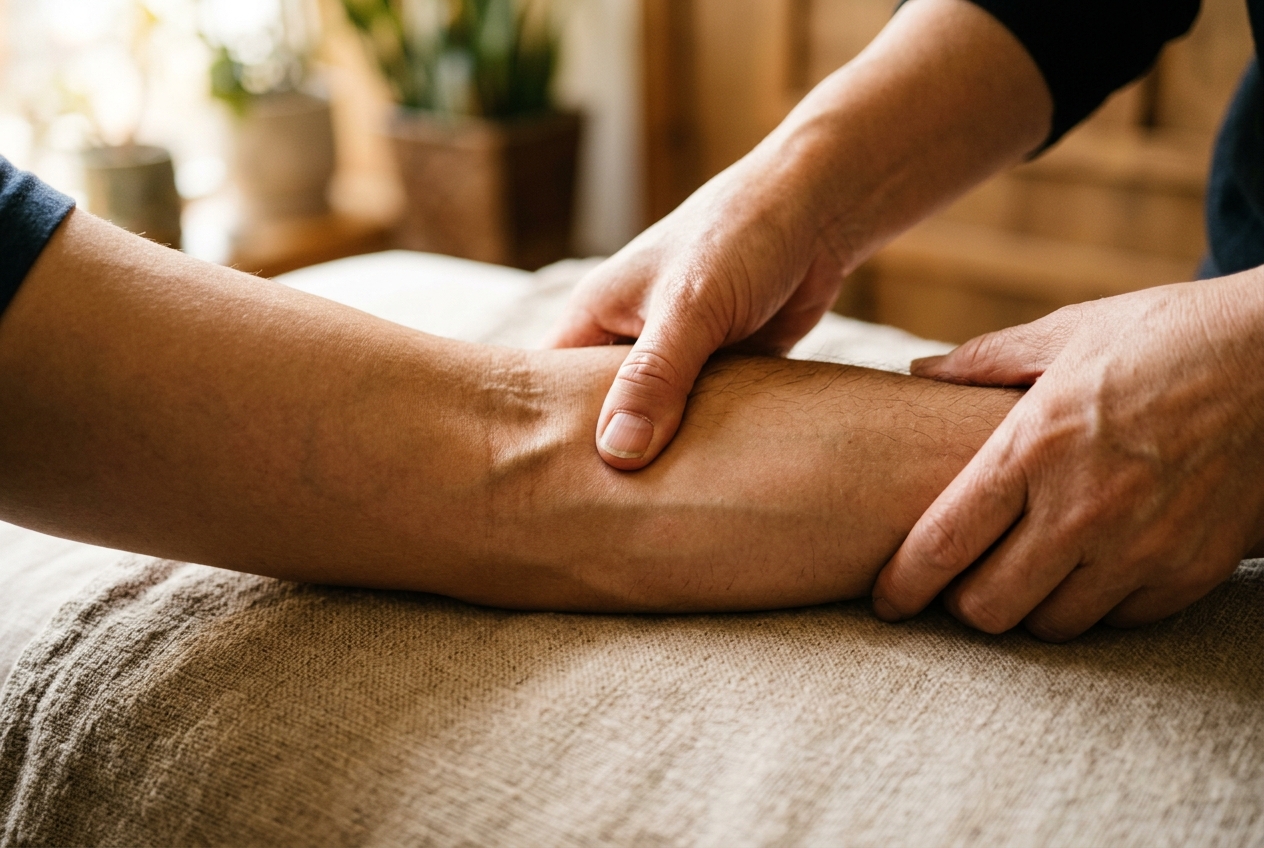
- Application Method: Anchor your fingers around the underside of the forearm for leverage. Press the thumb tip firmly inward toward the bone, applying rhythmic kneading pulses at approximately 1 cycle per second for 2 minutes.
- Daily Therapeutic Benefits: 1. Acute Cutaneous Pruritus & Hives: Calms inflammatory skin flares and histamine-driven allergic redness. 2. Tension Cephalalgia & Flushed Face: Drains upward-surging blood pressure and muscular stiffness in the neck. 3. Systemic Immune Stimulation: Supports white blood cell reactivity during the initial prodrome of seasonal illness.
Archetype III: Lung 5 (Chize) — The Respiratory & Emotional Gate
- Everyday Tactile Location: Turn your palm face up and slightly bend your elbow. In the center of the inner elbow crease, you will feel a thick, cord-like tendon (the biceps tendon). Slide your thumb just to the outside (the thumb side) of that tendon, resting in the soft, deep valley of the elbow fold.
- Somatosensory Feedback: A radiating, refreshing ache that travels down the radial side of the forearm toward the wrist crease, frequently accompanied by an involuntary deepening of the inhalation.
- Application Method: Flex the elbow to 30 degrees to soften the tendon. Press the thumb into the radial groove with sustained, steady, stationary pressure while taking slow, deep diaphragmatic breaths through the nose. Maintain for 90 seconds.
- Daily Therapeutic Benefits: 1. Spasmodic, Irritative Coughing: Relaxes bronchial hyper-responsiveness and eases dry throat tickles. 2. Chest Tightness & Emotional Grief: Releases hypertonic pectoral and intercostal myofascial bands. 3. Forearm Overuse Strain: Alleviates tendinopathic pain from extensive typing or manual labor.
Archetype IV: Pericardium 3 (Quze) — The Emotional & Visceral Anchor
- Everyday Tactile Location: Return to the inner elbow crease. Find the same thick biceps tendon used for LU5, but this time slide your thumb to the inside (the pinky side) of that tendon.
- Somatosensory Feedback: A deep, thrumming sensation that calms the pulse and creates a localized feeling of soothing warmth in the chest and epigastrium.
- Application Method: Apply gentle to moderate circular kneading with the pad of the thumb, synchronizing with prolonged exhalations for 1 to 2 minutes.
- Daily Therapeutic Benefits: 1. Acute Stress Nausea & Motion Sickness: Re-establishes normal gastrointestinal downward motility. 2. Palpitations & Performance Anxiety: Rapidly stimulates the vagal brake to slow a racing heart. 3. Upper Abdominal Heat: Relieves heartburn exacerbated by emotional frustration.
Archetype V: Gallbladder 34 (Yanglingquan) — The Master of Sinews
- Everyday Tactile Location: Slide your hand down the outside of your knee. About one inch below the joint line, you will encounter a distinct, rounded bony bump (the head of the fibula). Slide your finger just slightly forward and down into the soft dip immediately in front of and below this bone.
- Somatosensory Feedback: A sharp, spreading sensation that tracks down the lateral compartment of the lower leg toward the fourth toe.
- Application Method: Apply sustained perpendicular pressure using the knuckle of your index finger or thumb. Maintain for 2 minutes while slowly flexing and extending the ankle to mobilize the peroneal nerve sheath.
- Daily Therapeutic Benefits: 1. Stiff Neck & Shoulder Tension: Relaxes hypertonic fascial chains throughout the lateral kinetic line. 2. Sciatic Nerve Irritation: Relieves lateral hip, gluteal, and outer-thigh neural tightness. 3. Digestive Sluggishness & Gallbladder Stasis: Facilitates the smooth excretion of digestive bile.
5. Point Combinations for Common Clinical & Daily Scenarios
In classical East Asian medical strategy, single points are rarely used in isolation. Instead, synergistic pairings—combining a Yang Earth point with a Yin Water point, or coupling upper and lower He-Sea loci—create a dynamic biological circuit that rapidly restores homeostasis.
Protocol 1: Acute Gastric Rebellion, Acid Reflux & Post-Prandial Nausea
- Clinical Rationale: Stomach Qi must descend (Wei Qi Yi Jiang / 胃氣宜降). When stressed, sympathetic vasoconstriction and diaphragmatic tension stall peristalsis. This protocol anchors the autonomic nervous system via the Pericardium channel and enforces downward propulsion through the Stomach and Spleen He-Sea pathways.
- Execution Sequence: 1. Positioning: Sit in a supported, upright chair with the soles of both feet flat on the ground. Unbutton any constricting waistbands. 2. PC3 (Quze): Press the medial biceps crease of the left elbow for 90 seconds. Breathe in for 4 seconds, hold for 2, exhale for 6. Feel the settling of epigastric heat. 3. ST36 (Zusanli): Move to the right lower leg. Apply deep, rhythmic, circular kneading to ST36 for 2 minutes. Focus on feeling the radiating ache traverse toward the ankle. 4. SP9 (Yinlingquan): Conclude by pressing SP9 on both legs simultaneously using both thumbs, pressing upward and outward against the tibial condyle for 90 seconds to drain fluid stasis.
- Duration & Frequency: Total duration: ~6 minutes. Perform 20 minutes after meals or at the immediate onset of acid reflux.
Protocol 2: Febrile Upper-Respiratory Heat, Spasmodic Cough & Chest Constriction
- Clinical Rationale: Clears heat from the blood level, opens the bronchial smooth muscles, and descends upward-surging Lung Qi (Fei Qi Ni).
- Execution Sequence: 1. LU5 (Chize): Engage the radial cubital crease on the right arm for 2 minutes with firm, stationary compression. Visualize heat draining from the throat. 2. LI11 (Quchi): Transition immediately to the lateral cubital fold of the same arm. Knead vigorously for 2 minutes to clear systemic inflammation and cutaneous heat. 3. Repeat: Mirror the protocol on the left arm.
- Duration & Frequency: Total duration: 8 minutes. Perform twice daily during the acute phase of an upper respiratory flare.
Protocol 3: Chronic Lumbar Tension, Sciatic Stasis & Lower-Limb Heaviness
- Clinical Rationale: The Bladder channel governs the longest myofascial superficial back line in the human body. BL40 is the primary command point for the lumbar region (Yao Bei Wei Zhong Qiu / 腰背委中求). Combining it with GB34 unbinds both posterior and lateral fascial kinetic chains.
- Execution Sequence: 1. Positioning: Lie comfortably on your stomach (prone) or sit on the edge of a firm bed with the knees bent at 90 degrees. 2. BL40 (Weizhong): Using both index and middle fingers, sink into the exact center of the popliteal crease behind the knee. Press directly toward the kneecap with medium-firm pressure for 2 minutes per side. Avoid aggressive poking of the popliteal vein; seek a comfortable, deep ache. 3. GB34 (Yanglingquan): Move to the lateral head of the fibula and apply firm downward friction for 90 seconds on each leg.
- Duration & Frequency: Total duration: ~7 minutes before bedtime to release spinal compression accumulated during desk-bound work.
6. Safety, Neurovascular Anatomy, and Clinical Boundaries
While acupressure represents an exceptionally safe, non-invasive modality when compared to needle insertion (which requires licensed clinical training), understanding underlying anatomy is essential to ensure efficacy and prevent adverse events. Clinical resources from the National Center for Complementary and Integrative Health (NCCIH) emphasize that non-invasive point stimulation should complement, rather than replace, standard medical diagnostics.
Pressure Grading and Sensation Verification
- Optimal Pressure: The applied pressure should register between 4 and 7 on a subjective 10-point discomfort scale. It should be experienced as a "therapeutic ache"—a satisfying, releasing sensation.
- Signs of Excessive Pressure: Sharp, burning, lance-like, or electrically shocking sensations indicate direct impingement upon a superficial nerve trunk or vascular wall. Immediately reduce pressure or adjust your finger pad slightly anterior or posterior.
- Contraindications & Precautions:
- Pregnancy: While distal He-Sea points like ST36 and LU5 are generally safe for gentle acupressure, avoid forceful downward draining stimulation on strong descending points during the first trimester.
- Vascular Pathology: Never apply deep compression over areas of active phlebitis, deep vein thrombosis (especially in the popliteal fossa at BL40), severe peripheral arterial occlusive disease, or open ulcerations.
- When to Seek Immediate Medical Evaluation: Acupressure is designed for functional and chronic dysregulations. Acute, crushing retrosternal chest pain radiating to the jaw, sudden severe "thunderclap" headaches, hemoptysis, projectile vomiting, unremitting acute abdominal pain with peritoneal rigidity, or acute neurological deficits require emergency medical triage, not acupressure.
For further exploration of canonical point functions and clinical acupuncture research, consult the authoritative peer-reviewed literature in the Journal of Traditional Chinese Medicine and the encyclopedic compendiums at Wikipedia's List of Acupuncture Points.
7. Today's Takeaway: The Two-Minute Diaphragmatic Gastric Reset
You do not need to memorize the entire classical canon to experience the profound physiological utility of the He-Sea loci today. If you are reading this while experiencing a tight stomach, post-meal lethargy, or shallow, stress-induced breathing, perform this singular, two-minute restorative reset right now:
By tapping into the deep, oceanic convergence points of the human channel architecture, you master the ancient art of self-regulation—restoring biological order from the periphery to the visceral core.