Hand Meridian Microsystem: Navigating Metacarpophalangeal Somatotopy, Palmar Micro-Collaterals, and Precision Acupressure Protocols
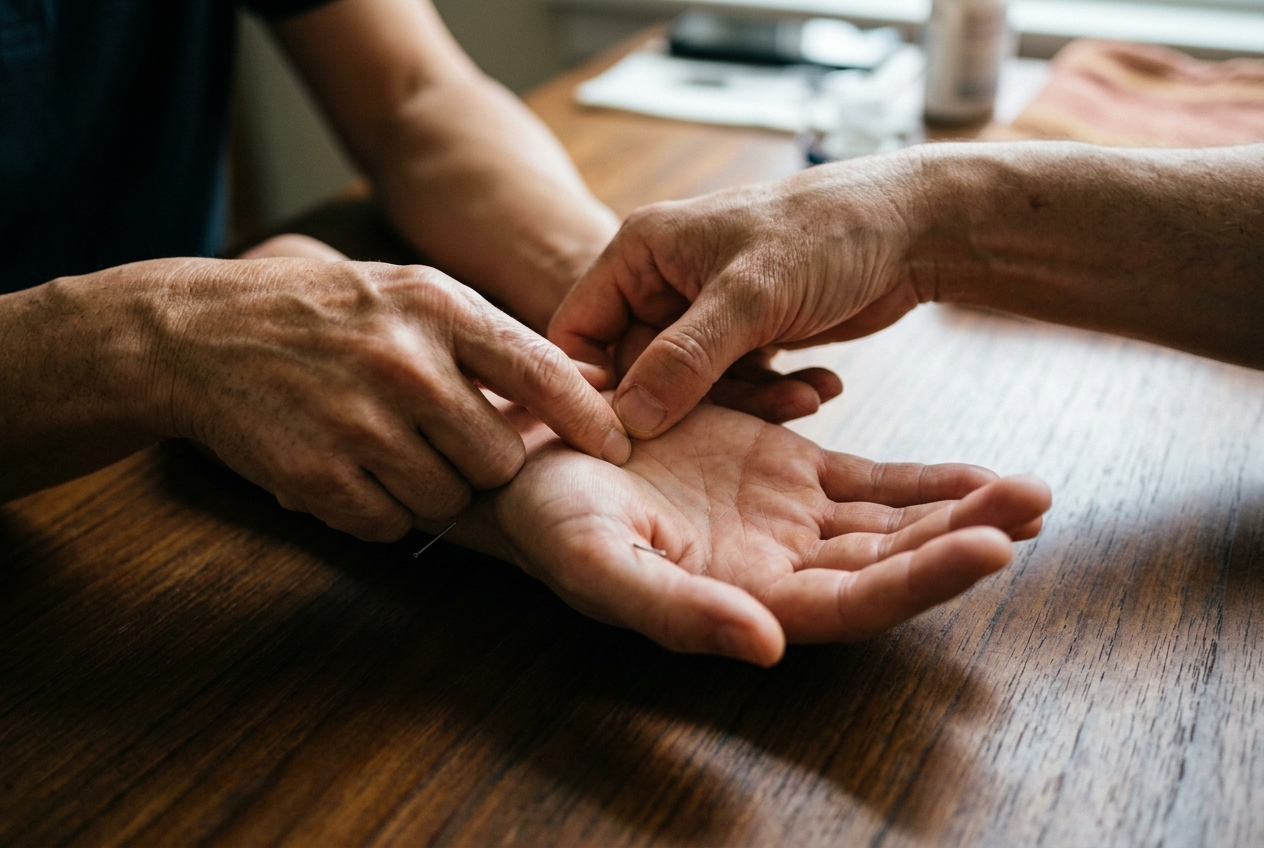
1. Opening — A Problem This Solves Today: Somatotopic Holography in the Digital Age
If you spend your working hours seated before a digital display, you are likely intimately familiar with a specific constellation of somatic complaints: a vise-like tension clamping the base of your skull, a stubborn, burning rigidity between your scapulae, an afternoon slump characterized by shallow breathing, and a postprandial heaviness or low-grade digestive stagnation. In contemporary clinical neurology, this symptom cluster reflects sustained sympathetic arousal, postural forward-head drift, and neuromuscular exhaustion. In Traditional Chinese Medicine (TCM), it represents an acute stagnation of Qi and Blood across the cranial, cervical, and gastrointestinal tracts.
Yet the most sophisticated and immediately accessible tool for modulating this systemic distress is resting at the end of your sleeves.
The human hand is far more than an evolutionary triumph of dexterity; it operates as a high-density biological switchboard. In classical Chinese medical literature—most notably within the foundational Han Dynasty treatise the Huangdi Neijing (Ling Shu, Chapter 10)—the peripheral terminals of the twelve primary meridians are described as consolidating into intricate networks of collateral vessels (luo-mai) across the palmar and dorsal aspects of the hand. The ancients posited that because all major channels either originate, terminate, or establish collateral communication at the digital extremities, the hand contains the holographic information of the entire somatic corpus.
In the late twentieth century, this classical intuition underwent rigorous contemporary reformulation. In 1971, Dr. Tae-Woo Yoo formalized Koryo Hand Therapy (KHT) in South Korea, demonstrating that every visceral organ and musculoskeletal segment possesses a topologically ordered reflex projection on the hand. Concurrently, biophysicist Professor Yingqing Zhang of Shandong University developed the ECIWO theory (Embryo Containing the Information of the Whole Organism), establishing that long bones—most prominently the second metacarpal—act as self-contained somatotopic axes reflecting the entire cranial-caudal polarity of the human organism.
When you manipulate specific loci on the hand, you are not merely performing localized manual therapy; you are delivering targeted neuro-sensory inputs into a micro-acupuncture architecture capable of modulating central autonomic tone and visceral perfusion.
2. The Meridian Path — A Journey Through the Body: Neuroanatomy, Fascial Tensegrity, and Cortical Homuncular Magnification
To understand how pressing a point between your metacarpal bones relieves a spasm in your cervical spine or soothes an inflamed stomach, one must look directly at the neuroanatomical architecture of the sensory cortex.
The glabrous (hairless) skin of the human palm and the tactile pads of the distal phalanges possess one of the highest concentrations of sensory receptors in the animal kingdom. These include: * Meissner's corpuscles, which register rapid skin deformation and dynamic touch; * Merkel cell-neurite complexes, mediating sustained pressure and high-resolution spatial tactile discrimination; * Pacinian corpuscles, sensing deep vibratory oscillations; * Ruffini endings, encoding directional skin stretch and joint rotation.
When sensory inputs travel from these peripheral receptors through the radial, median, and ulnar nerves into the dorsal horn of the spinal cord and ascend via the spinothalamic and dorsal column pathways, they arrive at the primary somatosensory cortex (S1).
As mapped in the famous Penfield cortical homunculus, the cortical territory devoted to the hand and fingers is disproportionately vast compared to their actual physical surface area. This neurobiological phenomenon—known as cortical magnification—means that mechanical stimulation applied to a square millimeter of the palm elicits a far larger neurochemical and bioelectrical response in the central nervous system than identical stimulation applied to the thigh, back, or abdomen.
Furthermore, functional neuroimaging studies published on PubMed Central have validated that stimulating distal acupressure loci selectively modulates deep subcortical structures, including the periaqueductal gray (PAG) matter, the thalamus, the insular cortex, and the dorsal motor nucleus of the vagus nerve.
Somatotopic Architecture Across the Hand
The systemic mapping of the human body onto the hand follows strict, predictable axes across both palmar and dorsal aspects:
- The Axial / Cranio-Caudal Pillar (The Middle Ray): * The tip of the middle finger corresponds to the vertex of the cranium and brainstem. * Moving proximally down the middle finger, the distal interphalangeal joint represents the cervical spine, the proximal interphalangeal joint maps to the thoracic spine and epigastrium, and the metacarpophalangeal (MCP) knuckle corresponds to the lumbosacral junction.
- The Appendicular Rays (The Lateral Digits): * The index and ring fingers project somatotopically as the upper extremities (shoulders, elbows, wrists). * The thumb and small finger project as the lower extremities and lateral pelvic stabilizing musculature.
- The Visceral Core (The Central Palm): * The hollow of the central palm (surrounding point Laogong, PC8) corresponds directly to the thoracic cavity, the cardiac plexus, the diaphragm, and the solar plexus. * The proximal palm toward the wrist crease maps to the lower digestive tract, bladder, and reproductive organs.
- The Second Metacarpal Holographic Vector (Zhang's Axis):
* The radial edge of the second metacarpal bone (the bone running along the base of your index finger) forms a complete vertical micro-homunculus:
- Distal extremity (near index knuckle): Head, eyes, sinuses, and facial motor centers.
- Upper third: Lungs, bronchi, and heart.
- Midpoint: Stomach, liver, gallbladder, and spleen.
- Lower third: Kidneys, small intestine, and large intestine.
- Proximal base (near wrist joint): Pelvic cavity, bladder, and lower limbs.
3. Three Key Microsystem Points You Can Press Right Now
To utilize this somatic matrix effectively, you do not need needles or electro-acupuncture devices. Focused manual compression using the thumb-tip or interphalangeal knuckle provides ample mechanoreceptive transduction.
Apply firm, sustained perpendicular or angled pressure until you elicit the characteristic De Qi sensation—a subjective feeling described in clinical literature as a dull, heavy ache, local distension, mild warmth, or subtle spreading tingling along fascial planes.
Point 1: The Second Metacarpal Cranial Pole & Upper Metacarpal Margin (Hegu / LI4 Reflex Axis)
- Physical Location: Locate the prominent fleshy web space between your thumb and index finger. Slide your pressing thumb along the outer (radial) edge of the long second metacarpal bone, stopping just before the midpoint where the bone forms a slight shelf. You can also pinch the muscular crest of the first dorsal interosseous muscle against the second metacarpal bone.
- The Sensation: When correctly engaged, you will not feel sharp, surface-level pain; rather, you will experience an unmistakable deep, spreading, dull soreness, often radiating along the radial side of the forearm toward the elbow.
- Biomechanical Vector & Cadence: Hook the tip of your thumb underneath the radial bone margin, applying firm pressure directed inward and slightly upward toward the index finger's long axis. Maintain steady, unyielding pressure for 90 to 120 seconds while maintaining deep diaphragmatic breathing.
- Clinical Indications: Acute tension headaches (frontal and temporal), facial muscle hypertonicity from jaw-clenching (bruxism), sinus congestion, and systemic downregulation of pain perception via endogenous opioid and descending serotonergic pathways.
Point 2: The Central Palmar Autonomic Epicenter (Laogong / PC8 & Solar Midpoint)
- Physical Location: Gently close your hand into a loose fist. Observe where the tip of your middle finger naturally makes contact with the center of your palm. The target locus lies in the depression between the second and third metacarpal bones, slightly closer to the radial side of the third metacarpal.
- The Sensation: A pleasant, deep, warm aching sensation, accompanied by a subtle local throbbing that mirrors arterial pulsation as the local capillary bed dilates.
- Biomechanical Vector & Cadence: Place the rounded knuckle of your opposing index or thumb directly into the palmar hollow. Apply a slow, rhythmic circular kneading motion (clockwise at approximately 1 Hertz frequency) with moderate depth (compressing the palmar aponeurosis without pinching the superficial skin). Sustain for 2 to 3 minutes per hand.
- Clinical Indications: Acute epigastric distension, stress-induced functional dyspepsia, racing heart rate associated with sympathetic arousal, insomnia, and psychological restlessness.
Point 3: The Fifth Metacarpal Ulnar Axis (Houxi / SI3 & Dorsal Spinal Reflex)
- Physical Location: Form a loose fist and examine the outer edge of your hand (the ulnar margin, beneath the little finger). Locate the deep skin fold at the end of the prominent transverse crease across your palm, immediately proximal to the knuckle of your little finger, where the pink palmar skin transitions into the darker dorsal skin.
- The Sensation: A pronounced, sharp-yet-dull, radiating ache that travels up the ulnar margin of the wrist and forearm, frequently eliciting an immediate reflex relaxation across the trapezius muscle.
- Biomechanical Vector & Cadence: Press the tip of your thumb firmly against the ulnar margin of the fifth metacarpal bone, angling your vector toward the center of the palm. Alternatively, hook your knuckle against this margin and perform small, longitudinal friction sweeps along the bone edge for 90 seconds.
- Clinical Indications: Cervical spine rigidity, acute neck stiffness from poor sleep posture or screen usage, occipital headaches, subscapular spasms, and postural spinal fatigue.
4. Point Combination for a Common Issue: The Digital Desk-Worker Protocol
For individuals experiencing the classic end-of-day triad—suboccipital tension headaches, cervical spine stiffness, and post-meal digestive heaviness—individual point stimulation is beneficial, but sequential multi-point chaining produces a compounding therapeutic effect.
The 5-Minute "Do This Tonight" Protocol
Phase 1: Axial Decompression via the Fifth Metacarpal Ulnar Margin (90 Seconds per Hand)
- Posture: Sit upright in an ergonomic chair, feet flat on the floor, shoulders actively dropped away from the ears. Allow your resting forearm to lie flat on the desk surface.
- Action: Engage point SI3 (Houxi) on the ulnar edge of the right hand using the left thumb-tip. Apply firm, sustained pressure while slowly rotating your head from side to side in a gentle 45-degree arc.
- Neuro-Biomechanical Mechanism: Activating this point while mobilizing the cervical spine creates proprioceptive gated inhibition within the spinal cord, downregulating hyperactive motor units in the splenius capitis and upper trapezius.
Phase 2: Cranio-Facial and Autonomic Clearing via the Second Metacarpal Axis (120 Seconds per Hand)
- Posture: Rest your elbows on your desk, allowing the weight of your forearms to support your hands.
- Action: Transition your opposing thumb to point LI4 (Hegu) on the radial margin of the second metacarpal. Grip the point firmly, pinching the muscle mass between your thumb on top and index finger beneath the palm. Execute micro-rotations (slow circles the size of a grain of rice) at 2.5 to 3.5 kg/cm² force threshold.
- Respiratory Synchronization: Inhale through the nose for a 4-second count, hold for 4 seconds, and exhale slowly through pursed lips for 6 seconds. This breathing pattern reinforces parasympathetic transition while the descending pain inhibition pathways are activated.
Phase 3: Centering the Vagal Rhythm and Enteric Core via the Palmar Center (90 Seconds per Hand)
- Posture: Lean back into your chair, resting both hands in your lap, palms facing upward.
- Action: Place the flat pad of your opposing thumb directly into the center of the palm at PC8 (Laogong). Apply steady, moderate, unhurried pressure with a gentle downward vector toward the wrist. Close your eyes and visualize the release of tension in your solar plexus and diaphragm.
- Physiological Outcome: This step decreases peripheral vascular resistance, promotes splanchnic circulation, and stimulates gastrointestinal peristalsis via vagal reflex loops, rapidly resolving afternoon dyspeptic bloating.
5. Safety, Clinical Vigilance, and Palpatory Diagnostics
While non-invasive acupressure applied to the hand microsystem is an inherently safe modality, its physiological potency requires clinical understanding and discernment.
Palpatory Diagnostic Cues
As you palpate your own or a patient's hands, pay close attention to objective tissue changes. The hand microsystem acts as an active diagnostic canvas:
- Tender Nodules (Ashi Micro-Loci): In areas corresponding to congested organs or strained muscles, you will frequently discover minute, rice-grain-sized nodules or fibrous bands within the subcutaneous fascia. These are not permanent anatomical structures, but neurogenic inflammatory exudates and localized fascial cross-linkages.
- Localized Temperature Discrepancies: Cold digital extremities or a cool central palm often indicate peripheral vasoconstriction driven by chronic sympathetic overactivity or systemic Qi deficiency.
- Galvanic Skin Shifts: Areas of chronic organ dysfunction exhibit measurable reductions in electrical impedance across corresponding metacarpal zones—a phenomenon utilized in modern electro-meridian diagnostic systems.
6. Today's Takeaway: The Two-Minute Radial Metacarpal Reset
You do not need an entire clinical suite or an hour of leisure to experience the systemic regulatory power of the hand meridian microsystem. Before you step away from this article, perform this simple, scientifically verified reset protocol:
- Locate: Place your left hand palm-down on your knee or desk. With your right hand, place your thumb-tip against the radial edge of the long bone leading to your left index finger (the second metacarpal), exactly halfway down its length.
- Engage: Slide the thumb-tip slightly underneath the bone margin until you locate a sensitive, tender indentation. Press firmly inward and slightly upward with approximately 2.5 to 3.5 kilograms of force until a distinct, dull ache blooms through the web space.
- Breathe: Close your eyes. Inhale slowly through your nose for 4 seconds, and exhale for 6 seconds. Hold this pressure and rhythm for 60 seconds.
- Switch: Transfer your left thumb to the midpoint of your right second metacarpal bone, and repeat the process for 60 seconds.
As you release the pressure, observe the immediate sensations: the sudden drop in shoulder tension, the cooling clearance behind the eyes, the spontaneous deepening of your breath, and the gentle warming of your fingertips.
By engaging the somatosensory architecture of your hand, you have modulated your autonomic balance, engaged your brainstem's descending pain-control mechanisms, and proved that ancient micro-acupuncture principles and modern neurobiology speak the exact same physiological language.
Authoritative References and Further Reading
- World Health Organization (WHO) Traditional Medicine & Acupuncture Standards
- National Center for Biotechnology Information (NCBI) on Somatosensory Cortical Representation
- PubMed Central: Neuroimaging Mechanisms of Distal Acupoint Stimulation
- Wikipedia: The Cortical Homunculus and Somatosensory Mapping
- PubMed Central: Autonomic Modulation and Vagal Regulation via Somatic Reflexes
- Wikipedia: Principles and Applications of Acupressure