Hand Diagnosis (Shou Zhen) Meridian Diagnostics: Governing Palmar Reflex Topography, Thenar Microvascular Differentiation, and Visceral Projection in Traditional Chinese Medicine
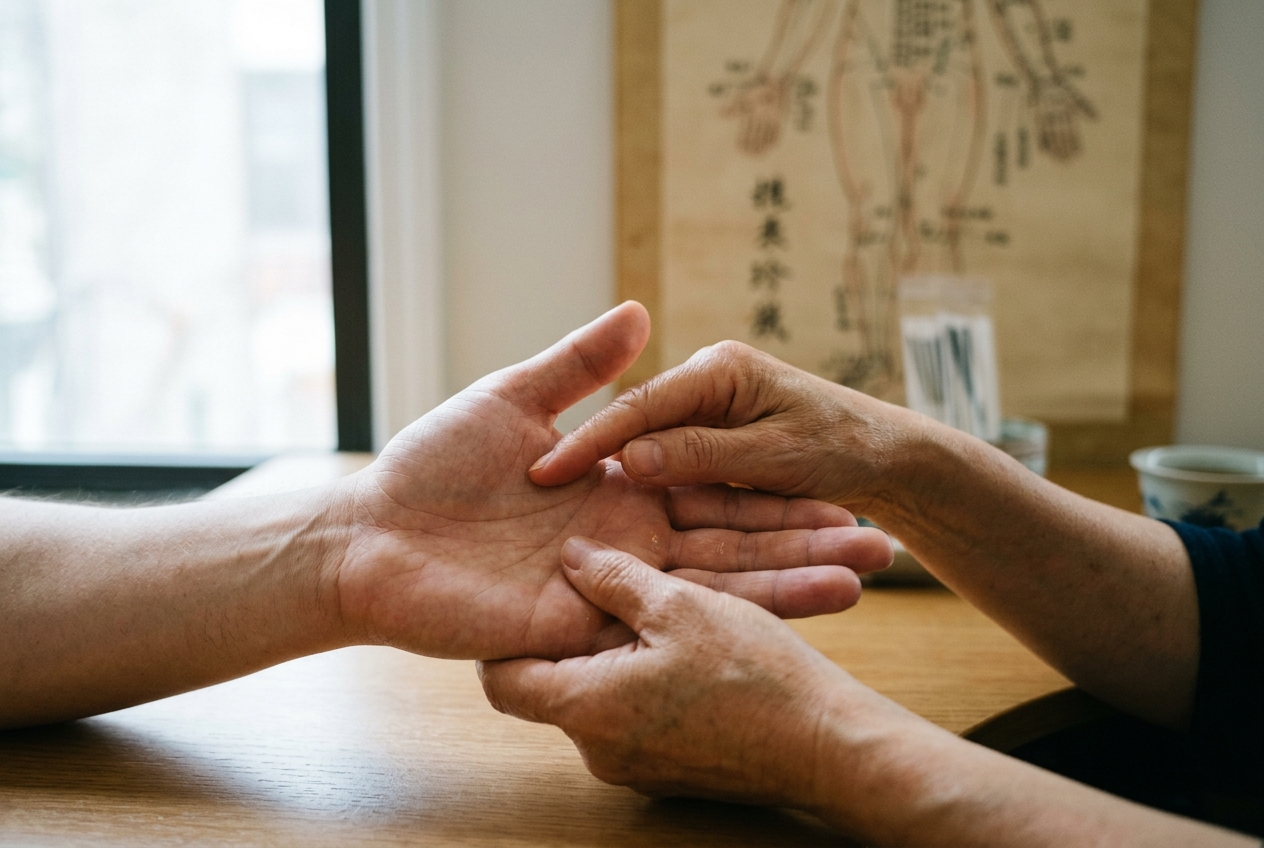
Look down at the palms of your hands under bright, natural light. Open them wide, then let the fingers relax into a gentle, natural curve. You might notice a vibrant, cherry-red flush blooming across the fleshy mound at the base of your thumb. Perhaps there is an intricate, web-like tracery of faint bluish venules winding through the center of your palm, or a pale, waxy cool zone nestled along the outer edge beneath your little finger. On stressful afternoons, your palms may feel damp, hot, and restless; following a heavy, rich meal, they may appear slightly swollen, doughy, and mottled with transient white spots.
In modern daily life, we tend to view our hands purely as mechanical instruments—bio-mechanical levers for typing on keyboards, turning steering wheels, and holding smartphones. Yet in classical medical traditions, particularly within Traditional Chinese Medicine (TCM), the human hand is understood as an exquisitely sensitive somatosensory mirror. Long before the advent of biochemical panels or ultrasound imaging, physicians observed that systemic shifts in internal physiology, emotional equilibrium, and microvascular circulation cast immediate, legible shadows upon the palmar surface.
This diagnostic art—known historically as Shou Zhen (手诊, Hand Diagnosis)—is not fortune-telling or esoteric palmistry. Rather, it represents a sophisticated branch of inspection diagnostics (Wang Zhen 望诊). By examining the subtle landscape of palmar topography, tissue turgor, microvascular coloration, and temperature gradients, practitioners read the living status of the body’s internal organs (Zang-Fu 脏腑) and their circulating energies (Qi and Blood). What presents on your palm this very moment is a real-time dispatch from your internal physiology.
+-----------------------------------------------------------------------------------+
|                           CLINICAL RESULT HIGHLIGHT                               |
|                                                                                   |
|  Palmar microvascular architecture operates as an accessible autonomic mirror:    |
|  arteriovenous anastomoses, capillary loop density, and dermal turgor across the  |
|  thenar, hypothenar, and central palm provide real-time clinical indices of       |
|  systemic microcirculation, autonomic balance, and visceral homeostasis.          |
+-----------------------------------------------------------------------------------+
2. What This Organ System Does: The Holographic Hand Microsystem & Visceral Meridian Architecture
To understand how the hand reflects total systemic health, one must examine the meridian infrastructure that tethers the upper extremities directly to the body’s visceral core. Traditional Chinese Medicine conceptualizes the body as an interconnected web of energy pathways known as the Jing-Luo (经络, Channels and Collaterals), documented comprehensively across foundational texts such as the Huangdi Neijing (Yellow Emperor's Inner Canon).
The hand represents a critical anatomical confluence: all six Hand Channels terminate or originate within the palmar and digital tissues:
- The Hand Taiyin Lung Meridian (Fei Jing 肺经) travels down the anterolateral aspect of the arm, traversing the prominent muscular mound at the base of the thumb—the thenar eminence (Yuji 鱼际)—before terminating at the radial corner of the thumbnail. This pathway links respiratory vitality, immune defence (Wei Qi), and peripheral fluid distribution directly to the thumb.
- The Hand Yangming Large Intestine Meridian (Dachang Jing 大肠经) begins at the radial tip of the index finger, traverses the dorsal interosseous space, and governs digestive elimination, mucosal barrier health, and systemic detoxification.
- The Hand Jueyin Pericardium Meridian (Xinbao Jing 心包经) courses through the exact midline of the inner forearm and plunges into the anatomical center of the palm (Laogong 劳宫, PC8), terminating at the tip of the middle finger. This channel acts as the primary vascular and emotional shock absorber for the Heart.
- The Hand Shaoyang San Jiao Meridian (Sanjiao Jing 三焦经) begins at the ulnar corner of the ring fingernail, regulating the metabolic and fluid-transforming networks across the upper, middle, and lower torso.
- The Hand Shaoyin Heart Meridian (Xin Jing 心经) descends along the medial forearm into the palm, traversing the hypothenar eminence (Xiao Yuji 小鱼际) to end at the radial tip of the little finger. It governs blood propulsion and mental-emotional clarity (Shen 神).
- The Hand Taiyang Small Intestine Meridian (Xiaochang Jing 小肠经) originates at the outer tip of the little finger, climbing the ulnar border of the hand, coordinating nutrient assimilation and clear mental discernment.
The Nine Palaces and Eight Trigrams (Jiu Gong Ba Gua 九宫八卦)
Beyond linear channel pathways, classical Chinese medical semiotics organizes the palm into a holographic microsystem governed by the Eight Trigrams (Ba Gua 八卦) and Nine Palaces (Jiu Gong 九宫), rooted in Daoist cosmological models and codified in specialized diagnostic treatises. This somatotopic map distributes specific visceral zones across distinct palmar sectors:
- The Thenar Eminence (Gen 艮 & Zhen 震 Palaces): The large muscular pillow beneath the thumb corresponds primarily to the Spleen-Stomach axis (Earth) and the Lung-Liver dynamic interface. Robust, resilient thenar musculature denotes strong metabolic assimilation and abundant foundational Qi (Zhong Qi).
- The Hypothenar Eminence (Qian 乾 & Kun 坤 Palaces): The fleshy ridge along the ulnar border mirrors the Kidney-Bladder reserve (Water) and the Large and Small Intestines. A firm, well-hydrated hypothenar pad indicates deep constitutional vitality (Yuan Qi).
- The Distal Palmar Metacarpal Bases (Li 离 & Xun 巽 Palaces): The zone spanning the roots of the index, middle, and ring fingers reflects the Cardiovascular system, Liver blood storage, and upper thoracic circulation.
- The Palmar Center / Clear Hall (Ming Tang 明堂 / Tai Ji): The depression in the heart of the palm corresponds to the Pericardium, autonomic nervous tone, and systemic thermoregulation.
From a contemporary biomedical viewpoint, this somatosensory correspondence is mediated by the dense autonomic and sensory innervation of the hands. As catalogued in global health research on integrative modalities by the World Health Organization (WHO) Traditional Medicine Strategy, microsystem diagnostics interface directly with the autonomic nervous system.
The human palm contains an extraordinarily high concentration of arteriovenous anastomoses (AVAs)—specialized vascular shunts governed by sympathetic postganglionic fibers. Visceral inflammation, hepatic congestion, or emotional distress alters sympathetic vasomotor tone, modulating blood velocity, capillary loop engorgement, and local dermal temperature across specific dermatomes of the palm.
3. How You Can Feel It: Signs of Balance and Imbalance
When your visceral systems and meridian networks operate in dynamic harmony, your hands reflect this equilibrium with quiet elegance. A healthy, balanced palm demonstrates: * A soft, resilient elasticity with natural muscular rebound (neither flaccid nor tense). * A warm, uniform base tone described in classical texts as Hong Run (红润)—a luminous, rosy-pink hue glowing beneath a translucent epidermal surface. * Clean, clear palmar creases without hyperpigmentation, deep branching cross-hatchings, or congested capillary fringes. * Even thermal distribution from the wrist to the distal tips of the fingers.
When internal balance falters, specific microvascular and dermatological deviations manifest across the palmar topography. You can evaluate these signs systematically using the following diagnostic criteria:
1. Thenar Erythema & Blotchy Hyperemia (Liver Heat & Yin Deficiency)
A pronounced, speckled redness concentrated over the thenar and hypothenar eminences—sparing the central hollow—is termed palmar erythema. In TCM, this signals Liver Fire flaring upward (Gan Huo Shang Yan) or Yin Deficiency with Heat (Yin Xu Nei Re).
As detailed in clinical literature on microcirculatory diagnostics and palmar erythema on NCBI PubMed, this localized capillary pooling reflects altered circulating hormone metabolism (particularly elevated free estrogens) and hyperdynamic peripheral microcirculation often linked to hepatic stress, prolonged emotional tension, or systemic inflammatory load.
2. Microvascular Cyanosis & Venule Engorgement (Qi Stagnation & Blood Stasis)
Examine the base of the thenar eminence and the subcutaneous zone along the wrist crease. The presence of dark purple, distended, or serpentine venules indicates Qi Stagnation (Qi Zhi) and Blood Stasis (Xue Yu). When the smooth flow of liver Qi falters—often due to chronic psychological stress or sedentary posture—venous return slows.
If these vessels appear distinctly cold and pale blue, it indicates Cold Congealing the Channels (Han Ning Xue Yu), presenting clinically with cold extremities, sluggish digestion, and menstrual or muscular cramping.
3. Palmar Pallor, Flaccidity & Sarcopenia (Spleen Qi & Blood Vacuity)
When the palm lacks a rosy undertone and displays a dull, chalky, or yellowish-white hue, it points to Spleen-Stomach Qi and Blood Deficiency (Pi Wei Qi Xue Liang Xu).
If the thenar muscle pad feels thin, soft, and easily indented without immediate elastic springback, the body’s metabolic capacity to transform nutrition into post-natal vitality (Hou Tian Zhi Qi) is compromised. Individuals with this sign typically experience chronic afternoon fatigue, mental fog, post-prandial bloating, and weak muscle tone.
4. Boggy Turgor & Clammy Hyperhidrosis (Phlegm-Damp Accumulation)
A palm that feels unusually thick, swollen, and doughy, accompanied by constant clammy perspiration, signifies Phlegm-Damp Accumulation (Tan Shi).
In TCM, when the Spleen fails to properly govern fluid transformation, pathological moisture gathers in the subcutaneous matrix. This manifests systemically as heavy limbs, sluggish bowel movements, nasal congestion, and metabolic lethargy.
5. Central Palmar Heat (Five-Center Heat Syndrome)
If the center of your palm (Laogong, PC8) radiates a dry, burning heat—often worsening in the late afternoon or evening—while your skin remains dry, this is the classic signature of Five-Center Heat (Wu Xin Fan Re).
This condition occurs when deep tissue fluids and constitutional reserves are depleted, allowing internal "Empty Fire" to agitate the Heart and Pericardium, frequently accompanied by night sweats, restless sleep, and vivid dreaming.
To establish rigorous clinical precision, the TCM practitioner never interprets palmar signs in isolation. Palmar semiology is cross-correlated with radial pulse palpation (Cun Guan Chi 寸关尺) and tongue inspection (She Zhen 舌诊). For example, a red thenar eminence paired with a wiry radial pulse (Xian Mai) and a red-tipped tongue confirms active Liver Fire agitating the upper burner. Conversely, if paired with a thin, rapid pulse (Xi Shu Mai) and a peeled, cracked tongue coating, it confirms true Yin fluid exhaustion.
4. Qigong & Movement Practice: The Eight Trigrams Palmar Awakening (Ba Gua Shou Yin Gong)
To clear microvascular stagnation, soothe hyperactive autonomic tone, and harmonize the six hand meridians, dedicate 8 to 10 minutes daily to this targeted, standing or seated Qigong sequence. No equipment is required.
Setup and Posture
Sit tall on a firm chair or stand in the Wuji (neutral) posture with feet shoulder-width apart, knees softly unlocked. Lengthen the crown of your head toward the sky while relaxing your tailbone downward. Allow your shoulders to drop away from your ears, and rest your elbows loosely at your sides. Breathe exclusively through your nose, allowing your lower abdomen to gently expand on each inhalation and contract on each exhalation.
Step-by-Step Movement Protocol
Phase 1: Palmar Friction & Thermal Priming (Igniting the Microcirculatory Fire)
Bring your hands together at the level of your heart. Rub your palms vigorously against each other in rapid, circular motions for approximately 30 seconds (36 rapid passes).
Focus your intention (Yi 意) entirely on the friction generating between your palms until you feel an intense, radiant warmth blossom across your Laogong points (the center of both palms).
Phase 2: Opening the Eight Trigrams (Metacarpal Expansion & Release)
Separate your palms by two inches, facing each other at chest level. * Inhalation (4 seconds): Slowly expand your hands outward until they are slightly wider than your shoulders. As you draw the breath in, gently extend your wrists backward and extend all ten fingers wide apart. Feel a distinct, pleasant stretch radiating across the thenar and hypothenar mounds, tautening the skin of the palm. * Exhalation (6 seconds): Slowly glide your hands back toward the center until they are two inches apart without touching. As you exhale, relax the extension: allow the fingers to soften into a relaxed, curved "Dragon Claw" shape, softening the center of the palm. * Repetitions: Complete 9 continuous, fluid cycles.
Phase 3: Spiral Metacarpal Wringing (Clearing Radial & Ulnar Channels)
Extend both arms forward at chest height, palms facing downward. * Slowly rotate your hands outward (supination) so your palms turn upward, then continue the circular rotation until the thumbs point outward to the sides, stretching the radial nerve and the Lung/Large Intestine channels across the thenar bed. * Reverse the spiral, rotating the wrists inward and downward (pronation), curling the little finger side of the hand upward to open the Heart and Small Intestine channels along the hypothenar border. * Repetitions: Perform 12 slow, continuous spiral wringings.
Phase 4: Laogong Visceral Grounding (Condensing the Energy)
To conclude the practice, overlap your warm palms directly over your lower abdomen—your Lower Dantian (Xia Dantian 下丹田), located roughly two to three inches below your navel (men place the left palm beneath the right; women place the right palm beneath the left). Close your eyes and breathe deeply into your lower belly for 12 complete, unhurried breath cycles.
+-----------------------------------------------------------------------------------+
|                         SENSORY & SOMATIC BIOFEEDBACK                             |
|                                                                                   |
|  Look for: A distinct prickling, fine-vibrational tingling in the fingertips      |
|  and a deep, permeating thermal warmth filling the central palm. This sensation   |
|  is the somatic hallmark of Deqi (得气, the arrival of vital Qi), reflecting      |
|  microvascular vasodilation and down-regulation of sympathetic vascular tone.     |
+-----------------------------------------------------------------------------------+
5. Acupressure Points You Can Try Today
Targeting specific acupressure loci situated along the palmar and digital channels allows direct self-regulation of visceral blood flow, autonomic tension, and emotional reactivity. The clinical mechanisms of these points are extensively documented in modern research on the neurobiological basis of acupuncture on NCBI PubMed.
1. Laogong (PC8, 劳宫 — "Palace of Toil")
- Anatomical Location: Located in the center of the palm. To locate it precisely, make a loose, natural fist; the point lies in the depression directly beneath the tip of your middle finger, between the second and third metacarpal bones.
- Technique: Use the tip of your opposite thumb to apply steady, perpendicular pressure directly into the central palmar hollow. Maintain firm, sustained pressure while making micro-rotations for 90 to 120 seconds per hand. You should feel a profound, heavy ache that radiates into the palm.
- Clinical Utility: Laogong is the Ying-Spring and Fire point of the Pericardium channel. It is the premier point for clearing Heart-Fire, relieving acute mental agitation, calming social anxiety, lowering elevated heart rate during panic episodes, and treating burning palmar heat.
2. Yuji (LU10, 鱼际 — "Fish Border")
- Anatomical Location: Located on the radial aspect of the thenar eminence, at the midpoint of the first metacarpal bone, right at the visible junction where the red palmar skin meets the lighter dorsal skin.
- Technique: Place your opposite thumb on the midpoint of the thumb bone and press inward toward the bone at a 45-degree angle. Apply deep, rhythmic pressure—pressing firmly for 3 seconds, then releasing slightly, for 2 full minutes.
- Clinical Utility: Yuji is the Ying-Spring point of the Lung Meridian. It specifically drains excess heat from the respiratory tract and clears thermal congestion from the thenar eminence. It is highly effective for soothing sore, dry throats, mitigating dry coughs, relieving thoracic tightness, and alleviating occupational thumb and wrist strain.
3. Shaofu (HT8, 少府 — "Lesser Mansion")
- Anatomical Location: Located on the palmar surface between the fourth and fifth metacarpal bones. When you make a loose fist, it sits directly where the tip of the little finger touches the palm.
- Technique: Anchor your fingers around the back of your hand and press the tip of your thumb firmly into the groove between the fourth and fifth metacarpal bones. Apply circular, kneading friction for 1 to 2 minutes on each hand while taking slow, long exhalations.
- Clinical Utility: As the Ying-Spring and Fire point of the Heart Channel, Shaofu clears endogenous heat from the Heart and Small Intestine. It is used clinically to address nighttime restlessness, insomnia accompanied by vivid dreams, chest palpitations, and localized ulnar palmar pain.
4. Hegu (LI4, 合谷 — "Joining Valleys")
- Anatomical Location: Located on the dorsal surface of the hand, in the muscular webbing between the first (thumb) and second (index) metacarpal bones. Place the transverse crease of the interphalangeal joint of your opposite thumb into the edge of the webbing, and fold your thumb down; the point lies at the peak of the muscle mound.
- Technique: Squeeze the point between your opposite thumb (on the dorsal surface) and index finger (on the palmar surface), aiming the pressure firmly toward the second metacarpal bone. Apply strong, pulsing pressure for 2 minutes. (Note: Contraindicated during pregnancy.)
- Clinical Utility: As a Yuan-Source and Command point, Hegu is one of the most powerful points in the body for moving stagnant Qi, alleviating pain throughout the head and face (tension headaches, jaw clenching, sinus congestion), and promoting systemic microvascular circulation.
6. Food & Lifestyle: Small Changes for Today
Your palmar tissues and microvascular beds respond dynamically to systemic dietary patterns, emotional regulation, and daily ergonomics. By introducing targeted, whole-food adjustments and micro-habits, you can actively reduce thenar erythema, resolve venular blood stasis, and nourish constitutional vitality.
Targeted Dietary Protocols
1. To Clear Thenar Heat and Decongest the Liver
If your palms exhibit red, mottled thenar and hypothenar mounds: * Infuse Cooling Florals: Sip loose-leaf Chrysanthemum tea (Ju Hua) paired with a small pinch of Goji berries (Gou Qi Zi) throughout the morning and early afternoon. Chrysanthemum clears excess heat from the Liver channel and soothes tired, strained eyes, while Goji gently nourishes hepatic Yin. * Incorporate Bitter Greens: Add a modest serving of lightly steamed or sautéed dandelion greens, chicory, arugula, or watercress to your midday meal. The bitter flavor (Ku Wei) naturally descends rebellious Qi and clears vascular heat. * Reduce Vascular Agitators: Significantly cut back on distilled spirits, heavily spiced or deep-fried foods, and high doses of caffeine, all of which trigger immediate peripheral vasodilation and exacerbate thenar redness.
2. To Resolve Venular Stasis and Warm the Channels
If your palms display cold, dark blue venules or feel perpetually chilly: * Introduce Hawthorn & Ginger: Prepare a daily decoction using dried Hawthorn berries (Shan Zha) and two thin slices of fresh ginger root simmered in warm water. Hawthorn is widely recognized in both TCM and modern vascular research for invigorating blood circulation, resolving microvascular stagnation, and supporting lipid metabolism. * Eat Warm, Cooked Meals: Shift away from iced drinks, raw salads, and frozen smoothies. Nourish your digestive fire with slow-cooked stews, roasted squash, bone or mushroom broths, and warming culinary spices such as cinnamon, cloves, and black pepper.
3. To Resolve Dampness and Restore Elastic Turgor
If your hands feel thick, puffy, doughy, or uncomfortably clammy: * Adopt Roasted Barley & Adzuki Broth: Drink warm Roasted Barley tea (Mai Cha) or a light broth made by simmering Adzuki beans (Chi Xiao Dou). These gentle, non-medicinal foods support the Spleen in draining surplus interstitial dampness and restoring lean tissue tone. * Eliminate Dampness Generators: Severely restrict rich dairy creams, ultra-processed baked goods, artificial sweeteners, and heavy, late-night meals that overburden your digestive transformation.
===================================================================================
                  DAILY PALMAR MICROVASCULAR RESTORATION RITUAL
===================================================================================

[ MORNING ]
  • Inspect palms under direct natural window light for 30 seconds.
  • Note thenar coloration, venular clarity, and tissue resilience.

[ MIDDAY ]
  • 2-Minute Desk Decompression: Interlace fingers, press palms outward to extend
    the flexor retinaculum, roll wrists in complete circles.
  • Acupressure: Press Laogong (PC8) and Hegu (LI4) for 60 seconds per hand.

[ EVENING ]
  • Hydro-Thermal Contrast: Immerse hands in warm water (38°C) for 3 minutes,
    briefly dip in cool water (20°C) for 15 seconds, return to warm for 2 minutes.
  • Nourishing Massage: Work sweet almond or sesame oil along thenar beds with thumb.
===================================================================================
Lifestyle and Ergonomic Adjustments
- Hydro-Thermal Hand Baths: If you experience chronic microcirculatory stasis or Raynaud-type coldness in your fingers, perform an evening contrast immersion. Submerge your hands up to the wrists in comfortably warm water for 3 minutes, switch to cool (not freezing) water for 15 seconds, and return to warm water for 2 minutes. This exercises the vascular smooth muscles of the palmar arteriovenous anastomoses.
- Carpal Tunnel & Metacarpal Decompression: Repetitive typing binds the flexor retinaculum and compresses the median nerve, directly obstructing the Hand Jueyin (Pericardium) channel. Every two hours, interlace your fingers behind your back, gently open your chest, and pull your thumbs backward to stretch the anterior myofascial chains of both arms.
- Tactile Rest: In our digital age, the tactile sensory cortex is chronically overstimulated by smooth, unyielding glass screens. Dedicate 15 minutes each evening to screen-free tactile recovery—gardening, working with clay, kneading dough, or simply resting your open hands palms-up upon your lap to restore natural resting tone.
7. Today's Takeaway
+===================================================================================+
|                              THE 5-MINUTE DAILY PROTOCOL                          |
|                                                                                   |
|  Tomorrow morning, before reaching for your smartphone, sit upright on the edge   |
|  of your bed and open your hands palms-up under natural light. Inspect the rosy   |
|  clarity of your thenar beds, rub your palms vigorously together until Laogong    |
|  (PC8) radiates intense warmth, and firmly compress each central palm with your   |
|  opposite thumb for 60 seconds while taking five slow, deep belly breaths.        |
|  In five minutes, you reset your autonomic tone, awaken internal visceral         |
|  circulation, and connect directly with the living wisdom written on your palms.  |
+===================================================================================+
Your palms are neither static flesh nor arbitrary biological tools; they are an expressive, real-time map of your internal physiological terrain. By learning to read their microvascular hues, honoring their meridian connections, and engaging in simple daily practices of palmar self-care, you claim a direct, intuitive partnership with your body’s enduring capacity for self-regulation and balance.
Authoritative References & Further Reading
- World Health Organization (WHO) Traditional Medicine Global Report
- NCBI PubMed — Clinical Significance of Palmar Erythema and Microcirculatory Diagnostics
- NCBI PubMed — Neurobiological Basis of Acupuncture and Somatosensory Reflexology
- NCBI PubMed — Autonomic and Microvascular Mechanisms in Acupressure and Meridian Diagnostics
- Wikipedia — Traditional Chinese Medicine Meridian Theory and Channels
- Wikipedia — Classical Chinese Cosmology and the Eight Trigrams (Bagua)