Guolin Walking Qigong: Xi-Xi-Hu Wind Respiration, Heel-Strike Biomechanics, and Microvascular Oxygenation in Medical Daoyin
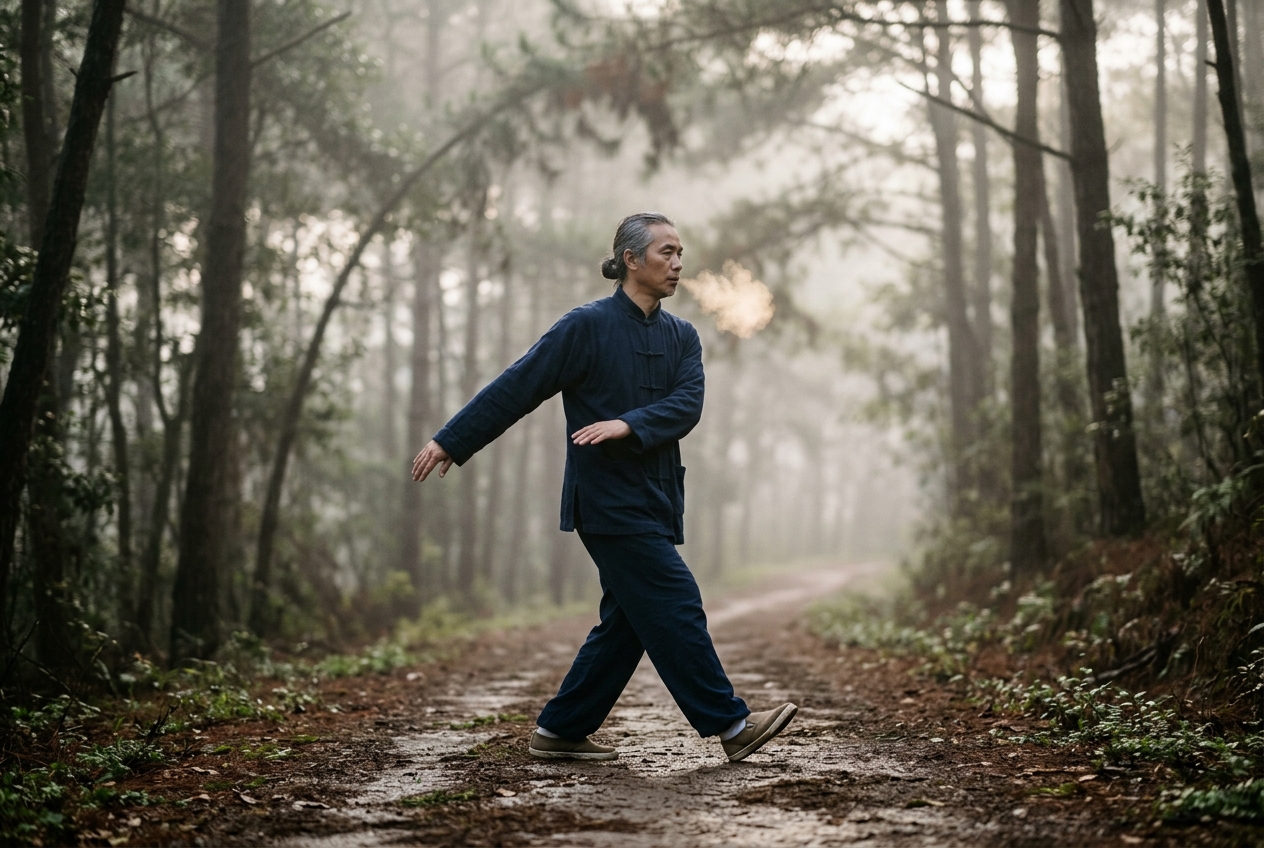
At its core, the practice transforms ordinary walking into a therapeutic intervention by synchronizing three distinct physiological actions: the rhythmic compression and release of the soles of the feet, the pendulum swing of the arms across the lower abdomen, and a wind-type (Feng-type) respiratory cadence. In the vocabulary of Traditional Chinese Medicine (TCM), the exercise is designed to cultivate and circulate Qi (functional vital energy and tissue perfusion) while anchoring consciousness in the Lower Dantian—the body’s neuromuscular center of gravity situated roughly two inches below the navel and three inches inward toward the spine. In modern somatic terms, it is an accessible, low-impact method of neuromuscular re-education that systematically shifts the practitioner out of chronic stress responses into profound autonomic balance.
       [ Phase 1: Heel Strike ]                 [ Phase 2: Rolling Stride ]

         Double Nasal Inhale                      Single Nasal Exhale
             (Xi - Xi)                                   (Hu)

       O  <- Head turned 45°                     O  <- Head returns to center
      /|\                                       /|\
     / | \ <- Hands pass Dantian                 | \ <- Arm completes arc
      / \                                       / \
     /   \                                     /   \
  [Heel]  \ [Trailing Toe]                 [Full Sole] [Trailing Step]
  (Dorsiflexion: Yongquan KD-1 Open)        (Ground Contact: Calcaneus to Metatarsals)
Step-by-Step Practice Guide
The efficacy of Guolin Daoyin depends on precise biomechanical execution and respiratory synchronization. Follow these sequential instructions to establish an authentic personal practice.
+-------------------------------------------------------------------------------+
|                       PHASE-BASED CADENCE SUMMARY                             |
+-------------------+-----------------------------+-----------------------------+
| Parameter         | Inhalation Phase (Xi-Xi)    | Exhalation Phase (Hu)       |
+-------------------+-----------------------------+-----------------------------+
| Gait Action       | Heel Strike (Dorsiflexion)  | Plantar Roll to Toe Contact |
| Breath Vector     | 2 Quick Nasal Inhalations   | 1 Long Nasal Exhalation     |
| Arm Trajectory    | Swing Across Lower Abdomen  | Natural Elastic Rebound     |
| Head Orientation  | 45-Degree Lateral Gaze      | Neutral Forward Realignment |
| Somatosensory Cue | Diaphragmatic Priming       | Visceral Gravitational Sink |
+-------------------+-----------------------------+-----------------------------+
1. The Preparatory Stance (Ziran Zhuang) and Centering (Dingxin)
Begin by standing in an open, quiet space with fresh airflow. Separate your feet to shoulder width, keeping the lateral borders of your feet parallel. Suspend the crown of your head from above by gently tucking the chin, which lengthens the cervical spine. Release the shoulders, allowing the armpits to remain hollow as if cradling two fragile eggs. Place the tip of your tongue lightly against the hard palate behind the upper incisors to bridge the upper energetic pathway. Rest both hands over the lower abdomen, breathe naturally through the nose for two to three minutes, and wait until your thoughts settle and your pulse slows.
2. The Lower-Limb Mechanics: The Rolling Heel Strike (Zhong Jiao Dibu)
Shift your body mass entirely into the right leg, softening the right knee. Advance the left leg forward along an unhurried, natural stride trajectory. * The Heel Strike: Make contact with the earth strictly upon the posterior-lateral calcaneus (heel bone), maintaining the foot in active dorsiflexion (toes pulled upward at an angle of 30 to 45 degrees). Ensure the foot lands softly without slamming; the impact should be a gentle, buoyant contact rather than a jarring shock. * The Plantar Roll: As the weight shifts forward, roll your sole progressively through the lateral longitudinal arch, across the transverse arch, and down through the metatarsal heads, finally establishing firm, grounded contact with the great toe. * The Unweighted Transition: The trailing (right) heel lifts naturally, resting lightly on the ball of the foot before swinging forward to execute the next heel strike. Maintain a constant, level pelvis without bobbing up and down.
3. The Respiratory Synchronization: The Wind-Type Breath (Xi-Xi-Hu)
The breath is entirely nasal, quiet yet crisp, executed without vocalization: * Xi (First Inhalation): As the left heel touches down, take a short, brisk inhalation through both nostrils (lasting roughly 0.5 seconds), allowing the breath to expand the lower ribs and abdomen rather than lifting the upper chest. * Xi (Second Inhalation): Without exhaling the first breath, take an immediate second nasal inhalation of equal volume as the weight begins its forward shift over the midfoot. * Hu (The Exhalation): As the foot rolls completely flat and the full body weight settles over the front leg, release the breath through the nose in a continuous, relaxed exhalation (lasting roughly 1.5 to 2.0 seconds). * Pacing Cadence: Repeat the sequence continuously: Left heel strike (Inhale-Inhale) -> Left roll (Exhale) -> Right heel strike (Inhale-Inhale) -> Right roll (Exhale).
4. The Upper Body: Dantian-Clearing Arm Swings (Baidong) and Cervical Turns
The upper body works in dynamic counter-oscillation to the lower limbs: * Arm Arc: As the left leg steps forward, both arms swing gently across the front of the pelvis in a soft, coordinated curve toward the left hip. The hands should pass directly across the lower abdomen, with the palms angled softly downward or toward the body. * Cervical Rotation: Simultaneously turn your head approximately 45 degrees to the left, directing your soft focus toward the horizon. * Return Phase: As the right leg steps forward, the arms arc back across the center line toward the right hip, while the head turns 45 degrees to the right. The movement must originate from the thoracic spine and waist (Yao), keeping the shoulder girdles entirely passive.
5. Closing Energy-Consolidation (Shougong)
Conclude the walking session by bringing the trailing foot parallel to the lead foot at shoulder width. Inhale deeply through the nose as both hands sweep out to the sides and ascend overhead in a wide arc, palms facing upward. Turn the palms downward at chest height and slowly press them down toward the lower abdomen while exhaling, consciously guiding internal warmth and kinetic energy down into the pelvis. Repeat this gathering movement three times. Finish by vigorously rubbing your palms together until they generate friction heat, then cup your warm palms over your lower back and kidneys for sixty seconds.
Common Beginner Mistakes and Mechanical Corrections
- Mistake: Hyperventilating through forced thoracic gasping. Correction: Keep inhalations small and diaphragmatic. The volume of the two sniffs combined should equal one ordinary resting breath.
- Mistake: Hard calcaneal slamming. Correction: Soften the supporting knee; imagine walking across thin ice or damp moss.
- Mistake: Rigid arm swings. Correction: Relax the elbows and wrists; allow the arms to move purely as passive pendulums driven by the rotation of the waist.
Somatosensory Markers: What You Will Feel
During the first ten to fifteen minutes of continuous walking, practitioners typically notice distinct physiological indicators: * Warmth and Tingling in the Extremities: A distinct buzzing or prickling sensation across the fingertips and palms (Laogong acupoints), indicating microvascular peripheral vasodilation. * Salivation (Yuye): An increase in thin, sweet saliva in the mouth, serving as an unambiguous marker of parasympathetic nervous activation. * Abdominal Borborygmi: Audible gurgling in the digestive tract as splanchnic circulation increases and smooth muscle peristalsis resumes. * Heaviness and Groundedness: A subjective sensation of somatic weight settling into the legs and feet, reflecting lower center-of-gravity stabilization.
The Science of Somatic Vitality: Biomechanics, Gas Exchange, and Autonomic Tone
The physiological mechanisms underlying Guolin Walking Qigong align closely with modern understandings of exercise physiology, biomechanical fluid dynamics, and neurocardiology. Far from being an esoteric curiosity, each component of Master Guo Lin’s protocol targets specific regulatory systems within the human body.
       [ Xi-Xi: Nasal Cavity Turbulence ]
                      |
                      v
       [ Paranasal Sinuses: Nitric Oxide (NO) Synthesis ]
                      |
                      v
       [ Pulmonary Vasodilation & Bronchodilation ]
                      |
                      v
  +-------------------+-------------------+
  |                                       |
  v                                       v
[ Enhanced Alveolar Gas Exchange ]      [ Microvascular Tissue Oxygenation ]
(Increased PaO2 / Optimized V/Q)         (Reversal of Hypoxic Microenvironments)
  |                                       |
  +-------------------+-------------------+
                      |
                      v
       [ Vagal Nerve Baroreflex Activation ]
                      |
                      v
       [ Parasympathetic Dominance & HRV Elevation ]
Hemodynamics and the Venous-Lymphatic Muscle Pump
The human circulatory system faces a formidable hydrostatic challenge: returning deoxygenated blood and metabolic waste from the lower extremities back to the right atrium of the heart against the pull of gravity. The soleus and gastrocnemius muscles of the calf are frequently termed the body’s "peripheral heart."
When performing Guolin Daoyin's exaggerated, active dorsiflexion followed by a complete heel-to-toe roll, the deep posterior compartment muscles undergo maximum eccentric elongation followed by powerful concentric contraction. This cyclical action compresses the intramuscular venous sinuses and the valves of the deep femoral-popliteal system, propelling pooled venous blood upward. Simultaneously, the rhythmic compression of the plantar fascial plexus accelerates lymphatic return through the thoracic duct, enhancing immune surveillance by circulating lymphocytes through regional lymph nodes.
+-------------------------------------------------------------------------------+
|                      SIX FOOT MERIDIAN STIMULATION PROFILE                    |
+-------------------+------------------+-------------------+--------------------+
| Meridian Channel  | Structural Layer | Biomechanical Cue | Clinical Function  |
+-------------------+------------------+-------------------+--------------------+
| Foot Shaoyin (KD) | Medial / Plantar | Calcaneal Strike  | Adrenal regulation |
| Foot Taiyin (SP)  | Anteromedial Leg | Medial Arch Roll  | Fluid distribution |
| Foot Jueyin (LR)  | Medial / Hallux  | Great Toe Push-off| Smooth Qi flow     |
| Foot Yangming(ST) | Anterior Leg     | Tibialis Firing   | Metabolic support  |
| Foot Shaoyang(GB) | Lateral Axis     | Pelvic Counter-arc| Fascial release    |
| Foot Taiyang (BL) | Posterior Chain  | Achilles Stretch  | Autonomic settling |
+-------------------+------------------+-------------------+--------------------+
Ground Reaction Forces and Meridian Acupoint Stimulation
In Traditional Chinese Medicine, six primary bilateral meridians terminate or originate in the feet: the three Yin channels (Spleen, Liver, Kidney) ascending the medial aspect of the leg, and the three Yang channels (Stomach, Gallbladder, Bladder) descending the anterior, lateral, and posterior compartments.
The mechanics of Guolin Daoyin directly stimulate these pathways through physical contact and myofascial tension lines: * The Calcaneus and the Yongquan Point (Kidney-1): Striking the ground with the heel unloads and opens the Yongquan acupoint (located in the depression created when the foot is in plantar flexion, roughly one-third the distance from the base of the toes to the heel). This creates a rhythmic mechanical pump on the plantar fascia that stimulates the deep neurovascular bundles of the tibial nerve, directly mapped to the Kidney channel. * The Medial Arch Roll (Spleen and Liver Channels): Rolling across the medial arch stimulates the Sanyinjiao (Spleen-6) regional crossway and Taichong (Liver-3), easing hepatic congestion and supporting digestive fluid transport. * The Anterior-Posterior Tension Arc (Stomach and Bladder Channels): Dorsiflexion engages the tibialis anterior (Stomach channel) and stretches the entire superficial back line through the gastrocnemius, soleus, and hamstring fascia (Bladder channel), promoting tension release along the paraspinal sympathetic chain.
Respiratory Physiology, Nitric Oxide, and Alveolar Gas Exchange
The Xi-Xi-Hu wind-type breath operates as a sophisticated gas-exchange optimization protocol. Nasal breathing is mandatory because the paranasal sinuses are the primary production sites of endogenous Nitric Oxide (NO), a potent cellular messenger molecule.
When air is inhaled through the nose with two rapid, turbulent pulses (Xi-Xi), the shearing forces against the mucosal linings of the maxillary and ethmoid sinuses significantly increase the release of gas-phase nitric oxide into the inspiratory airflow. As demonstrated in contemporary clinical research indexed by the National Center for Biotechnology Information, autologous nitric oxide inhaled into the lungs functions as a selective pulmonary vasodilator and bronchodilator. It dilates the vascular beds surrounding well-ventilated alveoli, dramatically improving the pulmonary ventilation-perfusion ratio ($V_A/Q$).
Furthermore, the brief pause between the two inhalations recruits under-ventilated alveoli in the dependent zones of the lower lung lobes via collateral channels (the Pores of Kohn). This elevates arterial oxygen saturation ($SaO_2$) and systemic oxygen delivery ($DO_2$) without requiring high cardiac output. In chronic illness and oncological recovery, tissue oxygenation is paramount: sustained aerobic saturation counters the metabolic microenvironment described in cancer biology, where hypoxic cellular states encourage aggressive glycolytic pathways and chronic tissue inflammation.
Autonomic Regulation, Vagal Tone, and Heart Rate Variability
Chronic illness, emotional trauma, and modern sedentary lifestyles trap the autonomic nervous system in a state of continuous sympathetic arousal (elevated baseline heart rate, low heart rate variability, and elevated circulating cortisol and interleukin-6). Guolin Daoyin directly breaks this loop through vagal nerve stimulation.
The prolonged, unforced nasal exhalation (Hu) increases intra-thoracic pressure and activates pulmonary stretch receptors, which send inhibitory signals via the vagus nerve (cranial nerve X) to the sinoatrial node of the heart. This triggers Respiratory Sinus Arrhythmia (RSA)—a healthy physiological phenomenon wherein the heart rate slows down predictably during exhalation. Over weeks of consistent practice, this neurovisceral training elevates High-Frequency Heart Rate Variability (HF-HRV), downregulates the hypothalamic-pituitary-adrenal (HPA) axis, and lowers systemic inflammatory markers, as documented across multiple clinical trials published in PubMed.
Classical Lineage, Clinical Adoption, and Historical Evolution
The history of Guolin Daoyin is one of the most compelling narratives in twentieth-century integrative medicine—a story of personal survival, classical preservation, and clinical democratization during an era of profound socio-political upheaval.
       [ 1909: Birth of Lin Meiduan (Master Guo Lin) ]
       * Inherits private family Daoist & Martial Daoyin traditions
                              |
                              v
       [ 1949–1969: Oncology Diagnosis & Recurrence ]
       * Uterine cancer followed by bladder metastasis; 6-month prognosis
                              |
                              v
       [ 1970–1971: Empirical Synthesis & Self-Remission ]
       * Adapts martial walking & wind-breathing into therapeutic walking
                              |
                              v
       [ Sept 4, 1971: Public Launch at Zizhuyuan Park, Beijing ]
       * Democratizes secret Daoyin; forms peer cancer recovery groups
                              |
                              v
       [ Modern Era: Clinical Integration & Global Adoption ]
       * Adopted across Chinese oncology hospitals and worldwide organizations
Master Guo Lin: Survival and Transformation
The system was developed by Master Guo Lin (born Lin Meiduan, 1909–1984), a classically educated artist and descendant of an aristocratic lineage in Guangdong Province. In her youth, she studied traditional Daoist moving arts, martial Daoyin, and internal cultivation under the direct tutelage of her grandfather, a Taoist master of the Lingbao tradition.
In 1949, Guo Lin was diagnosed with advanced uterine cancer. She underwent radical surgery, including a hysterectomy and partial bladder resection. Despite extensive medical interventions, the cancer metastasized to her bladder in 1969. Facing a dire prognosis with an estimated life expectancy of fewer than six months, and with conventional oncology offering no further curative paths, Guo Lin turned back to her family’s ancestral wellness scrolls.
Recognizing that classical, highly demanding Daoist martial practices were far too strenuous for a weakened, cachectic patient, she set out to reconstruct them. She stripped away esoteric religious dogma, lengthened the walking patterns to avoid cardiovascular strain, and integrated the dynamic Xi-Xi-Hu wind-type breathing method to maximize oxygen intake. Practicing her modified walking forms for several hours every morning in the open air, her health began a dramatic turnaround. Her tumors regressed, her vitality returned, and she lived for another fifteen years in robust health, dedicating the remainder of her life to teaching others.
The Courage to Teach: Purple Bamboo Park (1971)
On September 4, 1971, amidst the political sensitivities of the Cultural Revolution, Master Guo Lin took a courageous step: she began teaching her methods openly to cancer patients and those with chronic degenerative illnesses in Beijing’s Zizhuyuan (Purple Bamboo) Park. At a time when traditional practices were often viewed with suspicion, Guo Lin framed her methodology not as mysticism, but as an empirical somatic therapy called Xin Qigong Liaofa (New Qigong Therapy).
Her park gatherings quickly grew from a handful of desperate patients into hundreds of practitioners. Patients with advanced gastrointestinal, pulmonary, and gynecological cancers formed mutual-aid recovery communities, sharing techniques, tracking their blood panels, and supporting one another through rigorous daily practice. These gatherings evolved into the iconic "Cancer Clubs" (Kang’ai Julebu) that remain active in municipal parks throughout China, Singapore, Malaysia, and the West today. For comprehensive international historical records on these movements, consult Wikipedia.
Clinical Validation and Institutional Recognition
Following the political opening of China in the late 1970s and 1980s, the Chinese Ministry of Health and major academic hospitals began systematically evaluating Guo Lin’s empirical results. Clinical trials conducted at institutions such as the Beijing Traditional Chinese Medicine Hospital and the Shanghai Academy of Traditional Chinese Medicine evaluated cohorts of cancer patients undergoing concurrent chemotherapy, radiotherapy, and Guolin Qigong practice.
The research revealed that patients who combined standard oncological treatments with daily Guolin Walking Qigong demonstrated significantly lower rates of treatment-induced leukopenia (white blood cell depletion), reduced incidence of cancer-related fatigue, improved immune indices (including elevated Natural Killer [NK] cell activity and CD4+/CD8+ T-cell ratios), and statistically significant improvements in five-year overall survival rates. Today, organizations such as the World Health Organization and the National Qigong Association recognize the vital role of evidence-informed mind-body practices within comprehensive integrative oncology and chronic disease management.
Integrating the Method: Your Daily Practice Protocol
The beauty of Guolin Walking Qigong lies in its total independence from specialized equipment, expensive subscriptions, or athletic conditioning. It requires only an open outdoor space, comfortable flat-soled shoes, and your own focused awareness.
+-------------------------------------------------------------------------------+
|                      20-MINUTE DAILY PRACTICE TEMPLATE                        |
+-------------------+---------------+-------------------------------------------+
| Stage             | Duration      | Focal Goal                                |
+-------------------+---------------+-------------------------------------------+
| 1. Centering      | 3 Minutes     | Diaphragmatic settling in Ziran Zhuang    |
| 2. Natural Walk   | 12 Minutes    | Xi-Xi-Hu cadence with rolling heel-strike |
| 3. Kidney Rubbing | 2 Minutes     | Friction thermal stimulation of Mingmen   |
| 4. Energy Return  | 3 Minutes     | Three sweep descents into Lower Dantian   |
+-------------------+---------------+-------------------------------------------+
Tomorrow Morning's Practice Commitment
Tomorrow morning, before you check your smartphone or consume your first cup of coffee, dress warmly in loose layers and step outside into a park, garden, or quiet, tree-lined street. 1. Stand still for three minutes in the Preparatory Stance (Ziran Zhuang), letting the morning air fill your lungs and allowing your nervous system to settle. 2. Step forward into twelve continuous minutes of the rhythmic Xi-Xi-Hu walking practice: left heel down with two crisp, quiet nasal sniffs; roll the foot flat with one soft, steady nasal exhale; repeat smoothly on the right side. Let your arms swing gently across your lower abdomen and allow your gaze to rest softly on the horizon. 3. Conclude with the Three-Sweep Gathering closing sequence, warm your hands, and hold them over your lower back.
As you step back inside to begin your day, pause for a moment to observe the subtle shifts within: the warm glow of peripheral circulation in your fingers and toes, the deeper, unhurried cadence of your baseline breathing, and the clear, calm focus settled behind your eyes. This is the living art of Daoyin—where every mindful step becomes medicine, and every breath anchors the body in lasting vitality.