Root and Knot Points (Gen Jie Xue) Meridian Dynamics: Governing Distal-Proximal Channel Polarities, Craniotruncal Qi Terminations, and Ling Shu Axis Formations in Traditional Chinese Medicine
1. Opening Scene — A Moment You’ll Recognise
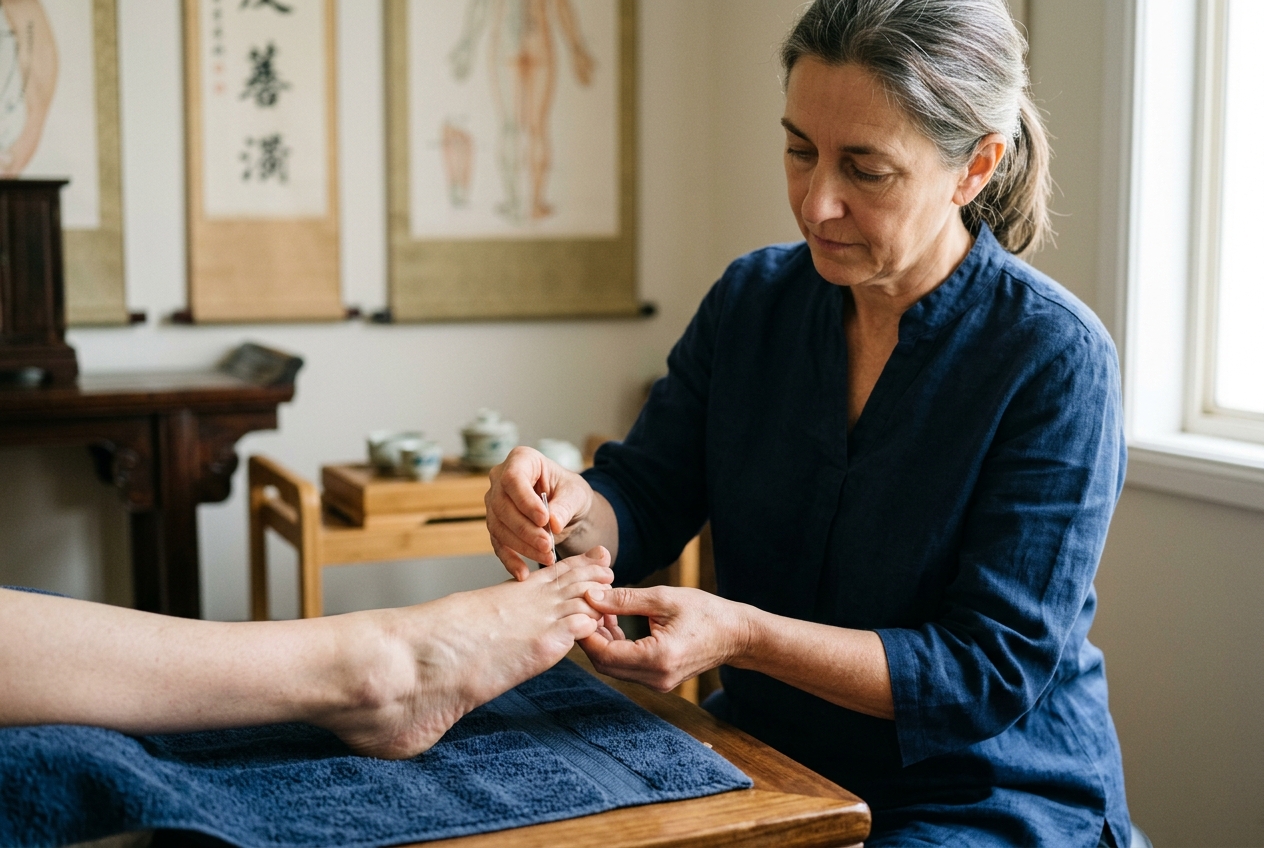
Consider an all-too-familiar physical ordeal: after ten relentless hours seated before a glare-heavy workstation, an intense, vice-like ache constricts the base of your skull, radiating tension upward across your scalp and settling directly behind your tired eyes. Your immediate, instinctive reaction is to press the bridge of your nose or vigorously massage the tight trapezoid muscles of your neck. Yet, within the clinical paradigm of classical Chinese medicine, an experienced acupuncturist might bypass your throbbing cranium entirely. Instead, they will palpate and gently needle the lateral edge of your little toe, or apply firm, steady pressure along the delicate web between your fourth and fifth metatarsals.
Within minutes of this remote intervention, a palpable sensation of descending warmth unfolds: the craniocervical constriction slackens, the orbital pressure dissipates, and a sudden systemic lightness returns to your breath.
This counterintuitive phenomenon—relieving severe, acute axial or cephalic distress via extreme peripheral micro-stimulation—is not a metaphysical riddle. It is the practical application of Root and Knot Theory (Gēn Jié Xué, 根結穴), one of the most sophisticated functional mapping systems preserved in the foundational medical canon of East Asia. Documented extensively in Chapter 5 of the Huangdi Neijing Ling Shu (The Spiritual Pivot, c. 1st century BCE), this doctrine establishes that human physiology operates as an integrated, longitudinal hydrodynamic and bioelectric continuum. By understanding how the distal terminal points on our toes and fingers (Gēn, the Root) dynamically feed, course, and concentrate into deep somatic reservoirs within our head, chest, and lower abdomen (Jié, the Knot), we uncover an elegant physiological architecture that bridges ancient meridian cartography and contemporary neuroanatomy and neurophysiology.
2. What This Organ System and Meridian Dynamic Does: The Architecture of Gen, Liu, Zhu, and Jie
To comprehend the Gēn Jié dynamic, one must step away from viewing the human body as a collection of isolated anatomical compartments and instead visualize it as a living hydraulic grid. In classical medical philosophy, the twelve primary conduits (Meridians or Jīngluò) are not inert tubes; they are dynamic pathways through which physiological energy (Qì, dynamic bio-electrochemical signaling) and nourishing fluids (Xuè, nutrient-rich blood and interstitial plasma) circulate continuously.
+-----------------------------------------------------------------------------------+
|                        THE FOUR-STAGE ENERGETIC VECTOR                           |
+-----------------------------------------------------------------------------------+
|  [ GĒN / Root ]     -->  [ LIÚ / Flow ]     -->  [ ZHǓ / Pour ]   --> [ JIÉ / Knot ]  |
|  Distal Extremity        Dynamic Channel          Massive Deep         Axial Reservoir|
|  Jing-Well Points        Shu-Stream / Yuan        He-Sea / River       Head / Trunk   |
|  (Terminal Digits)       (Wrists & Ankles)        (Elbows & Knees)     (Centres of Qi)|
+-----------------------------------------------------------------------------------+
Classical scholars structured the longitudinal projection of the six primary energetic divisions—Tàiyáng (Greater Yang), Shǎoyáng (Lesser Yang), Yángmíng (Brightness Yang), Tàiyīn (Greater Yin), Shǎoyīn (Lesser Yin), and Juéyīn (Absolute Yin)—along a four-phase hydrokinetic vector:
- Gēn (根 — The Root / Origin): The primordial point of emergence situated at the extreme distal boundaries of the extremities, specifically the Jǐng-Well (Well) acupuncture points located on the tips of the toes and fingers. Here, the energetic potential is narrow, shallow, dynamic, and highly sensitive to external mechanical or bioelectric stimulus.
- Liú (溜 / 流 — The Flow): As the conduit travels proximally past the metatarsal and metacarpal junctions toward the Shū-Stream and Yuán-Source zones, the energetic signal broadens, gaining velocity and volumetric stability.
- Zhǔ (注 — The Pour / Inflow): Near the major hinge joints—the cubital (elbow) and popliteal (knee) regions corresponding to the Hé-Sea points—the pathway deepens dramatically, pouring inward like an alpine tributary converging into a central river system.
- Jié (結 — The Knot / Terminal Convergence): The energetic vector culminates in the axial centres of the body: the sensory orifices of the cranium, the thoracic cage (Shānzhōng / pericardial palace), and the deep hypogastric visceral beds. At the Jié, the dynamic energetic force ties together, directly regulating central neurological integration, organ perfusion, and autonomic equilibrium.
The Six Classical Pairings of Ling Shu Chapter 5
The Ling Shu delineates precise anatomical polarities for each of the six great channel axes, creating a therapeutic axis between distal levers and central hubs:
+---------------------------------------------------------------------------------------+
|                      THE SIX CLASSICAL GĒN-JIÉ AXIAL PAIRINGS                         |
+-------------+-----------------------------+-------------------------------------------+
| Division    | Gēn (Distal Root Point)     | Jié (Central Knot / Convergence Centre)   |
+-------------+-----------------------------+-------------------------------------------+
| Tàiyáng     | Zhìyīn (BL67 - Little Toe)   | Míngmén / Jīngmíng (BL1 - Inner Canthus)  |
| Shǎoyáng    | Zúqiàoyīn (GB44 - 4th Toe)  | Chuānglóng / Tīnggōng (GB8/SI19 - Ears)   |
| Yángmíng    | Lìduì (ST45 - 2nd Toe)      | Sǎngài / Rényíng (ST9 - Carotid Triangle) |
| Tàiyīn      | Yǐnbái (SP1 - Great Toe)    | Tàicāng / Zhōngwǎn (CV12 - Epigastrium)   |
| Shǎoyīn     | Yǒngquán (KI1 - Sole)       | Liánquán (CV23 - Base of Tongue/Throat)   |
| Juéyīn      | Dàdūn (LR1 - Great Toe)     | Yùtáng (CV18 - Mid-Sternum/Pericardium)   |
+-------------+-----------------------------+-------------------------------------------+
- Foot Tàiyáng Axis: Originates at Zhìyīn (BL67) on the lateral margin of the fifth digit and knots cephalad at Míngmén (traditionally identified in this context with Jīngmíng BL1 at the inner eye canthus). It governs the dorsal biomechanical sheath, cerebrospinal fluid dynamics, and occipital-ocular tension.
- Foot Shǎoyáng Axis: Originates at Zúqiàoyīn (GB44) on the lateral fourth toe and knots at Chuānglóng (the temporal auditory complex encompassing Tiānchōng GB8, Tīnggōng SI19, and the peri-auricular network). It orchestrates lateral hemicranial tension, auditory sensory gating, and vestibular equilibrium.
- Foot Yángmíng Axis: Originates at Lìduì (ST45) on the second digit and knots at Sǎngài (convergently linked to Rényíng ST9 over the carotid sinus baroreceptors). It regulates anterior facial tone, orofacial neuralgia, systemic vascular tension, and gastrointestinal motility.
- Foot Tàiyīn Axis: Originates at Yǐnbái (SP1) on the medial corner of the great toe and knots at Tàicāng (the "Great Granary," anatomically anchored at Zhōngwǎn CV12 in the epigastric plexus). It commands the enzymatic and metabolic processing of nutritional substrate, splenic lymphatic drainage, and middle-jiao fluid transport.
- Foot Shǎoyīn Axis: Originates at Yǒngquán (KI1) in the depression of the anterior sole and knots at Liánquán (CV23) at the hyoid bone/pharyngeal junction. It harmonizes the primordial fluid-fire axis, hypothalamic-pituitary-thyroid communication, and deep vocal/laryngeal resilience.
- Foot Juéyīn Axis: Originates at Dàdūn (LR1) on the lateral nail bed of the great toe and knots at Yùtáng (CV18) across the fourth intercostal space on the sternum. It regulates diaphragm kinetics, portal vein decongestion, myocardial perfusion, and smooth neuro-emotional down-regulation.
Contrasting Gēn Jié with Root-Branch (Biāo Běn) Theory
While clinical practitioners frequently conflate Gēn Jié with Biāo Běn (Root and Branch) theory, the two paradigms represent distinct, complementary topologies. Biāo Běn is a relative, multi-level hierarchy of pathology: the Běn (primary root cause) often resides in the organ's functional vitality, while the Biāo (manifest branch symptom) appears peripherally or superficially.
Conversely, Gēn Jié describes an unidirectional, bio-topographical flow of functional polarity. Gēn is strictly distal (extremity-based), and Jié is strictly axial (head, chest, ventrum). Biāo Běn diagnoses causal hierarchy; Gēn Jié dictates kinetic leverage.
+---------------------------------------------------------------------------------------+
|                     GĒN JIÉ VS. BIĀO BĚN: ARCHITECTURAL COMPARISON                    |
+-------------------+--------------------------------+----------------------------------+
| Dimension         | Gēn Jié (Root & Knot)          | Biāo Běn (Root & Branch)         |
+-------------------+--------------------------------+----------------------------------+
| Primary Focus     | Hydrokinetic energetic flow    | Causal-symptomatic hierarchy     |
| Directionality    | Strictly Distal -> Axial       | Relational & Contextual          |
| Structural Center | Limbs (*Gēn*) to Truncus (*Jié*)| Underlying cause to presentation|
| Clinical Utility  | Distal torque & sensory gating | Etiological sequencing of cure   |
+-------------------+--------------------------------+----------------------------------+
Neuroanatomical Correlates: Somatosensory Leverage and Spinal Gating
Modern scientific investigation offers rigorous validation for these ancient functional mappings. When a clinician applies mechanical or electrical stimulation to a distal Gēn point (such as BL67 or ST45), high-density A-delta and C afferent fibers are recruited within discrete peripheral dermatomes.
These neural impulses ascend the spinothalamic tracts and dorsal columns to synapse in the spinal dorsal horn, activating the gate control mechanism of pain modulation first formulated by Melzack and Wall.
Simultaneously, these signals ascend to the brainstem, engaging the periaqueductal gray (PAG) and the rostral ventromedial medulla (RVM). This triggers Diffuse Noxious Inhibitory Controls (DNIC) and provokes endogenous opioid release (endorphins, enkephalins, and dynorphins).
Because the central autonomic projection fields of the cranial and vagal nerves interface with the somatosensory dermatomes of the head, neck, and trunk (the Jié regions), powerful distal micro-stimulation initiates a profound reflex cascade. It down-regulates focal sympathetic vasoconstriction, normalizes baroreceptor tone (as seen in the Yángmíng ST45–ST9 axis), and releases deep fascial tensions along the human body’s myofascial kinetic chains (as classified by modern anatomists like Thomas Myers in Anatomy Trains).
3. How You Can Feel It: Signs of Balance and Imbalance
When the Gēn Jié dynamic functions with optimal vitality, the body exhibits seamless kinetic and autonomic integration: physical posture feels effortlessly upright, sensory faculties (vision, hearing, speech) remain acute and clear, digestion proceeds without abdominal distension, and the transition between wakeful alertness and deep restorative sleep occurs without friction.
When the flow between the distal Root and central Knot stalls or surges uncontrollably, characteristic patterns of functional polarity emerge.
+-------------------------------------------------------------------------------------+
|                     SYSTEMIC MANIFESTATIONS OF GĒN-JIÉ DYSFUNCTION                  |
+-------------------+----------------------------------+------------------------------+
| Channel Dynamic   | Signs of Harmonious Flow         | Signs of Stagnation / Excess |
+-------------------+----------------------------------+------------------------------+
| Tàiyáng (BL Axis)  | Flexible spine, clear vision     | Occipital headaches, dry eyes|
| Shǎoyáng (GB Axis)| Acute hearing, level mood        | Migraines, tinnitus, jaw pain|
| Yángmíng (ST Axis)| Robust digestion, calm pulse     | Acid reflux, facial neuralgia|
| Tàiyīn (SP Axis)  | Steady energy, flat abdomen      | Post-prandial fog, bloating  |
| Shǎoyīn (KI Axis) | Grounded vitality, clear voice   | Pharyngeal dryness, insomnia |
| Juéyīn (LR Axis)  | Open diaphragm, deep respiration | Subcostal knot, chest tight  |
+-------------------+----------------------------------+------------------------------+
Self-Assessment: Evaluating Your Longitudinal Axes
Take a quiet moment to systematically evaluate your own energetic conduits:
- The Dorsal/Cephalic Check (Tàiyáng Axis): Close your eyes and roll your shoulders back. Do you experience a dragging tension pulling from your calves up through your hamstrings, sacrum, suboccipital ridge, and terminating as an ache behind your eyeballs? If so, the energetic vector between Zhìyīn (BL67) and Míngmén (BL1) is congested.
- The Lateral-Temporal Check (Shǎoyáng Axis): Clench your jaw lightly and touch the region above your ears. Is there localized soreness, clicking in the temporomandibular joint (TMJ), a bitter taste in your mouth upon waking, or an intermittent ringing in your ears? This signals disharmony between Zúqiàoyīn (GB44) and the temporal knot (Chuānglóng).
- The Epigastric-Digestive Check (Tàiyīn Axis): Place your palms flat over your epigastrium (the space between your sternum and navel). Does the tissue feel tender, bloated, or cold to the touch after eating, accompanied by mental fogginess and muscular heaviness in the limbs? The flow from the distal splenic Root (Yǐnbái SP1) to the central metabolic knot (Tàicāng CV12) requires dynamic mobilization.
- The Diaphragmatic-Emotional Check (Juéyīn Axis): Inhale deeply into the bottom of your lungs. Does your breath catch across the center of your chest (Yùtáng CV18), accompanied by an involuntary sigh, a sense of constriction under your rib cage, or persistent emotional irritability? The liver-pericardium vector from Dàdūn (LR1) is functionally constrained.
4. Qigong & Movement Practice: The Longitudinal Meridian Wave (Chōng Hé Yī Qì)
To clear obstructions along the Gēn Jié axes and restore energetic transport from the peripheral extremities to the central somatic knots, perform this gentle, highly effective classical medical Qigong sequence: The Longitudinal Meridian Wave. This dynamic exercise leverages rhythmic plantar flexion, gentle axial spinal articulation, and thoracic expansion to clear stagnant Qi and facilitate longitudinal flow across all six channels.
         THE LONGITUDINAL MERIDIAN WAVE

   1. INHALE (Ascending Vector)
      - Weight shifts forward onto balls of feet (Yǒngquán KI1 / Gēn)
      - Arms float upward along the central axis
      - Spine lengthens; gaze lifts slightly

   2. SUSPENSION (Knot Expansion)
      - Sternum opens at Yùtáng (CV18 / Juéyīn Knot)
      - Throat softens at Liánquán (CV23 / Shǎoyīn Knot)

   3. EXHALE (Descending Vector)
      - Weight grounds into heels; knees soften
      - Palms press down along the midline (Tàicāng CV12 / Tàiyīn Knot)
      - Turbid Qi descends back into the earth
Step-by-Step Practice Guide
- Starting Position and Postural Setup:
- Stand barefoot on a level, comfortable surface with feet parallel and shoulder-width apart.
- Allow your tailbone to sink gently toward the floor, releasing lower back lordosis. Soften your knees.
- Suspend the crown of your head (Bǎihuì GV20) toward the sky as if suspended by an invisible silk cord, tucking your chin slightly to elongate the cervical spine.
-
Rest the tip of your tongue against the upper palate behind the incisors, bridging the Governing and Conception vessels. Let your arms hang loosely at your sides.
-
Phase 1: Mobilizing the Distal Root (Gēn) on Inhalation (4 to 5 Seconds):
- Inhale slowly, smoothly, and deeply through your nose, drawing breath into your lower abdomen (Dāntián).
- Simultaneously shift your body weight forward onto the balls of your feet and the tips of your toes, gently stimulating Yǒngquán (KI1), Yǐnbái (SP1), and Lìduì (ST45) without lifting your heels entirely off the floor.
-
As you ground through the distal root of your feet, float both arms upward in front of your body with wrists relaxed and palms facing down, mirroring the ascending energetic vector (Liú and Zhǔ).
-
Phase 2: Opening the Central Knot (Jié) at the Breath Apex (2 Seconds):
- As the hands reach chest height, gently rotate your palms inward and open the elbows outward, expanding the thoracic cage across Yùtáng (CV18) and Shānzhōng (CV17).
- Allow your gaze to elevate slightly, softening the suboccipital muscles and opening the ocular knot (Míngmén/Jīngmíng BL1).
-
Feel the structural and bioelectric continuity extending uninterrupted from the tips of your toes straight through the crown of your head.
-
Phase 3: Harmonizing and Descending on Exhalation (5 to 6 Seconds):
- Exhale smoothly through your nose, slowly rotating the palms downward and gently pressing them down along the midline of the torso toward the epigastrium (Tàicāng CV12).
- As your hands descend, sink your weight back evenly across the entire surface of both feet, bending your knees slightly and releasing any residual tension stored within your spine, neck, and abdomen.
-
Visualize any excess, turbulent heat or cranial tension draining downward through the leg channels, exiting through the terminal Jǐng-Well points back into the earth.
-
Dosage and Repetitions:
-
Perform this movement sequence for 9 to 18 continuous cycles (approximately 5 to 10 minutes), ideally in the morning or during late afternoon fatigue crashes.
-
Sensory Shifts to Notice:
- Within 4 to 6 cycles, you will likely perceive a clear prickling warmth (Deqì sensation) in your fingertips and toes, followed by a noticeable softening of your ocular globes, the spontaneous generation of thin, sweet saliva in your mouth (indicating parasympathetic activation), and a profound reduction in cranial pressure.
5. Acupressure Points You Can Try Today: High-Leverage Distal-Axial Pairs
The therapeutic beauty of Gēn Jié theory lies in its immediate self-care accessibility: you do not require clinical acupuncture needles to recruit these longitudinal pathways. By applying focused, ischemic acupressure to distal Root points (Gēn), you can exert immediate mechanical and neurological leverage over distressing cephalic, cervical, and visceral symptoms (Jié).
Protocol 1: Zhìyīn (BL67) for Occipital Headaches, Eye Strain, and Cervical Rigidity
- Classical Function: Gēn (Root) of the Foot Tàiyáng Channel, connecting to Míngmén / Jīngmíng (BL1 / Knot).
- Precise Anatomical Location: On the lateral aspect of the little toe, approximately 0.1 cùn (about 1 to 2 millimetres) posterior to the lateral corner of the toenail bed.
- Technique: Grasp the tip of the fifth toe between your thumb and index finger. Use the edge of your thumbnail or a blunt stylus to apply firm, localized, pulsing pressure directly on the point.
- Duration: Apply pressure for 90 to 120 seconds per side, taking slow, deep diaphragmatic breaths.
- Clinical Utility: Exceptionally potent for acute occipital cephalalgia, suboccipital stiffness caused by prolonged screen reading, retro-orbital eye strain, and acute upper-back muscle spasms.
Protocol 2: Zúqiàoyīn (GB44) for Temporal Migraines, Jaw Clenching, and Tinnitus
- Classical Function: Gēn (Root) of the Foot Shǎoyáng Channel, connecting to the auditory and temporal cranial knot (Chuānglóng / Tīnggōng).
- Precise Anatomical Location: On the lateral aspect of the fourth toe, 0.1 cùn proximal to the lateral corner of the nail.
- Technique: Rest your foot over your opposite knee. Use the knuckle of your thumb or a firm fingernail to press firmly inward toward the base of the phalanx until a sharp, localized aching sensation (Deqì) is produced.
- Duration: Maintain continuous, firm pressure with small circular micro-rotations for 2 minutes per foot.
- Clinical Utility: Rapidly dissipates acute unilateral temporal headaches (migraines), eases tension from clenching the jaw, relieves ear fullness, and calms sudden bursts of irritability or sensory overload.
Protocol 3: Dual Activation of Yǐnbái (SP1) and Zhōngwǎn (CV12) for Visceral Stagnation and Brain Fog
- Classical Function: The Foot Tàiyīn metabolic axis, connecting the distal splenic root (Yǐnbái) with the central digestive knot (Tàicāng / Zhōngwǎn).
- Precise Anatomical Location:
- Yǐnbái (SP1): On the medial aspect of the big toe, approximately 0.1 cùn from the medial corner of the toenail.
- Zhōngwǎn (CV12): On the anterior midline of the abdomen, exactly midway between the base of your sternum (xiphoid process) and the center of your umbilicus (belly button).
- Technique: Sit comfortably. Apply firm, steady thumb pressure to Yǐnbái on one foot while placing your other palm flat over Zhōngwǎn on your epigastrium, infusing gentle clockwise circular warmth into the abdominal core.
- Duration: Perform for 3 minutes, then alternate feet.
- Clinical Utility: Instantly stimulates sluggish gastrointestinal peristalsis, relieves post-prandial bloating, halts gastric distension, and clears the heavy mental lethargy ("food coma") associated with Dampness.
6. Food & Lifestyle: Nourishing the Longitudinal Axis
To maintain fluid conduction along the Gēn Jié pathways, daily lifestyle and dietary choices must sustain tissue hydration, prevent microvascular stagnation, and preserve the integrity of our fascia and connective tissues. Classical Chinese dietary therapy (Shíliáo) emphasizes thermal energetics, organ affinity, and clean metabolic assimilation to ensure conduits remain open and responsive.
+---------------------------------------------------------------------------------------+
|                    DIETARY & LIFESTYLE STRATEGIES FOR GĒN-JIÉ HEALTH                  |
+-------------------+-----------------------------------+-------------------------------+
| Strategic Pillar  | Foods & Habits to Prioritize      | Substances & Habits to Limit  |
+-------------------+-----------------------------------+-------------------------------+
| Fascial Hydration | Bone broths, warm water, citrus   | Ice-cold beverages, soda      |
| Smooth Qi Flow    | Radish, fennel, mint, ginger tea  | Heavy saturated fats, dairy   |
| Kinetic Movement  | Daily barefoot walking, stretching| Static sitting > 2 hours      |
| Rest & Reset      | Sleep by 22:30, evening foot bath | Late-night screen exposure    |
+-------------------+-----------------------------------+-------------------------------+
Dietary Principles for Unobstructed Meridian Transmission
- Prioritize Warmth and Bioavailable Hydration: The longitudinal pathways rely heavily on well-hydrated, supple connective tissue sheets. Cold and raw foods extinguish the metabolic fire (Pí Yáng), generating internal "Dampness" that coagulates along the deeper Zhǔ and Jié nodal convergence zones.
- Emphasize: Warm, gently simmered vegetable broths, long-cooked porridges (congee) with fresh ginger, lightly steamed leafy greens (spinach, bok choy, Swiss chard), and regular sips of warm water throughout the day.
-
Reduce: Ice-chilled water, unpasteurized dairy, excessive refined sugars, and greasy, deep-fried meals that bog down splenic transport.
-
Incorporate Pungent and Aromatic Dispersing Agents: When Qi becomes stagnant at the thoracic (Juéyīn) or abdominal (Tàiyīn) knots, gentle aromatic herbs act as natural bio-catalysts:
- Add thinly sliced daikon radish, fresh fennel bulbs, cilantro, and cracked black pepper to soups to break up abdominal distension and encourage the downward movement of gastric energy.
- Sip peppermint or spearmint tea infused with dried tangerine peel (Chénpí) in the mid-afternoon to relax the diaphragm and ease hepatic tension.
Essential Lifestyle Modifications
-
The Classical Evening Foot Soak (Zú Yù): Because all six primary Gēn (Root) points originate on the feet, soaking your feet in hot water (40°C–42°C / 104°F–108°F) for 15 to 20 minutes before sleep draws trapped, turbulent heat downward from the brainstem and eyes (Jié), dilating peripheral capillaries and down-regulating the sympathetic nervous system. Add a cup of Epsom salts (magnesium sulfate) and three sliced pieces of fresh ginger to dramatically enhance peripheral circulation.
-
Break Static Biomechanical Compression: Protracted sitting compresses the popliteal and inguinal creases—the precise anatomical zones where the Zhǔ (Pour) dynamic must flow smoothly into the trunk. For every 50 minutes of seated computer work, stand up for 3 minutes, roll up onto the balls of your feet several times, and perform gentle neck rotations to prevent the dorsal Tàiyáng axis from locking.
7. Today’s Takeaway
If you do only one thing today to restore harmony along your body's vital energetic axes, make it this simple five-minute intervention: take off your shoes and socks, sit comfortably, and spend two minutes applying firm, focused, pinching acupressure to the outer corner of your fifth toe (Zhìyīn BL67), followed by three minutes of soaking both feet in warm water while breathing smoothly into your lower abdomen.
By activating the distal Gēn (Root), you instantly trigger the neurological and bioelectric levers that unravel tension at the central Jié (Knot), releasing suboccipital constriction, clearing ocular strain, and grounding your nervous system in a state of calm, centered vitality.
Authoritative Medical & Scientific References
- World Health Organization. WHO Traditional Medicine Strategy: 2014-2023. Comprehensive global standards for acupuncture and traditional energetic medicine paradigms.
- National Center for Biotechnology Information (NCBI / PubMed). Neuroanatomical Basis of Acupuncture and Somatotopic Point Selection. Detailed scientific evaluation of spinal gating, dermatomes, and peripheral-to-central neural signaling.
- Unschuld, Paul U. Huang Di Nei Jing Ling Shu: The Ancient Classic on Needle Therapy. University of California Press. Foundational translations of Chapter 5 (Gen Jie).
- Melzack, R., & Wall, P. D. Pain Mechanisms: A New Theory. The seminal neurophysiological model underlying acupuncture analgesia and distant sensory gating.
- Myers, Thomas W. Anatomy Trains: Myofascial Meridians for Manual and Movement Therapists. Structural analysis of continuous longitudinal myofascial transmission pathways matching classical Chinese meridian trajectories.