Four Gates Protocol: Navigating Bilateral LI4 and LV3 Dynamics, Systemic Qi Harmonization, and Distal Acupressure Protocols
If you have ever caught yourself clenching your jaw during a routine spreadsheet audit, felt an unyielding constriction banding across your temples by mid-afternoon, or noticed a stubborn, heavy knot lodging itself between your ribs whenever emotional stress mounts, you are intimately familiar with somatic gridlock. In modern clinical neurology, this state is frequently categorized as chronic sympathetic hyper-arousal: a dysregulated axis where continuous, low-grade stress locks muscular fascial beds into spasm, elevates systemic inflammatory cytokines, and suppresses healthy gastrointestinal motility.
Yet long before modern neuroimaging mapped how the autonomic nervous system buckles under persistent cognitive overload, classical East Asian medicine devised an elegant, four-point mechanical intervention specifically engineered to dissolve systemic tension: the Si Guan (四關), historically translated as the Four Gates.
Comprising just two pairs of bilateral acupressure loci—Hegu (LI4) on the hands and Taichong (LV3) on the feet—the Four Gates protocol functions as a master circuit breaker for the human body. By strategically coupling an upper extremity point characterized by high metabolic mobilization with a lower extremity point governing visceral smooth flow, this foundational protocol addresses everything from intractable tension cephalalgia and psycho-emotional exhaustion to spastic gastrointestinal disorders. To master this protocol is to understand how precise mechanical pressure can engage peripheral nerves, recalibrate central pain gating networks, and restore systemic equilibrium.
1. The Classical Architecture: Why Coupling Hand Yangming and Foot Jueyin Opens the Twelve Channels
The conceptual foundation of the Four Gates is articulated in seminal historic treatises of Chinese medicine, notably the Jin/Yuan dynasty master Dou Hanqing’s Biao You Fu (標幽賦, Ode to the Mysterious Path) and subsequently codified in Yang Jizhou’s Ming dynasty masterpiece, the Zhen Jiu Da Cheng (針灸大成, Compendium of Acupuncture and Moxibustion). In classical channel theory, the human organism is traversed by twelve primary energetic conduits (Jingmai), through which Qi (functional metabolic energy) and Xue (circulating nutrient-rich blood) circulate in continuous diurnal cycles.
When pathology manifests as diffuse irritability, regional ischemia, migraines, or systemic pain, classical diagnostics rarely attribute the condition to an isolated local lesion. Instead, they diagnose Qi Zhi—a global failure of free circulation across the connective tissue matrices. The Zhen Jiu Da Cheng posits that the Four Gates act as four primary physiological locks or portals. Opening them simultaneously clears obstructions across all twelve primary meridians.
This remarkable systemic efficacy relies upon a sophisticated energetic polarity:
-
The Upper Gate: Hand Yangming (Large Intestine Channel — Hegu, LI4)
The Yangming (Conjoined Yang) system is classically designated as Duo Qi Duo Xue—exceptionally rich in both vital energy and circulating blood volume. Furthermore, the Hand Yangming pathway ascends from the index finger along the lateral aspect of the forearm and arm, transverses the shoulder girdle, and terminates at the contralateral alae of the nose, governing the head, face, sensory orifices, and the exterior defensive layers of the physiology. As the Yuan-Source point of this channel, LI4 possesses an inherently dynamic, dispersing force capable of discharging pathogen heat, opening facial orifices, and driving systemic mobilization from the upper body downward. -
The Lower Gate: Foot Jueyin (Liver Channel — Taichong, LV3)
Conversely, the Foot Jueyin system governs the smooth, unhindered coursing of bodily fluids, emotions, and systemic tension, while acting as the primary reservoir for blood storage (Gan Cang Xue). When an individual experiences unexpressed psychological stress, muscular holding patterns, or hepatic congestion, the Liver channel constricts, leading to upward-surging internal Wind (manifesting as temporal throbbing, hypertension, dizziness, and muscular twitching). As both the Shu-Stream and Yuan-Source point of the Liver channel, LV3 anchors the ascending pathology, purges hyperactive Liver Yang, and restores fluid harmony to the lower viscera and peripheral circulation.
By pairing LI4 (an upper, exterior-clearing, high-energy Yangming locus) with LV3 (a lower, interior-regulating, smoothing Jueyin locus), the clinician establishes a dynamic physiological axis. LI4 drives movement from above while LV3 anchors and dredges from below, creating an integrated push-pull biomechanical dynamic that resolves multi-channel stagnation.
2. The Meridian Pathways: A Somatosensory Journey Through the Body
To understand how stimulating your extremities exerts profound systemic effects across your entire frame, one must trace the physical pathways of these two complementary conduits using tangible somatic landmarks.
The Hand Yangming (Large Intestine) Pathway
The Large Intestine meridian begins at the radial tip of your index finger. It travels up the border of the finger into the muscular web space between your thumb and forefinger—where LI4 resides in the fleshy mound of the first dorsal interosseous muscle. From there, the path crosses the "anatomical snuffbox" at your wrist joint, climbs along the top, outer muscular ridge of your forearm (the brachioradialis muscle), passes the outer crease of your bent elbow, and ascends the lateral contour of your deltoid muscle.
Crossing the crest of the shoulder blade, it moves upward along the side of your neck, crosses the jawbone, passes the corner of your mouth, and crosses beneath your nose to terminate at the opposite nostril furrow. This direct anatomical routing explains why working with the web of your hand provides immediate relief for facial tension, sinus congestion, jaw clenching (temporomandibular joint discomfort), and fronto-temporal headaches. For broader context on classical meridian pathways and standardized charting, consult the World Health Organization (WHO) Standard Acupuncture Nomenclature.
The Foot Jueyin (Liver) Pathway
The Liver meridian begins at the lateral corner of your big toenail on the dorsum of the foot. It courses backward along the top of the foot between the first and second metatarsal bones, passing through the deep anatomical groove where LV3 is situated.
Continuing upward, the conduit glides directly in front of the inner ankle bone (medial malleolus), travels up the inner border of the lower leg along the back edge of the shinbone, crosses the inner crease of your knee, and traverses the inner thigh into the groin. It encircles the external genitalia, ascends through the lower abdomen, enters its home organs—the liver and gallbladder—and branches through the diaphragm to disperse across the costal margins beneath the ribcage, before sending deep internal connections to the throat, eyes, and the vertex of the head. This extensive medial trajectory accounts for LV3’s clinical dominion over pelvic cramping, costal tightness, emotional irritability, and apex vertex headaches.
3. The Neurovascular Loci: Anatomical Precision and Acupressure Technique
While classical terminology relies on bone-proportional Cun (the patient's personal anatomical unit of measurement), modern applied anatomy confirms that these classical points correspond precisely to specialized neurovascular bundles embedded within fascial clefts.
Point 1: Hegu (LI4) — "Joining Valley"
- Classical Definition: On the dorsum of the hand, radial to the midpoint of the second metacarpal bone.
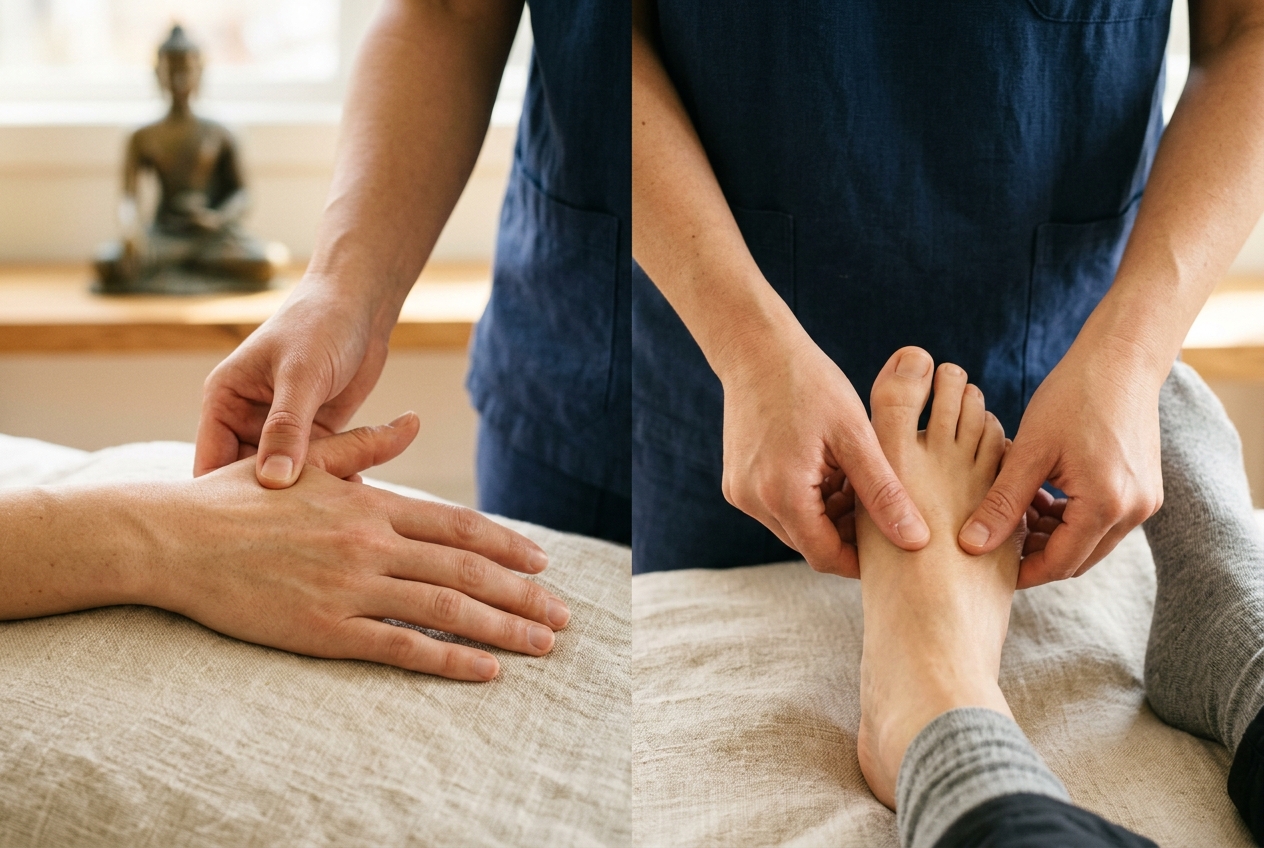
- Everyday Location: Bring your thumb and index finger flush together. Observe the prominent fleshy muscular ridge that bulges on the back of your hand between the two bones. Relax the hand, and locate the highest point of that muscular mound. Press your opposing thumb inward and slightly under the edge of the index finger’s bone (the second metacarpal).
- Neurovascular Substrate: The point penetrates the first dorsal interosseous muscle and the adductor pollicis. It is richly innervated by the superficial branch of the radial nerve and supplied by the dorsal digital branches of the radial artery and the first dorsal metacarpal artery.
- The De Qi Sensation: When properly engaged, you will not feel a sharp skin pinch; rather, you will experience a distinctive, spreading somatosensory ache, characterized by deep distension, warmth, or a mild electrical hum propagating toward the wrist or index finger.
- Manual Application: Direct pressure medially toward the shaft of the second metacarpal bone using a sustained, perpendicular-to-oblique angle. Maintain firm, steady ischemic compression or slow, micro-circular frictions for 90 to 180 seconds per side.
- Daily Indications: Frontal and temporal tension headaches, temporomandibular joint (TMJ) bruxism, sinus pressure, cervical stiffness, and general fatigue.
Point 2: Taichong (LV3) — "Great Rushing"
- Classical Definition: On the dorsum of the foot, in the depression distal to the junction of the first and second metatarsal bones, approximately 1.5 to 2 cun proximal to the web margin.
- Everyday Location: Place your finger in the skin web between your big toe and second toe. Slide your finger upward along the groove between the two long bones on top of your foot for about an inch and a half to two inches. Your finger will naturally drop into a distinct, sensitive valley just before the two metatarsal bones converge into a "V" joint.
- Neurovascular Substrate: Located directly over the first dorsal interosseous muscle and the tendon of the extensor hallucis longus, LV3 is innervated by the medial branch of the deep peroneal nerve, with vascularization via the dorsalis pedis artery and the dorsal venous rete of the foot.
- The De Qi Sensation: LV3 is notoriously reactive. Proper palpation typically elicits a dull, deeply soothing yet acutely sensitive ache that may radiate up the anterior surface of the ankle or down toward the toes.
- Manual Application: Apply moderate, focused thumb pressure angled slightly proximal into the bony notch. Due to minimal subcutaneous fat over the foot dorsum, initiate pressure gently, gradually deepening the vector as the local fascial tissue softens. Sustain for 2 minutes on each foot while practicing slow abdominal breathing.
- Daily Indications: High psycho-emotional stress, anger, irritability, visceral PMS cramping, intercostal neuralgia, eye strain, and hyperactive restlessness preventing sleep onset.
For detailed clinical anatomical references regarding these mapped pathways, explore Wikipedia's comprehensive review on Acupressure and classical Acupuncture Point Classifications.
4. Modern Physiology and Neurofascial Mechanisms: How the Four Gates Work
The clinical efficacy of the Four Gates is not merely metaphorical. Contemporary biomedical research has illuminated the precise neurobiological and mechanical mechanisms through which mechanical stimulation of LI4 and LV3 alters systemic physiology.
Neurofascial Mechanotransduction
Connective tissue (fascia) forms a continuous, body-wide communicative web. When firm mechanical pressure or rotatory shearing is applied to the dense fascial planes at LI4 (first dorsal interosseous) and LV3 (metatarsal interosseous bed), local fibroblasts undergo cytoskeletal remodeling. This cellular deformation triggers the extracellular release of adenosine triphosphate (ATP), which rapidly hydrolyzes into adenosine—a potent local analgesic and microvascular vasodilator. The mechanical signal is translated into bioelectric and biochemical cascades, hydrating compressed fascial sheaths and releasing chronically trapped myofascial trigger points.
Diffuse Noxious Inhibitory Controls (DNIC) and Pain Gating
At the spinal level, sustained acupressure activates low-threshold mechanoreceptive A-beta fibers as well as moderate-threshold A-delta sensory fibers. As detailed in biomedical studies cataloged by the National Center for Biotechnology Information (NCBI PubMed), this sensory barrage engages the "Gate Control Theory of Pain" at the substantia gelatinosa within the spinal dorsal horn, effectively inhibiting the transmission of unmyelinated C-fiber nociceptive (pain) signals to the cerebral cortex.
Simultaneously, this peripheral stimulation activates a supra-spinal, top-down pain-modulation network known as Diffuse Noxious Inhibitory Controls (DNIC), mediated via the subnucleus reticularis dorsalis in the medulla. Through DNIC, localized somatic stimulation at the distal extremities induces a generalized, body-wide reduction in background pain perception. Further investigations into pain gating and central processing can be accessed via NCBI PMC's open-access medical literature.
Central Autonomic Downregulation and Endorphinergic Cascades
Functional magnetic resonance imaging (fMRI) evaluations have revealed that simultaneous stimulation of LI4 and LV3 modulates key subcortical structures, including the limbic system, the periaqueductal gray (PAG), and the hypothalamus. The clinical response unfolds across two key physiological axes:
- Endogenous Opioidergic Induction: Mechanoreceptor stimulation via the radial and deep peroneal nerves ascends via the spinothalamic tract to the PAG and rostral ventromedial medulla (RVM), stimulating the systemic secretion of endogenous beta-endorphins, enkephalins, and dynorphins into the cerebrospinal fluid and bloodstream.
- Sympathovagal Balance: The Four Gates protocol induces immediate suppression of sympathetic outflow while up-regulating parasympathetic (vagal) activity via the nucleus tractus solitarii (NTS). This shifts the cardiac sympathovagal balance, reducing heart rate variability stress metrics, lowering elevated arterial blood pressure, and encouraging visceral smooth muscle relaxation.
5. Clinical Acupressure Protocols: Step-by-Step Somatosensory Sequencing
To optimize therapeutic outcomes, acupressure must be delivered with rigorous clinical intention. The practitioner or self-treating reader must modulate mechanical intensity, sequence the upper and lower gates thoughtfully, and synchronize the intervention with deep ventilatory cycles.
================================================================================
           THE COMPLETE EVENING CRANIOSOMATIC RESET PROTOCOL (8 MINUTES)
================================================================================
 PHASE 1: PREPARATION & RESPIRATORY ENTRAINMENT (1 Minute)
 • Posture: Supine or supported Fowler's position.
 • Respiration: Inhale 4s (diaphragmatic) -> Retain 2s -> Exhale 6s (vagal).

PHASE 2: OPENING THE UPPER GATES (LI4 BILATERAL) (3 Minutes)
 • Sequence: Left LI4 (90s) -> Right LI4 (90s).
 • Technique: Xie Fa (Sedation) — Deep, counter-clockwise micro-rotations.
 • Target: Resolves suboccipital tension, TMJ compression, and mental overload.

PHASE 3: GROUNDING THE LOWER GATES (LV3 BILATERAL) (3 Minutes)
 • Sequence: Left LV3 (90s) -> Right LV3 (90s).
 • Technique: Bu Fa (Harmonizing) — Sustained perpendicular ischemic pressure.
 • Target: Anchors somatic Qi, down-regulates autonomic tone, releases visceral gut.

PHASE 4: INTEGRATION (1 Minute)
 • Quiet rest, observing warm microvascular perfusion throughout limbs.
================================================================================
Sequencing: Upper-Lower Dynamic Synchrony
There are two clinical approaches to administering the Four Gates:
- Simultaneous Bilateral Synchrony (Partner-assisted): Stimulating all four points simultaneously produces rapid, profound central sedation, often plunging hyper-aroused patients into an immediate parasympathetic, theta-brainwave state.
- Sequential Cross-Sedation (Self-treatment): When performing self-acupressure, address the upper body first (LI4) to discharge stagnant tension from the head, neck, and senses, followed immediately by the lower body (LV3) to draw metabolic activity downward, anchoring emotional energy and cooling systemic heat.
Modulating Pressure: Tonification (Bu) vs. Sedation (Xie)
- The Sedation Technique (Xie Fa) — For Acute Spasm, Anger, Migraines, or Throbbing Pain: Apply firm, penetrating pressure. Execute small, rhythmic, counter-clockwise circular frictions while maintaining deep tissue contact for 90 seconds. Match this with forceful, slow oral exhalations to facilitate the release of trapped muscular tone.
- The Tonification/Harmonizing Technique (Bu Fa) — For Depletion, Chronic Aching, or Nervous Fatigue: Apply steady, uniform, clockwise compression at moderate depth. Hold the position statically without aggressive friction for 2 to 3 minutes per locus, synchronizing pressure increases with slow nasal inhalations.
6. Targeted Application: The Evening Craniosomatic Reset Protocol
This clinical protocol is engineered for individuals suffering from post-work cognitive fatigue, screen-induced tension headaches, jaw clenching, and internal restlessness.
Target Condition: Chronic Desk-Bound Cephalalgia & Sympathetic Hyper-arousal
Estimated Duration: 8 Minutes Total
Recommended Posture: Seated comfortably with feet flat on the floor, or lying supine with knees elevated by a bolster.
Phase 1: Respiratory Alignment (1 Minute)
Assume a supported resting posture. Close your eyes. Initiate slow, diaphragmatic box breathing: inhale through the nose for 4 seconds, expand the lower abdomen, hold gently for 2 seconds, and exhale smoothly through the mouth for 6 seconds. This respiratory cadence down-regulates the sympathetic fight-or-flight reflex before mechanical stimulation begins.
Phase 2: Clearing the Cranial Aperture via Left & Right LI4 (3 Minutes)
- Grasp your left hand with your right thumb and index finger. Position the fleshy pad of your right thumb over Left LI4.
- Exhale slowly, pressing your thumb firmly inward toward the second metacarpal bone until a distinct, dull, radiating ache (De Qi) develops.
- Perform slow, micro-circular kneading for 90 seconds. Maintain a steady, firm pressure (approximately 6–7 on an internal 10-point intensity scale).
- Shift your hands and repeat the identical protocol on Right LI4 for 90 seconds.
- Somatic Cue: Visualize the tight muscular bands along your neck, jaw, and brow uncoiling and draining downward.
Phase 3: Anchoring the Circuit via Left & Right LV3 (3 Minutes)
- Bring your right hand down to your bare left foot. Slide your thumb into the valley of Left LV3 (between the first and second metatarsals).
- Angle your pressure slightly backward toward the ankle joint. Press steadily into the depression until a localized, deep sensation spreads across the instep.
- Apply static ischemic pressure combined with gentle, minute pulses for 90 seconds, breathing deeply into the pelvic floor.
- Switch hands and replicate the technique on Right LV3 for 90 seconds.
- Somatic Cue: Feel your systemic energy sink into the soles of your feet, dispelling mental chatter and easing abdominal tightness.
Phase 4: Autonomic Integration (1 Minute)
Rest both hands comfortably in your lap or at your sides. Maintain gentle nasal breathing. Notice the surge of warm microvascular perfusion tingling in your fingers, toes, and facial muscles as autonomic homeostasis restores systemic flow.
For complementary non-pharmacological evidence, review integrative health summaries provided by the National Center for Complementary and Integrative Health (NCCIH).
7. Safety Protocols, Contraindications, and Clinical Boundaries
While acupressure is an extraordinarily safe, non-invasive therapeutic modality, precise safety parameters must be observed.
================================================================================
                      CRITICAL SAFETY & TRIAGE MATRIX
================================================================================
 [ ABSOLUTE CONTRAINDICATION ]
 • PREGNANCY: Strong dispersion of LI4 is STRICTLY PROHIBITED.
   LI4 exerts powerful down-bearing, oxytocinergic actions that stimulate uterine
   hyper-motility, risking induction of premature labor or spontaneous abortion.

[ LOCAL MECHANICAL RESTRICTIONS ]
 • Never apply deep pressure over broken skin, open abrasions, phlebitic veins,
   active infections, acute hematomas, or localized thromboses.
 • Diabetic patients with peripheral neuropathy must receive gentle, non-ischemic
   pressure to prevent unnoticed microvascular tissue damage.

[ BIOMEDICAL TRIAGE RED FLAGS - REFER IMMEDIATELY TO EMERGENCY CARE ]
 • Thunderclap onset headaches ("worst headache of life") or accompanied by
   focal neurological deficits (dysphasia, facial droop, hemiparesis).
 • Acute, tearing chest or abdominal pain.
 • Systemic infectious symptoms: High fever, nuchal rigidity (stiff neck), photophobia.
================================================================================
The Obstetric Warning: Pregnancy Precaution
CRITICAL CONTRAINDICATION: The vigorous stimulation of LI4 (Hegu) is strictly contraindicated throughout all stages of pregnancy, except during active labor under the direct supervision of a qualified midwife or licensed acupuncturist. In both classical treatises and modern clinical trials, LI4 is recognized as a powerful labor-inducing point. It strongly descends systemic Qi, stimulates oxytocin receptor pathways, and induces uterine smooth muscle contractions. Avoid deep pressure on LI4 in pregnant individuals. (While LV3 is generally safer, it should also be stimulated with gentle, non-aggressive harmonizing techniques during pregnancy).
Calibrating Applied Force
Acupressure should never produce sharp, tearing, or bruising pain. The desired somatosensory threshold is De Qi—a therapeutic, satisfying, dull distension. If an individual winces, involuntarily holds their breath, or exhibits reflex withdrawal, the mechanical force is excessive. Excessive pressure can bruise delicate interosseous muscle fibers or provoke paradoxical sympathetic vasospasm. Always balance pressure firmly within the patient's comfortable tolerance.
When to Seek Immediate Medical Evaluation
Self-administered acupressure is intended to support wellness, restore autonomic balance, and manage functional muscular discomfort. It is not an alternative to emergency medicine. Seek immediate biomedical triage if headaches are accompanied by sudden visual loss, confusion, speech difficulties, motor weakness, high fever, or neck stiffness; or if abdominal symptoms present as acute, severe, unremitting abdominal guarding.
8. Today's Takeaway: The Two-Minute Reset You Can Do Right Now
You do not need an entire clinic or an hour of leisure to experience the therapeutic potency of the Four Gates. You can access its regulatory effects right at your desk with this simple two-minute practice.
- Minute 1 — The Upper Gate (Left LI4): Pinch the muscular web between your left thumb and index finger using your right thumb and forefinger. Press firmly into the bone until you feel that familiar, dull, spreading ache. Close your eyes, drop your shoulders away from your ears, unclamp your teeth, and breathe out slowly for 60 seconds.
- Minute 2 — The Lower Gate (Left LV3): Slip off your left shoe. Slide your left index or thumb into the groove between your big toe and second toe, resting in the soft valley an inch and a half above the web space. Press downward with steady, centered force. Take four long, unhurried breaths, allowing the tension that accumulated in your head to anchor downward into the earth.
By opening the Four Gates, you step into an ancient physiological tradition—leveraging precise anatomical portals to dissolve the physical knots of modern life.
Authoritative References & Further Reading
- World Health Organization (WHO) Standard Acupuncture Nomenclature
- NCBI PubMed: Neurobiological Mechanisms of Acupuncture and Somatic Stimulation
- NCBI PMC: Diffuse Noxious Inhibitory Control and Central Pain Modulation
- Wikipedia: Acupressure Principles and Applications
- Wikipedia: Classical Acupuncture Points & Channels
- National Center for Complementary and Integrative Health (NCCIH) Research Database