Herbal Formula Architecture (Jun Chen Zuo Shi) Prescription Dynamics: Governing Sovereign, Minister, Assistant, and Courier Synergies in Traditional Chinese Medicine
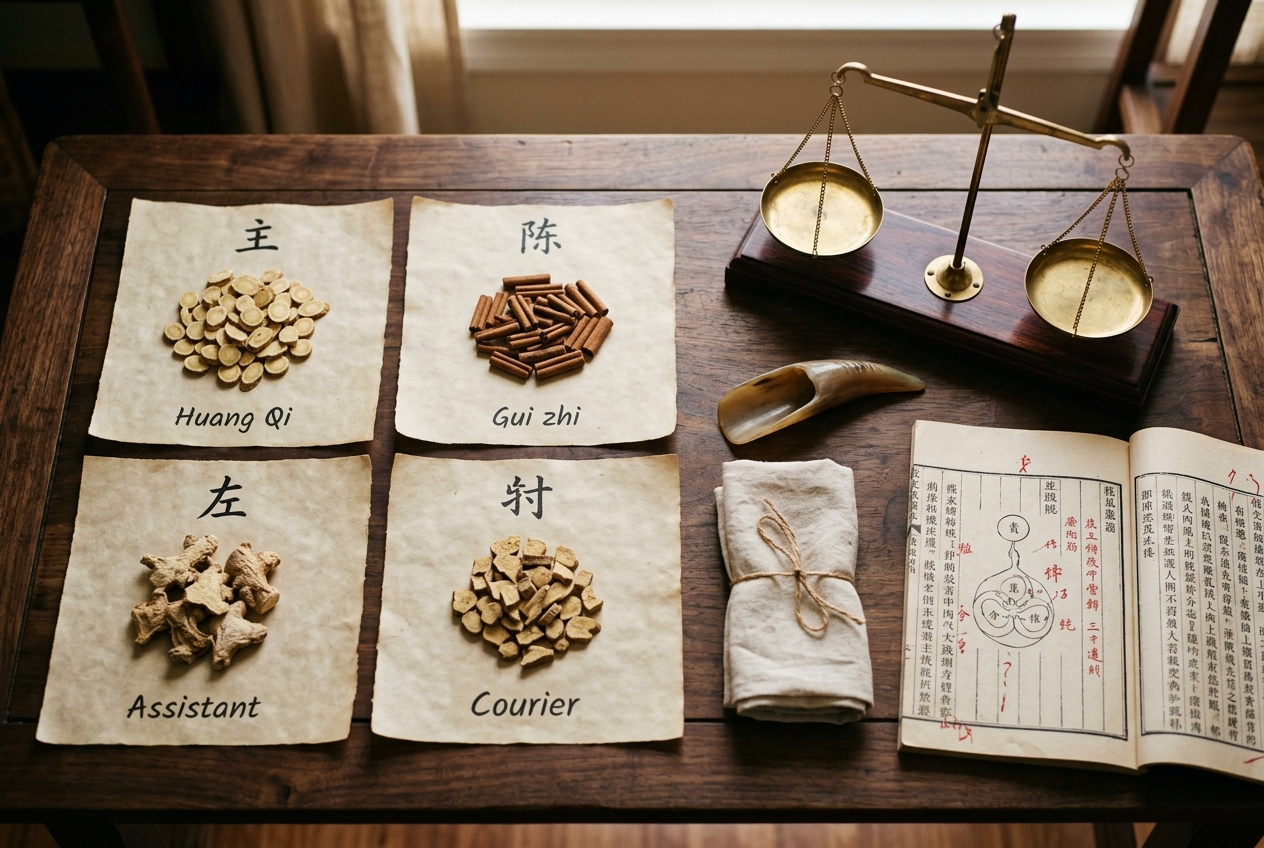
Far from being an archaic administrative metaphor, Jun-Chen-Zuo-Shi constitutes a sophisticated design grammar. It dictates thermodynamic balance, meridian tropism (Gui Jing), stoichiometric dosage ratios, bio-accessibility enhancement, pharmacokinetic smoothing, and toxicological attenuation. Through this architectural discipline, historical clinicians managed systemic diseases by orchestrating multi-pathway biological interventions that closely parallel contemporary network pharmacology and polypharmacology.
1. Classical Theoretical Foundations: The Neijing Canon and Formulary Lineage
The structural codification of Chinese formula design traces its primary lineage to the foundational canon of East Asian medicine, the Huangdi Neijing (Inner Canon of the Yellow Emperor). Specifically, Chapter 74 of the Suwen (至真要大論—"Treatise on the Utmost Truth of the Great Essentials") establishes the classical architectural dictum:
「主病之謂君,佐君之謂臣,應臣之謂使。」
"That which governs the disease pattern is termed the Sovereign (Jun); that which aids the Sovereign is termed the Minister (Chen); that which complies with and facilitates the Minister is termed the Assistant (Zuo); that which responds to and directs the formula is termed the Courier (Shi)."
This passage laid the ontological groundwork for clinical formulation, elevating empirical herbalism into a systematic science of relationship and dynamic equilibrium. Later medical masterminds, notably Zhang Zhongjing in the Han dynasty masterpiece Shanghan Zabing Lun (Treatise on Cold Damage and Miscellaneous Diseases), refined this conceptual blueprint into rigorous clinical formulas. In the Jin-Yuan medical renaissance, scholars such as Li Gao (Li Dongyuan) in the Pi Wei Lun (Treatise on the Spleen and Stomach) and later Qing dynasty pharmacologists formalized the precise functional sub-categorizations of these tiers, establishing a reproducible methodology for formula construction and modification.
The socio-political metaphor of an imperial cabinet was consciously chosen not as ornamental rhetoric, but as a framework for functional hierarchy: a state cannot achieve stability through fragmented edicts, nor can a disease pattern be resolved through uncoordinated medicinals. Every herb within a balanced formula must possess a defined jurisdictional role, ensuring that therapeutic vectors (Fa, 法) are concentrated precisely against the core etiology (Zheng, 證) without destabilizing the physiological matrix of the host.
2. Deconstruction of the Four Functional Tiers
The functional distribution of a formula is divided across four inter-reliant tiers, each addressing distinct spatial, thermodynamic, and pharmacodynamic dimensions of disease resolution.
2.1 The Sovereign (Jun Yao 君藥)
The Sovereign herb serves as the principal pharmacodynamic driver of the entire prescription. It possesses the most direct, aggressive therapeutic affinity for the primary disease pattern (Zhu Zheng) or fundamental underlying etiology (Zhu Bing).
- Dosage Characteristics: The Sovereign agent typically represents the highest individual dose or the highest thermodynamic potency within the formula.
- Therapeutic Mandate: It establishes the broad therapeutic trajectory—whether expelling exogenous pathogens, purging visceral heat, tonifying constitutional deficiency, or breaking blood stasis. A formula cannot exist without a Sovereign; omitting or substituting this component fundamentally alters the identity and taxonomic classification of the prescription.
2.2 The Minister (Chen Yao 臣藥)
The Minister acts as the chief collaborator to the Sovereign, functioning through one of two classical mechanisms: 1. Direct Synergistic Potentiation: Enhancing and reinforcing the specific pharmacodynamic vector of the Sovereign herb (e.g., combining two acrid-warm exterior-releasing medicinals to augment diaphoresis). 2. Addressing Concurrent Primary Pathologies: Treating secondary, co-existing syndromes or underlying root disharmonies that are intimately linked to the chief disease pattern, thereby preventing pathogen migration or therapeutic stagnation.
2.3 The Assistant (Zuo Yao 佐藥)
The Assistant tier is the most functionally intricate tier of the classical prescription, encompassing three distinct sub-categories designed to balance efficacy, safety, and physiological receptivity:
A. Reinforcing Assistant (Zuo Zhu Yao 佐助藥)
Strengthens the therapeutic effects of the Sovereign and Minister agents, or targets secondary, tertiary, and symptomatic manifestations (Ci Yao Zheng Hou). This ensures that while the core pathology is being dismantled, secondary systemic disturbances (such as accompanying cough, nausea, or localized pain) are concurrently pacified.
B. Moderating / Detoxifying Assistant (Zuo Zhi Yao 佐制藥)
Directly mitigates, neutralizes, or restrains the intrinsic toxicity, extreme thermal bias (hyper-cold or scorching-heat), or drastic side effects of the Sovereign or Minister herbs. By neutralizing adverse reactions in advance, the moderating assistant widens the therapeutic window of inherently harsh or poisonous botanicals (such as Aconitum or Euphorbia).
C. Paradoxical / Opposing Assistant (Fan Zuo Yao 反佐藥)
Employs an herb with thermodynamic, directional, or functional characteristics directly opposite to those of the Sovereign herb. This paradoxical addition is deployed in severe, life-threatening, or refractory pathologies characterized by "True Cold with False Heat" (Zhen Han Jia Re) or "True Heat with False Cold" (Zhen Re Jia Han). When extreme pathogenic cold occupies the interior, administering an intensely hot formula can trigger immediate gastrointestinal or immunological rejection (emesis, agitation, or severe visceral resistance). Introducing a minute quantity of a cold-natured Fan Zuo agent acts as a biochemical "decoy," pacifying the rebellious Qi and allowing the dominant hot Sovereign herbs to penetrate the deep yin strata without provoking cytotoxic or physiological recoil.
2.4 The Courier or Envoy (Shi Yao 使藥)
The Courier represents the tactical navigational agent of the formula, operating through two classical actions: 1. Channel-Guiding Agent (Yin Jing Yao 引經藥): Botanicals possessing distinct meridian and anatomical tropisms (Gui Jing). These agents guide the total collective bio-active payload of the formula to specific viscera (Zang-Fu), anatomical compartments (such as the Upper Jiao, Taiyang channel, or bone marrow), or pathological sites. 2. Harmonizing Agent (Tiao He Yao 調和藥): Medicinals that reconcile, buffer, and unify the disparate tastes, energetic temperatures, and digestive profiles of the constituent botanicals. The classic example is Radix et Rhizoma Glycyrrhizae (Gan Cao), which regulates absorption kinetics, protects the gastric mucosa against chemical irritation, and coordinates gastrointestinal uptake.
3. Structural Deconstruction of Benchmark Classical Prescriptions
To understand how the Jun-Chen-Zuo-Shi dynamic operates in clinical practice, we can analyze the structural morphology of fundamental benchmark prescriptions from Zhang Zhongjing’s Shanghan Lun, examining how exact biomass ratios and functional designations govern clinical outcomes.
3.1 Ma Huang Tang (Ephedra Decoction)
Prescribed for Taiyang disease presenting as Wind-Cold Exterior Excess, characterized by severe chills, high fever, generalized body aches, absence of perspiration (anhidrosis), and wheezing dyspnea due to constrained Lung Qi.
- Sovereign (Jun): Herba Ephedrae (Ma Huang, 9g). Acrid, slightly bitter, and warm. It directly targets the primary pathology by forcefully opening the interstitial spaces (Cou Li), inducing diaphoresis, and diffusing constrained Lung Qi (Xuan Fei).
- Minister (Chen): Ramulus Cinnamomi (Gui Zhi, 6g). Acrid, sweet, and warm. It releases muscle-layer constriction, warms the vascular network, and synergizes with Ma Huang to dramatically augment peripheral diaphoretic action while releasing exterior pathogenic cold.
- Assistant (Zuo Zhu): Semen Armeniacae Amarum (Xing Ren, 6g). Bitter and slightly warm. While Ma Huang diffuses Lung Qi upwards and outwards, Xing Ren directs Lung Qi downwards (Jiang Fei Qi). This paired dynamic equilibrium—one ascending/diffusing (Xuan), one descending (Jiang)—restores the natural physiological respiratory cycle of the respiratory tract, resolving wheezing and dyspnea.
- Courier (Shi / Tiao He): Radix Glycyrrhizae Preparata (Zhi Gan Cao, 3g). Sweet and neutral. It harmonizes the acute, abrupt dispersing actions of Ma Huang and Gui Zhi, buffers excessive depletion of bodily fluids (Jin Ye), and protects the Middle Jiao (Spleen-Stomach).
3.2 Gui Zhi Tang (Cinnamon Twig Decoction)
Prescribed for Taiyang Exterior-Deficiency patterns characterized by disharmony between Defensive Qi (Wei Qi) and Nutritive Qi (Ying Qi), manifesting as fever, persistent aversion to wind, spontaneous mild sweating that fails to resolve the fever, and a floating, lax pulse (Mai Fu Huan).
- Sovereign (Jun): Ramulus Cinnamomi (Gui Zhi, 9g). Disperses pathogenic wind-cold from the muscle layer and warms the channels to activate Wei Qi.
- Minister (Chen): Radix Paeoniae Alba (Bai Shao, 9g). Sour, bitter, and slightly cool. It pairs with Gui Zhi in an exact 1:1 stoichiometric ratio. While Gui Zhi is acrid, warm, and dispersing (moving outward to the Wei exterior), Bai Shao is sour, astringent, and yin-nourishing (consolidating inward to the Ying interior). This pair balances dispersion with consolidation, expelling the external pathogen while preventing diaphoresis from exhausting intrinsic vascular fluids.
- Reinforcing Assistants (Zuo Zhu): Rhizoma Zingiberis Recens (Sheng Jiang, 9g) and Fructus Jujubae (Da Zao, 12 pieces). Sheng Jiang aids Gui Zhi in venting exterior wind while descending rebellious Stomach Qi to arrest nausea. Da Zao assists Bai Shao in tonifying Spleen Qi and enriching blood. Together, they establish a localized micro-harmony of the Middle Jiao.
- Courier (Shi / Tiao He): Radix Glycyrrhizae Preparata (Zhi Gan Cao, 6g). Coordinates the entire formula, assisting Gui Zhi in generating Yang via sweet-acrid synergy (Xin Gan Hua Yang), and assisting Bai Shao in generating Yin via sweet-sour synergy (Suan Gan Hua Yin).
3.3 Si Ni Tang (Frigid Extremities Decoction)
Prescribed for Shaoyin Cold-Transformation patterns or collapsed Yang syndrome, manifesting as cold inversion of the four limbs, profuse cold sweats, profound fatigue, clear-food diarrhea, and a faint, imperceptible pulse (Mai Wei Yu Jue).
- Sovereign (Jun): Radix Aconiti Lateralis Praeparata (Fu Zi, 15g). Acrid, sweet, and fiercely hot. It directly revives devastated Kidney Yang, penetrates all twelve channels, and dispels profound interior pathogenic cold.
- Minister (Chen): Rhizoma Zingiberis (Gan Jiang, 9g). Acrid and hot. While Fu Zi acts predominantly upon the Lower Jiao and Kidney-Heart axis, Gan Jiang warms the Middle Jiao (Spleen-Stomach). Together, they form the classical aphorism: "Fu Zi without Gan Jiang does not display its full heat; Gan Jiang with Fu Zi secures the root and expands the branches."
- Assistant & Courier (Zuo Zhi / Shi): Radix Glycyrrhizae Preparata (Zhi Gan Cao, 6g). It acts as a Zuo Zhi (moderating assistant) by attenuating the neurotoxic and cardiotoxic properties of raw aconitine alkaloids through chemical complexation, while concurrently functioning as a Shi (courier) to stabilize gastrointestinal absorption and prevent the rapid dissipation of transient Yang heat.
4. Modern Pharmacological and Biomolecular Convergence
Modern biomedical research, metabolomics, and systems biology have validated the clinical wisdom embedded in the Jun-Chen-Zuo-Shi structural model. Contemporary pharmacological investigation reveals that these classical relationships correspond directly to well-characterized molecular mechanisms, including multi-target polypharmacology, pharmacokinetic modulation, and toxicological attenuation.
4.1 Multi-Target Receptor Modulation and Polypharmacology
In contrast to the classical pharmaceutical reductionist paradigm—which prioritizes single-molecule ligands designed for high-affinity interaction with a solitary target receptor—human systemic pathology typically involves dysregulated, polygenic biological networks. Research cataloged by the National Center for Biotechnology Information (NCBI) demonstrates that Chinese herbal formulas achieve complex efficacy precisely through multi-target polypharmacology:
- In Ma Huang Tang, ephedrine alkaloids from Ma Huang activate adrenergic $\beta_2$-receptors in bronchial smooth muscle to promote bronchodilation.
- Concurrently, amygdalin from Xing Ren is metabolized into trace hydrocyanic acid to quiet the respiratory center, while cinnamaldehyde from Gui Zhi reduces systemic inflammatory prostanoids by down-regulating COX-2 expression.
- This concerted multi-target assault on distinct biochemical pathways achieves clinical bronchodilation, anti-inflammatory relief, and diaphoretic pathogen clearance with lower individual drug concentrations, reducing single-target adverse events.
4.2 Bioavailability Enhancement and Pharmacokinetic Smoothing
Herbal compounds within a multi-herb matrix dynamically alter each other’s absorption, distribution, metabolism, and excretion (ADME) profiles. Classical research published across international scientific literature, including detailed studies on herbal synergy available in PMC databases, reveals that Envoy (Shi Yao) and Assistant (Zuo Yao) herbs frequently act as biological bioavailability enhancers:
- Efflux Pump Inhibition: Glycyrrhizin, isoliquiritigenin, and flavonoids contained in Gan Cao have been shown to modulate intestinal P-glycoprotein (P-gp / ABCB1) efflux transporters and inhibit cytochrome P450 enzymes (e.g., CYP3A4, CYP2C9). By transiently suppressing apical drug extrusion in enterocytes, these compounds enhance the systemic absorption and oral bioavailability of co-administered, poorly soluble lipophilic compounds from Sovereign and Minister herbs.
- Physical Co-Decoction Micelle Formation: When multiple botanicals are boiled together (Gong Jian), hydrophobic triterpenoid saponins form natural self-assembling supramolecular micelles in the aqueous decoction. These micelles encapsulate otherwise insoluble diterpene alkaloids and volatile lipophiles, enhancing their solubility and yielding a smoothed plasma concentration curve ($C_{\max}$) that avoids sharp toxic spikes.
4.3 Toxicological Attenuation and Metabolic Detoxification
The Zuo Zhi (moderating assistant) concept is a sophisticated approach to clinical toxicology, providing empirical methods to control inherently hazardous medicinals. A prime example is the detoxification of Radix Aconiti (Fu Zi) by Radix Glycyrrhizae (Gan Cao) and Rhizoma Zingiberis (Gan Jiang):
- Toxic diester diterpenoid alkaloids (DDAs: aconitine, mesaconitine, hypaconitine) exert severe arrhythmogenic cardiotoxicity and neurotoxicity by persistently activating voltage-gated sodium channels ($Na_v1.5$).
- When co-decocted with Gan Cao, the rich triterpenoid saponins (glycyrrhizic acid) form stable, biologically inert intermolecular coordination complexes with the DDA molecules. This structural binding significantly reduces free alkaloid toxicity.
- Extended aqueous heating accelerates the ester hydrolysis of toxic DDAs into monoester diterpenoid alkaloids (MDAs: benzoylaconine) and non-esterified amine alkaloids (aconine), which exhibit less than 1/1000th of the original cardiotoxicity while preserving positive inotropic, anti-inflammatory, and central analgesic efficacy. This transformation is detailed extensively in scientific literature on herb-herb interactions and toxicological attenuation.
5. Principles of Clinical Modification (Jia Jian Fa 加減法)
The clinical power of Chinese formulary architecture lies in its adaptive flexibility. A formula is not an unalterable chemical formula, but a dynamic structural template. Through the methodology of Jia Jian Fa (Methods of Addition and Subtraction), the prescribing clinician can modify a standard baseline formula to match the patient's evolving constitutional state, pathogenic mutations, and shifting disease stages.
5.1 Addition and Subtraction of Medicinals (Yao Wei Jia Jian)
This modality adjusts specific herbs within the Assistant or Courier tiers while keeping the primary Sovereign-Minister axis intact, expanding or narrowing the formula's therapeutic reach: - If a patient taking Gui Zhi Tang presents with severe cervical stiffness and shoulder rigidity due to external pathogen invasion binding the Taiyang and Yangming channels, the formula is modified by adding Radix Puerariae (Ge Gen), yielding Gui Zhi Jia Ge Gen Tang. Here, Ge Gen acts as a targeted Courier-Assistant, directing the warming and muscle-releasing actions of Gui Zhi upward to the nuchal and cervical regions while generating fluids to nourish contracted tendons. - If deep abdominal fullness, severe cramping, and constipation emerge, Radix et Rhizoma Rhei (Da Huang) is added to generate Gui Zhi Jia Da Huang Tang, converting a mild exterior harmonizing prescription into an interior-draining, stasis-breaking formula.
5.2 Stoichiometric Dosage Calibration (Yao Liang Jia Jian)
Changing the biomass ratio of identical herbal components can invert their functional hierarchy, altering the primary mechanism of action and redirecting clinical indications:
- In Gui Zhi Tang, Gui Zhi (9g) and Bai Shao (9g) exist in a balanced 1:1 ratio. The primary vector is directed outward to the exterior, harmonizing the superficial vascular and autonomic interface (Ying-Wei).
- In Gui Zhi Jia Shao Yao Tang, the dose of Bai Shao is doubled to 18g while Gui Zhi remains at 9g, skewing the ratio to 1:2. This stoichiometric alteration reallocates the Sovereign role from Gui Zhi to Bai Shao. Consequently, the formula shifts from an exterior-releasing prescription to an interior-relaxing, antispasmodic Taiyin formulation that softens the Liver, relaxes smooth muscle spasm, and relieves cramping abdominal pain.
5.3 Galenic Formulations and Pharmaceutical Transformations (Ji Xing Geng Huan)
Altering the pharmaceutical delivery vehicle—such as transitioning from a fast-acting decoction (Tang, 湯) to a slow-releasing pill (Wan, 丸), fine powder (San, 散), or alcoholic tincture (Jiu, 酒)—directly influences absorption kinetics, duration of therapeutic action, and visceral targeting: - Decoctions (Tang Ji): Yield rapid, high-peak systemic plasma concentrations, making them optimal for acute, volatile conditions such as high fevers, shock, and sudden exterior invasions. - Pills (Wan Ji): Release bio-actives slowly and steadily, making them suitable for nourishing chronic, deep-seated constitutional deficiencies or gently clearing long-standing blood stasis without causing metabolic shock to the Middle Jiao.
6. Synthesis and Clinical Taxonomy
The architectural structure of classical formulation represents an organized, rule-based approach to multi-target therapeutics. By arranging botanicals into the distinct tiers of Sovereign, Minister, Assistant, and Courier, classical practitioners achieved:
- Targeted Specificity: Directing therapeutic vectors directly to the affected viscera and meridians while treating secondary symptomatic branches.
- Dynamic Equilibrium: Balancing opposing thermal and kinematic properties (such as ascending vs. descending, dispersing vs. consolidating) to avoid therapeutic over-correction.
- Intrinsic Pharmacovigilance: Utilizing moderating (Zuo Zhi) and paradoxical (Fan Zuo) agents to neutralize toxicity, suppress adverse reactions, and ensure host tolerance.
- Adaptive Customization: Re-aligning formula architecture in response to real-time pathophysiological shifts using precise addition, subtraction, and stoichiometric recalibration (Jia Jian Fa).
| Functional Tier | Classical Designation | Primary Pharmacological Mandate | Typical Proportion & Characteristic |
|---|---|---|---|
| Sovereign | Jun Yao (君藥) | Treats primary disease pattern; defines formula identity | Highest relative dose/potency; indispensable |
| Minister | Chen Yao (臣藥) | Synergizes with Sovereign; addresses concurrent root pathologies | High dose; amplifies therapeutic vector |
| Assistant (Reinforcing) | Zuo Zhu (佐助) | Strengthens actions; treats secondary and collateral symptoms | Moderate dose; covers associated symptomatology |
| Assistant (Moderating) | Zuo Zhi (佐制) | Suppresses toxicity, severe thermal extremes, or harsh side-effects | Variable dose; detoxifies and widens safety margin |
| Assistant (Paradoxical) | Fan Zuo (反佐) | Counters rejection in severe true-cold/false-heat or vice versa | Minute dose; acts as a biological decoy |
| Courier (Channel-Guiding) | Yin Jing (引經) | Directs whole-formula pharmacodynamics to specific meridians | Small-to-moderate dose; exhibits specific tissue tropism |
| Courier (Harmonizer) | Tiao He (調和) | Coordinates kinetics, buffers GI tract, balances energetic tastes | Small-to-moderate dose; stabilizes absorption |
As modern medicine increasingly shifts toward systems-based perspectives—acknowledging the utility of combination pharmacotherapy, network pharmacology, and multi-target drug design for complex, polygenic diseases—the classical principles of Jun-Chen-Zuo-Shi offer valuable insights for contemporary integrative medicine. They illustrate how complex botanical mixtures can be systematically designed, optimized, and customized into safe, potent, and coherent multi-component therapeutic interventions.
Authoritative References and Further Reading
- World Health Organization (WHO) Traditional Medicine Global Centre & Strategy
- National Center for Biotechnology Information (NCBI) PubMed Central Database
- Pharmacological Synergy and Multi-Component Formulations (PMC3658732)
- Network Pharmacology in Traditional Chinese Medicine Research (PubMed 22428588)
- Herb-Herb Interactions and Attenuation of Botanical Toxicity (PMC7127393)
- Historical Lineage of Chinese Herbology and Formulation Science
- Classical Canons: The Huangdi Neijing Treatise