Foot Diagnosis (Zu Zhen) Meridian Diagnostics: Governing Plantar Reflex Topography, Podiatric Microvascular Differentiation, and Visceral Grounding in Traditional Chinese Medicine
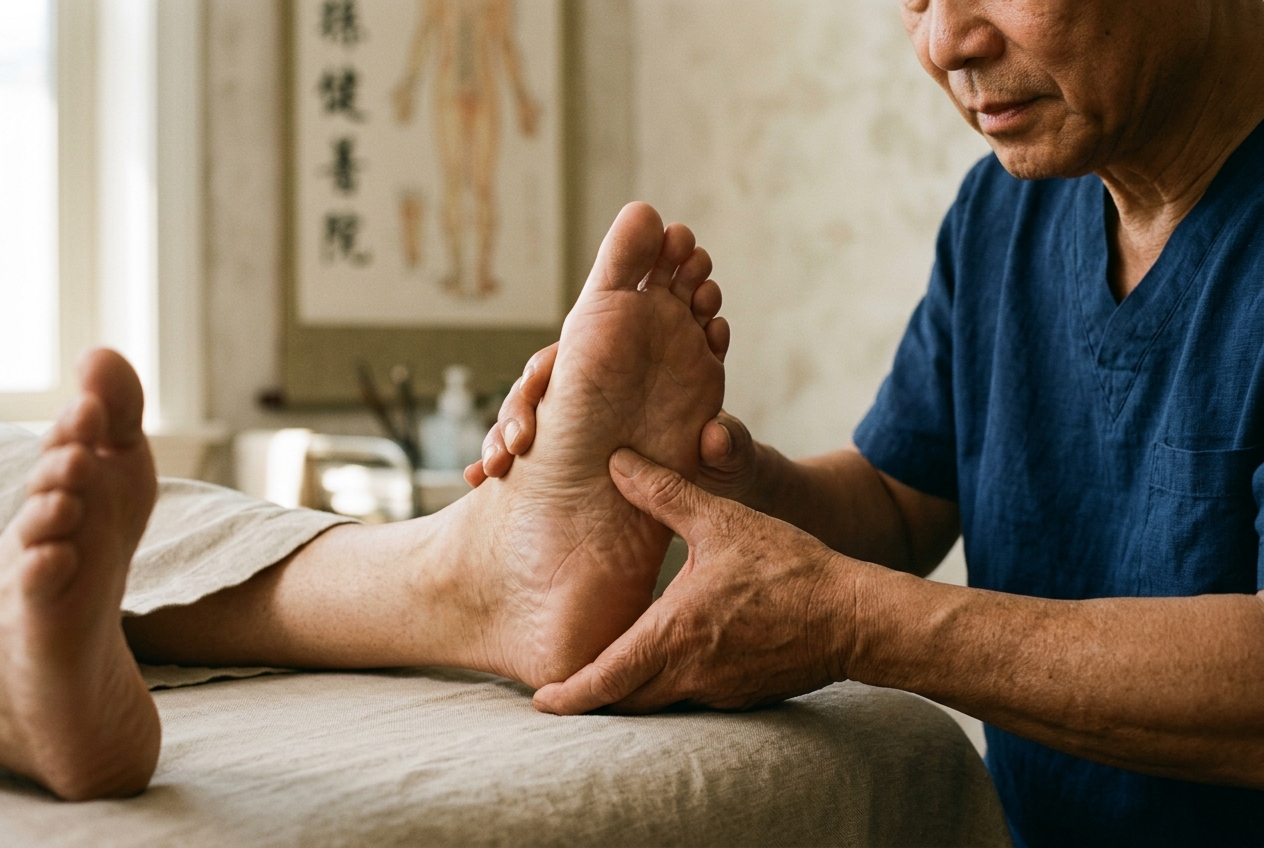
At the conclusion of an arduous, mentally demanding day, you peel off your shoes and collapse onto the edge of your bed. As your bare soles meet the floor, an intricate tapestry of physical sensations announces itself: a dull, throbbing heat radiating across the balls of your feet, an icy numbness stiffening the distal tips of your toes, or perhaps a persistent, sharp tension anchoring itself along the inner arch. You might reach down and notice a stubborn patch of thickened, yellowish callus just below your big toe, or a deep, tender crevice cracking open the lateral perimeter of your heel.
In conventional biomedical perspectives, these localized anomalies are routinely dismissed as mere consequences of mechanical friction, poor shoe ergonomics, or superficial epidermal dehydration. Yet within the sophisticated epistemological framework of Traditional Chinese Medicine (TCM), the human foot is understood not as an inert biomechanical lever, but as a profound somatotopic map—a dynamic, holographic terminal that continuously broadcasts the state of your internal organs (Zang-Fu).
The burning sensation beneath the metatarsal head is not arbitrary; it is the physiological signature of unanchored sovereign Fire rising when the cardiopulmonary dynamic is overtaxed. The stiff, cold toes mirror a stagnation in peripheral microcirculation dictated by the Liver’s inability to smoothly distribute Vital Energy (Qi) and Blood (Xue). And the chronically cracked heel signals an underlying depletion of deep ancestral reserves (Jing Essence) housed within the Kidney-Adrenal axis. The human foot, bearing the ultimate weight of our vertical existence, serves as an exquisitely sensitive mirror reflecting internal visceral balance, vascular perfusion, and psycho-emotional equilibrium.
2. What This Organ System Does: Classical Foundations and Somatotopic Architecture of Zu Zhen
The Classical Canon and Channel Convergence
The clinical science of Foot Diagnosis, known in Chinese medical literature as Zu Zhen (足診), possesses a lineage documented in foundational classical texts. In the seminal Han Dynasty treatise, the Huangdi Neijing (The Yellow Emperor’s Classic of Internal Medicine), and more specifically within the Ling Shu (Spiritual Pivot, Chapter 10, Jingmai), the human body is detailed as an interconnected network of conduits through which Vital Energy (Qi) and Blood (Xue) course.
The distal extremities—specifically the feet and ankles—represent the vital convergence zones of the Six Lower Meridians (Zu Liu Jing). Three Yin channels originate at or traverse the plantomedial architecture of the foot, connecting directly to the solid, storage organs: - The Foot Taiyin Spleen Channel (Zu Taiyin Pi Jing): Governs digestive transformation, metabolic assimilation, and the structural integrity of connective fascia. - The Foot Shaoyin Kidney Channel (Zu Shaoyin Shen Jing): Governs foundational Yin-Yang balance, constitutional Essence (Jing), bone marrow, fluid homeostasis, and hormonal reserves. - The Foot Jueyin Liver Channel (Zu Jueyin Gan Jing): Regulates the smooth, unobstructed dispersion of Qi, microvascular vascular tone, tendon flexibility, and emotional modulation.
Simultaneously, three Yang channels terminate or originate along the lateral and dorsal aspects of the foot, communicating with the hollow, transforming viscera: - The Foot Yangming Stomach Channel (Zu Yangming Wei Jing): Manages gastrointestinal motility, nutrient ripening, and bodily fluid generation. - The Foot Shaoyang Gallbladder Channel (Zu Shaoyang Dan Jing): Controls decision-making, physiological fluidity, lateral musculoskeletal balance, and biliary secretion. - The Foot Taiyang Bladder Channel (Zu Taiyang Pangguang Jing): The longest meridian in the human body, governing autonomic nervous system adaptation, neuro-endocrine reflex arcs, and systemic water metabolism.
       =========================================================
       SOMATOTOPIC CONVERGENCE OF THE THREE JIAOS (SAN JIAO)
       =========================================================

       [ Cranial / Sensory ]  --> Digital Ungual Beds & Apices
                                  (Brain, Eyes, Ears, Sinuses, Shen)
       ---------------------------------------------------------
       [ Upper Jiao ]         --> Metatarsal Ball & Yongquan (KI 1)
                                  (Heart & Lung Dynamics, Fire-Water)
       ---------------------------------------------------------
       [ Middle Jiao ]        --> Medial Longitudinal Arch
                                  (Spleen-Stomach, Digestion, Qi)
       ---------------------------------------------------------
       [ Lower Jiao ]         --> Calcaneal Heel Vault
                                  (Kidney, Bladder, Essence, Pelvis)
       =========================================================
       [ Spinal Axis ]        --> Medial Osseous Border (SP-KI Path)
       =========================================================
The Podiatric Topography of the Three Burners (San Jiao)
In classical somatotopic mapping—a phenomenon validated in contemporary neurophysiology through the concept of cortical somatotopic arrangement—the human foot is configured as an inverted homunculus, structurally compartmentalized according to the Three Burners (San Jiao):
- Upper Jiao (Shang Jiao) — The Metatarsal Ball: The anterior third of the plantar surface, extending across the metatarsal heads and embracing the depression of Yongquan (Kidney 1, "Gushing Spring"), corresponds directly to the thoracic cavity. It mirrors the dynamics of the Heart (Xin) and Lungs (Fei). It governs cardiopulmonary rhythm, oxygenation, and the downward grounding of emotional and physiological heat.
- Middle Jiao (Zhong Jiao) — The Plantar Arch: The central vault, spanning the medial longitudinal arch along the navicular, cuneiform, and proximal metatarsal bones, maps the digestive furnace—the Spleen (Pi) and Stomach (Wei), alongside the Liver (Gan) and Gallbladder (Dan). This zone indicates metabolic efficiency, nutrient absorption, lymphatic transport, and gastrointestinal motility.
- Lower Jiao (Xia Jiao) — The Calcaneal Heel: The posterior third of the foot, dominated by the dense osseous structure of the calcaneus, corresponds to the pelvic basin, urogenital organs, lumbar spine, and deep reproductive vitality. It reflects the root of constitutional vigor—the Kidney (Shen), Urinary Bladder (Pangguang), uterus/prostate, and lower bowel.
- The Medial Border — The Spinal Axis: The osseous margin running along the medial aspect of the foot, from the first metatarsophalangeal joint through the navicular tuberosity down to the medial calcaneus, charts the exact biomechanical and energetic trajectory of the vertebral column (cervical, thoracic, lumbar, and sacrococcygeal segments).
- The Digital Ungual Beds — The Cranial and Sensory Orifices: The distal phalanges and nail margins of all five toes correlate to the cerebral cortex, facial sinuses, eyes, ears, and the psycho-emotional clearing center (Shen).
Research indexed in the NCBI PubMed Database on peripheral neural mapping and meridian transmission mechanisms indicates that plantar stimulation induces quantifiable somatosensory evoked potentials and autonomic nervous system recalibrations, confirming the ancient empirical observations documented in the Huangdi Neijing.
3. How You Can Feel It: Clinical Differentiation of Podiatric Morphologies and Semiotics
A thorough clinical inspection of the feet reveals a wealth of objective diagnostic data through changes in skin texture, color, vascular architecture, temperature, and localized sensitivity. By understanding these semiotic markers, both clinicians and individuals can evaluate visceral health with remarkable precision.
       =========================================================
       PODIATRIC SEMIOTIC MATRIX: FIVE-ELEMENT DIAGNOSIS
       =========================================================

        Tissue Marker       TCM Pathomechanism          Zang-Fu Pattern
       ---------------------------------------------------------
        Medial Arch Corn    Damp-Phlegm Accumulation    Spleen Deficiency
        Calcaneal Fissures  Essence (Jing) Dehydration  Kidney Yin Deficit
        Plantar Erythema    Deficiency Heat / Agitation  Heart-Kidney Discord
        Spider Telangiect.  Microcirculatory Stasis     Liver Qi / Blood Stasis
        Hallux Abduction    Fascial Tendon Weakness     Liver-Spleen Disharmony
       =========================================================
Morphological and Epicutaneous Diagnostic Indicators
1. Epidermal Hyperkeratosis (Callosities, Corns, and Plaques)
When an internal organ suffers from chronic functional deficiency (Xu) or stagnant accumulation (Shi), the corresponding cutaneous reflex zone undergoes compensatory epidermal thickening. - Medial Arch Hyperkeratosis: Chronic calluses spanning the medial cuneiform and navicular area signify Middle Jiao dampness and Spleen Qi deficiency. The body fails to transport fluids properly, creating tissue edema that manifests peripherally as dense, hardened stratum corneum. - First Metatarsophalangeal Joint Callus: Thickening on the plantar or medial aspect of the hallux ball indicates chronic Liver Qi stagnation and Gallbladder disharmony, frequently paired with hypertonicity in the neck and shoulder musculature. - Calcaneal Perimeter Callusing: Extensive, hard bordering around the heel reflects chronic pelvic congestion, lumbar exhaustion, and Kidney Yang insufficiency failing to warm and circulate fluids through the lower extremities.
2. Desquamation, Rhagades, and Fissuring
- Deep Calcaneal Fissures (Heel Cracking): In TCM, the heel is nourished by Kidney Essence (Jing) and moistened by Kidney Yin. Chronic, non-healing cracks that bleed or ache indicate severe Kidney Yin deficiency with internal dryness. Systemically, this often coincides with nocturnal hot flashes, lumbar soreness, dry mucous membranes, and auditory tinnitus.
- Interdigital Desquamation (Peeling Between Toes): Peeling, moist, or macerated skin between the fourth and fifth toes (the trajectory of the Foot Shaoyang Gallbladder and Taiyang Bladder meridians) indicates Damp-Heat lodging in the lower burner, commonly manifesting systemically as digestive bloating, bitter taste in the mouth, or urinary hesitancy.
3. Thermal Disparities
- Plantar Frigidity (Cold Feet extending to Ankles): Indicates Kidney Yang deficiency (Shen Yang Xu). The Mingmen ("Gate of Vital Life-Fire") is insufficient to drive arterial and Qi circulation to the distal extremities.
- Plantar Erythema and Burning Heat ("Five-Center Heat"): Sensation of intense heat isolated to the metatarsal and mid-plantar zones—especially worsening in the evening—is the classic marker of Kidney Yin deficiency with Empty Heat (Shen Yin Xu Nei Re), often accompanied by restless sleep, night sweats, and palpitations.
4. Microvenular Engorgement and Telangiectasias (Spider Veins)
- Sub-Malleolar Cyanotic Venules: Clustered, dark red or purplish micro-vessels beneath the medial malleolus (along the path of Kidney meridians KI 3 to KI 6) reveal deep pelvic Blood stasis (Xue Yu). In women, this frequently correlates with dysmenorrhea, uterine fibroids, or endometriosis; in men, it points toward prostatic hypertrophy or pelvic congestion.
- Lateral Dorsal Venous Distension: Prominent, tortuous blue veins across the dorsal trajectory of the Bladder and Gallbladder channels reflect systemic autonomic nervous tension, physical overwork, and chronic Liver-Gallbladder Qi stagnation.
5. Musculoskeletal Deformities: Hallux Valgus (Bunions)
The lateral deviation of the great toe (Hallux Abduction) directly impacts the convergence of the Spleen (Zu Taiyin) and Liver (Zu Jueyin) channels at points Taibai (SP 3) and Dadun (LR 1). Biomechanically, it represents ligamentous laxity and structural collapse driven by chronic Spleen Qi deficiency (which fails to hold tissues firm) combined with Liver Blood insufficiency (which fails to nourish the tendons and synovial capsular structures).
Comprehensive Clinical Differentiation Table
The following table synthesizes podiatric findings with comprehensive TCM differential diagnosis, corroborating foot indicators with radial pulse (Mai Zhen) and tongue (She Zhen) evaluations:
| Podiatric Phenomenon | Primary Plantar Somatotope | Systemic Zang-Fu Pattern | Concomitant Tongue Signs (She Zhen) | Concomitant Pulse Qualities (Mai Zhen) | Classical Pathophysiological Mechanism |
|---|---|---|---|---|---|
| Deep Calcaneal Fissures with Dryness | Calcaneus / Heel (Lower Jiao) | Kidney Yin Deficiency with Fluid Dehydration | Red body, peeled/scanty coating, transversal fissures | Fine (Xi), Rapid (Shuo), Deep (Chen) in chi position | Failure of Kidney water to ascend and moisten lower extremity tissues; exhaustion of constitutional Jing. |
| Plantar Erythema & Burning at Ball of Foot | Metatarsal heads / Yongquan (Upper Jiao) | Heart-Kidney Non-Interaction (Xin Shen Bu Jiao) | Red tip, thin yellow dry coat, central midline crack | Floating (Fu), Empty (Xu), Rapid (Shuo) | Deficient Kidney Yin fails to anchor Heart Fire, allowing hyperactive Yang to flare upward and disturb peripheral capillary beds. |
| Medial Longitudinal Arch Collapse & Callus | Medial Navicular / Cuneiform (Middle Jiao) | Spleen Qi Deficiency with Damp Accumulation | Pale, swollen body, scalloped toothmarks on margins, greasy white coat | Deficient (Xu), Moderate (Huan), Slipped (Hua) | Spleen fails to govern muscles and transform fluids; connective fascia collapses under downward gravitational fluid retention. |
| Sub-Malleolar Cyanotic Telangiectasias | Medial Inframalleolar Sulcus (Taixi - Zhaohai) | Lower Jiao Blood Stasis (Xue Yu) | Purple, dusky body with dark sublingual veins and petechiae | Choppy (Se), Wiry (Xian), or Knotted (Jie) | Chronic pelvic or microvascular stasis causing retrograde pooling of deoxygenated blood in collateral conduits (Luo Mai). |
| Hallux Valgus with Medial Eminence Erythema | First MTP Joint (Taibai - Dadu) | Liver Blood Stasis with Spleen Connective Weakness | Dusky red, swollen side lobes, thin yellow coating | Wiry (Xian) on left guan, Weak (Ruo) on right guan | Liver failing to nourish tendons coupled with Spleen failing to support structural integrity; acute inflammation generates local Heat. |
| Persistent Cyanotic Frigidity of All Digits | Ungual Beds and Distal Phalanges | Kidney Yang Deficiency with Interior Cold Consolidation | Pale, wet, swollen body with thick white slippery coating | Deep (Chen), Slow (Chi), Faint (Wei) | Mingmen Fire depleted; Yang Qi incapable of propelling arterial blood and defense Qi to the distal capillary microbeds. |
Step-by-Step Clinical Palpation and Corroboration Protocol
To conduct an authoritative podiatric evaluation, follow this four-tier clinical palpation protocol:
- Visual Epicutaneous Survey: Inspect both feet in a non-weight-bearing position. Note gross asymmetries, color gradients (pallor, erythema, cyanosis), hyperkeratotic plaques, and vascular telangiectasias.
- Thermal and Moisture Topography: Pass the dorsal surface of your hands smoothly from the proximal ankles down to the distal toes. Note abrupt thermal transitions—such as a warm metatarsal ball coupled with cold phalanges.
- Meridian Pressure-Pain (Ashi) Threshold Testing: Using perpendicular, deliberate thumb pressure (approximately 3 to 4 kg/cm²), palpate the primary diagnostic points: - Yongquan (KI 1) on the central plantar depression. - Taixi (KI 3) in the retro-malleolar groove. - Taichong (LR 3) in the dorsal inter-metatarsal valley. - Taibai (SP 3) proximal to the first metatarsal head. - Gongsun (SP 4) at the base of the first metatarsal bone. A sharp, disproportionate tenderness indicates acute functional stagnation or heat in the corresponding organ.
- Tri-Diagnostic Cross-Corroboration: Cross-reference the podiatric findings with: - Radial Pulse (Mai Zhen): Verify whether a tender medial arch (Spleen) coincides with a weak, slippery right Guan pulse position, or if calcaneal cracks (Kidney) match an attenuated Chi position. - Tongue Topography (She Zhen): Confirm whether plantar erythema reflects a red, strawberry tongue tip (Heart Fire) or lateral redness (Liver Fire).
4. Qigong & Movement Practice: Somatosensory Mobilisation and Channel Activation
To revitalize the six lower channels, restore plantar microvascular circulation, and discharge accumulated pathogenic heat, practice the classical restorative sequence: "Grounding the Root: The Calcaneal Wave and Plantar Dispersal" (Zhen Ti Dun Zu).
       =========================================================
       SOMATOSENSORY MOBILISATION: THE CALCANEAL WAVE
       =========================================================

       [ Phase 1: Ascent ]    Inhale --> Rise onto Metatarsals (KI 1)
                              (Draw Yin Earth Qi up Medial Channels)
       ---------------------------------------------------------
       [ Phase 2: Apex ]      Retain --> Expand Spine & Cranial Vertex
                              (Crown Baihui aligns with Pelvic Floor)
       ---------------------------------------------------------
       [ Phase 3: Descent ]   Exhale --> Drop onto Calcaneal Vault (Heels)
                              (Vibrational Impulse Clears Bladder/Spine)
       =========================================================
Starting Position and Biomechanical Setup
- Stand barefoot on a flat, non-slip wooden floor or natural earth surface.
- Place your feet parallel, exactly hip-width apart, with toes pointed directly forward.
- Unlock your knees slightly; do not hyperextend.
- Tuck your pelvis subtly forward to flatten the lumbar spine, and suspend your head from the crown (Baihui, GV 20) as if drawn upward by an invisible silk thread.
- Rest your tongue softly against the hard palate behind the upper front teeth, completing the connection between the Governing (Du) and Conception (Ren) vessels.
- Rest your hands gently over the Lower Dantian (two inches below the navel).
The Movement Sequence
- Step 1 (The Inhalation and Plantar Ascent): Slowly inhale through your nose over a count of four seconds, using deep diaphragmatic expansion. As you inhale, smoothly transfer your body weight forward onto the metatarsal balls of your feet, gently elevating your heels two to three inches off the floor. Feel the activation at Yongquan (KI 1), drawing cooling Earth Yin upward along the medial calves.
- Step 2 (The Suspended Apex): Hold the breath gently for two seconds at the apex of elevation. Feel your entire spinal axis lengthen, opening the intervertebral spaces.
- Step 3 (The Calcaneal Drop and Kinetic Shockwave): Exhale suddenly and completely through your mouth with a soft "Haa" sound, allowing your heels to drop directly onto the floor with a firm, unbuffered impact. The kinetic vibration should travel from the calcaneal bone, up the tibia, through the sacrum, and resonate along the Taiyang Bladder channel to the base of the skull.
- Step 4 (The Toe Grasp and Plantar Rebound): Immediately following the heel strike, grip the floor firmly with all ten toes for two seconds, flexing the plantar fascia and stimulating the distal ungual points (Jing-Well points). Relax the toes completely.
Dosage and Sensory Indicators
- Repetitions: Perform 24 consecutive rhythmic drops in the morning to awaken circulation, and 36 slower, softer cycles in the evening to clear mental fatigue.
- Sensory Shifts: Within 12 to 18 repetitions, you will feel a warming sensation blooming in the center of your soles, accompanied by a pleasant heaviness in the legs. This confirms that hyperactive, unanchored mental energy (Shen) is descending from the cranium and grounding into the lower visceral terminals.
5. Acupressure Points You Can Try Today: Key Podiatric Acupoints and Reflex Modulation
Targeted manual pressure on specific podiatric acupoints delivers immediate neuromodulatory signals, harmonizing Zang-Fu functions, easing muscular tension, and promoting deep systemic relaxation. According to the World Health Organization Guidelines on Traditional Medicine, precise tactile stimulation on distal acupoints produces measurable analgesic and autonomic balancing responses.
                  THE INNER & PLANTAR FOOT ACUPOINT MAP
                  -------------------------------------

                              (Dorsal Aspect)
                                    |
                             [ LR 3 Taichong ]  <-- Valley between 1st & 2nd Metatarsals
                                    |
  [ KI 1 Yongquan ]                 |
  (Plantar Vault / Depression)      |
             \                      |
              \                     |
               \                    |
                +-------------------+-------------------+
                |                                       |
     [ SP 4 Gongsun ]                            [ KI 3 Taixi ]
     (Distal/Inferior 1st Base)                  (Depression behind Medial Malleolus)
                |                                       |
     [ SP 3 Taibai ]                             [ KI 6 Zhaohai ]
     (Proximal to 1st MTP Joint)                 (1 Cun below Medial Malleolus)
1. Yongquan (Kidney 1 — "Gushing Spring")
- Anatomical Localization: Located on the sole of the foot, in the prominent depression formed when the foot is plantar-flexed, approximately one-third of the distance from the base of the second and third toes to the posterior tip of the heel.
- Manual Palpation Technique: Apply firm, perpendicular pressure using the tip of your thumb or a rounded massage tool. Press inward and slightly toward the heel with deep, sustained pressure for 2 to 3 minutes per foot. Maintain a level of pressure that produces a distinct, heavy, dull ache (De Qi sensation) without sharp, guarding pain.
- Clinical Applications: The premier point for descending hyperactive Liver Yang and clearing mental agitation. Highly effective for reducing hypertension, terminating tension headaches, calming insomnia, easing nocturnal anxiety, and warming cold lower extremities.
2. Taichong (Liver 3 — "Great Surge")
- Anatomical Localization: Located on the dorsal surface of the foot, in the distal depression between the junction of the first and second metatarsal bones, approximately two finger-widths proximal to the web space between the big and second toes.
- Manual Palpation Technique: Place your thumb into the bony valley and glide proximally until it locks into the triangular angle formed by the two bones. Apply pressure directed obliquely toward the ankle joint. Utilize circular, kneading motions with moderate to firm pressure for 90 to 120 seconds on each foot.
- Clinical Applications: The supreme point for releasing emotional frustration, irritability, and somatic stress. Clinically indicated for temporal migraines, eye strain, intercostal neuralgia, digestive bloating, and menstrual cycle irregularities.
3. Taixi (Kidney 3 — "Supreme Stream")
- Anatomical Localization: Situated on the medial aspect of the ankle, in the deep anatomical depression between the prominence of the medial malleolus (inner ankle bone) and the medial border of the Achilles tendon (Tendo Calcaneus).
- Manual Palpation Technique: Grasp the heel with your hand, placing your thumb into the depression behind the inner ankle bone. Apply steady, perpendicular pressure toward the center of the joint space. Hold sustained pressure for 2 minutes while taking slow, diaphragmatic breaths.
- Clinical Applications: The primary tonification point for both Kidney Yin and Kidney Yang. Excellent for relieving chronic lower back soreness, strengthening unstable ankles, resolving chronic heel pain, alleviating systemic fatigue, and clearing throat dryness.
6. Food & Lifestyle — Small Changes for Today: Visceral Nourishment and Podiatric Hydrotherapy
Long-term restoration of the lower meridians and internal organs requires consistent, practical daily nourishment and targeted thermal care.
       =========================================================
       DAILY VISCERAL NOURISHMENT MATRIX FOR PODIATRIC HEALTH
       =========================================================

        Organ System        Foods to Prioritise         Foods to Restrict
       ---------------------------------------------------------
        Kidney (Lower Jiao) Black Sesame, Walnuts,      Iced Drinks, Excess Salt,
                            Bone Broths, Black Beans    Processed Nitrates
       ---------------------------------------------------------
        Spleen (Middle Jiao) Steamed Pumpkin, Oats,     Refined Sugars, Dairy,
                            Stewed Apples, Ginger       Raw Uncooked Salads
       ---------------------------------------------------------
        Liver (Circulation) Steamed Greens, Dandelion,  Trans-Fats, Heavy
                            Warm Lemon-Water, Mint      Alcohol, Deep-Fried Foods
       =========================================================
Targeted Dietary Therapy
- To Nourish the Kidney-Calcaneal Axis (Lower Jiao): Incorporate deeply nourishing, mineral-dense foods that tonify Kidney Jing and lubricate dry tissues. Consume black sesame seeds (freshly ground), walnuts, organic bone broths, adzuki and black beans, and dark leafy greens. Reduce: Excessive raw, cold-temperature beverages, refined sodium, and processed foods that deplete Kidney fluid reserves.
- To Strengthen the Spleen-Arch Matrix (Middle Jiao): Protect the structural integrity of your arches and fascia by warming the digestive fire. Favor easily assimilable, cooked meals: slow-cooked stews, roasted squash, steamed root vegetables, oats, and warming digestive spices like fresh ginger (Sheng Jiang), cinnamon (Gui Zhi), and cardamom. Reduce: Excessive dairy, refined white sugar, iced drinks, and massive quantities of cold, raw salads that generate internal Dampness and weaken connective tissue.
- To Smooth Liver-Tendon Flow (Microvascular Perfusion): Support smooth circulation to the toes and tendons by introducing gently moving, bitter, and sour foods. Incorporate lightly steamed cruciferous vegetables, dandelion tea, warm water with fresh lemon juice in the morning, and peppermint infusions. Reduce: Deep-fried, greasy foods, trans-fats, and heavy alcohol, all of which create stagnant Heat that lodges in the peripheral vascular beds.
Classical Podiatric Hydrotherapy: The Herbal Foot Soak (Zu Yu)
Soaking the feet in a warm, medicinal botanical infusion is one of the most effective traditional methods to draw circulation downward, dilate lower extremity microvasculature, and calm the central nervous system.
The Home Protocol:
- Preparation: Fill a deep basin with warm water (temperature between 40°C and 43°C / 104°F–110°F) deep enough to fully submerge the ankles, ensuring the Taixi (KI 3) and Sanyinjiao (SP 6) points are covered.
- Botanical Additions: Add 3 to 4 thick slices of freshly crushed ginger root (Zingiber officinale—to warm the channels and disperse cold), two tablespoons of natural sea salt or Epsom salt (rich in magnesium to relax the plantar fascia and nourish the Kidneys), and optionally a small handful of dried mugwort leaves (Artemisia vulgaris / Ai Ye—to invigorate peripheral blood flow).
- Immersion: Soak for exactly 15 to 20 minutes in the evening, approximately 60 to 90 minutes before retiring to bed.
- Physiological Goal: Continue until a light, comfortable perspiration breaks out across your forehead or upper back. Do not soak to the point of profuse sweating, which depletes Heart and Kidney Yang.
- Immediate Care: Dry your feet thoroughly immediately afterward, paying special attention to the interdigital spaces, and put on warm, breathable natural cotton or wool socks to prevent external wind-cold invasion (Feng Han).
7. Today's Takeaway: The Five-Minute Plantar Reset Protocol
If you do only one thing for your body today, dedicate five minutes this evening to the Plantar Grounding Reset:
Follow this by spending two minutes using your thumb to slowly trace and press the inner bony margin of your foot, from your big toe joint down along the arch to the front of your heel, releasing accumulated fascial tension along the spinal reflex line.
Repeat on the other foot.
This simple, equipment-free practice grounds overactive mental energy, stimulates autonomic relaxation, accelerates lower extremity microvascular return, and restores natural harmony between your physical root and your internal visceral health.
Authoritative References and Further Reading
- World Health Organization (WHO) Traditional, Complementary and Integrative Medicine Strategy
- National Center for Biotechnology Information (NCBI) PubMed Central Database
- Huangdi Neijing (Inner Canon of the Yellow Emperor) Historical & Clinical Overview
- National Institutes of Health (NIH) PMC Clinical Research on Acupuncture Meridian Channels
- Neurophysiological Basis of Somatotopic Mapping & Reflex Arcs
- Clinical Studies on Reflexology and Peripheral Microcirculation on PubMed