Fifteen Luo-Collaterals: Navigating Secondary Channel Networks, Dabao Interstitial Drainage, and Precision Acupressure Protocols
If you regularly wake with an ill-defined stiffness across your ribcage, experience stubborn heaviness in your limbs after an ordinary workday, or suffer from a diffuse, low-grade irritability that defies psychological explanation, you are experiencing what classical Asian medicine terms collateral stagnation. In contemporary terms, we might describe this as a bottleneck in microvascular perfusion, interstitial fluid stasis, and neurofascial tension. While modern wellness discourse frequently fixates on the major organ systems or the primary meridian superhighways, Classical Chinese Medicine (CCM) recognizes that the most persistent somatic complaints take root not in the primary channels (Jingmai), but in their intricate, branching network: the Fifteen Luo-Collaterals (Shi Wu Luo Mai, 十五絡脈).
For over two millennia, physicians working in the lineage of the Huangdi Neijing Ling Shu (The Spiritual Pivot, c. 1st century BCE) understood that vitality depends on the continuous exchange of fluids and bio-electrical information between the deep core of the body and its superficial periphery. The Luo-collaterals represent this exact transitional territory. They are the physiological tributaries, capillary beds, and neurofascial cross-links that bridge our deep visceral organs (Zangfu) with our musculoskeletal envelope. When these delicate channels become overwhelmed by emotional distress, physical trauma, or sedentary habits, systemic circulation falters.
Bridging classical channel theory with 21st-century neurovascular physiology and fascia research reveals that the fifteen Luo-collaterals offer one of the most clinically sophisticated frameworks available for understanding and resolving chronic somatic tension.
1. Classical Foundations: The Architecture of the Fifteen Luo-Collaterals
The foundational architecture of the Luo-collateral system is systematically delineated in Chapter 10 of the Ling Shu ("On the Vessels"). The classical canon conceptualizes the primary meridians as deep, trunk-like rivers (Jing), while the Luo (literally "to net," "to connect," or "network") are the bifurcating tributaries that irrigate the interstitial space (Fenrou, 分肉) lying between the skin, muscles, and deep fascial planes.
Longitudinal vs. Transverse Collaterals
The classical literature categorizes the Luo network into two distinct functional architectures:
-
The Transverse Luo-Collaterals (Heng Luo, 橫絡): These serve as homeostatic horizontal cross-bridges between Yin-Yang paired channels (such as the Lung and Large Intestine, or the Spleen and Stomach). Originating at the specific Luo-connecting point (Luo Xue) of one channel, the transverse branch runs directly to the Yuan-Source point of its coupled interior-exterior partner. In clinical practice, this gives rise to the elegant Host-Guest (Yuan-Luo) methodology: when an organ system is compromised (the "Host," treated via its Yuan-Source point), its coupled partner (the "Guest") is engaged through its Luo-connecting point to mobilize compensatory physiological reserves and clear excess pathogenic load.
-
The Longitudinal Luo-Collaterals (Zong Luo, 縱絡): These are extensive pathways that depart from the primary meridian at the Luo-connecting point and pursue an independent trajectory. Unlike primary channels, which maintain a strictly linear organ-to-extremity route, longitudinal collaterals ascend or descend into superficial muscle groups, traverse into the sensory orifices (the throat, tongue, eyes, and ears), or plunge inward to connect directly with the viscera. Functionally, the longitudinal collaterals act as physiological "overflow reservoirs." When emotional shock, climatic extremes, or physical trauma overwhelm the primary meridians, the body shunts this pathogen into the longitudinal Luo network, preventing catastrophic damage to the core vital organs (Zang) at the expense of chronic, localized peripheral symptoms.
The Trunk Collaterals and the Great Regulators
In addition to the twelve bilateral collaterals arising from the primary organ channels, the classical canon establishes three unpaired trunk collaterals, complemented by an essential auxiliary regulator:
- The Conception Vessel Luo (Jiuwei, CV15): Emerging from the inferior tip of the xiphoid process, this collateral spreads across the epigastrium and fans over the abdominal fascia. It commands the anterior surface of the trunk, regulating core myofascial integrity, diaphragmatic excursion, and the cutaneous microcirculation of the belly.
- The Governing Vessel Luo (Changqiang, GV1): Originating at the base of the spine between the coccyx and anus, this powerful vessel bifurcates and ascends along the paravertebral musculature to the nape of the neck, spreading over the occiput and cranial aponeurosis. It modulates spinal tone, cerebrospinal fluid movement, and autonomic neurovascular reflexes along the central nervous system axis.
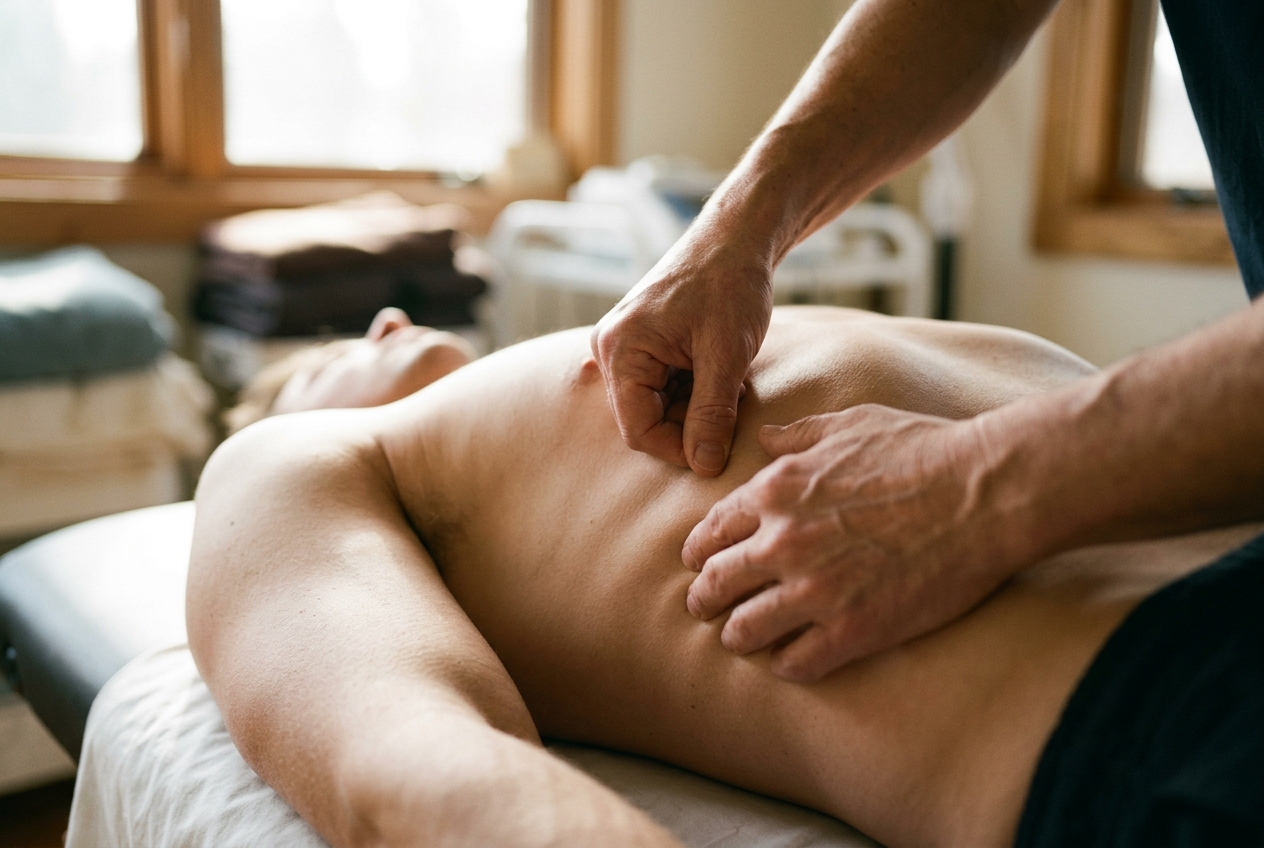
- The Great Luo of the Spleen (Dabao, SP21): Emerging on the lateral thoracic cage along the mid-axillary line, Dabao (meaning "Great Enfolder") is classically designated as the master coordinator of the entire peripheral collateral system. It literally "wraps the ribs, embraces the chest, and gathers the blood of all thirty-six collaterals and three hundred and sixty-five minor vessels," maintaining structural integrity across the global myofascial web.
- The Great Luo of the Stomach (Xuli, 虛裏): Documented in the Neijing Suwen (Chapter 18), this unnumbered collateral originates in the Stomach, perforates the respiratory diaphragm, threads the lung tissue, and emerges beneath the left breast. Palpated as the apical heartbeat (the point of maximal impulse), Xuli serves as the primary diagnostic window into the body's Zong Qi (Ancestral/Pectoral Qi) and dynamic hemodynamic stroke volume.
2. Fullness (Shi) vs. Emptiness (Xu): Diagnostic Pathophysiology
A cornerstone of classical collateral diagnostics is the precise differentiation between states of Repletion/Fullness (Shi, 實) and Vacuity/Emptiness (Xu, 虛). Because the Luo-collaterals are intimately bound to the vascular system—the Ling Shu explicitly states that "the Luo vessels are those that contain blood and visible discoloration"—pathology within these channels manifests with distinct structural, sensory, and affective markers.
When a collateral is in a state of Fullness (Shi), pathogenic energy and blood stagnate together. This generates acute swelling, localized heat, sharp or throbbing pain, microvascular engorgement (spider veins or dark venules), and hyperactive motor responses. Conversely, when a collateral is in a state of Emptiness (Xu), the vessel is drained of microvascular perfusion and bioelectric nourishment. This results in tissue atrophy, numbness, flaccidity, coldness, functional weakness, and loss of sensory acuity along its distribution zone.
3. Neurovascular Integration: The Modern Biology of the Luo Network
To the contemporary physician and researcher, the classical description of the Luo-collaterals reads as a direct observation of microvascular physiology, interstitial fluid dynamics, and neurofascial transmission. Contemporary biomedical investigations, accessible via resources like the NCBI PubMed Central Database, confirm that classical acupressure points and meridian pathways correspond to anatomical sites rich in loose connective tissue planes, neurovascular bundles, and high densities of unmyelinated autonomic nerve endings.
Modern scientific inquiry elucidates several key mechanisms through which stimulating the Luo-collaterals exerts profound local and systemic effects:
- Capillary Microcirculation and Endothelial Shear Stress: The Luo-collaterals map precisely to the transitional zones where terminal arterioles feed into capillary networks and post-capillary venules. Mechanical pressure applied to these loci induces cellular shear stress on vascular endothelial cells, triggering the immediate enzymatic synthesis of endothelial Nitric Oxide (eNOS). This induces rapid vasodilation, dissolves local microvascular spasms, and flushes metabolic byproducts (such as lactic acid and inflammatory cytokines) out of trapped interstitial beds. Detailed mechanisms of acupuncture and connective tissue shear stress are thoroughly documented in scientific literature on PubMed.
- Neurofascial Mechanotransduction: Fascial planes are dense with low-threshold mechanoreceptors (Ruffini endings, Pacinian corpuscles, and interstitial receptors). Targeted mechanical compression and cross-fiber shearing deform local fibroblasts, signaling them to restructure the extracellular matrix (ECM) and downregulate pro-inflammatory neuropeptides like Substance P and Calcitonin Gene-Related Peptide (CGRP).
- Autonomic Vasomotor Modulation: The Luo-connecting points sit at primary communicative nexuses between the somatic and autonomic nervous systems. Stimulating these sites modulates peripheral sympathetic vasoconstrictor tone, balancing arterial inflow with venous return. Comprehensive anatomical analyses of these loci are standardized in international frameworks such as the WHO Standard Acupuncture Point Locations.
- Interstitial Fluid Migration: The interstitial matrix consists of a collagenous ground substance rich in hyaluronic acid. Fluid stasis in this matrix creates tissue gelation and stiffness. Rhythmic manual manipulation of the Luo zones restores liquid sol-gel fluidity, accelerating interstitial lymphatic drainage and restoring pain-free glide between adjacent myofascial sheets. Research into these somatosensory neurovascular pathways is further detailed in studies on neurovascular acupoint mechanisms.
4. The Meridian Path: A Tangible Journey Through the Body
To understand how the Luo-collaterals function in your own body, you do not need to memorize abstract diagrams. You can trace their living pathways using your own skeletal landmarks and palpable tissue planes.
The Upper Extremity: The Radial-Brachial and Ulnar Pathways
Place your hand palm-up on a table. The Lung Luo-collateral emerges just above your wrist bone on the thumb side. Instead of running straight into the lung, its longitudinal branch travels down into the fleshy muscular pad at the base of your thumb (the thenar eminence) before distributing outward across the palms. It governs the tissue tension of your grip, the openness of your chest, and the microcirculation of your hands.
Shift your attention to the opposite side of your wrist, along the inside edge of your forearm near the little finger. Here lies the Heart Luo-collateral. Its longitudinal branch ascends along the inner seam of your arm, crosses the armpit, threads deep through the throat, and anchors into the root of your tongue. This pathway explains why acute cardiovascular stress or social panic instantly produces a sensation of a "lump in the throat," vocal stuttering, or an inability to speak.
The Lower Extremity: The Crural and Visceral Ascents
Trace your finger to the inner arch of your foot. Just beneath the prominent joint of the big toe lies the Spleen Luo-collateral. This pathway ascends the inner line of your calf and thigh, penetrates straight through the pelvic basin, and enters the gastrointestinal viscera. When physical or emotional overload hits, this collateral locks down the intestinal walls, triggering abdominal cramping or nervous digestive distress.
Now palpate the outer side of your lower leg, midway between your knee and ankle bone, in the fleshy groove lateral to your shinbone. This is the Stomach Luo-collateral. Its powerful branch ascends the front of the leg, travels up the lateral thigh, traverses the abdominal muscle wall, ascends the throat, and terminates across the jaw and facial muscles. It acts as the body's primary somatic release valve for psychological tension, nervous agitation, and metabolic stagnation.
The Axial Trunk: The Ribcage and the Core Fascia
Spread your fingers and press firmly against the side of your ribcage, along the mid-axillary line roughly four finger-widths beneath your armpit. Here sits Dabao (SP21). The Great Luo of the Spleen radiates from this single thoracic nexus like an intricate web, encasing the ribcage, interlacing with the serratus anterior and intercostal muscles, and distributing fascia-binding tension across your entire torso.
5. Four Key Luo-Points You Can Press Right Now
The following four Luo-connecting points provide potent, non-invasive therapeutic leverage for resolving acute tension, clearing microvascular stasis, and calming the central nervous system.
1. Lieque (LU7, 列缺) — "Broken Sequence" / The Lung Collateral
- Anatomical Localization: Interlock the webs of your thumbs so your index finger rests naturally on the outer edge of your opposite wrist. The tip of your index finger will settle into a distinct, small bony notch just above the radial styloid process, roughly 1.5 finger-widths above your primary wrist crease.
- Palpatory Cue & Somatosensory Feedback: When palpated correctly, you will feel a distinct tender depression between two tendons (brachioradialis and abductor pollicis longus). Firm pressure produces an unmistakable dull ache, a light tingling sensation radiating toward the base of the thumb, or a gentle warmth spreading into the wrist.
- Stimulation Dynamics: Apply firm, circular friction using the tip of your thumb. Maintain direct perpendicular contact with the bone edge for 90 to 120 seconds.
- Therapeutic Application: Rapidly relieves occipital headaches, cervical neck stiffness from prolonged computer posture, acute emotional grief, and shallow, constricted breathing.
2. Fenglong (ST40, 豐隆) — "Abundant Bulge" / The Stomach Collateral
- Anatomical Localization: Locate the midpoint on the lateral side of your lower leg, exactly halfway between the crease of your knee joint and the tip of your outer ankle bone. Place your fingers two finger-breadths (roughly 1.5 inches) lateral to the sharp anterior crest of your shinbone, resting directly in the belly of the tibialis anterior muscle.
- Palpatory Cue & Somatosensory Feedback: Deep pressure into this thick muscular ridge will reveal a pronounced, sensitive trigger zone. You will feel a deep, heavy, spreading ache that may radiate downward into the ankle or upward toward the lateral knee.
- Stimulation Dynamics: Use your thumb knuckle or a reinforced double-thumb grip. Apply deep, rhythmic, cross-fiber kneading across the muscle grain for 2 to 3 minutes, alternating with sustained ischemic compression.
- Therapeutic Application: The premier point in the body for resolving physical and cognitive "phlegm"—clearing persistent brain fog, lethargy, digestive heaviness after meals, and generalized somatic agitation.
3. Gongsun (SP4, 公孫) — "Grandfather-Grandson" / The Spleen Collateral
- Anatomical Localization: Run your thumb along the inside edge of your foot, moving backward from the base of your big toe. As you slide off the prominent joint along the medial edge of the first metatarsal bone, your thumb will drop into a distinct hollow on the lower border of the bone, situated right at the junction where the red-and-white skin of the foot meets.
- Palpatory Cue & Somatosensory Feedback: This point is exceptionally reactive. Even gentle palpation yields a sharp, localized sensitivity or a deep visceral ache that reflects its direct neurological connection to the autonomic enteric plexuses.
- Stimulation Dynamics: Anchor your fingers around the top of your foot and press your thumb tip firmly upward and inward against the inferior border of the metatarsal bone. Hold sustained static pressure for 90 seconds while practicing deep abdominal breathing.
- Therapeutic Application: Instantly relieves acute stomach bloating, epigastric cramps, menstrual discomfort, nervous indigestion, and visceral tightness caused by chronic psychological worry.
4. Tongli (HT5, 通裏) — "Penetrating the Interior" / The Heart Collateral
- Anatomical Localization: Turn your hand palm-up. Locate the prominent wrist crease on your pinky-finger side. Move approximately one finger-breadth up your forearm from the wrist crease, directly along the inside margin of the prominent tendon (flexor carpi ulnaris).
- Palpatory Cue & Somatosensory Feedback: You will feel a soft, subtle notch against the radial side of the ulnar tendon. Light to moderate pressure evokes a mild, soothing, tender ache with occasional faint tingling tracking toward the fifth finger.
- Stimulation Dynamics: Apply gentle, steady, sustained ischemic pressure with the flat pad of your thumb. Avoid aggressive grinding; maintain smooth, rhythmic, calming circular pressure for 1 to 2 minutes.
- Therapeutic Application: Regulates sudden cardiac palpitations, alleviates social anxiety and stage fright, resolves vocal tightness or throat constriction before public speaking, and settles racing thoughts prior to sleep.
6. Clinical Acupressure Protocols: Dispersion, Tonification, and Synergistic Protocols
In clinical practice, mechanical manipulation of the Luo-collaterals is governed by two fundamental therapeutic objectives: Dispersion (Xie, 瀉) to clear full, stagnated vessels, and Tonification (Bu, 補) to nourish empty, vacuous channels.
Step-by-Step Evening Protocol: The Somatic Decompression Sequence
This clinical acupressure sequence is engineered to dismantle the microvascular stasis, cervical rigidity, and digestive pooling caused by prolonged desk work and chronic mental strain.
Detailed Execution:
- Positioning: Sit comfortably on a firm cushion or chair with your spine upright and feet flat on the floor. Loosen any restrictive clothing around your waist and neck.
- Step 1 — Mobilize the Cervico-Thoracic Axis via LU7 (Lieque): * Interlock your thumbs and locate LU7 on your left wrist. * Apply firm, perpendicular friction with the tip of your right thumb for 90 seconds. Rotate clockwise in small, precise circles. * Inhale deeply into your upper chest, exhaling slowly through an open mouth. Feel the tension draining from your occiput and jaw. * Switch hands and repeat on the right wrist for 90 seconds.
- Step 2 — Decongest the Enteric Microcirculation via SP4 (Gongsun): * Bring your left foot onto your opposite knee. Slide your thumb into the hollow beneath the big toe joint at SP4. * Apply sustained, unyielding upward-and-inward compression against the metatarsal bone for 90 seconds. * Direct your inhalation down into your lower belly, expanding the abdominal wall against the pressure. * Switch feet and repeat on the right side for 90 seconds.
- Step 3 — Purge Somatic Stagnation via ST40 (Fenglong): * Locate the thick muscular belly of ST40 on your left outer shin. * Using your knuckle or reinforced thumbs, execute firm, rhythmic, cross-fiber rolling across the muscle fibers for 2 minutes. * Maintain a deep, mobilizing pressure that elicits a clear, spreading ache. * Repeat on the right leg for 2 minutes.
- Step 4 — Global Fascial Integration via SP21 (Dabao): * Cross your arms across your chest and place your flat palms (or loose fists) against your lateral ribcage along the mid-axillary line, roughly four finger-widths beneath your armpits at SP21. * Apply gentle, firm inward compression against the lateral ribs while taking five deep, continuous diaphragmatic breaths. * On each exhalation, visualize the fascial casing of your torso softening, releasing tension outward through your limbs.
7. Safety, Clinical Cautions, and Boundaries
While non-invasive acupressure on the Luo-collaterals is exceptionally safe, intelligent practice requires understanding physiological boundaries, contraindications, and clinical red flags.
8. Today's Takeaway: The Two-Minute Micro-Reset
If you have only two minutes right now before closing this article, perform this simple reset on your Stomach Luo-Collateral (ST40) to immediately clear cognitive fatigue and reset systemic microvascular tone.
By understanding the fifteen Luo-collaterals, we bridge the ancient clinical observations of the Ling Shu with contemporary neurovascular science. These branching vessels remind us that health does not depend solely on the major highways of the body, but on the open, fluid, and vibrant movement through every microvascular tributary of our living tissue.