Facial Meridian Microsystem: Navigating Craniofacial Somatotopic Mapping, Ling Shu Visceral Topography, and Precision Acupressure Protocols
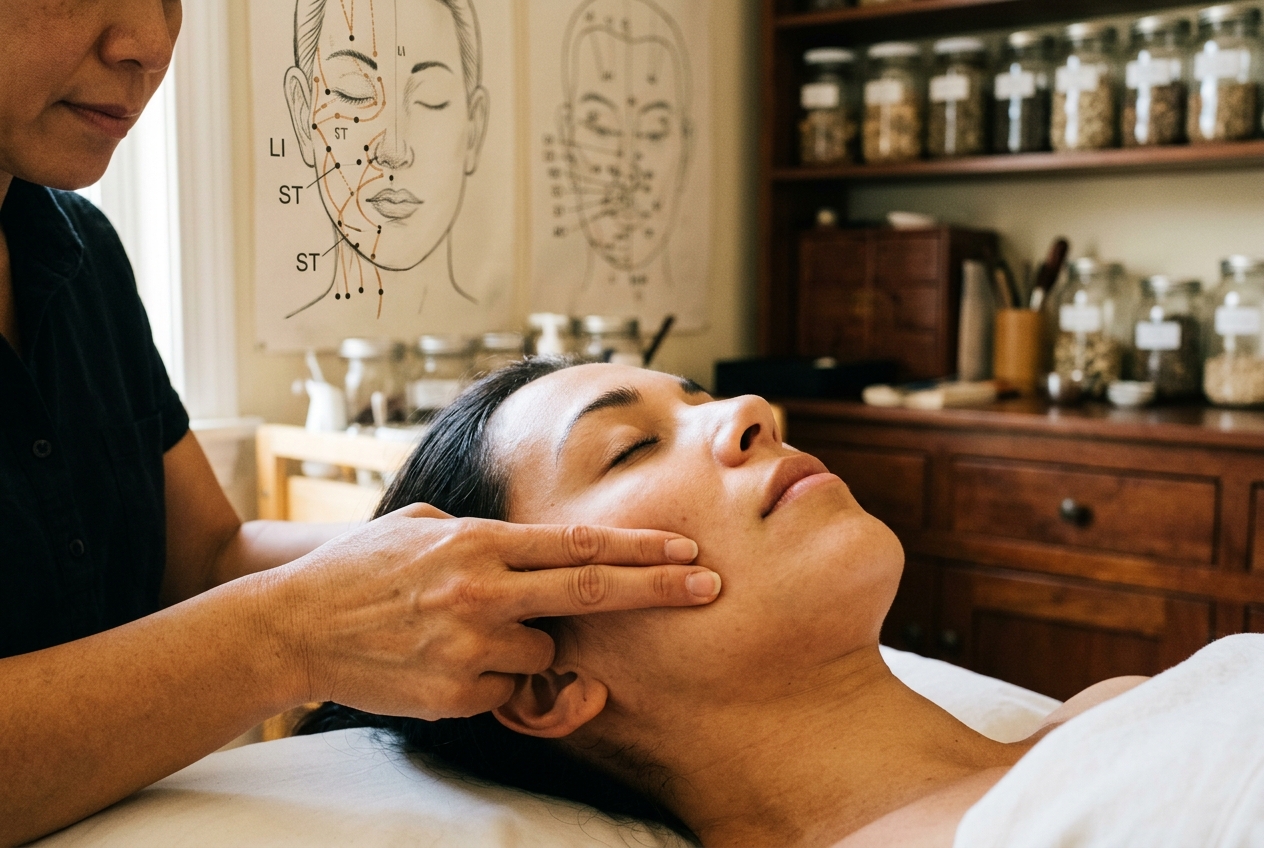
Modern neurobiology increasingly validates what ancient physicians documented across millennia: the face possesses the highest sensory and motor receptor density in the entire human somatosensory cortex. Through the intricate arborization of the trigeminal nerve ($CN\ V$) and the facial nerve ($CN\ VII$), non-invasive mechanical stimulation of craniofacial acupoints accesses central autonomic processing networks. By understanding how the craniofacial landscape acts as an organized somato-visceral map, we can deploy targeted, non-invasive acupressure to modulate brainstem nuclei, release stubborn muscular splinting, and balance distant organ systems.
1. The Classical Somatotopic Map: Foundations from the Huangdi Neijing
The theoretical bedrock of facial meridian reflexology originates in the seminal Han dynasty medical corpus, the Huangdi Neijing (The Yellow Emperor’s Inner Classic). Specifically, Ling Shu (The Spiritual Pivot), Chapter 4 (Xie Qi Zang Fu Bing Xing), sets forth an essential physiological axiom:
"The clear Yang Qi and essence of all twelve primary meridians and three hundred and sixty-five collateral vessels ascend directly to flood the head and face, suffusing the sensory orifices with vitality."
Because all six primary Yang channels (Stomach, Large Intestine, Small Intestine, Bladder, Gallbladder, and San Jiao) physically traverse or terminate upon the craniofacial surface, and because the Yin organ channels project upward via internal divergent pathways (Jing Bie), the face serves as a real-time monitor of systemic physiological harmony.
In Ling Shu, Chapter 49 (Wu Se — The Manifestation of the Five Colors), the classical authors delineate an organized somatotopic projection that maps the human organism onto the vertical and horizontal axes of the face:
- The Upper Forehead (Tian Ting and Que Zhong / Glabella): The Seat of the Heart (Fire)
The supraorbital plate and frontal bone reflect the cardiovascular system and the emotional-cognitive governor known as Shen (the Mind/Spirit). Vascular congestion, transverse furrowing, or cutaneous erythema in this zone denotes autonomic hyperarousal, insomnia, and Heart-Fire agitation. - The Nasal Dorsum and Bridge (Shan Gen to Nian Shou): The Hepato-Biliary Axis (Wood)
The osseous junction where the frontal bone meets the nasal bones corresponds to the Liver and Gallbladder. In classical diagnostics, a greenish hue or deep horizontal line across the root of the nose indicates chronic emotional constraint, autonomic dysregulation, or Stagnant Liver Qi compromising systemic circulation. - The Nasal Tip and Alae (Zhun Tou and Lan Tai): The Spleen and Stomach (Earth)
The fleshy apex of the nose directly mirrors the digestive core. Flaring, erythema, capillary telangiectasia, or persistent swelling over the lower third of the nasal cartilage reveals Spleen Qi deficiency, damp accumulation, or hyperactive Stomach Heat. - The Zygomatic Region and Cheeks (Quan and Jia): The Lungs and Lateral Viscera (Metal)
The right malar zone mirrors pulmonary function and upper respiratory immunity (Fei), while the left cheek interfaces with peripheral hepatic detoxification. Subdermal congestion or pale, flaccid tissue over the maxillary prominence correlates with impaired defensive Qi (Wei Qi) and shallow diaphragmatic excursion. - The Philtrum, Mandible, and Chin (Di Ge): The Renal-Endocrine Continuum (Water)
The inferior facial pole, spanning the mental protuberance and perioral perimeter, corresponds to the Kidneys, Urinary Bladder, and the endocrine/reproductive axis (Ming Men). Hormonal breakouts along the jawline, deep vertical perioral creases, or dark shadowing under the lower lip reflect Kidney Yin/Yang depletion and adrenal fatigue.
2. Neurobiological Mechanisms: Trigemino-Autonomic and Somato-Visceral Reflexes
Where classical texts describe the ascent of Yang Qi, contemporary neurobiology identifies the dense sensory network of the trigeminal nerve ($CN\ V$) operating in concert with the motor architecture of the facial nerve ($CN\ VII$).
The cranial sensory innervation divides into three primary dermatomal territories: * Ophthalmic Division ($CN\ V_1$): Innervates the forehead, glabella, upper eyelid, and frontal sinus mucosa. * Maxillary Division ($CN\ V_2$): Innervates the mid-face, lower eyelid, paranasal sinuses, zygoma, and upper lip. * Mandibular Division ($CN\ V_3$): Carries sensory afferents from the jaw, lower lip, temporal fossa, and anterior two-thirds of the tongue, while delivering motor fibers to the muscles of mastication.
When mechanical pressure is applied to specialized acupuncture points located at craniofacial osseous foramina and muscular junctions, mechanoreceptors (Merkel discs, Meissner's corpuscles, and Ruffini endings) transduce mechanical force into high-frequency sensory action potentials. These afferent signals travel via $CN\ V$ directly into the Spinal Trigeminal Nucleus and the Principal Sensory Nucleus within the brainstem.
As demonstrated in contemporary somatosensory research cataloged by the National Center for Biotechnology Information (NCBI), these brainstem sensory relay centers maintain direct monosynaptic and polysynaptic connections with the Nucleus Tractus Solitarius (NTS). The NTS is the primary integration center for visceral afferent information and serves as the master controller of central autonomic outflow.
Activation of trigeminal sensory fibers through rhythmic, non-invasive acupressure triggers the Trigemino-Vagal Reflex Arc, which produces two profound physiological responses: 1. Parasympathetic Recruitment: It excites the Dorsal Motor Nucleus of the Vagus Nerve (DMV) and the Nucleus Ambiguus, triggering downstream efferent signals via the vagus nerve ($CN\ X$). This slows heart rate, increases heart rate variability (HRV), stimulates gastrointestinal peristalsis, and relaxes mesenteric vasculature. 2. Sympathetic Downregulation: It inhibits hyperactive firing within the Rostral Ventrolateral Medulla (RVLM) and the Locus Coeruleus, terminating systemic fight-or-flight cascades and reducing serum cortisol and epinephrine concentrations.
3. Craniofacial Convergence Loci: Precision Non-Invasive Protocols
To achieve predictable somato-visceral balancing, practitioners must locate points with millimeter-level accuracy relative to osseous landmarks, apply appropriate bi-directional mechanical forces, and engage the target neurovascular bundle. The following points represent the most potent convergence loci on the human face, standardized according to the WHO Standard Acupuncture Point Locations.
Table 1: Comprehensive Anatomy and Clinical Profile of Craniofacial Points
| Point Name & Code | Exact Osseous & Soft-Tissue Landmark | Neurovascular Substrate | Deqi Sensation Profile | Primary Visceral & Neurological Indications |
|---|---|---|---|---|
| Yintang (EX-HN3) | Glabellar midpoint between the medial heads of both eyebrows | Supratrochlear nerve ($V_1$), supratrochlear artery/vein | Deep spreading distension radiating to occiput | Calms the Shen, reduces sympathetic tone, eases frontal headache, treats rhinitis |
| Zanzhu (BL-2) | In the supraorbital notch at the medial extremity of the eyebrow | Supraorbital nerve ($V_1$), frontal branch of ophthalmic artery | Local dull ache, slight sub-cranial electrical tingling | Alleviates ocular strain, lowers intraocular pressure, clears Bladder meridian heat |
| Taiyang (EX-HN5) | Depression 1 fingerbreadth posterior to the midpoint between lateral brow and outer canthus | Zygomaticotemporal nerve ($V_2$), superficial temporal artery | Radiant fullness deep within temporal fossa | Resolves migraines, releases temporalis spasm, clears Gallbladder meridian heat |
| Sibai (ST-2) | Depression at the infraorbital foramen, ~0.7 cun below the inferior orbital rim, pupil line | Infraorbital nerve ($V_2$), infraorbital artery/vein | Warm radiating ache into upper maxillary dentition | Modulates gastric motility, drains sinus congestion, relieves facial palsy ($CN\ VII$) |
| Bitong (EX-HN8) | At the highest apex of the nasolabial groove, inferior to nasal bone junction | Anterior ethmoidal nerve ($V_1$), infraorbital nerve ($V_2$) | Sharp, clarifying distension opening the nasal cavity | Restores olfactory acuity, clears Lung heat, eases sinus pressure |
| Quanliao (SI-18) | Directly inferior to outer canthus, in the deep notch on the lower border of the zygomatic bone | Maxillary nerve ($V_2$), facial nerve branches ($CN\ VII$) | Pronounced deep muscular ache spreading across cheek | Relaxes hypertonic masseters, eases trigeminal neuralgia, clears Small Intestine heat |
| Dicang (ST-4) | 0.4 cun lateral to the corner of the mouth (oral commissure), directly below the pupil | Buccal nerve ($V_3$), facial nerve motor fibers ($CN\ VII$) | Localized spreading fullness along the mandibular arch | Relieves jaw clenching, stimulates salivation and gastric juices, eases facial droop |
Detailed Application Protocols
1. Yintang (EX-HN3) — The Glabellar Gateway (Hall of Impression)
- Surface Anatomy: Positioned on the midline of the forehead, in the depression directly between the medial margins of the two superciliary arches.
- Technique: Place the pad of the dominant middle finger perpendicular to the frontal bone. Apply static, perpendicular pressure for 30 seconds until a deep, heavy distension develops. Then, initiate slow, counter-clockwise micro-rotations (1 Hz) for 90 seconds while maintaining uninterrupted bone contact.
- Clinical Effect: Modulates the default mode network (DMN) and triggers pineal-hypothalamic-pituitary axis down-regulation to relieve psycho-emotional stress and insomnia.
2. Zanzhu (BL-2) — The Supraorbital Notch (Gathered Bamboo)
- Surface Anatomy: Locate the distinct vertical notch or small foramen along the superior medial rim of the orbit with the tip of the thumb.
- Technique: Hook the thumbs underneath the supraorbital ridge, applying pressure in an antero-superior and slightly lateral vector (pressing upward into the bone, not backward into the eye). Maintain continuous, firm pressure for 60 to 90 seconds while engaging in slow, diaphragmatic breathing.
- Clinical Effect: Regulates the ophthalmic division of $CN\ V_1$, lowering ocular tension, relieving screen fatigue, and soothing sinus congestion.
3. Taiyang (EX-HN5) — The Temporal Fossa (Supreme Yang)
- Surface Anatomy: Locate the tender osseous depression on the temporal bone, approximately one thumb-width posterior to the midpoint between the lateral tip of the eyebrow and the lateral canthus of the eye.
- Technique: Apply simultaneous bilateral pressure using the thumb pads. Exert firm, medial compression while executing clockwise rotations for 60 seconds (tonifying circulation), followed by static pressure directed slightly anteriorly toward the orbit for 60 seconds.
- Clinical Effect: Decompresses the temporalis muscle and deep temporal fascia, clearing Gallbladder channel stagnation and alleviating vascular tension headaches.
4. Sibai (ST-2) — The Infraorbital Nexus (Four Whites)
- Surface Anatomy: With the eyes looking straight ahead, palpate approximately one centimeter below the inferior orbital margin directly in line with the pupil to locate the distinct infraorbital foramen.
- Technique: Use the index or middle fingertips to press straight back against the maxillary bone with gentle-to-medium firmness. Do not gouge or vibrate aggressively, as the infraorbital nerve is easily provoked. Hold steady for 90 seconds.
- Clinical Effect: Engages the maxillary division ($CN\ V_2$), evoking a direct trigemino-gastric reflex that stimulates gastric acid balance and relieves intestinal bloating.
5. Bitong (EX-HN8) — The Nasolabial Respiratory Bridge (Penetrating the Nose)
- Surface Anatomy: Located bilaterally at the superior terminus of the nasolabial sulcus, in the soft depression immediately adjacent to the junction of the nasal cartilage and nasal bone.
- Technique: Apply inward and medial pressure with the index fingertips, angling slightly toward the bridge of the nose. Maintain continuous bilateral compression for 2 minutes.
- Clinical Effect: Stimulates the nasal mucosa and parasympathetic innervation of the upper respiratory tract, clearing Lung phlegm and relieving sinus pressure.
6. Quanliao (SI-18) — The Zygomatic Sub-Arch (Cheek Bone Hole)
- Surface Anatomy: Drop directly down from the lateral canthus of the eye into the deep osseous hollow situated along the inferior border of the zygomatic bone.
- Technique: Place thumbs bilaterally into the hollows and press superiorly and medially beneath the zygomatic arch. Maintain firm, steady pressure for 90 seconds while intentionally relaxing the lower jaw and tongue.
- Clinical Effect: Releases hypertonicity within the masseter and pterygoid muscles, relieves temporomandibular joint (TMJ) pain, and soothes trigeminal nerve irritability.
7. Dicang (ST-4) — The Oral Commissure Anchor (Earth Granary)
- Surface Anatomy: Located 0.4 cun (approximately half a thumb width) lateral to the corner of the mouth, directly along the vertical line descending from the pupil.
- Technique: Grasp the cheek tissue using the index finger on the cutaneous surface and thumb gently stabilizing from behind, or apply direct inward pressure with index fingertips. Use gentle circular friction for 60 seconds.
- Clinical Effect: Harmonizes the Stomach meridian, encourages healthy digestive secretions, and relieves perioral spasms.
4. The Evening Craniofacial Somato-Autonomic Decompression Protocol
For individuals suffering from the combined effects of prolonged screen exposure, cognitive fatigue, chronic jaw clenching, and evening digestive discomfort, the following seven-minute sequential protocol can be performed before sleep.
Step-by-Step Execution
Phase 1: Glabellar Unwinding and Calming the Shen (2 Minutes)
- Sit upright with your spine unsupported and feet flat on the floor, or lie supine with a thin pillow beneath your neck. Close your eyes.
- Place your right middle fingertip on Yintang (EX-HN3). Exert firm, steady pressure for 30 seconds, coordinating with a 4-second nasal inhalation and an 8-second oral exhalation.
- Transition both thumbs to Zanzhu (BL-2) in the supraorbital notch. Hook upward against the bone. Hold for 90 seconds while visualizing physical tension draining downward from your forehead into the earth.
Phase 2: Temporal and Masticatory Decompression (2.5 Minutes)
- Shift your thumb pads to Taiyang (EX-HN5). Apply steady medial pressure for 60 seconds, using slow circular strokes to smooth out the temporalis fascia.
- Glide your thumbs down into the hollow under the cheekbone at Quanliao (SI-18). Press firmly upward into the zygomatic notch.
- Separate your upper and lower teeth by 5 millimeters and rest the tip of your tongue against the roof of your mouth behind your front teeth. Maintain this position for 90 seconds to release the masseters and quiet the trigeminal motor nucleus.
Phase 3: Mid-Face Spleen-Stomach Grounding (2.5 Minutes)
- Place the tips of your index fingers at Bitong (EX-HN8). Apply firm pressure for 30 seconds to open the nasal airways.
- Move your fingers down into the infraorbital hollows at Sibai (ST-2). Apply gentle, static pressure against the maxillary bone for 60 seconds, activating the Trigemino-Vagal reflex arc.
- Conclude by sliding your index fingertips to the corners of your mouth at Dicang (ST-4). Apply light circular pressure for 60 seconds, then swallow any accumulated saliva to help ground your digestive energy.
5. Clinical Safety, Sensory Thresholds, and Contraindications
While non-invasive facial acupressure is exceptionally safe, the high concentration of sensitive structures across the head and neck requires thoughtful technique and anatomical precision.
Essential Safety Guidelines
- The Sensation of Deqi vs. Neurogenic Trauma:
Correct acupoint stimulation elicits Deqi—a characteristic sensation of dull ache, heaviness, localized distension, or gentle warmth. If you experience a sharp, electric shock-like sensation, sudden numbness, or shooting pain, you are compressing a nerve trunk directly against an osseous ridge. Immediately reduce your pressure and adjust your finger position by 1–2 millimeters. - Vascular Vulnerabilities:
Never apply deep, forceful pressure over the superficial temporal artery anterior to the ear, or directly over the facial artery where it crosses the lower border of the mandible. Avoid aggressive pressure around the eye socket to prevent bruising fragile capillaries. - Skin Lesions and Inflammatory Conditions:
Do not perform acupressure over active acne cysts, open wounds, facial shingles (Herpes zoster ophthalmicus), or active dermatitis, as localized friction can spread infection or worsen inflammation. - Pregnancy Considerations:
While gentle, localized facial acupressure is safe during pregnancy, avoid combining strong facial stimulation with powerful distal draining points such as Hegu (LI-4) or Jianjing (GB-21), which strongly promote the downward movement of Qi. - When to Seek Professional Medical Care:
Facial acupressure is a supportive practice for daily self-care and autonomic balance. It is not a substitute for medical evaluation. Sudden, severe headaches ("thunderclap" onset), unilateral facial drooping, slurred speech, visual field loss, high fever with neck stiffness, or sharp, stabbing facial pain characteristic of acute trigeminal neuralgia require immediate clinical evaluation by a physician or licensed acupuncturist.
6. Today's Takeaway: The Two-Minute Glabellar-Orbital Reset
You can experience the benefits of this system right now before closing this article. If you have spent hours staring at screens, your frontalis muscle is likely contracted and your sympathetic nervous system mildly elevated.
By viewing the human face through this integrated lens—honoring both the classical somatotopic maps of the Ling Shu and modern cranial neurobiology—we gain a practical, drug-free tool for self-regulation. The face is not simply an expression of our emotions; it is an accessible biological switchboard for the entire body.
Authoritative References & Further Reading
- World Health Organization: Standard Acupuncture Point Locations in the Western Pacific Region — The global international standard for anatomical location of classical and extra meridian points.
- NCBI Bookshelf: Neuroanatomy, Cranial Nerve 5 (Trigeminal) — Comprehensive neuroanatomical description of trigeminal sensory pathways, brainstem nuclei, and autonomic reflexes.
- PubMed Central: Neurobiological Basis of Acupuncture and Somato-Autonomic Reflex Modulation — Clinical evaluation of trigeminal and peripheral somatosensory stimulation on parasympathetic nerve activation.
- Wikipedia: Huangdi Neijing (The Yellow Emperor's Classic of Medicine) — Historical, philosophical, and diagnostic foundations of the Ling Shu and Su Wen classical texts.
- Wikipedia: Vagus Nerve and Autonomic Regulation — Physiological mechanisms governing the parasympathetic nervous system and somato-visceral reflex arcs.