Facial Diagnosis (Mian Zhen) Meridian Diagnostics: Governing Ming Tang Topography, Five Phase Color Differentiation, and Visceral Projection in Traditional Chinese Medicine
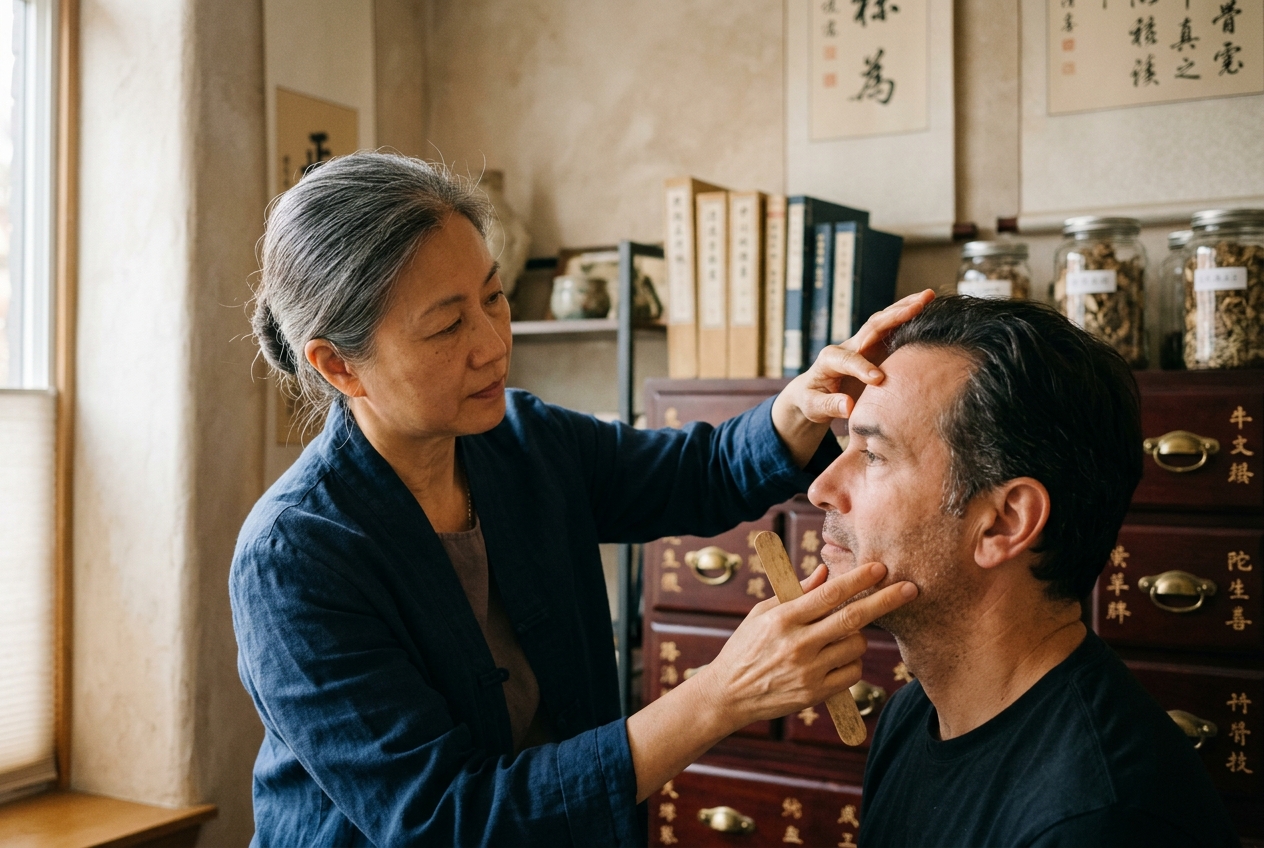
1. Opening Scene — A Moment You'll Recognise
You stand before the bathroom mirror in the sharp, unforgiving light of early morning. Before you have brushed your teeth or brewed your first cup of tea, your eyes scan the landscape of your reflection. Perhaps it is a persistent, shadow-like duskiness encircling the lower eye sockets and draining into the philtrum; a dull, sallow veil muting the skin across the bridge of your nose following a week of rushed, stressful lunches; or a sudden, localized crimson bloom burning across your forehead after nights of restless, fragmented sleep.
In conventional biomedical framing, these subtle dermatological shifts are frequently dismissed as superficial cosmetic inconveniences—dehydration, minor skin barrier disruption, or ordinary fatigue to be concealed with topical serums. Yet in East Asian medical traditions, this surface is anything but superficial. For more than two millennia, practitioners of Traditional Chinese Medicine (TCM) have recognized the human face as an intricate, real-time diagnostic projection screen. Every capillary dilation, tonal gradation, textural shift, and subtle gleam of skin luster offers a precise, non-invasive readout of the body's internal physiological landscape.
When your digestion is impaired, your nervous system is overtaxed, or your deep hormonal reserves are depleted, your internal organs do not suffer in silence; they telegraph their distress directly onto the living canvas of your face. By learning to decode this classical topography, you transform the mundane morning mirror into an empowering instrument of self-awareness, clinical insight, and preventative vitality.
2. What This Organ System Does: Classical Foundations of Facial Somatotopy
In classical Chinese medical physiology, the face occupies an exalted anatomical position. The foundational medical text of East Asia, the Huangdi Neijing (The Inner Canon of the Yellow Emperor), compiled between the third and first centuries BCE, establishes that the head and face serve as the primary confluence where all primary channels (Jing Luo) and their collateral vascular networks converge. As the Neijing asserts: "The essence and blood of the twelve primary channels and three hundred and sixty-five collateral vessels all ascend to the face and pour into its orifices."
Facial diagnosis, known classically as Mian Zhen (面诊), is rooted in the doctrine of somatotopic projection—the principle that the whole organism is reflected holographically within its distinct micro-regions, analogous to modern reflexology or the sensory homunculus in neuroanatomy. Central to this diagnostic science is the Ming Tang (明堂, "Hall of Light") projection map, detailed comprehensively in Lingshu (The Spiritual Pivot), Chapter 49 (Wu Se, "The Five Colors"), and expanded in Suwen Chapter 32.
The Ming Tang map organizes the facial geography into specific zones, each intimately bound to one of the Five Zang Organs (the solid, essence-storing organ networks) through meridian trajectories, neuro-visceral reflexes, and capillary microcirculation:
                      =========================================
                                     FOREHEAD (Tíng)
                                      HEART (Xīn)
                         [Shen / Spirit, Blood Perfusion, Sleep]
                      =========================================
                                         |
               +-------------------------+-------------------------+
               |                                                   |
      LEFT CHEEK (Zuǒ Guān)                                RIGHT CHEEK (Yòu Guān)
          LIVER (Gān)                                           LUNGS (Fèi)
  [Qi Regulation, Microcirculation]                     [Respiration, Defensive Wei Qi]
               |                                                   |
               +-------------------------+-------------------------+
                                         |
                                  NOSE (Bí Liáng)
                             SPLEEN & STOMACH (Pí-Wèi)
                        [Nutrient Extraction, Central Earth]
                                         |
                      =========================================
                               CHIN & PHILTRUM (Dì Tǐng)
                                    KIDNEYS (Shèn)
                        [Jing / Essence, Water Fluid, Endocrine]
                      =========================================
The Topographical Facial Zones and Their Physiological Correspondences
-
The Forehead (Ting / Que) — The Heart (Xīn):
The upper third of the face represents the imperial Heart network, which governs the blood vessels and houses the Shen (the mind, conscious awareness, and emotional tranquility). Because the Heart commands systemic arterial circulation and cardiac output, the vascular tone, temperature, and skin quality of the forehead directly reflect mental-emotional equilibrium, cardiovascular strain, and the quality of sleep. -
The Chin, Jawline, and Philtrum (Diting / Renzhong) — The Kidneys (Shèn):
The lower third of the face belongs to the Kidney system, the root of Jing (inherited constitutional essence), fluid metabolism, adrenal vigor, and the reproductive/urogenital axis. The tissue density, deep pigmentation, and structural firmness of the chin and the perioral zone communicate the integrity of deep hormonal reserves and long-term vitality. -
The Nose (Bridge, Bi Liang, and Tip, Zhun Tou) — The Spleen (Pí) and Stomach (Wèi):
The central meridian of the face is the domain of the Earth element. The nasal bridge and apex correspond to the digestive network responsible for transforming ingested food and fluid into usable Qi (vital metabolic energy) and Xue (nourishing blood). Chronic digestive sluggishness, intestinal dysbiosis, and systemic fluid accumulation manifest rapidly in the tissue quality and color of the nasal zone. -
The Left Cheek (Zuo Guan) — The Liver (Gān):
In classical East Asian medical directionality, the left corresponds to the ascending energetic movement of Wood and the Liver. The Liver is responsible for the smooth, uninhibited coursing of Qi throughout the body and the storage of blood. The left cheek reflects autonomic nervous system balance, peripheral vascular resistance, hepatic microcirculation, and the physical toll of emotional frustration or chronic stress. -
The Right Cheek (You Guan) — The Lungs (Fèi):
The right side governs the descending and purifying movement of Metal and the Lung network. The Lungs govern respiration, systemic oxygenation, and the dispersion of Wei Qi (the defensive immune barrier) and fluids to the cutaneous tissue and skin pores. The right cheek serves as a direct indicator of respiratory integrity, mucosal immunity, and environmental resilience.
Modern clinical research has increasingly investigated these somatotopic projections. Contemporary studies published on microvascular perfusion and autonomic reflexology via NCBI PubMed indicate that visceral distress induces distinct changes in regional facial blood flow, sympathetic capillary tone, and localized sebum composition, confirming that classical Mian Zhen observations correlate with measurable physiological parameters.
3. How You Can Feel It: Signs of Balance and Imbalance
Clinical facial diagnosis does not merely note where a feature appears; it assesses the dynamic interplay between the Five Diagnostic Colors (Wu Se) and the presence of Vital Luster (Shen / Run).
+----------------------------------------------------------------------------------------------------+
|                                 THE FIVE DIAGNOSTIC HUES (WU SE)                                   |
+--------------+-------------------+----------------------------+------------------------------------+
| Classical    | Chromatic         | Primary Pathological       | Systemic Clinical                  |
| Color        | Presentation      | Correlation                | Manifestations                     |
+--------------+-------------------+----------------------------+------------------------------------+
| Qīng (青)    | Cyanotic,         | Liver Stagnation,          | Hypochondriac tension, muscle      |
|              | Blue-Green, Ashen | Microspasm, Pain, Cold     | spasms, migraine, chronic anger    |
+--------------+-------------------+----------------------------+------------------------------------+
| Chì (赤)     | Crimson,          | Heart Fire, Vascular       | Insomnia, palpitations, systemic   |
|              | Vivid Vermilion   | Heat, Acute Inflammation   | inflammation, hot flashes          |
+--------------+-------------------+----------------------------+------------------------------------+
| Huáng (黄)   | Sallow Ocher,     | Spleen Deficiency,         | Postprandial bloating, chronic     |
|              | Dull Earth Yellow | Dampness, Malabsorption   | brain fog, muscular heaviness      |
+--------------+-------------------+----------------------------+------------------------------------+
| Bái (白)     | Chalk White,      | Qi and Blood Exhaustion,   | Shortness of breath, dizziness,    |
|              | Pale Alabaster    | Yang Deficiency, Cold      | cold extremities, severe fatigue   |
+--------------+-------------------+----------------------------+------------------------------------+
| Hēi (黑)     | Leaden Black,     | Kidney Jing Exhaustion,    | Lower back soreness, tinnitus,     |
|              | Sooty Charcoal    | Deep Stasis, Fluid Arrest  | adrenal exhaustion, dark circles   |
+--------------+-------------------+----------------------------+------------------------------------+
The Crucial Matrix: Chromatic Hue vs. Luster (Run vs. Ku)
In the diagnostic philosophy of the Huangdi Neijing, color reveals the nature and location of an imbalance, but luster (Guang Ze) determines the prognosis and vitality of the patient. Luster is the optical manifestation of Stomach Qi (metabolic resilience) and Shen (vital spirit).
- Moist and Contained (Run / 润): When a color appears subtly beneath the skin, bathed in a soft, natural radiance with moist elasticity, the condition is classified as Good Shen (You Shen). Even if the hue indicates an acute pathology, the body's self-healing reserves remain intact, and recovery is swift.
- Dry and Exposed (Ku / 枯): When a color is dull, harsh, dry, or appears starkly floating on the surface of the skin like powdered pigment, it is termed Exhausted Shen (Wu Shen). This indicates that the organ's functional vitality has been worn down, requiring immediate, deep restorative intervention.
Micro-Reflections and Dermatological Anomalies
Beyond baseline coloration, the astute practitioner observes fine micro-reflections and regional tissue anomalies:
- Subcutaneous Telangiectasias (Spider Capillaries): Fine, spider-like purplish micro-vessels blooming on the wings of the nose (Ala Nasi) indicate chronic gastric heat and portal vein congestion; when manifesting on the left cheek, they signal long-standing Liver Blood stasis and vascular stiffness.
- Regional Follicular Eruptions: Cystic blemishes isolated strictly to the lower chin and jawline reflect pelvic lymphatic congestion, hormonal endocrine imbalances, or cold dampness in the Kidney-Bladder meridian pathway. Conversely, papules clustered on the forehead point toward emotional heat, mental overwork, and toxic heat accumulation in the Heart and Small Intestine.
- Sub-Orbital Pigmentation and Pockets: The periorbital tissue belongs directly to the Kidneys (fluid balance) and Spleen (tissue elasticity). Puffy, fluid-filled lower eyelid sacs indicate Spleen deficiency failing to transform fluids, whereas deep, dark indigo-black circles reveal Kidney essence depletion, circadian rhythm disruption, and adrenal fatigue.
====================================================================================================
               CLINICAL SYNTHESIS: INTEGRATING THE FOUR EXAMINATIONS (SI ZHEN)
====================================================================================================

Facial diagnosis is never deployed in clinical isolation. In traditional differential diagnosis,
facial cues are rigorously cross-validated against the remaining modalities of the Four
Examinations (Inspection, Auscultation/Olfaction, Inquiry, and Palpation):

[ FACIAL DIAGNOSIS (Mian Zhen) ]
                 |
                 v
  +-----------------------------------------------------------------------------------------------+
  | Cross-Validated With:                                                                         |
  |                                                                                               |
  | 1. TONGUE DIAGNOSIS (She Zhen):                                                               |
  |    A crimson forehead (Heart Heat) must be corroborated by a red, prickled tongue tip.        |
  |    A sallow nose (Spleen Dampness) is verified by a swollen, scallop-edged tongue body with   |
  |    a thick, turbid greasy coating.                                                            |
  |                                                                                               |
  | 2. RADIAL PULSE PALPATION (Mai Zhen):                                                         |
  |    Cyanotic left cheek hues (Liver Qi Stagnation) correlate with a wiry, taut pulse at the    |
  |    left Guan position. Sallow facial tones correlate with a moderate, soggy (Ru Mai) pulse.   |
  |                                                                                               |
  | 3. ABDOMINAL PALPATION (Fukushin / Hara):                                                     |
  |    Facial signs of lower-jiao Kidney stasis are checked against tenderness in the subumbilical|
  |    Kikai / Guanyuan zone; Liver stasis correlates with subcostal resistance (Mune-no-tsukae).  |
  +-----------------------------------------------------------------------------------------------+
====================================================================================================
Self-Assessment: Evaluating Your Face Right Now
- Lighting Setup: Position yourself before a mirror illuminated exclusively by indirect, natural morning daylight. Artificial LED or incandescent bulbs artificially distort yellow and red spectrums.
- Step 1 — The General Shen: Look at your face as a unified whole. Does the skin exhibit a soft, cohesive, inner luminosity (Run), or does it look parched, chalky, and disconnected (Ku)?
- Step 2 — The Central Earth (Nose): Inspect the bridge and apex of your nose. Is the skin clear and warm, or is there an oily, dull yellow sheen indicating digestive stagnation?
- Step 3 — The Imperial Hearth (Forehead): Observe the upper third of your face. Look for pinpoint redness, horizontal tension furrows, or micro-congestion signaling cognitive overextension and Heart Fire.
- Step 4 — The Lateral Flow (Cheeks): Compare your left and right cheeks. Does the left display a tight, reddish-purple or cyanotic hue (Liver tension), while the right appears pale or dry (Lung Qi deficiency)?
- Step 5 — The Deep Foundation (Chin & Eye Contours): Examine the lower jaw, philtrum, and infraorbital rings for deep blue, brown, or black pigmentation marking deep energetic depletion.
4. Qigong & Movement Practice: The Five-Organ Harmonizing Facial Dao Yin
To clear stagnant Qi, improve microvascular perfusion, and restore the vital luster (Run) across all five facial zones, practice the classical Five-Organ Harmonizing Facial Dao Yin & Wise Owl Sequence. This practice utilizes neuro-fascial stretching and the somatic meridian stimulation described in clinical trials on qigong, autonomic regulation, and acupoint therapy.
+----------------------------------------------------------------------------------------------------+
|                            FIVE-ORGAN FACIAL DAO YIN SEQUENCE                                      |
+----------------------------------------------------------------------------------------------------+
| 1. Warm the Palms (Lao Gong Activation)  --> Generate friction heat in hands                      |
| 2. Ascending Yang Wash                  --> Glide palms up jawline to forehead (Inhale)            |
| 3. Lateral Clearing & Drainage           --> Sweep down cheeks to neck base (Exhale)                |
| 4. The Wise Owl Turns Its Head          --> Cervical rotation with lateral gaze (Hold 2s)          |
| 5. Central Earth Acupoint Tapping        --> Rhythmic micro-percussion over nose & chin             |
+----------------------------------------------------------------------------------------------------+
Step-by-Step Instructions
- Starting Position & Setup: Stand in the natural posture (Ziran Zhan Zhuang) with feet shoulder-width apart, knees slightly softened, spine elongated as if suspended from the crown (Baihui), and shoulders fully relaxed. Rest the tip of your tongue lightly against the upper hard palate to link the Conception (Ren) and Governing (Du) vessels. No specialized equipment is required.
- Phase 1: Cultivating Palm Heat (Lao Gong Activation): Rub the palms of your hands together vigorously for 15–20 seconds until intense therapeutic heat is generated in the centers of your palms (Lao Gong, PC8 point).
- Phase 2: The Four-Directional Facial Wash:
- Inhale (Diaphragmatic): Place your heated palms at the base of your chin (Kidney Zone). Slowly glide your hands upward over the bridge of your nose (Spleen Zone) and across your eyebrows to cover the forehead (Heart Zone).
- Exhale (Slow & Unhurried): Separate your hands and sweep down across the temples, over the left and right cheeks (Liver and Lung Zones), and down along the jawline back to the chin.
- Repetitions: Complete 9 continuous, fluid cycles.
- Phase 3: The Wise Owl Looks Back (Ba Duan Jin Integration):
- Inhale: Keep your shoulders stationary, slowly rotate your neck and head to the far left, directing your gaze backward past your shoulder. This stretches the sternocleidomastoid muscle, stimulating the carotid sinus, vagus nerve, and the ascending Yang meridians that nourish the left cheek (Liver Zone).
- Hold: Pause for 2 seconds at the end of the rotation.
- Exhale: Slowly return to center.
- Inhale: Repeat the rotation smoothly to the far right, clearing the right cheek (Lung Zone).
- Repetitions: Complete 6 full cycles (left and right alternating).
- Phase 4: Sensation & Biomarker Feedback: Upon completing the sequence, stand in stillness with eyes closed for 60 seconds. You should feel a distinct, gentle tingling warmth across the entire facial landscape (De Qi sensation), accompanied by a reduction in muscular tension around the jaw and forehead. This warm glow indicates active microvascular dilation, lymphatic clearance, and the re-establishment of balanced Qi-Blood perfusion across the Ming Tang zones.
5. Acupressure Points You Can Try Today
Targeted stimulation of classical acupressure points acts directly upon the meridian pathways that supply the facial zones, clearing heat, lifting stagnation, and restoring tone. Scientific investigations into the neurobiological mechanisms of acupuncture and meridian systems confirm that mechanical stimulation of these peripheral sites modulates local and systemic microcirculation while balancing autonomic nervous activity.
====================================================================================================
                                      ACUPRESSURE TARGET MATRIX
====================================================================================================

(1) YINTANG (EX-HN3)                   (2) YINGXIANG (LI20)             (3) ZUSANLI (ST36)
      Midpoint between Eyebrows              Nasolabial Groove at Ala Nasi    Four fingers below Patella
             |                                        |                                  |
             v                                        v                                  v
   [ Clears Heart Fire & Shen ]             [ Regulates Spleen & Lung ]        [ Central Qi & Blood Root ]
   [ Calms Frontal Tension    ]             [ Clears Facial Fluid Stasis ]     [ Restores Facial Luster  ]

====================================================================================================
1. Yintang (EX-HN3 / "Hall of Impression")
- Anatomical Location: Situated directly at the midpoint between the medial ends of the two eyebrows, directly above the root of the nose.
- Application Technique: Place the pad of your middle or index finger directly on the point. Apply steady, firm, but gentle perpendicular pressure. Maintain this pressure while executing small, slow circular motions for 2 to 3 minutes. Breathe deeply into your lower abdomen.
- Clinical Indications: Pacifies the Shen, clears excess Heart Fire, alleviates frontal tension headaches, relieves ocular strain, and calms an overactive sympathetic nervous system before sleep.
2. Yingxiang (LI20 / "Welcome Fragrance")
- Anatomical Location: Located in the nasolabial groove, directly parallel to the midpoint of the lateral border of the ala nasi (the outer flare of the nostril).
- Application Technique: Use the tips of both index fingers to apply firm, angled inward pressure toward the nasal bone. Apply continuous, pulsating pressure (press for 3 seconds, ease slightly for 1 second) for 90 seconds.
- Clinical Indications: Clears nasal congestion, drains accumulated dampness from the maxillary sinuses, activates microcirculation across the central Spleen-Earth zone, and reduces chronic puffiness in the middle third of the face.
3. Zusanli (ST36 / "Leg Three Miles")
- Anatomical Location: Located on the lower leg, four finger-widths (three anatomical cun) below the inferior border of the patella (kneecap), and one finger-breadth lateral to the anterior crest of the tibia bone.
- Application Technique: Place the knuckle of your thumb or middle finger firmly into the muscular depression. Apply deep, firm pressure until a pronounced, dull, spreading ache (De Qi) is elicited. Maintain and massage for 2 to 3 minutes on each leg.
- Clinical Indications: The premier systemic point for generating Qi and Blood, boosting Spleen digestive transformation, eliminating sallow facial discoloration, and directly enhancing the radiant luster (Run) of the skin.
6. Food & Lifestyle: Small Changes for Today
Facial color and luster are direct downstream reflections of dietary habits and metabolic efficiency. In TCM dietary therapy (Shi Liao), we do not treat the skin purely from the outside; we nourish the underlying Zang-Fu organs using whole, accessible foods categorized by their thermal nature and five-element affinities.
+----------------------------------------------------------------------------------------------------+
|                                DIETARY & LIFESTYLE THERAPY PROTOCOL                                |
+------------------+----------------------------------+----------------------------------------------+
| Target Organ     | Everyday Foods to Add            | Items to Eliminate or Reduce                 |
| & Facial Zone    | (Readily Available)              | (Pathology Generators)                       |
+------------------+----------------------------------+----------------------------------------------+
| Spleen / Stomach | Steamed pumpkin, butternut       | Iced drinks, raw salads in excess, refined   |
| (Central Nose)   | squash, oats, ginger, carrots    | sugars, ultra-processed dairy (Generates     |
|                  | (Warms and dries Dampness)       | turbid dampness and sallow skin tone)        |
+------------------+----------------------------------+----------------------------------------------+
| Liver            | Steamed dandelion greens, kale,  | Deep-fried foods, late-night alcohol,        |
| (Left Cheek)     | lemon water, peppermint tea      | excess black coffee (Generates Liver Heat    |
|                  | (Smooths Qi and clears Heat)     | and cyanotic vascular stasis)                |
+------------------+----------------------------------+----------------------------------------------+
| Kidneys          | Black beans, black sesame seeds, | Excessive refined table salt, extreme        |
| (Chin / Eyes)    | walnuts, bone/vegetable broths   | sleep deprivation past 11 PM (Depletes       |
|                  | (Replenishes Jing and Yin)       | Jing and deepens dark periorbital circles)   |
+------------------+----------------------------------+----------------------------------------------+
| Lungs / Heart    | Pears, stewed apples, almonds,   | Highly spicy greasy foods, industrial seed   |
| (Forehead/Right) | chamomile tea (Moistens Lung,    | oils (Generates Heart Fire and damages       |
|                  | clears Heart Fire and agitation) | defensive cutaneous barrier)                 |
+------------------+----------------------------------+----------------------------------------------+
Actionable Dietary Strategies
- Eliminate Cold-Damp Confections for Breakfast: Swap iced smoothies, chilled yogurt, and raw cold juices for warm, cooked breakfasts such as steel-cut oatmeal with cinnamon and walnuts, or warm savory broths. Cold thermal foods shock the Spleen-Stomach fire, immediately manifesting as fluid puffiness under the eyes and a dull, yellow skin cast.
- Integrate Bitters for Liver Decongestion: Introduce a small portion of bitter greens (arugula, radicchio, or dandelion tea) before your main meal. The bitter flavor descends excess heat, regulates bile flow, and relieves the vascular congestion that drives red and cyanotic discolorations across the left cheek.
- Circadian Alignment for Kidney Jing Preservation: The Huangdi Neijing emphasizes that the Gallbladder and Liver channels regenerate between 11:00 PM and 3:00 AM. Going to sleep before 11:00 PM prevents the burning of foundational Yin and Jing, directly preventing the formation of deep leaden-black discoloration around the chin and eyes.
7. Today's Takeaway
Tomorrow morning, before looking at your phone or drinking your coffee, stand before a mirror in natural daylight and take 60 seconds to silently observe your face through the lens of the five zones—not with cosmetic judgment, but with diagnostic curiosity. Follow this with 3 minutes of the Five-Organ Facial Dao Yin (vigorously warming your palms and sweeping up through the chin, over the nose to the forehead, and draining down the cheeks) and 60 seconds of firm acupressure on Yintang (between the eyebrows). This simple, zero-cost practice will awaken your microcirculation, regulate your nervous system, and immediately begin restoring radiant, vital luster to the living canvas of your health.